Prediction of Nitrogen Loading from Forest Stands in Eutrophication of Lake
Doug-Young Chung*, Young-Han Lee
1, Jin-Ho Lee
2, and Mi-suk Park
Department of Bioenvironmental Chemistry, College of Agriculture and Life Science, Chungnam National University, Daejeon 305-764, Korea
1
Gyeongsangnamdo Agricultural Research and Extension Services, Jinju 660-370, Korea
2
Department of Bioenvironmental Chemistry, College of Agricultural and Life Sciences, Chonbuk National University, Jeonju 561-756, Korea
The continuous release of nutrient sources into natural water resource can be a continuing problem in eutrophication, as well as severe reductions in water quality. However, any desirable measure is not developed yet even though so many researches and efforts have been done to solve this problem. Forest as one of troublesome nonpoint sources may contributes most to nutrient loading, but the loading of N and P from forest in order to grasp the eutrophication potential of nonpoint sources has not been evaluated. The nutrient sources from the organic litter accumulated on the surface of forest soils can be a critical factor in continuity of eutrophication of a lake. The decomposition rate of litter can be estimated to predict release of N and P from the forest stand. The loss rate of nitrogen is complicated but depends in part upon the physical matrix of the element. Therefore, long-term nutrient budget and flux estimates at stand would be useful tools in calculating potential nutrient fluxes into the watercourses in a sustainable way. The present investigation can give insight to the actual situation of the eutrophication potentials of forest as the practical nonpoint sources.
Key words: Nitrogen, Phosphate, Loading, Forest, Eutrophication
Received : August 7. 2010 Accepted : August 11. 2010
*Corresponding author : Phone: +82428216739 E-mail: [email protected]
Introduction
Eutrophication, a key concern when considering future policy, poses a problem not only to ecosystems, but to humans as well. Eutrophication similar to red tides is an increase in the concentration of chemical nutrients in an ecosystem to an extent that increases the primary productivity of the ecosystem. What are the sources of nutrients causing eutrophication of natural water resources such as lakes and reservoirs? All activities reflecting directly or indirectly in the water quality of the water bodies in the entire drainage area of a lake or reservoir are sources. In many lakes and reservoirs wastewater has been known to be the main source since untreated wastewater or wastewater treated only by a conventional mechanical- biological methods still contains nitrogen and phosphorus (UNEP, 2010).
In order to gauge how to best prevent eutrophication
from occurring, specific sources that contribute to nutrient loading must be identified. Two common sources of nutrients and organic matter are point and nonpoint. In point sources the nutrient waste travels directly from source to water. Point sources are relatively easy to regulate.
Nonpoint source pollution known as diffuse or ‘runoff’
pollution is that which comes from ill-defined and diffuse sources. Nonpoint sources are difficult to regulate and usually vary spatially and temporally (Carpenter et al., 1998). Also nutrients from human activities tend to accumulate in soils and remain there for years. It has been shown (Sharpley et al., 1996) that the amount of phosphorus lost to surface waters increases linearly with the amount of phosphorus in the soil. Thus much of the nutrient loading in soil eventually makes its way to water.
EPA (1990) and Judy (1982) reported that more than
50% of the pollution entering the nation’s water comes
from nonpoint sources with agricultural and forested lands
topping the list. However, poor management practices can
cause serious pollution problems mainly due to sedimentation
although forested watersheds provide good quality water
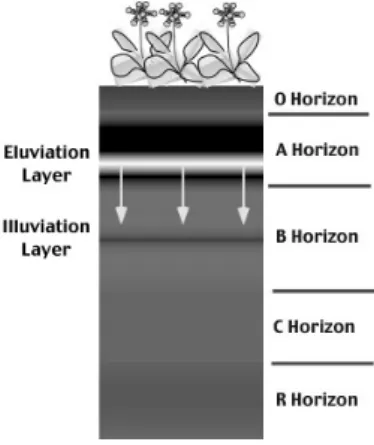
Fig. 1. Typical layers found in a soil profile.
among land uses (Brown and Binkley, 1994).
A forest soil which is an important foundation for trees and plants to grow on, a habitat for numerous insects, fungi, and algae, and a lab where old organic matter is recycled back into the ecosystem. Incorporated organic content is high because of continual deposition of forest litter, long intervals between harvest, and lower rates of oxidation (Carmean, 1957; Lutz and Chandler, 1947). Soil erosion on forested land is a serious concern that can have both on-site and off-site detrimental effects. Rates of water infiltration and percolation are faster than agricultural soils because of the surface organic layers, large numbers of root channels extending into subsoil, and a high content of large soil pores. The differences in the soil-profile between the lower and higher elevations markedly influence runoff.
Under natural forest-conditions, infiltration-values are well in excess of occurring rainfall-intensities (Hoover and Hursh, 1943).
Nitrogen is lost as dissolved organic compounds in stream waters from unpolluted forests, but very large organic molecules and colloidal organic matter are not usable by plants. The significance of the dissolved organic nitrogen in those streams is not that these are the forms of nitrogen that the forest uses, but that they are the forms that it does not recycle because it cannot use them (Addiscott and Brookes, 2005).
From these information stated above it needs to investigate that how nitrogen is released from forest influence the lake eutrophication. This paper reviews results obtained in individual studies and provides a compilation of our understanding of the lake eutrophication by dynamics of N cycling from forest.
Here I discuss ways in which the forest, primarily through its role as litter producer, influences the availability of nutrients in the forest floor and soil in order to grasp the eutrophication potential of nonpoint sources.
Discussion
Nature and Characteristics of Forest Soils Most forest soils have a distinct profile or sequence of horizontal layers up to five layers from the very important surface organic layers down to the mineral parent material (Fig. 1).
A long-term buildup of soil organic matter should vary depending on the chemical composition of the falling litter, both within a species and between species (Berg, 2000). The O horizon, the topmost layer of most soils in
forest and a major reservoir of organic matter and nutrients for the ecosystem, is a surface horizon that is comprised of organic material of plant litter at various stages of decomposition and humus. Soluble organic compounds released from the organic forest floor layers comprise decomposition products of vascular plant tissues as well as microbial metabolites (Cronan et al., 1978; Cronan and Aiken, 1985). However, the importance of soil organic matter as a chemical “buffering” agent in stabilizing the chemistry of drainage waters is still unquestionable (e.g.
Likens et al., 1967; 1969 Likens and Bormann, 1972).
Especially, Gosz (1976) mentioned that the dynamics of nutrients in the forest floor were much less well known because of the array of continuous inputs (e.g. litter fall, direct precipitation, throughfall, stemflow, root exudation, microbial fixation), outputs (e.g. leaching, erosion, root uptake), and internal processes of decomposition and mobilization.
Gosz et al., (1976) summarized factors influencing the structure and function of the forest floor at various locations within the watershed as follows: 1) Net primary productivity is markedly lower in the upper location of the watershed. 2) the importance of more decomposition- resistant species (spruce, fir, and beech) increases at the uppermost elevation. 3) High winds are responsible for considerable breakage with the highest woody litter fall occurring at the very highest elevations, while lowest woody litter fall occurs just below the ridge; woody litter has lower rates of decomposition than does annual tissue. 4) The steepest slopes which may cause the downslope movement of litter.
Properties of Organic Matter in Forest Soils The
nature of different forest plant litters and the effect of their
degradation processes on the properties of soil dissolved
Table 1. Selected properties of bulk soil samples on forest stands in Italy.
Cover type Depth (cm) C
orgN
totC/N ratio Clay content (%) Remarks (g kg
-1)
L 0-2 239 12.5 19.1 -
Traversa (2008)
2-5 62.2 5.6 11.1 > 38
5-20 27.3 2.7 10.1 > 47
CC 0-2 158.7 99.5 16.7 -
2-5 66.4 5.3 12.5 > 38
5-20 49.5 4.0 12.4 > 47
P 0-2 117.6 6.1 19.3 -
2-5 66.8 4.8 13.9 38
5-20 49.8 4.2 11.9 47
FL 0-2 159.1 11.2 14.2 -
2-5 118.3 9.0 13.1 38
5-20 70.7 5.5 12.8 47
L: Quercus ilex CC: Carpinus betulus and Carpinus orientalis P: Pinus halepensis, FL: Quercus trojana and Quercus ilex.
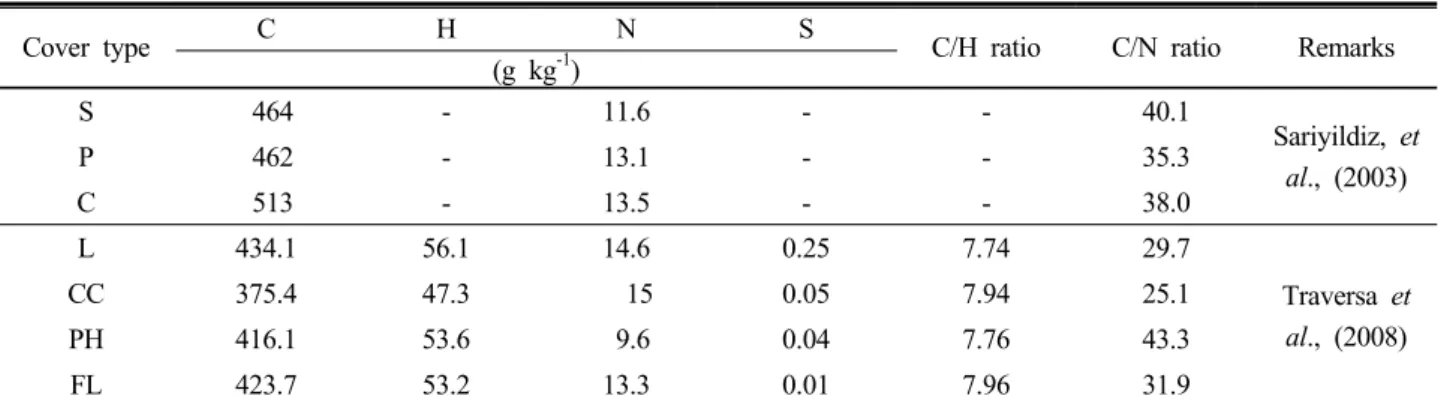
Table 2. Elemental composition of litter samples for various tree species.
Cover type C H N S
C/H ratio C/N ratio Remarks (g kg
-1)
S 464 - 11.6 - - 40.1
Sariyildiz, et al., (2003)
P 462 - 13.1 - - 35.3
C 513 - 13.5 - - 38.0
L 434.1 56.1 14.6 0.25 7.74 29.7
Traversa et al., (2008)
CC 375.4 47.3 15 0.05 7.94 25.1
PH 416.1 53.6 9.6 0.04 7.76 43.3
FL 423.7 53.2 13.3 0.01 7.96 31.9
S:Spruce, P:Pine, C:Castanea, L: Quercus ilex CC: Carpinus betulus and Carpinus orientalis PH: Pinus halepensis, FL: Quercus trojana and Quercus ilex.
organic matter is a very important environmental issues.
According to investigation about the properties of dissolved organic matter in forest soils in Italy by Traversa et al., (2008), organic carbon concentrations were greatest in the top 2 cm of soil for all cover types, and decreased at progressively greater depths in forest ecosystems. The changes in total N concentration and C/N ratio with increasing soil depth followed a similar pattern (Table 1).
Johansson (1995) also observed that the bulk of litter comprises structural components of plant cell walls and hence carbon was always in much larger concentrations than nutrients. In addition to structural polymers, litter also contains water-soluble fractions (Alexander, 1977;
Swift et al., 1979).
Elemental composition data of forest litters samples observed by Sariyildiz, et al., (2003) and Traversa (2008) and indicated that the amounts of elements for carbon,
nitrogen, and sulfur ranged from 375 - 434 g kg
-1, 9.6 - 15 g kg
-1, and 0.01-0.25 g kg
-1, respectively (Table 2).
However, the sulfur concentration showed significant differences between all the litter samples. In particular, the highest C/N ratio of samples may be ascribed to the hard cuticle of pine needles, which limits markedly the decomposition of the corresponding litter.
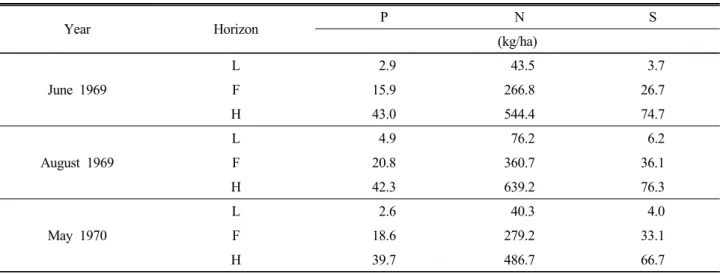
Gosz et al., (1976) also observed the changes of N, S, and P during tree different sampling dates as shown in Table 3.
There were significant differences in the concentrations
of various elements with depth. Some of this difference in
August may have been due to other summer litterfall (bud
scales, frass) and leaching from the forest canopy. However,
the depth trends were the same for different sampling
periods. He assumed that decomposition rates and leaching
of the litters could influence the concentration of the
elements with depth.
Fig. 2. Linear relation between mass loss of organic material from Scots pine needle litter and net release of nitrogen (Simplified from Berg, 2000).
Table 3. Element content (weighted watershed average) of the forest floor horizons. (Source : Gosz, 1976)
Year Horizon P N S
(kg/ha) June 1969
L 2.9 43.5 3.7
F 15.9 266.8 26.7
H 43.0 544.4 74.7
August 1969
L 4.9 76.2 6.2
F 20.8 360.7 36.1
H 42.3 639.2 76.3
May 1970
L 2.6 40.3 4.0
F 18.6 279.2 33.1
H 39.7 486.7 66.7
Litter Decomposition in forest
Litter fall is an important flux of organic matter into soil subsystems (Swift et al., 1979). Fresh litter is very different from older, partly decomposed litter from a chemical point of view, thus influencing the rate-regulating factors and the microbial community (Berg, 2000).
According to Berg (2000), the decomposition rates may be positively related to the concentration of N in fresh litter, and a lack of macronutrients, such as N, P, and S thus limit the decomposition rates of the celluloses. The decomposition rate of fresh plant litter may decrease from ca. 0.1% per day in fresh litter to 10
-5% per day or lower in more completely decomposed material due to changes in its organic-matter quality as the recalcitrant chemical components (Berg, 2000).
In an early stage climate as well as concentrations of the major nutrients and water solubles had a clear influence on decomposition rate. In a later phase the decomposition of lignin dominated over the influence of nutrients and thus ruled the decomposition of litter.
The model suggested by Berg (2000) shown in Fig. 2, decomposition of litter may be divided into at least two phases. In the first phase decomposition of soluble substances and non-lignified carbohydrates is controlled by the concentrations of nutrients limiting the microbial activity such as nitrogen, phosphorus and sulfur. In the second phase primarily lignin and lignified celluloses remain.
Simultaneously the rate decreased and the accumulated mass loss even may approach a limit value.
Runoff and Erosion in A Forest Generally, areas
with high-intensity precipitation, more frequent rainfall, more wind, or more storms are expected to have more erosion. Sediment with high sand or silt contents and areas with steep slopes erode more easily.
Erosion takes place when runoff carrying nutrients, chemicals, and soil particles occurs, resulting in off-site sedimentation of water bodies and diminished water quality.
Debris slides are the predominant erosional process on forested hillslopes.
Surface runoff and slopewash are basic geomorphic processes that affect hillslope and catchment-scale hydrology, surface water sediment concentration and chemistry, aquatic habitats, etc. According to Douglas (1967), however, slopewash in the tropics may be most important in areas where rainfall is seasonal and concentrated into high-intensity storms. Bruenig (1975) measured average slopewash rates of 20 Mg km
-2yr
-1under virgin forest, and data compiled in Unesco/UNEP/
FAO (1978) indicate that slopewash may be as high as 100
Table 4. Element contents of the forest floor and inputs to the forest floor, residence time (yrs.), and fractional annual loss of elements and organic matter in the forest floor.
Element Forest floor Litter Precip. Net Stemflow/
Throughfall Residence time (yrs) Fractional loss -kg ha
-1-
P 61.4 4.0 0.10 0.68 15.4 12.8 0.06 0.08
N 830.4 54.2 5.6 9.92 15.3 11.9 0.07 0.08
S 104.4 5.8 9.8 20.98 18.9 2.9 0.06 0.34
OM 46800 5702 - 115.4 8.2 8.0 0.12 0.12
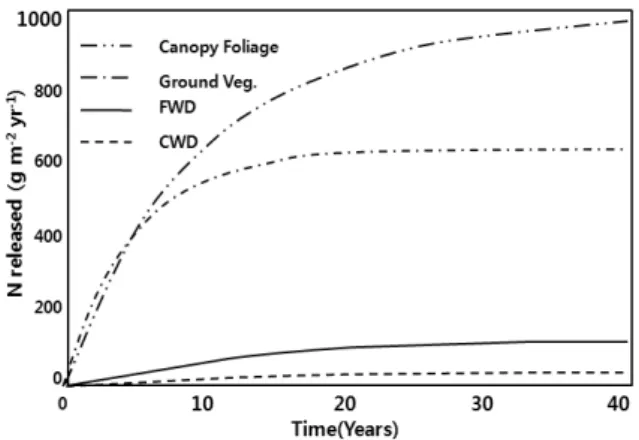
(Source : Johnson et al., 1968) Fig. 3. Contributions of canopy foliage, ground vegetation, fine woody debris and coarse woody debris to annual N release from decomposing organic matter in three Rocky Mountain forests, during a 40-year simulation period (Laiho and Prescott 1999).
Mg km
-2yr
-1for the humid tropics in general (Reading et al., 1995).
Loss of Nitrate and Phosphate from Organic Matter in Forest Soils Sverdrup et al., (1990) defined that the critical load for N can be the maximum deposition of nitrogen compounds that will not cause eutrophication or induce any type of nutrient imbalance in a part of the ecosystem or recipients to the ecosystem. The nitrogen could be lost to streamwater or groundwater, lost to the atmosphere, or retained within the disturbed system through nitrogen immobilization by decomposers, clay fixation of ammonium, lags in nitrification, nitrate reduction to ammonium, nitrate adsorption on soil colloids, a lack of water for nitrate transport, or plant nitrogen uptake (Vitousek, 1979).
The most important aspect of the canopy in terms of its influence on nutrient cycling is its role as the source of leaf litter. The results of nutrient cycling in three Rocky Mountain forests measured by Laiho and Prescott (1999) showed that canopy litter (foliage, reproductive tissue and fine woody debris) accounted for 66 to 86% of the mass, 63 to 90% of the N, and 49 to 92% of the P returned annually in aboveground litter. Extrapolation of input and decomposition rate data from these forests demonstrates the overriding importance of canopy litter in the recycling of N and P (Fig. 3).
Hydrologic nutrient losses can constrain the accumulation and availability of nitrogen in terrestrial ecosystems with important long-term effects on productivity and carbon storage in nitrogen-limited temperate forest ecosystems (McKane et al., 1997, Nadelhoffer et al. 1999). Perakis and Hedin (2002) reported that dissolved organic nitrogen is responsible for the majority of nitrogen losses from the forests. The loss rate of nitrogen by the various ways is complicated (Table 4) but depends in part upon the physical matrix of the element, i.e. in dissolved or
particulate form, in labile or refractory organic matter (Johnson et al., 1968).
A study of Sitka spruce plantations of varying age in Wales has shown that relatively little nitrate leaches from younger forests of under 30 years, but it does so to an increasing extent from older forests (Stevens et al., 1994).
Titus and Malcolm (1992) observed that leaching losses of NH
4-N and PO
4-P from the litter layer of Sitka spruce stands exceeded precipitation inputs. while leaching losses were less than precipitation inputs for NO
3-N.
However, It is also possible that soil hydrological changes in older stands allow increased bypass flow through cracks and root channels and therefore more N leaching.
Prediction of N And P Loadings From the Forest Stands Loadings of N and P released from the forest floors into water resources have been poorly understood.
There are large differences in terms of their biotic and
abiotic chemical reactions among the major anions in soil
solutions that can be involved in leaching processes. The
production and mobility of NO
3-is regulated almost
entirely by biological processes (uptake, mineralization, nitrification) (Johnson and Cole, 1980).
In an undisturbed forest, the surface horizons of undisturbed forest soils are often well structured and the mineral soil is covered by a litter layer which protect the soil by absorbing the impact of rain drops. This layer and the underlying soil in a forest are porous and highly permeable to rainfall. Therefore, only the most severe rainfall and large hailstorm events will lead to overland flow in a forest. Moore et al. (1986) attributed the rapid subsurface stormflow response of the forested catchments to rapid preferential flow in such interconnected macropore systems, under both saturated and unsaturated conditions.
Water including dissolved nutrients in soil moves vertically through the forest canopy and soil to the groundwater, where it is transported mainly horizontally to the watercourses. Water and dissolved nutrients can also move horizontally with surface runoff and with rapid subsurface flow in conductive layers close to the soil surface. Therefore, long-term nutrient budget and flux estimates at stand would be useful tools in calculating nutrient fluxes into the watercourses in a sustainable way.
In environmental and ecological modelling, GIS-based data processing can be utilized in multi-disciplinary process modelling to predict environmental fate and transport of solutes in forest management. The two dimensional model (FEMMA) which is constructed by combining existing hydrological, forest ecological, and solute transport models accounts for water and nitrogen (N) fluxes within and from a forested first-order catchment by combining the hydrological and biochemical processes taking place in the forest canopy and in the soil-root system (Kellomäaki et al., 1993).
Laurén et al., (2005) found that the simulated results were in reasonable agreement with the nitrate, dissolved organic N and dissolved total N measurements from the study catchment and with other results in the literature.
The characteristic profile model (CPM) presented in Karvonen et al. (1999) describes the soil water movement, runoff generation and nitrogen dynamics along a typical longitudinal section from a water divide to a stream. The other scheme tested is a three-dimensional groundwater and solute transport model (MODFLOW) (McDonald and Harbaugh 1988, Zheng 1990, Zheng and Wang 1998, Konikow et al. 1996).
Conclusions
In the forest floor, nutrients incorporated in organic matter, held on exchange sites, or in soil solution are eventually lost from the forest floor to stream drainage via lateral subsurface flow or to surface soil erosion processes.
The rate of nutrient loss depends in part upon the physical matrix of the element, i.e. in dissolved or particulate form, in labile or refractory organic matter. Each of the major anions in forest soil solutions has some unique properties which affect its production and mobility. Knowing these properties of the major anions, it is possible to assess and to predict soil leaching rates of nutrients in forest floor.
Especially the loadings of nutrient sources by landslide can be critical factor in eutrophication of the lake. Further research into organic anion mobility and further attention to mobility should add greatly to the body of knowledge on nutrient transport processes in forest soils.
References
Addiscott, T. and P. Brookes. 2002. Nitrogen cycle: What governs nitrogen loss from forest soils?. Nature. 418. 604.
Alexander, M. 1977. Introduction to Soil Microbiology. 2nd ed. John Wiley and Sons, New York.
Berg, B.È. 2000. Litter decomposition and organic matter turnover in northern forest soils. Forest Ecology and Management 133. p13-22.
Brown, T.C. and D. Binkley. 1994. Effects of management on water quality in North American forests. USDA Forest Service General Technical Report RM-248, p. 27.
Bruenig, E.F. 1992. `Tropical forest resources’, in Furtado, J.I., Morgan, W.B., Pfafflin, J.R. and Ruddle, K. (Eds), Tropical Resources ecology and development, Harwood Academic Publishers, Philadelphia, 67-96.
Carmean, W.H. 1957. The structure of forest soils. OH J Sci. 57:165–-168.
Carpenter, S.R., N.F. Caraco, and V.H. Smith. 1998. Nonpoint pollution of surface waters with phosphorus and nitrogen.
Ecological Applications 8:559-568.
Cronan, C.S. and G.R. Aiken. 1985. Chemistry and transport of soluble humic substances in forested watersheds of the Adirondack Park, New York. Geochimica et Cosmochimica Acta 49, 1697–1705.
Cronan, C.S., W.A., Reiners, R.C., Reynolds jr., and G.E Lang. 1978. Forest floor leaching: contributions from mineral, organic, carbonic acids in New Hampshire subalpine forests. Science 200, 309–.311.
Douglas, I. 1967. `Erosion of granite terrains under tropical
rain forest in Australia, Malaysia, and Singapore’, International
Union of Geodesy and Geophysics/ International Association
of Scientific Hydrology Symposium on River Morphology, publication 75, 31-39.
EPA. 1990. National Water Quality Inventory:Report to Congress.
EPA 40-4-90-003, Office of Water, U.S. Environmental Protection Agency, Washington, D.C.
Gosz, J.R., G.E. Likens, and F.H. Bormann. 1976. Organic matter and nutrient dynamics of the forest floor in the Hubbard Brook forest. Oecologia 22:305–320.
Hoover, M.D. and C.R. Hursh. 1943. Influence of topography and soil depth on runoff from forest land. Transactions, American Geophysical Union Part 2: 693-698.
Johansson, M.B. 1995. The chemical composition of needle and leaf litter from Scots pine, Norway spruce and white birch in Scandinavian forests. Forestry. 68: 49-62.
Johnson, D.W. and D.W. Cole. 1980. Anion mobility in soils:
Relevance to nutrient transport from forest ecosystems.
Environment International. Volume 3, Issue 1 Pages 79-90.
Judy, R.D., P.N. Seeley, T.M. Murray, S.C. Svirsky, M.R.
Whitworth, and L.S. Ischinger. 1984. 7982 National Fishery.
Vol. I Technical Report: Initial Findings. FWS/OBS-84/06, U.S. Fish and Wildlife Service: Washington, D.C.
Karvonen, T, H. M. Koivusalo, J.P. Jauhiainen, and K. Wepling.
1999. A hydrological model for predicting runoff from different land use areas, Journal of Hydrology 217. p. 253–265.
Kellomäaki, S., H. Väaisäanen, and H. Strandman. 1993. Finnfor:
A model for calculating the response of boreal forest ecosystem to climate change. University of Joensuu, Faculty of Forestry.
Research Notes 6. p. 120.
Konikow, L.F., D. J. Goode, and G.Z. Homberger. 1996. A three-dimensional method-of-characteristics solute-transport model. U. S. Geological Survey. Water Resources Investigations Report 96-4267.
Laiho, R. and C.E. Prescott. 1999. The contribution of coarse woody debris to carbon, nitrogen and phosphorus cycles in three Rocky Mountain coniferous forests. Can. J. For.
Res. 29:1592–1603.
Laurén, A., L. Finér, H. Koivusalo, T. Kokkonen, T. Karvonen, S. Kellomäki, H. Mannerkoski, and M. Ahtiainen. 2005.
Water and nitrogen processes along a typical water flowpath and streamwater exports from a forested catchment and changes after clear-cutting: a modelling study Hydrology and Earth System Sciences 9. 657-674.
Likens G.E., F.H. Bormann, and N.M. Johnson. 1969. Nitrification:
importance to nutrient losses from a cut-over forested ecosystem. Science 16., 1205-1206.
Likens G.E., F.H. Bormann, N.M. Johnson, and R.S. Pierce.
1967. The calcium, magnesium, potassium, and sodium budgets for a small forested ecosystem. Ecology 48:772-785.
Likens, G.E., and F. H. Bormann. 1972. Nutrient cycling in ecosystems, p. 25-67. In: J. Wiens, ed., Ecosystems: structure and function, 176 p. Corvallis, Oregon: Oregon State Univ.
Press.
Lutz, H.J. and R.F. Chandler Jr. 1947. Forest Soils. 514 p.
John Wiley and Sons, Inc., New York.
McDonald, M.G. and A.W. Harbaugh. 1988. A modular three-dimensional finite- difference groundwater flow model.
USGS, Techniques of Water Resources Investigations of the United States Geological Survey, Book 6, Chapter A1. 586 p.
McKane, R.B., E.B. Rastetter, G.R. Shaver, K.J. Nadelhoffer, A.E. Giblin, J.A. Laundre, and F.S. Chapin, III. 1997.
Reconstruction and analysis of historical changes in carbon storage in arctic tundra. Ecology 78:1188-1198.
Moore, I.D., G.J. Burch, and P.J. Wallbrink. 1986. Preferential Flow and Hydraulic Conductivity of Forest Soils. Soil Sci Soc Am J 1986 50: 876-881.
Nadelhoffer, K.J., B.A. Emmett, P. Gundersen, O.J. Kjonaas, C.J. Koopmans, P. Schlepi, A. Tietema, and R.F. Wright, 1999. Nitrogen deposition makes a minor contribution to carbon sequestration in temperate forests. Nature 398:
145-148.
Perakis, S.S. and L.O. Hedin, Nitrogen cycle: Natural organic tendencyNature 415, 416-419 (2002).
Reading, A.J., R.D. Thompson, and A.C. Millington. 1995.
Humid Tropical Environments, Blackwell, Cambridge, MA, 429 p.
Sariyildiz, T. 2003. Litter Decomposition of Picea orientalis, Pinus sylvestris and Castanea sativa Trees Grown in Artvin in Relation to Their Initial Litter Quality Variables. Turk J Agric For 27. 237-243.
Sharpley A.N., T.C. Daniel, J.T. Sims, and D.H. Pote. 1996.
Determining environmentally sound soil phosphorus levels.
Journal of Soil and Water Conservation 51:160-166.
Stevens, P.A., D.A. Norris, T.H. Sparks, and A.L Hodgson.
1994. The impacts of atmospheric N inputs on through fall, soil and streamwater interactions for different aged forest and moorland catchments in Wales. Water, Air Soil Pollut., 73:297-317.
Sverdrup, H., W. de Vries, and A. Hendriksen. 1990. Maping Critical Loads. Environmental Report 1990: 14, Nordic Courcil of Ministers, Copenhagen, 124.
Swift, M.J., O.W. Heal, and J.M. Anderson. 1979. Decomposition in Terrestrial Ecosystems. Blackwell Scientific Publications, Oxford.
Titus, B.D. and D.C. Malcolm. 1992. Nutrient Leaching from the Litter Layer after Clearfelling of Sitka Spruce Stands on Peaty Gley Soils. Forestry 1992 65:389-416.
Traversa, A.V. and D.N. Senesi. 2008. Forest Ecology and Management 256 p. 2018–028
Unesco/UNEP/FAO. 1978. Tropical Forest Ecosystems, Unesco, Paris.
United Nations Environment Programme (UNEP). 2010. Water Quality: The Impact of Eutrophication. IETC. Lakes and Reservoirs vol. 3.
Vitousek, P., M.1 Melillo, and M. Jerry. 1979. Nitrate Losses From Disturbed Forests: Patterns and Mechanisms Source:
Forest Science, Volume 25:605-619.
Zheng, C. and P.P. Wang. 1998. MT3DMS, A modular three- dimensional multispecies transport model for simulation of advection, dispersion and chemical reactions of contaminants in groundwater systems. Documentation and User’s Guide.
Departments of Geology and Mathematics, University of
Alabama.
호소 부영양화에 있어서 산림임반으로부터 질소부하 평가를 위한 조사
정덕영*·이영한
1·이진호
2·박미숙
충남대학교 농업생명과학대학 생물환경화학과,
1경남농업기술원,
2