http://dx.doi.org/10.11620/IJOB.2014.39.3.145
Lactoferrin Constitutively Enhances Differentiation of Osteoblastic MC3T3-E1 Cells in Vitro
Hee-Young Yang
1, Ha-Mi Lee
2, Byung-Ju Park
1, and Tae-Hoon Lee
1,3*1
Department of Oral Biochemistry, Dental Science Research Institute, Medical Research Center for Biomineralization Disorders, School of Dentistry, Chonnam National University, Gwangju, Korea
2
Laboratory of Veterinary Pathology, College of Veterinary Medicine, Chonnam National University, Gwangju, Korea
3
Department of Molecular Medicine, Graduate School, Chonnam National University, Gwangju, Korea (received August 05, 2014; revised September 04, 2014; accepted September 05, 2014)
*Correspondence to: Tae-Hoon Lee, Department of Biochemistry, School of Dentistry, Chonnam National University, 300 Yongbong-Dong, Buk-Ku, Gwangju 500-757, Korea.
Tel.: +82-62-530-4842, Fax: +82-62-530-4848, E-mail: [email protected]
This is an Open-Access article distributed under the terms of the Creative Commons Attribution Non-Commercial License (http://creati- vecommons.org/licenses/by-nc/3.0) which permits unrestricted non- commercial use, distribution, and reproduction in any medium, pro- vided the original work is properly cited.
During bone remodeling, there is requirement of differentiation of osteoblastic cells. Previously, we identified proteins differentially expressed in soft tissue during bone healing. Of these proteins, we focused the effect of LTF on differentiation of osteoblast. In order to analyze the osteogenic ability of LTF, we treated conditioned media collected from human LTF-stably transfected HEK293T cells into osteoblastic MC3T3-E1. The results showed that the activity and expression of alkaline phosphatase were increased in MC3T3-E1 cells treated with conditioned media containing LTF in dose- and time-dependent manner. At the same time, we observed the significant increase of the expression of osteoblastic genes, such as ALP, BSP, COL1A1, and OCN, and along with matrix mineralization genes, such as DMP1 and DMP2, in LTF conditioned media-treated groups. Moreover, the result of treating recombinant human LTF directly into osteoblastic MC3T3-E1 showed the same pattern of treating conditioned media containing LTF. Our study demonstrated that LTF constitutively enhances osteoblastic differentiation via
induction of osteoblastic genes and activation of matrix mineralization in MC3T3-E1 cells.
Key words: lactoferrin, conditioned media, osteoblast differentiation, DMP1, DMP2
Introduction
The controlled bone regeneration is regulated with the cross-talk and orchestrated regulation of osteoblasts and osteoclasts. The accurate balance between bone formation and resorption is critical for the maintenance of bone mass density and systemic regulation of mineral homeostasis. Any disturbance of this balance may lead to various bone diseases, including osteoporosis, which is typically specified as the decrease in bone density with high risk of fracture occurrences [1]. As resorption of a controlled and pre-defined portion of bone by osteoclasts, osteoblasts and their constituent progenitor cells migrate to the newly resorbed region where they produce an osteoid matrix and mineralize the osteoclast-orchestrated cavities [2]. The balance of bone remodeling is disrupted because bone resorption exceeds bone formation. Recent advanced research in the signal regulating of osteoblast and bone formation may provide potential therapeutic strategies to address this imbalance and rebuild the bone tissue.
145
Lactoferrin (lactotransferrin, LTF) is transferrin family of iron-binding glycoproteins and secreted by glandular epithelial cells. Several biological functions for LTF have been described, including iron homeostasis, cellular growth and differentiation, host defense against microbial infection, anti-inflammatory activity, and cancer protection [3]. LTF has been shown to be differentially regulated by hormones and transcription factors in a tissue-specific manner [4]. Depend on cell types and niches, LTF binding to target cells exerts an influence on cellular signaling pathways, resulting in altered gene expression [5-7]. Some studies indicated that LTF promotes the inhibitory effect on osteoclast-mediated bone absorbing activity [8-10]. And recent study showed the osteogenic effect of LTF-embedded collagen membrane [11].
These beneficial effects of LTF suggest the application as a growth factor or drug in bone tissue engineering.
Recently, we reported target proteins differentially expressed between soft tissue and bone in porcine model for bone healing [12]. Of these proteins, we selected the specific targets that contain signal sequences and show altered expression level in soft tissue. To demonstrate its biological effect on osteoblast differentiation in vitro, we used conditioned media that are collected from human LTF stably transfected epithelial cell. Our finding suggests that LTF directly promotes the differentiation of osteoblast-like cell.
Materials and methods
Reagents and antibodies
All chemicals are purchased from Sigma-Aldrich, Merck, Bio-Rad, USB products (Affimetrix, Inc., Santa Clara, CA, USA). Antibodies to human lactoferrin and mouse β-actin were purchased from Millipore (cat no. 07-685) and Sigma- Aldrich (cat no. A4451), respectively. Recombinant human lactoferrin protein was purchased from Prospec (cat no.
PRO-592).
Plasmid construction and cell transfection
To construct human LTF overexpressing vector, human LTF expression construct was generated by subcloning PCR amplified full-length LTF cDNA into KpnI and BamHI sites of a pCR3.1 expression vector (Invitrogen, Carlsbad, CA, USA). For stable expression of human LTF into HEK293T cells, human LTF cDNA was transfected into HEK293T cells
using Lipofectamine 2000 reagent (Invitrogen, Carlsbad, CA, USA) according to the manufacturer’s instructions. And then, the transfected cells were selected by resistance of geneticin (Welgene Inc., South Korea).
Cell culture and conditioned media (CM) collection Stably transfected HEK293T cells ectopically expressing the indicated constructs (human LTF or pCR3.1) were maintained in DMEM (Gibco, Grand Island, NY, USA) supplemented with 10% FBS, 100 U/ml penicillin, and 100 U/ml streptomycin, and 400 µg/ml geneticin. After reached the confluence at 70-80%, the media was changed to serum free α-MEM supplemented with 100 U/ml penicillin and 100 U/ml streptomycin. After 24 hours of incubation, the media was collected, filtered through 0.2 µm filters and stored at -20
oC until use.
Murine osteoblastic cell line MC3T3-E1 was cultured in α -MEM (Invitrogen, Carlsbad, CA, USA) supplemented with 10% FBS, 100 U/ml penicillin, and 100 U/ml streptomycin (GenDEPOT, Barker, TX, USA) at 37°C and 5% CO
2. MC3T3-E1 cells were treated with mock, 10%, 25% or 50%
conditioned media of total media volume supplemented with 50 µg/ml ascorbic acid and 5 mM β-glycerolphosphate. The media were changed every 2 or 3 days.
Western blotting
The conditioned media were enriched to 200-fold by using centrifugal filter (Amicon Ultracel-30K; MilliPore, Billerica, MA, USA). And cell lysates were prepared in lysis buffer containing protease inhibitors (50 mM Tris-HCl, pH 7.5, 0.15 M NaCl, 1% Triton X-100, 0.5%
sodium deoxycholate, 0.1% SDS, 1 mM NaF, 1 mM Na
3VO
4, 0.1 mM AEBSF, 1 µg/ml pepstatin, 1 µg/ml aprotinin, 0.5 µg/ml leupeptin, and 1 mM PMSF). Protein concentrations were determined using BCA protein assays (Thermo Scientific, San Jose, CA, USA), and then 30 µg of protein were separated on 12% polyacrylamide gels.
The separated proteins were transferred onto polyvinylidene
fluoride membranes (Bio-Rad Laboratories, Hercules, CA,
USA), after which the membranes were incubated first
with anti-LTF or anti-β-actin as the primary antibody and
then incubated with HRP conjugated secondary antibody
(Cell Signaling, Beverly, MA, USA). Immunoreactive
proteins were detected using an ECL system (iNtRON,
South Korea).
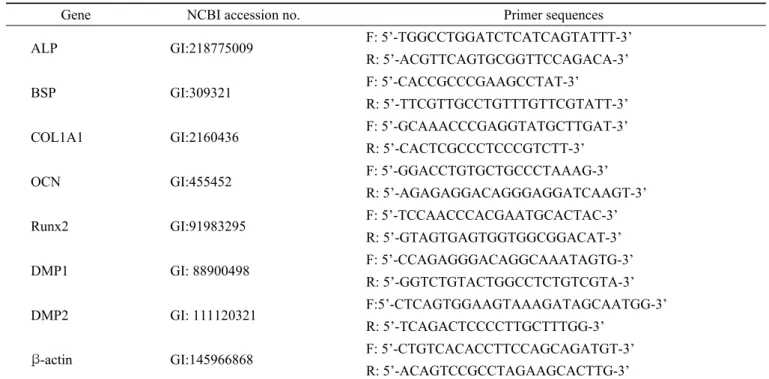
Gene NCBI accession no. Primer sequences
ALP GI:218775009 F: 5’-TGGCCTGGATCTCATCAGTATTT-3’
R: 5’-ACGTTCAGTGCGGTTCCAGACA-3’
BSP GI:309321 F: 5’-CACCGCCCGAAGCCTAT-3’
R: 5’-TTCGTTGCCTGTTTGTTCGTATT-3’
COL1A1 GI:2160436 F: 5’-GCAAACCCGAGGTATGCTTGAT-3’
R: 5’-CACTCGCCCTCCCGTCTT-3’
OCN GI:455452 F: 5’-GGACCTGTGCTGCCCTAAAG-3’
R: 5’-AGAGAGGACAGGGAGGATCAAGT-3’
Runx2 GI:91983295 F: 5’-TCCAACCCACGAATGCACTAC-3’
R: 5’-GTAGTGAGTGGTGGCGGACAT-3’
DMP1 GI: 88900498 F: 5’-CCAGAGGGACAGGCAAATAGTG-3’
R: 5’-GGTCTGTACTGGCCTCTGTCGTA-3’
DMP2 GI: 111120321 F:5’-CTCAGTGGAAGTAAAGATAGCAATGG-3’
R: 5’-TCAGACTCCCCTTGCTTTGG-3’
β-actin GI:145966868 F: 5’-CTGTCACACCTTCCAGCAGATGT-3’
R: 5’-ACAGTCCGCCTAGAAGCACTTG-3’
Table 1. Sequences of primer for mouse osteoblastic marker
Quantitative Real-Time PCR
Total RNA was isolated from MC3T3-E1 cells (0, 7, 14, 21 days after treatment of conditioned medium) using RNA Lysis reagent (Qiagen, Germantown, MD, USA), after which cDNAs were synthesized using RT reagent Kit (Takara Bio, Japan) according to the manufacturer's instructions. Quantitative PCR was performed using an ABI 7300 real time PCR detection system (Applied Biosystems, Foster City, CA, USA) with a SYBR Ex Taq kit (Takara Bio, Japan) and a standard temperature protocol. The results obtained using CT (cycle threshold) are expressed as relative quantities and were calculated using the 2
-ΔΔCTmethod (expressed as relative fold ratio). Detailed primer information is shown in Table 1.
Alkaline phosphatase (ALP) activity and alizarin red S staining
At day 7, 14, and 21 after treatment of CM, cells were washed twice with 1X PBS and lysed with 100 µl/well of CellLytic
TMM cell lysis reagent (Sigma-Aldrich, St. Louis, MO, USA). 5 µg of total protein extracts were mixed with 50 µl of 40 mM p-Nitrophenyl Phosphate (Sigma-Aldrich, St. Louis, MO, USA) in 96 well plates and incubated at 37
oC for 1 hour. The reactions were stop by addition of 3 N NaOH, the plates were read at 420nm and the p-Nitrophenol products (Sigma-Aldrich, St. Louis, MO,
USA) were used as the standard. The ALP activity unit was measured as µM/µg protein/Hr. For ALP staining, cells were fixed with 70% ethanol for 1 hour and treated with a BCIP
®/NBT solution (Sigma-Aldrich, St. Louis, MO, USA) for overnight. For Alizarin Red S staining, cells fixed with 70% ethanol for 1 hour were stained with 400 µl/well (24 well plates) of 2% Alizarin Red S (Sigma Aldrich, St. Louis, MO, USA) solution for 1 hour. The plates were air-dry and visualized by photograph.
Statistical analysis
One-way analysis of variance was used to evaluate the significance of the differences between the groups in each experiment with SigmaPlot software version 10.0 (Systat Software Inc., San Jose, CA, USA). The level of significance was set at p < 0.05.
Results
Conditioned media containing LTF induces ALP activity in MC3T3-E1 cells
To confirm the osteogenic ability of LTF, we treated
conditioned media collected from LTF-transfected HEK293T
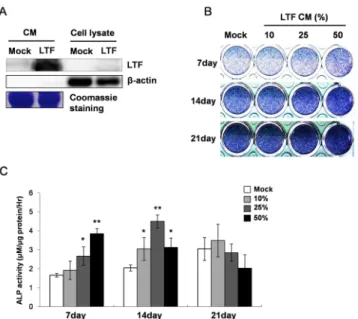
cells to MC3T3-E1 cells. LTF protein was completely
secreted into culture media from LTF-transfected cells
Fig. 1. The treatment of conditioned media (CM) containing LTF induces alkaline phosphatase activity in MC3T3-E1 cells.
(A) Expression of human LTF into CM of stable expressed-HEK293T cells cultured in serum free media for 24 hr. The CM was collected, concentrated and analyzed by Western blotting. β-actin and coommassie staining are loading control. (B) ALP staining in MC3T3-E1 cells. MC3T3-E1 cells were treated with mock or LTF stably expressed CM with differentiation media (50 µg/ml ascorbic acid and 5mM β -glycerolphosphate). (C) ALP activity in MC3T3-E1 cells for the indicated times. y-axis shows enzyme activity unit (μM/μg protein/Hr). Mock represents CM from stably expressed cells for empty vector. Data presented the mean ± SD for three independent experiments. *p < 0.05 and **p < 0.001 in comparison with mock media treatment.
compared with mock (Fig. 1A). We found the increase of ALP staining depends on concentration of conditioned media (Fig. 1B). Interestingly, when we treated 50% conditioned media, the activity of ALP was highest at 7 days (about 2 fold higher than mock treatment) and then decreased at 14 and 21 days (Fig. 1C). This result implies that high concentration of LTF affects the early stage of differentiation of osteoblastic-like cells. Thus, we suggest that LTF may have a role in the early stage of osteoblast differentiation.
Conditioned media containing LTF enhances expression of osteogenic genes and mineralization in MC3T3-E1
Next, we checked the expression levels of osteoblastic genes, such as ALP, BSP, COL1A1, and OCN, in MC3T3-E1 during treatment of conditioned media containing LTF. As the result, the expression levels of these markers were significantly increased at 7 day (Fig. 2A, 2B, 2C, and 2D).
Fig. 2. The conditioned media (CM) containing LTF enhances the expression of osteogenic genes in MC3T3-E1 cells.
MC3T3-E1 cells were treated with mock, 10%, 25% or 50% of LTF-conditioned media for the indicated time. The mRNA expression level of alkaline phosphatase (A), bone sialoproteins (B), collagen type I alpha1 (C), osteocalcin (D), and Runx2 (E) were analyzed by quantity real-time PCR. MC3T3-E1 cells untreated at 0 day were used as control. Error bars indicated ± SD for three independent experiments. *p < 0.05 and **p <
0.001 in comparison with mock media treatment of each group.
After that, those osteoblastic genes were down-regulated at 14 to 21 days. Notably, the expression level of BSP was highly expressed at 14 to 21 days (Fig. 2B). However, either conditioned media from mock- or LTF-transfected cells did not affect Runx2 expression (Fig. 2E). In a physiological phase, LTF are likely to participate in differentiation stage after induction of Runx2 protein during osteoblast differentiation.
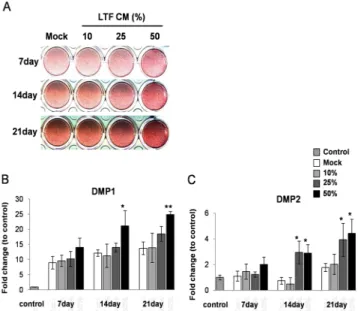
We also confirmed whether LTF-conditioned media
enhance matrix mineralization as well. Alizarin red staining
results showed that the treatment of LTF-conditioned media
induced matrix mineralization in a dose-dependent manner at
indicated time (Fig. 3A). Next, we checked transcriptional
changes of DMP1 (dentin matrix protein 1) and DMP2
(dentin matrix protein 2) that are critical for proper
mineralization of bone and dentin. After treatment of
LTF-conditioned media, both genes were significantly
Fig. 3. The conditioned media (CM) containing LTF promotes matrix mineralization in MC3T3-E1 cells. (A) Alizarin red S (AR) staining in MC3T3-E1 with mock or LTF-CM for the indicated time. (B, C) The mRNA expression of matrix mineralization marker, DMP1 and DMP2. MC3T3-E1 cells untreated at 0 day were used as control. Error bars showed ± SD for three independent experiments. *p < 0.05 and **p < 0.001 in comparison with mock media treatment of each group.
upregulated at later than 14 day after treatment (Fig. 3B and 3C). The results showed the evidences that LTF continuously enhances matrix mineralization in MC3T3-E1 cells as well.
Recombinant human LTF stimulates differentiation of MC3T3-E1 cells
LTF-conditioned media contains not only human LTF, but also other factors that could have artificial effect on osteoblast differentiation. We thus tested recombinant human LTF protein in order to confirm the direct effect of LTF on osteoblastic differentiation of MC3T3-E1 cells. We treated purified commercial rhLTF to MC3T3-E1 cells at concentrations ranging from 0, 100, 200, and 400 µg/ml for 7 days. The ALP activity showed a significantly increase in MC3T3-E1 cells treated with rhLTF in a dose-dependent manner (Fig. 4A and 4B). Moreover, rhLTF induced the transcriptional expression of osteogenic genes and mineralization (Fig. 4C, 4D and 4E). As the same context of the data in Figure 2, Runx 2 transcriptional expression was not influenced by the direct treatment of rhLTF compared with non-treatment (Fig. 4F). These results strongly suggest that LTF play a role in osteoblastic differentiation of MC3T3-E1 cells as enhancer.
Fig. 4. Recombinant human LTF protein induces differentiation of MC3T3-E1 cells. (A) ALP and AR staining, (B) ALP activity in MC3T3-E1 after treatment of rhLTF (100, 200, 400 μg/ml) with differentiation media for 7 days. The treated cells were analyzed for osteogenic genes (C, D, F) and mineralization genes (E) by real-time PCR. MC3T3-E1 cells untreated at 0 day were used as control. AA+β-GP, treated with 50 µg/ml ascorbic acid and 5mM β-glycerolphosphate. The data are presented as the mean ± SD of three experiments. *p < 0.05 and **p < 0.001 in comparison with mock media treatment (a white bar) of each group.
Discussion
Previously, we reported a time-dependently increase of LTF in soft tissue around alveolar bone after tooth extraction [12]. However, the role of LTF in communication between soft tissues and bone in bone regeneration was not clearly understood. At physical environment, it have been reported that LTF can promote bone growth [13]. In vivo, local injection of LTF in the hemicalvaria of adult mice showed considerable increase in histomorphometric result of bone area [14]. In this regard, LTF may have a capacity for physiological bone healing, and a latent ability as therapeutic factor in bone disorder.
Basically, the current challenge for preventing bone
deterioration is to advance osteoblastogenesis and bone
formation. With aging, the rate of bone turnover augments in
genders because of an impaired osteoblastic bone formation compared with osteoclastic bone resorption caused by decreased number and activity of individual osteoblastic cells [15]. The osteoblast dysfunctions related with age may be affected by intrinsic mechanisms caused by osteoblast cellular senescence and, extrinsic mechanisms that are caused by age-related weakening in bone microenvironment containing alterations in levels of hormones and growth factors [16]. The progressive bone loss with aging is deteriorated in patients with osteoporosis featured by decreased bone mass, and increased bone fragility. Based on this phenomenon to aging with imbalance between bone formation and resorption, potent anticatabolic molecules, growth factors and hormone, can be primary therapies for osteoporosis. These anticatabolics are likely to reduce bone resorption and secondarily bone formation due to the coupling phenomenon during bone regeneration and thus preserve bone mass [17]. However, these molecules should be also efficient to target osteoblastic cell to increase bone formation and strength. So far, the convinced effects of LTF in bone have been proven in vitro and in vivo. For example, LTF have a role in induction of osteoblast proliferation, differentiation, inhibition of osteoclast formation, and bone loss. In our study, LTF could even accelerate matrix mineralization through the transcriptional induction of DMP1 and DMP2 genes during osteoblast differentiation. Nevertheless, the direct and indirect mechanisms of LTF in promoting bone-related cells are only partially understood. For a better pharmaceutical understanding, the physiological effect of LTF on anabolic activity of bone could be developed by mimicking its designed compounds and in systemic/local applications.
Acknowledgments
This work was supported by the National Research Foundation of Korea (NRF) grant funded by the Korea government (MSIP) (2011-0030121), and by a grant of the Korean Health Technology R&D Project, Ministry of Health & Welfare (HI11C1409), Republic of Korea.
Conflict of interest
The authors declare that they have no competing interest.
References
1. Zuo C, Huang Y, Bajis R, Sahih M, Li YP, Dai K, Zhang X. Osteoblastogenesis regulation signals in bone remodeling. Osteoporos Int. 2012;23:1653-1663.
2. Hadjidakis DJ, Androulakis, II. Bone remodeling. Ann N Y Acad Sci. 2006;1092:385-396.
3. Ward PP, Paz E, Conneely OM. Multifunctional roles of lactoferrin: a critical overview. Cell Mol Life Sci.
2005;62:2540-2548.
4. Teng CT. Lactoferrin gene expression and regulation: an overview. Biochem Cell Biol. 2002;80:7-16.
5. Oh SM, Hahm DH, Kim IH, Choi SY. Human neutrophil lactoferrin trans-activates the matrix metalloproteinase 1 gene through stress-activated MAPK signaling modules. J Biol Chem. 2001;276:42575-42579.
6. Grey A, Banovic T, Zhu Q, Watson M, Callon K, Palmano K, Ross J, Naot D, Reid IR, Cornish J. The low-density lipoprotein receptor-related protein 1 is a mitogenic receptor for lactoferrin in osteoblastic cells. Mol Endocrinol. 2004;18:2268-2278.
7. Oh SM, Pyo CW, Kim Y, Choi SY. Neutrophil lactoferrin upregulates the human p53 gene through induction of NF-kappaB activation cascade. Oncogene.
2004;23:8282-8291.
8. Guo HY, Jiang L, Ibrahim SA, Zhang L, Zhang H, Zhang M, Ren FZ. Orally administered lactoferrin preserves bone mass and microarchitecture in ovariectomized rats. J Nutr.
2009;139:958-964.
9. Yamano E, Miyauchi M, Furusyo H, Kawazoe A, Ishikado A, Makino T, Tanne K, Tanaka E, Takata T. Inhibitory effects of orally administrated liposomal bovine lactoferrin on the LPS-induced osteoclastogenesis. Lab Invest.
2010;90:1236-1246.
10. Du M, Xu W, Yi H, Han X, Wang C, Zhang L. Protective effects of bovine colostrum acid proteins on bone loss of ovariectomized rats and the ingredients identification. Mol Nutr Food Res. 2011;55:220-228.
11. Takayama Y, Mizumachi K. Effect of lactoferrin-embedded collagen membrane on osteogenic differentiation of human osteoblast-like cells. J Biosci Bioeng. 2009;107:191-195.
12. Yang HY, Kwon J, Kook MS, Kang SS, Kim SE, Sohn S, Jung S, Kwon SO, Kim HS, Lee JH, Lee TH. Proteomic analysis of gingival tissue and alveolar bone during alveolar bone healing. Mol Cell Proteomics. 2013;12:2 674-2688.
13. Naot D, Grey A, Reid IR, Cornish J. Lactoferrin-a novel bone growth factor. Clin Med Res. 2005;3:93-101.
14. Cornish J, Callon KE, Naot D, Palmano KP, Banovic T, Bava U, Watson M, Lin JM, Tong PC, Chen Q, Chan VA, Reid HE, Fazzalari N, Baker HM, Baker EN, Haggarty NW, Grey AB, Reid IR. Lactoferrin is a potent regulator of bone cell activity and increases bone formation in vivo.
Endocrinology. 2004;145:4366-4374.
15. Khosla S, Riggs BL. Pathophysiology of age-related bone
loss and osteoporosis. Endocrinol Metab Clin North Am.
2005;34:1015-1030.
16. Marie PJ, Kassem M. Osteoblasts in osteoporosis: past, emerging, and future anabolic targets. Eur J Endocrinol.
2011;165:1-10.
17. Riggs BL, Parfitt AM. Drugs used to treat osteoporosis:
the critical need for a uniform nomenclature based on their action on bone remodeling. J Bone Miner Res. 2005;20:
177-184.