The Properties of Livestock Waste Composts Tea Depending on Manufacturing Method and Their Effect on Chinese Cabbage Cultivation
Jae-Eun Jang*, Chang-Sung Kang, Jung-Soo Park, Sun-Jae Kim, and Hee-Dong Kim Gyeonggi-do Agricultural Research and Extension Services, Hwasong, 445-784, Korea
(Received: October 16 2013, Revised: February 20 2015, Accepted: February 24 2015)
Livestock waste compost tea is a liquid extract of compost obtained by mixing livestock compost. In this study, some chemical and microbiological characteristics of compost tea depending on the kind of raw materials used were examined, and several experiments to investigate the practical effects on Chinese cabbage cultivation were conducted. This experiment showed that livestock composts needed to be added into aerated water at the ratio between 1:100 and 1:10 (1 part compost to 10~100 parts water) to produce the high quality compost tea. Compost teas must be aerated more than 24 to 48 hours to be able to support aerobic organisms.
In cultivation test with compost teas, swine manure compost teas were made by the extracting ratio of 50x, in the aerated condition for 24 hours in water and oil cake in the extracting ratio of 100x were added as supplements.
Following the input of oil cake, the concentration of nitrogen and aerobic bacteria increased. Another experiment was conducted to determine the effect of different swine manure compost teas on plant growth and yield of Chinese cabbage. The fresh yield of Chinese cabbage was higher in the fertigated plots by compost tea with oil cake compared to those of N, P2O5, K2O fertilization plot with chemical fertilizer by soil test recommendation (Fert.
NPK). The effect of compost tea on growth of Chinese cabbage was largely attributable to the increased number of microorganisms as well as nutrients.
Key words: Compost tea, Livestock waste compost, Oil cake, Chinese cabbage
The fresh yield of chinese cabbage in cultivation test.
Treatments Fresh yield (g plant-1)
Pot Plastic film house
No treatment 53.9d -
Oil cake (100x) com. FG†† 125.4c -
Fert. NPK§ 162.2bc 3,519
Swine LC† com. FG‡ 189.6b 3,390
Swine LC+oil cake com. FG 291.6a 3,524
†LC, Livestock waste compost.
‡Com. FG, compost tea fertigation.
§Fert. NPK, N, P2O5, K2O fertilization plot with chemical fertilizer by soil test recommendation.
1)
*Corresponding author : Phone: +82312295824, E-mail: [email protected]
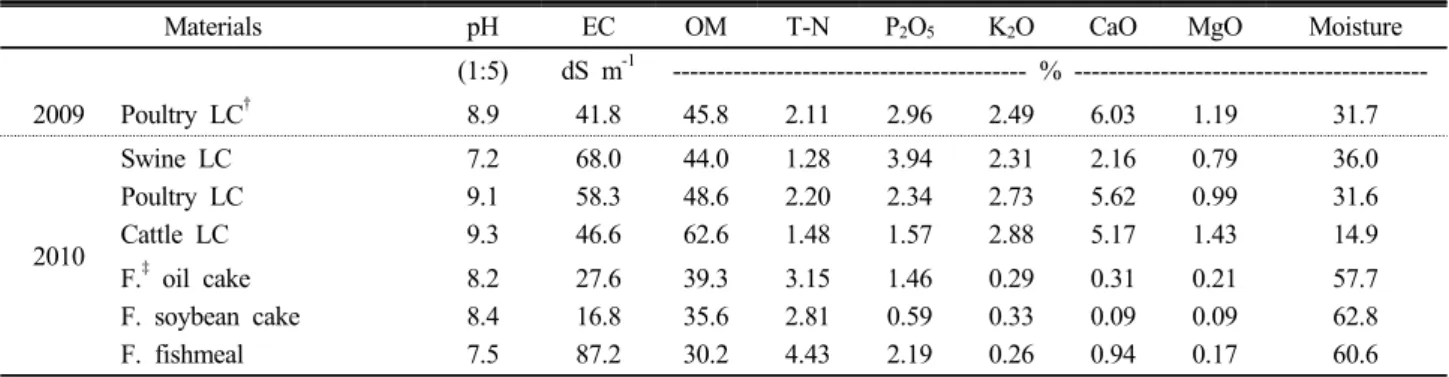
Table 1. Chemical properties of raw materials for making the compost tea.
Materials pH EC OM T-N P2O5 K2O CaO MgO Moisture (1:5) dS m-1 --- % --- 2009 Poultry LC† 8.9 41.8 45.8 2.11 2.96 2.49 6.03 1.19 31.7
2010
Swine LC Poultry LC Cattle LC
7.2 9.1 9.3
68.0 58.3 46.6
44.0 48.6 62.6
1.28 2.20 1.48
3.94 2.34 1.57
2.31 2.73 2.88
2.16 5.62 5.17
0.79 0.99 1.43
36.0 31.6 14.9 F.‡ oil cake
F. soybean cake F. fishmeal
8.2 8.4 7.5
27.6 16.8 87.2
39.3 35.6 30.2
3.15 2.81 4.43
1.46 0.59 2.19
0.29 0.33 0.26
0.31 0.09 0.94
0.21 0.09 0.17
57.7 62.8 60.6
†LC, Livestock waste compost.
‡F, Fermentated nitrogen source.
Introduction
가축분뇨에 다량 함유되어 있는 질소, 인산 성분은 작물의 필수 영양원임과 동시에 환경오염원도 되므로 가축분뇨의 친 환경 순환이용 및 관리가 중요하다 (Kang et al., 2011).
돈분뇨를 제외한 우분, 계분 등은 퇴비로 제조하여 대부 분 밑거름으로 사용하는 실정으로 화학비료를 사용하지 않 을 경우는 웃거름에 의한 적절한 양분공급 방안이 절실히 필요하다. 가축분퇴비를 호기조건에서 물로 추출하여 액상 으로 사용하는 퇴비차 (compost tea)는 웃거름으로 이용 가 능하며 그 원료인 가축분 퇴비가 부숙과정 중 고온을 거쳐 인체에 유해한 병원균이나 잡초종자 등이 사멸된 안전한 물질 이므로 유기농가에서도 사용할 수 있는 범용자재이다 (Ingham, 2002). 퇴비차는 퇴비에서 추출된 양분 공급효과 뿐만 아니 라 퇴비에 자생하는 다양한 미생물 공급효과도 기대되어 양 분 및 유용미생물 공급, 병충해 방제, 악취제거 등 다양한 용도로 사용할 수 있다 (Elad, 1994; Ingham, 2002; Haggar and Saber, 2007; Weltzien, 1991). 또한, 관주나 엽면 살포 등이 가능하고 쉽게 제조하여 사용할 수 있어 유기농업이나 도시농업 등에서 활용범위가 넓다. 고체 유기질비료보다 속 효성이라 사용범위가 넓으며 축분퇴비에 발효깻묵을 혼합 하여 제조한 퇴비차는 가축분 단용으로 제조한 퇴비차에 비 해 질소성분과 작물생육에 유익한 미생물을 풍부하게 강화 시켜주는 장점을 가지고 있어 화학비료 절감과 가축분뇨의 친환경 순환이용 확대에도 기여할 수 있다.
퇴비차 효과에 대한 연구는 다수 이루어졌으나 (Bess et al., 2002; Duffy et al., 2004; Guo, 2009; Radovich et al., 2012;
Ryoo et al., 2010, 2011; Scheuerell and Walter, 2002; St. Martin et al., 2012) 퇴비차 제조에 대한 과학적이고 체계적인 매 뉴얼이 확립되어 있지 않다. 이를 농가 현장에서 적용하기 에는 어려움이 있어 (Lee et al., 2007; Ryoo et al., 2011), 본 연구는 가축분뇨 친환경 순환이용 확대를 위한 기술개발 의 일환으로 가축분퇴비를 이용한 퇴비차 제조시 원료조성 에 따른 퇴비차 양분 및 미생물 강화효과와 작물에 대한 시
용효과를 검토하고자 실시하였다.
Materials and Methods
퇴비차 제조 본 시험은 2009~2010년의 2년간 경기도 농업기술원 비닐하우스 내에서 실시하였다. 2009년에 35 리터 플라스틱 용기에 물 30 리터를 채우고 계분톱밥발효퇴 비를 각각 0 (무처리), 3 kg (10배), 600 g (50배), 300 g (100배)을 고운 망사자루에 넣어 물 속에 넣고, 무통기 조건 과 가정 어항용 공기주입기를 각 용기별로 2개씩 넣어 공기 를 주입하는 통기조건 등 7처리를 두어 100시간 동안 추출 하며 경시적 성분변화를 측정하였다. 또한, 2010년에는 상 기 용기에 무처리 및 돈분, 우분, 계분 톱밥발효퇴비를 각각 3 kg (10배), 600 g (50배), 300 g (100배) 넣은 10처리와, 양분 및 미생물 강화효과를 구명하기 위하여 돈분, 우분, 계 분 톱밥발효퇴비 각 300 g (100배)에 1차 발효시킨 깻묵, 콩 분, 어분을 각각 600 g (50배), 300 g (100배), 150 g (200 배) 추가하여 추출하는 30처리 등 총 40개 처리를 두어 상 기 요령과 동일한 방법으로 24시간 추출하여 시험하였다.
시험에 사용한 톱밥발효퇴비와 발효시킨 깻묵, 콩분, 어분 은 수분 50% 기준으로 하여 첨가하였고, 시험처리는 모두 완전임의배치법 3반복으로 실시하였으며 시험재료의 화학 성은 Table 1과 같다.
작물재배 및 시료분석 가축분 퇴비차 시용효과 시험 을 위해 2011년부터 2012년까지 2년간 경기도농업기술원 비닐하우스 내에서 2011년에는 포트 (1/5,000 a)에 배추를 1 주씩 정식하여 시험구배치는 완전임의배치 10반복으로 연 구를 수행하였다. 2012년에는 비닐하우스에서 배추에 대한 퇴 비차 시용효과를 조사하였다. 시험전 토양의 화학성은 Table 2와 같으며, 이를 토대로 작물별 시비처방 기준 (NIAST, 2006) 에 따라 토양검정시비구에 화학비료를 시용하였다. 화학비 료는 기비로 질소 40%, 인산 100%, 칼리 60%를 시용하였 고, 추비로 질소 30%씩 2회, 칼리 40%를 시용하였다. 배추
Table 2. Chemical properties of soil used in the experiments.
Soil pH EC OM NO3-N Avail.P2O5 K Ca Mg Na
(1:5) dS m-1 g kg-1 --- mg kg-1 --- --- cmolc kg-1 ---
Pot 7.1 0.6 13.5 17.3 451 0.4 5.9 2.3 0.2
Plastic film house 7.2 3.4 15.3 132.0 469 0.6 8.9 2.7 0.6
Table 3. Chemical characteristics of used compost tea in chinese cabbage cultivation.
Compost teas pH EC NH4-N NO3-N T-N PO4-P K Ca Mg Aerobic bacteria dS m-1 --- mg L-1 --- cfu mL-1, ×107
Water 7.9 0.5 1.1 5.7 3 0.1 2.4 54.0 13.9 -
Oil cake (100x) 7.2 1.4 96.6 5.2 70 74.1 103.7 32.1 42.3 - Swine LC† (50x) 7.9 2.8 8.7 110.0 16 67.3 517.6 34.7 77.7 0.3 Swine LC (50x)+oil cake (100x) 7.8 3.4 112.2 26.6 159 73.9 599.2 40.4 63.2 144.0
†LC, Livestock waste compost.
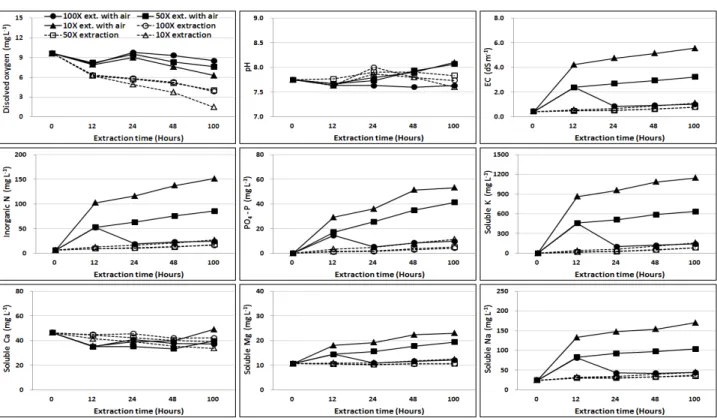
Fig. 1. Chemical characteristics of compost teas as the extraction ratio of poultry manure compost to water and aeration time.
재배에 사용된 퇴비차의 양분특성은 Table 3과 같으며, 관 수 및 관주량은 모든 처리구에서 수분장력 –33 kPa을 관수 시점으로 하여 동일량이 공급되도록 하였다. 2011년에는 배 추 포트재배시 주당 1회씩 총 7회 관수 (4.6ℓ관수 포트-1) 하였으며, 2012년에는 시설배추 정식후 퇴비차를 제조하여 주당 1회씩 총 9회 관수 (86.3톤 10a-1)하였다.
토양 및 식물체 분석은 농업과학기술원의 토양 및 식물 체 분석법 (NIAST, 2000)에 준하였으며, 토양은 표토 15 cm를 채취 후 풍건하여 2 mm 체를 통과시켜 분석하였다.
토양 pH와 EC는 5배량의 물로 추출하여 초자전극법에 의하 여 pH meter (ATI orion 370)와 EC meter (ATI orion 170)
로 각각 측정하였으며, 질소는 Kjeldahl 증류법, 유기물은 Tyurin법, 유효인산은 Lancaster법으로 분석하였다. 치환성 양이온은 1N-NH4OAC (pH 7.0) 완충용액으로 추출하여 ICP (GBC Integra XL, Australia)를 이용하여 분석하였다. 퇴비 와 식물체는 H2SO4-HClO4로 습식분해하여 질소는 Kjeldahl 법, 인산은 Vanadate법, K, Ca, Mg, Na는 ICP (GBC Integra XL, Australia)를 이용하여 분석하였다. 퇴비와 식물체의 유 기물 함량은 550°C 전기로에서 회화시켜 회화 전후의 감량 으로 계산하였으며, pH와 EC는 5배량의 물로 추출하여 초 자전극법으로 측정하였다. 생육 및 수량조사는 농업과학기 술 연구조사분석기준 (RDA, 2003)에 준하여 조사하였다.
Table 4. The change of microorganism of extracted compost teas in 24 hours.
Treatments Aerobic bacteria Fungi Actinomycetes
E.coli Samonella S.aureus (×107) (×102) (×105)
--- cfu mL-1 --- Aerobic poultry LC†
100x 5.6 0.3 1.9
ND‡ ND ND
50x 13.5 0.3 4.7
10x 74.0 0.7 33.1
Anaerobic poultry LC
100x 0.7 0.7 0.3
ND ND ND
50x 2.5 0.7 0.1
10x 0.6 1.8 5.7
Water 0.3 0 0.3 ND ND ND
†LC, Livestock waste compost.
‡ND, No Ditection.
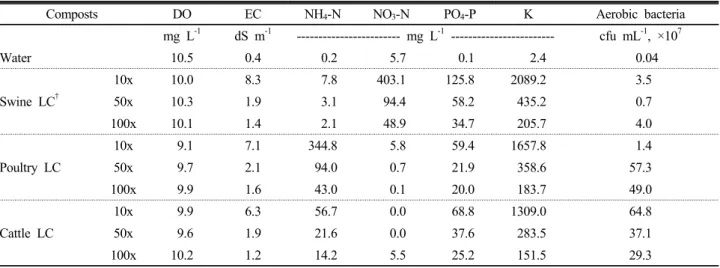
Table 5. Chemical and microbiological characteristics of compost teas as kind and extraction ratio of livestock waste compost.
Composts DO EC NH4-N NO3-N PO4-P K Aerobic bacteria mg L-1 dS m-1 --- mg L-1 --- cfu mL-1, ×107
Water 10.5 0.4 0.2 5.7 0.1 2.4 0.04
Swine LC†
10x 10.0 8.3 7.8 403.1 125.8 2089.2 3.5 50x 10.3 1.9 3.1 94.4 58.2 435.2 0.7 100x 10.1 1.4 2.1 48.9 34.7 205.7 4.0 Poultry LC
10x 9.1 7.1 344.8 5.8 59.4 1657.8 1.4 50x 9.7 2.1 94.0 0.7 21.9 358.6 57.3 100x 9.9 1.6 43.0 0.1 20.0 183.7 49.0 Cattle LC
10x 9.9 6.3 56.7 0.0 68.8 1309.0 64.8 50x 9.6 1.9 21.6 0.0 37.6 283.5 37.1 100x 10.2 1.2 14.2 5.5 25.2 151.5 29.3
†LC, Livestock waste compost.
Results and Discussion
계분퇴비차의 경시적 성분변화 계분퇴비를 원료로 퇴비차 제조시 성분변화는 Fig. 1에서 보는 바와 같이 용존 산소는 통기처리구에서 희석배율이 높을수록 높았으며 추 출 24시간을 최고점으로 하여 시간이 경과함에 따라 낮아지 는 경향이었다. 따라서 용존산소를 기준으로 할 때 24시간 추출이 적당할 것으로 판단되었다. 일반적으로 용존산소가 5.7 mg L-1 이하가 될 경우 혐기성균들의 활동이 시작되어 바람직하지 못한데 통기조건에서는 모든 처리에서 충분한 용존산소 농도를 보였다. 그러나 용존산소는 용액 온도와 밀접한 관계를 가지고 있기 때문에 온도별 변이에 대한 검 토가 추가로 필요하다. pH는 수용성 Ca 함량에 가장 큰 영 향을 받아 24시간 추출시 무통기 조건에서 높았으나 이 후 통기조건의 10배 및 50배액 추출에서 높아졌다. EC는 무기 태 질소, 인, 칼륨, 마그네슘, 나트륨과 동일한 경향으로서 통기조건의 10배, 50배액 12시간 추출에서 크게 높아진 이 후 완만한 증가세를 보였다. 따라서 양분 추출량을 기준할
때 통기조건에서 12시간 이상 추출하되 희석배율은 50배액 이하로 하는 것이 효율적임을 나타내고 있으며 이 같은 결 과는 미국 국가유기표준위원회 보고서 (National organic standards board, 2006)에서 지적한 바와 같이 일반적으로 퇴비차는 10~50배액으로 12~24시간 추출하여 사용한다는 내용과도 일치하는 결과로 판단된다.
추출방법에 따른 미생물상의 분포는 Table 4와 같이 추 출 24시간 후에 통기조건에서는 호기성세균과 방선균, 무통 기조건에서는 사상균이 많았다. 또한, 희석배수가 적을수록 밀도가 높아지는 경향을 보여 미생물 공급효과를 기대하기 위하여는 통기조건에서 적은 희석배율로 추출하는 것이 유 리할 것으로 판단되었다. 한편 인체에 유해한 대장균, 살모 넬라균, 포도상구균은 모든 처리에서 건조배지법으로 검출 되지 않았다.
가축분퇴비 및 질소원 종류별 퇴비차 성분변화 퇴 비차 제조시 24시간 통기조건에서 제조방법별 퇴비차 성분 변화를 살펴보면 Table 5와 같이 가축분퇴비 등 원료 투입
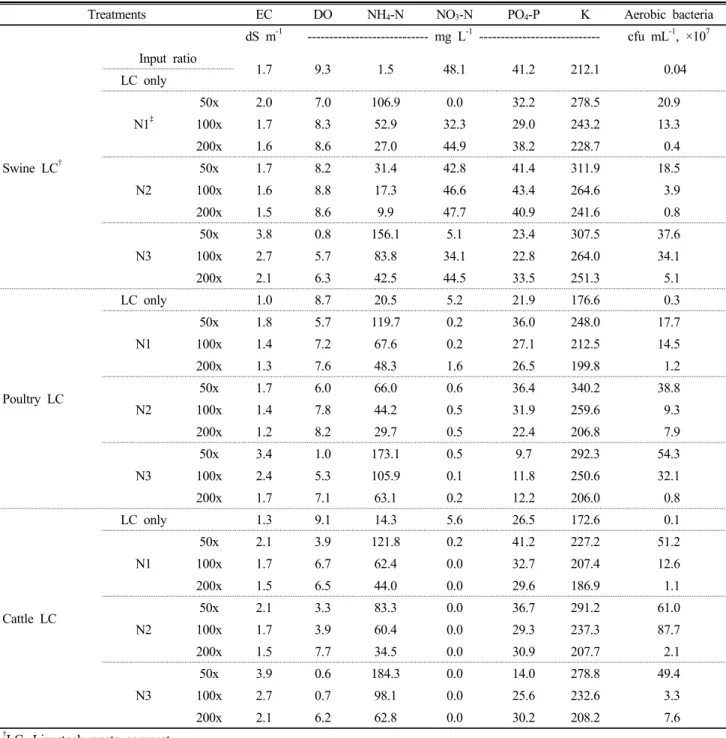
Table 6. Properties of livestock waste compost teas (100x) as input ratio of nitrogen sources.
Treatments EC DO NH4-N NO3-N PO4-P K Aerobic bacteria dS m-1 --- mg L-1 --- cfu mL-1, ×107
Swine LC†
Input ratio
1.7 9.3 1.5 48.1 41.2 212.1 0.04 LC only
N1‡
50x 2.0 7.0 106.9 0.0 32.2 278.5 20.9 100x 1.7 8.3 52.9 32.3 29.0 243.2 13.3
200x 1.6 8.6 27.0 44.9 38.2 228.7 0.4
N2
50x 1.7 8.2 31.4 42.8 41.4 311.9 18.5
100x 1.6 8.8 17.3 46.6 43.4 264.6 3.9
200x 1.5 8.6 9.9 47.7 40.9 241.6 0.8 N3
50x 3.8 0.8 156.1 5.1 23.4 307.5 37.6 100x 2.7 5.7 83.8 34.1 22.8 264.0 34.1
200x 2.1 6.3 42.5 44.5 33.5 251.3 5.1
Poultry LC
LC only 1.0 8.7 20.5 5.2 21.9 176.6 0.3
N1
50x 1.8 5.7 119.7 0.2 36.0 248.0 17.7
100x 1.4 7.2 67.6 0.2 27.1 212.5 14.5
200x 1.3 7.6 48.3 1.6 26.5 199.8 1.2
N2
50x 1.7 6.0 66.0 0.6 36.4 340.2 38.8
100x 1.4 7.8 44.2 0.5 31.9 259.6 9.3
200x 1.2 8.2 29.7 0.5 22.4 206.8 7.9
N3
50x 3.4 1.0 173.1 0.5 9.7 292.3 54.3 100x 2.4 5.3 105.9 0.1 11.8 250.6 32.1
200x 1.7 7.1 63.1 0.2 12.2 206.0 0.8
Cattle LC
LC only 1.3 9.1 14.3 5.6 26.5 172.6 0.1
N1
50x 2.1 3.9 121.8 0.2 41.2 227.2 51.2
100x 1.7 6.7 62.4 0.0 32.7 207.4 12.6
200x 1.5 6.5 44.0 0.0 29.6 186.9 1.1
N2
50x 2.1 3.3 83.3 0.0 36.7 291.2 61.0
100x 1.7 3.9 60.4 0.0 29.3 237.3 87.7
200x 1.5 7.7 34.5 0.0 30.9 207.7 2.1
N3
50x 3.9 0.6 184.3 0.0 14.0 278.8 49.4
100x 2.7 0.7 98.1 0.0 25.6 232.6 3.3
200x 2.1 6.2 62.8 0.0 30.2 208.2 7.6
†LC, Livestock waste compost.
‡N, Nitrogen source (N1: Oil cake, N2: Soybean cake, N3: Fishmeal).
비율이 높을수록 EC, 양분함량, 호기성세균수가 증가하였 고, 양분함량은 돈분 > 계분 > 우분 퇴비차 순이었고 호기성 세균은 반대 경향이었다.
퇴비차의 질소 성분을 증가시키기 위해 가축분퇴비 100 배액 기준량에 발효시킨 깻묵, 콩분, 어분을 각각 500, 100, 200배액 기준량으로 첨가하여 24시간 통기조건에서 추출한 후 퇴비차의 특성을 조사한 결과는 Table 6과 같다. 깻묵, 콩분, 어분 첨가비율을 높일수록 질소, 칼리 성분이 증가하 였으나 용존산소가 감소하는 것이 제한요인으로 나타났다.
따라서 가축분퇴비 100배액 기준량에 양분강화물질 첨가시
용존산소 5.7 mg L-1 이상 가능한 깻묵, 콩분, 어분의 첨가 가능배수는 돈분퇴비는 50, 50, 100배액, 계분퇴비는 50, 50, 200배액, 우분퇴비는 100, 200, 200배액으로 각각 나타 나 돈분퇴비가 비교적 안정적이었다. 특히 호기성세균은 깻 묵, 콩분, 어분 첨가에 의해 균수가 크게 증가하였고 균수는 돈분과 계분퇴비는 어분첨가시, 우분퇴비는 콩분 첨가시 증 가폭이 컸다. 상기 용존산소 조건을 충족하는 처리에서 퇴 비단용에 비해 돈분퇴비는 깻묵 (50배액) 523배, 콩분 (50 배액) 463배, 어분 (100배액) 853배 증가하였다. 계분퇴비 는 깻묵 (50배액) 59배, 콩분 (50배액) 129배, 어분 (200배
Table 7. The change of chemical properties in soil by chinese cabbage cultivation test in Plastic Film House.
Treatments pH EC OM NO3-N Avail.P2O5 K Ca Mg Na
(1:5) dS m-1 g kg-1 --- mg kg-1 --- --- cmolc kg-1 --- Before cultivation test 7.2 3.4 15 132.0 469 0.6 8.9 2.7 0.6
Fert. NPK§ 6.9 3.9 16 74.1 505 0.5 9.8 2.9 0.6
Swine LC† com. FG‡ 7.2 3.9 15 44.6 514 0.5 9.4 3.0 0.7
Swine LC+oil cake com. FG 7.1 3.3 16 56.3 561 0.6 9.4 2.9 0.7
†LC, Livestock waste compost.
‡Com. FG, compost tea fertigation.
§Fert. NPK, N, P2O5, K2O fertilization plot with chemical fertilizer by soil test recommendation.
Table 8. The change of microorganism in soil by chinese cabbage cultivation test in Plastic Film House.
Treatments
Aerobic bacteria (×107)
Fungi (×104)
Actino- mycetes
(×106) --- cfu mL-1 ---
Fert. NPK§ 3.9 5.7 3.1
Swine LC† com. FG‡ 4.3 6.4 4.7 Swine LC+oil cake com. FG 5.3 4.9 3.9
†LC, Livestock waste compost.
‡Com. FG, compost tea fertigation.
§Fert. NPK, N, P2O5, K2O fertilization plot with chemical fertilizer by soil test recommendation.
Table 9. The fresh yield of chinese cabbage in cultivation test.
Treatments Fresh yield (g plant-1) Pot Plastic film house
No treatment 53.9d -
Oil cake (100x) com. FG 125.4c - Fert. NPK§ 162.2bc 3,519 Swine LC† com. FG‡ 189.6b 3,390 Swine LC+oil cake com. FG 291.6a 3,524
†LC, Livestock waste compost.
‡Com. FG, compost tea fertigation.
§Fert. NPK, N, P2O5, K2O fertilization plot with chemical fertilizer by soil test recommendation.
액) 2.7배 증가하였다. 우분퇴비는 깻묵 (100배액) 140배, 콩분 (200배액) 23배, 어분 (200배액) 84배로 각각 증가하 였다. 따라서 호기성세균수에 용존산소량보다는 양분함량 의 영향이 많은 것으로 나타났다.
토양화학성 및 미생물상 배추를 하우스에서 재배한 후 토양화학성을 분석한 결과, 처리구별 유의성있는 차이는 나타나지 않았으나 돈분퇴비차 단독 처리구에 비해 질소원 으로 발효시킨 깻묵을 첨가한 퇴비차 처리구에서 질소, 인 산 함량이 높아지는 경향이었다 (Table 7). 처리구별 토양의 미생물상은 처리구별 유의성있는 차이는 나타나지 않았으 나 토양검정시비구에 비해 퇴비차 처리구에서 호기성세균 이 증가하는 경향이었다 (Table 8). 이는 호기적으로 퇴비차 를 제조하는 과정에서 작물 생물에 유용한 작용을 하는 미 생물들이 다량 배양되어 퇴비차 시용이 양분 공급뿐만 아니 라 유용한 미생물의 공급원으로도 작용할 수 있다는 것을 의미한다.
배추 생육 및 수량 배추 포트재배 처리별 배추 생육 및 수량은 Table 9와 같이 토양검정시비구에 비해 돈분 50 배액 퇴비차 처리구에서 배추 생육 및 수량이 비슷하게 나 타났으며 깻묵을 강화한 돈분퇴비차 처리구에서는 배추 생
체중이 80% 정도 증가하였다. 이는 돈분퇴비차 시용이 화 학비료를 대체할 수 있고 질소원으로 발효시킨 깻묵을 첨가 하면 배추 생육 및 수량을 증가시킨다는 것을 나타낸다.
비닐하우스 시설재배시험에서 정식후 퇴비차를 제조하여 주당 1회씩 총 9회 관수한 결과 돈분퇴비차 단독처리구에 비 해 질소원으로 깻묵을 혼합한 돈분퇴비차 처리구에서 토양 검정시비구와 배추의 생육과 생체중이 대등한 경향이었다.
Conclusion
돈분, 계분, 우분 톱밥발효퇴비를 이용한 퇴비차 제조 및 시용기술을 확립하여 유기농업 및 가축분뇨의 친환경 순환 이용 확대에 기여하고자 본 연구를 수행하였다. 계분퇴비차 제조시 물 희석배율을 10~100배로 할 경우 통기조건에서 100시간후까지 용존산소가 혐기미생물 생육조건인 5.7 mg L-1 이상 유지되었고 축분퇴비 투입비율이 높을수록 EC, 양분 함량, 미생물수가 증가하였으나 유해미생물은 검출되지 않 았다. 퇴비차 제조시 축분퇴비 및 질소원 등 원료 투입비율 이 높을수록 EC, 양분함량, 호기성세균수가 증가하였으나 용존산소가 적어지는 것이 제한요인으로 나타났다. 질소성 분을 높이기 위해 질소원으로 깻묵, 콩분, 어분을 사용하여 농도별 퇴비차 성분함량과 미생물상을 조사하여 퇴비차 제
조기술 확립시험을 수행하였고 배추에 대한 시용효과를 조 사한 결과 퇴비차 제조시 발효시킨 깻묵 첨가로 NH4-N, PO4-P, K 및 호기성세균이 증가하였다. 배추 포트재배 결 과 질소원으로 깻묵을 첨가한 퇴비차의 경우에는 토양검정 시비구에 비해 생체중이 80%까지 증가하였다. 배추 시설재 배에서도 배추 포트재배 결과와 같은 경향으로 돈분퇴비차 시용시 토양검정시비구와 생육 및 수량이 대등하였고 발효 시킨 깻묵을 첨가한 경우에는 생육과 수량이 더욱 증가하였 다. 시설배추 시험후 토양화학성은 처리구별 유의적인 차이 가 없었으나 토양미생물상을 분석한 결과 돈분퇴비차 시용 시 토양검정시비구에 비해 호기성세균이 증가하였다. 따라 서 퇴비차는 쉽게 제조하여 사용할 수 있고 고체 유기질비 료보다 속효성이라 사용범위가 넓으며 발효깻묵 강화 퇴비 차는 가축분 단용으로 제조한 퇴비차에 비해 질소성분과 작 물생육에 유익한 미생물을 풍부하게 강화시켜주는 장점을 가지고 있다. 가축분 퇴비차는 화학비료 절감 및 가축분뇨 의 친환경 순환이용 확대에도 기여하고 앞으로 유기농업이 나 도시농업 등에서 활용범위가 넓을 것으로 판단된다.
References
Bess, V.H., R.B.S. Manes, and J.L. Snodgrass. 2002. E. coli survival in compost tea using different nutrient substrates.
Proceedings 2002 International Symposium Composting and Compost Utilization, May 6-8, Columbus, Ohio.
Duffy, B., C. Sarreal, R. Subbarao, and L. Stanker. 2004. Effect of molasses on regrowth of E. coli O157:H7 and salmonella in compost teas. Compost Science and Utilization. 12(1):93-96.
Elad, Y., and D. Shtienberg. 1991. Effect of compost water extracts on grey mould (Botrytis cinetea). Crop protection. 13:109-114.
Guo, H. 2009. Study on Process Optimization for Brewing Compost Tea Made from Cow Manure. J. Anhui Agric. Sci. 37(8):
3613-3614.
Haggag, W.M. and M.S. Saber. 2007. Suppression of early blight on tomato and purple blight on onion by foliar sprays of aerated and non-aerated compost teas. J. Food Agric. Environ. 5:
302-309.
Ingham ER. 2002. The compost tea brewing manual. Soil Foodweb Incorporated, Corvallis, Oregon, USA.
Kang, C.S., A.S. Roh, S.K. Kim, and K.Y. Park. 2011. Effects of the Application of Livestock Manure Compost on Reducing
the Chemical Fertilizer Use for the Lettuce Cultivation in Green House. Korean J. Soil. Sci. Fert. 44(3):457-464.
Lee, J.T., I.J. Ha, J.S. Moon, and W.D. Song. 2007. Comparison of Liquefying Efficiency of Mixed Organic Fertilizer as Affected by Aeration Time and the Ratio of Organic Fertilizer to Water.
Korean J. Soil. Sci. Fert. 40(2):156-163.
National organic standards board. 2006. Crop committee recom- mendation for guidance. Use of compost, vermicompost, processed manure, and compost teas.
NIAST (National Institute of Agricultural Science and Technology).
2000. Analytical methods of soil and plant. RDA, Suwon, Korea.
NIAST. 2003. Investigation and standard for agriculture experiment.
RDA. Suwon, Korea.
NIAST. 2006. Fertilizer recommendation for crops. RDA, Suwon, Korea.
Radovich, T.J.K., and Hue N.V. 2012. Biochemical properties of compost tea associated with compost quality and effects on pak choi growth, Scientia horticulturae. 148:138-146.
Ryoo, J.W., D.C. Choi., and J.S. Lim. 2010. Effects of Compost teas on Growth Characteristics and Early Defoliation of Leaf in Ginseng. Korea Institute of Organic Agriculture Conference 143-152.
Ryoo, J.W. 2011. The Nutrients and Microbial Properties of Animal Manure and Spent Mushroom Compost Tea and the Effect of Growth of Lettuce (Lactuca sativa L.). Korean J.
Organic Agriculture. 19(4):589–602.
Ryoo, J.W., and D.C. Choi. 2011. The Investigation of Microbial population of compost teas. Korea Institute of Organic Agriculture Conference 129-129.
Scheuerell, S. and M. Walter. 2002. Compost teas: principles and prospects for plant disease control. Compost Sci. and Util.
10(4):313-338.
Scheuerell, S. 2002. Compost teas and compost amended container media for plant disease suppression. Dissertation. Oregon State University, Corvallis, Oregon.
St. Martin, C.C.G., Brathwaite, R.A.I. 2012. Compost and compost tea : Principles and prospects as substrates and soil-borne disease management strategies in soil-less vegetable production, Biological agriculture &horticulture : an international journal.
28(1):1-3, 144-8765.
Weltzien, H.C. 1991. Biocontrol of foliar fungal disesae with compost extracts, in: Andrews, J.H. and S.S. Hirano (eds.).
Microbial ecology of leaves. Springer-Verlag, New York. 430-450.