The Optimum of Respiratory Phase Using the Motion Range of the Diaphragm: Focus on Respiratory Gated Radiotherapy of Lung Cancer
Myoungju Kim*, Inchul Im**, Jaeseung Lee**, Suman Kang**
Department of Cancer for health promotion & Cancer prevention Center, Dongnam Inst. of Radiological & Medical Science*, Department of Radiological Science, Dongeui University**
횡격막의 움직임을 이용한 최적화된 호흡 위상의 선택: 폐암의 호 흡 동기 방사선치료 중심
김명주*, 임인철**, 이재승**, 강수만**
동남원자력의학원 건강증진센터*, 동의대학교 방사선학과**
Abstract
This study was to analyze quantitatively movement of planning target volume (PTV) and change of PTV volume through movement of diaphragm according to breathing phase. The purpose of present study was to investigate optimized respiration phase for radiation therapy of lung cancer. Simulated breathing training was performed in order to minimize systematic errors which is caused non-specific or irregular breathing. We performed 4-dimensional computed tomography (4DCTi) in accordance with each respiratory phase in the normalized respiratory gated radiation therapy procedures, then not only defined PTVi in 0 ~ 90%, 30 ~ 70%
and 40 ~ 60% in the reconstructed 4DCTi images but analyzed quantitatively movement and changes of volume in PTVi. As a results, average respiratory cycle was 3.4±0.5 seconds by simulated breathing training.
R2-value which is expressed as concordance between clinically induced expected value and actual measured value, was almost 1. There was a statistically significant. And also movement of PTVi according to each respiration phase 0 ~ 90%, 30 ~ 70% and 40 ~ 60% were 13.4±6.4mm, 6.1±2.9mm and 4.0±2.1mm respectively. Change of volume in PTVi of respiration phase 30 ~ 70% was decreased by 32.6±8.7% and 40
~ 60% was decreased by 41.6±6.2%. In conclusion, PTVi movement and volume change was reduced, when we apply a short breathing phase (40 ~ 60%: 30% duty cycle) range. Furthermore, PTVi margin considered respiration was not only within 4mm but able to get uniformity of dose.
Key Words : Respiratory phase, planning target volume (PTV), Internal target volume (ITV), Respiratory gated radiation therapy
요약
본 연구는 각 호흡 위상에 따른 계획용표적체적(planning target volume. PTV)의 움직임 및 체적(PTV volume)의 변화를 횡격막(diaphragm)의 움직임을 이용하여 정량적으로 분석함으로써 폐암의 호흡 동기 방사선치료를 위한 최적 화된 호흡 위상을 알아보고자 하였다. 비특이적 호흡이나 불규칙적인 호흡에 의한 체계적 오류(system error)를
Corresponding Author: Suman Kang E-mail:[email protected], Tel: +82-51-890-4230 Addr. 614-714, Dong-Eui University, 995 Eomgwang-no, Busanjin-gu, Busan, korea
Received : April, 05, 2013 Revised :April 18, 2013 Accepted : April 19, 2013
위상으로 재구성된 4DCTi 영상에서 PTV를 정의하고 PTVi의 움직임 및 체적의 변화를 정략적으로 분석하였다. 모의 호흡 훈련에 의한 평균 호흡 주기는 3.4±0.5초로 나타났으며 임상적으로 유도되는 예상 값과 실제 측정값의 일치 정 도를 나타내는 R-제곱 값은 1에 근접하여 유의하였다. 또한 각 호흡 위상 i에 따른 PTVi의 움직임은 0~90% 호흡 위 상의 경우 13.4±6.4mm, 30~70% 호흡 위상의 경우 6.1±2.9mm, 40~60% 호흡 위상의 경우 4.0±2.1mm 이었으며 PTVi의 체적 변화는 30~70% 호흡 위상의 경우 32.6±8.7%, 40~60% 호흡 위상의 경우 41.6±6.2% 감소되었다. 결 론적으로 짧은 호흡 위상(40~60%: 30% duty cycle) 폭을 적용하였을 때 PTV의 움직임 및 체적의 변화가 감소되어 호흡을 고려한 PTV 마진이 4mm 이내이면서 PTV 내 선량의 균일성을 얻을 수 있었다.
중심단어: 호흡 위상, 계획용표적체적, 내부표적체적, 호흡 동기 방사선치료
Ⅰ. 서론
폐암의 방사선치료는 호흡의 불균일성이나 기침 (cough), 한숨(sigh), 침 삼킴(swallow) 등의 비특이적 호 흡에 의하여 중대한 체계적 오류(system error)를 유발 할 수 있다. 방사선치료 과정에서 호흡에 의한 표적의 움직임은 불필요한 조사 범위가 증가되는 주된 원인 이 되거나 선량 예측 모델을 이용하여 수학적으로 계 산된 계획용표적체적(planning target volume. 이하 PTV) 의 처방선량(prescription dose)과 피폭된 흡수선량의 오 차를 유발할 수 있다[1-3]. 최근 종양의 움직임에 따른 임상적 오류를 개선하기 위한 다양한 방법들이 시도 되고 있으며 호흡에 따른 폐의 움직임을 정량적으로 평가할 수 있는 4차원 전산화단층촬영(4-dimensional computed tomography. 이하 4DCT) 기술이 도입되면서 호흡 위상(respiratory phase)에 따라 영상을 획득하고 폐암과 인접 장기들의 움직임을 고려한 4차원 방사선 치료(4-dimensional radiation therapy)가 시도되고 있다
[4-7].
호흡에 따른 표적의 움직임을 고려한 4차원 방사선 치료 기술은 종양의 움직임을 추적하여 방사선을 조 사하는 동적 병소 추적 방사선치료(dynamic tumor tracking radiation therapy), 환자의 호흡을 인위적으로 조절하여 방사선을 조사하는 호흡 조절 방사선치료 (breath-holding radiation therapy), 그리고 자유 호흡 (free-breathing) 상태에서 호흡 동기 폭(gating width)에 따라 안정된 호흡 주기에서 방사선을 조사하는 호흡
동기 방사선치료(respiratory gated radiation therapy) 등이 있다. 여기서 호흡을 인위적으로 조절하는 방법은 복 합적 합병증이 동반되어 전신 건강 상태가 양호하지 않은 폐암 환자에게 많은 부담을 줄 수 있기 때문에 광범위하게 적용하기 어려운 문제점을 가지고 있다[8]. 이와 비교하여 호흡 동기 방사선치료는 자유 호흡 상 태에서 호흡 동기 폭에 따라 안전하게 PTV를 감소시 킬 수 있고 전체 호흡 주기 중 안정된 주기에서 방사 선을 조사함으로써 폐암에 집중시키면서 주변 인접 장기의 방사선량을 감소시킬 수 있기 때문에 향후 폐 암의 방사선치료 방법으로 유용하게 적용될 수 있는 기술이라 할 수 있다.
호흡 동기 방사선치료는 호흡에 따른 표적의 움직 임과 연관된 방사선 속의 동기화를 위하여 표적 또는 주변 인접 장의 움직임을 실시간으로 관찰할 수 있는 장비가 부가적으로 필요하며 다양한 방법이 개발되어 사용되고 있다[9]. 특히 카메라에 장착된 LED(light emitting diode) 광원에서 방출된 적외선을 환자의 복부 에 위치시킨 표식자(fiducial marker)의 두 점에서 반사 시키고 이 때 반사되는 적외선을 전자 결합 소자 (charge coupled device. CCD) 카메라를 이용하여 표식 자의 위치를 실시간 측정함으로써 환자의 호흡 주기 를 측정하는 RPM(real-time position management) 시스템 이 보편적으로 사용하고 있다. 그러나 안정된 호흡 주 기 신호를 획득할 수 있다 할지라도 호흡 동기 방사선 치료에서 최적화된 호흡 위상(respiratory phase)을 선택 하기 위하여 국제방사선단위측정위원회(International Commission on Radiation Units and Measurements. 이하
“Journal of the Korean Society of Radiology, Volume 7, Number 2”
ICRU)는 호흡 위상에 따른 표적 및 주변 장기의 움직 임을 모두 고려된 내부표적체적(internal target volume.
이하 ITV)을 호흡 위상에 따라 결정함으로써 PTV가 방사선치료 범위를 벗어나지 않도록 권고하고 있다
[10-11].
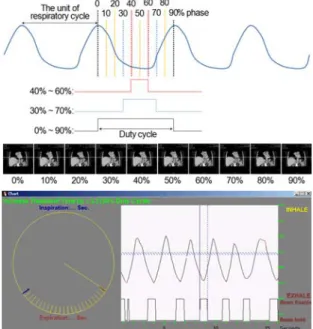
따라서 본 연구는 정규화된 폐암의 호흡 동기 방사 선치료 절차에 따라 자유 호흡(free-breathing) 상태에서 4DCT를 시행하고 단위 호흡 주기(respiratory cycle)를 10개의 호흡 위상(i=0~90%)으로 구분하고 0~90%, 30~70%, 40~60%의 호흡 위상에 대하여 4DCTi 영상을 재구성함으로써 각 호흡 위상 i 에 따른 PTV의 변화를 횡격막의 움직임을 이용하여 알아보고자 하였으며 이 를 정량적으로 분석함으로써 폐암의 호흡 동기 방사 선치료에서 최적화된 호흡 위상을 알아보고자 하였다.
II. 대상 및 방법
1. 대상 및 4DCT 영상 획득
본 연구는 2012년 03월부터 12월까지 방사선종양학 과를 내원하여 방사선치료를 시행한 폐암 환자 42명을 편의 추출하였다. 대상자의 선정 기준은 질환의 일관 성을 유지하기 위하여 가슴 통증, 기침, 호흡 곤란 등 의 호흡 패턴이 유사한 비소세포성 폐암(non-small cell lung cancer. NSCLC) 환자를 대상으로 하였으며 소세포 성 폐암(small cell lung cancer. SCLC) 환자는 대상에서 제외하였다.
Fig. 1은 자유 호흡 상태에서 환자의 비특이성 호흡 이나 불규칙적인 호흡에 의한 체계적 오류(system error)를 최소화하기 위하여 본 연구에 사용된 호흡 동 기 방사선치료 절차를 보여준다. 본 연구를 위하여 감 정의 변화, 스트레스 정신 및 육체적 불안에 의한 호 흡의 변화를 가능한 조절하면서 성인의 정상 호흡수 를 유도할 수 있도록 모의 호흡 훈련 과정이 기술된 동의서를 설계(design)하였으며 4DCT를 시행하기 전 환자에게 이를 설명하고 동의서에 서명하도록 하였다.
본 연구를 위하여 방사선치료 전용 4DCT 모의치료 기(Lightspeed RT, GE Healthcare, USA)를 사용하였으며 관전압 120kV, 절편 두께(slice thickness) 2.5mm, 관전류 자동 노출 조절(automatic exposure control. AEC)의 촬
영 조건을 사용하여 화소 크기 0.84mm, 해상도 512×512matrix의 4DCT 영상을 획득하였다. 이 때 환자 의 호흡 신호를 획득하기 위하여 RPM gating 시스템 (real-time position managementTM, Varian medical system, USA)을 사용하였다. 4DCT 모의치료기에서 획득한 영 상과 RPM gating 시스템에서 얻은 호흡 신호는 의료영 상전송시스템(digital imaging and communication in medicine. DICOM)을 이용하여 4DCT 영상 분석이 가 능한 워크스테이션(Advantage 4D, GE healthcare, USA) 으로 전송하였다.
Fig. 1. Clinical process for respiratory-gated radiation therapy using in this study.
2. 호흡 위상의 선택 및 PTV의 설정
Fig. 2는 환자의 안정된 단위 호흡 주기에서 정의되 는 10개의 호흡 위상과 각 호흡 위상 i 에 따라 재구성 된 0~90%, 30~70%, 40~60% 호흡 위상을 보여준다. 단 위 호흡 주기를 10개의 호흡 위상으로 구분하여 0~90% 호흡 위상(4DCT0%+10%+…+90%), 30~70% 호 흡 위상(4DCT30%+40%+…+70%), 그리고 40~60% 호 흡 위상(4DCT40%+50%+60%)에 대하여 최대강도 투 사기법(maximum intensity projection. MIP) 기법으로 4DCTi 영상을 각각 재구성하였다.
각 호흡 위상 i 에서 재구성된 4DCTi 영상들은 치료 계획시스템(treatment planning system. 이하 TPS, EclipseTM, Varian medical system, USA)에서 PBC(pencil
법(modified Batho's power law. MBPL)를 적용하여 치료 계획을 수립하였다. 호흡에 의한 폐암의 움직임을 모 두 고려한 PTV를 설정하기 위하여 4DCTi 영상에서 임상표적체적(clinical target volume. CTVi)과 ITVi를 설 정하고 최종적인 PTVi를 정의하였다.
Fig. 2. Illustrated a division respiratory-cycles and 0 ~ 90%, 30 ~ 70%, and 40 ~ 60% respiratory phases.
3. 횡격막의 움직임을 이용한 PTV 분석
각 호흡 위상 i 에 따라 재구성된 4DCTi 영상에 대 하여 횡격막(diaphragm)의 움직임과 TPS에서 ITVi를 설 정하여 최종적으로 정의된 PTVi의 움직임과 체적(PTV volume)의 변화를 비교하여 분석하였다. 흉부와 복부 를 나누는 근육으로 된 횡격막은 숨을 들이 마실 때 아래로 내려가고 숨을 내쉴 때 위로 올라가는 움직임 을 통해 호흡 운동을 보조하기 때문에 본 연구에서는 움직이지 않고 고정되어 있는 흉추를 기준으로 하여 재구성된 호흡 위상 i 에서 횡격막의 움직임을 측정하 였다(Fig. 3).
또한 Fig. 4는 TPS에서 각 호흡 위상 i 에 따라 정의 된 PTVi의 체적을 보여준다. ICRU에서 제안하는 방법
PTVi를 최종적으로 정의하였으며 체적은 TPS에서 지 시하는 값으로 하였다.
Fig. 3. Measured the diaphragm motion and recording value at the respiratory phase, respectively.
Fig. 4. Showed the definition of planning target volume (PTV) according to the respiratory phase in treatment planning
system.
III. 결과
Table 1은 정규화된 호흡 동기 방사선치료 절차에 따른 폐암 환자의 호흡 주기와 추가적으로 일정한 값 을 유도하기 위한 로그형 추세선(log type trend line)을 보여준다. 모의 호흡 훈련 절차를 시행하였을 때 최대 호흡 주기는 8.5초에서 3.6초 사이에서 분포하였으며 임상적으로 적용하기 위한 로그형 추세선을 그렸을 때 추세선의 예상 값이 실제 측정값과 일치하는 정도 를 나타내는 R-제곱 값은 0.8462로 그 값이 1에 근접하 기 때문에 유의하였다. 최소 호흡 주기는 2.9초에서 0.8 초 사이에서 분포하였으며 R-제곱 값은 0.6496으로 실
“Journal of the Korean Society of Radiology, Volume 7, Number 2”
제 측정값과는 유의하지 않았다. 그리고 폐암 환자의 평균 호흡 주기는 3.4±0.5초로 나타났으며 R-제곱 값 은 0.8405로 유의한 결과를 나타내었다.
Table 2는 각 호흡 위상 i 에 따라 재구성된 4DCTi
영상에서 횡격막의 움직임을 이용하여 PTVi와 환자의 복부에 위치시킨 표식자(fiducial marker)의 움직임을 보 여준다. 표식자의 움직임은 5mm 내지 19.5mm에서 상 하(superior-inferior. SI) 방향으로 분포하였으며 평균 10.4±5.4mm의 움직임이 있었다. 각 호흡 위상 i 에 따 른 PTVi의 움직임은 0~90% 호흡 위상의 경우 최대 22.8mm, 평균 13.4±6.4mm 이었다. 이와 비교하여 일정 한 호흡 위상 구간에서 방사선을 조사하는 30~70% 호 흡 위상과 40~60% 호흡 위상의 경우 평균 6.1±2.9mm, 4.0±2.1mm 이었다. 짧은 호흡 위상 폭을 사용할수록 PTVi의 움직임이 감소함을 알 수 있었으며 40~60% 호 흡 위상을 적용할 경우 4mm 이내에서 호흡에 의한 폐 암의 움직임을 모두 고려한 PTVi를 설정할 수 있었다.
Table 3은 각 호흡 위상 i 에 따라 재구성된 4DCTi
영상에서 TPS를 이용하여 3차원 윤곽선 자동 기법 (3-dimensional auto-contouring tools)으로 PTV를 체적화 (volume rendering)시킨 결과와 0~90% 호흡 위상에서 정의한 PTV0-90%의 체적에 대하여 30~70% 호흡 위상 과 40~60% 호흡 위상에서 정의한 PTV30-70%, PTV40-60%
의 체적의 비를 보여준다. 각 호흡 위상에 따라 계획 용표적체적의 체적은 5.9cm3에서 103.3cm3까지 분포되 어 있었다. PTV0-90%에서 PTV가 가장 크게 나타났으며 30~70% 호흡 위상에 대한 체적 비(PTV30-70%/PTV0-90%) 는 32.6±8.7%, 40~60% 호흡 위상에 대한 체적 비 (PTV40-60%/PTV0-90%)는 41.6±6.2%의 감소를 보였다.
Respiratory cycle (sec)
log type trend line
Dmax Dmin Davg.
Y-log (Y=aln(x)+b)
R2-value
a b
Maximum 8.5 3.6 4.9 1.204 1.896 0.8462
Minimum 2.9 0.8 2.6 0.950 0.201 0.6496
Mean±SD 4.7±1.3 2.3±1.0 3.4±0.5 0.562 2.029 0.8405 Dmax,Dmin,and Davg.; maximum, minimum, and average of distribution for respiratory cycles, SD; standard deviation.
R2-values were statistically significant in close vicinity to 1.
Table 1. Result of measured respiratory cycle times and log type trend line from the free-breathing.
Marker motion range
(mm)
PTV motion range (mm) 0 - 90%
phase
30 - 70%
phase
40 - 60%
phase
Maximum 19.5 22.8 13.9 8.0
Minimum 5.0 1.6 1.1 1.2
Mean±SD 10.4±5.4 13.4±6.4 6.1±2.9 4.0±2.1
Table 2. Result of planing target volume (PTV) and marker motion range according to the respiratory phase in coronal plane reconstructed 4DCT images.
Measured PTV (cm3)
Volume rate (%)
PTV0-90% PTV30-70% PTV40-60% PTV30-70%
PTV0-90%
PTV40-60%
PTV0-90%
Maximum 103.3 58.4 44.6 64.1 72.4
Minimum 19.8 12.2 5.9 33.9 28.9
Mean±SD 63.9±18.3 46.7±15.1 39.4±11.7 32.6±8.7 41.6±6.2 Table 3. Comparison of variation in the planing target volume (PTV) according to the respiratory phase.
IV. 고찰
폐암은 주변 발암 물질에 의해 폐내 세포가 비정상 적으로 성장하면서 종괴(덩어리)를 형성하기 때문에 호흡에 따른 폐암의 움직임은 특이적인 양상을 보이 며 불필요한 조사 범위가 증가되는 주된 원인이 된다.
최근 4차원 전산화치료계획 시스템이 도입되면서 폐 암의 움직임에 관한 연구들이 활발하게 진행되고 있 으며 특히 환자의 비특이적 호흡이나 불규칙적인 호 흡에 의한 체계적 오류(system error)를 최소화하려는 방안들이 시도되고 있다[12-13]. 본 연구에서 정규화된 모의 호흡 훈련 절차를 시행하였을 때 환자의 평균 호 흡 주기는 약 3.5초 정도였으며 대상 환자 이외의 임상 적으로 변동률을 추정하기 위하여 사용한 로그형 추 세선을 분석한 결과 실제 측정값과 일치하는 정도를 나타내는 R-제곱 값이 1에 근접하여 유의하다고 판단 하였으며 모의 호흡 훈련 절차는 다른 환자에게 임상 적으로 적용할 수 있을 것으로 판단되었다. 이 결과로 부터 정규화된 모의 호흡 훈련 절차는 환자로부터 감 정의 변화 및 스트레스, 정신 및 육체적 불안을 해소 함으로써 비특이적 호흡 또는 불규칙적인 호흡을 최
호흡 동기 방사선치료에서 PTV의 마진(margin)을 설정하는데 있어 ICRU는 보고서 62를 출간하면서 호 흡 위상에 따른 표적 및 주변 장기의 움직임을 모두 고려한 ITV를 호흡 위상에 따라 결정하고 PTV가 방사 선치료 범위를 벗어나지 않도록 권고하고 있다[11]. 이 와 관련하여 Jiang[14]은 4차원 전산화치료계획에서 환 자의 호흡 신호 특성에 따른 호흡 동기 방사선치료의 기술적 문제를 제안하였으며 Liu 등[15]은 호흡에 따른 폐암의 움직임은 상하(superior-inferior. SI) 방향의 움직 임이 크고 1cm 이상으로 보고하고 있다. 본 연구는 각 호흡 위상 i 에 따라 재구성된 4DCTi 영상에서 횡격막 의 움직임을 이용하여 PTVi의 움직임과 체적의 변화 를 측정하였다. 각 호흡 위상 i 에 따른 폐암의 움직임 은 전체 호흡 주기에서 방사선을 조사하는 0~90% 호 흡 위상과 비교하여 30~70% 호흡 위상의 경우 약 50%, 40~60% 호흡 위상의 경우 약 70% 정도 움직임 이 감소되는 것을 알 수 있었다. 이 결과는 ICRU[11]와 van Herk 등[16-17]이 제안하는 움직임을 고려한 PTVi의 마진 설정 방법으로 적용할 때 4mm 이내에서 호흡에 의한 폐암의 움직임을 모두 고려할 수 있었다. 또한 각 호흡 위상 i 에 따른 PTVi의 체적 변화는 0~90% 호 흡 위상에서 정의한 PTV0-90%와 비교하여 30~70% 호 흡 위상과 40~60% 호흡 위상에서 정의한 PTV30-70%과
PTV40-60%의 변화는 32.6±8.7%, 41.6±6.2%의 감소를 보
여 Allen 등[18-19]의 연구와 일치하였다.
따라서 본 연구를 통해 폐암의 호흡 동기 방사선치 료는 호흡에 따른 움직임이 모두 고려된 ITV를 호흡 위상에 따라 결정함으로써 PTV를 정의할 수 있었다.
또한 모의 호흡 훈련을 치료 전 시행함으로써 불규칙 적인 호흡에 의한 방사선치료의 체계적 오류를 최소 화할 수 있었으며 특히 일정한 호흡 위상 구간에서 방 사선을 조사하는 호흡 동기 방사선치료라 할지라도 30~70% 호흡 위상(50% duty cycle)을 사용하는 것 보다 40~60% 호흡 위상(30% duty cycle)을 적용하였을 때 PTV의 움직임 및 체적을 감소시킴으로써 호흡을 고려 한 PTV의 마진(margin)을 4mm 이내로 제할 수 있었고 폐의 방사선 장해를 유발할 수 있는 확률이 감소하면 서 국소적 방사선 허용량을 극대화할 수 있었다.
V. 결론
방사선치료의 궁극적인 목적은 종양을 95% 제어할 수 있는 선량(tumor control dose. TCD95%)을 조사하기 위하여 PTV 내 선량의 균일성을 얻으면서 주변 정상 조직의 방사선 피폭을 최소화하는 것이라 할 수 있다.
폐암은 방사선 감수성이 높은 결정 장기가 인접해 있 기 때문에 호흡에 의한 폐암의 움직임을 최소화하고 위치 및 크기를 정확하게 파악 할 수 있다면 호흡 동 기 방사선치료는 근치 목적 조사가 가능한 치료 방법 이라 생각된다. 폐암의 호흡 동기 방사선치료에 최적 화된 호흡 위상은 40~60% 호흡 위상(30% duty cycle)이 었으며 호흡을 고려한 마진이 4mm 이내이면서 PTV 내 선량의 균일성을 얻을 수 있었다. 그러나 짧은 호 흡 위상의 적용에 따른 방사선치료 시간이 수분 증가 되는 단점은 본 연구의 한계점이라 판단되었으며 임 상적 환경이 허락하는 한도에서 단위 시간당 방사선 량을 의미하는 선량률(dose rate)을 증가시킬 때 한계점 은 다소 감소될 것으로 판단하였다.
참고문헌
[1] A. Sola, E. Martínez-López, M. Rico, et. al., "Radiotherapy of mobile tumors", An. Sist. Sanit. Navar., Vol.32, No.2, pp.39-49, 2009.
[2] T. Roland, R. Hales, T. McNutt, et. al., "A method for deriving a 4D-interpolated balanced planning target for mobile tumor radiotherapy", Med. Phys., Vol.39, No.1, pp.195-205, 2012.
[3] E. W. Pepin, H. Wu, Y. Zhang, et. al., "Correlation and prediction uncertainties in the cyberknife synchrony respiratory tracking system", Med. Phys., Vol.38, No.7, pp.4036-4044, 2011.
[4] M. Falk, P. Munck af Rosenschöld, P. Keall, et. al., "Real-time dynamic MLC tracking for inversely optimized arc
radiotherapy", Radiother. Oncol., Vol.94, No.2, pp.218-223, 2010.
[5] H. Shirato, R. Onimaru, M. Ishikawa, et. al., "Real-time 4-D radiotherapy for lung cancer", Cancer Sci., Vol.103, No.1, pp.1-6, 2012.
[6] H. Onishi, K. Kuriyama, T. Komiyama, et. al., "A new irradiation system for lung cancer combining linear accelerator, computed tomography, patient self-breath-holding, and patient-directed beam-control without respiratory monitoring
“Journal of the Korean Society of Radiology, Volume 7, Number 2”
devices", Int. J. Radiat. Oncol. Biol. Phys., Vol.56, No.1, pp.14-20, 2003.
[7] P. Giraud, E. Morvan, L. Claude, et. al., "Respiratory gating techniques for optimization of lung cancer radiotherapy", J.
Thorac. Oncol., Vol.6, No.12, pp.2058-2068, 2011.
[8] J. Hanley, M. M. Debois, D. Mah, et. al., "Deep inspiration breath-hold technique for lung tumors: the potential value of target immobilization and reduced lung density in dose escalation", Int. J. Radiat. Oncol. Biol. Phys., Vol.45, No.3, pp.603-611, 1999.
[9] D. P. Gierga, J. Brewer, G. C. Sharp, et. al., "The correlation between internal and external markers for abdominal tumors:
implications for respiratory gating", Int. J. Radiat. Oncol. Biol.
Phys., Vol.16, No.5, pp.1551-1558, 2005.
[10] E. Heath, J. Unkelbach, U. Oelfke., "Incorporating uncertainties in respiratory motion into 4D treatment plan optimization", Med.
Phys., Vol.36, No.7, pp. 3059-3071, 2009.
[11] ICRU report No. 62, "Prescribing recording, and reporting photon beam therapy", International commission on Radiation Unit and Measuremnet, Bethesda, 1999.
[12] A. Hertanto, Q. Zhang, Y. C. Hu, et. al., "Reduction of irregular breathing artifacts in respiration-correlated CT images using a respiratory motion model", Med. Phys., Vol.39, No.6, pp.3070-3079, 2012.
[13] J. W Wong, M. B. Sharpe, D. A. Jaffray, et. al. "The use of active breathing control (ABC) to reduce margin for breathing motion", Int. J. Radiat. Oncol. Biol. Phys., Vol.44, No.4, pp.911-919, 1999.
[14] S. B. Jiang, "Radiotherapy of mobile tumor", Semin. Radiat.
Oncol., Vol.16, No.4, pp.:239-248, 2006.
[15] H. H. Liu, P. Balter, T. Tutt, et. al. "Assessing
respiration-induced tumor motion and internal target volume using four-dimensional computed tomography for radiotherapy of lung cancer", Int. J. Radiat. Oncol. Biol. Phys., Vol.68, No.2, pp.531-540, 2007.
[16] M. van Herk, P. Remeijer, C. Rasch, et. al., "The probability of correct target dosage: dose-population histograms for deriving treatment margins in radiotherapy", Int. J. Radiat. Oncol. Biol.
Phys., Vol.47, No.4, pp.1121-1135, 2000.
[17] J. C. Stroom, B. J. Heijmen, "Geometrical uncertainties, radiotherapy planning margins, and the ICRU-62 report", Radiother. Oncol., Vol.64, No.1, pp.75-83, 2002.
[18] A. M. Allen, K. M. Siracuse, J. A. Hayman, et. al., "Evaluation of the influence of breathing on the movement and modeling of
lung tumors", Int. J. Radiat. Oncol. Biol. Phys., Vol.58, No.4, pp.1251-1257, 2004.
[19] J. R. van Sörnsen de Koste, F. J. Lagerwaard, R. H.
Schuchhard-Schipper, et. al., "Dosimetric consequences of tumor mobility in radiotherapy of stage I non-small cell lung cancer--an analysis of data generated using 'slow' CT scans", Radiother. Oncol., Vol.61, No.1, pp. 93-99, 2001.