1. INTRODUCTION
Over recent decades, image enhancement has become an important research field for improving the quality of images. It focuses on processing an image to bring out important hidden features.
Generally, medical microscopy and real-world im- ages often suffer from poor contrast or lack of de- tail [1-4]. Thus, image-enhancement techniques are used to manipulate the original images to ob- tain better results for further image processing and analysis.
Recently, many different techniques have been used. Histogram equalization (HE) is a well- known contrast-enhancement technique, because of its strong performance for almost all types of image [5-13]. A homomorphic filtering algorithm is used to provide enhancement in an image by de-
emphasizing the illumination effect and emphasiz- ing higher frequencies of the image; it can be ap- plied by setting apart these two elements of the image [14]. The unsharp masking algorithm is used to sharpen an image by adding a mask to the origi- nal image. The mask is obtained by subtracting the blurred image from its original. However, this cre- ates a halo effect, which is caused by under- and over-enhancement. Thus, a modified unsharp masking method was proposed [15]; it overcame this drawback using an edge-preserving filter and adding a rescaling process.
The retinex theory assumes that image intensity is the product of illumination and reflectance [16].
This theory has been used in many fields, such as aerospace, safety and security, consumer imagery, science and technology, medical purposes, and even in forensics. New algorithms based on retinex
Color Image Enhancement Using a Retinex Algorithm with Bilateral Filtering for Images with Poor Illumination
Agustien Mulyantini
†, Heung-Kook Choi
††ABSTRACT
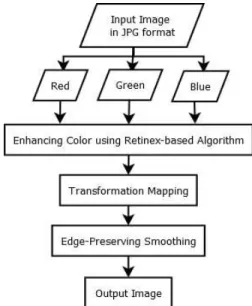
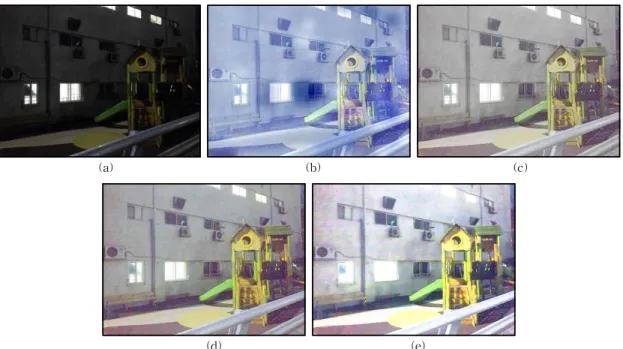
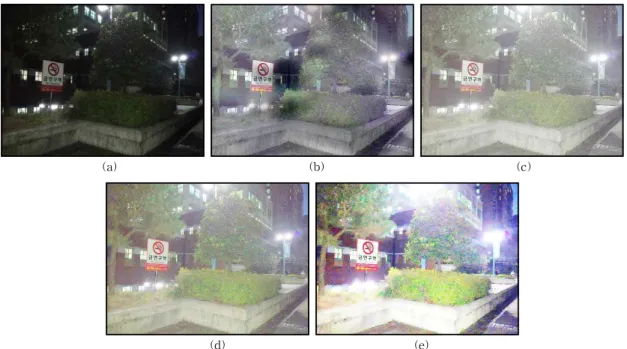
Color enhancement basically deals with color manipulation in digital images. Recently, the technique has become widely used as a result of the increasing use of digital cameras. Retinex-based color- enhancement algorithms are a popular technique. In this paper, retinex with bilateral filtering is proposed to improve the quality of poorly illuminated images. Generally, it consists of three main steps: first, a retinex-based algorithm with color restoration; second, transformation mapping using histogram matching; and finally, smoothing the image using a bilateral filter. The experimental results demonstrate that the proposed method can successfully enhance image contrast while avoiding the halo effect and maintaining the color distribution in the image.
Key words: Color, Image Enhancement, Retinex Algorithm, Poor Illumination.
※ Corresponding Author : Heung-Kook Choi, Address:
(50834) Injero 197, Gimhae, Gyeongnam, Korea, TEL : +82-55-320-3437, FAX : +82-55-322-3107, E-mail : cschk
@inje.ac.kr
Receipt date : Dec. 20, 2015, Revision date : Jan. 28, 2016 Approval date : Jan. 30, 2016
††
Dept. of Health and Science Technology, Inje Univer- sity, Korea, (E-mail : [email protected])
††