1. INTRODUCTION
Recent years, three dimension (3D) printing is widely used in many areas of life as healthcare, industry, automotive and many sectors [1, 2]. Due to the fact that the benefits of 3D printing is enor- mous in all domain and the price of a 3D printer is not expensive so the individual user can buy a 3D printer and download 3D models on Internet to print out real objects without any permission from the original providers. Moreover, some special models and anti-weapon models must be secured from un-authorized users. Thus 3D printing data should be encrypted before being stored and trans-
mitted in order to ensure the access and to prevent illegal copying.
For meeting to issues above, we would like to propose an effective encryption algorithm in the frequency domain of discrete cosine transform for 3D printing models in this paper. The data format of 3D printing is the 3D triangle mesh. The main content of the proposed algorithm is to extract fac- ets from 3D triangle mesh and three vertices of each facet is used to construct a three by three (3×3) dimensional matrix. The proposed algorithm is based on encrypting the DC coefficients of the constructed matrixes in the frequency domain of discrete cosine transformation (DCT) [3] in order
An Effective Encryption Algorithm for 3D Printing Model Based on Discrete Cosine Transform
Ngoc-Giao Pham
†, Kwnag-Seok Moon
††, Suk-Hwan Lee
†††, Ki-Ryong Kwon
††††ABSTRACT
In this paper, we present an effective encryption algorithm for 3D printing models in the frequency domain of discrete cosine transform to prevent illegal copying, access in the secured storage and transmission. Facet data of 3D printing model is extracted to construct a three by three matrix that is then transformed to the frequency domain of discrete cosine transform. The proposed algorithm is based on encrypting the DC coefficients of matrixes of facets in the frequency domain of discrete cosine transform in order to generate the encrypted 3D printing model. Experimental results verified that the proposed algorithm is very effective for 3D printing models. The entire 3D printing model is altered after the encryption process. The proposed algorithm is provide a better method and more security than previous methods.
Key words: 3D Printing Data, 3D Printing Security, Selective Encryption, DCT.
※ Corresponding Author : Ki-Ryong Kwon, Address:
(608-737) 45 Yongso-ro, Nam-gu, Busan, Pukyong National University, Daeyon campus, #A12, No. 1315, TEL : +82-51-629-6257, FAX : +82-51-629-6230, E-mail : [email protected]
Receipt date : Nov. 15, 2017, Revision date : Dec. 15, 2017 Approval date : Jan. 5, 2018
††
Dept. of IT Convergence and Application Engineering, Pukyong National University
(E-mail : [email protected])
††
Dept. of Electronics Engineering, Pukyong National University
(E-mail : [email protected])
††††
Dept. of Information Security, Tongmyong University (E-mail : [email protected])
††††
Dept. of IT Convergence and Application Engineering, Pukyong National University
※ This research was supported by Basic Science
Research Program through the National Research Foun-
dation of Korea (NRF) funded by the Ministry of Educa-
tion, Science and Technology (NRF-NRF-2016R1D1A3B
03931003 and NRF-2017R1A2B2012456), Institute for
Information & communications Technology Promotion
(IITP) grant funded by the Korea government (MSIT)
(No.2015-0-00225), and also supported by Brain Busan
(BB21) project.
to generate the encrypted 3D triangle mesh. To clarify the proposed algorithm, we organize our pa- per as follow. In Sec. 2, we look into previous en- cryption techniques for 3D models and explain the relation of 3D triangle mesh to the proposed algorithm. In Sec. 3, we show the proposed algo- rithm in detail. Experimental results and the evalu- ation of proposed algorithm will be shown in Sec.
4. Sec. 5 shows the conclusion.
2. RELATED WORKS 2.1 3D Model Security
In fact, the watermarking schemes for 3D con- tent, 3D model [4, 5] are not suitable for the secured storage and transmission. Because the water- marking techniques do not alter the content of 3D printing models. They only embeds watermark da- ta into 3D printing models, and anybody can see the content of 3D printing models and design them again for printing. So, they could be not applied to the secured storage and transmission for 3D printing models.
There are some proposed techniques for secret sharing the content of 3D models or 3D CAD model encryption. E. Marc et al. [6] proposed a method to encrypt 3D objects based on geometry preserv- ing. This algorithm introduces a geometry pre- serving protection paradigm that heavily distorts 3D objects while preserving some intrinsic geo- metrical property (e.g. the bounding box or the convex hull), thereby avoiding a global corruption of the whole 3D scene. However, the key idea of
this method only permute some facets of a 3D object. It did not alter the entire content of a 3D object and it is not effective to the various formats of 3D printing data. Moreover, reconstruction can- not fully restore the encrypted 3D objects and the security of this method is very low. X.T. Cai et al. [7–9] proposed an encryption approach for CAD models, which is based on geometric trans- formation encryption mechanisms of features of CAD models. The key content of this approach is centered on an Enhanced Encryption Transforma- tion Matrix, which is characterized parametric, randomized and self-adaptive for feature encryp- tion. This method only changes a little the shape of 3D CAD models. Consequently, the previous proposed methods cannot response to the secured storage and transmission for 3D printing model.
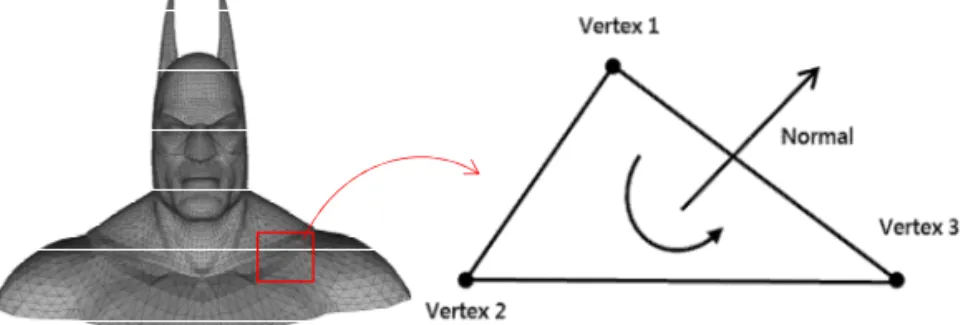
2.2 3D Triangle Mesh Based Encryption Currently, 3D printing technology often uses 3D triangle mesh [10, 11] to print real objects. A 3D triangle mesh is a set of facets. Each facet contains three vertices (a triangle) and a normal vector (see Fig. 1). Each vertex is presented by three coor- dinates x, y and z. Triangles are connected togeth- er to form a 3D triangle mesh as shown in Fig.
1. Therefore, facets are the target of the encryption process. Due to the fact that the normal vector of a facet only describes the direction of a facet, it does not determine the shape of a 3D triangle mesh.
So, in order to encrypt a 3D triangle mesh we only extract facets and encryption all 3D triangles of a
Fig. 1. Structure of 3D Triangle Mesh.
3D triangle mesh by the secret key.
3. THE PROPOSED ALGORITHM
3.1 Overview
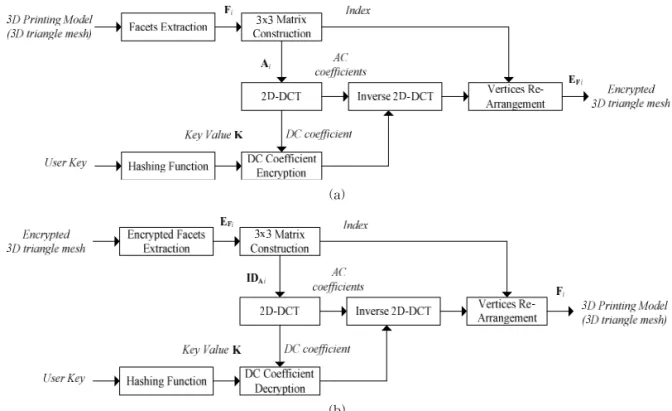
The proposed algorithm is described in Fig. 2a.
Facets are firstly extracted from 3D triangle mesh and three vertices of each facet is used to construct a 3x3 matrix as shown in Fig. 3. These matrixes are then transformed to DCT domain. In DCT do- main, DC coefficients are selected and encrypted by a secret key value. The secret value is gen- erated by a hashing function with a user’s key input. After the DC coefficients encryption process in DCT domain, DCT coefficients which include the encrypted DC coefficient and AC coefficients, are performed inverse DCT in order to change all coefficients one more time. Finally, the coefficients of the inverse DCT process will be re-arranged to generate the encrypted facet. The vertices re-ar- rangement process uses the index of 3×3 matrix that is constructed before. The encrypted 3D tri-
angle mesh is a set of the encrypted facets.
3.2 Selective Encryption
As the mention above, a 3D triangle mesh con- tains a set of facets. Each facet includes three vertices. Each vertex is presented by x, y and z coordinates. We consider a 3D triangle mesh M=
{F
i| I ∈ [1, |M|} with |M| is the cardinalities of a 3D triangle mesh; F
i= {v
i1, v
i2, v
i3and n
i} is in- dicated the i
thfacet with three vertices {v
i1, v
i2, v
i3} and the normal vector. n
i(nx
i, ny
i, nz
i). Each vertex is presented by three coordinates x, y and z. Due to the fact that the normal vector of a facet does not determine the shape of 3D triangle mesh, we briefly consider the facet F
iincludes three vertices as Eq. (1):
(1) Three vertices of the facet F
iis used to con- struct the matrix A
ias shown in Eq. (2). Given DCT(.), IDCT(.) are forward DCT function and in- verse DCT function respectively; and EC(.) is the
(a)
(b)
Fig. 2. The proposed algorithm. (a) Encryption Process and (b) Decryption Process.
encryption function. The matrix A
iis transformed to DCT domain by DCT(.) as shown in Eq. (3) with D
Aiis the matrix of DCT coefficients.
(2)
(3)
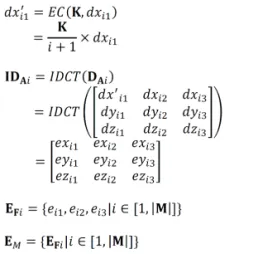
In DCT domain, the DC coefficient dx
i1is en- crypted by the key value K as shown in Eq. (4).
The key value K is generated by the SHA-512 hashing algorithm [12] that use a user’s key input.
The length of each key value is 512 bits. After DC coefficient encryption, we perform inverse DCT to change all DCT coefficients one more time in order to generate the encrypted vertices ID
Aias shown in Eq. (5).
(4)
(5)
(6) (7) Due to the fact that DC coefficients are changed, after the inverse DCT process all DCT coefficients will be changed one more time. Finally, the en- crypted vertices are re-arranged in order to obtain the encrypted facet E
Fias shown in Eq. (6). The
encrypted facet E
Fiincludes three encrypted verti- ces e
i1, e
i2and e
i3. The encrypted 3D triangle mesh E
Mis a set of the encrypted facets as shown in Eq. (7). Fig. 3 show the encryption process in DCT domain of a 3D triangle mesh.
3.3 Decryption Process
Fig. 2b shows the decryption process. The de- cryption process is an inverse process with the en- cryption process. The encrypted facet is also ex- tracted from the encrypted 3D triangle mesh and three vertices of each encrypted facet is also used to construct a 3×3 matrix. These matrixes are then transformed to DCT domain. In DCT domain, DC coefficients are decrypted by a secret key and all DCT coefficients will be then performed inverse DCT in order to restore the decrypted facet. Finally, the decrypted facets are re-arranged to generate the decrypted 3D triangle mesh.
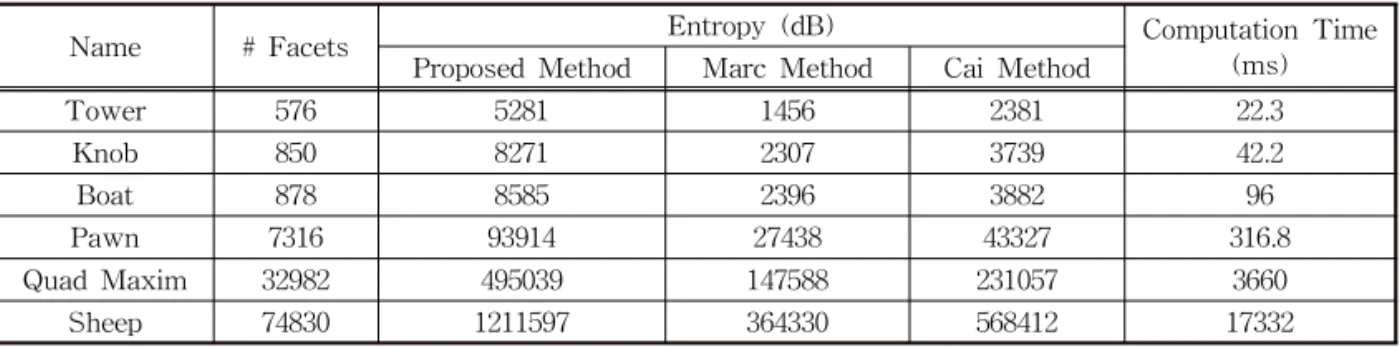
4. EXPERIMENTAL RESULTS & ANALYSIS We experimented the proposed algorithm with 3D triangle meshes as shown in Table 1. The for- mat of 3D triangle meshes is STL file, VRML file [10, 11]. The detailed information of models is shown in Tab.1. In order to evaluate the proposed algorithm, we evaluate visualization experiments, the security and computation time of the proposed algorithm. Sec. 4.1 shows visualization experiments.
Sec. 4.2 shows the security evaluation and the computation of the proposed algorithm is shown in Sec. 4.3.
4.1 Visualization Experiments
Experimental results are shown in Fig. 4. The
Fig. 3. Selective encryption process in DCT domain of a 3D triangle mesh.
number of 3D triangle meshes is different. Facets are connected together in order to form a 3D shape.
After the encryption process, facets are distorted into small facets (see “Encrypted Tower”, “Encrypt- ed Knob” and “Encrypted Boat” models) or big fac- ets (see “Encrypted Pawn” and “Encrypted Quad Maxim”), changed location, positioned disorderly and not connected together. This lead to the shape of 3D triangle meshes is changed. Consequently, the content of 3D triangle meshes is completely al- tered after the selective encryption process. Pirates
or un-authorized users cannot extract or view the content of 3D triangle meshes.
4.2 Security Evaluation
To evaluate the security of the proposed method,
we will analyze the entropy of the encrypted 3D
triangle mesh. If the entropy is high, the security
will be high. From the equations in Sec. 3, we can
see that the entropy of the encrypted 3D triangle
mesh is dependent on both the secret key K and
the number of facets |M|. But K and |M| are ran-
Fig. 4. Experimental results with test models.
dom independent variables. So the entropy of the encrypted 3D triangle mesh H
Mis the sum of the entropies of variables K and |M|, and determined by Eq. (8).
(8) Assume that the secret key is fixed, we can cal- culate the entropy of the encrypted 3D triangle mesh according to the number of facets |M| as shown in Table 1. The entropy of the encrypted 3D triangle mesh is formed from 5281 dB to 1.21×10
6dB with |M| ∈ [576,74830]. From Eq. (8) and Table 1 we can see that if |M| is high, the entropy will be high.
In Marc’s method [6], he used the secret key K to encrypt and change the location of the vertices of 3D triangle mesh in OXYZ space. Simply, we can understand that Marc’s method encrypted the vertices of 3D triangle mesh by a secret key K.
But the number of vertices in a 3D triangle mesh is always smaller than the number of facets. Thus the entropy of this method is always lower than the proposed method. With test models in Table 1, the entropy of Marc’s method is formed from 1456 dB to 364330 dB (see Table 1). In Cai’s method [9], he encrypt the features of 3D CAD model by a random 3×3 matrix that is generated the a secret key. Thus, we can consider that Cai’s method is encrypted 3D CAD models based on features and a random matrix by a secret key K. So, the entropy of this method is dependent on both the number of features and the 3×3 matrix. In experimental re- sults, around 50% of facets are selected as the fea-
ture of 3D CAD model. With test models in Table 1, the entropy of Cai’s method is formed from 2381 dB to 568412 dB. Fig. 5 show the entropy of the proposed method with the entropy of previous methods according to the number of facets. The entropy of the proposed method is always higher than the entropy of previous methods. Consequently, the proposed method is better and more security than previous methods.
4.3 Computation Time
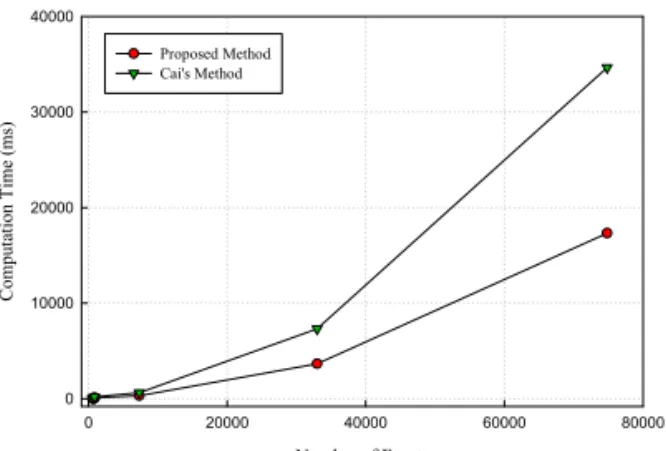
In our experiments, we used an Intel Core i7 Quad 3.5 - GHz, 8 GB of RAM, Windows 7 64-bits, and C++ on Visual Studio 2013. The computation time of the proposed method is dependent on the number of facets. With test models in Table 1, the computation time is formed from 22.3 ms to 17332 ms with |M| ∈ [576,74830]. From Table 1 we can conclude that if the number of groups and the number of facets is small, the computation time is
Table 1. Experimental results
Name # Facets Entropy (dB) Computation Time
Proposed Method Marc Method Cai Method (ms)
Tower 576 5281 1456 2381 22.3
Knob 850 8271 2307 3739 42.2
Boat 878 8585 2396 3882 96
Pawn 7316 93914 27438 43327 316.8
Quad Maxim 32982 495039 147588 231057 3660
Sheep 74830 1211597 364330 568412 17332
Number of Facets
0 20000 40000 60000 80000
Entropy
0.0 2.0e+5 4.0e+5 6.0e+5 8.0e+5 1.0e+6 1.2e+6 1.4e+6
Proposed Method Macr's Method Cai's Method
Fig. 5. Entropy of the proposed method according to
the number of facets.
small and otherwise. In Marc’s method, he did not show the computation time, so we could not com- pare Marc’s methods with our method. In Cai’s method, he only analysis the complexity time. The computation time of Cai’s method is dependent on the time of valid check CAD model, time of feature encryption and time of CAD model encryption. He concluded that the enough to meet user’s require- ments. With the dependent on three processes in Cai’s method, we consider and evaluate that the computation time of Cai’s method is greater at least two the computation time of our method. Compar- ing to Cai’ method, our method is faster than Cai’s method. Fig. 6 show the computation time of the proposed method and Cai’s method according to the number of facets.
5. CONCLUSION
In this paper, we proposed an effective en- cryption algorithm for 3D printing models in DCT domain. Three vertices of facet in 3D printing mod- el is used to construct a 3×3 matrix. The proposed algorithm is based on transforming matrixes to DCT domain and encrypting selectivity the DC co- efficients of matrixes in DCT domain by the se- crete key in order to generate the encrypted 3D printing model. The proposed algorithm is very more effective than previous methods. It is also re- sponsive to the various formats of 3D printing
model. It provides a better solution and is more se- curity than the previous proposed methods. In fu- ture, we improve the proposed algorithm and apply it to the secured storage and transmission systems.
REFERENCE
[ 1 ] United States Government Accountability Office, 3D Printing Opportunities, Challenges, and P olicy Implications of Additive Manufactur- ing, USA, 2015.
[ 2 ] A.T. Kearney, 3D Printing: A Manufacturing Revolution, Korea, 2015.
[ 3 ] G. Strang, “The Discrete Cosine Transform,”
Society for Industrial and Applied Mathe- matics, Vol. 41, No. 1, pp. 135-147, 1999.
[ 4 ] S.H. Lee, S.G. Kwon, and K.R. Kwon, “Geo- metric Multiple Watermarking Scheme for Mobile 3D Content Based on Anonymous Buyer-Seller Watermarking Protocol,” Jour- nal of Korea Multimedia Society, Vol. 12, No.
2, pp. 244-256, 2009.
[ 5 ] Q. Ai, Q. Liu, D. Zhou, L. Yang, and Q. Xi, “A New Digital Watermarking Scheme for 3D Triangular Mesh Models,” J ournal of Signal P rocessing, Vol. 89, pp. 2159-2170, 2009.
[ 6 ] E. Marc, Y. Maetz, and D. Gwenael, “Geome- try-preserving Encryption for 3D Meshes,”
P roceeding of Conference: Compression at Representation Signal Audio, pp. 7-12, 2013.
[ 7 ] X.T. Cai, F.Z. He, W.D. Li, X.X. Li, and Y.Q.
Wu, “Encryption Based Partial Sharing of CAD Models,” Integrated Computer-Aided Engineering, Vol. 22, pp. 243-260, 2015.
[ 8 ] X.T. Cai, W.D. Li, F.Z. He, and X.X. Li,
“Customized Encryption of Computer Aided Design Models for Collaboration in Cloud Manufacturing Environment,” J ournal of Manufacturing Science and Engineering, Vol.
137, pp. 1-10, 2015.
[ 9 ] X.T. Cai, F.Z. He, W.D. Li, X.X. Li, and Y.Q.
Wu, “Parametric and Adaptive Encryption of Feature-Based Computer-Aided Design Models
Number of Facets
0 20000 40000 60000 80000
Computation Time (ms)
0 10000 20000 30000 40000
Proposed Method Cai's Method