1. INTRODUCTION
Digital cameras and smart phones, and digital image processing software such as Photoshop, Paintshop Pro, you can duplicate digital counterfeit images relatively easily [1-14].
A variety of algorithms for detecting duplicated forgery images or tampering images have been proposed in many papers [1-14]. A technique of digital image forgery is copy-move image forgery.
Copy-move image forgery is a method of forging an image by copying a specific image area of the image itself and then attaching it to another area of the same image [1-14]. The purpose of copy- move image forgery detection is to detect the same or very similar region image within the original image.
An example of copy-move forged image is showed by Fig. 1 (a) and (b), and each of Fig. 1(a)
and Fig. 1(b) shows an original image and a copy- moved forged image respectively.
J. Fridrich [1] proposed an exacting match method for the forged image detection of a copy- move forged image. J. Fridrich [1] studied detect- ing copy-move forgery image and explaining an efficient and reliable detection method. This meth- od can successfully detect the forged image part
Fast Detection of Forgery Image using Discrete Cosine Transform Four Step Search Algorithm
Yong-Dal Shin†, Yong-Suk Cho††
ABSTRACT
Recently, Photo editing softwares such as digital cameras, Paintshop Pro, and Photoshop digital can create counterfeit images easily. Various techniques for detection of tamper images or forgery images have been proposed in the literature. A form of digital forgery is copy-move image forgery. Copy-move is one of the forgeries and is used wherever you need to cover a part of the image to add or remove information. Copy-move image forgery refers to copying a specific area of an image itself and pasting it into another area of the same image. The purpose of copy-move image forgery detection is to detect the same or very similar region image within the original image. In this paper, we proposed fast detection of forgery image using four step search based on discrete cosine transform and a four step search algorithm using discrete cosine transform (FSSDCT). The computational complexity of our algorithm reduced 34.23 % than conventional DCT three step search algorithm (DCTTSS).
Key words: Duplicated Forgery Image, Discrete Cosine Transform, Four Step Search Algorithm
※ Corresponding Author : Yong-Suk Cho, Address: (31415) Younamsan-ro 52-70, Eumbong-Myun, Asan-si, Choong- nam, Korea, TEL : +82-41-536-5734, FAX : +82-41-536- 5739, E-mail : [email protected]
Receipt date : Feb. 14, 2019, Revision date : Apr. 16, 2019
Approval date : Apr. 23, 2019
††Dept. of IT & Securities, U1 University (E-mail : [email protected])
††Dept. of IT & Securities, U1 University
(a) Original image (b) Copy-move forgery image Fig. 1. Conception of copy-move forged image.
even if the copied area is enhanced/modified [1].
Popescu [2] proposed Principal Component Analysis (PCA) to reduce the representation of di- mensions in image blocks [9]-[12]. We presented an efficient and robust technology that automati- cally detects duplicate areas of an image. This technique works by applying PCA first on a small fixed-size image block to produce a reduced di- mension representation. Detection of copy-forgery has become one of the areas studied in blind image forensics. Christlein etc. [3] proposed that copy- move forgery detection methods and processing steps are in various post-processing methods. The point of [3] is to evaluate the performance of pre- viously proposed feature sets [3].
Most of the copy-move forgery image detection methods are divided by overlapping blocks in the matching search area [1-14]. The N×N image size data is divided into (N-B+1)2 overlapping blocks having a block size of B×B in order to match of copy-move forgery image detection [6], [9-14].
The exhaustive search method require huge computational complexity to match forged block in the copy-move forgery image detection [1-4], [9- 14]. However, Shin [11]-[14] proposed low com- plexity algorithms to match forged block. Shin [11-14] proposed a fast detection method of the copy-move forgery image using DCT and spatial domain. The proposed algorithm reduced computa- tional complexity, when compared to the conven- tional various copy-move forgery detection meth- ods.
In this paper, we proposed a four step search fast detection of forgery image using discrete cosine transform. We proposed a new four step search us- ing discrete cosine transform (FSSDCT). The computational complexity of our algorithm reduced 34.23% than conventional three step search algo- rithm using DCT (TSSDCT).
2. THE PROPOSED METHOD
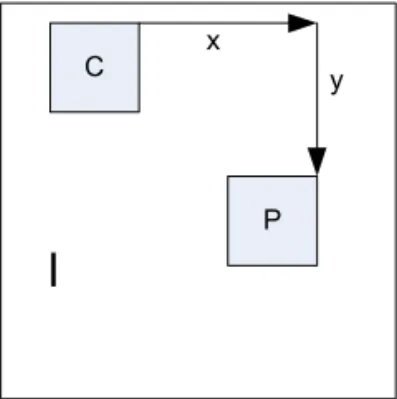
Copy-move forgery image is shown in Fig. 2.
From the Fig. 2, C block image is copy image of the original image , is copy-move for- gery image block. We have an original image
by shifting motion vector (), we can get the for- gery image , such that[9]
= (1)
The C block and P block of the Fig. 2 show copy block and pasted block respectively. The Fig. 2 is copy-move forgery image by shifting motion vec- tor x and motion vector y.
We proposed a fast detection method of forgery image using four step search algorithm using dis- crete cosine transform (DCT) (FSSDCT) to reduce computational complexity. The Koga et al [15] pro- posed the three step search algorithm (TSS) for motion estimation in the spatial domain [9-12]. The TSS algorithm of video has been widely used for motion estimation due to its simplicity and ex- cellent performance
We proposed four step search algorithm using DCT (FSSDCT). Our FSSDCT algorithm works as follows. Our algorithm obtained DCT coeffi- cients of 8×8 pixel block for FSSDCT in the fre- quency domain. The DCT algorithm [16] converts the image/video signal in the spatial domain 6into the image/video signal in the frequency domain [9-12], Most of image/video signal energy lies in the DC and low frequency region [1]; These repre- sent the DCT DC (0) and three (1, 2, 3) coefficients of Fig. 3 [14]. The high frequency of the DCT do-
C
P x
y
I
Fig. 2. Motion vector x and y of copy-move forgery im- age.
main is often a small energy value, and the energy of the high frequency region can be neglected with little visible distortion [16]. The DCT transform al- gorithm is equation (1), also the Inverse DCT algo- rithm is shown in Equation (2) [16].
(2) Inverse DCT (IDCT) is
(3) The DCT transform coefficient DC value for u=0, v=0, is the average value of the DCT transform domain for the spatial domain B × B pixel block, where B is the 8 × 8 pixel block [10]. AC co- efficients of the DCT transform domain are all oth- er coefficients except the DC value.
The proposed algorithm try to find copy-moved motion vectors in the forged image using FSSDCT.
The copy-moved motion vectors of forged image can be obtained by using FSSDCT, which reduces computational complexity. It will be described in detail the proposed method in the following.
Step 1: We use the DCT transform of Eq. (1) to compute the DCT coefficients from the forged
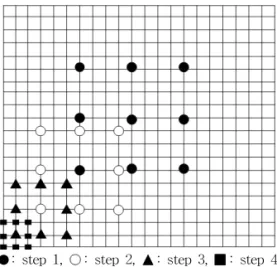
input image by 8x8 pixel blocks [10]. The FSSDCT algorithm starts with a check point with the center of the DCT coefficient (0,0) in Fig. 3 and measures the horizontal and vertical lines for nine check points with a step size(SS) of SS=4, (4 pixels / 4 lines) in order to find copy-moved forged block image, and four-step search algorithm is perfor- med around black check point. Find the minimum check point by calculating equation (4) from the nine check points. From Fig. 3, the minimum check point is (-4,-4).
Step 2 : From Fig. 3, Eight check points are set based on the DCT coefficient position of the check points (-4, -4) found in step 1, and the step size is set to 3, 3 pixel / 3 line in step 2. After perform- ing FSSDCT on the eight check points, find check points satisfying minimum of equation (4). From step 2, the minimum check point is (-7, -7) in Fig.
3.
Step 3 : From Fig. 3, Eight check points are set based on the DCT coefficient position of the check points (-7, -7) found in step 2, and the step size is set to 2, 2 pixel / 2 line in step 3. After perform- ing FSSDCT on the eight check points, find check points satisfying minimum of equation (4). From step 3, the minimum check point is (-9,-9).
Step 4 : From Fig. 3, Eight check pointers are set based on the DCT coefficient position of the check points (-9, -9) found in step 3, and the step size is set to 1, 1 pixel / 1 line in step 4. After per- forming FSSDCT on the eight check points, find check points satisfying minimum of equation (4).
From step 4, the minimum check point is (-10,-10).
The best-match block (-10,-10) in the step 4 is found. The best-match check point of DCT co- efficients location is the copy-moved motion vector value (-10,-10).
The computational complexity of FSSDCT al- gorithm needs 33 DCT coefficients check points.
In the case of a maximum displacement window of 10 i.e. w= -10∼+10, the total number of checking points required is [9(Step 1) + 8(Step 2) + 8(Step : step 1, : step 2, : step 3, : step 4
Fig. 3. Algorithm of the DCTFSS.
3) +8(Step4)] or 33 for search window 21×21 DCT coefficients. On the other hand, check points of the exhaustive search method need 441 check points to search motion vector of copy-move forgery image.
We used block difference (BD) for matching of copy-moved forgery image detection based on FSSDCT. In order to search motion vectors x and y of copy-moved image forgery, we found mini- mum of block difference (BD) of eq. (4) based on FSSDCT.
BD =min
(4) DI(i+ii, j+jj) is DCT coefficients of block at the position (i, j) of reference image, where, i=0,1,2, 3….N-B+1, j=0,1,2,3….N-B+1, ii, jj=0,1,2,3. DI(i+ii+x,j+jj+y) are DCT coefficients of block at position (i+ii, j+jj) of the matching search image, and the motion vectors x and y of copy-move forgery im- age obtained by FSSDCT. We used 10 pixels for maximum displacement window of FSSDCT. The test image is 8 bits/pixel and 256×256 pixels, and block size is 8×8 pixel block. The FSSDCT is div- ided into non-overlapping 21×21 pixel blocks to search motion vector x and y of copy-move for- gery image block in the matching search block image. Thus, the computational complexity is re- duced to 4 instead of 64 in an 8×8 pixel block to obtain the motion vector x, y in the FSSDCT. The
ii and jj in Equation (4) require the 4-computational complexity indicated by 0,1,2,3 in Fig. 4. Hence, the BD of FSSDCT reduces computational complexity.
If ( BD == 0)
Copy-moved image forgery block (5) Else
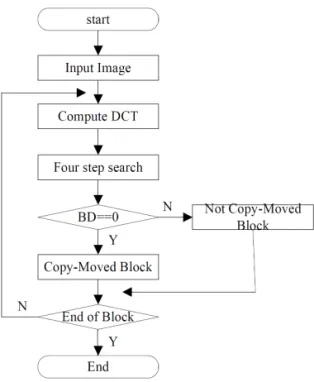
Not copy-moved image forgery block The proposed method is four step search algo- rithm using DCT. The flowchart of the proposed method FSSDCT is shown Fig. 5. From equation (5), if BD is 0, the copied block is the same as the moved block, so that is the copy moving counterfeit block image [11-14]. If BD is not 0, the copied block image is different from the attached block image, so the block image is not a duplicate move counter- feit block [11-14].
3. EXPERIMENTAL RESULTS
We proposed a fast detection algorithm for copy-moved forgery image using four step search algorithm by discrete cosine transform (FSSDCT).
The proposed FSSDCT method reduces computa- Fig. 4. One DC (0) and three (1,2,3) low frequency co-
efficients.
Fig. 5. The flowchart of proposed DCTFSS.
tional complexity much more than the conventional forgery detection algorithms.
The test image for the simulation, Bridge, Car3, and Airplane images are 8 bits and the resolution is 256×256 pixels [17]. The matching search area of the test image is divided into 21×21 which does not overlap from the first position (0,0) of the im- age to the last image position (255,255). BD of copy-moved image forgery detection is Equation (4) based on FSSDCT method.
In this paper, the computational complexity of the FSSDCT algorithm requires four DCT co- efficients for the 21×21 pixel block matching search per checking point. In order to reduce computa- tional complexity of the proposed FSSDCT algo- rithm, one DC and three low-frequency DCT co- efficients per checkpoint are sufficient instead of 64 checkpoints in an 8×8 pixel block.
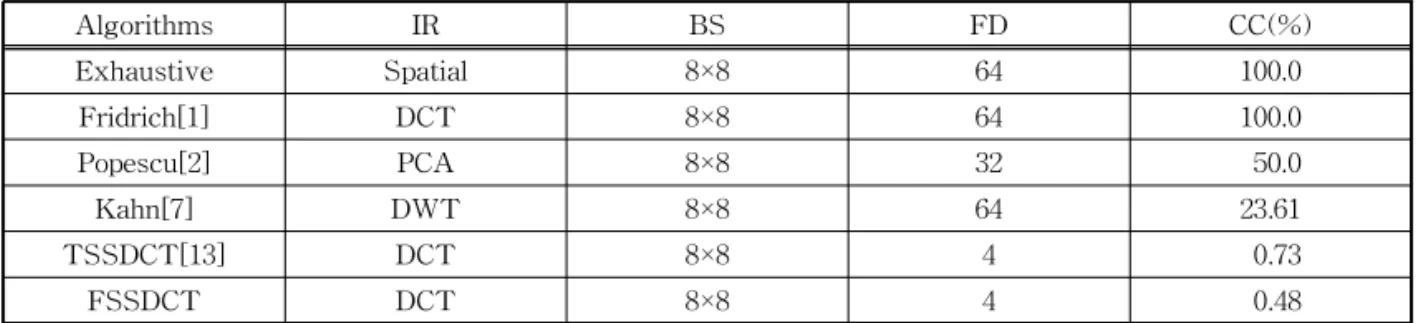
Table 1 shows the computational complexity and compares the proposed FSSDCT algorithm with the existing methods. The proposed fast FSSDCT algorithm detected 99% of copy-move forgery images.
From Table 1, IR, BS, MSACPN, FD, CC are image representation, block size of reference re- gion, matching search area checking points num- ber, feature dimension, computation complexity (based on reference[1])method, respectively.
The proposed FSSDCT algorithm reduced 99.52
% of computational complexity than exhaustive search [1]. As shown in Table 1, the proposed FSSDCT method reduces the computational com- plexity compared to the conventional method [1], [2],[7], because the FSSDCT method used DC and three low frequency DCT coefficients which char- acteristic of DCT compression in the frequency domain, and it is a matching search area -10∼+
10, non-overlapping 21 × 21 pixel block.
The Fig. 6, 7, and 8 showed performance of pro- posed method. Figures showed original images, copy-moved image forgery, detection of copy- moved image forgery in the Fig. 6, 7, and 8. From the Fig. 6(c), left black box is copied, right black box is moved to image forgery block. From Fig.
7(c) and 8(c), right black box is copied, left black box is moved to image forgery block. From Fig.
6, 7, and 8, our algorithm detected above 99% copy- moved image forgery. Copy-moved forgery image detection rates of Bridge, Car3, and Airplane are 99.70%, 99.17%, and 99.01%, respectively. Detection rate of copy-move forgery image (DR) is expre- ssed by equation (6).
DR =
(6)
where, detected pixel number of copy move image (DPN), total pixel number of copy move image (TPN).
Table 1. Computational complexity of the proposed FSSDCT and conventional methods
Algorithms IR BS FD CC(%)
Exhaustive Spatial 8×8 64 100.0
Fridrich[1] DCT 8×8 64 100.0
Popescu[2] PCA 8×8 32 50.0
Kahn[7] DWT 8×8 64 23.61
TSSDCT[13] DCT 8×8 4 0.73
FSSDCT DCT 8×8 4 0.48
Table 2. Computational complexity of the proposed FSSDCT and TSSDCT
Algorithms IR BS Search Area MSACPN FD CC(%)
TSSDCT[13]
FSSDCT DCT
DCT 8×8
8×8 -7∼7
-10∼10 25 × 172
33 × 122 4
4 100.0
65.77
4. CONCLUSION
we proposed fast detection algorithm of forgery image using four step search based on discrete co- sine transform. We proposed a new four step search using discrete cosine transform (FSSDCT).
The computational complexity of our algorithm re- duced 34.23% than conventional three step search
algorithm using DCT (TSSDCT).
REFERENCE
[ 1 ] J. Fridrich, D. Soukal, and J. Lukas, “Detection of Copy-move Forgery in Digital Images,”
P roceeding of Digital Forensic Research Workshop, IEEE Computer Society, pp. 55- (a) Original Bridge image (b) Copy-Moved forgery
Bridge image (c) Detection block of Copy-Moved forgery Bridge image (Black box) Fig. 6. Result of proposed FSSDCT
(a) Original Car3 image (b) Copy-Moved forgery
Car3 image (c) Detection block of Copy-Moved forgery Car3 image (Black box) Fig. 7. Result of proposed FSSDCT.
(a) Original Airplane image (b) Copy-Moved forgery
Airplane image (c) Detection block of Copy-Moved forgery Airplane image (Black box) Fig. 8. Result of the proposed FSSDCT.
61, 2003.
[ 2 ] A.C. Popescu and H. Farid,Exposing Digital Forgeries by Detecting Duplicated Image Regions, Technical Report TR2004-515, De- partment of Computer Science, Dartmouth College, 2004.
[ 3 ] V. Christlein, C. Riess, J. Jordan, and E.
Angelopoulou, “An Evaluation of Popular Copy-move Forgery Detection Approaches,”
IEEE Transactions on Information Forensics and Security, Vol. 7, No. 6, pp. 1841-1854, 2012.
[ 4 ] D. Mahalakshmi, S.K. Vijayalakshmi, and S.
Priyadharsini, “Digital Image Forgery4detec- tion and Estimation by Exploring Basic Image Manipulations,”Digital Investigation, Vol. 8, No. 3, pp. 215-225, 2012.
[ 5 ] E.S. Khan and E.A. Kulkarni, “An Efficient Method for Detection of Copy-move Forgery Using Discrete Wavelet Transform,”Interna- tional Journal of Computer Science and Engin- eering, Vol. 2, No. 5, pp. 1801-1806, 2010.
[ 6 ] H.J. Lin, C.W. Wang, and Y.T. Kao, “Fast Copy-move Forgery Detection,” World Sci- entific and Engineering Academy and Society Transaction on Signal P rocessing, Vol. 5, Issue 5, pp. 188-197, 2009.
[ 7 ] S. Kahn and A. Kulkarni, “Reduced Time Complexity for Detection of Copy-move For- gery Using Discrete Wavelet Transform,”In- ternational Journal of Computer Applications, Vol. 6, No. 7, pp. 31-36, 2010.
[ 8 ] J. Casey,An Investigation of Block Searching Algorithms for Video Frame Coders, Masters of Science Thesis of Dublin Institute of Tech- nology, 2008.
[ 9 ] N. Singhal and S. Gandhani, “Analysis of
Copy-move Forgery Image Forensics: A Review,”
International J ournal of Signal Processing, Image Processing and Pattern Recognition, Vol. 8, No. 7, pp. 265-272, 2015.
[10] S. Bayram, H.T. Sencar, and N. memon, “A Survey of Copy-move Forgery Detection Techniques,” P roceeding of IEEE Western New York Image Processing Workshop, pp.
538-542, 2008.
[11] Y.D. Shin, “Fast Detection of Copy-move Forgery Image Using Three Step Search Algorithm in the Spatial Domain,”Proceeding of International Conference on Hybrid Infor- mation Technology, pp. 389-395, 2012.
[12] Y.D. Shin, “Fast Detection of Copy-move Forgery Image Using DCT,”Journal of Korea Multimedia Society, Vol. 16, No. 4, pp. 411- 417, 2013.
[13] Y.D. Shin, “Analysis of Copy Move Forgery Image Detection,” Proceeding of the 13th International Workshop Series, pp. 20-22, 2017.
[14] Y.D. Shin, “Fast Detection of Image Forgery Using Three Step Search Algorithm Based on Discrete Cosine Transform,” International J ournal of Grid and Distributed Computing, Vol. 11, No. 11, pp. 57-66, 2018.
[15] T. Koga, K. Iinuma, A. Hirano, Y. Iijima, and T. Ishiguro, “Motion Compensated Interframe Coding for Video Conferencing,” P roceeding of National Telecommunication Conference, pp. G5.3.1-5.3.5, 1981.
[16] P. Yip and K.R. Rao,Discrete Cosine Trans- form: Algorithms, Advantages, and Applica- tions, Academic Press, San Diego, 1990.
[17] The USC-SIPI Image Database, http://sipi.
usc.edu/database (accessed May, 10, 2012).
Yong-Dal Shin
is a professor in department of IT & securities at U1 university, Choongnam Korea. He received PH.D. degree from Kyungpook national university, Daegu Korea, 1994. He research areas include multimedia security, digital watermarking, digital forensics.
Yong-Suk Cho
received the B.S., M.S., and Ph.
D. degree in the Department of Electronic Communication Eng- ineering from Hanyang Univer- sity in 1986, 1988 and 1998, re- spectively. From 1989 to 1996, he was a researcher at Korea Telecom. He has been a professor in the Department of IT & Securities at U1 University since 1996. His current research interests include finite field arith- metic, cryptography, and error-control coding.