국내 실외공기의 곰팡이 분포 및 노출에 따른 염증영향평가
윤원석
†· 임재훈 · 김다사랑 · 김승현 · 이효선 · 김채봉 · 강주완* · 이근화* · 오인보** · 김양호** · 서정욱*** · 홍영습*** · 유 영****
†고려대학교 천식환경보건센터, *제주대학교 환경보건센터, **울산대학교 환경보건센터,
***동아대학교 환경보건센터, ****고려대학교 의과대학 소아청소년과학교실
Evaluation of Distribution and Inflammatory Effects of Airborne Fungus in Korea
Wonsuck Yoon
†, Jaehoon Lim, Dasarang Kim, Seunghyun Kim, Hyo-sun Lee, Chae-Bong Kim, Ju-Wan Kang*, Keun-Hwa Lee*, Inbo Oh**, Yangho Kim**, Jung-Wook Seo***,
Young-Seoub Hong***, and Young Yoo****
†The Environmental Health Center, University of Korea
*The Environmental Health Center, Jeju National University
**The Environmental Health Center, University of Ulsan College of Medicine
***The Environmental Health Center, Dong-A University
****Department of Pediatrics, College of Medicine, Korea University
ABSTRACT
Objectives: For the risk management of airborne fungal diseases, our aim was to evaluate airborne fungi and study the toxicity associated with fungal allergic diseases using fungal species native to Korea.
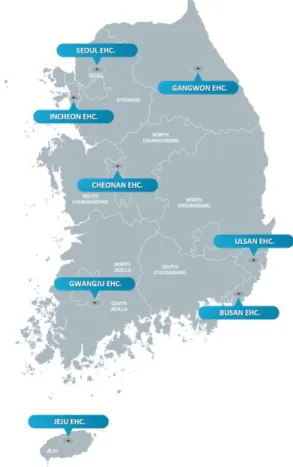
Methods: Fungi were isolated from outdoor air samples collected from Seoul, Incheon, Cheonan, Gwangju, Ulsan, Busan, and Jeju and tested for their cytotoxicity potential and their ability to induce proliferation and secretion of macrophage-derived chemokine (MDC) in human mast cells (HMC-1).
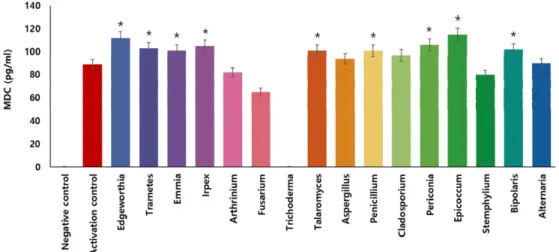
Results: More than 18 species of fungi were collected from outdoor air in Korea over one year, and the strains were identified and systematically analyzed. The results showed that the Cladosporium (59%) and Alternaria (22%) strains are the most common in outdoor air. Three of the collected strains (Fusarium, Trichoderma, and Penicillium) showed mild toxicity in cells involved in allergic inflammation, and twelve induced cell proliferation in HMC-1 cells. More importantly, many strains (Edgeworthia, Trametes, Emmia, Irpex, Talaromyces, Penicillium, Periconia, Epicocum, Bipolaris) induced the MDC protein in activated HMC-1 cells.
Conclusion: Nineteen percent of the tested strains caused cytotoxicity in mast cell lines, whereas, most of the non-toxic strains contributed to cell activity. Among the tested strains, more than 80% increased the expression of MDC protein, which contributes to the severity of atopic dermatitis, asthma, and rhinitis. It is, in fact, one of the markers for these conditions. Therefore, airborne fungus could be considered as an important marker for environmental risk management for allergic diseases in Korea.
Key words: Airborne fungus, Allergy, Fungal diversity, Toxicity
†
Corresponding author: The Environmental Health Center, University of Korea, Korea, Tel: +82-2-920-6963, E-mail:
[email protected]
†