* This work was supported by a special research grant from Seoul Women's University(2011).
First author:Lee, Eun-heui, Division of Environmental Life Sciences, Seoul Women’s University, Tel:+82-2-970-7717, E-mail:[email protected]
Corresponding author:Lee, Eun-heui, Division of Environmental Life Sciences, Seoul Women’s University, Tel:+82-2-970-7717, E-mail:[email protected]
Received:26 July, 2011. Revised:16 August, 2011. Accepted:24 August, 2011.
- 81 -
Effects of Extensive Green Roof System on Rainwater Circulation*
Lee, Eun-heui
1)․Jang, Ha-kyung
2)and Ahn Geun-young
2)1)
Division of Environmental Life Sciences, Seoul Women’s University,
2)
Lab. Ecological Landscape Planning, Seoul Women’s University.
관리조방형 옥상녹화시스템이 우수순환체계에 미치는 영향*
이은희
1)․장하경
2)․안근영
2)1)
서울여자대학교 환경생명과학부ㆍ
2)서울여자대학교 조경연구실
국문요약
본 연구는 관리조방형 옥상녹화 시스템의 우수유출 저감 및 유출지연 효과를 규명하기 위하여 2007 년~2010년의 4년간 연구를 진행하였다. 실험대상지는 서울여자대학교 행정관 옥상에 조성된 관리조 방형 옥상녹화지로 2007년에 조성하였으며, 세덤류 및 다년생 초화류를 포함하여 총 18종의 식물을 식재하였다. 우수유출 저감 및 지연효과를 지속적으로 모니터링하기 위해 옥상녹화지를 통과한 우수 를 저장할 수 있는 시스템을 설치하여 유출수의 유입량 및 시간을 측정였다. 조사기간 중 총 24번의 강우사례를 분석한 결과 단위면적당 평균 약 90.3%(78.8~99.3%)의 유출량이 저감되었으며, 지연시간 은 평균 약 1.6시간으로 나타났다. 본 연구결과를 종합분석해본 바, 빗물이 거의 전량 유출되는 도심의 건축물 옥상을 녹화함으로써 옥상에 유입되는 우수의 유출을 지연 및 저감시켜 도심의 수순환체계 개선에 기여할 수 있을 것으로 생각된다.
주요어:강우, 유출량, 저감, 지연효과, 도심 수 순환체계
I. INTRODUCTION
The rainwater circulation in urban areas is modified from the rainwater circulation in nature.
The hydrological cycle in urban areas is influenced by the change of land uses; for example, from forest to agricultural land, the draining of wetlands and the increase of developed areas. The surface of built up areas is almost covered with paving.
Therefore, the surface retention and interception of rainwater are reduced because the surface of the urban area is smooth. The characteristics of the hydrological cycle in urban areas are increased runoff, reduced evaporation and infiltration (König K. W, 1996; Lee, E. H, 1997). This causes many unseen problems. The increased runoff causes higher peaks of stream discharge and shortens lag time (Herrmann R, 1977; Dunnett N and Kingsbury N, 2005). In order to prevent disasters, it is necessary to build higher riverbanks and regulation dams and straighten rivers. However, the results of those efforts are often higher water levels, the disturbance of aquatic ecosystems and reduction of biodiversity. It is difficult in urban areas to increase green areas, but the roofs, where the runoff coefficient is almost one, have a great potential to be green space because the areas of roofs in urban areas are immense and the spreading effects are also enormous. For example, Seoul today is beset with perplexing difficulties where 48% of urban areas are over 70% paved zones (Seoul metropolitan government, 2001). The rainfall runoffs of parks, natural ground and green roofs are low, while those of slope roofs and paving areas with asphalt are very high.
Urbanization also increases surface runoff by creating more impervious surfaces such as pave-
ment and building that does not allow percolation of the water down through the soil to the aquifer.
It is instead forced directly into streams or storm water runoff drains where erosion can be a major problem, even when flooding is not. Increased runoff reduces groundwater recharge, thus lowering the water table and making droughts worse (Kim YR, 2008).
In the case of Seoul, heavy floods cause a great deal of damage to the area annually. In the flood occurrence period, surface runoff volume increased about 2,488,000m
3per day (www.
ecoinfo.seoul.go.kr). Incidence of sudden severe rain storm has become more frequent over the last few years.
There is some studies on Reducing, attenuating and mitigating storm water runoff which lowers risks of urban floods and improving the urban water balance to approach the natural one (Bengtsson et al., 2005; Berndtsson J C, 2010;
Krupka B, 1992; Mentens et al., 2006; Roth- Kleyer S, 2005; Schmidt M, 2005; VanWoert et al., 2005). But few studies have been conducted to analyze annual monitoring result for effect of green roof on runoff retention quantity and time-lag in Korea where has climate heavy rain are concentrated in summer.
Therefore the objective of this study was to analyze how extensive green roof systems function in the local weather conditions, as the result of observing an existing green roof in Seoul, Korea.
The task was to assess the storm water retention
potential as well as the runoff water quantity and
lag time of a green roof. Twenty four different
rain events were observed in the measuring period
from September 2007 to July 2010.
Family Scientific name Hight anthesis (month)
Crassulaceae
Sedum kamtschaticum 5-30 6-7
Sedum takesimense 50 7
Sedum middendorffianum 20 6-8
Sedum sarmentosum - 5
Saxifragaceae Astilbe chinensis var. davidii 30-70 7-8
Heuchera micrantha 30 7-8
Rosaceae Duchesnea chrysantha - 4-5
Potentilla fragarioides var. major 30 4-8
Polemoniaceae Phlox subulata 10 4-9
Verbenaceae Caryopteris incana 30-60 7-8
Lamiaceae Thymus quinquecostatus var. japonica - 6
Dracocephalum argunense 15-60 6-8
Scrophulariaceae Veronica linariaefolia 40-70 7-8
Asteraceae
Chrysanthemum zawadskii var . latilobum 50 9-10
Aster koraiensis 40-60 6-10
Aster spathulifolius 40 7-11
Liliaceae Hemerocallis dumortieri 30-50 5-7
Polygonatum odoratum var. pluriflorum 30-50 4-5 Table 1. Plant species planted in the site.
II. MATERIALS AND METHODS
To investigate rain water retention capacity of existing green roofs accurately, a rainwater storage system was constructed with a green roof system.
Materials and methods are as follows.
1. Green roof system
The Green Roof system was established in June 2007 and has been situated in Seoul Women's University Administration Building (Figure 1).
The reference roof has no slope and the area is about 140m
2. The length of the green roof is 14m, and its width is 10m, its height from the ground is about 13m.
The green roof type is an extensive green roof
Figure 1. The green roof site at Seoul Women's University Administration Building.
system with 100mm substrate depth. Plant species
used in this study included Korean native plants
( Caryopteris incana, Hemerocallis dumortieri etc.)
and some sedum species ( Sedum kamtschaticum,
Sedum sarmentosum etc.)(Table 1).
2. Rain water storage system
The rain water storage system was established with the green roof system to investigate rain water retention potential and runoff time after initial rainfall. Two tanks and an open-type gutter along the edge of the roof were installed to store rain water which passed through the substrate, and a flow meter was set up in the tanks (Figure 2). It was used to measure the volume of rain water drained from the system with time. A solar system was established to use the stored rainwater semi-permanently with water pumps installed in each tank.
Figure 2. Rain water tank and storage system.
3. Data collection and analysis
A Model CM6 automated weather station, made by Campbell Scientific, was installed on the research site to record precipitation. The weather station included ambient air temperature, relative humidity, wind speed and direction (Figure 3). The float-operated Thailmedes shaft encoder with inte- gral data logger, made by OTT MESSTECHNIK GmbH & Co. KG, was installed in the rain water tanks to quantify rainwater runoff.
Data from the shaft encoder and the weather station were collected at 10-min intervals 24 h a day from September 2007 through July 2010
Figure 3. The mean air temperature and precipitation of the green roof site in monitoring period.
using a data logger equipped with switch closure modules and a storage module. Retention data were analyzed with 24 rain event cases that occurred during the monitoring period.
III. RESULTS
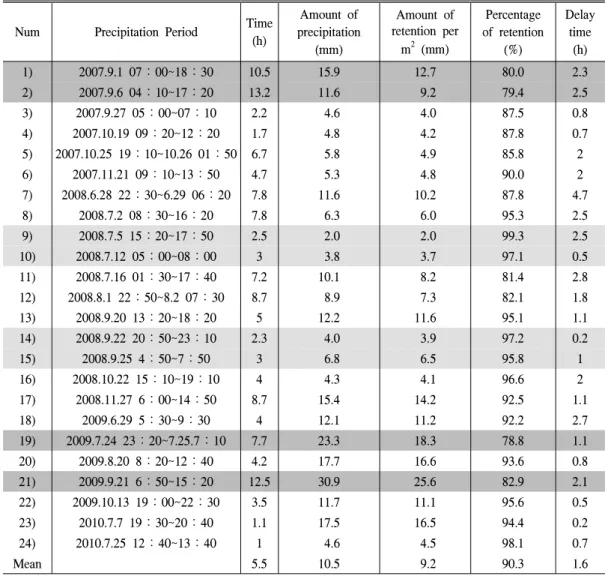
Twenty-four rain events were collected during the monitoring period (Table 2). The precipitation amounts ranged from 2.0 to 30.9mm. The selected rain events show the effects that the roof greening had on quantity, and delay of the runoff.
Eight cases from the 24 rain events were selected to analyze the characteristics of the heavy and light rain events.
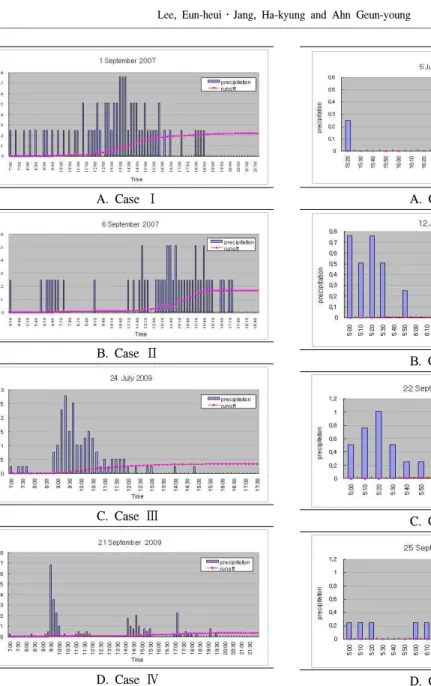
Case Ⅰ:one of the heavy rain events occurred
on September 1, 2007. Precipitation was 15.89mm
and the volume of runoff was 3.18mm/m
2. The
percentage of retention was 80% and the lag time
was 2.3h. Case Ⅱ:this case of the heavy rain
events occurred on September 6, 2007. Precipitation
was 11.56mm and the volume of runoff was
2.38mm/m
2. The percentage of retention was
79.4% and the lag time was 2.5h. Case Ⅲ:one
of the heavier rain events occurred on July 24,
2009. Precipitation was 23.3mm and the volume
of runoff was 4.94mm/m
2. The percentage of
retention was 78.8% and the lag time was 1.1h.
Num Precipitation Period Time (h)
Amount of precipitation
(mm)
Amount of retention per
m
2(mm)
Percentage of retention
(%)
Delay time
(h)
1) 2007.9.1 07:00~18:30 10.5 15.9 12.7 80.0 2.3
2) 2007.9.6 04:10~17:20 13.2 11.6 9.2 79.4 2.5
3) 2007.9.27 05:00~07:10 2.2 4.6 4.0 87.5 0.8
4) 2007.10.19 09:20~12:20 1.7 4.8 4.2 87.8 0.7
5) 2007.10.25 19:10~10.26 01:50 6.7 5.8 4.9 85.8 2
6) 2007.11.21 09:10~13:50 4.7 5.3 4.8 90.0 2
7) 2008.6.28 22:30~6.29 06:20 7.8 11.6 10.2 87.8 4.7
8) 2008.7.2 08:30~16:20 7.8 6.3 6.0 95.3 2.5
9) 2008.7.5 15:20~17:50 2.5 2.0 2.0 99.3 2.5
10) 2008.7.12 05:00~08:00 3 3.8 3.7 97.1 0.5
11) 2008.7.16 01:30~17:40 7.2 10.1 8.2 81.4 2.8
12) 2008.8.1 22:50~8.2 07:30 8.7 8.9 7.3 82.1 1.8
13) 2008.9.20 13:20~18:20 5 12.2 11.6 95.1 1.1
14) 2008.9.22 20:50~23:10 2.3 4.0 3.9 97.2 0.2
15) 2008.9.25 4:50~7:50 3 6.8 6.5 95.8 1
16) 2008.10.22 15:10~19:10 4 4.3 4.1 96.6 2
17) 2008.11.27 6:00~14:50 8.7 15.4 14.2 92.5 1.1
18) 2009.6.29 5:30~9:30 4 12.1 11.2 92.2 2.7
19) 2009.7.24 23:20~7.25.7:10 7.7 23.3 18.3 78.8 1.1
20) 2009.8.20 8:20~12:40 4.2 17.7 16.6 93.6 0.8
21) 2009.9.21 6:50~15:20 12.5 30.9 25.6 82.9 2.1
22) 2009.10.13 19:00~22:30 3.5 11.7 11.1 95.6 0.5
23) 2010.7.7 19:30~20:40 1.1 17.5 16.5 94.4 0.2
24) 2010.7.25 12:40~13:40 1 4.6 4.5 98.1 0.7
Mean 5.5 10.5 9.2 90.3 1.6
*1), 2), 19), 21):heavy rain events / 9), 10), 14), 15):light rain events.
Table 2. Measured rain events and delay time of runoff from September 2007 to July 2010.
Case Ⅳ:this case, the heaviest rain event occur- red on September 21, 2009. Precipitation was 30.9mm and the volume of runoff was 5.29mm/m
2. The percentage of retention was 82.9% and lag time was 2.1h (Figure 4).
Case Ⅴ was a light rain event. This rain event occurred on July 5, 2008. Precipitation was 2.01mm and the volume of runoff was 0.02mm/m
2. The percentage of retention was 99.3% and the lag time was 2.5h. A case of a light rain event (case
Ⅵ ) occurred on July 12, 2008. Precipitation was
3.79mm and the volume of runoff was 0.11mm/m
2.
The percentage of retention was very high with
97% and the lag time was 0.5h. A case of a light
rain event (case Ⅶ) occurred on September 22,
2008. Precipitation was 4.0mm and the volume of
runoff was 0.11mm/m
2. The percentage of retention
was very high with 97.2% and the lag time was
0.2h. The case of a light rain event (Ⅷ) occurred
on September 25, 2008. Precipitation was 6.8mm
A. Case Ⅰ
B. Case Ⅱ
C. Case Ⅲ
D. Case Ⅳ
Figure 4. Runoff hydrographs of heavy rain events.
and the volume of runoff was 0.29mm/m
2. The percentage of retention was very high with 95.8%
and the lag time was 1h (Figure 5).
1. Synthetic Analysis
Mean percent rainfall retention at the investigated green roof was 89.7%, ranging from 78.8% to 99.3%. Twenty-four rain events selected from the
A. Case Ⅰ
B. Case Ⅱ
C. Case Ⅲ
D. Case Ⅳ
Figure 5. Runoff hydrographs of light rain events.
monitoring period are shown in Table 2. The
results also showed that the investigated green
roof could delay the rainwater runoff by about
1.6h. There were some differences in rainwater
retention and lag time between heavy and light
rain events. The mean percent rainfall retention
of four heavy rain events was 80.2%, and the lag
time was 2.0h. On the other hand, the light rain
events showed 97.3% retention and the runoff time delayed 1.1h.
IV. DISCUSSION
Vegetated green roofs retained greater quantities of rainfall and delayed runoff times. Some studies have shown that the rainfall runoff rate of paved areas including building roof areas is almost 90-100% compared to natural green areas of 10- 20%, and its runoff time is faster than for green areas (Geiger W and Dreiseitl H, 1995; Jeroen M et al., 2005).
On the green roof monitoring project at Van- couver Library in Canada, it was reported that green roof of the library reduced the runoff rate 16% on average more than a general paved roof.
There was a reduction of just 3% of runoff quantity in the case of storm water but the rainfall runoff rate was reduced 80% or more in the dry season (Johnston J and Newton J, 1996). The results of the study on the hydrologic behavior of vegetated roofs have shown that green roof stormwater retention ranged from 39 to 100 percent, with an average retention just under 78 percent (Carter T L and Rasmussen T C, 2006).
As a result, the findings of our experiment are in general consist with other results reported by Geiger W and Dreiseitl H (1995), Johnston J and Newton J (1996), Jeroen M et al (2005) and Carter T L and Rasmussen T C (2006). Other studies that have considered the effects of rooftop greening on water retention have shown that green roofs can absorb water and release it slowly over a period of time as opposed to a conventional roof where storm water is immediately discharged (Liesecke HJ, 1999; Schade C, 2000; Moran A et al., 2003; Roth-Kleyer S, 2005). Some research
has indicated that an extensive green roof, depending on substrate depth, can retain 60 to 100% of incoming rainfall (Liesecke HJ, 1998;
Schade C, 2000; Monterusso MA et al., 2004).
The FLL Guidelines “Planning, Installation and Maintenance of Green Roofs” (2002) also suggested that the annual water retention on green roof sites is dependent on the course depth. On the FLL Guidelines, the annual average water retention was 55% at extensive green roofs with 100-150mm depth. However, our findings that the average retention percentages were 90.3% with 100mm depth contradicts the results of the FLL, because the results of this study are not annual but are limited to the major rainfall duration. The FLL data were annual average but the results of this study should some differences like time and climate etc. The annual average water retention was 90% or more at an intensive green roof with 500mm or more depth in the FLL Guidelines.
There are many intensive green roofs with deep media depth in Korea, for which additional studies of the effects on water retention at the intensive green roof areas are needed. Our observations on the mean percent of rainfall retention and the lag time showed that green roofs can contribute to the improvement of urban water circulation with retention and delay the effects of runoff. Thus may be concluded that green roofs can help with prevention of urban flooding.
Green roofs as substitution for green areas are
the best alternative plan in downtown areas in
Seoul where land prices are very high. Incentives
will be needed so that citizens can participate in
creating green roofs spontaneously and active
supports should be increased for construction of
sustainable urban environment.
REFERENCE