KIEAE Journal
Korea Institute of Ecological Architecture and Environment
66
1)
Heating and Cooling Energy Conservation Effects by Green Roof Systems in Relation with Building Location, Usage and Number of Floors
Son, Hyeong Min*⋅Park, Dong Yoon**⋅Chang, Seong Ju***
* Dept. of Civil and Environmental Engineering, KAIST, South Korea ([email protected])
** Dept. of Civil and Environmental Engineering, KAIST, South Korea ([email protected])
*** Corresponding author, Dept. of Civil and Environmental Engineering, KAIST, South Korea ([email protected])
A B S T R A C T K Y E W O R D S
Building energy consumption takes up almost 25% of the total energy consumption. Therefore, diversified ways, such as improving wall and window insulation, have been considered to reduce building energy consumption.
Recently, green roof system has been explored as an effective alternative for dealing with reducing heating and cooling energy, thermal island effect and improving water quality. However, recent studies regarding a green roof system have only focused on building energy reduction without considering the applied usage, location, and story of the green roof system. Therefore, this study pays attention to the heating and cooling energy in relation to the applied usage, location, and story of a green roof system for investigating its impact on energy reduction.
The result of simulations show that the reduction in heating energy consumption is higher when applied to Cherwon-gun province which has a continental climate condition, compared to the city of Busan that is distinguished by its warm climate. Cooling energy saving turns out to be higher when the green roof system is applied to Busan in comparison with Cherwon. As for the applied usage or function of the building, residential space acquires the highest heating and cooling energy saving effect rather than commerce, educational or office space because of HVAC's running time based on usage. When it comes to the story of the green roof, both heating and cooling energy saving become the highest when the green roof is applied to single-storied buildings. The reason is that single story building is affected by the ground largely. Generally, the variations of heating energy consumption are larger than the cooling energy consumption. The outcome of the simulations, when a green roof system is applied, indicates that the energy consumption reduction rate is dynamically responding to the applied usage, location, and story. Therefore, these factors should be counted closely for maximizing the reduction of energy consumption through green roof systems.
ⓒ 2014 KIEAE Journal
Green roof system, Usage,
Location, Height,
Heating and cooling energy consumption, Simulation
A C C E P T A N C E I N F O
Received February 10, 2014 Final revision received April 11, 2014 Accepted April 15, 2014
1. Introduction
1.1 Research Background and Objective
According to Korea Comprehensive Energy Survey Report, the energy consumption of architecture sector takes 25% of the total energy consumption of Korea[1].
Therefore, the conservation of energy used in buildings takes a great part in the reduction of the entire energy conservation in Korea. Currently, a variety of researches are being carried out to improve the insulation performance of external walls and windows in an effort to reduce building energy consumption. Green roof system also has a merit of reducing city heat island effect, creating resting
pISSN 2288-968X, eISSN 2288-9698 http://dx.doi.org/10.12813/kieae.2014.14.2.011
space and improving the quality of air and water as well as energy conservation.[2] Energy conservation through green roof system reduces heating energy load by the insulation effect of soil layer and cooling energy load by transpiration action and the prevention of direct light that goes through the leaves of plants.
Energy conservation by green roof system has been
studied in various fields. Hong Tae-Hun (2012) analyzed
energy conservation effect by the combination of green
roof and other energy conservation factors in an
educational facility[3]. Ahn Tae-Kyung (2003) carried out
an evaluation of energy conservation effect on the green
roof system installed on the top of an apartment[4]. Issa
Jaffal (2011) analyzed cooling and heating energy
conservation effect by change in soil thickness and leaf
area index (LAI) when green roof is applied to a detached
Division winter (January) summer (October) Height
(m)
temper- ature (°C )
humidity (%)
wind speed (m/s)
temper- ature (°C )
humidity (%)
wind speed (m/s)
800-1000 - 7.0 5.4 7.7 20.8 68.2 6.2
600-800 - 5.7 54.2 6.7 20.9 68.4 5.5
400-600 - 4.1 54.0 5.3 22.3 69.4 4.7
200-400 - 2.3 53.6 3.2 23.7 72.4 3.6
0-200 - 3 67.7 2.1 25.1 79.0 2.5
Table 2. Outside environmental condition(Osan which is similar to Seoul)[9]
Fig 1. Overview of the research goal and scope
location
mean temperature
(°C )
mean relatively humidity (%)
coldest month mean temperature
(°C )
warmest month mean temperature
(°C )
Busan 14.5 58 2.8 27.5
Seoul 12.2 57 - 2.8 27.1
Cheorwon 9.6 68 - 6.6 24.8
location HDD(Heatig degree-day)
CDD(Cooling degree-day)
evaporation (mm)
precipitation (mm)
Busan 1879.8 112.1 1221.5 1983.3
Seoul 2675.9 119.5 1378.8 1646.3
Cheorwon 3078.4 81.6 1136.4 1317.7
Table 1. Climate condition of the target region[8]
house[5]. Chi Feng (2010) established the conservation effect of green roof on cooling energy by the transpiration of plants and the reduced long-wave radiation [6]. N.H Wong (2003) analyzed energy consumption to find suitable kinds of plants for effective green roof system and studied effective methods to apply green roof system [7].
However, most of these existing studies have limited their focus to energy conservation effect of green roof system in individual building and any study hasn't attempted yet to conduct a comparative study of energy conservation effect by difference in the characteristics of building, such as location, number of floors and usage, to which rooftop garden system is applied. For the reason, existing studies haven't been able to suggest an effective location to choose for energy conservation when green roof is applied to a building. In this respect, the present study aimed to propose an effective way to conserve energy in consideration of the characteristics of a building when green roof is applied to a building. Eventually the present study expects that this effort will be able to propose a guideline for buildings on which green roof has been installed yet and so actual test can't be conducted.
1.2 Research Progress and Method
The present study tries to reveal the cooling and heating energy conservation effect by the usage, location and floor of a building to which green roof is applied. By doing so, it aims to propose efficient ways to choose for the energy conservation of green roof. Figure 1 shows the objective of
the study and proposes efficient methods to choose for the
energy conservation by green roof system on the basis of the
characteristics of a building. The usage of a building was
divided into residence, commercial facility, educational
facility and office building. Heat value was set differently
according to running hour, the number of occupants and
internal equipment of a building. To analyze the impact of
green roof system by location, cities were selected first and
energy changes were measured by latitude, longitude and
weather of the areas. Seoul, Busan and Cherwon were
chosen as target cities because they were believed to
represent the climates of the nation. Seoul is characterized
with its middle point of continental climate and warm
temperature climate of the southern areas. Busan is the
area whose average temperature is the highest in South
Korea except for Jeju and thus has a trait of warm
temperature climate. On the contrary, Cherwon is the
coldest area in the country during winter, so having the
characteristics of continental climate. Climatic features of
each region are summarized in Table 1. And surface layer
tends to have lower air temperature and humidity but wind
speed increases as floor (height) goes up. Table 2 shows
the tendency of change of temperature, humidity and wind
Single story building 5 story building
10 story building 15 story building Fig 2. Test case building models for simulations
volume (m³)
floor area (m²)
ext.wall area (m²)
window area (m²)
239.15 85.35 103.54 12.09
Table 3. Zonning of the simulation target building
Properties of the materials Material Thickness
[mm]
Conductivity [W/mK]
Specific heat [J/kg·K]
Ext wall
Concrete reinforced
(with 2%steel) 220 2.5 1000
Glass fibre wool 50 0.040 840
Gypsum board 60 0.25 1000
Roof
Concrete roofing slab 50 0.16 840
Roofing felt 4 0.19 837
Foam-polyurethan 50 0.03 1470
Asphalt-poured 1 1.2 920
Concrete reinforced
(with 2% steel) 200 2.5 1000
Gypsum plaster board 80 0.25 1000
Floor
Concrete reinforced
(with 2% steel) 200 2.5 1000
Glass fibre wool 50 0.04 840
Floor / Roof
Screed 30 0.41 840
Timber Flooring 30 0.14 1200
Table 4. Properties of the building materials for simulations
Material Thickness [mm]
Air gap [mm]
U-value [W/m²·K]
Window Generic
LOWIRON 3 6 3.159
Table 5. Properties of the window for simulations
speed by height. For this study, green roof system was
installed on the rooftop of a building with a single floor, 5 floors, 10 floors or 15 floor, respectively. The analysis of cooling and heating energy consumption was performed only on the top floor of a building where it can be influenced by the installation of green roof system. For simulation, usage and number of floor were varied by city.
2. Research Object and Conditions for Simulation 2.1 Analysis Target Building
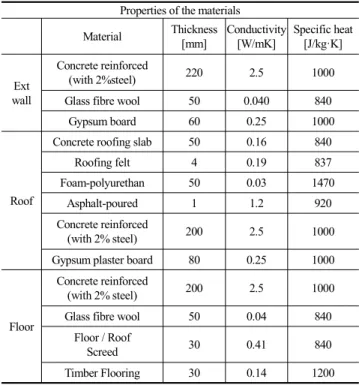
Simulations were conducted with EnergyPlus-based Design Builder 3.0. However, it is hardly possible to conduct a actual test on the simulation models because they were too simplified to know the tendency of change in energy consumption after green roof system was applied according to the proposal of this study. On the contrary, when the simulation models were set for residential building, we could get energy consumption per unit space from a real residential building and compare it with that of the models for their similarity. Figure 2 shows the shape of the simulated building used for this study. To set the conditions of insulation for the applied model, the present study reviewed the report released by the Ministry of Land, Transport and Maritime Affairs that 'insulation rate is more than 58% for 20-year-old or older building and 24% for 10-year to 20 year-old building as of 2011'. And the study applied the insulation standard of 1987[10] to the models because it supposed green roof system would have to be installed on existing building. Table 3 shows volume, floor space, size of external wall and window. The material properties of the external walls, roof and floors are shown in Table 4. Internal insulation was applied to the models.
The material properties of windows are shown in Table 5.
2.2 Condition Setting of Simulation
Those material properties were applied to the models and the models were classified by usage: residential, commercial, educational and office. And then schedule (running hours), occupants and HVAC system were chosen. For setting temperature, the study followed the recommended cooling and heating temperature standard by building usage, which is suggested by Korea Energy
Management Corporation. HVAC system was set by
usage. Floor radiation heating system was applied to a
residential building during winter season and air
conditioner during summer season while commercial and
Conditions for the simulation target Residential space model
Weather data
Climate data in Incheon, Which is similar to Seoul Climate data in Ulsan, Which is similar to Busan Climate data in Sapporo , Which is similar to Cheorwon
Run period 01/01/2010~12/31/2010
Holiday Korea, 2010
Schedule Dwell (running time : from 16 to 5) Occupancy 0.03 (people/m²)
Equipment 3.9W/m²
Lighting load density 5W/m²
HVAC Heating : Under floor heating system Cooling : Packaged direct system Setting temperature Heating set point: 21°C
Cooling set point: 26°C Conditions for the simulation target Retail space model
Schedule General sale (running time : from 9 to 18) Occupancy 0.1169 (people/m²)
Equipment 5.2W/m²
Lighting load density 5W/m²
HVAC Fan-coil unit
Setting temperature Heating set point: 20°C Cooling set point: 27°C
Conditions for the simulation target Educational space model Schedule Education (running time : from 8 to 18) Occupancy 0.552 (people/m²)
Equipment 4.7W/m²
Lighting load density 5W/m²
HVAC Fan-coil unit
Setting temperature Heating set point: 21°C Cooling set point: 26°C Conditions for the simulation target Office space model
Schedule Genetic office (running time : from 7 to 19) Occupancy 0.111 (people/m²)
Equipment 11.77W/m²
Lighting load density 5W/m²
HVAC Dual duct VAV
Setting temperature Heating set point: 21°C Cooling set point: 26°C Table 6. Conditions for the simulations
Leaf Grass and
flower Soil type Natural
soil Height of plant (m) 0.15 Thickness (m) 0.3
Leaf area index 5 Conductivity of dry soil
(W/m-K) 0.5
Leaf reflectivity 0.1 Specific Heat (J/kg-K) 1350 Leaf emissivity 0.8 Density of dry soil
(kg/m³) 800
Minimum stomatal
resistance (s/m) 180 Thermal absorptance (emissivity) 0.9 Max volumetric moisture
content at saturation 0.5 Solar absorptance 0.6 Min residual volumetric
moisture content 0.01 Visible absorptance 0.6 Initial Volumetric moisture
content 0.15 - -
Table 7. Properties of the green roof systems
educational building used fan coil unit system. And variable air volume system was applied to office building to reduce energy consumption. For weather data for the
simulation, the weather data of EnergyPlus were used. If they were not available, the meteorological data of the region with similar weather conditions were adopted. In this case, the weather data of Incheon were used for those of Seoul; the meteorological data of Ulsan were borrowed for Busan. Particularly, Cherwon is hot in summer and cold in winter. And it belongs to cold climate with moist winter.
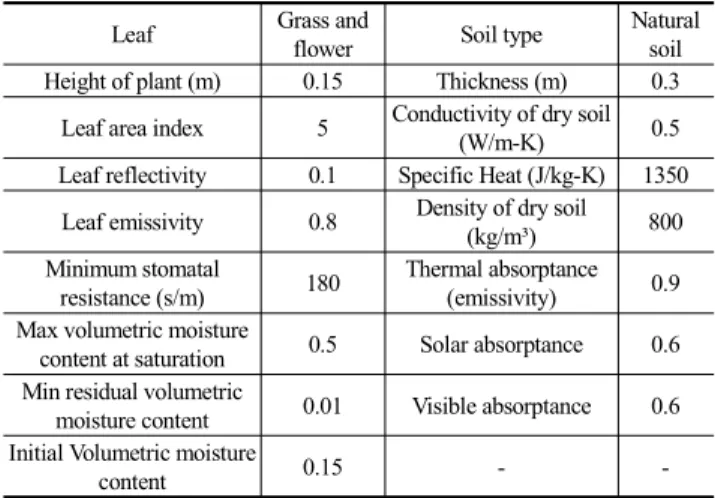
Therefore, the weather data of Sapporo, which belongs to the same Koppen's classification of climate (Dfa) as Cherwon, were used. Items set for the models by the usage of building are shown in Table 6. The present study referred to the studies (Hong Tae-Hun, Kim Ji-Min and Kim Jong-Whan) for the material properties for green roof as shown in Table 7[11]. The thickness of soil was set to 300mm. In previous studies, the thickness had been proven to have high insulation performance and structurally stable against the weight of a simulation building[12].
3. Result of Energy Consumption Simulation of Target Buildings
3.1 Cooling and Heating Energy Consumption of Building Without Green Roof System
Table 8 shows the heating energy consumption of a
single-story building without green roof system on the top,
by usage and location. It turned out that Cherwon area is of
the highest heating energy consumption in case green root
is not applied: residential building (17475.54 kWh),
commercial building (3777.08 kWh), educational building
(7002.64 kWh) and office building (4119.19 kWh) by
usage. By usage, residential building consumed the largest
heating energy as a whole and was followed by
educational, office and commercial building. Table 9
shows the cooling energy consumption of a single-story
building without green roof system on the top by usage and
location. Commercial building in Busan consumed the
highest level of cooling energy (6807.87 kWh). In regional
comparison, it turned out that cooling energy consumption
was largest in Busan while heating energy consumption
was highest in Cherwon. In comparison by usage,
commercial area used the highest cooling energy and was
followed by office educational and residential area.
Fig 3. Residential space heating energy saving
Fig 5. Educational space heating energy saving
Fig 6. Office space heating energy saving Fig 4. Commercial space heating energy saving Location
Usage Busan Seoul Cheorwon
Residence 6317.07 11661.70 17475.54
Commerce 1204.57 2502.38 3777.08
Education 2238.40 4826.55 7002.64
Office 1269.83 2691.08 4119.19
Table 8. Heating energy consumption (kWh)
Location
Usag Busan Seoul Cheorwon
Residence 2322.28 1689.41 985.463
Commerce 6807.87 5289.40 3624.39
Education 3123.52 2134.97 923.15
Office 5631.56 4348.51 2901.13
Table 9. Cooling energy consumption (kWh)
3.2 Heating Energy Conservation with Green Roof System
The results of the simulation revealed that the amount of cooling and heating energy conservation varied by region, floor and usage when green roof system was applied to a building. Figure 3 shows that the energy consumption of a residential building more decreased as green roof system is applied to higher level of floor. When the green roof system was applied to the top of a sing-story residential building, heating energy was decreased by 1070 kWh in Busan, 1483.42 kWh in Seoul and 1548.51 kWh in Cherwon, respectively. When green roof system was applied to a residential building, heating energy was conserved the most in Cherwon that belongs to continental climate zone while it was conserved the least in Busan that belongs to warm temperate zone. Compared with other floors on which green roof system was installed, the system on the top of a single-story building seemed to most contribute to the conservation of heating energy con- servation. It was assumed so because cool air from the ground directly reaches a single-story building while the insulation effect of green roof system fades away as the system is installed on upper level (5th, 10th or 15th floor) because the heating and insulation of a lower floor reduce the thermal load of an upper floor.
Figure 4 shows the amount of heating energy saved by green roof system installed on a commercial building.
W hen the green roof system was applied to the top of
a single-story com m ercial building, heating energy w as
decreased by 162.73 kWh in Busan, 281.63 kWh in Seoul and 383.90 kWh in Cherwon, respectively. While heating energy was conserved the most in Cherwon that belongs to continental climate zone, it was conserved the least in Busan that belongs to warm temperate zone. Compared with a residential building, heating energy consumption was not saved considerably as a whole. In comparison with a residential building, the heating energy consumption of a commercial building where green roof system was installed on the top of the first floor was more saved by 908.2 kWh in Busan, 1202.08 kWh in Seoul and 1164.60 kWh in Cherwon. These differences were attributed to the different schedule (running hours), number of occupants and equipment inside of the space between a residential and commercial building. In a commercial building, the amount of heating energy conservation decreased as green roof system was installed on higher but the difference was mild, within 45 kWh.
Figure 5 shows the amount of heating energy saved when green roof system was installed on an educational building. When the green roof system was applied to the top of a single-story educational building, heating energy was decreased by 220.65 kWh in Busan, 326.31 kWh in Seoul and 411.27 kWh in Cherwon, respectively. While heating energy was conserved the most in Cherwon, it was conserved the least in Busan. In an educational building, the amount of heating energy conservation decreased as green roof system was installed on higher but the difference was not considerable, within 60 kWh.
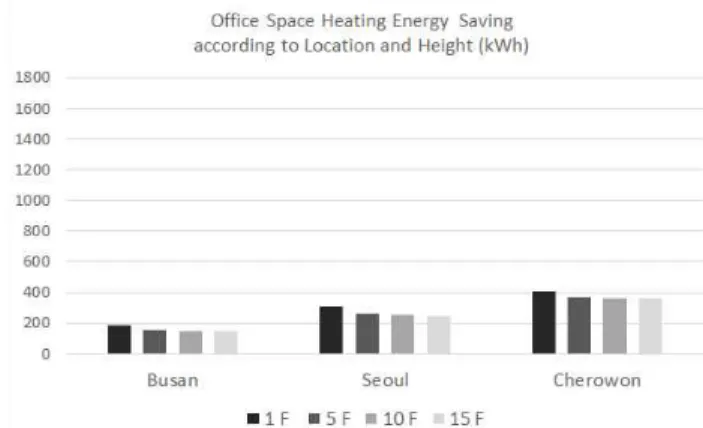
Figure 6 shows the amount of heating energy conserved when green roof system was installed on an office building. When the green roof system was applied to the top of a single-story educational building, heating energy was saved by 186.39 kWh in Busan, 310.504 kWh in Seoul and 406.92 kWh in Cherwon, respectively. While heating energy was conserved the most in Cherwon, the amount of heating energy conserved was not considerable in Busan.
The amount saved by green roof was very mild on other floors excepts the first floor.
3.3 Cooling Energy Consumption of Building With Green Roof System
Figure 7 shows that the amount of cooling energy
conservation in a residential building by region and floor when green roof system was applied to the building. When the green roof system was applied to the top of a sing-story residential building, cooling energy consumption was decreased by 97.28 kWh in Busan, 68.01 kWh in Seoul and 72.56 kWh in Cherwon, respectively. While cooling energy was conserved the most in Busan, it was conserved the least in Seoul (68.01 kWh). The difference of Busan and Seoul in the conserved cooling energy was 29.27 kWh, which is very inconsiderable in comparison with conserved heating energy. This can be explained by the fact that regional gaps of average temperature during summer are not as wide as during winter. It turned out that cooling energy was the most saved when green roof system is installed on the top of a single-story residential building.
When the system was installed on 5-storied, 10-storied and 15-storied residential building, the conservation effect was inconsiderable. It was assumed that, for a single-story building, the cooling energy load increases according to the ground temperature during summer and so the effect of green roof system gets greater.
Figure 8 shows the amount of cooling energy conser-
vation in a commercial building by region and floor when
green roof system was applied to the building. When the
green roof system was applied to the top of a single-story
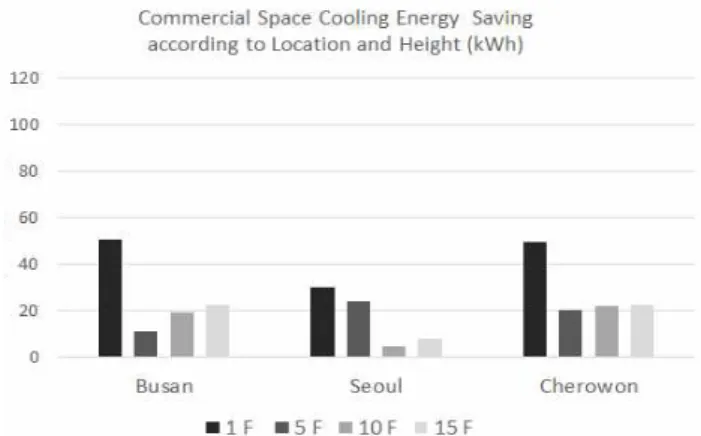
commercial building, cooling energy consumption was
decreased by 50.71 kWh in Busan, 30.41 kWh in Seoul
and 49.44 kWh in Cherwon, respectively. Compared with
a single-story residential building where green roof system
reduced the cooling energy consumption by 97.28 kWh to
2224.99 kWh in Busan, green roof system reduced the
cooling energy consumption of the commercial building
by 50.71 kWh to 6807.87 in the same region. Although
commercial building is assumed to consume more cooling
energy than a residential building, it turned out in this
study that the amount of cooling energy consumption saved
by green roof system in a commercial building wasn't greater
than that of residential building. The reason can be explained
by comparing the internal heat value of building. When a
building is used for commercial purpose, more occupants
and equipment and devices that emit heat are present inside
of the building then a residential building.
Fig 9. Educational space cooling energy saving
Fig 10. Office space cooling energy saving Fig 7. Residential space cooling energy saving
Fig 8. Commercial space cooling energy saving
Therefore, a commercial building uses more cooling energy but internal heat can't efficiently discharged out of the building due to the increase insulation effect of the roof. As a result, the conservation of cooling energy by green roof system is limited.
Figure 9 shows the amount of cooling energy conserved by region and floor when green roof system was installed on an educational building. When the green roof system was applied to the top of a single-story educational building, cooling energy consumption was decreased by 37.84 kWh in Busan, 33.00 kWh in Seoul and 36.75 kWh in Cherwon, respectively. While cooling energy was conserved the most in Busan, it was conserved the least in Seoul. By height (floor), the amount of cooling energy conservation was similar in all the floors except a single-story building.
Figure 10 shows the amount of cooling energy conserved by region and floor when green roof system was installed on an office building. When the green roof system was applied to the top of a single-story educational building, cooling energy was conserved by 67.17 kWh in Busan, 46.53 kWh in Seoul and 54.26 kWh in Cherwon, respectively. In comparison by usage, the cooling energy conservation of an office building turned out to be greater than that of all other usages (commercial and educational but residential). By the height of a building, green roof efficiency increased as the system was installed on a higher floor, except on a single-story building. However, the improvement was inconsiderable, 10 kWh.
3.4 Total Conservation of Cooling and Heating Energy by Green Roof System
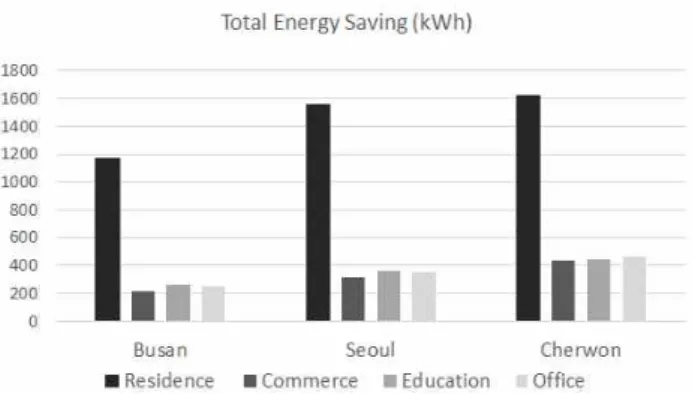
Figure 11 shows that the amount of cooling and heating energy conservation by region and usage when green roof system was applied on the top of a single-story building.
Cherwon showed the most improved energy conservation,
regardless of the usage of building: 1621.07 kWh
(residential), 433.35 kWh (commercial), 448.02 kWh
(educational) and 461.19 kWh(office). In comparison with
Busan area, it turned out that Cherwon had considerable
heating energy conservation due to its continental climate
while having low cooling energy saving. As a result, the
total cooling/heating energy conservation turned out the
Fig 11. Total energy saving
![Table 2. Outside environmental condition(Osan which is similar to Seoul)[9]](https://thumb-ap.123doks.com/thumbv2/123dokinfo/4910417.292852/2.892.468.825.696.908/table-outside-environmental-condition-osan-which-similar-seoul.webp)