1 접수 2012년 7월 19일, 수정(1차: 2012년 8월 27일, 2차: 2012년 10월 15일), 게재확정 2012년 10월 16일 Received 19 July 2012; Revised(1st: 27 August 2012, 2nd: 15 October 2012); Accepted 16 October 2012
2 도시생태학연구센터 Urban Ecology Research Center, 124-22 Bangi-dong, Songpa-gu, Seoul(138-052), Korea([email protected]) 3 도시생태학연구센터 Urban Ecology Research Center, 124-22 Bangi-dong, Songpa-gu, Seoul(138-052), Korea([email protected]) 4 서울시립대학교 대학원 조경학과 Dept. of Landscape Architecture, Graduate School, Univ. of Seoul(130-743), Korea
* 교신저자 Corresponding author([email protected])
용문산 상원사계곡 식물군집구조 분석 1
김종엽2⋅기경석3*⋅민건영4
A Study for Plant Community Structure Analysis in Sangwonsa(Temple) Valley, Yongmunsan(Mt.)
1Jong-Yup Kim
2, Kyong-Seok Ki
3*, Geon-Young Min
4요 약
본 연구는 용문산 상원사계곡의 식생구조 특성을 분석하여 온대 중부지방 대규모 산림의 연구 및 기초자료를 제공하 고자 수행하였다. 상원사계곡 현존식생 조사결과 참나무류림이 75.0%로 넓게 분포하였다. 낙엽활엽수군집 내에 설정한 17개 조사지(단위면적: 400㎡)의 평균상대우점치를 통한 군집분류 결과 5개 유형으로 구분되었다. 5개 유형은 서어나 무와 졸참나무가 우점하는 군집, 졸참나무와 굴참나무가 우점하는 군집, 신갈나무와 졸참나무가 우점하는 군집, 졸참나 무가 우점하는 군집, 고로쇠나무가 우점하는 군집이었다. 서어나무, 고로쇠나무 등과 경쟁하는 참나무류림은 향후 낙엽활엽수림으로 천이가 예측되었다. 샤논의 종다양도지수(H')는 0.3708∼1.3083이었다.
주요어: 천이, TWINSPAN, 종다양도지수, 상대우점치, 졸참나무
ABSTRACT
This study is aimed at analyzing the structural characteristics of vegetation in the Sangwonsa(Temple) valley, Yongmunsan(Mt.), and to collect basic data for research of large mountains which are located in the temperate, central region. The research on the entire vegetation structure of Sangwonsa(Temple) valley observed that oak trees are distributed over a wide area, accounting for 75.0% of the total vegetation in the area. We examined 17 plots(unit area: 400㎡) in the deciduous forest, dividing the trees into 5 community types based on the average important value. The 5 community types are as follows: A mixed dominant group of Carpinus laxiflora and
Quercus serrata, a mixed dominant group of Quercus serrata and Quercus variabilis, a mixed dominant group
of Quercus mongolica and Quercus serrata, a dominant group of Quercus serrata, a dominant group of Acerpictum supsp. mono. It is expected that the oak trees competing with Carpinus laxiflora and Acer pictum supsp.
mono would flourish in a deciduous forest. The Shannon’s species diversity index(H') was 0.3708 ~ 1.3083.
KEY WORDS: SUCCESSION , TWINSPAN, SPECIES DIVERSITY INDEX, IMPORTANT VALUE,
Quercus serrata
서 론
양평 용문산은 백두산, 금강산, 설악산, 태백산, 덕유산, 지리산, 한라산과 같이 고산에 속하는 지형을 갖추고 있으 며, 중부산악지역 중심으로 나타나는 북방식생과 남방식생 -극상(climax)고산식물이 교차하는 한반도 내륙에서의 식 생전이대이다. 용문산의 식물상에 관한 조사는 여러 학자들 에 의해 실시되었으나, Lee(1964)에 의해 475종이 고도별 로 정리된 것이 체계적인 것으로 처음이었고, 이후 Kim (1984)에 의해 식물구계가 조사되어 용문산은 서어나무, 졸 참나무 등이 나타나는 온대중부구이며 소산식물은 540종류 로 밝혀졌다. 또한 Lee et al.(1990b)은 22년 전 용문산 산림 의 식물군집구조 분석 연구에서 소나무군집 천이계열 추정 을 소나무림에서 졸참나무, 갈참나무, 신갈나무 등의 참나 무류림과 서어나무림으로 발달할 것으로 예측하였다.
우리나라에서 낙엽성 참나무류의 분포는 온대 수종으로 상수리나무, 굴참나무, 갈참나무, 졸참나무, 떡갈나무, 신갈 나무 6종이 기본종으로 분포하고 있다(Lee, 1961a; Lee, 1961b; Kim et al., 1981). 상수리나무, 갈참나무, 졸참나무, 굴참나무 등은 온대북부까지 분포하며 신갈나무는 한라산 과 북부 및 중부의 고산지대 부근과 북부의 백두산 등지까 지 분포하고 있다(Lee, 2007). 낙엽활엽수의 천이는 Kang et al.(1982)이 광릉 임업시험림 내의 자연림을 대상을 ordination 분석을 통해 소나무에서 졸참나무로, 갈참나무 에서 서어나무를 거쳐 까치박달 등으로 천이계열을 제시하 였으며, Park et al.(1987)이 서울시와 인접한 북한산국립공 원에서 DCA 분석을 통해 소나무에서 졸참나무, 산벚나무, 팥배나무에서 신갈나무, 들메나무, 물푸레나무로의 천이과 정을 추정한 바 있다. Park et al.(1988)은 치악산국립공원 구룡사-비로봉구간에서 DCA를 이용한 ordination 분석을 통해 능선 및 중북부에서는 소나무에서 신갈나무 및 참나무 류, 팥배나무에서 서어나무로, 계곡저지대에서는 소나무에 서 참나무류를 거쳐 층층나무, 까치박달로 진행단계에 있음 을 밝혔다.
현재 중부지방의 식물군집구조 분석 연구는 주로 소나무 림의 식생구조 특성을 밝히고 관리방안을 제시하는게 대부 분 이었다(Lim et al., 1980; Lee et al., 1996; Lee et al., 1998; Lee et al., 2005). 또한 온대 중부지방 식생의 생태적 천이에 관한 연구는 주로 국립공원을 대상으로 진행되었다 (Kwak, 2001). 국립공원을 대상으로 실시한 연구결과로는 북한산국립공원(Park et al., 1987; Choi et al., 1993), 치악 산국립공원(Park et al., 1988), 설악산국립공원(Lee et al., 1997), 덕유산국립공원(Lee et al., 1994; Oh, 1994), 소백산 국립공원(Lee et al., 1993a; Lee et al., 1993b), 속리산국립
공원(Lee et al., 1990a), 가야산국립공원(Park et al., 1989), 계룡산국립공원(Han et al., 2001), 지리산국립공원(Park et al., 1991; Lee et al., 1991) 등이 이루어졌으며, 서울과 인 접한 경기권에서는 Kang et al.(1982)이 광릉 임업시험림 내의 자연림을 대상으로 연구를 진행한 바 있다. 그러나 용 문산을 대상으로 식물군집구조 특성을 밝힌 연구는 Lee et al.(1990b)에 의한 연구 이후 진행된 바가 없는 실정이었다.
따라서 본 연구는 용문산 상원사계곡의 식생구조를 분석하 고 천이 경향을 예측하여 중부지방 대규모 산림의 연구 및 기초자료를 제공하는데 목적이 있다.
연구방법
1. 조사범위 및 시기
본 연구는 양평군 용문면 용문산 상원사에서 약 2km 구 간 계곡 주변의 낙엽활엽수 군락을 대상으로 하였다. 연구 대상지는 비교적 급경사를 이루는 상원사의 동쪽 유역권을 대상으로 하였다. 본 유역은 상원사 및 등산로가 포함되어 인간에 의한 생태계 훼손이 발생하는 지역이며, 참나무류 및 낙엽활엽수가 발달되어 있는 숲이었다. 조사구는 10m×
10m 크기의 방형구 4개(400㎡)를 1개소로 하여 상원사의 동쪽 계곡부에 위치한 참나무류림 및 낙엽활엽수림에 설정 하였다. 조사구는 총 17개소를 설정하였으며 2010년 5월에 조사하였다. 조사구 위치도는 Figure 1과 같다.
Figure 1. The location map of research site in Sangwonsa (Temple) valley, Yongmunsan(Mt.)
Type Area(㎡) Ratio(%)
Quercus Spp. community
1. Qs community 958,805 27.8 2. Qv community 54,028 1.6 3. Qm community 34,161 1.0 4. Qs-Qm community 1,536,113 44.6 Subtotal 2,583,107 75.0
Quercus-Pd community 5. Qs-Pd community 3,354 0.1
Quercus-deciduous borad leaved community
6. Qs-Fr community 9,230 0.3 7. Qs-Ca community 24,524 0.7
Subtotal 33,754 1.0
Quercus-artificial forest community 8. Qs-Cc community 9,773 0.3
Pd community 9. Pd community 766,290 22.2
Pd-Quercus community
10. Pd-Qs community 179 0.0 11. Pd-Qm community 13,265 0.4
Subtotal 13,445 0.4
Fr-Quercus community
12. Fr-Qs community 5,340 0.2 13. Fr-Qa community 509 0.0
Subtotal 5,849 0.2
Fr-deciduous borad leaved community 14. Fr-Co community 6,871 0.2 Artificial forest community
15. Pr community 2,208 0.1 16. Lk community 2,064 0.1
Subtotal 4,272 0.1
Others
17. Planting area 65 0.0
18. Temple 8,865 0.3
19. Road 8,324 0.2
Subtotal 17,254 0.5
Total 3,410,191 100.0
* Qs: Quercus serrata, Qv: Quercus variabilis, Qm: Quercus mongolica, Qa: Quercus aliena, Pd: Pinus densiflora, Fr:
Fraxinus rhynchophylla, Ca: Carpinus laxiflora, Co: Cornus controversa, Cc: Castanea crenata,, Pr: Pinus rigida, Lk:
Larix kaempferi
Table 1. The distribution rate of actual vegetation types in the Sangwonsa(Temple) valley,
Yongmunsan(Mt.)
2. 조사분석 방법1) 현존식생 조사
상원사계곡의 낙엽활엽수 분포현황을 파악하고자 산림 지역을 대상으로 현존식생을 조사하였다. 현존식생은 1/5,000 수치지형도를 기초로 교목층 우점종의 식생상관을 바탕으로 현존식생유형을 구분하였으며 최소 식생단위 면 적은 50m×50m(2,500㎡)를 기준으로 하였다.
2) 식생구조 조사
현존식생 조사결과를 바탕으로 상원사계곡에 분포하는 대표적 낙엽활엽수림 유형별 식생구조를 분석하기 위해 식 생조사를 실시하였다. 식생조사는 Monk et al.(1969)의 방 법을 참조하여 교목층, 아교목층, 관목층으로 구분하여 수 관층위별로 실시하였다. 교목층과 아교목층은 10m×10m 크기의 방형구에서 수목의 수고, 지하고, 흉고직경, 수관폭 (장변×단변)을, 관목층은 각 방형구에서 5m×5m 크기로 중 첩해서 설치한 소형 방형구 1개소에서 수목의 수고, 지하고,
수관폭(장변×단변)을 조사하였다.
3) 식물군집구조 분석
식생조사 자료를 토대로 각 수종의 상대적 우세를 비교하 기 위하여 Curtis and McIntosh(1951)의 중요치(importance percentage: I.P.)를 통합하여 백분율로 나타낸 상대우점치 (Brower and Zar, 1977)를 수관층위별로 분석하였다. 상대 우점치(importance percentage: I.P.)는 (상대밀도+상대피 도)/2로 계산하였으며 개체들의 크기를 고려하여 수관층위 별로 가중치를 부여한 (교목층I.P.×3+아교목층I.P.×2+관목 층I.P.×1)/6으로 평균상대우점치(mean importance percentage:
M.I.P.)를 구하였다(Park et al., 1987). 군집의 분류는 상대우 점치 분석자료를 토대로 TWINSPAN에 의한 classification 분석(Hill, 1979)을 실시하였다. 또한 구분된 식물군집별 Shannon의 종다양도지수(H')(Pielou, 1975) 및 균재도(J'), 종수 및 개체수, 흉고직경급별 분포를 분석하였다.
결과 및 고찰
Community Ⅰ Ⅱ Ⅲ
Plot number 6 7 5 8 9 11 13 14
Altitude(m) 435 455 435 480 450 460 385 390
Aspect S25W N60E S25W S10E S45E S35W S25W S20E
Slope(°) 20 15 25 25 20 25 20 25
Canopy layer
Height(m) 18 18 22 16 18 21 24 16
Mean DBH(㎝) 30 38 25 28 27 28 25 25
Coverage(%) 90 85 85 80 85 75 75 90
Understory layer
Height(m) 6 7 5 6 5 4 6 6
Mean DBH(㎝) 6 14 7 7 5 4 8 6
Coverage(%) 40 25 35 60 40 40 60 60
Shrub layer
Height(m) 1 1.5 1.5 1 1 1 1 1
Coverage(%) 20 50 20 10 15 25 80 60
Table 2. Description of the physical features and stratum of each plot by TWINSPAN stand classfication
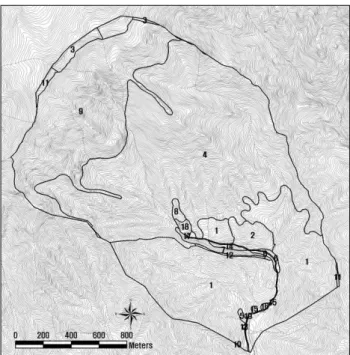
Figure 2. Actual vegetation map in the Sangwonsa(Temple) valley, Yongmunsan(Mt.) 1. 현존식생
Table 1, Figure 2는 상원사계곡 현존식생을 분석한 결과 이다. 현존식생유형별 현황을 살펴보면 참나무류림(75.0%) 이 대부분을 차지하고 있었으며, 소나무류림(22.2%)이 동 측과 북서쪽에 일부 분포하고, 물푸레나무-참나무류림 (0.2%), 물푸레나무-층층나무림(0.2%)이 계곡 주변에 일부 분포하고 있었다. 그 외에 인공림(0.1%)이 분포하고 있으며 기타 지역(0.5%)이 분포하고 있었다. 참나무류림에서 가장 넓게 분포하고 있는 것은 졸참나무-신갈나무림으로 44.6%
분포하고 있었으며, 졸참나무림은 27.8%로 두 번째로 넓게
분포하고 있었다. 낙엽활엽수 군집인 고로쇠나무 군집은 주 로 계곡을 따라 소면적으로 분포하였고(Park et al., 1988;
Han et al., 2001; Bae, 2011; Kang, 2012), 참나무류 군집은 주로 사면 및 능선부에 대면적으로 분포하였다.
상원사계곡 유역권의 현존식생은 용문산 전체가 참나무 류림 49.8%, 낙엽활엽수림 3.5%와 비교하였을 때 참나무 류림의 비율이 높은 계곡이었고, 서울시 산림과 비교하였을 때 수락산이 참나무류림 47.5%, 낙엽활엽수림 0.3%, 북한 산은 참나무류림 22.7%, 낙엽활엽수림 0.4%, 관악산은 참 나무류림 34.2%, 낙엽활엽수림 0.3%분포하고 있어(Kwak, 2011), 참나무류림의 분포 비율은 높고, 낙엽활엽수림의 분 포 비율은 유사한 수준이었다.
2. 식물군집구조
1) 조사지 개황
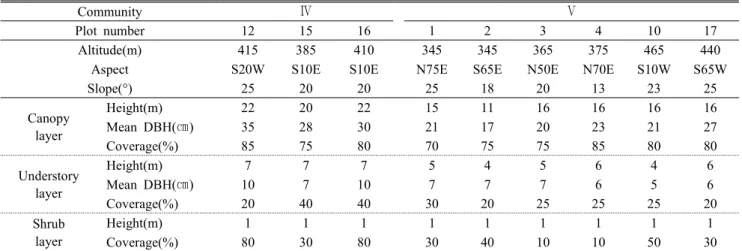
Table 2는 용문산 상원사 계곡 지역에 설정한 17개 조사 지에 대하여 TWINSPAN에 의한 classification 분석에 의 해 구분된 군집별 일반적 개황을 나타낸 것이다. 총 5개로 구분된 군집은 대부분 참나무류가 우점종이었으며, 교목층 에 동반 출현한 경쟁 수종 또는 아교목층, 관목층 우점종의 차이가 있었다. 군집 Ⅰ은 2개 조사구가 포함되었으며, 교 목층에서 서어나무와 졸참나무가 경쟁하고 있는 서어나무- 졸참나무 군집으로 조사지는 해발 435∼455m, 경사 15∼
20°의 남서사면, 북동사면에 위치하였고, 교목층 평균수고 18m, 평균 흉고직경 34㎝이었다. 군집 Ⅱ는 1개 조사구가 포함되었으며, 교목층에서 졸참나무와 굴참나무가 우점하 고 있었으며, 아교목층에는 당단풍나무가 우점하는 졸참나 무-굴참나무군집으로 조사지는 해발 435m, 경사 25°의 남 서사면에 위치하였고, 교목층 평균수고 22m, 평균 흉고직
Community Ⅳ Ⅴ
Plot number 12 15 16 1 2 3 4 10 17
Altitude(m) 415 385 410 345 345 365 375 465 440
Aspect S20W S10E S10E N75E S65E N50E N70E S10W S65W
Slope(°) 25 20 20 25 18 20 13 23 25
Canopy layer
Height(m) 22 20 22 15 11 16 16 16 16
Mean DBH(㎝) 35 28 30 21 17 20 23 21 27
Coverage(%) 85 75 80 70 75 75 85 80 80
Understory layer
Height(m) 7 7 7 5 4 5 6 4 6
Mean DBH(㎝) 10 7 10 7 7 7 6 5 6
Coverage(%) 20 40 40 30 20 25 25 25 20
Shrub layer
Height(m) 1 1 1 1 1 1 1 1 1
Coverage(%) 80 30 80 30 40 10 10 50 30
*Ⅰ: Carpinus laxiflora-Quercus serrata comm., Ⅱ: Q. serrata-Q. variabilis comm., Ⅲ: Q. mongolica-Quercus serrata comm.,
Ⅳ: Quercus serrata comm., Ⅴ: Acer mono comm.
(Table 2. Continued)
Figure 3. Cluster analysis of 17 plots by TWINSPAN
* Qs: Quercus serrata, Qm: Quercus mongolica, Qv: Quercus variabilis, Ca: Carpinus laxiflora, Ac: Acer
pictum supsp. mono
* Ⅰ: Carpinus laxiflora-Quercus serrata comm., Ⅱ: Q. serrata-Q. variabilis comm., Ⅲ: Q. mongolica-Quercus
serrata comm., Ⅳ: Quercus serrata comm., Ⅴ: Acer mono comm.
경 25㎝이었다. 군집 Ⅲ은 5개 조사구가 포함되었으며, 교 목층에서 신갈나무, 졸참나무가 우점하고 있는 신갈나무-졸 참나무군집으로 조사지는 해발 385~480m, 경사 20~25°인 남동사면, 남서사면에 위치하였고, 교목층 평균수고 19m, 평균 흉고직경 27㎝이었다. 군집 Ⅳ는 3개 조사구가 포함되 었으며, 아교목층에서 쪽동백나무가 우점하고, 관목층에 조 릿대가 우점하고 있는 졸참나무군집으로 조사지는 해발 385~460m, 경사 20~25°인 남동사면, 남서사면에 위치하였 고, 교목층 평균수고 20m, 평균 흉고직경 26㎝이었다. 군집
Ⅴ는 6개 조사구가 포함되었으며, 교목층에서 고로쇠나무 가 우점하고 있었으며, 아교목층에서 당단풍나무와 고로쇠 나무가 우점하는 고로쇠나무군집으로 조사지는 해발 345~465m, 경사 13~25°인 북동사면, 남서사면, 남동사면
에 위치하였고, 교목층 평균수고 15m, 평균 흉고직경 21㎝
이었다. 조사구의 지형특성을 살펴보면 낙엽활엽수 군집인 군집 Ⅰ,Ⅴ는 계곡부에 위치하고 있었으며, 졸참나무-굴참 나무, 졸참나무 군집인 군집 Ⅱ, Ⅳ는 사면부에 위치하고 있었고, 신갈나무-졸참나무 군집인 군집 Ⅲ은 능선 및 사면 부에 위치하고 있었다.
2) 식물군집 분류
Figure 3은 용문산 상원사 계곡에 설정한 17개 조사구별 종조성을 분석하고자 classification 분석 중 TWINSPAN 분석을 실시하여 군집을 분류하였다. 군집분류는 많은 식분 (stand)에 대하여 식생자료를 바탕으로 식별종(differential species)에 의해 구분하는 것이다. 분석결과 제 1division에
Community Ⅰ Ⅱ Ⅲ
Plot number 6 7 5 8 9 11 13 14
Quercus serrata
22.9 20.0 26.9 15.0 19.5 12.2 33.7 5.8Q. mongolica
5.2 8.7 3.6 38.1 35.9 18.1 14.4 34.4Q. variabilis
9.2 - 15.4 5.3 - 19.5 5.5 6.7Styrax obassia
7.6 10.5 5.3 5.7 7.5 13.4 7.7 11.8Acer pictum supsp. mono
- - 0.9 - - - 1.0 -Carpinus laxiflora
24.0 27.0 2.0 0.6 - - - 1.6Lindera obtusiloba
4.1 4.6 5.1 3.7 8.5 9.2 1.5 4.0Sasa borealis
- - - - - 1.2 13.9 8.1Prunus sargentii
2.8 0.1 2.8 3.2 7.4 3.7 1.5 2.9Zelkova serrata
- - - - - - - -Fraxinus rhynchophylla
- - - - - 2.1 - 2.1Cornus controversa
- 0.4 2.7 - - - - -Tilia amurensis
2.1 - - 0.7 - - - -Celtis jessoensis
- - - - - - - -Sorbus alnifolia
- 1.9 - 0.5 3.3 4.6 0.9 -Callicarpa japonica
1.0 0.5 1.4 0.4 0.5 0.3 - -Deutzia uniflora
1.6 0.9 0.4 0.4 - - - -Symplocos chinensis for. pilosa
- - 5.3 - - 3.2 2.2 1.0Carpinus cordata
- 6.2 - - - - - -Kalopanax septemlobus
- - 3.7 - - - - -Ulmus davidiana var. japonica
- - - - - 0.4 - -Magnolia sieboldii
- 3.3 - - - - - 0.7Rhododendron schlippenbachii
2.3 1.6 - 2.6 1.0 - - 3.9Staphylea bumalda
- - 0.7 - - - - -Actinidia arguta
- - - 2.6 - - - -Rhus tricocarpa
- - 0.5 0.5 - - 0.1 2.7Crataegus pinnatifida
- - - - - - - -Hydrangea serrata for. acuminata
0.4 0.3 2.8 0.4 - - - -Hovenia dulcis
- - - - - - - -Acer pseudosieboldianum
13.2 6.0 18.5 19.1 14.3 11.4 17.6 14.0Other 3.8 8.0 2.0 1.4 2.0 0.8 - 0.1
Table 3. Mean importance percentage of the woody plants by the stratum in seven community types classified by TWINSPAN in the Sangwonsa(Temple) valley, Yongmunsan(Mt.)
서는 왼쪽으로 신갈나무, 졸참나무, 오른쪽으로 고로쇠나무 가 식별종이었다. 제 2division에서는 오른쪽으로 졸참나무 가 식별종이었다. 제 3division에서는 왼쪽으로 서어나무가 식별종이었다. 제 4division에서는 왼쪽으로 굴참나무에 의 해서 구분되었다. 분류결과 5개 군집 모두 참나무류가 전체 적으로 분포하였다. 제 1division에서 왼쪽으로 분류된 군집 은 참나무류가 다수 서식하는 군집이였으며, 오른쪽으로 분 류된 군집은 고로쇠나무 및 낙엽활엽수가 우점하는 군집으 로 구분되었다.
또한, TWINSPAN을 통한 분석을 검토하기 위하여 평균 상대우점치를 이용하였다. Table 3은 상원사 계곡에서 구분 된 5개 군집의 조사구별 평균상대우점치를 정리한 것이다.
군집 Ⅰ, Ⅴ는 참나무류와 낙엽활엽수가 경쟁하고 있었으 며, 군집 Ⅱ, Ⅲ, Ⅳ는 참나무류가 우점하고 있었다. 군집
Ⅰ(조사구 6, 7)은 서어나무, 졸참나무가 우점하는 가운데 경쟁을 하고 있었고, 군집 Ⅱ(조사구 5)는 졸참나무와 굴참 나무가 우점하는 군집이었다. 군집 Ⅲ(조사구 8, 911,13,14) 은 신갈나무, 졸참나무가 우점하고 있는 군집이었으며, 군 집 Ⅳ(조사구 12, 15, 16)는 졸참나무가 우점하는 군집이었 다. 군집 Ⅴ(조사구 1, 2, 3, 4, 10, 11)은 고로쇠나무가 우점 하고 있는 군집이었다.
3) 군집별 상대우점치
Table 4는 상원사계곡의 층위별 상대우점치를 분석한 결과 이다. 군집 Ⅰ(조사구 6,7)은 졸참나무(I.P.: 40.3%), 서어나무 (I.P.: 32.7%)가 우점하는 가운데 경쟁을 하고 있었고, 아교목 층에서는 쪽동백나무(I.P.: 26.3%), 서어나무(I.P.:26.3%), 당 단풍나무(I.P.:23.2%)의 세력이 높았다. 따라서 향후 서어
Community Ⅳ Ⅴ
Plot number 12 15 16 1 2 3 4 10 17
Quercus serrata
22.9 36.0 39.9 17.7 - 15.3 3.2 3.3 -Q. mongolica
- - 2.0 - - - 1.5 3.5 -Q. variabilis
15.2 - - 1.6 - - - - -Styrax obassia
7.6 20.6 2.7 3.8 - 7.1 9.6 2.9 2.0Acer pictum supsp. mono
- 5.2 3.5 17.1 29.0 12.1 4.8 23.5 14.8Carpinus laxiflora
- 1.0 - - - 4.3 19.9 6.9 -Lindera obtusiloba
0.3 3.8 2.5 4.5 0.4 1.4 3.4 1.6 0.8Sasa borealis
14.0 - 10.7 2.9 0.2 - - 1.0 -Prunus sargentii
5.5 3.2 - 5.5 2.0 2.1 8.2 - -Zelkova serrata
- - - 2.6 4.6 1.9 1.6 4.3 34.5Fraxinus rhynchophylla
2.5 5.5 8.5 4.8 7.1 5.5 - - 4.2Cornus controversa
- - - - 11.6 8.4 8.5 7.7 2.8Tilia amurensis
4.9 - - 10.4 5.7 2.1 2.6 - -Celtis jessoensis
- - 1.6 2.2 3.9 3.1 - 11.6 4.4Sorbus alnifolia
3.5 0.3 7.8 - - - - 0.2 -Callicarpa japonica
0.2 3.0 2.5 0.5 0.7 1.0 3.4 0.7 6.4Deutzia uniflora
2.0 4.3 - 0.3 4.3 2.1 0.6 2.1 1.2Symplocos chinensis for. pilosa
- 1.1 0.6 1.7 0.2 - - 1.9 0.4Carpinus cordata
- 1.2 0.8 - - 2.8 6.5 - -Kalopanax septemlobus
3.0 - 0.1 - - - 2.5 0.1 7.1Ulmus davidiana var. japonica
- - 2.0 7.0 2.2 0.2 - 3.9 -Magnolia sieboldii
- - - - 0.8 2.5 4.2 - -Rhododendron schlippenbachii
- - - - - - - - -Staphylea bumalda
0.1 - 0.2 0.4 2.8 0.5 2.7 1.9 1.8Actinidia arguta
- - - - - - - - 6.5Rhus tricocarpa
3.5 - - - - - - - -Crataegus pinnatifida
- - - - - - - 6.3 -Hydrangea serrata for. acuminata
- 0.4 - - - 0.5 0.3 0.3 0.3Hovenia dulcis
- - - - - 5.6 - - -Acer pseudosieboldianum
13.6 7.0 12.2 5.3 11.2 14.7 13.9 10.9 10.7Other 1.3 7.5 2.4 11.8 13.6 7.0 2.7 5.4 2.1
*Ⅰ: Carpinus laxiflora-Quercus serrata comm., Ⅱ: Q. serrata-Q. variabilis comm., Ⅲ: Q. mongolica-Quercus serrata comm., Ⅳ: Quercus serrata comm., Ⅴ: Acer mono comm.
(Table 3. Continued)
나무의 세력이 커지고, 졸참나무가 도퇴되는 천이가 예측되 었다. 군집 Ⅱ(조사구 5)는 졸참나무(I.P.: 47.4%)가 우점하 고 있었으며, 굴참나무(I.P.:26.3%)도 세력이 높았다. 아교 목층은 당단풍나무(I.P.: 50.5%)의 세력이 가장 컸으며, 쪽 동백나무(I.P.:12.6%)도 출현하였다. 관목층에서는 졸참나 무(I.P.: 26.9%), 당단풍나무(I.P.: 18.5%), 굴참나무(I.P.:
15.4%)가 주요 출현종이였다. 따라서 향후 졸참나무와 굴 참나무가 우점을 하는 군집으로 유지될 것으로 판단되었다.
군집 Ⅲ(조사구 8, 9, 11, 13, 14)는 신갈나무(I.P.: 44.5%)가 우점하고 있었으며, 졸참나무(I.P.: 32.8%)도 세력이 높았 다. 아교목층은 당단풍나무(I.P.: 35.3%)의 세력이 가장 컸 으며, 쪽동백나무(I.P.: 26.2%), 신갈나무(I.P.:15.7%)도 출 현하였다. 관목층에서는 조릿대(I.P.: 39.4%), 생강나무
(I.P.: 19.3%)가 주요 출현종이였다. 따라서 향후 신갈나무 와 졸참나무가 우점을 하는 군집으로 유지될 것으로 판단되 었다. 군집 Ⅳ(조사구 12, 15, 16)는 졸참나무(I.P.: 68.7%) 가 우점하고 있었다. 아교목층은 쪽동백나무(I.P.: 43.0%), 당단풍나무(I.P.: 23.8%)의 세력이 가장 컸다. 관목층에서 는 조릿대(I.P.: 56.9%), 생강나무(I.P.: 12.0%)가 주요 출현 종이였다. 따라서 향후 졸참나무가 우점을 하는 군집으로 유지될 것으로 판단되었으며, 관목층에 조릿대가 다수 분포 하고 있어서 다른 종의 생장에 방해를 주는 것으로 판단되 었다. 군집 Ⅴ(조사구 1, 2, 3, 4, 10, 17)는 고로쇠나무(I.P.:
20.0%), 졸참나무(I.P.: 14.5%)가 경쟁관계이며, 층층나무 (I.P.: 11.9%)도 세력이 높았다. 아교목층은 당단풍나무 (I.P.: 26.5%), 고로쇠나무(I.P.: 18.1%), 쪽동백나무(I.P.:
Community I II III Ⅳ Ⅴ
Species name C U S M C U S M C U S M C U S M C U S M
Quercus serrata
40.3 6.8 0.6 22.5 47.4 8.9 1.4 26.9 33.8 2.93 - 17.9 68.7 0.9 0.3 34.7 14.5 - - 7.2Q. mongolica
13.8 - 0.7 7.0 3.5 4.3 2.4 3.6 44.5 15.7 0.5 27.6 1.6 - - 0.8 1.4 - 0.1 0.7Q. variabilis
8.1 - - 4.0 27.0 5.6 - 15.4 15.7 - 0.2 7.9 6.9 - - 3.5 0.7 - - 0.4Styrax obassia
- 26.3 - 8.8 2.2 12.6 - 5.3 - 26.2 0.4 8.8 1.0 43.0 - 14.8 0.6 14.0 0.4 5.0Acer pictum supsp. mono
- - - 2.7 - 0.9 - 0.5 - 0.2 1.5 6.8 0.4 3.1 20.0 18.1 0.8 16.2Carpinus laxiflora
32.7 26.3 - 25.1 4.1 - - 2.0 0.7 0.5 - 0.5 - - 1.5 0.3 8.9 3.6 - 5.7Lindera obtusiloba
- - 27.1 4.5 - - 30.6 5.1 - 2.0 19.4 3.9 - - 12.0 2.0 - 0.4 11.4 2.1Sasa borealis
- - - 39.4 6.6 - - 56.9 9.5 - - 6.5 1.1Prunus sargentii
- 4.9 0.6 1.7 - 8.5 - 2.8 4.0 5.3 - 3.8 4.3 1.1 - 2.5 1.8 7.3 0.2 3.3Zelkova serrata
- - - 11.4 3.1 0.6 6.8Fraxinus rhynchophylla
- - - 0.9 0.8 - 0.7 7.0 6.6 - 5.7 6.0 1.7 0.2 3.6Cornus controversa
- - 1.7 0.3 5.5 - - 2.7 - - - 11.9 0.9 0.5 6.3Tilia amurensis
2.3 - - 1.1 - - - 0.6 - 0.2 - 2.0 - 0.7 3.9 6.2 - 4.0Celtis jessoensis
- - - 1.3 - 0.4 5.6 1.5 2.2 3.7Sorbus alnifolia
- 1.1 4.6 1.1 - - - - 0.5 3.8 0.7 1.6 2.3 5.1 0.7 3.0 - - 0.2 0.0Callicarpa japonica
- - 3.6 0.6 - - 8.3 1.4 - - 0.8 0.13 - - 10.7 1.8 - - 9.1 1.5Deutzia uniflora
- - 6.7 1.1 - - 2.4 0.4 - - 0.2 0.0 - - 10.3 1.7 - - 11.3 1.9Symplocos chinensis for. pilosa
- - - 4.8 22.1 5.3 - 1.0 4.1 1.0 - 2.0 - 0.7 - 0.9 2.3 0.7Carpinus cordata
- 6.6 5.2 3.1 - - - 0.7 - 0.2 - 2.4 - 0.8 1.9 2.6 0.2 1.9Kalopanax septemlobus
- - - - 7.4 - - 3.7 - - - - 1.2 - 0.3 0.6 2.7 - 0.2 1.4Ulmus davidiana var. japonica
- - - 0.4 0.1 - 1.7 0.3 0.6 2.6 2.6 1.2 2.4Magnolia sieboldii
- 3.7 1.2 1.4 - - - 0.5 - 0.2 - - - 2.1 3.3 1.2Rhododendron schlippenbachii
- 1.2 6.2 1.4 - - - 1.4 5.8 1.4 - - - -Staphylea bumalda
- - - 2.0 - 0.7 - - - 0.7 0.1 - - 9.1 1.5Actinidia arguta
- - - 5.2 0.9 - - - 1.3 2.2 0.8Rhus tricocarpa
- - - 2.8 0.5 - 2.2 0.2 0.8 1.5 - - 0.7 - - - -Crataegus pinnatifida
- - - 2.4 0.6 0.9Hydrangea serrata for.
acuminata
- - 1.9 0.3 - - 16.9 2.8 - - 0.2 0.0 - - - 0.1 - - 1.3 0.2Hovenia dulcis
- - - 1.5 0.8 - 1.0Acer pseudosieboldianum
- 23.2 13.2 9.9 - 50.5 10.3 18.5 - 35.3 19.0 14.9 - 23.8 3.2 8.5 1.1 26.5 7.6 10.7Other 2.9 - 26.7 5.9 3.1 - 2.9 2.0 - 0.5 3.5 0.8 4.0 3.4 2.5 3.5 3.6 4.2 28.5 8.0
* Ⅰ: Carpinus laxiflora-Quercus serrata comm., Ⅱ: Q. serrata-Q. variabilis comm., Ⅲ: Q. mongolica-Quercus serrata comm., Ⅳ: Quercus serrata comm., Ⅴ: Acer mono comm.
* C: importance percentage in canopy layer, U: importance percentage in understory layer, S: importance percentage in shrub layer, M: mean importance percentage
Table 4. Importance percentage of the woody plant species related community groups
14.0%)의 세력이 가장 컸다. 관목층에서는 생강나무(I.P.:11.4%), 매화말발도리(I.P.: 11.3%)가 주요 출현종이였다.
따라서 고로쇠나무의 세력이 커지고, 졸참나무가 도퇴되는 천이가 예측되었다. 군집유형별 상대우점치 결과를 통한 향
후 식생발달 예측을 종합하면 현재의 참나무류림이 유지될 것으로 예측되는 군집(군집 Ⅱ, Ⅲ, Ⅳ), 참나무류와 낙엽활 엽수의 경쟁에 의해 낙엽활엽수로 천이가 예측되는 군집(군 집 Ⅰ, Ⅴ)으로 구분되었다.
Commuity H'(Shannon) J'(evenness) D'(dominance) H'max
Ⅰ 0.4436∼0.9431 0.4110∼0.7917 0.2083∼0.5890 1.0414∼1.2304
Ⅱ 0.6924∼1.0955 0.5516∼0.8567 0.1433∼0.4484 1.2553∼1.2788
Ⅲ 0.4436∼0.9488 0.4110∼0.8278 0.1722∼0.5890 1.0414∼1.2304
Ⅳ 1.0506∼1.1076 0.8823∼0.8075 0.1177∼0.1925 1.2553∼1.3010
Ⅴ 1.0619∼1.3083 0.7933∼0.8946 0.1054∼0.2067 1.2553∼1.5315
*Ⅰ: Carpinus laxiflora-Quercus serrata comm., Ⅱ: Q. serrata-Q. variabilis comm., Ⅲ: Q. mongolica-Quercus serrata comm.,
Ⅳ: Quercus serrata comm., Ⅴ: Acer mono comm.
Table 5. Various Species diversity related community types (Unit: 400㎡)
Community No. of Species No. of individual
Type Canopy Understory Shurb Total Canopy Understory Shurb Total
Ⅰ 4±1 6±1 9±1 19±1 13±2 15±5 178±70 215±62
Ⅱ 8 9 13 20 25 29 180 234
Ⅲ 5±1 8±3 7±2 14±3 22±4 35±5 177±100 233±158
Ⅳ 5±2 7±3 11±1 17±2 18±8 25±9 233±125 277±115
Ⅴ 8±3 9±3 18±5 27±6 17±8 22±8 239±165 278±178
*Ⅰ: Carpinus laxiflora-Quercus serrata comm., Ⅱ: Q. serrata-Q. variabilis comm., Ⅲ: Q. mongolica-Quercus serrata comm., Ⅳ: Quercus serrata comm., Ⅴ: Acer mono comm.
Table 6. Analysis of the number of species and individuals of the five community types (Unit: 400㎡)
Community Unit(㎡) Species Shurb D1 D2 D3 D4 D5 D6 D7 D8 D9 D10 D11 D12
Ⅰ 800
Quercus serrata
4 - - 2 3 1 2 1 1 - - - 2Q. mongolica
4 - - - 1 1 - - 1 - 1 - -Q. variabilis
0 - - - - - - - 2 - - - -Carpinus laxiflora
0 - 1 1 5 1 1 4 1 2 - - 1Ⅱ 400
Q. serrata
4 - 2 1 2 1 3 3 1 1 - - -Q. mongolica
4 - - 1 - 1 - - - - - - -Q. variabilis
0 - - 1 1 3 1 1 1 - - - -Ⅲ 2,000
Q. serrata
0 - - 2 4 5 10 13 2 1 1 1 -Q. mongolica
8 - - 5 10 13 11 10 8 3 1 - -Q. variabilis
4 - - - 2 4 3 2 3 1 - 1 -Ⅳ 1,200
Q. serrata
4 - - 1 1 11 8 8 1 3 3 1 -Q. mongolica
0 - - - - - 1 - - - - - -Q. variabilis
0 - - - - - - 2 - 1 - - -Ⅴ 2,400
Q. serrata
- - - - 1 4 2 4 - - 1 1 -Acer pictum supsp. mono
20 - 5 14 7 3 7 3 2 1 - 1 -Cornus controversa
4 - - - 1 - 2 3 1 2 1 - -*Ⅰ: Carpinus laxiflora-Quercus serrata comm., Ⅱ: Q. serrata-Q. variabilis comm., Ⅲ: Q. mongolica-Quercus serrata comm.,
Ⅳ: Quercus serrata comm., Ⅴ: Acer mono comm.
* D1<2, 2≤D2<7, 7≤D3<12, 12≤D4<17, 17≤D5<22, 22≤D6<27, 27≤D7<32, 32≤D8<37, 37≤D9<42, 42≤D10<47, 47≤D11<52, 52≤D12 (㎝)
Table 7. The DBH distribution of major tree species for each community classified by TWINSPAN ordination
4) 종다양도상원사계곡 산림의 군집을 단위면적 400㎡를 기준으로 종다양도 지수를 분석하였다(Table 5). 참나무류 군집인 군 집 Ⅱ, Ⅲ, Ⅳ의 조사구별 H'은 0.4436~1.1076이었는데 서 울시 외곽 산림의 신갈나무군락(H': 1.2602), 상수리나무군
락(H': 1.3772)(Kwak, 2011)과 비교해 다소 낮게 나타났다.
이는 교란의 정도가 심한 서울시 산림에 비해 비교적 안정 적인 종 구성을 나타나고 있기 때문으로 판단되었다. 낙엽활 엽수 군집인 군집 Ⅰ, Ⅴ의 조사구별 H'은 0.4436~1.3083이 었는데 설악산국립공원 백담계곡 서어나무군집(H': 1.1625) (Lee et al., 1998)과 비슷하였고, 계룡산국립공원 동학사
Ⅰ(
Carpinus laxiflora
-Quercus serrata
comm.) Ⅱ(Q. serrata-Q. variabilis
comm.)Ⅲ(
Q. mongolica
-Quercus serrata
comm.) Ⅳ(Quercus serrata
comm.)Ⅴ(
Acer mono
comm.)Figure 4. The distribution of the major woody spedies diameter of breast height in seven community types in the Sangwonsa(Temple) valley, Yongmunsan(Mt.)
* D1<2, 2≤D2<7, 7≤D3<12, 12≤D4<17, 17≤D5<22, 22≤D6<27, 27≤D7<32, 32≤D8<37, 37≤D9<42, 42≤D10<47, 47≤D11<52, 52
≤D12(㎝)
계곡의 서어나무군집(H': 1.3333)(Han et al., 2001)보다는 낮은 수준이었다.
5) 종수 및 개체수
5개 군집유형별 단위면적 400㎡를 기준으로 종수 및 개 체수를 분석하였다(Table 6). 단위면적별 전체출현 종수는 11~34종이었고, 층위별로 살펴보면 교목층에서 4~11종, 아 교목층에서 5~13종, 관목층에서 5~25종이었다. 단위면적 별 전체출현 개체수는 131~450개체이었고, 층위별로 살펴 보면 교목층에서 10~26개체, 아교목층에서 13~41개체, 관
목층에서 72~404개체이었다. 참나무류 군집인 군집 Ⅱ, Ⅲ,
Ⅳ의 조사구별 종수 및 개체수는 11~20종, 136~391개체로 나타났으며, 서울시 외곽 산림의 신갈나무군락(33종 734개 체), 상수리나무군락(39종 830개체)(Kwak, 2011)보다 높 게 나타났다. 낙엽활엽수 군집인 군집 Ⅰ, Ⅴ의 조사구별 종수 및 개체수는 18~34종, 131~450개체로 나타났으며, 내 장산국립공원 금선계곡 및 원전계곡 개서어나무군집(22~36 종 215~451개체), 낙엽활엽수혼효군집(21~26종 187~258 개체)(Bae, 2011)과 유사한 수준이었다.
6) 흉고직경급별 분석
전체 군집에서 주요 수종의 흉고직경급별 분포를 분석한 것이 Table 7이다. 군집 Ⅰ에서 서어나무는 DBH 2∼52㎝
이상의 범위로 고르게 분포하고 있었으며, 참나무류의 DBH는 2∼52㎝이상의 범위로 분포하고 있었다. 서어나무 와 참나무류는 현재 수종간의 경쟁을 하고 있는 것으로 보 여지며, 앞으로 참나무류는 경쟁에서 도태될 것으로 예상된 다. 군집 Ⅱ에서 굴참나무는 DBH 7∼37㎝, 신갈나무는 DBH 7∼22㎝, 졸참나무는 DBH 2∼42㎝로 분포하고 있 었으며, 졸참나무와 굴참나무가 우점하고 있었다. 군집 Ⅲ 에서 졸참나무는 DBH 7∼52㎝, 신갈나무는 DBH 12∼52
㎝, 굴참나무는 DBH 7∼47㎝로 분포하고 있었으며, 신갈 나무, 졸참나무가 우점하고 있었다. 앞으로도 이 군집은 유 지될 것으로 예상된다. 군집 Ⅳ에서 굴참나무는 DBH 27∼
42㎝, 신갈나무는 DBH 22∼27㎝, 졸참나무는 DBH 7∼52
㎝로 분포하고 있었으며, 졸참나무가 우점하고 있었다. 앞 으로도 이 군집은 유지될 것으로 예상된다. 군집 Ⅴ에서 졸참나무는 DBH 12∼52㎝, 고로쇠나무는 DBH 2∼52㎝, 층층나무는 DBH 12∼47㎝로 분포하고 있었으며, 고로쇠 나무가 우점하고 있었다. 앞으로 졸참나무가 쇠퇴하고 고로 쇠나무가 우점할 것으로 예상된다.
3. 고찰
본 연구는 용문산 상원사계곡을 대상으로 식생 유형별 분포현황 및 군집구조 특성 분석을 통해 향후 중부지방 산 림의 보전 및 연구를 위한 기초자료 제공을 목적으로 수행 하였다. 상원사계곡 유역원의 현존식생 분석결과 참나무류 림이 75.0%로 분포하고 있었으며, 이 중 졸참나무-신갈나 무림이 44.6%로 가장 넓게 분포하고 있었고, 졸참나무림은 27.8%로 분포하고 있었다. 식생유형별 군집구조 조사를 통 해 군집유형 분포 및 군집구조 특성을 분석한 결과 총 5개 군집으로 분류되었으며 군집 Ⅱ, Ⅲ, Ⅳ가 참나무류군집으 로 유지될 것으로 예측되었으며, 군집 Ⅰ은 서어나무로 천 이가 진행되고, 군집 Ⅴ는 고로쇠나무로 군집이 유지될 것 으로 예측되었다. 기존 연구에서 온대 중부지방 식생구조 천이경향은 대체로 능선 또는 사면에서는 소나무에서 신갈 나무, 굴참나무, 졸참나무, 팥배나무로 그리고 다음 천이는 서어나무로의 천이가 예측되었으며 계곡부에서는 소나무 에서 신갈나무, 졸참나무로 다음은 까치박달, 층층나무로의 천이계열으로 추정하였다(Kwak, 2011). 본 연구에서 온대 중부지방 대규모 산림인 용문산의 상원사계곡 식물군집구 조를 분석한 결과 천이경향을 졸참나무에서 서어나무와 고 로쇠나무로 천이가 진행되는 것과 참나무류림으로 유지되
는 것으로 예측하여 유사한 결과를 도출하였다.
본 연구는 대상지 전체의 현존식생 분석을 통해 참나무류 및 낙엽활엽수림의 식생유형별 분포현황을 파악하고 식물 군집구조를 분석하였으며 식생유형별 천이경향을 밝혀 중 부지방 낙엽활엽수 산림의 관리 및 연구의 기초자료로 활용 될 수 있을 것이라 판단된다. 우리나라 산림의 대부분을 차 지하고 있는 낙엽활엽수림이 갖고 있는 특성 및 활용성에 대한 가치를 고려하여 앞으로 생물종다양성 보전측면 뿐만 아니라 다양한 가치측면에서 향후 다양하고 지속적인 연구 가 진행되어야 할 것이다.
인용문헌
Bae, K.W.(2011) A Study on the Vegetation Structure of the Geumsun Valley and Weonjeok Valley Plant Community in Naegangsan National Park, Korea. Thesis for the Degree of Master, Graduate School, University of Seoul, 94pp. (in Korean with English abstract)
Brower, J.E. and J.H. Zar(1997) Field and Laboratory Methods for General Ecology. Wm. C. Brown Company, 194pp.
Choi, S.H. and K.J. Lee(1993) A Study on the Change of the Plant Community Structure for Five years in Pukhansan National Park. Journal of Korean Applied Ecology 7(1): 35-48. (in Korean with English abstract)
Curtis, J.T. and R.P. McIntosh(1951) An Upland Forest Continuum in the Prairie-forest Border Region of Wisconsin. Ecology 32:
476-496.
Han, B.H., W. Jo. and S.D, Lee(2001) Plant Community Structure of Donghaksa Valley in Kyeryongsan National Park. Korean Journal of Environment and Ecology 14(4): 238-251. (in Korean with English abstract)
Hill, M.O.(1979) TWINSPAN - a FORTRAN program for arrang- ing multivariate data in an ordered two way table by classi- fication of the individuals and attribute. Ecology and Systematics, Cornell Unibersity, Ithaca, N.Y., 99pp.
Kang, J.Y.(2012) Development of the Community Planting Models of the Zelkova serrata Community in the Middle Temperate Region, Korea:- In Case of Ungilsan(Mt.) Sujongsa(Temple) Valley, Namyangju, Gyeonggido -. Thesis for the Degree of Master, Graduate School, University of Seoul, 105pp. (in Korean with English abstract)
Kang, Y.S. and G.C. Oh(1982) An Application of Ordinations to Kwangnung Forest. Jornal of the Botanical Society of Korea 25(2): 83-99. (in Korean with English abstract)
Kim, H.(1984) A Study of flora in Yongmoonsan region. Thesis for the Degree of Master, Graduate School, Seoul University, 211pp.
Kim, Y.S., S.C. Jo and B.U. Oh(1981) Distribution Atlas of Plants
of Korea(V). Atlas of Fagaceae in Korea. Korea University sci- ence and engineering Thesis Book, pp. 93-133. (in Korean with English abstract)
Kwak, J.I.(2011) A Study on Vegetation Structure Characteristics and Ecological Succession Trends of Seoul Urban Forest, Korea. Thesis for the Degree of Doctor, Graduate School, University of Seoul, 316pp. (in Korean with English abstract) Lee, C.B.(1961a) Phytogenetic study of the subgenus lep- idobalanus of the genus quersus in Korea(1). Korean journal of environmental agriculture, pp. 87-108. (in Korean with English abstract)
Lee, C.B.(1961b) Phytogenetic study of the subgenus lep- idobalanus of the genus quersus in Korea(2). Seoul University Thesis Book 10: 97-141. (in Korean with English abstract) Lee, I.K.(1964) An investigation of flora of the Mt. YongMoon,
Kyong Hee Univ. These Call. 3: 245-265. (in Korean with English abstract)
Lee, K.J., B.H. Han and O.H. Lee(1998) Vegetation Structure Analysis and Ecological Distance of Pinus densiflora Community in Chayang-Chon Area, Soraksan National Park.
Journal of Korean Applied Ecology 11(4): 493-505. (in Korean with English abstract)
Lee, K.J., G.H. Goo, J.S. Choi and H.S. Jo(1991) Analysis on the Forest Community of Daewon Vally in Mt. Chiri by the Classification and Ordination techniques. Korean Journal of Environment and Ecology 5(1): 54-67. (in Korean with English abstract)
Lee, K.J., I.H. Park, J.C. Jo. and C.H. Oh(1990a) Studies on the Structure of the Forest Community in Mt. Sokri(Ⅱ) - Analysis on the Plant Community by the Classification and Ordination Techniques -. Korean Journal of Korean Applied Ecology 4(1):
33-43. (in Korean with English abstract)
Lee, K.J., J.C. Jo and C.H. Ryu(1990b) Structure and Plant Community by Classification and Ordination. Journal of the Botanical Society of Korea 33(3): 173-182. (in Korean with English abstract)
Lee, K.J., J.H. Kim and B.H. Han(2005)Ecological Characteristics and Change for Fifteen Years(1990~2004) of Plant Community Structure of the Pinus densiflora S. et Z. Forest in Namsan, Seoul. Korean Journal of Environment and Ecology 19(3): 312-326. (in Korean with English abstract)
Lee, K.J., S.H. Choi and H.S. Jo(1993a) The Analysis of the Forest Community Structure of Huibang Valley in Sobaeksan National Park. Korean Journal of Korean Applied Ecology 6(2): 113-126. (in Korean with English abstract)
Lee, K.J., S.H. Choi, H.S. Jo. and Y.W. Lee(1994) The Analysis of the Forest Community Structure of Tokyusan National Park -Case Study of Paekryunsa-Kumpotan-. Korean Journal of
Environment and Ecology 7(2): 135-154. (in Korean with English abstract)
Lee, K.J., S.H. Min and B.H. Han(1997) Plant Community Struc -ture Analysis in Jujeongol Valley of Soraksan National Park.
Korean Journal of Environment and Ecology 10(2): 283-296.
(in Korean with English abstract)
Lee, K.J., W. Jo and B.H. Han(1996) Plant Community Structure of
Pinus densiflora Forests in Odaesan National Park. Korean
Journal of Environment and Ecology 9(2): 115-125. (in Korean with English abstract)Lee, K.J., W. Jo and J.C. Jo(1993b) Analysis on the Plant Commu -nity Structure of Chundong Valley in Sobaeksan National Park. Korean Journal of Korean Applied Ecology 6(2):
134-146. (in Korean with English abstract)
Lee, M.J.(2007) Community structure analysis and ecological plan -ting model subject of the principal Quercus community in Korea. Thesis for the Degree of Master, Graduate School, Chungnam national University, 173pp. (in Korean with English abstract)
Lim, K.B., I.H. Park and K.J. Lee(1980) Phytosociological Changes of Pinus densiflora Forest Induced by Insect Damage in Kyonggi-do Area. Journal of Korean Forest Society 50:
56-71. (in Korean with English abstract)
Monk, C.D., G.I. Child and S.A. Nicholson(1969) Species Diversity of a Stratified Oak-hickory Community. Ecology 50(3): 468-470.
Oh, K.K.(1994) Plant Community Structure of the Choksangsansong Area in Tokyusan national Park. Korean Journal of Environment and Ecology 7(2): 172-180. (in Korean with English abstract) Park, I.H., J.C. Jo. and C.H. Oh(1989) Forest Structure in Relation
to Altitude and Part of Slope in a Valle and a Ridge Forest at Mt.
Gaya Area. Journal of Korean Applied Ecology 3(1): 42-50. (in Korean with English abstract)
Park, I.H., K.J. Lee and J.C. Jo(1987) Forest Community Structure of Mt. Bukhan Area. Korean Journal of Korean Applied Ecology 1(1): 1-23. (in Korean with English abstract) Park, I.H., K.J. Lee. and J.C. Jo(1988) Structure of Forest
Communities in Chiak Mountain National Park - Case Study of Guryong Temple-Birobong Area -. Journal of Korean Applied Ecology 2(1): 1-8. (in Korean with English abstract)
Park, I.H., Y.C. Choi. and W. Jo(1991) Forest Structure of the Hwaomsa Valley and the Piagol Valley in the Chirisan National Park -Forest Community Analysis by the Classification and Ordination Techniques-. Korean Journal of Environment and Ecology 5(1): 42-51. (in Korean with English abstract) Pielou, E.C.(1975) Mathematical ecology. John Wiley & Sons,
N.Y., 385pp.