외래거북의 국내 현황 및 관리방안
이도훈*·김영채*·장민호*·김수환*·김동언*·길지현**
국립생태원*, 국립환경과학원**
Current Status and Management of Alien Turtles in Korea
Do-Hun Lee*·Young-Chae Kim*·Min-Ho Chang*·Suhwan Kim*·
Dongeon Kim*·Jihyon Kil**
National Institute of Ecology*, National Institute of Environmental Research**
요 약 : 붉은귀거북(Trachemys) 속 전종이 2001년 환경부의 생태계교란생물로 지정되어 수입이 금지되 어 있지만 대부분의 외래거북 국내 도입과 자연생태계 서식 현황은 아직까지 알려지지 않았다. 본 연구는 국내에 도입된 외래거북의 종류와 서식 실태를 밝히고 자연생태계에 대한 영향 및 향후 관리방향을 제시 하고자 수행되었다. 외래거북은 국내에 총 9과 73종이 도입되었으며, 2008년 이후 연간 6,000kg 이상 의 거북이 수입되어 동물판매업체와 재래시장, 개인 간 거래를 이용하여 전국적으로 유통되었다. 자연생 태계 서식현황을 조사한 결과, Chrysemys picta, Pseudemys concinna, P. nelsoni, P. peninsularis, P. rubriventris, Mauremys sinensis, Macrochelys temminckii, Trachemys scripta 등 3과 8종이 발견되었다. 국내에 도입된 외래거북 중 국외의 침입외래생물 관리 및 지정 현황을 검토하여 자라과 (Trionychidae), 남생이과(Geoemydidae), 늪거북과(Emydidae), 늑대거북과(Chelydridae)에 속하는 4과 13종을 외부 유출과 자연생태계 유입 관리가 필요한 외래거북으로 구분했다. 외래거북의 효과적 관 리를 위해서는, 수입되는 외래거북은 수입목록에 등재하고, 수입목적, 유통, 관리실태 등 종합적인 정보 를 관련 기관에서 공유해야 한다. 사육 및 유통자는 거북의 식별조치 및 관리기록을 의무화하고 관리기관 은 거북의 이동 및 양도 상황을 주기적으로 점검하여 유입과 확산을 조기에 제어할 필요가 있다. 그리고 자연 서식하는 외래거북 개체군의 변화를 정기적으로 조사하고, 확산으로 인한 생태적 영향이 큰 도서지 Research Paper
First Author: Do-Hun Lee, Division of Ecological Conservation, National Institute of Ecology, Seocheon 33657, Korea, Tel: +82-41-950- 5399, E-mail: [email protected]
Co-Corresponding author : Do-Hun Lee, Division of Ecological Conservation, National Institute of Ecology, Seocheon 33657, Korea, Tel: +82-41-950-5399, E-mail: [email protected]
Jihyon Kil, Division of Natural Environment Research, National Institute of Environmental Research, Incheon, 22689, Korea, Tel: +82-32-560-7559, E-mail: [email protected]
Co-Author: Young-Chae Kim, Division of Ecological Conservation, National Institute of Ecology, Seocheon 33657, Korea, Tel: +82-41- 950-5972, E-mail: [email protected]
Min-Ho Chang, Division of Ecological Assessment Research, National Institute of Ecology, E-mail: E-mail: [email protected] Suhwan Kim, Division of Ecological Conservation, National Institute of Ecology, Seocheon 33657, Korea, Tel: +82-41-950-5398, E-mail: E-mail: [email protected]
Dongeon Kim, Division of Ecological Conservation, National Institute of Ecology, Seocheon 33657, Korea, Tel: +82-41-950-5397, E-mail: E-mail: [email protected]
Received: 1 August, 2016. Revised: 10 October, 2016. Accepted: 13 October, 2016.
http://dx.doi.org/10.14249/eia.2016.25.5.319
I. 서 론
산업의 급속한 발달과 함께 나타난 세계화로 교역 과 수송, 여행, 관광업이 활발해졌으며, 이로 인해 외 래생물의 국가 간 이동도 증가되었다. 새로운 서식지 에 도입된 외래생물 가운데 정착지역에서 생존하고 번성하는 외래생물은 먹이자원과 서식지 측면에서 고유의 자생 생물을 압도하고 새로운 환경에서 확산 하며 개체수를 증가시키며 도입된 범위 내에서 생태 계를 교란하게 된다(Kil 2012). 이러한 침입성 외래 생물은 기후변화, 서식지 파괴, 오염, 인간에 의한 생 태계 교란 등 생물다양성에 손실을 주는 다른 원인들 에 의해 생태계의 부정적인 영향을 가중시킨다. 이들
은 지구상 거의 모든 유형의 생물다양성에 위협을 주 며, 생물다양성 손실의 가장 큰 원인 중 하나로 생태 계의 보존과 기능, 나아가 인류의 복지에 있어 커다 란 위협이 되고 있다(SCBD 2009).
척추동물로 파충강(Reptilia) 거북목(Testudines) 에 속하는 거북은 형태적 특성에 따라 잠경아목 (Cryptodira)과 곡경아목(Pleurodira)으로 구분되 며, 현재 14과 약 300여종 이상이 서식하는 것으로 알려져 있다(The Reptile Database 2016). 세계 각 지에 널리 분포하는 거북은 서식 장소에 따라 육지거 북, 반수생거북, 바다거북으로 나뉘기도 하는데, 이 중 반수생거북은 약 200여종 이상으로 가장 많은 수 를 차지하고 있다(Bickham et al. 2007; Gibbons &
역 및 생태경관보전지역 등의 지역에서는 즉각적인 관리계획을 수립하여 시행하는 등 적극적인 대응이 필요하다. 또한, 국내 유입된 외래거북은 생태계에 대한 정기적 위해성평가를 통해 필요시 생태계교란 생 물로 지정하고, 본 연구에서 외부 유출 및 자연생태계에 대한 유입관리가 필요한 것으로 제시한 4과 13종 을 포함한 자연생태계 미유입 외래거북은 필요시 위해우려종에 포함하는 등 법제적 관리를 검토할 필요 가 있다.
주요어 : 침입외래생물, 외래거북, 자연서식, 수입, 생태계위해성평가
Abstract : Alien turtles belonging to Genus Trachemys have been designated as Invasive Alien Species since 2001 and their import has been banned in Korea. However, current status of import and distribution of the other alien turtles have not been reported. In this study, we aimed to investigate the taxa of alien turtles introduced into Korea, to assess their potential risks to the natural ecosystems and to suggest the future management directions of them in Korea. We identified 73 species of alien turtles belonging to 9 families. Since 2008, more than 6,000 kg of turtles have been imported annually and widely distributed through the pet shops, traditional markets and individual transactions. From the survey of natural habitats, we found that 8 species belonging to 3 families including Chrysemys picta, Pseudemys concinna, P. nelsoni, P. peninsularis, P. rubriventris, Mauremys sinensis, Macrochelys temminckii and Trachemys scripta have inhabited in 12 study sites. Out of 73 alien turtles, the potential adverse impacts of 13 species to ecosystems are serious when we considered status of designation of invasive alien species in other countries. For the management of alien turtles, it is required to register alien turtles in the import list and share general information such as import purpose, distribution and management condition among relevant authorities. The breeders and distributors must be obliged to identify turtles and to record management. The government must check transfer and migration of turtles periodically to prevent their introduction and spread into natural environments. The change of alien turtle populations in natural habitats should be monitored and their management plan should be developed to control the alien turtles in areas where the impacts are significant.
Keywords : Invasive alien species, Alien turtle, Inhabit, Importation, Risk assessment
Greene 2009; Vitt & Caldwell 2013; van Dijk et al. 2014).
거북은 서식지의 기온과 먹이 가용성 등 환경 조건 에 따라 성장에 차이를 보이지만(Gibbons et al.
1982; Wyneken et al. 2007), 일반적으로 일부 대 형거북을 제외한 대부분의 거북은 알에서 부화하고 성 성숙에 이르기까지 급격한 성장세를 보이며, 성체 가 된 이후에 성장이 급격하게 둔화된다(Cagle 1946;
Plummer 1977; Limpus 1979). 육상생활을 하는 거 북은 대부분 초식성이고 일부 종에서 잡식 성향을 보 이지만, 수생생활을 하는 거북은 완전한 육식성에서 육식에 가까운 잡식성, 초식에 가까운 잡식성 등 다 양한 먹이 습성을 보인다(Wyneken et al. 2007).
우리나라에서는 Trachemys 속 외래거북을 포함 하여 뉴트리아 등 20분류군의 침입외래생물을 생태 계교란 생물로 지정하여 관리하고 있다(Ministry of Environment notification Article 2016-112). 생 태계교란 생물은 수입 및 유통판매가 금지되어 있으 므로, 향후 추가적인 도입에 의한 자연 증식은 어려 울 것으로 보인다. 그러나 붉은귀거북처럼 외국에서 도입된 거북은 국내 토종 거북인 남생이에 비해 채색 이 화려하고 새로운 서식 환경에 대한 적응력이 우수 하여 지속적으로 사육에 선호되고 있는 한편, 사육 포기와 유기, 종교적인 목적의 방생 등으로 전국의 수계에 유입되고 있다(Kim et al. 2014).
붉은귀거북속에 대한 규제 이후 이를 대체하기 위 해 다양한 외래거북이 수입되어 전국적인 유통이 이 루어지는 것으로 추정되지만, 정확한 수입 실태와 자 연 유입 현황은 보고된 바 없다. 현재, 많은 외래거북 이 수입되고 있지만, 수입절차를 포함하여 관리과정 전반에 필요한 기초자료는 부족한 실정이다.
이에 본 연구에서는 외래거북 수입과 유통과정에 서의 문제를 파악하고 국내에 도입된 외래거북을 조 사하여 관리에 필수적인 종 목록을 정리하였으며, 자 연에 유입되어 서식하고 있는 외래거북을 확인했다.
더불어, 자연생태계 유입 관리가 필요한 외래거북을 구분하여 제시함으로써 침입외래생물 대응에 필요한 기초자료와 생태계 위협 요인 관리에 유용한 자료를 제공하고자 했다.
II. 연구범위 및 방법
1. 외래거북 수입과 유통 실태 조사
외래거북의 도입 실태 조사는 2015년 2월부터 2015년 12월까지 문헌자료 분석과 현장조사를 병행 하여 실시했다. 외래거북의 지역별 유통업체 규모를 파악하고자 농림축산검역본부 동물보호관리시스템 에 등록된 동물판매등록업체를 확인했고, 한국무역 통계진흥원에서 제공하는 무역통계자료를 이용하여 최근 22년간(1993년-2015년) 국내 거북 수입 규모 와 도입 경로를 파악했다. 더불어, 서울, 경기, 인천, 대전, 대구, 부산, 광주 등에 위치한 애완동물도매점 과 성남, 대전, 대구, 광주, 마산의 재래시장을 대상 으로 현장조사를 실시하여 국내 도입된 외래거북의 유통실태를 조사했고, 거래되는 거북은 육안으로 직 접 확인하며 형태학적 특성에 따라 동정했다.
2. 자연 생태계 외래거북 서식 확인 조사
외래거북 서식 확인 조사지역은 외래거북 중 붉은 귀거북의 출현이 보고된 바 있는 선행 조사 자료 (National Institute of Environmental Research 2004; 2011; 2012)를 참고하여 12개 지역을 선정했 다(Table 1).
거북의 활동과 활력은 기온 변화에 민감하게 반응 하며, 낮은 기온에서는 활동성이 저하되고 은신처를 찾아 동면에 들어간다(Feldman 2005; Wyneken et al. 2007). 외래거북 서식 확인 조사는 거북의 활동 시기를 고려하여 2013년 4월부터 2015년 10월까지 매년 4월부터 10월까지 중 기온과 일조량 등 기상조 건이 양호한 일자를 선택하여 월 1-2회 오전 10시부 터 오후 17시까지 실시했다. 쌍안경(10×50, Nikon), 디지털캠코더(HRD×R550, Sony) 등을 이용한 육 안 관찰과 뜰채를 이용한 포획조사를 병행하였으며, 육안 확인과 조사자의 접근이 어려운 지역은 자체 제 작한 거북이 전용 트랩(95cm×85cm×32cm, NIE) 을 설치하여 개체를 포획한 후 동정했다. 조사에서 확인된 외래거북은 Powell et al.(1998), Arnold &
Ovenden(2002), The Reptile Database(2015)에서 제시한 거북 검색 정보를 참고하여 분류했고, 형태학
적으로 동정이 어려운 거북은 정확도를 고려하여 확 인 외래거북 목록에서 제외했다.
3. 도입 외래거북 확인
동물판매업체와 재래시장을 중심으로 거래되고 있 는 외래거북을 직접 확인하고 The Reptile Database (2016)에서 제공하는 분류기준을 참고하여 국내 도 입된 외래거북 목록을 정리했다. 동물원, 서식지외보 전기관 등 전시·사육 기관에서 보유한 거북은 외부 유출 가능성이 낮고 이용 목적이 한정된 것으로 판단 하여 목록에서 제외하였고, 온라인으로 거래되는 거 북은 객관적 자료 정리의 오류 가능성이 높아 목록에 서 제외했다.
국내 도입이 확인된 외래거북은 International Union for Conservation of Natural Resources (IUCN), Global Invasive Species Database(GISD), European Network on Invasive Alien Species (NOBANIS), Delivering Alien Invasive Species in Europe(DAISIE), GB Non-Native Species Secretariat(NNSS), Australian Government, Center for Invasive Species and Ecosystem Health(INVASE.ORG), Ministry of Environment (MOE), Database of Invasive Alien Species in China(CAAS) 등에서 제공하는 종 정보, 생태계 영 향과 위해성 정보, 생태적 습성 관련 자료 및 국가별
침입외래생물로 지정·관리 현황 등의 자료를 종합 하여, 국내 도입 과정과 자연 유입 차단을 위해 적극 적인 관리가 필요한 종으로 제안했다.
III. 결과 및 고찰
1. 외래거북 수입 및 유통 실태 1) 외래거북의 수 입 절차
1994년 자연환경보전법이 2013년 생물다양성보전 및 이용에 관한 법률로 이어지면서 관련 조항 제23 조, 제24조, 제25조 및 환경부 고시 제2016-112호에 따라 생태계교란 생물은 수입, 반입, 양도, 양수, 재 배, 사육 등이 금지되어 왔다. 특히 2001년 자연환경 보전법에 의해 생태계위해외래동식물에 지정되었다 가 생태계교란 생물에 포함된 Trachemys 속 거북은 2002년과 2003년 수입량의 일시적으로 감소 추세를 보였으나, 이후 증가 추세를 회복함에 따라 2004년 이후에는 다양한 외래거북으로 대체된 것으로 추정 된다. 과거 우리나라의 거북은 주요 방생 동물로 이 용되었으나, 서식지 환경 변화에 따른 토종 거북 감 소와 애완동물 시장의 급성장으로 인해 다양한 외래 거북에 대한 수요가 증가했다(National Institute of Environmental Research 2011).
국내에 도입되는 거북은 전량 수입에 의존하고 있어 외래거북을 수입하고자 하면, “야생생물 보호 Table 1. Field survey sites of alien turtles in Korea
No. Site type Address Coordinate
St.1 Dyke Anseo-dong, Dongnam-gu, Cheonan-si N35°50′01.5″, E127°11′35.7″
St.2 Lake Sangin-dong, Dalseo-gu, Daegu N35°49′09.9″, E128°32′46.2″
St.3 Lake Wonpyeong-dong, Gumi-si N36°07′06.5″, E128°19′01.2″
St.4 Pond Deokjin-dong, Deokjin-dong, Jeonju-si N35°50′56.3″, E127°07′24.6″
St.5 Pond Pungam-dong, Seo-gu, Gwangju N35°07′41.3″, E126°52′13.1″
St.6 Pond Soy-myeon, Eumseong-gun N36°56′58.9″, E127°43′57.4″
St.7 Pond Guam-dong, Buk-gu, Daegu N35°55′56.1″, E128°34′03.2″
St.8 Reservoir Gojan-dong, Danwon-gu, Ansan-si N37°18′08.5″, E126°49′22.6″
St.9 Reservoir Songjuk-dong, Jangan-gu, Suwon-si N37°17′58.8″, E127°00′03.9″
St.10 Waterway Jeongnam-myeon, Hwaseong-si N36°39′48.49″, E126°53′36.1″
St.11 Waterway Daesul-myeon, Yesan-gun N36°39′58.9″, E126°55′40.4″
St.12 Stream Chimsan-dong, Jung-gu, Daejeon N36°17′07.5″, E127°23′18.5″
및 관리에 관한 법률”에 따라 수입 규제 대상 여부 를 확인해야 한다. 동법 시행규칙 제28조 별표8에 의하면, 현재 수·출입허가대상 거북은 총 20 종이 다(Appendix 1). ‘멸종위기에 처한 야생 동식물의 국 제거래에 관한 협약(Convention on International Trade in Endangered Species of Wild Fauna and Flora, CITES)’에 따라 등급별 적합한 허가기준 과 절차를 준수하면 수입이 가능하다(Ministry of Environment 2014).
수입 허가된 거북은 관세청 통관 절차를 거쳐 수입 신청자에게 양도된다. 기본적인 절차를 준수하여 수 입된 거북은 “가축전염병예방법” 제2조의 검역대상 수출입동물에 해당되지 않으므로 검역 대상에서 제 외된다. 거북은 서류상의 수입 허가가 완료되면 별 도의 검역절차 없이 수입되므로 인수공통 혹은 거북 간 전파되는 각종 전염성 질병 유입에 취약할 것으로 판단되며, 수입되는 거북을 정확하게 동정하고 도입 목록을 관리하는 과정도 현행 제도 상 불가능한 실정 이다.
2) 거북 수입 실태
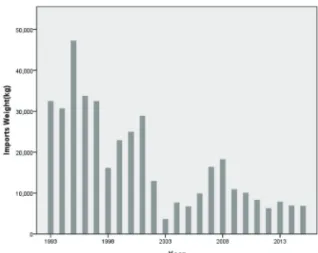
1993년부터 2015년까지 22년간의 거북 수입 규모 를 조사한 결과, 1995년 거북 수입량이 46,928kg으 로 집계 기간 중 최대 물량이 수입되었고, 1995년 이 후 2001년까지 연간 최소 약 15,000kg 이상의 거북
이 지속적으로 수입되었다. 2002년에는 전년 대비 수입이 44.2% 감소했고, 2003년에는 2001년 대비 11.6% 수준까지 감소했지만, 2004년에는 전년 대비 45.2% 수입량 증가를 보이며 점차 회복하는 양상을 나 타 냈 다 . 2004년 부 터 2015년 까 지 연 간 최 소 6,000kg 이상의 거북이 지속적으로 수입되고 있다 (Figure 1).
국가별 거북 수입 실태를 살펴보면, 1993년부터 2001년까지 약 97% 이상이 미국에서 도입됐지만, 2001년 중국과의 교역이 점차 증가했다. 2015년 국 Figure 1. The trend of imported alien turtles from 1993 to
2015
* Source: Korea Trade Statistics Promotion Institute. Trade Statistics Service
Figure 2. The comparative ratio of imported nation of alien turtle from 1993 to 2015
* Source: Korea Trade Statistics Promotion Institute. Trade Statistics Service
가별 거북 수입 비중은 중국(76.7%)>기타 국가 (13.3%)>미국(7.5%)>대만(1.0%)>태국(0.8%)>인도 네시아(0.7%) 순으로 나타났으며, 아시아 지역에서 의 거북 수입이 전체 수입량의 약 79% 이상을 나타 냈다(Figure 2). 2001년 1.1%를 점유한 기타 국가 수 입량이 2015년에는 13%까지 증가하는 등 과거에 비 해 다양한 국가에서 거북이 수입되고 있다.
3) 외래거북의 국내 유통
수입 거북은 적법한 절차를 거치거나 밀반입의 형 태로 국내에 도입되며, 동물판매업체, 재래시장, 개 인 간 직거래를 통해 유통되고 있다.
동물판매업체는 온·오프라인 매장을 이용하여 외 래거북의 애완용 사육을 목적으로 하는 수요자와 거 래한다. 2015년 기준 등록된 동물판매업체는 총 3,467개로 파악되었다(Figure 2). 동물판매업체의 전국적인 분포는 경기 997개(28.8%)>서울 515개 (14.9%)>인천 262개(7.6%)>부산 245개(7.1%)>경남 214개(6.2%)>경북 166개(4.8%)>대구 148개(4.3%)>
충남 146개(4.2%)>대전 131개(3.8%)>강원 130개 (3.7%)>광주 119개(3.7%)>충북 108개(3.1%)>울산 93개(2.7%)>전북 82개(2.4%)>전남 76개(2.2%)>제 주 29개(0.8%)>세종 6개(0.2%) 순으로 나타났고, 특 히, 서울, 경기, 인천 등 수도권 지역에 전체 동물판 매업체의 약 51.2%가 집중되어 있다.
급속한 경제성장에 따른 소득 증대와 사회구조 변 화, 다양성을 중시하는 사회 변화는 애완동물 시장 규모의 급속한 성장을 불러왔으며, 2014년 약 1조 4,300억원의 시장규모는 2020년 약 6조원대로 성장 할 것으로 예측되어(Gyeonggi Research Institute 2014), 애완 목적의 거북 사육은 지속적인 증가 추세 를 보일 것으로 예상된다. 재래시장에서는 원산지나 유통경로가 명확하지 않은 수입 외래거북과 국내에 서 양식한 자라가 방생시기에 활발히 거래되었다. 유 통이 규제되고 있는 Trachemys 속 거북을 포함하 여, Mauremys sinensis, Pseudemys peninsularis, P. nelsoni, Chrysemys picta 등의 유통이 확인되 었다. 애완 목적으로 판매되는 일부 외래거북은 사 육자의 관리 부주의와 변심, 방생, 방류 등에 의해
수계에 유입되고 있으며(National Institute of Environmental Research 2004; 2012), 이 가운데 일부는 어업 종사자들이 포획하여 재래시장에 다시 공급하고 있다. 국내에 도입된 외래거북의 자연 유입 및 정착을 선제적으로 제어할 수 있는 실효적인 관리 대책 마련이 중요할 것으로 판단된다.
2. 자연 유입 외래거북
국내 자연생태계 유입 현황 조사에서 확인된 외래 거북은 총 3과 8종으로 나타났다(Table 2). 총 252개 체의 외래거북이 확인되었으며, 12개 모든 조사지역 에서 외래거북을 발견했다. 특히, St.5에서는 Chrysemys picta, Pseudemys concinna, P. nelsoni, P. peninsularis, Trachemys scripta, Macrochelys temminckii 등 외래거북 6종 79개체가 출현하여 가장 많은 개체의 서식이 확인되었다.
출현 외래거북별로 살펴보면, T. scripta는 St.10 과 St.11을 제외한 10개 조사지역에서 157개체가 확 인되었고, C. picta는 St.1, St 2 등 4개 조사지역에 서 13개체가 확인되었다. P. concinna는 St.1, St.4 등 6개 조사지역에서 46개체가 발견되었으며, P.
nelsoni는 St.2, St.3 등 4개 조사지역에서 7개체가 확인됐다. P. peninsularis는 St.1, St.2 등 6개 지역 에서 7개체가 확인되었다. P. rubriventris는 St.6과 St.3 2개 조사지역에서 9개체가 확인되었으며, M.
temminckii는 St.10과 St.11 2개 조사지역에서 각 1 개체가 출현했다.
외래거북의 자연 유입 여부 확인을 목적으로 실시 된 본 조사에서는 선호 서식지 유형과 인간 출입 및 간섭에 따른 서식 규모 양상이 특정되지 않았다. 이 어지는 연구에서는 자연 생태계 내 조사범위를 확대 적용하여 서식지 유형별 외래거북의 정착 선호도, 종 별 번식 성공 여부와 외부 환경 요인에 따른 서식 영 향, 주요 유입 경로 파악에 대한 면밀한 조사가 필요 할 것으로 판단된다. 아울러, 외래거북 관리에 기본 적으로 필요한 전국적인 분포와 서식실태, 거북종별 기초 생태특성, 유입된 생태계에 미치는 영향 등 관 련 연구를 추가하면 광역적 확산 이전 선제적 대응이
가능할 것으로 판단된다.
3. 국내 도입 외래거북 목록
국내 도입된 외래거북은 총 9과 73종으로 확인되 었다(Appendix 1). 동물판매업체 조사에서는 외래거 북 9과 72종이 확인되었고, 재래시장에서 거래되는 종류로 총 2과 5종, 자연생태계 서식 조사에서는 총 3과 8종을 확인했다. 본 조사는 형태학적 특성을 기 준으로 분류가 가능한 종을 대상으로 기록하였으며, 기준에 따른 동정이 불가능한 아종 수준은 목록에서 제외했다.
외래거북의 국내 도입 실태에 관해, Korea Environment Institute(2014)에서는 총 10과 102종 이 국내에 도입된 것으로 보고했고, National Institute Ecology(2014a)에서는 총 11과 102종을 보고한 바 있지만, 선행 보고 사례는 동물원 등 전시시설에서 사육되고 있는 거북과 온라인으로 거래되는 거북을 대상으로 문헌자료를 종합한 결과이며, 외래거북 목 록을 아종 수준까지 제시하여 본 조사와 차이를 나타 냈다.
4. 국외 관리 대상 침입성 외래거북
국내 도입이 확인된 외래거북 9과 73종을 대상 으로 국외의 침입성 외래생물 지정 및 관리 현황
을 검 토 하 여 자 라 과 (Trionychidae), 남 생 이 과 (Geoemydidae), 늪거북과(Emydidae), 늑대거북과 (Chelydridae)에 속하는 4과 13종을 외부 유출과 생 태계 유입 관리가 필요한 외래거북으로 구분했다 (Appendix 1).
일본 외래생물법에서는 Trachemys 속, Graptemys 속, Pseudemys 속 등 위해성이 높은 생물종을 대상 으로 속 수준까지 확대 지정하여 관리하는 등 수입 단계에서부터 선제적으로 도입을 제한하고 있다 (Ministry of the Environment 2015). 자 라 과 (Trionychidae)에 속하는 Pelodiscus sinensis는 일 본과 유럽에서, Apalone ferox는 일본과 중국에서, A. spinifera는 미국에서 침입성 외래생물로 관리되 고 있다. 이들은 국내 자연 생태계 적응이 용이하고, 정착 시 토속종과의 경쟁 및 생태계 교란의 우려가 높을 것으로 추정된다. 남생이과(Geoemydidae)의 Mauremys sinensis는 일본에서 침입외래생물로 지 정하여 관리하고 있고, 본 연구에서 자연 유입과 정 착이 확인되었으며, 토종 거북 남생이(Chinemys reevesii)를 대신하여 방생에 이용되고 있다. 늪거북 과(Emydidae)의 Trachemys 속은 섭식특성과 기후 적응능력을 기반으로 유입된 생태계에서 위협적인 존재로 평가된다(Feldman 2005; National Institute of Environmental Research 2010). 특히, 붉은귀 거북(Trachemys scripta)은 자연생태계에서의 부정 Table 2. The survey results of alien turtles in Korea
Scientific name No. of individuals
St.1 St.2 St.3 St.4 St.5 St.6 St.7 St.8 St.9 St.10 St.11 St.12 Family Chelydridae
Macrochelys temminckii · · · · · · · · · 1 1 ·
Family Emydidae
Chrysemys picta 5 1 · 4 3 · · · · · · .
Pseudemys concinna 12 · · 13 11 3 1 · · · · 6
Pseudemys nelsoni · 2 3 · 1 1 · · · · · ·
Pseudemys peninsularis 2 1 1 1 1 · · · · · · 1
Pseudemys rubriventris · · 1 · · 8 · · · · · ·
Trachemys scripta 15 9 16 4 59 16 9 9 12 · · 8
Family Geoemydidae
Mauremys sinensis · · 5 · 4 · · · · · · 2
Total 34 13 26 22 79 28 10 9 12 1 1 17
적인 측면으로 인해 세계자연보전연맹(International Union for Conservation of Nature, IUCN)에서는 세계 100대 악성 침입외래생물에 포함하고 있으며 (Lowe et al. 2000), 국내 환경에 적응하며 증식하 는 Trachemys 속 거북은 먹이와 서식지 이용 등에 있어 토착종과 경쟁관계에 있을 것으로 추정되는 등 생태계 부정적 영향이 보고된 바 있다(National Institute of Environmental Research 2006; 2012).
Trachemys 속 거북을 대체하여 애완용으로 수입되 는 Pseudemys concinna, P. peninsularis, P. nelsoni, P. rubriventris 등은 국내 자연에서 관찰되고 있으 며, 일본과 유럽에서 침입외래생물로 관리하고 있다.
붉은귀거북과 동일 원산으로 일본에서 침입외래생물 로 관리하는 Graptemys cagleir와 G. kohnii는 유 입과 정착 여부에 대한 지속적인 예찰이 필요하다.
늑대거북과(Chelydridae)의 Chelydra serpentina 와 본 연구를 통해 자연유입이 확인된 Macroclemys temminckii는 유럽과 일본, 중국 등에서 침입성 외 래생물로 관리되고 있으며, 국내 자연생태계 내 천적 이 없고 강한 턱과 공격적인 성향을 가지고 있어 자 연생태계 위해성이 높을 것으로 판단된다(National Institute of Environmental Research 2012;
National Institute of Ecology 2014b).
IV. 결론 및 관리방안
최근 침입외래생물의 이동과 정착이 세계적인 환 경 문제로 인식되는 가운데 국내에서는 연간 최소 6,000 kg 이상의 거북이 지속적으로 수입되어 동물 판매업체, 재래시장, 개인 간 거래 등 다양한 경로 를 이용하여 유통되고 있으므로, 자연생태계 유입 을 사전에 예방하고 유출된 거북을 효과적으로 제 어하는 문제에 직면하고 있다. 국내 도입이 확인된 총 9과 73종의 외래거북 중 외국에서 침입성이 높 아 관리하고 있는 자라과(Trionychidae), 남생이과 (Geoemydidae), 늪거북과(Emydidae), 늑대거북과 (Chelydridae)에 속하는 4과 13종에 대해서는 도입 과 유통 과정에서 특히 집중적인 관리가 필요할 것으 로 판단된다. 도입된 외래거북은 자연 유입 즉시 생
태계에 위해를 가할 수 있는 종이 있는 반면, 서식 환 경 등 가변적인 요소의 흐름에 따라 잠재적인 위험성 을 지닌 거북이 있으므로 이들의 선별적인 관리가 이 루어져야 하는데, 현재 도입되는 거북은 종 수준의 구분 뿐 아니라, 생태계 영향 및 질병 위험에 관한 사 항이 검토되고 있지 않다.
따라서 먼저 외래거북 수입단계에서는 분류학적 검토 기준을 바탕으로 도입되는 모든 거북 종 목록을 구축할 필요가 있다. 목록 구축시 해당 종의 원산지, 수입 목적, 수입 개체수 등의 정보가 함께 수반되어 야 한다.
또한, 외래거북이 보유하고 있는 잠재적 질병 유발 가능성을 고려할 때, 외래거북을 검역대상 동물에 포 함시킬 필요가 있다. 그리고 질병 검역 수준은 검역 대상동물 및 식물방역법 수준에 준해야 한다. 일본의 검역체계는 국내와 유사하지만, 일본 “외래생물법”
에서는 침입성이 높은 외래생물의 생태계 영향과 피 해 가능성을 검토하여 수입 단계부터 도입을 엄격히 규제한다. 국내에서는 “가축전염병예방법”의 검역대 상동물을 대상으로 생태계 영향 부분이 검토되고 있 지 않는 반면, “식물방역법”에서는 수입되는 잡초와 이와 관련된 병해충만을 대상으로 하더라도 검역과 정에서 ‘생태계 영향’ 관련 사항이 검토되고 있다. 성 공적으로 정착한 침입외래생물을 관리하기 위해서는 많은 비용과 노력이 소요되므로, 생태계와 생물종 또 는 서식지를 위협할 수 있는 침입외래생물의 유입을 사전에 차단하는 것이 최선의 관리로 강조되는 상황 에서(CBD 2002), 국내 유입의 관문이라고 할 수 있 는 수입 및 검역단계에 원산지에서의 특성을 고려한 국내에서의 잠재적 생태계 영향에 관한 평가를 추가 하여 사전 유입 관리 체계를 강화할 필요가 있다.
다음으로, 외래거북의 유통과정에서는 수입단계 에서 구축된 종 목록 및 수입 이후의 유통과정, 관리 실태 등 종합적인 정보를 관련 기관에서 축적하고 유 관기관 간 공유하는 절차를 도입하면 수입 이후 자연 유출 방지를 위한 관련 기제를 마련할 수 있을 것으 로 판단된다. 국립수의과학검역원에서는 RFID 시스 템을 통해, 수입되는 쇠고기의 통관시점부터 가공, 유통, 판매에 이르는 일련의 과정을 추적하고 관리
하고 있으며, 시스템에서는 수입되는 쇠고기의 원산 지 및 검역 정보를 관련 기관간 공유하고 있다(Park 2006).
종 동정이 어려운 개인 사육자에 대해서는, 일본의 경우처럼 공항에 관련 전문가를 배치하여 식별에 도 움을 주고 필요시 종 증명서를 부여함으로써 사육할 개체에 대한 명확한 인식에 도움을 줄 수 있다. 이를 통해, 개인 사육자에 외래거북 식별조치와 관리기록 작성을 의무화 하고, 관리 주체 기관에서는 이동 및 양도 상황에 대해 주기적으로 점검하는 노력이 필요 하다. 거북의 관리과정에서 수입업자, 판매업자, 사 육자 등 이해 당사자들의 민원 발생 소지가 있으므로 이들의 의견을 적극 수렴하고 전문가가 참여하는 토 론과 이해의 기회를 마련하여 분쟁을 미연에 방지하 는 노력은 합리적인 문제 해결을 위해 중요하다. 개 인 사육자의 외래거북 관리를 안전하게 돕기 위해서 는 2014년 4월 1일부터 실시된 동물등록제의 방법을 응용해 볼 수도 있다. 현재는 개를 대상으로 내장형 무선식별장치를 삽입하거나 외장형 무선식별장치를 부착 혹은 등록인식표를 부착하는 방법을 사용하여 (Animal Protection Management System) 반려견 의 보호 및 분실시에 도움을 주고 있지만, 장기적으 로 수입 단계에서 외래거북을 포함하여 관리 및 추적 이 필요한 외래동물에 식별장치를 부착하여 관리한 다면 이동 및 흐름과정이 투명해져 자연방출로 인한 생태계 영향 등을 사전 관리할 수 있을 것이다.
본 연구에서는 총 3과 8종의 외래거북이 자연생태 계에 유입된 것을 현장조사를 통해 육안으로 확인했 다. 자연에 유입되어 정착하고 확산되는 외래거북은 광역적 확산 이전 조기에 유입과 확산을 제어하기 위 한 노력이 중요하며, 자연 유입으로 인하여 생태계 문제를 야기하거나 야기 할 가능성이 높은 수역에서 는 엄격한 방생 관리가 필수적이다. 거북의 생태 특 성 상 물 밖의 바위나 나무 등걸 등에 올라앉아 있는 경우가 많으므로 생태계에 대한 위해성이 내포된 외 래거북은 일광 지점을 중심으로 그물이나 투망을 사 용하여 적극적으로 포획하고, 수초와 수련 등이 발달 하여 수초를 보호할 필요가 있는 곳에서는 통발이나 낚시 등을 이용하여 포획하는 방법으로 관리할 수 있
다. 거북 전용 포획트랩을 주기적으로 운용하는 것도 개체 밀도를 저하시키는 유용한 방법에 속한다. 늪거 북과(Emydidae)의 경우 물가의 모래땅이나 흙모래 땅을 파고 산란하므로 주요 산란기인 4-7월 사이에 물가의 모래나 사질토양 또는 거북이 지나간 흔적을 살펴보고 산란지가 확인되면 구멍을 돌과 흙으로 막 거나 알과 개체를 제거하면 효과적인 관리가 가능할 것이다. 발견되는 개체수가 많고 구제 지역이 광범위 한 경우에는 정부의 수매 및 퇴치사업으로 효과를 볼 수 있다. 그러나 늑대거북과(Chelydridae)의 서식이 확인될 경우에는 발생할 수 있는 위험성을 미연에 방 지하기 위해 직접적인 포획을 지양하고 관련 기관에 신고하여 포획하는 것이 바람직하다.
그리고 대국민 교육과 홍보를 통한 관리 필요성 공 감과 적극적 관리 참여는 외래거북 출연지역에서의 상시적인 감시와 조기탐지의 효과를 기대할 수 있다.
외래거북의 자연생태계 증식이 제한적이라는 의견이 있으므로 방생과 방류를 지속적으로 감소시키는데 많은 관심을 가질 필요가 있다. 또한, 개체군의 크기 와 변동, 번식 및 섭식 생태, 생태계 위해성 등에 대 한 장기적인 연구와 모니터링을 통해 확산되거나 위 축되는 종 및 그 추세를 확인할 수 있을 것으로 판단 된다. 확산으로 인한 생태적 영향이 큰 도서지역 및 생태경관보전지역 등에서는 즉각적 관리계획을 수립 하여 시행하는 등 적극적인 대응이 필요하다.
제도적으로는, 국내 유입된 개체의 생태계에 대한 정기적 위해성평가를 통해 필요시 생태계교란 생물 로 지정하고, 본 연구에서 외부 유출 및 자연생태계 에 대한 유입관리가 필요한 것으로 제시한 4과 13종 을 포함한 자연생태계 미유입 외래거북은 필요시 위 해우려종 지정을 검토하는 등 제도적 뒷받침이 필요 하다.
사 사
본 내용은 국립환경과학원의 “생태계위해성이 높은 외래생물 정밀조사”와 국립생태원의 “외래생물 안전 관리” 연구사업의 연구비 지원으로 수행되었습니다.
References
Arnold EN, Ovenden DW. 2002. Reptiles and amphibians of Europe (Vol. 288). Princeton:
Princeton University Press.
Animal and Plant Quarantine Agency. Animal sale [Internet]. 1993-2015. Animal protection management system; [Cited 2016 Jun 28].
Available from: http://www.animal.go.kr/
portal_rnl/sale/sale_list.jsp?s_wrk_cd=A Animal Protection Management System. Available
from: http://www.animal.go.kr/portal_rnl/
vicarious/public_info.jsp
Australian Government. Invasive species [Internet].
Department of the Environment and Energy; [Cited 2015 May 26]. Available from: http://www.environment.gov.au/
biodiversity/invasive-species
Branch WR. 1998. Field guide to snakes and other reptiles of southern Africa. Struik.
Bickham JW, Iverson, JB, Parham JF, Philippen, HD. 2007. An Annotated List of Modern Turtle Terminal Taxa with Comments on Areas of Taxonomic Instability and Recent Change Turtle Taxonomy Working Group.
Chelonian research monographs. 4: 173- 199.
CAAS: Species search [Internet]. Database of invasive alien species in China; [Cited 2015 May 16]. Chinese Academy of Agricultural Science. Available from: http://www.
chinaias.cn/wjPart/SpeciesSearch.aspx?
daohan=0
Cagle FR. 1946. The growth of the slider turtle, Pseudemys scripta elegans. American Midland Naturalist. 685-729.
Conant R, Collins JT. 1998. A field guide to reptiles & amphibians: eastern and central North America (Vol. 12). Houghton
Mifflin Harcourt.
CBD: Alien species that threaten ecosystems, habitats or species [Internet]. 2002. COP6 decision VI/23. Convention on Biological Diversity [Cited 2015 May 16]. Available from: https://www.cbd.int/decision/cop/
default.shtml?id=7197
DAISE: Species Search [Internet]. Delivering Alien Invasive Species In Europe; [Cited 2015 May 3]. Available from: http://www.
europe-aliens.org/speciesSearch.do
Feldman ML. 2005. The Red eared Slieder Turtle(Trachemys scripta elegans) in New Zealand. In Proceedings of the 13th Australian Vertebrate Pest Conference: 96- 101. Manaaki Whenua-Landcare Research.
George RH. 1996. 14 Health Problems and Diseases of Sea Turtles. The biology of sea turtles. 1: 363.
Gibbons JW, Greene J. 2009. Turtles: The Animal Answer Guide. The John Hopkins University Press. Baltimore, MD.
Gibbons JW, Greene JL, Patterson KK. 1982.
Variation in reproductive characteristics of aquatic turtles. Copeia.776-784.
GISD: Species [Internet]. Global Invasive Species Database; [Cited 2015 May 8]. Available from: http://www.iucngisd.org/gisd/
Gyeonggi Research Institute. 2015. Current situation and main issue of pet Issue &
Analysis.188: 1-20.
Hedges SB, Kumar S. 2009. The timetree of life.
OUP Oxford.
INVASIVE.ORG: Species [Internet]. Center for Invasive Species and Ecosystem Health;
[Cited 2015 May 23]. Available from:
http://www.invasive.org/species.cfm Kang YS, Yoon BI. 1975. Illustrated
Encyclopedia of Fauna & Flora of Korea
vol. 17 Amphibia-Reptilia. Mun’gyobu.
[Korean Literature]
Kil JY. 2012. Invasive Alien Species A Threat to Biodiversity. National Institute of Environmental Research. [Korean Literature]
Kil JH, Kim JM, Kim YH, Kim HM, Lee DH, Kim DE, Hwang SM, Lee CW, Sin HC.
2012. Invasive Alien Species. National Institute of Environmental Research.
[Korean Literature]
Kim SH, Lee HHM, Kim DE, Lee DH, Hwang IC, Lee CW, Kim HM, Lee HJ, Kim MJ, Kim DK, Song HY, Park EJ, Kim JM.
2014. Information on Alien Species on Korea. National Institute of Ecology.
[Korean Literature]
Korea Environment Institute. 2014. The First National Mid-Long Term management Plan of Alien Species. [Korean Literature]
Korea Trade Statistics Promotion Institute.
Statistics [Internet]. Trade Statistics Service;
[Cited 2015 Dec 28]. Available from:
http://www.trass.or.kr/service/statistic/Sta tisticsViewServlet?mainServiceURL=P02M0 2D010
Limpus CJ. 1979. Notes on growth rates of wild turtles. Marine Turtle Newsletter. 10(3-5):
8.
Lovich JE, Barbour RW. 1994. Turtles of the United States and Canada. Smithsonian Inst. Press. Washington, DC.
Lowe S, Browne M, Boudjelas S, De poorter M.
2000. 100 of the World’s Worst Invasive Alien Species: a Selection from the Global Invasive Species Database. Invasive Species Specialist Group. Auckland, New Zealand.
Ministry of Environment. 2014. The Guide for
Convention of international trade in Endangered species of wild fauna and flora. [Korean Literature]
Ministry of Environment notification 2016-112 (2016.6.17). Designation and notification of invasive alien species. [Korean Literature]
Ministry of Government Legislation. 2015. Act on The Prevention of Contagious Animal Diseases [Internet]. Nation law information center; [Cited 2015 Mar 28]. Available from: http://www.law.go.kr/eng/engLsSc .do?menuId=1&query=+Act+on+The+Pre vention+of+Contagious+Animal+Diseases
&x=54&y=24#liBgcolor0
Ministry of Government Legislation. 2015.
Wildlife Protection and Management Act [Internet]. Nation law information center;
[Cited 2015 Mar 20]. Available from:
http://www.law.go.kr/eng/engLsSc.do?me nuId=1&query=+Act+on+The+Preventio n+of+Contagious+Animal+Diseases&x=5 4&y=24
Ministry of Government Legislation. 2015. Plant Protection Act [Internet]. Nation law information center; [Cited 2015 Oct 12].
Available from: http://www.law.go.kr/
eng/engLsSc.do?menuId=1&query=PLAN T&x=0&y=0
Ministry of Government Legislation. 2014. Act on Conservation and Utilization of Biodiversity [Internet]. Nation law information center;
[Cited 2015 Mar 23]. Available from:
http://www.law.go.kr/ [Korean Literature]
Ministry of the Environment. 2015. List of Regulated Living Organisms under the Invasive Alien Species Act [Internet].
[Cited 2015 Jul 24]. Available from:
http://www.env.go.jp/nature/intro/1outlin e/list/list.pdf
Ministry of the Environment. Invasive Alien Species Act [Internet]. Ministry of the Environment; [Cited 2015 May 18].
Available from: http://www.env.go.jp/en/
nature/as/040427.pdf
National Institute of Ecology. 2014a. Nationwide Survey of Non-native Species in Korea(I).
[Korean Literature]
National Institute of Ecology. 2014b. Ecological Studies of Alien Species (I). [Korean Literature]
National Institute of Environmental Research.
2012. Detailed Studies on Invasive Alien Species and Their Management(VII).
[Korean Literature]
National Institute of Environmental Research.
2011. Monitoring of invasive alien species designated by the wildlife protection act(V). [Korean Literature]
National Institute of Environmental Research.
2006. A Study of Detailed on Invasive Alien Species on Korea and Designation of Invasive Alien Species on Foreign Countries. [Korean Literature]
National Institute of Environmental Research.
2004. Wildlife Animal Survey. [Korean Literature]
NOBANIS: Alien species [Internet]. European Network on Invasive Alien Species; [Cited 2015 May 10]. Available from:
https://www.nobanis.org/search-alien- species/
NNSS: Non native species [Internet]. GB Non- Native Species Secretariat; [Cited 2015 May 7]. Available from: https://secure.
fera.defra.gov.uk/nonnativespecies
Park JH. 2006. RFID Technology Trends and
its application. Electronics and Telecommunications Trends 21(3): 137- 146.
Plummer MV. 1977. Reproduction and growth in the turtle Trionyx muticus. Copeia. 440- 447.
Powell R, Collins JT, Hooper ED. 1998. key to amphibians & reptiles of the continental United States and Canada. University Press of Kansas.
SCBD: Secretariat of the Convention on Biological Diversity. 2009. Review of the Literature on the Links Between Biodiversity and Climate Change: Impacts, Adaptation, and Mitigation. No. 42. UNEP/Earthprint.
The Reptile Database. Turtle [Internet]. 2016.
[Cited 2016 Jul 7]. Available from: http://
www.reptile-database.org/db-info/taxa.
html#C8
van Dijk PP, Iverson JB, Rhodin GJ, Shaffer HB, R Bour. 2014. Turtles of the world, 7th Edition: annotated checklist of taxonomy, synonymy, distribution, and conservation status. Chelonian Research Monographs. 5:
351-479.
Vitt LJ, Caldwell JP. 2013. Herpetology: an introductory biology of amphibians and reptiles. Academic Press.
Wyneken J, Godfrey MH, Bels V. 2007. Biology of Turtles: From Structures to Strategies of Life. CRC Press.
Zhao EM, Adler K. 1993. Herpetology of China.
Oxford, Ohio, USA: Society for the Study of Amphibians and Reptiles in cooperation with Chinese Society for the Study of Amphibians and Reptiles.
Appendix 1. The lists of alien turtles in Korea
Family Scientific name Review Current status of Alien turtles in Korea Management countries as invasive sp.
a b c d e f
Carettochelyidae Carettochelys insculpta ◎ ◎ - - - Australia -
Chelidae
Chelodina longicollis ◎ ◎ - - - Australia -
Chelus fimbriatus ◎ ◎ - - - South America -
Emydura subglobosa ◎ ◎ - - - Australia -
Mesoclemmys gibba - ◎ - - - South America -
Platemys platycephala ◎ ◎ - - - South America -
Chelydridae Chelydra serpentina ◎ ◎ - - - Central and North America EU, China, Japan,
Macroclemys temminckii ◎ ◎ - ◎ ◎ USA EU, China, Japan,
Emydidae
Chrysemys picta ◎ ◎ ◎ ◎ - North America EU, USA
Clemmys guttata ◎ ◎ - - - North America -
Clemmys marmorata ◎ ◎ - - - Central and North America -
Deirochelys reticularia ◎ ◎ - - - USA -
Emydoidea blandingii ◎ ◎ - - - North America -
Emys orbicularis ◎ ◎ - - - Europe -
Graptemys caglei ◎ ◎ - - - USA Japan
Graptemys geographica - ◎ - - - North America -
Graptemys kohnii ◎ ◎ - - - USA Japan
Malaclemys terrapin ◎ ◎ - - - USA -
Pseudemys concinna ◎ ◎ - ◎ - USA EU, Japan,
Pseudemys nelsoni ◎ ◎ ◎ ◎ - USA Japan
Pseudemys peninsularis ◎ ◎ ◎ ◎ - USA Japan
Pseudemys rubriventris ◎ ◎ - ◎ - USA -
Terrapene carolina ◎ ◎ - · - North America -
Terrapene ornata ◎ ◎ - · - Central and North America -
Trachemys scripta ◎ - ◎ ◎ - North America China, EU, Japan, New
Zealand, USA, UK
Geoemydidae
Cistoclemmys flavomarginata ◎ ◎ - · - China, Japan, Taiwan -
Cuora amboinensis ◎ ◎ - · - Southeast Asia -
Cyclemys dentata ◎ ◎ - · - Southeast Asia -
Hieremys annandalii ◎ ◎ - · - Southeast Asia -
Leucocephalon yuwonoi ◎ ◎ - · - Indonesia -
Mauremys japonica ◎ ◎ - · - Japan -
Mauremys sinensis ◎ ◎ ◎ ◎ - China, Taiwan, Vietnam Japan
Pyxidea mouhotii - ◎ - - - Vietnam -
Rhinoclemmys pulcherrima ◎ ◎ - - - Central America -
Rhinoclemmys punctularia - ◎ - - - South America -
Kinosternidae
Kinosternon angustipons ◎ ◎ - - - Central America -
Kinosternon baurii ◎ ◎ - - - USA -
Kinosternon cruentatum ◎ ◎ - - - Central America -
Kinosternon flavescens ◎ ◎ - - - Mexico, USA -
Kinosternon leucostomum ◎ ◎ - - - North and South America -
Kinosternon scorpioides ◎ ◎ - - - Mexico, Honduras,
Colombia -
Appendix 1. Continued
Family Scientific name Review Current status of Alien turtles in Korea Management countries as invasive sp.
a b c d e f
Kinosternidae
Kinosternon sonoriense ◎ ◎ - - - Mexico, USA -
Kinosternon subrubrum ◎ ◎ - - - USA -
Sternotherus carinatus ◎ ◎ - - - USA -
Staurotypus salvinii ◎ ◎ - - - South America -
Platysternidae Platysternon megacephalum ◎ ◎ - - - China, Southeast Asia - Testudinidae
Aldabrachelys gigantea ◎ ◎ - - - Seychelles islands -
Astrochelys yniphora ◎ ◎ - - - Madagascar -
Chelonoidis cabonaria ◎ ◎ - - - Central and South America -
Testudinidae
Geochelone pardalis ◎ ◎ - - - sub-Saharan Africa -
Geochelone platynota ◎ ◎ - - - Myanmar -
Geochelone radiate ◎ ◎ - - - Madagascar -
Geochelone sulcata ◎ ◎ - - - sub-Saharan Africa -
Gopherus agassizii ◎ ◎ - - - Mexico, USA -
Gopherus polyphemus ◎ ◎ - - - USA -
Geochelone elegans ◎ ◎ - - - India, Pakistan, SriLanka -
Geochelone nigra ◎ ◎ - - - Galapagos Islands -
Indotestudo forstenii ◎ ◎ - - - Indonesia -
Malacochersus tornieri ◎ ◎ - - - Kenya, Tanzania -
Manouria impressa ◎ ◎ - - - Southeast Asia -
Pyxis arachnoides ◎ ◎ - - - Madagascar -
Pyxis planicauda ◎ ◎ - - - Madagascar -
Stigmochelys pardalis ◎ ◎ - - - Africa -
Testudo graeca ◎ ◎ - - - Balkan peninsula,
Southwest Asia, Egypt -
Testudo hermanni ◎ ◎ - - - Europe -
Testudo horsfieldii ◎ ◎ - - - Central and Southwest
Asia, China, Russia -
Testudo kleinmanni ◎ ◎ - - - Libya -
Testudo marginata ◎ ◎ - - - Albania, Greece -
Trionychidae
Apalone ferox ◎ ◎ - - - USA Japan, China
Apalone spinifera ◎ ◎ - - - North America USA
Pelodiscus sinensis ◎ ◎ - - ◎ China, Taiwan, Vietnam EU, Japan
Pelusios castaneus ◎ ◎ - - - West Africa -
Pelusios subniger ◎ ◎ - - - Africa -
* a: Introduced alien turtles (Korea Environment Institute 2014); b: Pet shop; c: Traditional market; d: Natural habitat, e: Permission- required lists of alien turtles for exportation and importation by the Ministry of Environment ; f: Native range; g: Management countries as invasive sp.