Abstract
BACKGROUND: Agricultural use and pest control purposes of pesticides may lead to livestock products contamination.
Thiodicarb and its degraded product, methomyl, are carbamate insecticides that protect soya bean, maize, fruit, and vegetables and control flies in animal and poultry farms.
For maximum residue limit enforcement and monitoring, the JMPR residue definition of thiodicarb in animal products is the sum of thiodicarb and methomyl, expressed as methomyl.
This residue definition was set to consider the fact that thiodicarb was readily degraded to methomyl in animal commodities. And therefore the simultaneous analytical method of thiodicarb and methomyl is required for monitoring in livestock products.
METHODS AND RESULTS: The study was conducted using a quick, easy, cheap, effective, rugged, and safe (QuEChERS) method and HPLC-MS/MS to determine the thiodicarb and methomyl in livestock products. The limit of quantitation (LOQ) was 0.01 mg/kg for livestock products, including beef, pork, chicken, milk, and egg. The coefficient of determinations (r2) for the calibration curve were > 0.99,
which was acceptable values for linearity. Average reco- veries at spiked levels (LOQ, 10LOQ, and 50LOQ, n=5) in triplicate ranged from 73.2% to 102.1% and relative standard deviations (RSDs) were less than 10% in all matrices.
CONCLUSION: The analytical method was validated for the performance parameters (specificity, linearity, accuracy, and precision) in livestock products to be acceptable by the CODEX guidelines.
Key words: Analytical Method, LC-MS/MS, Livestock, Methomyl, Thiodicarb
서 론
축산물 중 잔류농약은 가축이 사료로 사용되는 농산물 중 잔류농약을 섭취하거나, 가축농가에서 해충방제의 목적으로 살포한 농약이 가축의 체내에 유입될 수 있어, ‘살충제 계란’
등 소비자의 불안감을 해소할 수 있도록 축산물 중 잔류농약 의 안전관리 강화가 필요하다[1,2].
농림축산식품부는 축산물 중 잔류농약에 대한 소비자의 신뢰를 높이고자, 축산물위생관리법에서 가축에 농약을 사용 한 축산물 중 농약 검사에서 불합격 판정에 따른 행정처분의 세부기준을 마련함으로써, 생산과정에서 축산물 중 잔류농약 의 안전관리체계를 개선하였다(MAFRA, 2020). 식품의약품 안전처는 축산물의 잔류물질 잔류허용기준에서 농약의 잔류 허용기준을 고시하여 관리하고 있으며, 2021년 3월 기준으로 127종 농약에 대하여 설정되어 있다. 축산물 중 농약잔류허
†This author contributed equally to this work
*Corresponding author: Hee-Ra Chang Phone: +82-41-540-9696; Fax: +82-41-540-9696;
E-mail: [email protected]
Korean J Environ Agric. 2021;40(2):142-147. Korean Online ISSN: 2233-4173
Published online 2021 June 30. https://doi.org/10.5338/KJEA.2021.40.2.17 Print ISSN: 1225-3537
축산물 중 Thiodicarb와 대사산물 Methomyl의 동시분석법개발
장희라*, 유정선†, 반선우, 곽혜민
호서대학교 생명보건대학 식품제약공학부
Development of Simultaneous Analytical Method for Thiodicarb and its Metabolite Methomyl in Livestock Products
Hee-Ra Chang*, Jung-Sun You†, Sun-Woo Ban and Hye-min Gwak (Department of Food & Pharmaceutical Engineering, College of Life & health Sciences, Graduate School of Hoseo University, Asan 31499, Korea)
Received: 21 June 2021/ Revised: 25 June 2021/ Accepted: 26 June 2021 Copyright ⓒ 2021 The Korean Society of Environmental Agriculture
This is an Open-Access article distributed under the terms of the Creative Commons Attribution Non-Commercial License (http://creativecommons.org/licenses/by-nc/3.0) which permits unrestricted non-commercial use, distribution, and reproduction in any medium, provided the original work is properly cited.
ORCID Hee-Ra Chang
https://orcid.org/0000-0002-0307-7703
142
Research Article Open Access
용기준은 농산물 중 514종 농약의 잔류허용기준 설정과 비교 하여 약 19% 수준으로 현저히 낮아, 축산물 중 농약 잔류허 용기준(Maximum Residue Limit, MRL)을 확대 및 안전 성검사를 위한 분석법 개발이 필요하다(MFDS, 2021).
최근 국내외 축산물 중 잔류농약 분석법은 인체위해성 및 환경적 측면을 고려하여 유기용매의 사용량이 적고, 분석 전처 리 방법이 간단하여 분석시간을 단축할 수 있는 QuEChERS 법을 많이 적용하고 있다[3-5]. 국제적으로 표준화된 QuEChERS 법은 추출 방법에 따라 citrate buffer(pH 5-5.5)를 이용한 EN15662법, acetate buffer(pH 4.8)를 이용한 AOAC 2007.01 법과 buffer를 이용하지 않는 original법이 있으며, 추출조건 에서 농약의 추출용매 pH에 의한 영향을 고려하여 다양하게 적용할 수 있다[5].
Thiodicarb는 carbamate계 살충제로 콩, 옥수수에 Lepidoptera, Coleopter 및 Hemiptera 해충을 방제하는데 사용되며, 대사 산물인 methomyl은 농산물 외에 양계 및 낙농에서 파리방제 에 사용된다[6]. Thiodicarb는 Codex에 축산물 중 기준이 설 정되어 있으며, 잔류분 정의는 포유류 및 가금류의 동물대사에 서 빠르게 methomyl로 전환되어, thiodicarb와 methomyl 의 합을 methomyl로 하고 있다[7].
본 연구는 국내 축산물 중 기준이 설정되어 있지 않으나, 농산물에 등록되어 있어, 비의도적으로 축산물에 잔류가능성 이 있는 thiodicarb와 대사체인 methomyl에 대하여 축산물 중 잔류농약의 안전관리에 활용할 수 있도록 신속하고 정확 한 동시분석법을 QuEChERS법을 적용하여 개발하였다.
재료 및 방법
Reagents, pesticide standards and samples Thiodicarb 표준품은 순도 98.6%(Sigma-Aldrich, St Louis, USA), methomyl은 순도 99.7%(Dr. Ehrenstorfer GmbH, Augsburg, Germany)를 사용하였고, acetonitrile, methanol, water는 HPLC grade(J.T. Baker®, Radnor, PA, USA), formic acid 및 ammonium formate는 ACS reagent grade (Sigma-Aldrich, St Louis, USA), sodium chloride는 특 급(Junsei Chemical Co., Tokyo, Japan), 추출 및 정제는 QuEChERS Kit(Agilent Technologies, Santa Clara, CA, USA)를 사용하였다. 축산물시료는 식품의약품안전처의 가 이드라인에 근거하여 소고기(등심), 돼지고기(삼겹살), 닭고 기(닭다리), 우유, 알의 5종을 대표시료로 선정하였고, 국내 산 소고기, 돼지고기, 닭고기는 구매 당일 실험실에서 dry ice를 넣고 균질하게 분쇄하여 분석을 수행하기 전까지 냉동보 관하였고, 우유, 알은 구입 후 바로 분석에 사용하였다[MFDS 2016].
Preparation of matrix matched standard solutions Thiodicarb와 methomyl의 혼합 저장표준용액은 각각의 표준품을 순도 보정하여 칭량한 후, methanol에 용해시켜 각각의 농도가 1,000 mg/L이 되도록 조제하였고, 이를 계열
희석하여 1, 2, 5, 10, 20 및 50 µg/L의 working solution 조제하였다. 축산물 시료에 대한 matrix-matched 표준용액은 working solution과 무처리시료 추출용액을 부피기준 1:9로 혼합하여 최종농도가 1, 2, 5, 10, 20 및 50 µg/L가 되도록 조제하여 검량선 표준용액에 사용하였다. 축산물 중 돼지시료 의 matrix-matched 검량선 표준용액과 표준용액의 검량선 의 기울기를 이용하여 matrix effect를 확인하였다.
LC-MS/MS conditions
Thiodicarb 및 methomyl의 동시분석을 위하여 LC-MS/
MS(Exion LC UPLC/QTRAP 5500 Mass spectrometer, AB SCIEX, CA, USA)를 사용하였다. LC column은 Luna Omega Polar C18 (100x2.1 mm, 3 µm, Phenomenex, CA, USA), 컬럼 oven의 온도는 40℃로 설정하였고, 이동상 은 0.1% formic acid/5 mM ammonium formate 함유 물(A)와 0.1% formic acid와 5 mM ammonium formate 함유 메탄올(B)을 이용하여 이동상 B를 0~1분까지 5%로 유 지한 후, 1~3분까지 100%로 유기용매의 부피를 늘리고, 3~6 분까지 100%를 유지하였고, 6~8분까지 5%로 유기용매의 양 을 낮춘 후, 8~9분까지 5%로 유지하는 gradient 조건이었 다. 이때 이동상의 유속은 0.2 mL/min, 시료주입량은 1 µL 로 설정하여 분석하였다.
질량분석기 조건은 20 µg/L의 thiodicarb와 methomyl 혼합표준용액을 이용하여 scan을 진행하여, 전기분무이온화 법(Electro Spray Ionization, ESI)의 양이온모드를 사용하여 확인된 선구이온(Precursor ion, m/z)에 다양한 collision energy(CE, eV)값을 주어 감도가 우수한 2개의 이온을 토막이 온(Fragment ion, m/z)을 정량이온(Quantitation ion)과 정 성이온(Confirmation ion)으로 선정하여 multiple reaction monitoring(MRM)조건을 확립하였고, ion spray voltage + 5,500 V, source temperature 550℃, nebulizer gas 60 psi, heater gas 50 psi이었다.
Sample preparation
분석법의 적용성 검토하고자 축산물 중 돼지시료 5 g을 50 mL 원심분리 튜브에 칭량하여 acetonitrile 20 mL을 넣 어 시료전처리 장비(Genogrinder, Labsystem, Korea)를 이용하여 3분간 1,300 rpm 진탕한 후, 추출법 확립은 축산물 중 돼지시료를 적용하여 AOAC(6 g NaCl, 1.5 g NaOAc), EN(0.5 g disodium sesquihydrate, 1 g Na citrate, 1 g NaCl, 4 g MgSO4), Original(1 g NaCl, 4 g MgSO4) 및 선 행연구의 cotton시료에서 적용한 NaCl(10 g)만을 첨가한 방법 을 비교하였고, 추출액은 원심분리기(Fleta 5, Hanil science, Korea)를 이용하여 4,000 rpm에서 5분간 원심분리하였다.
d-SPE정제 방법을 확립하기 위하여, PSA 정제(150 mg PSA, 900 mg MgSO4) 및 C18 정제(150 mg C18, 900 mg MgSO4) 법을 비교하고자, AOAC, EN 및 NaCl만을 첨가하여 추출 한 상층액 6 mL을 각각의 PSA 정제 및 C18 정제 kit인 15 mL 원심분리 튜브에 넣어 vortex로 1분간 충분히 혼합하였
고, 4,000 rpm에서 5분간 원심분리 하였다. 상층액을 시린지 필터(0.45 ㎛, PTFE, Korea vaccine, Korea)로 여과하여 LC-MS/MS로 정량분석하였다.
Method validation
축산물 중 thiodicarb 및 methomyl의 분석법 검증은 Codex 및 식약처 가이드라인에 근거하여 분석법 허용기준에 적합하도록 분석법 검증항목을 확인하였다[Codex 1993, MFDS 2016]. 분석법 정량한계(Limit of Quantification, LOQ)는 표준용액을 이용하여 기기분석 크로마토그램에서 S/N가 10 이상 되는 기기정량한계와 기기 주입량(μL)을 계산하여 최소 검출량을 산출한 후, 시료 무게(g), 기기 주입량(μL), 분석용 액의 최종부피(mL) 및 희석배수를 적용하여 산출하였다[8].
직선성은 matrix-matched 표준용액 6개 농도(1, 2, 5, 10, 20 및 50 µg/L)를 분석하여 각 chromatogram의 peak면 적을 기준으로 작성한 검량선의 회귀식에 의한 결정계수(r2) 로 확인하였다. 정확성 및 정밀성은 회수율시험을 정량한계, 정량한계 10배 및 정량한계 50배의 3개 농도 수준에서 각각 5반복으로 수행하여 각 수준의 평균 회수율이 70 ~ 120% 이 내, CV(%)가 20%이내인지 확인하였다.
결과 및 고찰 Optimization of LC-MS/MS conditions
Thiodicarb 및 methomyl의 log Pow는 1.6 및 0.093로 극성의 비해리성 화합물이고, 증기압은 2.7 ~ 0.72 mPa(2 5℃)로 휘발성이 낮으며, methomyl이 열과 UV에서 안정성 및 감도가 낮아서, 0.01 mg/kg 수준의 정량한계를 확보하여 잔류분석에 적용하고자 HPLC-MS/MS를 이용한 잔류분석법 을 확립하였다[9]. Thiodicarb와 methomyl은 LC-MS/MS 의 ESI positive ion mode에서 thiodicarb 및 methomyl의 선구이온을 확인하기 위하여 각각 250 ~ 450 m/z 및 70 ~ 250 m/z 범위로 scan을 수행하였고, Thiodicarb 및 methomyl은 질량 값(exact mass, M)에 양성자(H+)가 결합된 [M+H]+ 형 태로 thiodicarb의 선구이온은 355 m/z, 정량이온과 정성이 온은 88 및 108 m/z, methomyl의 선구이온은 163 m/z, 정량이온과 정성이온은 88.1 및 106 m/z로 확인하였다 (Table 1).
Optimization of extraction and purification Thiodicarb와 methomyl의 QuEChERS법을 적용한 동 시분석법에 대한 연구는 사과 및 상추에 대하여 AOAC 2007. 01법에 의한 추출(6 g NaCl and 1.5 g NaOAc) 및 d-SPE(150 mg anhydrous MgSO4, 50 mg PSA, 50 mg C18, 7.5 mg GCB)을 적용하였고, cotton 시료는 추출(6 g NaCl) 및 SPE cartridge법(Pesti-Carb/NH2)을 적용하였 다[9, 10]. 축산물에 대한 분석법은 AOAC 2007. 01법에 의 한 추출(6 g NaCl and 1.5 g NaOAc) 및 Silica SPE cartridge법을 적용하고 있어, 본 연구에서는 축산물 중 Thiodicarb와 methomyl의 기존의 QuEChERS법의 추출 및 d-SPE정제를 활용하여 신속한 동시분석법을 확립하고자 하였다. QuEChERS법에 의한 추출법을 확립하기 위하여, AOAC, EN 및 선행연구의 cotton시료에서 적용한 NaCl만 을 첨가한 방법을 정량한계, 정량한계 10배, 정량한계 50배 (0.01, 0.1 및 0.5 mg/kg)의 3개 농도수준, 5반복으로 비교한 결과, thiodicarb 및 methomyl에 대하여 AOAC 추출은 각각 83~103.5% 및 91.4~103.5%, EN 추출은 각각 77.4~85.8%
및 88.8~91.2%, NaCl 추출은 78.9~86.4% 및 93.3~93.6%
으로 식약처의 허용기준에 적합하였다(Fig 1).
Thiodicarb 및 methomyl의 d-SPE정제는 AOAC, EN, 및 NaCl만을 첨가하여 추출한 후, PSA 또는 C18를 첨가하 여 정제하는 방법을 정량한계, 정량한계 10배, 정량한계 50배 (0.01, 0.1 및 0.5 mg/kg)의 3개 농도수준, 3반복으로 수행하 여 회수율을 비교하였다. 각각의 시험법에 대한 Thiodicarb 및 methomyl의 회수율은 AOAC 추출 후 C18 정제의 경우, 각각 87.3~99.5% 및 73.8~82.5%, PSA정제는 96.4~107.8%
및 73.3~84.4%이었고, EN 추출 후 C18 정제는 각각 92.3~95.7% 및 74.1~82.1%, PSA 정제 는 85.2~107.5% 및 86.8~91.2%였으며, NaCl 추출 후 C18 정제에서 thiodicarb 및 methomyl의 회수율은 각각 74.0~83.5% 및 101.3~102.9%, PSA 정제 시험법은 82.3~ 99.2% 및 88.7~91.5%로 식약처 의 guideline에서 요구하는 정확성의 허용기준에 적합하였다 (Fig. 2).
축산물 중 돼지시료에 대한 추출방법별, d-SPE정제방법별 적용성 확인을 위한 회수율 시험에서 thiodicarb는 EN 추출 후 PSA 정제시 CV(%)가 21.3%로 정밀성 판단기준에 적합하 지 않았고, NaCl 추출 후 C18 정제에서 LOQ 수준의 회수율
Compound Molecular weight Exact mass Precursor ion (m/z) Product ion (m/z) CE (eV) a)
Thiodicarb 354.5 354.04 355
88b) 27
107.8 21
338.3 13
Methomyl 162.2 162.04 163
88b) 13
106 15
72.9 37
a) Collision energy, b) Quantification ion
Table 1. LC-MS/MS parameters for the analysis of thiodicarb and methomyl
0 10 20 30 40 50 60 70 80 90 100 110 120
LOQ 10LOQ 50LOQ
Efficiency extraction(%)
AOAC EN NaCl
(A)
0 10 20 30 40 50 60 70 80 90 100 110 120
LOQ 10LOQ 50LOQ
Efficiency extraction(%)
AOAC EN NaCl
(B)
Fig. 1. Efficiency comparison for extraction method of (A)thiodicarb and (B)methomyl at LOQ, 10LOQ and 50LOQ (0.01, 0.1 and 0.5 mg/kg) in swine.
100 20 3040 5060 7080 90 100110 120130
LOQ 10LOQ 50LOQ
Mean recovery (%)
AOAC + C18 AOAC + PSA EN + C18 EN + PSA NaCl + C18 NaCl + PSA
(a) (A)
100 2030 4050 6070 8090 100110 120130
LOQ 10LOQ 50LOQ
Mean recovery (%)
AOAC + C18 AOAC + PSA EN + C18 EN + PSA NaCl + C18 NaCl + PSA
(b) (B)
Fig. 2. Mean recovery for extraction and dSPE method of (A)thiodicarb and (B)methomyl at LOQ, 10LOQ and 50LOQ (0.01, 0.1 and 0.5 mg/kg) in swine.
Commodities Pesticides Fortification (mg/kg) Mean recovery±SDa) (%) CV (%)b) Linearity (r2)
Beef
Thiodicarb
LOQ 83.46.7 8.0
0.9943
10LOQ 81.04.5 5.5
50LOQ 83.42.4 2.9
Methomyl
LOQ 92.03.4 3.7
0.9997
10LOQ 101.82.1 2.0
50LOQ 102.11.8 1.8
Pork
Thiodicarb
LOQ 99.25.3 5.3
0.9976
10LOQ 85.65.8 6.7
50LOQ 82.37.2 8.8
Methomyl
LOQ 91.50.8 0.8
0.9901
10LOQ 88.72.0 2.2
50LOQ 89.60.9 1.0
Chicken
Thiodicarb
LOQ 90.25.8 6.4
0.9944
10LOQ 81.27.7 9.4
50LOQ 80.73.9 4.8
Methomyl
LOQ 81.72.5 3.0
0.9966
10LOQ 86.02.4 2.8
50LOQ 85.21.5 1.7
Milk
Thiodicarb
LOQ 85.52.3 2.7
0.9988
10LOQ 75.33.0 4.0
50LOQ 73.22.1 2.8
Methomyl
LOQ 91.32.4 2.6
0.9950
10LOQ 89.71.5 1.7
50LOQ 89.22.8 3.2
Egg
Thiodicarb
LOQ 89.01.1 1.3
0.9934
10LOQ 81.81.9 2.4
50LOQ 81.42.6 3.3
Methomyl
LOQ 84.12.0 2.3
0.9927
10LOQ 85.91.2 1.4
50LOQ 87.92.0 2.3
a) Standard deviation, b) Coefficient variation
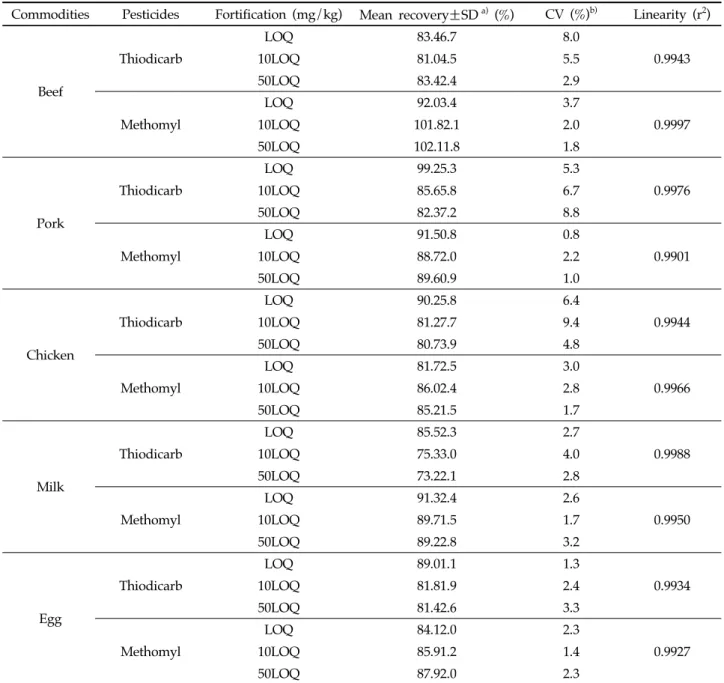
Table 2. Recovery and coefficient of variation of thiodicarb and methomyl at LOQ, 10LOQ and 50LOQ (0.01, 0.1 and 0.5 mg/kg)
이 70.6 ~ 75.8%로 80% 이하였으며, methomyl은 10LOQ 및 50LOQ 수준의 회수율이 AOAC 추출 후 C18 정제에서 73.3~76.6%, PSA 정제에서 72.0~76.1%, EN 추출 후 C18 정 제에서 70.4~76.3%로 80% 이하였다(Table 2). Thiodicarb 및 methomyl은 이온화되지 않는 물질로 알려져 있으며, PSA정 제시 축산물 시료의 organic acid, lipid 등에 간섭물질을 효 율적으로 제거할 수 있었다(JMPR 2000, EFSA 2008). 최종적 으로, 5종의 축산물시료에 대한 QuEChERS법은 NaCl 추출 후 PSA 정제방법이 정량한계, 정량한계 10배, 정량한계 50배 (0.01, 0.1 및 0.5 mg/kg)의 3개 농도수준에서 안정적인 정 확성 및 정밀성을 확보할 수 있을 것으로 판단하였다.
Method validation
개발된 분석법의 검증은 Codex 및 식약처 guideline에 근거하여 정량한계, 특이성, 직선성, 회수율시험을 통한 정확 성 및 정밀성을 평가하였다. 분석법 정량한계는 0.01 mg/kg 에서 무처리시료와 비교 분석하여 thiodicarb와 methomyl 의 머무름 시간 5.35 및 4.68분에 간섭물질이 나타나지 않아 특이성을 확인하였다.
축산물 시료 5종(소고기, 돼지고기, 닭고기, 우유, 알)를 적 용한 Matrix-matched 검량선 표준용액(1, 2, 5, 10, 20 및 50 µg/L)의 회귀식에 의한 결정계수(r2)가 0.9901 ~ 0.9997 로 직선성을 확인하였으며, 정량한계, 정량한계 10배, 정량한
계 50배(0.01, 0.1 및 0.5 mg/kg)의 3개 농도수준, 5반복에 대한 회수율시험에 의한 정확성 및 정밀성은 소고기, 돼지고 기, 닭고기, 우유, 알 시료에서 각각 75.9~105.2% 및 CV 8.0%, 70.5~94.1% 및 CV 4.0%, 73.6~92.0% 및 CV 9.4%, 73.7~107.2% 및 CV 8.8%, 77.4 ~ 90.5% 및 CV 3.3% 이 내로 허용기준에 적합하였다(Table 2).
Thiodicarb의 축산물에 대한 잔류분 정의는 thiodicarb 와 methomyl의 합을 methomyl로 환산하도록 되어 있으 며, thiodicarb의 회수율시험에서 축산물 시료 중 소고기, 돼 지고기, 닭고기 및 우유는 methomyl이 1.9 ~ 35.5% 수준이 었고, 알에서 84.7 ~ 93.9%로 대부분이 methomyl로 확인되 었다. Thiodicarb는 pH 9에서 빠르게 가수분해되는데, 알의 난백, 난황 및 난백과 난황이 섞인 상태의 pH를 측정한 결과, 난황의 pH는 6.38, 난백은 10.1, 난황과 난백을 섞인 상태는 9.59로 측정되었으며, 알에서 thiodicarb가 가수분해가 일어 난 것으로 판단된다[11].
본 연구에서 축산물에 대한 thiodicarb 및 methomyl 잔 류농약의 안전관리에 활용할 수 있도록 QuEChERS법을 적 용한 신속하고 정확한 동시분석법을 축산물 중 대표시료 5종 (소고기, 돼지고기, 닭고기, 우유 및 알)에 대하여 개발 및 검 증하였으며, 추후 실험실간 교차검증을 수행한 후, 유통과정 의 축산물에 적용하고자 한다.
Note
The authors declare no conflict of interest.
Acknowledgement
This research was supported by the Ministry of Food and Drug Safety, Republic of Korea (grant number: 19162MFDS562).
References
1. Lo SC, Hwang CH, Kim MS, Ma SY, Han SS (2004) Residue analysis of insecticide thiodicarb in sweet persimmon and its safety evaluation. The Korean Journal of Pesticide Science, 8(3), 184-188.
2. Choe WJ, Kang HS, Chang HW, Lee SB, Rye DG, Mo EJ, Jung YK, Oh JH (2020) Multiclass Pesticides Multi residue Methods for Validation of 29 Pesticides in Livestock Products using GC-MS/MS. The Korean Journal of Pesticide Science, 24, 196-217.
https://doi.org/10.7585/kjps.2020.24.2.196.
3. Lee HS, Do JA, Park JS, Cho SM, Shin HS, Jong DE,
Choi YN, Jung YH, Lee KB (2019) Development and Validation of an Analytical Method for Fenpropimorph in Agricultural Products Using QuEChERS and LC-MS/
MS. Journal of Food Hygiene and Safety, 34, 115-123.
https://doi.org/10.13103/JFHS.2019.34.2.115.
4. Seo EK, Kim TK, Hong SM, Kwon HY, Kwon JH, Son KA, Kim JE, Kim DH (2013) Analysis of Systemic Pesticide Imidacloprid and Its Metabolites in Pepper using QuEChERS and LC-MS/MS. The Korean Journal of Pesticide Science, 17(4), 264-270.
https://dx.doi.org/10.7585/kjps.2013.17.4.264.
5. Kim YH, Hong SM, Son KA, Lee JY, Min ZW, Kwon HY, Kim TK, Kyung KS (2012) The analysis of pesticide residue in leafy vegetables using the modified QuEChERS pre-treatment methods. The Korean Journal of Pesticide Science, 16(2), 121-130.
https://dx.doi.org/10.7585/kjps.2012.16.2.121.
6. Tomlin C.D.S (2018) The Pesticide Manual, eighteenth edition, British Crop ProductionCouncil (BCPC), UK.
ISBN 9781901396188.
7. Pesticide Residues in food (2001) Report of the 2001 Joint Meeting of the FAO Panel of Experts on Pesticide Residues in Food and the Environment and the WHO Core Assessment Group. FAO Plant Protection Paper, pp. 163. Available on
https://www.fao.org/fileadmin/templates/agphome/
documents/Pests_pesticides/JMPR/Reports_1991-2006 /REPORT2001.pdf.
8. Park JS, Yang SH, Choi H (2017) Residue patterns and biological half-lives of pyridalyl and fluopicolide in watermelon. Korean Journal of Environmental Agriculture, 36, 50-56. https://doi.org/10.5338/KJEA.2017.36.1.08.
9. Wu Y, Liu X, Dong F, Xu J, Yan Z, Wu X, Zheng Y (2013) Simultaneous determination of thiodicarb and its main metabolite residues in cotton by ultra-performance liquid chromatography coupled to tandem mass spec- trometry. Analytical Methods, 5, 1052-1057.
https://doi.org/10.1039/c2ay26337h.
10. Kwon HY, Kim CS, Park BJ, Jin YD, Son KA, Hong SM, Lee SB, Im GJ (2011) Multiresidue Analysis of 240 Pesticides in Apple and Lettuce by QuEChERS Sample Preparation and HPLC-MS/MS Analysis. The Korean Society of Pesticide Science, 15, 417-433.
11. Lee SM, Kim KH, Hong CH (2002) Changes of egg quality during storage. Korean Journal of Veterinary Service, 25(1), 15-22.