Print ISSN: 2288-4637 / Online ISSN 2288-4645 doi:10.13106/jafeb.2021.vol8.no2.0833
Cloud-Based Accounting Adoption in Jordanian Financial Sector
Abdel Rahman ELDALABEEH
1, Mohannad Obeid AL-SHBAIL
2, Mohammad Zayed ALMUIET
3, Mohammad BANY BAKER
4, Dheifallah E’LEIMAT
5Received: November 05, 2020 Revised: January 05, 2021 Accepted: January 15, 2021
Abstract
Cloud accounting represents a new area of accounting information systems. Past research has often focused on accounting information systems and its antecedents, rather than factors that adopt cloud accounting system. The purpose of this paper is to explain the factors that influence the adoption of cloud accounting in the financial sectors. This paper applied the technology acceptance model (TAM), technology-organization-environment, and the De Lone and Mc Lean model, coupled with proposed factors relevant to cloud accounting.
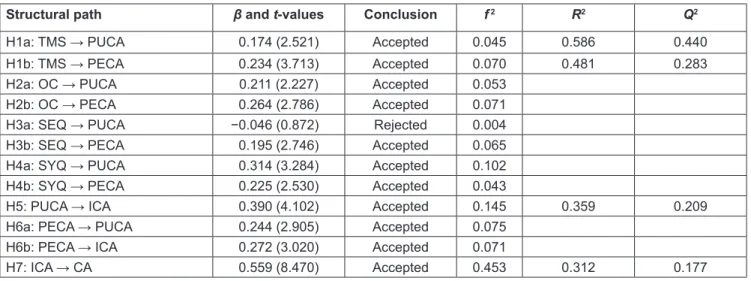
The proposed model was empirically evaluated using survey data from 187 managers (financial managers, IT department managers, audit managers, heads of accounting departments, and head of internal control departments) in Jordanian bank branches. Based on the SEM results, top management support, organizational competency, service quality, system quality, perceived usefulness, and perceived ease of use had a positive relationship with the intention of using cloud accounting. Cloud accounting adoption positively affected cloud accounting usage. This paper contributes to a theoretical understanding of factors that activate the adoption of cloud accounting. For financial firms in general the results enable them to better develop cloud accounting framework. The paper verifies the factors that affect the adoption of cloud accounting and the proposed cloud accounting model.
Keywords: Cloud Accounting, TAM Model, TOE Model, De Lone and Mc Lean Model, Jordan JEL Classification Code: M15, M41, O33
states that accounting change determinants can be divided into three primary categories which are, increasing globalization, enhanced IT, and enhanced production techniques (Cleary, 2016). Accounting refers to the language and science of business performance measurement, and it has been adapting to the economic context throughout the years. The introduction of accounting software has led to a considerably enhanced accounting practice. Owing to the significant information volume and the required processing time, accounting software has become a must as an accountant tool for faster and efficient job completion (Turner & Weickgenannt, 2020;
El-dalabeeh, 2019). Despite the inception of accounting software in a few decades, its potential has increased over the years, and a resulting outcome is a sophisticated tool.
In relation to technological developments, companies’
accounting departments have become susceptible to the influence of business digitization, the intense potential of the internet, big data implications, and the increasing data mining importance (Laudien & Pesch, 2019). In this realm, cloud computing was introduced, and it paved the way for creating new business models. Cloud computing is indubitably influential, and it has been predicted to be the platform upon which future changes in the economic
1
First Author. Associate Professor, Accounting Department, Faculty of Economics and Administrative Sciences, Al al-Bayt University, Jordan. Email: [email protected]
2
Corresponding Author. Assistant Professor, Accounting Department, Faculty of Economics and Administrative Sciences, Al al-Bayt University, Jordan [Postal Address: P. O. BOX 130040, Mafraq 25113, Jordan] Email: [email protected]
3
Assistant Professor, Queen Noor Aviation Technical College, Cyber Security Department, Jordan, Jordan. Email: [email protected]
4
Researcher, Center for Artificial Intelligence Technology, Faculty of Information Science and Technology, Universiti Kebangsaan Malaysia, Bangi, Malaysia. Email: [email protected]
5
Director of Financial Affairs, Al al-Bayt University, Jordan.
Email: [email protected]
© Copyright: The Author(s)
This is an Open Access article distributed under the terms of the Creative Commons Attribution Non-Commercial License (https://creativecommons.org/licenses/by-nc/4.0/) which permits unrestricted non-commercial use, distribution, and reproduction in any medium, provided the original work is properly cited.