374
Copyright © 2019 The Korean Society of Fisheries and Aquatic Science pISSN:0374-8111, eISSN:2287-8815
서 론
양식은인류의식량생산을위한중요한산업이다
.
국내넙치 양식산업은1984
년인공종묘생산기술개발이후지속적으로 발전하고있다(Son et al., 2006).
국내넙치양식생산량은1990
년1,037
톤에서2018
년37,238
톤으로30
여년간35
배이상증 가되었다(Pham et al., 2005; KOSIS, 2019).
하지만양식산업 이발전함에도몇몇문제점은남아있는실정이다.
일반적으로 양식어류1 kg
생산시1.9 kg
의자연산어류가필요하며,
육식성어류의경우
1 kg
생산시5 kg
의자연산어류가사용된다(Naylor et al., 2000). Hardy (2010)
는양식생산과정에투입된 어족자원이양식생산량보다더많이소모되고있는현상을두 고“
지속가능한양식의모순”
이라말하였다.
어분은우수한영양소조성을갖추고있으며
,
어류의성장을 촉진시키는미지성장인자를지니고있어양어사료내주요단 백질원료로사용되고있다(Lim and Lee, 2009).
하지만어분 은제한적인자원이며,
지속가능한양식을위해서는사료내어 분의사용량을감소시켜야한다(Gómez-Requeni et al., 2004).
사료내어분을줄이기위한여러연구가이루어지고있으며
,
대체원료로써식물성단백질원료가자주사용되고있다.
식물 성단백질원료의사용은경제적이며,
지속가능한양식을위한 요소중하나이다(Gisbert et al., 2016).
대두박(soybean meal)
은대표적인식물성단백질원료로써저렴한가격,
안정적인공 급,
높은단백질함량을지녀어분대체원료로각광받고있다(Kim et al., 2000).
밀,
콩등에서생산되는 밀글루텐(wheat gluten),
대두농축단백(soy protein concentrate)
과같은고단백식물성 단백질 혼합물을 이용한 넙치(Paralichthys olivaceus) 사료 내 어분대체 가능성 평가
김민기·신재형·이초롱·이봉주
1·허상우
1·임상구
1·이경준*
제주대학교 해양생명과학과, 1국립수산과학원 사료연구센터
Evaluation of a Mixture of Plant Protein Source as a Partial Fish Meal Replacement in Diets for Juvenile Olive Flounder Paralichthys olivaceus
Min-Gi Kim, Jaehyeong Shin, Chorong Lee, Bong-Joo Lee1, Sang-Woo Hur1, Sang Gu Lim1 and Kyeong-Jun Lee*
Department of Marine Life Sciences, Jeju National University, Jeju 63243, Korea
1Aquafeed Research Center, National Institute of Fisheries Science, Pohang 37517, Korea
This study was conducted to examine a mixture of plant protein sources as a fish meal (FM) substitute. Two feeding trials were carried out using similar dietary formulations but different FM levels. In Experiments 1 and 2, the basal diets were formulated to contain 65% and 60% of FM, respectively. The other five diets were formulated replacing FM by 10, 15, 20, 25 and 30% with a mixture of soybean meal, wheat gluten and soy protein concentrate. Three synthetic amino acids (lysine, threonine and methionine) were added to the test diet. Groups of fish in experiment 1 (6.76±0.03 g) and experiment 2 (32.5±0.1 g) were fed one of the experimental diets for 7 and 9 weeks, respectively.
Each experiment was carried out in triplicate. There were no significant differences among groups in terms of growth performance, feed utilization, survival or hematological parameters in either experiment. The results indicated that a mixture of soybean meal, wheat gluten and soy protein concentrate, supplemented with three synthetic amino acid, can replace fish meal by up to 30% in diets for juvenile olive flounder.
Key words: Olive flounder, Fish meal, Plant protein source, Low-fish meal diet
*Corresponding author: Tel: +82. 64. 754. 3423 Fax: +82. 64. 756. 3493 E-mail address: [email protected]
This is an Open Access article distributed under the terms of the Creative Commons Attribution Non-Commercial Licens (http://creativecommons.org/licenses/by-nc/3.0/) which permits unrestricted non-commercial use, distribution, and reproduction in any medium, provided the original work is properly cited.
Received 1 July 2019; Revised 18 July 2019; Accepted 2 August 2019
저자 직위: 김민기(대학원생), 신재형(대학원생), 이초롱(대학원생), 이봉주(박사), 허상우(박사), 임상구(박사), 이경준(교수)
https://doi.org/10.5657/KFAS.2019.0374
Korean J Fish Aquat Sci 52(4), 374-381, August 2019
농축물또한많이사용되고있다
(Hardy, 2010; Draganovic et al., 2011).
밀글루텐은조단백질함량이높으며(80%),
일반적 인식물성단백질원료와는다르게항영양인자가적고,
소화율 이높다(Apper-Bossard et al., 2013).
대두농축단백은60-65%
의조단백질을함유하고있으며
, rainbow trout Oncorhynchus mykiss, halibut Hippoglossus hippoglossus, Atlantic salmon Salmo salar, starry flounder Platichthys sellatus
사료에서어분 대체가능성을보여주었다(Kaushik et al., 1995; Berge et al., 1999; Storebakken et al., 2000; Li et al., 2015).
하지만넙치사 료내25%
이상대두농축단백을사용하면성장률,
사료효율,
사 료섭취량이감소되었다(Deng et al., 2006).
일부연구에서는단백질원료의혼합을통해어류의성장
,
사 료효율,
사료섭취량을개선시킬수있다고보고하였다(Lee et al., 1996). Valente et al. (2016)
는완두콩박,
대두농축단백,
감 자농축단백,
밀글루텐,
콘글루텐을혼합하여사용시senega- lese sole Solea senegalensis
사료내어분을최대75%
까지대 체할수있다고보고하였다. Gisbert et al. (2016)
는flathead grey mullet Mugil cephalus
사료내어분을대두농축단백,
밀 글루텐,
대두박을혼합하여최대75%
까지대체할수있다고 보고하였다.
육식성어종인넙치는단백질이용성이높은반면탄수화물 과지방에대한이용성이낮기때문에사료내단백질공급은 아미노산요구량과에너지요구량충족을위해매우중요하다
(Moon and Gatlin, 1991; Kim et al., 2000; Kikuchi and Takeu- chi, 2002; NRC, 2011).
넙치사료내적정단백질요구량은46.4-51.2%
이며, 57.7%
에서최대성장이나타난다(Kim et al., 2002).
이는Korean rockfish Sebastes schlegeli
와같은타어종 과비교하여높은편이다(Lee et al., 1993a).
높은단백질요구 량충족을위해넙치사료내많은양의어분이사용되고있다. Kim et al. (2011)
은넙치사료내어분사용량이40-60%
라고 보고하였으며,
배합사료회사에서는사료내어분을65%
이상 사용하기도한다.
본연구에서는넙치를대상으로어분함량이 다른두사료내어분을식물성단백질원료혼합물을이용하여 대체하는연구를실시하였다.
재료 및 방법
실험사료
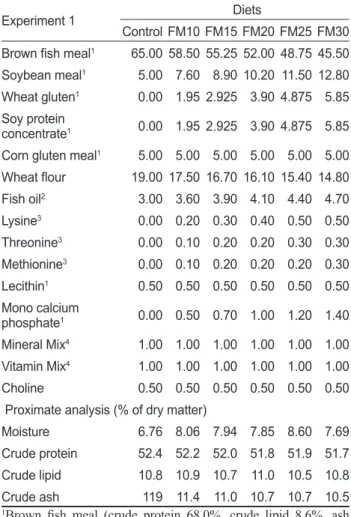
실험
1
에사용된실험사료배합비는Table 1
에나타내었다.
실 험사료에사용된어분은일반적으로사용되는갈색어분(brown fish meal)
이사용되었다.
실험1
은대조사료(Control)
내어분 의함량이65%
로설정되었다. 5
종의실험사료는대조사료내 어분이대두박,
밀글루텐,
대두농축단백혼합물로대체되었다.
실험사료내어분대체율은각각10%, 15%, 20%, 25%, 30%
(FM10, FM15, FM20, FM25, FM30)
로설정되었다.
대체실험 사료간의동일한조단백(52%),
조지질(10.0%),
인(1.5%)
조성을위해밀가루
,
어유, mono calcium phosphate
가사용되었다.
동일한필수아미노산조성을위해합성아미노산3
종(lysine, threonine, methionine)
을첨가하였다.
실험
2
에사용된실험사료배합비는Table 2
에나타내었다.
실Table 1. Composition of the experimental diets in experiment 1 (%
of dry matter basis)
Experiment 1 Diets
Control FM10 FM15 FM20 FM25 FM30 Brown fish meal1 65.00 58.50 55.25 52.00 48.75 45.50 Soybean meal1 5.00 7.60 8.90 10.20 11.50 12.80 Wheat gluten1 0.00 1.95 2.925 3.90 4.875 5.85 Soy protein
concentrate1 0.00 1.95 2.925 3.90 4.875 5.85 Corn gluten meal1 5.00 5.00 5.00 5.00 5.00 5.00 Wheat flour 19.00 17.50 16.70 16.10 15.40 14.80 Fish oil2 3.00 3.60 3.90 4.10 4.40 4.70 Lysine3 0.00 0.20 0.30 0.40 0.50 0.50 Threonine3 0.00 0.10 0.20 0.20 0.30 0.30 Methionine3 0.00 0.10 0.20 0.20 0.20 0.30 Lecithin1 0.50 0.50 0.50 0.50 0.50 0.50 Mono calcium
phosphate1 0.00 0.50 0.70 1.00 1.20 1.40 Mineral Mix4 1.00 1.00 1.00 1.00 1.00 1.00 Vitamin Mix4 1.00 1.00 1.00 1.00 1.00 1.00
Choline 0.50 0.50 0.50 0.50 0.50 0.50
Proximate analysis (% of dry matter)
Moisture 6.76 8.06 7.94 7.85 8.60 7.69 Crude protein 52.4 52.2 52.0 51.8 51.9 51.7 Crude lipid 10.8 10.9 10.7 11.0 10.5 10.8 Crude ash 119 11.4 11.0 10.7 10.7 10.5
1Brown fish meal (crude protein 68.0%, crude lipid 8.6%, ash 17.1%), Soybean meal (crude protein 52.7%, crude lipid 1.8%, ash 6.8%), wheat gluten (crude protein 83.2%, crude lipid 15.2%, ash 1.3%), soy protein concentrate (crude protein 68.9%, crude lipid 0.5%, ash 7.1%), corn gluten meal (crude protein 64.1%, crude lipid 3.5%, ash 0.6%), lecithin and mono calcium phosphate were by The Feed Co., Ltd., Seoul, Korea. 2Fish oil was by E-wha oil Co., Ltd., Busan, Korea. 3Lysine, threonine and methionine were by Vixxol Co., Ltd., Gyeonggi, Korea. 4Vitamin C and vitamin E were by AlphaAqua Co., Busan, Korea. FM10, 10% fish meal was replaced with mixture of plant protein sources in diet. FM15, 15% fish meal was replaced with mixture of plant protein sources in diet. FM20, 20% fish meal was replaced with mixture of plant protein sources in diet. FM25, 25% fish meal was replaced with mixture of plant protein sources in diet. FM30, 30% fish meal was replaced with mixture of plant protein sources in diet.
험
2
는대조사료내어분의함량이60%
로설정되었다. 5
종의 실험사료는대조사료내어분이대두박,
밀글루텐,
대두농축단 백혼합물로대체되었다.
실험사료내어분대체율은각각10%, 15%, 20%, 25%, 30% (FM10, FM15, FM20, FM25, FM30)
로설정되었다
.
대체실험사료간의동일한조단백(49%),
조지 질(10.5%),
인(1.4%)
조성을위해밀가루,
어유, mono calcium
phosphate
가사용되었다.
동일한필수아미노산조성을위해합성아미노산
3
종(lysine, threonine, methionine)
이첨가하였 다.
실험사료에사용되는사료원들중분말형태의사료원들은사 료혼합기를이용하여완전히섞은후
,
어유를첨가하였다.
이후 사료원총중량의15%
에해당하는증류수를첨가하여사료혼 합기에서혼합·
반죽하였다.
혼합반죽물은펠렛성형기(SP-50, Geumgang ENG, Korea)
를이용하여각각2 mm, 3 mm
크기 의펠렛사료형태로제작되었다.
제작된실험사료는건조기를 이용하여25°C
에서24
시간건조시켜 사료공급전까지-20°C
에보관하였다.
실험어 및 사육관리
실험어는 제주도서귀포시 성산읍신산리에 위치한대형수 산에서구입하였다
.
실험환경에대한적응을위해시판되는넙 치용배합사료를공급하며순치하였다.
실험1
은예비사육된 평균무게6.76±0.03 g
의넙치를18
개150 L
원형propylene (PP)
수조에각실험구당55
마리씩3
반복으로배치하였다.
사 양실험은7
주간진행되었다.
실험2
는예비사육 된평균무게32.5±0.1 g
의넙치를18
개150 L
원형PP
수조에각실험구당30
마리씩3
반복으로배치하였다.
사양실험은9
주간진행되었 다.
실험1, 2
모두실험사료는1
일3
회(8:00, 13:00, 18:00)
만복 공급되었다.
사료공급30
분후수조용량의80%
만큼환수를 진행하였다.
환수시까지수조내남아있는사료는수거하여건 조하였으며,
건중량을 측정하여 사료공급량에서제외하였다.
사육수는모래여과해수를사용하여4 L/min
의유수량이되도 록조절하였다.
각실험수조내사육수순환과용존산소유지를 위하여에어스톤을설치하였다.
사육수온은자연수존에의존 하였다.
실험1
의사육수온은16.5-22.3°C
였으며,
평균수온은19.5±1.5°C
로측정되었다.
실험2
의사육수온은19.6-30.5°C
였으며,
평균수온은23.9±2.3°C
로측정되었다.
성분분석
AOAC (2000)
분석법에따라실험사료에대한일반성분분석을진행하였다
.
수분은상압가열건조법(125°C, 3
시간),
조회분 은직접회화법(550°C, 4
시간)
으로분석되었다.
지방은Folch et
al. (1957)
의방법에따라분석되었다.
단백질은자동조단백질분석기
(Kejltec system 2300, Sweden)
로분석되었다. 어체측정
사양실험종료시성장률과사료효율그리고생존율의측정을 위해실험어류의수와무게를측정하였다
.
실험어는어체측정18
시간전부터절식되었다.
무게측정후증체율(weight gain,
%),
일간성장률(specific growth rate, %),
사료섭취량(feed in- take, g/fish),
사료전환효율(feed conversion ratio),
단백질이용 Table 2. Composition of the experimental diets in experiment 2 (%of dry matter basis)
Experiment 2 Diets
Control FM10 FM15 FM20 FM25 FM30 Brown fish meal1 60.00 54.00 51.00 48.00 45.00 42.00 Soybean meal1 5.00 7.40 8.60 9.80 11.00 12.20 Wheat gluten1 0.00 1.80 2.70 3.60 4.50 5.40 Soy protein
concentrate1 0.00 1.80 2.70 3.60 4.50 5.40 Corn gluten meal1 5.00 5.00 5.00 5.00 5.00 5.00 Wheat flour 23.50 22.20 21.70 21.00 20.40 19.90 Fish oil2 3.50 4.00 4.20 4.50 4.70 5.00 Lysine3 0.00 0.10 0.20 0.30 0.40 0.40 Threonine3 0.00 0.10 0.10 0.10 0.20 0.20 Methionine3 0.00 0.10 0.10 0.20 0.20 0.20 Lecithin1 0.50 0.50 0.50 0.50 0.50 0.50 Mono calcium
phosphate1 0.00 0.50 0.70 0.90 1.10 1.30 Mineral Mix4 1.00 1.00 1.00 1.00 1.00 1.00 Vitamin Mix4 1.00 1.00 1.00 1.00 1.00 1.00
Choline 0.50 0.50 0.50 0.50 0.50 0.50
Proximate analysis (% of dry matter)
Moisture 5.97 5.67 6.26 5.39 5.33 5.18 Crude protein 49.3 49.4 49.3 49.5 49.7 49.6 Crude lipid 10.8 10.8 10.9 10.0 10.1 10.0 Crude ash 11.7 11.2 11.1 10.8 10.6 10.6
1Brown fish meal (crude protein 68.0%, crude lipid 8.6%, ash 17.1%), Soybean meal (crude protein 52.7%, crude lipid 1.8%, ash 6.8%), wheat gluten (crude protein 83.2%, crude lipid 15.2%, ash 1.3%), soy protein concentrate (crude protein 68.9%, crude lipid 0.5%, ash 7.1%), corn gluten meal (crude protein 64.1%, crude lipid 3.5%, ash 0.6%), lecithin and mono calcium phosphate were by The Feed Co., Ltd., Seoul, Korea. 2Fish oil was by E-wha oil Co., Ltd., Busan, Korea. 3Lysine, threonine and methionine were by Vixxol Co., Ltd., Gyeonggi, Korea. 4Vitamin C and vitamin E were by AlphaAqua Co., Busan, Korea. FM10, 10% fish meal was replaced with mixture of plant protein sources in diet. FM15, 15% fish meal was replaced with mixture of plant protein sources in diet. FM20, 20% fish meal was replaced with mixture of plant protein sources in diet. FM25, 25% fish meal was replaced with mixture of plant protein sources in diet. FM30, 30% fish meal was replaced with mixture of plant protein sources in diet.
효율
(protein efficiency ratio),
생존율(survival, %)
을조사하였 다.
샘플수집 및 생화학적 분석
어체측정후
,
각각의수조에서8
마리의어류를무작위로선별 하였다.
선별된실험어는2-phenoxyethanol
용액(100 ppm)
을 이용하여마취시켰으며,
주사기를이용하여 미부동맥에서채 혈을실시하였다.
채혈된혈액은헤파린이20 µL
씩처리된1.5 mL eppendorf tube
에넣어hematocrit, hemoglobin
및nitro- blue tetrazolium (NBT) activity
측정에사용되었다.
Hematocrit
은모세혈관채혈튜브(micro-hematocrit capillary tubes)
에혈액을채운다음고무판(wax plates)
에세운후,
혈액 진단원심분리기(Micro Hematocrit VS-12000, Vision Scien- tific, Korea)
에서10
분간원심분리하여값이측정되었다. He-
moglobin
분석은시판되고있는kit
시약과반응시킨 후혈액생화학분석기
(Express plus system, Bayer, USA)
를이용하여end point
방법으로분석되었다.
혈액내의대식세포활성(NBT activity)
은Kumari and Sahoo (2006)
의분석방법을바탕으로respiratory burst
동안호중구(neutrophils)
에의한산화라디칼 의생성량이측정되었다.
통계학적 분석
성장및분석결과는
SPSS (Version 18.0)
프로그램을이용하여
One-way ANOVA-test
로통계분석되었다.
데이터값의유 의차는Tukey’s HSD (P<0.05)
로비교되었다.
데이터는평균값±
표준편차(mean±SD)
로나타내었다.
백분율데이터는arc-
sine
변형값으로계산하여통계분석되었다.
결과 및 고찰
실험
1
과2
의성장실험결과는Table 3
에나타내었다.
모든실 험구에서증체율,
일간성장률,
사료공급량,
사료전환효율,
단백 질이용효율,
생존율은유의적인차이가없었다.
본연구결과와 는반대로여러연구결과에서는식물성단백질원료를이용하 여어분을대체할경우성장률,
사료효율등에부작용이발생 한다고보고되었다.
평균무게35 g
의치어기넙치를대상으로 대두박을이용하여사료내어분을대체한연구에서는18.4%
이상대체한실험구가대조구에비해증체율이유의적으로낮 았고
,
사료효율(feed efficiency)
과단백질이용효율은27.6%
대 체한실험구가대조구에비해유의적으로낮았다(Kim et al.,
2000).
대두농축단백을이용하여넙치사료내어분을대체한연구에서는
25%
이상사용할경우성장률,
사료섭취량,
사료 효율이유의적으로감소하였다(Deng et al., 2006).
산가수분 해농축대두박을이용하여넙치치어사료내어분을40%
까 지대체하여도성장에유의적인차이는없었으나30%
이상사 용할경우사료효율이 감소하였다(Kim et al., 2014). Turbot
Table 3. Results of growth performance, feed utilization and survival in experiment 1 and experiment 21
FBW2 WG3 SGR4 FI5 FCR6 PER7 Survival8
Experiment 1
Control 27.0±0.5 298±6 2.09±0.02 24.6±3.5 1.22±0.16 1.59±0.21 76.4±4.8
FM10 29.7±1.3 340±20 2.24±0.07 24.7±3.7 1.07±0.10 1.80±0.17 71.5±10.0
FM15 27.3±4.0 303±58 2.10±0.22 25.8±4.6 1.27±0.19 1.53±0.22 80.0±16.7
FM20 24.8±2.3 265±36 1.96±0.15 20.7±2.2 1.17±0.25 1.68±0.36 81.8±4.8
FM25 25.1±2.2 274±33 1.99±0.14 20.0±1.8 1.10±0.17 1.77±0.26 80.6±6.9
FM30 25.1±0.8 272±12 1.99±0.05 24.5±0.1 1.33±0.06 1.44±0.07 87.8±1.0
Experiment 2
Control 155±2 378±8 2.48±0.02 131±25 1.06±0.21 1.96±0.34 62.2±8.4
FM10 141±5 332±15 2.32±0.06 140±19 1.35±0.27 1.55±0.30 42.2±12.6
FM15 152±14 366±42 2.44±0.14 132±20 1.12±0.28 1.88±0.43 66.7±17.3
FM20 152±5 367±15 2.45±0.05 126±22 1.05±0.20 1.99±0.43 62.2±5.1
FM25 146±5 349±17 2.38±0.06 143±24 1.26±0.20 1.64±0.25 57.8±18.4
FM30 152±5 367±14 2.45±0.05 133±28 1.11±0.19 1.88±0.34 55.6±9.6
1The lack of superscript letter indicates no significant differences among treatments.2FBW (final mean body weight, g/fish). 3WG (weight gain, %)=(final weight-initial weight)×100/initial weight. 4SGR (specific growth rate, %/day)=(loge final weight-loge initial weight/days. 5FI (feed intake, g/fish)=dry feed consumed (g)/fish. 6FCR (feed conversion ration)=dry feed intake/wet weight gain. 7PER (protein efficiency ratio)=wet weight gain/protein intake. 8Survival (%)=Number of fish at end of experiment/number of fish stocked×100. FM10, 10% fish meal was replaced with mixture of plant protein sources in diet. FM15, 15% fish meal was replaced with mixture of plant protein sources in diet. FM20, 20% fish meal was replaced with mixture of plant protein sources in diet. FM25, 25% fish meal was replaced with mixture of plant protein sources in diet. FM30, 30% fish meal was replaced with mixture of plant protein sources in diet.
Scophthalmus maximus
사료내어분을대두농축단백을이용 하여대체할경우에도25%
까지대체가능하다고보고되었으 며,
그이상대체할경우성장률및사료효율이감소하였다(Day and Plascencia GonzÁlez, 2000).
식물성단백질원료는어분에 비해아미노산조성이불균형적이기때문에어분을식물성단 백질원료로대체할경우아미노산의첨가가필요하다(Gatlin et al., 2007).
평균무게5 g
의치어기넙치를대상으로대두박을이 용하여사료내어분을대체한연구에서도20%
까지어분을대 체할수있었으나,
필수아미노산을첨가할경우30%
까지어분 대체가가능한것으로보고하였다(Choi et al., 2004).
넙치사료 내대두농축단백을이용하여어분을대체한연구에서도아미노 산첨가시어분대체에따른성장저하를다소완화시켰다(Deng et al., 2006).
본연구에서도필수아미노산3
종을추가하여필수 아미노산을충족시켰기때문에어분대체시성장률과사료효율 의감소를보완해준것으로판단된다.
Kim et al. (2000)
은여러가지원료의적절한혼합이원료의 부족한영양소를보완하여성장효과를개선하고나아가높은 비율의어분대체를실현할수있을것이라보고하였다.
넙치를 대상으로한 연구에서Kikuchi (1999)
는대두박,
혈분(blood meal),
콘글루텐밀(corn gluten meal)
을혼합하여 사료내어 분을40%
대체할수있다고보고하였으며, Kim et al. (2019)
은밀글루텐,
대두농축단백,
수지박(tankage meal),
가금부산물 분(poultry by-product meal)
을혼합하여사료내어분을40- 50%
대체할수있다고보고하였다.
타어종에서도식물성원료 의혼합을통해높은비율의어분대체가이루어졌다고보고되 었다. Summer flounder Paralichthys dentatus
사료내대두박,
콘글루텐밀,
유채단백농축분, taurine
을혼합하여사용시어분 을40%
대체할수있었다(Enterria et al., 2011). Turbot Psetta maxima
사료내콘글루텐밀,
밀글루텐,
루핀박(lupine)
을혼 합하여사용시어분을50%
대체할수있었다(Fournier et al., 2004). Atlantic salmon
사료와rainbow trout
사료내밀글루 텐,
콘글루텐혼합물과스피룰리나(spirulina),
대두박혼합물을 각각사용시어분을100%
대체할수있었다(Espe et al., 2006;
Flores et al., 2012).
본연구에서도어분대체를위해대두박,
밀 글루텐,
대두농축단백혼합을통해단일원료사용시부족할수있는영양소를서로보완해주었기때문에어분을
30%
대체함에도성장과사료효율에문제가없었던것으로판단된다
.
혈액학적분석은어류건강을평가하는데있어중요한기준으 로간주된다(De Pedro et al., 2005).
혈장의성분은사료의영양 소의차이,
사육환경등에따라차이가난다(Murai et al., 1982;
Lee et al., 1993b; Park et al., 1999).
넙치사료내어분을대체 할경우에도혈장의성분이변화된다고보고되었다.
산가수분 해농축대두박을이용하여어분을대체한연구에서어분대체 율이증가할수록hemoglobin
과hematocrit
수치가감소하였으 며, 50%
이상대체시대조구와유의적으로차이가났다(Kim et
al., 2014).
대두박과면실박을혼합하여어분을대체한연구에서도어분대체율이증가할수록
hemoglobin
과hematocrit
수치 가유의적으로감소하였다.
이외에도타어종을대상으로한연 구에서어분대체시혈장성분의유의적인변화가관찰되었다(Lim et al., 2011; Shin et al., 2019).
하지만돈모분(pig bristle meal)
을이용한어분대체연구에서는hemoglobin, hematocrit, NBT
의유의적인차이가없었다(Kim et al., 2018).
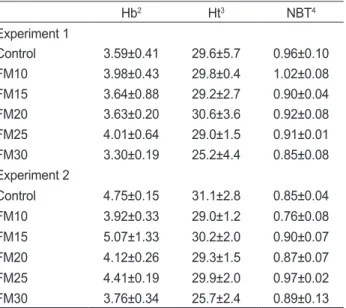
본연구에 서도혈액학적분석결과hemoglobin, hematocrit, NBT
에서모 든실험구가control
그룹과비교하였을때,
유의적인차이를보 이지않았다(Table 4).
결론적으로대두박,
밀글루텐,
대두농축단백혼합물을이용해어분을
30%
대체하여도넙치의건강에유해한영향을끼치지않을것으로판단된다
.
본연구에서실험
2
의생존율은다소낮았다.
실험2
에서의평 균수온은23.9°C
였으나최고수온은30.5°C
까지상승하였다.
넙치의적정수온은21-24°C
이다(Oh et al., 2014).
미성어기넙 치를대상으로고수온에서4
주간실험한결과,
생존율은최저68%
로보고된바있다(Kim et al., 2015a).
수온은어류의섭식 욕구에영향을미치며,
과도한수온상승은먹이섭식활동을저 하시켜어류의영양상태에악영향을끼칠수있다(Kim et al.,
2015b).
또한수온상승은어류의스트레스를일으키는주요요인으로면역력감소와폐사율증가시킨다
(Choi et al., 2009).
따Table 4. Results of hematological analysis in experiment 1 and ex- periment 21
Hb2 Ht3 NBT4
Experiment 1
Control 3.59±0.41 29.6±5.7 0.96±0.10
FM10 3.98±0.43 29.8±0.4 1.02±0.08
FM15 3.64±0.88 29.2±2.7 0.90±0.04
FM20 3.63±0.20 30.6±3.6 0.92±0.08
FM25 4.01±0.64 29.0±1.5 0.91±0.01
FM30 3.30±0.19 25.2±4.4 0.85±0.08
Experiment 2
Control 4.75±0.15 31.1±2.8 0.85±0.04
FM10 3.92±0.33 29.0±1.2 0.76±0.08
FM15 5.07±1.33 30.2±2.0 0.90±0.07
FM20 4.12±0.26 29.3±1.5 0.87±0.07
FM25 4.41±0.19 29.9±2.0 0.97±0.02
FM30 3.76±0.34 25.7±2.4 0.89±0.13
1The lack of superscript letter indicates no significant differences among treatments. 2Hemoglobin (Hb, g/dL). 3Hematocrit (Ht, %).
4Nitro blue tetrazolium activity (absorbance). FM10, 10% fish meal was replaced with mixture of plant protein sources in diet.
FM15, 15% fish meal was replaced with mixture of plant protein sources in diet. FM20, 20% fish meal was replaced with mixture of plant protein sources in diet. FM25, 25% fish meal was replaced with mixture of plant protein sources in diet. FM30, 30% fish meal was replaced with mixture of plant protein sources in diet.
라서실험
2
에서넙치생존율이낮은이유는과도한수온상승 이어류의영양상태,
생리적기능,
면역계에악영향을끼쳤기때 문으로판단된다.
본연구결과
,
넙치사료내아미노산(lysine, threonine, me-
thionine)
을첨가하여식물성단백질혼합물을사용할경우사료내
30%
까지어분대체가가능할것으로보인다.
하지만식물성 단백질혼합물을이용한최대어분대체비율은본연구에서밝 힐수없었기때문에향후추가적인연구를통해밝혀나가야할 것으로판단된다.
또한,
식물성단백질을사용하여어분대체비 율이높아질수록어류장내염증반응이발생하는등어분대체 시발생하는문제점들에대한연구가보고되고있다(Gu et al., 2016).
향후조직학적분석및PCR
분석과같은추가적인연구 를통해식물성단백질혼합물의이용성에관하여더욱자세히 밝혀야할것으로판단된다.
사 사
이논문은국립수산과학원
(R2016016)
및해양수산부의지원 으로수행된연구이며연구비지원에감사드립니다.
References
AOAC (Association of Official Analytical chemists). 2000. Of- ficial methods of analysis of AOAC International (17th ed.).
Gaithersburg, MD, U.S.A.
Apper-Bossard E, Feneuil A, Wagner A and Respondek F. 2013.
Use of vital wheat gluten in aquaculture feeds. Aquatic Bio- systems 2013, 9-21. https://doi/10.1186/2046-9063-9-21.
Berge GM, Grisdale-Helland B and Helland SJ. 1999. Soy protein concentrate in diets for Atlantic halibut (Hippoglos-
sus hippoglossus). Aquaculture 178, 139-148. https://doi.
org/10.1016/S0044-8486(99)00127-1.
Choi HS, Myoung JI, Park MA and Cho MY. 2009. A study on the summer mortality of Korean rockfish Sebastes schlegeli in Korea. J Fish Pathol 22, 155-162.
Choi SM, Wang X, Park GJ, Lim SR, Kim KW, Bai SC and Shin IS. 2004. Dietary dehulled soybean meal as a re- placement for fish meal in fingerling and growing olive flounder Paralichthys olivaceus (Temminck et Schlegel).
Aquac Res 35, 410-418. https://doi.org/10.1111/j.1365- 2109.2004.01046.x.
Day OJ and Plascencia GonzÁlez HG. 2000. Soybean pro- tein concentrate as a protein source for tubot Scopthalmus
maximus L. Aquac Nutr 6, 221-228. https://doi.org/10.1046/
j.1365-2095.2000.00147.x.
Deng J, Mai K, Ai Q, Zhang W, Wang X, Xu W and Liufu Z.
2006. Effects of replacing fish meal with soy protein con- centrate on feed intake and growth of juvenile Japanese flounder, Paralichthys olivaceus. Aquaculture 258, 503- 513. https://doi.org/10.1016/j.aquaculture.206.04.004.
De Pedro N, Guijarro AI, López-Patiño MA, Martínez-Álvarez R and Delgado MJ. 2005. Daily and seasonal variations in haematological and blood biochemical parameters in the tench, Tinca tinca Linnaeus, 1758. Aquac Res 36, 1185- 1196. https://doi.org/10.1111/j.1365-2109.2005.01338.x.
Draganovic V, van der Goot AJ, Boom R and Jonkers J. 2011.
Assessment of the effects of fish meal, wheat gluten, soy protein concentrate and feed moisture on extruder system parameters and the technical quality of fish feed. Anim Feed Sci Thechnol 165, 238-250. https://doi.org/10.1016/j.ani- feedsci.2011.03.004.
Enterria A, Slocum M, Bengtson DA, Karayannakidis PD and Lee CM. 2011. Partial replacement of fish meal with plant protein sources singly and in combination in diets for sum- mer flounder, Paralichthys dentatus. J World Aquac Soc 42, 753-765. https://doi.org/10.1111/j.1749-7345.2011.00533.x.
Espe M, Lemme A, Petri A and El-Mowafi A. 2006. Can Atlan- tic salmon (Salmo salar) grow on diets devoid of fish meal?
Aquaculture 255, 255-262. https://doi.org/10.1016/j.aqua- culture.2005.12.030.
Flores GH, Hernández LHH, Araiza MAF and López OA.
2012. Effects of Total Replacement of Fishmeal with Spiru-
lina Powder and Soybean meal on Juvenile Rainbow Trout
(Oncorhychus mykiss Walbaum). Isr J Aquac 64, 41-48.http://hdl.handle.net/10524/31828.
Folch J, Lees M and Sloane-Stanley GH. 1957. A simple method for the isolation and purification of total lipids from animal tissues. J biol Chem 226, 497-509.
Fournier V, Huelvan C and Desbruyeres E. 2004. Incorporation of a mixture of plant feedstuffs as substitute for fish meal in diets of juvenile turbot (Psetta maxima). Aquaculture 236, 451-465. https://doi.org/10.1016/j.aquaculture.2004.01.035.
Gatlin III DM, Barrows FT, Brown P, Dabrowski K, Gaylord TG, Hardy RW, and Overturf K. 2007. Expanding the utili- zation of sustainable plant products in aquafeeds: a review.
Aquac Res 38, 551-579. https://doi.org/10.1111/j.1365- 2109.2007.01704.x.
Gisbert E, Mozanzadeh MT, Kotzamanis Y and Estévez A.
2016. Weaning wild flathead grey mullet (Mugil cephalus) fry with diets with different levels of fish meal substitution.
Aquaculture 462, 92-100. https://doi.org/10.1016/j.aquacul- ture.2016.04.035.
Gómez-Requeni P, Mingarro M, Calduch-Giner JA, Médale F, Martin SAM, Houlihan DF and Pérez-Sánchez J. 2004.
Protein growth performance, amino acid utilisation and so- matotropic axis responsiveness to fish meal replacement by plant protein sources in gilthead sea bream (Sparus aurata).
Aquaculture 232, 493-510. https://doi.org/10.1016/S0044- 8486(03)00532-5.
Gu M, Bai N, Zhang Y and Krogdahl Å. 2016. Soybean meal induces enteritis in turbot Scophthalmus maximus at high supplementation levels. Aquaculture 464, 286-295. https://
doi.org/10.1016/j.aquaculture.2016.06.035.
Hardy RW. 2010. Utilization of plant proteins in fish diets: effects of global demand and supplies of fishmeal. Aqu Res 41, 770- 776. http://dx.doi.org/10.1111/j.1365-2109.2009.02349.x.
Kaushik SJ, Cravedi JP, Lalles JP, Sumpter J, Fauconneau B and Laroche M. 1995. Partial or total replacement of fish meal by soybean protein on growth, protein utilization, potential estrogenic or antigenic effects, cholesterolemia and flesh quality in rainbow trout, Oncorhynchus mykiss.
Aquaculture 133, 257-274. https://doi.org/10.1016/0044- 8486(94)00403-B.
Kikuchi K. 1999. Use of defatted soybean meal as a substitute for fish meal in diets of Japanese flounder (Paralichthys
olivaceus). Aquaculture 179, 3-11. https://doi.org/10.1016/
S0044-8486(99)00147-7.
Kikuchi K and Takeuchi T. 2002. Pp. 113-120. In: Webster CD and Lim C (Eds.) Nutrient requirements and feeding of fin- fish for aquaculture. CABI Publishing, Alabama, U.S.A.
Kim KW, Kim KD, Son MH and Ahn CM. 2011. Evaluation of Squid Liver Powder as a Dietary Protein Source Replacing Fish Meal in Juvenile flounder, Paralichthys olivaceus. Jour Fish Mar Edu 23, 461-467.
Kim KW, Wang XJ and Bai SC. 2002. Optimum dietary pro- tein level for maximum growth of juvenile olive floun- der Paralichthys olivaceus (Temminck et Schlegel).
Aquac Res 33, 673-679. https://doi.org/10.1046/j.1365- 2109.2002.00704.x.
Kim MG, Lee CR, Kim YJ, Oh DH, Lee BJ, Kim SS and Lee KJ. 2015b. Optimum feeding rates of subadult Korean rock- fish Sebastes schlegeli fed a commercial diet at different water temperature. Korean J Fish Aquat Sci 48, 322-328.
https://dx.doi.org/10.5657/KFAS/2015.0322.
Kim MG, Lee CR, Shin JH, Lee BJ, Kim KW and Lee KJ. 2019.
Effects of fish meal replacement in extruded pellet diet on growth, feed utilization and digestibility in olive flounder
Paralichthys olivaceus. Korean J Fish Aquat Sci 52, 149-
158. https://doi.org/10.5657/KFAS.2019.0149.Kim SS, Kim KW, Kim KD, Lee BJ, Han HS and Lee KJ.
2015a. Optimum feeding rates for growing and sub-adult olive flounder Paralichthys olivaceus fed practical extruded pellets at high water temperature. Korean J Fish Aquat Sci 48, 681-687. https://dx.doi.org/10.5657/KFAS.2015.0681.
Kim SS, Oh DH, Cho SJ, Seo SH, Han HS and Lee KJ. 2014.
Evaluation of acid-concentrated soybean meal as a fishmeal replacement and its digestibility in diets for juvenile olive flounder Paralichthys olivaceus. Korean J Fish Aquat Sci 47, 824-831. http://dx.doi.org/10.5657/KFAS.2014.0824.
Kim YJ, Shin JH, Kwon HW, Lee SY, Kim JM, Kim MG, Kim JD and Lee KJ. 2018. Evaluation of a hydrolyzed pig bristle meal as a partial fish meal replacer in diets for juvenile olive flounder Paralichthys olivaceus. Korean J Fish Aquat Sci 51, 148-456. https://doi.org/10.5657/KFAS.2018.0148.
Kim YS, Kim BS, Moon TS and Lee SM. 2000. Utilization of defatted soybean meal as a substitute for fish meal in the diet of juvenile flounder (Paralichthys olivaceus). Fish Aquatic Sci 33, 469-474.
KOSIS (Korean Statistical Information Service). 2019. Ex- penditure per aquaculture. Retrieved from http://kosis.
kr/statHtml/statHtml.do?orgId=307&tblId=TX_30702_
A018&conn_path=I2 on Jun 10, 2019.
Kumari J and Sahoo PK. 2006. Dietary β-1,3 glucan potenti- ates innate immunity and disease resistance of Asian catfish,
Clarias batrachus (L.). J Fish Dis 29, 95-101. https://doi.
org/10.1111/j.1365-2761.2006.00691.x.
Lee JY, Kang YJ, Lee SM and Kim IB. 1993a. Protein require- ments of the Korean rockfish Sebastes schlegeli. J Aquacul- ture 6, 13-27.
Lee SM, Lee Jy, Kang YJ and Hur SB. 1993b. Effects of dietary n-3 highly unsaturated fatty acids on growth and biochemi- cal changes in the Korean rockfish Sebastes schlegeli II.
Chages of Blood Chemistry and Properties of Liver Cells. J Aquaculture 6, 107-123.
Lee SM, Jeon IG, Lee JY, Park SR, Kang YJ and Jeong KS.
1996. Substitution of plant and animal proteins for fish meal in the growing Korean rockfish (Sebastes schlegeli) Feeds.
Fish Aquatic Sci 29, 651-662.
Li PY, Wang JY, Song ZD, Zhang LM, Zhang H, Li XX and Pan Q. 2015. Evaluation of soy protein concentrate as a substitute for fishmeal in diets for juvenile starry flounder (Platichthys stellatus). Aquaculture 448, 578-585. https://
doi.org/10.1016/j.aquaculture.2015.05.049.
Lim SJ and Lee KJ. 2009. Partial replacement of fish meal by cottonseed meal and soybean meal with iron and phytase supplementation for parrot fish Oplegnathus fasciatus.
Aquaculture 290, 283-289. https://doi.org/10.1016/j.aqua- culture.2009.02.018.
Lim SJ, Kim SS, Ko GY, Song JW, Oh DH, Kim JD, Kim JU and Lee KJ. 2011. Fish meal replacement by soybean meal in diets for tiger puffer, Takifugu rubripes. Aquaculture 313, 165-170. https://doi.org/10.1016/j.aquaculture.2011.01.007.
Moon HY and Gatlin III DM. 1991. Total sulfur amino acid requirement of juvenile red drum, Sciaenops ocellatus.
Aquaculture 95, 97-106. https://doi.org/10.1016/0044- 8486(91)90076-J.
Murai T, Ogata H and Nose T. 1982. Methionine coated with various materials supplemented to soybean meal diet for fin- gerling carp Cyprinus carpio and channel catfish Ictalurus
punctatus. Bull Jpn Soc Sci Fish 48, 85-88.
Naylor RL, Goldbug RJ, Primavera JH, Kautsky N, Beveridge MCM, Clay J, Folke C, Lubchenco J, Mooney H and Tro- ell M. 2000. Effect of aquaculture on world fish supplies.
Nature 405, 1017-1024. https://doi.org/10.1038/35016500.
NRC (National Research Council). 2011. Nutrient requirements of fish and shrimp. The National Academy Press, Washing-
ton DC, U.S.A.
Oh DH, Kim SS, Kim KW, Kim KD, Lee BJ, Han HS, Kim JW, Okorie OE, Bai SC and Lee KJ. 2014. Optimum feeding rate for growing olive flounder (317 g) Paralichthys oliva-
ceus fed practical extruded pellets at optimum water tem-
perature (21-24°C). Korean J Fish Aquat Sci 47, 399-405.https://dx.doi.org/10.5657/KFAS.2014.0399.
Park MR, Chang YJ and Kang DY. 1999. Physiological response of the cultured olive flounder (Paralichthys olivaceus) to the sharp changes of water temperature. J Aquacult 12, 221-228.
Pham MA, Lee KJ, Lim SJ, Lee BJ, Kim SS, Park YJ and Lee SM. 2005. Fish meal replacement by cottonseed and soy- bean meal in diets for juvenile olive flounder, Paralichthys olivaceus. Kor Aquac Soc 18, 215-221. Shin SJ, Lee TK, Lee OH, Lim SR, Yang IC, Kim SS, Choi JW, Kim JS and Kim JD. 2019. Effect of dietary fish meal replacement by a blend of plant and animal ingredients on the growth and blood chemistry of starry flounder Platichthys stellatus. Ko- rean J Fish Aquat Sci 52, 134-140. https://doi.org/10.5657/
KFAS.2019.0134.
Son MH, Park MW, Kim EO, Lim HK, Kim DJ, An CM, Eom KH, Kim SG, Cho YC, Lee CH, Hwang HK, Youn SJ, Han SJ, Choi NJ, Park YB, Eh YY. 2006. Standard manual of olive flounder culture, National Fisheries Research and De- velopment Institute (NFRDI), Busan, Korea.
Storebakken T, Shearer KD and Roem AJ. 2000. Growth, uptake and retention of nitrogen and phosphorus, and absorption of other minerals in Atlantic salmon Salmo salar fed diets with fish meal and soy-protein concentrate as the main sources of protein. Aquac Nutr 6, 103-108. https://doi.org/10.1016/
S0044-8486(99)00316-6.
Valente LMP, Cabral EM, Sousa V, Cunha LM and Fernandes JMO. 2016. Plant protein blends in diets for senegaless sole affect skeletal muscle growth, flesh texture and the expres- sion of related genes. Aquaculture 453, 77-85. https://doi.
org/10.1016/j.aquaculture.2015.11.034.