약학회지 제
42권 제
1호
108~~113(1998) Yakhak Hoeji Vol. 42. No. 1사염화탄소로 독성을 유발시킨 일차배양 간세포에 미처는 G009의 효과
이 미 경 • 김 홍 표 • 이 준 우* ■정 훈* • 이 승 룡* • 김 영 중*
서울대학교 약학대학, •일앙약품 중앙연구소
(Received November 26. 1997)
Hepatoprotective Effect of G009 on CCLrinduced Hepatotoxicity in Primary Cultured Rat Hepatocytes
Mi Kyeong Lee, Hong Pyo Kim, Ju n e Woo Lee*, Hoon Jung*, Seung Yong Lee* and Young Choong Kirr/
College of Pharmacy, Seoul National University, Seoul 151-742, Korea
*11 Yang pharm. Co. Ltd., Central Research Center, Yongin, Kyonggi-Do 449-900, Korea
Abstract
—G009. a polysaccharide isolated from the mycelia of
Ganoderma lucidumIY009. showed a hepa
toprotective activity against CCLrinduced cytotoxicity in primary cultured rat hepatocytes. Incubation of CCIrintoxicated hepatocytes with G009 significantly reduced the levels of ^utamic pyruvic tran
saminase and sorbitol dehydrogenase released from hepatocytes in the medium. G009 showed an- tioxidative effect by elevating the activities of glutathione reductase and superoxide dismutase. and the content of glutathione in CCIrintoxicated primary cultured rat hepatocytes. Furthermore. G009 sig
nificantly elevated glutathione-S-transferase activity in CCIrintoxicated primary cultured rat hepa
tocytes. G009 also reduced the production of malondialdehyde. a byproduct of lipid peroxidation. From these results, it could be concluded that G009 exerted hepatoprotective activity against CClrinduced cytotoxicity through antioxidation.
Keywords □ G009. primary cultured rat hepatocytes, CCU glutamic pyruvic transaminase, sorbitol dehydrogenase, glutathione reductase, glutathione, superoxide dismutase. glutathione-S-transferase.
malondialdehyde.
영지버섯(Gflworfm/w
lucidum)은이뇨, 강장, 정신안 정 및 기관지염 등에 널리 사용되어 왔으며 그 약효를 규명하기 위한 활발한 연구가 수행되어 항암효과/ ® 혈 당강하 효과.® insulin 분비 효과,^* 보체 계 활성 효과,®*
지질과산화 생성 억제 효과,®"'" 간섬유화 억제효과,®*
간 보호 효과** 등 다양한 활성 이 보고 되 었다.
본 연구에서는 최근 인간의 간세포와 생리적으로나 생화학적으로 유사하다고 알려 진일 차 배 양 한 흰쥐 외 간세포를 검색계로 이용하여 영지버섯의 균사체인 IY 009로부터 분리 정제한 다당체인 G009의 간세포
•본 논문에 관한 문의는 이 저자에게로
(
전화
) 02-880-7842 (팩스
) 02-888-2933보호 작용 및 그 기전을 규명하고자 하였다. 일차배양
한 흰쥐외 간세포에 대표적인 간득성 물질 중외 하나
인 사염화탄소로 득성을 유발시킨 후 G009를 투여하
여 간세포 보호 효과를 측정하였다. 간세포 보호 효과
및 그 작용기전은 배양액 중으로 유리되는 glutamic
pyruvic transaminase, sorbitol dehydrogenase
및 간세포내에 존재하는 여러 효소둘 즉. 해득작용에
관여하는 glutathione-S-transferase, 자유기 생성
외 억제 및 생성된 자유기외 제거에 관여하는 glu-
tathione reductase, superoxide dismutase외 활
성 및 자유기로 인한 glutathione의 양. 지질과산화의
지표인 malondialdehyde외 앙 등을 즉정하여 알아
보았다.
G009
의 간세포 보호 효과
109실험방법
실험동물
흰쥐 (Wistar. male, 150~200g)는 서울대학교 실 험동물 사육장으로부터 공급받은 것을 온도
2 2± rc . 습도 60±5%로 유지하면서 12시간 간격으로 명암을 바꿔주면서 사료와 물을 마음껏 섭취하도록 하였다. 실 험시에는 하루 전부터 굶겨 공복 상태가 되도록 하였다.
시약및재료
본 연구에 사용한 모든 시약은 Sigma사(St. Louis.
MO, U.S.A)의 제품을, fetal calf serum은 Hydone사 (Logan, Utah, U.S.A.)의 제품을 사용하였으며 GPT kit은 영동제약으로부터 구입하였다. G009는 일양약품 중앙연구소로부터 제공받아 사용하였다 .
간세포의분리및배양
흰쥐의 간세포는 Berry와 Friend의 방법*을 약간 수정한 2단계 collagenase 관류법*^*^을 이용하여 분 리하였다. 분리한 간세포는 5x10"cells/m; 로 희석하 여 collagen으로 도포된 용기에 배양하였다. 배양액으 로는 Waymouth's MB 752/1 medium, 5% fetal calf serum, 2.0 mg/mZ bovine serum albumin (fraction V), 10^ M dexamethasone, 10'구 M in
sulin, 5.32xlO'"M L-serine, 4.09x lO'^M L-alan- ine, 2.67 X 10심 M NaHCOa, 100 lU /m ; penicillin.
100 나g/m/ streptomycin, 5 |Xg/m/ amphotericin B 또는 50 ng/mZ gentamycin sulfate로 구성된 것을 사용 허;였으of. 습도가 유지되는 3TC 배양기에서 공기 (95%)와 C02(5% )의 혼합기체를 계속 공급하면서 세 포률 배양하였다.
시료의제조
G009를 HBSS 완층용액으로 용해시킨 후 이를 mil- lipore membrane(0.22 nm, Millex-GV U.S.A)을 사용하여 여과시켜 무균상태로 제조하였다.
사염화탄소에의한간세포독성유도및
G009
의투여간세포를 배양한지 1.5시간이 지난 후 새로운 배양액 으로 같아준 다옴 24시간 동안 세포를 배앙한 후 10 mM 사염화탄소를 함유한 배양액으로 같아주고 1.5시 간 동안 세포를 더 배양하여 세포득성을 유도하였다.
G009는 사염화탄소를 함유하는 배양액으로 같아주면 서 동시에 투여하였다.
Glutamic pyruvic transainina$e(GPT)
의활성측정세포 득성이 유도된 간세포의 배양액을 취하여 GPT 의 활성을 GPT Kit를 사용하여 Reitman-Frankel 의 방법 으로 측정하였다.
Sorbitol dehydrogenase(SDH)
의활성측정세포 득성 이 유도된 간세포의 배양액을 취하여 Ger- lach의 방법 *®•을 약간 수정 한 방법 으로 SDH의 활성을 측정하였다.
Superoxide disinutase(SOD)
의활성측정일차배양한 간세포내외 SOD의 활성은 McCord와 Fridovich의 방범*을 수정하여 측정하였다.
Glutathione-S-transferase(GST)
의활성측정일차배양한 간세포내외 GST의 활성은 Habig 등의 방법 *®•을 이용하여 측정하였다. .
Glutathione reductase(GSSG-R)
의활성측정일차배양한 간세포내의 GSSG-R외 활성은 Carl- berg와 Mannerviik외 방법™을 이용하여 즉정하였다.
Glutathione
의정량일차배양한 간세포내의 총 glutathione의 양과 ox- idized glutathione(GSSG)의 양은 Griffith의 방법™
으로 측정하였다.
지질과산화측정
지질과산화 정도를 1,1,3,3-tetraethoxypropane을 표준물질로 하여 Masuage법^■'에 외하여 측정하였다.
단백질정량
단백질 양은 bovine serum albumin을 표준품으로 하여 Lowry 방법오^•으로 측정하였다.
통계처러
통계적 유의성을 검토하기 위해 대조치로부터의 번 동을 "ANOVA" test에 의해 판정하였으며 P 값이 5%
머만일 때 통계적으로 유의성이 있다고 관정하였다.
Vol. 42, No. 1, 1998
Ctrl Ref 1 10 100 300 Concentration (니 g/ml)
지 농도롤 증가시키면서 투여한 결과 1 ^igAn/에서부터 30(Uig/m; 까지 농도외존적으로 배양액 중으로 유리되 는 GPT 및 SDH의 양을 감소시켰으며 300 ng/m; 외 농도에서 최고의 활성을 나타내어 득성을 50%나 차단 시켰다(Fig. 1). 그러나 1000 ng/m; 의 농도에서는 그 활성이 감소하였다. 이것이 G009외 자체, 득성에 외한 것인지 또는 다른 작용기전에 의한 것인지는 추후 연구 가 진행되어야 할 것이다.
세포내에는 oxidative stress에 대한 여러 방어기전 이 존재한다. 그 방어기전의 대표적인 역할을 하는
GSH는 구성
되어 있으며 2GSHOGSSG로 평형을 이루고 정상상태 에서는 대부분 GSH의 형태로 존재한다. 그러나 ox
idative stress로 인하여 자유기가 증가되면 GSH는
|
bGSH C GSSG-R S3
sod]
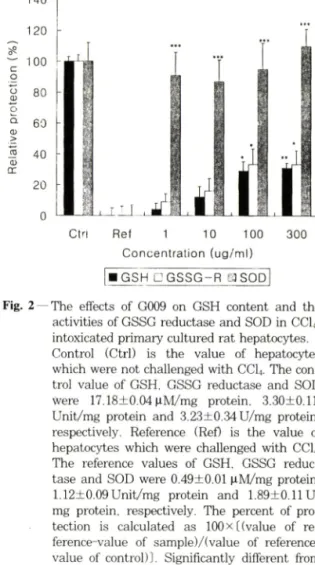
Fig. 2—The effects of G009 on GSH content and the
activities of GSSG reductase and SOD in CClr intoxicated primary cultured rat hepatocytes.
Control (Ctrl) is the value of hepatocytes which were not challenged with CCLj. The con
trol value of GSH. GSSG reductase and SOD were 17.18±0.04 |iM/mg protein. 3.30+0.11 Unit/mg protein and 3.23±0.34U/mg protein, respectively. Reference (Ref) is the value of hepatocytes which were challenged with CCI
4. The reference values of GSH, GSSG reduc
tase and SOD were 0.49±0.01 M-Wmg protein.
1.12+0.09 Unit/mg protein and 1.89+0.11 U/
mg protein, respectively. The percent of pro
tection is calculated as
100x [{value of re- ference-value of sample)/(value of reference- value of control)]. Significantly different from the reference; *p<0.05. **p<0.01. ***p<0.001.
Ctrl Ref 1 10 100 300 Concentration (ug/ml)
1000
GPT □ SDH I
Fig. 1
— The effects of G009 on the activities of GPT and SDH released from CCU-intoxicated pri
maiy cultured rat hepatocytes.
Control (Ctrl) is the value of hepatocytes which were not challenged with CCI
4. The con
trol values of GPT and SDH were 25.31 ±1.84 lU// and 48.75±0.18 Unit/m/, respectively. Ref
erence (Ref) is the value of hepatocytes which were challenged with CCU. The reference values of GPT and SDH were 108.27±1.92 IU/7.
2.75±0.02 Unit/m/, respectively. The percent of protection is calculated as
100x [(values of reference-value of sample)/(values of reference- values of control)]. Significantly different from the reference : *p<0.05. **p<0.01. ***p<0.001.
결과 및 고찰
G009외 간세포 보호 활성을 알아보기 위하여 일차 배양한 간세포에 사염화탄소로 득성을 유발시키면서 G009틀 투여 하여 알아보았다.
간득성 유기용매인 사염화탄소는 3 mM 이상의 농도 에서 선텍성이 없는 득성 효과를 나타낸다.^• 이는 사염 화탄소의 용매효과(solvent properties)라고 불리우며 세포막을 파괴하고 03^^의 항상성을 깨뜨려 결국은 세 포괴사를 초래한다.^' 그러므로 일차배양한 간세포에 사염화탄소로 득성을 유발시키면 세포막의 파괴로 인하 여 간세포내외 효소인 GPT 및 SDH의 배양액 중으로 유러 가 증가된다. 또한 세포막의 파괴에 외해 유리된 불 포화 지방산의 매개로 자유기가 생성되며 이 자유기는 연쇄반응을 거쳐 지질과산화를 유도하고 세포내 여러 효소돌을 파괴 한다.®
일차배양한 흰쥐의 간세포에 사염화탄소로 득성을 유 발시키면서 G009률 U ig/m /에서부터 lOOOiig/m/까
110
이미경
■김롱표
•이준우
•정훈
•이승룡
•김영중
{%}uouo
이
J0JC3아
AI1TOI아
y^
T O
S
^
^
^ Uo!}u01ojd?!lrol
이
y1
1
Fig. 3
Ctrl Ref 1 10 100 Concentration (ug/m I)
■ GST □ MDA 1
The effects of G009 on MDA content and the ac
tivity of GST in CCLrintoxicated primary cul
tured rat hepatocytes.
Control (Ctrl) is the value of hepatocytes which were not challenged with CCI
4. The control value of GST and MDA were 0.37±0.01 나mol product/
min/mg protein, 2.40±0.40 nmol/mg protein, respectively. Reference (Ref) is the value of hepa
tocytes which were challenged with CCI
4. The reference values of GST and MDA were 0.09±
0.01 Mmol product/min/mg protein and 3.41±0.32 nmol/mg protein, respectively. The percent of protection is calculated as
100x [(value of re- ference-value of sample)/(value of reference- value of control)]. Significantly different from the reference: *p<0.05. **p<0.01. ***p<0.001.
Vol 42, No. 1, 1998
결 론
1. 0)09는 사염화탄소로 득성을 유발시킨 일차배앙 한 간세포에 투여하였을 때 배양액중으로 유리되는 GPT 및 SDH틀 유외성있게 감소시켜 간세포 보호 활 성을 나타내었다.
2. G009는 사염화탄소로 인하여 감소된 GSSG-R, SOD. GST의 활성 및 GSH의 양을 유의 성있게 증가시 켜 해득작용 및 항산화효과를 나타내었다.
3. G009는 사염화탄소로 인하여 증가된 MDA외 양 을 감소시킴으로써 지 질과산화 억 제효과를 나타내었다.
감사의 말씀
본 연구는 보건복지부 보건의료기술 연구개발사업 (과제번호 HMP-96-D-5-0040) 및 일앙약품 연구지원 버로 수행되었기에 이에 감사도립니다.
문 헌
1) Mizuno. T.. Kato, N.. Totsuka, A.. Takenaka. K., Shinkai. K. and Shimizu. M. ■ Fractionation, structral features and antitumor activity of water soluble polysaccharide from 'Reishi. the fruit
G009
외
Tl■세포
•빙
-:스
■효가
111GSSG로 번화되어 GSH 가 고같된다. 산화된 GSSG는 GSSG-R에 의하여 다시 GSH로 환원된다. 따라서 G S SO R 외 활성의 감소는 GSSG를 GSH로 환원시키 지 못함을 의미하며 이는 GSH외 감소를 초래한다. 그 러므로 GSH외 감소는 oxidative stress외 지표가 되 며 걸국에는 지질과산화가 진행된다.^®
일차배양한 간세포에 사염화탄소로 득성을 유발시키 면 간세포내의 GSH의 앙이 감소되고 GSSG-R외 활 성이 현저히 떨어진다. 그러나 G009를 투여한 경우 300|xg/m/외 농도에서 사염화탄소로 인하여 감소된 GSH외 양 및 GSSG-R의 활성을 정상상태 때외 30%
수준까지 회복시켜 항산화효파를 나타냄을 알 수 있었 다. 또한 G009는 항산화효소인 SOD외 활성도 정상상 태때의 수준으로 유지시켜 G009외 항산화효과를 뒷받 침하였다(Fig. 2).
사염화탄소로 인한 득성은 여러 반응을 거쳐 결국 지
질과산화룰 유도하고 이 과정외 최종산물인 MDA틀 생 성 한다. G009를 투여한 후 MDA를 측정하여 지질과산 화외 억제정도를 알아본 결과 유외성이 인정되지는 않 았으나 30(Uig/m/외 농도에서 가장 뚜렷한 억제효과 를 나타내었다(Fig. 3).
GST는 간의 세포질에 주로 존재하는 가용성 단백질 로 생체내 이물질의 대사와 배설에 중요한 역할을 하는 효소이다.*® 사염화탄소로 간세포 득성을 유발시키면 GST외 활성이 현저히 감소되었으나 G009를 투여한 경우 그 활성이 점차 증가되어 lOOHg/m/외 농도에서 정상상태때의 50% 수준까지 유지시 켜 G009가 해득작 용에 도 관여하여 간세포 보호 활성 나타냄을 알 수 있었 다(Fig. 3).
이상외 결과로 G009는 사염화탄고로 득성을 유발시 킨 일차배양한 흰쥐의 간세포에 투여하였을 때 간세포 보호 효과를 나타내었으며 이는 G009의 항산화 작용에 의한 것으로 생각된다.
Sco!10810.iclsurolay
112
이미경
•김홍표
•이준우
•정훈
•이승룡• 김영중
body of
Ganodemm lucidum. Nippon Noegeigaku Ka-
ishi 58.871 (1984).
2) Miyazaki. T. and Nixhijima, M. : Studies on fungal polysaccharide of
Ganoderma lucidum.Chem. Pharm. Bull. 29.
3611 (1981).
3) Kikono. H.. Isiyama, M. Suzuki. Y. and Konno.
D. : Mechanism of hypoglycemic activity of gonoderan B. A glycan of
Ganoderma lucidum fruit bodies. Planta Med.55. 423 (1989).
4) Jeong, H., Lee. J. W. and Lee. K. H. : Studies on anticomplementary activity of Korean high
er fungi. Kor. J. Mycol. 18. 145 (1990)
5) Kohoda, H.. Tokumato. W., Sakanoto. K.. Fugi.
M.. Kirai. Y.. Yamasaka. K.. Komoda, Y.. Na
kamura. H.. Ishihara, S. and Ushida, M.
'■The biologically active constituent of Ganoderma lu
cidum Karst., histamine relea^ inhibitory tri- teipene.
Chem. Pharm. Bull.33. 1367 (1985).
6) Lee, J. W.. Jung. H.. Han. M. D., Baek. S. J..
Kim. Y. S. and Kang. S. M. : Effect of G009 on CCLrinduced hepatic injury and lipid perox
idation in rats.
Kor. f. Pharmacogn. 27.159 (1996).
7) Lee. J. W.. Jung. H.. Lee. S. M.. Kim, K. N..
Han. M. D.. Lee, S. Y.. Kim. S. U. and Kang. S.
M. : Effect of G009 on lipid peroxidation in
duced by poroxidizer in rats. /.
Applied Pharmacol. 4,244
(1996).
8) Park. E. J.. Kim. K. Y.. Kim. J. B.. Kim. S. U..
Lee. S. Y. and Sohn. D. H. : The antifibrotic ef
fect of polysaccharides extracted from
Ganoderma lucidum
on the experimental hepatic cir
rhosis.
Yakhak Hoeji 38.338 (1994).
9) Lee. J. Y., Park. K. S., Chung. J. R . Cho. M.
Y.. Ko. K. Y.. Lee. J. W.. Jung. H. and Lee. S.
Y. ■ Effect of G009 on chemical-induced liver damage in rats.
I Applied Pharmacol. 2,206 (1994).
10) Freshney, R. I. : '"Manual of basic techique'in Culture of animal cells. Alan. R.. ed, Liss Inc..
New York, p 1. (1984).
11) Berry. M. N. and Friend. D. S. ■ High-yield pre
paration of isolated rat liver paranch>Tnal cells.
J. Cell Biol. 43
5006 (1969).
12) Berry. M. N.. Edward. A. M. and Banitt, G. J. ■
Laboratory Techniques in Biochemistry and Molecular Biology, vol. 21, Elsevier. NY. p. 1 (1991).
13) Lee, M. K., Choi. Y. J., Sung. S. H.. Shin, D. L.
Kim. J. W. and Kim. Y. C. ; Antihepatotoxic Ac
tivity of Icariin. a Major Constituent of
Epimedium koreanum. Planta Med. 61
523 (1995) 14) Kiso, Y.. Suzuki. Y. and Hikino H. ■ Assay
method of antihepatotoxic activity using carbon tetrachloride induced cytotoxicity in primary cultured hepatocytes.
Planta Med. 49.222 (1983).
15) Reitman, S. and Frankel. S. : A colorimetric method for the determination of^erum glu
tamic oxaloacetic and glutamic pyruvic tran
saminase.
Am. J. CU. Pathol. 28.56 (1957).
16) Gerlach U : Sorbitol dehydrogenase. In: Method in Enzymology. NY. Elsevier, p. 761 (1965).
17) McCord. J. M. and Frivich. J. ; Superoxide dismutase. /.
Biol. Chem. 244.6049 (1969).
18) Habig. W. H.. Pabst, M. J. and Jakoby, W. B. : Glutathione-S-transferase.
}. Biol. Chem. 249,7130 (1974).
19) Carlberg. I. and Mannervik. B. : Purification and characterization of the flavoenzyme glu
tathione reductase from rat river.
J. BioL Chem.250.
5475 (1975).
20) Griffith. O. W. : Determination of glutathione and glutathione disulfide using glutathione reduc
tase and 2-vinyl pyridine.
A m i. Biochem. 106.207 (1980).
21) Asakawa. T. and Matushita. S. : Thiobarbitu
ric acids test for detecting lipid peroxides.
Lipids 14.401 (1980).
22) Lowry. O. H., Rosebrough, N. J.. Fan'. A. L.
and Randall. R. J. ■ Protein measurement with the folin phenol reagent. /■
Biol. Chem. 193.265 (1951).
23) Berger, L. M.. Bhatt. H.. Combes. B. and Es- tabrook. R. W. : CCU-Induced toxicity in iso
lated hepatocytes ■ The importance of direct of solvent injury.
Hepatol. 6.36 (1986).
24) Albino. E., Carini. R.. Parola, M.. Bellomo. G.,
Goria-Gatti. L., Poli. G. and Dianzani. M. U. :
Effects of carbon tetrachloride on calcium
homeostasis, a critical reconsideration.
Biochem.G009
외 간세포 보호 효과
113Pharmacol.38,
2719 (1989).
25) Richard. O. R., Eric. A. G. and Robert. S. B.
(1991) Free radical damage and lipid perox
idation. In ■ Hepatoxicology. Florida. CRC Press, p. 401.
26) Prasada, R. S. K. and Harihara. M. M. (1991) Markers for the role of glutathione turnover in hepatotoxicity. In : Hepatoxicology. Florida, CRC Press, p. 302.
Vol 42, No. 1, 1998