• 검색 결과가 없습니다.

A Case of Novel Influenza A (H1N1) Virus Pneumonia Complicated Pnemomediastinum and Subcutenous Emphysema

N/A
N/A
Protected

Academic year: 2021

Share "A Case of Novel Influenza A (H1N1) Virus Pneumonia Complicated Pnemomediastinum and Subcutenous Emphysema"

Copied!
5
0
0

로드 중.... (전체 텍스트 보기)

전체 글

(1)

Tuberc Respir Dis 2011;70:155-159

CopyrightⒸ2011. The Korean Academy of Tuberculosis and Respiratory Diseases. All rights reserved.

A Case of Novel Influenza A (H1N1) Virus Pneumonia Complicated Pnemomediastinum and Subcutenous Emphysema

Yu Jin Kim, M.D.

1

, Sung-Young Kyung, M.D.

1

, Jung-Woong Park, M.D.

1

, Sung Hwan Jeong, M.D.

1

, Yiel-Hea Seo, M.D.

2

, Sang-Pyo Lee, M.D.

1

Division of Pulmonology, Departments of

1

Internal Medicine,

2

Laboratory Medicine, Gachon University Gil Hospital, Incheon, Korea

Recently, a novel influenza A (H1N1) has been recognized as the cause of a worldwide respiratory infection outbreak. Although the symptoms of a novel influenza A (H1N1) are usually mild, the disease can cause severe illness and death. A complication of novel influenza A (H1N1) is pneumomediastinum, a rarely reported condition.

We report a case of influenza A (H1N1) complicating pneumomediastinum with subcutaneous emphysema, which had initially presented with blood tinged sputum and chest pain. In addition, we demonstrate bronchoalveolar lavage in influenza A (H1N1).

Key Words: Influenza A Virus, H1N1 Subtype; Pneumomediastinum, Diagnostic; Pneumonia

Address for correspondence: Sang-Pyo Lee, M.D.

Division of Pulmonology, Department of Internal Medicine, Gachon University Gil Hospital, Guwol 1-dong, Namdong- gu, Incheon 405-760, Korea

Phone: 82-32-460-2634, Fax: 82-32-469-4320 E-mail: [email protected]

Received: Oct. 14, 2010 Accepted: Dec. 21, 2010

Introduction

A novel influenza A (H1N1) has been known as the cause of a worldwide respiratory infection outbreak. A novel influenza A (H1N1) usually causes febrile respira- tory symptoms, but severe illness and death in pre- viously healthy persons has been reportd

1,2

. The com- plicating pneumomediastinum of this have only rarely been reported. The finding of bronchoalvolar lavage is unknown. We experience a case of influenza A (H1N1) complicating pneumomediastium and perform bron- choalveolar lavage.

Case Report

A previously healthy 18-year-old high school student was admitted to the emergency room of this hospital.

On day 1 before admission he developed a sore throat and febrile sense. On admission day, his chief com- plaint was chest pain and blood tinged sputum asso- ciated with cough, sputum, fever, chills and dyspnea.

There was neither vomiting nor a history of trauma. The patient had no history of smoking, alcohol drinking or drug use, nor did he have a remarkable personal or familial history. There was no history of recent travel.

He was living at apartment in urban area.

On arrival at hospital, his physical examination re- vealed the following results: heart rate 90 beats/min, temperature 39.0

o

C, respiratory rate 20 breaths/min, and blood pressure 120/70 mm Hg. Oxygen was supplied by nasal canula. He had an acutely ill looking appearance. There was subcutenous emphysema in both sides of the neck. A chest examination revealed coarse breathing sounds and rales without wheezing. A cardiac examination revealed a regular heart beat. CBC count showed the following: Hb 16.9 g/dL, hematocrit 47.8%, WBC 12,000/mm

−3

, segment neutrophil 88.3%

and platelet 177,000/μL. hsCRP was increased to 7.76

mg/dL and ESR was normal. Arterial blood gas analysis

had a pH of 7.439, a PCO

2

of 32.3 mm Hg, PO

2

of 102.3

mm Hg, HCO

3

22.1 meq/L and Saturation 98.2% by a

(2)

Figure 1. Chest radiograph on admission showed pneumomediastinum and peribronchial haziness in both lungs (A∼C).

Figure 2. Neck radiograph on admission showed sub- cutaneous emphysema, neck and upper thorax (A, B).

nasal canula 2 L oxygen supplement. Biochemical data was not significant except AST 54 IU/L, CPK 975 IU/L.

Culture of sputum, blood and urine did not show any bacterial pathogen; tuberculosis was also ruled out.

Urine Streptococcus pneumonia Ag, Legionella Ag was negative. Real time PCR to detect influenza A (H1N1) was positive. We performed real time-PCR by throat swab specimen. There was no evidence of AIDS, VDRL.

On bronchial alveolar lavage, Real time- PCR of influen- za A (H1N1) was positive. There was no evidence of influenza B, RSV A, B, parainfleuenza virus, Corona vi- rus 229E/NL63, OC43/HKU1, Rhino virus A/B,

Adenovirus and Metapneumovirus. Also we found neg- ative results of TB-PCR and CMV PCR. Cell count of bro- chial alveolar lavage was Lymphocytes 42%, eosinophils 3%, neutrophils 1% and macrophages 54%. On lympho- cyte subset, CD4/CD8 was decreased (0.37). There was no endobronchial lesion with little secretion at broncho- scopic finding. There was obtained boody fluid but no alveolar hemorrhage was found at bronchial alveolar lavage. ECG showed normal sinus rhythm. Chest X-ray showed peribronchial haziness in both lungs (Figure 1).

Neck AP and lateral showed subcutaneous emphysema

in neck and upper thorax (Figure 2). HRCT showed

(3)

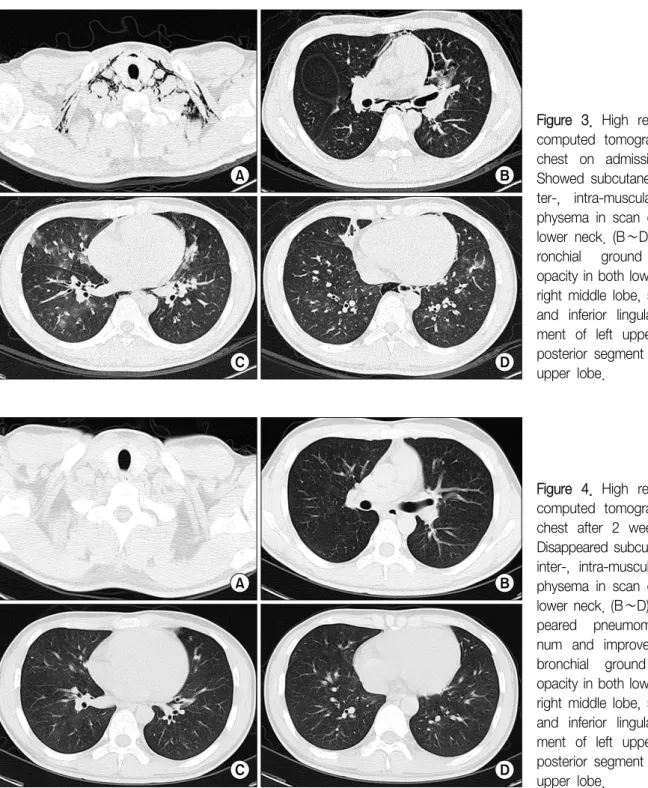
Figure 3. High resolution computed tomography of chest on admission. (A) Showed subcutaneous in- ter-, intra-muscular em- physema in scan covered lower neck. (B∼D) Perib- ronchial ground grass opacity in both lower lobe, right middle lobe, superior and inferior lingular seg- ment of left upper lobe, posterior segment of right upper lobe.

Figure 4. High resolution computed tomography of chest after 2 weeks. (A) Disappeared subcutaneous inter-, intra-muscular em- physema in scan covered lower neck. (B∼D) Disap- peared pneumomediasti- num and improved peri- bronchial ground grass opacity in both lower lobe, right middle lobe, superior and inferior lingular seg- ment of left upper lobe, posterior segment of right upper lobe.

pneumomediastinum, subcutaneous inter- and in- tra-muscular emphysema in scan covered lower neck and multiple peribronchial ground grass in both lungs (Figure 3).

He required oxygen supplementation (2 L/min) and was treated with oseltamivir 75 mg bid for 5 days. Three days after in admission he was fever-free and he felt

symptomatically improved. We found, on Chest X-ray,

that the peribronchial haziness in both lungs had pro-

gressively improved. On days 7 of hospitalization, bron-

choscopy was performed because he still had blood

tinged sputum. There was no active bleeding focus or

blood clots in bronchus. He was discharged from the

hospital on day 10. After 1weeks, follow up HRCT

(4)

showed that pneumomediastinum and subcutaneous emphysema had disappeared, and peribronchial ground grass opacity was improved (Figure 4).

Discussion

Recently, a Novel Swine-Origin influenza A (H1N1) virus was identified in humans in Mexico and the United States. Its worldwide spread was rapid; influenza A (H1N1) virus was genetically and antigenically un- related to human seasonal influenza viruses and genet- ically related to virus circulating in swine

1-3

. It has been reported to be a triple reassortant influenza virus from swine, avian and human. The Spanish flu pandemic vi- rus was relatively mild first but showed more virulence when it returned in the winter. There are concerns that this virus may mutate or reassort with existing influenza viruses, giving rise to more transmissible or more patho- genic viruses

1

. Most patients had mild symptoms but some required hospital care. These more severe cases usually had pneumonia and dehydration. Certain hospi- talized cases have included rapidly progressive lower respiratory tract infections ranging from self-limited to respiratory failure and death

3

. Influenza A (H1N1) can cause severe acute repiratory distress syndrome and death in previously healthy persons who are young to middle aged

3

. Half of all patients who died were be- tween 13 and 47 years of age. Others reported as younger than 19 years of age was 43%

2

.

Spontaneous pneumomediastinum (SPM) is uncomm- on. Usually Its occurrence is correlated with status asth- maticus with bronchitis

4,5

. Pneumomediastinum is iden- tified as the presence of air in the mediastinum. A bio- modal peak is shown in children younger than 7 years and in youth, aged 13 to 17 years

4

. It is usually caused by respiratory infection or inflammation and leads to in- trathoracic pressure increases followed by rupture of a pulmonary alveolus surrounding bronchioles and pul- monary vessels

5

. The air extends into the mediastinum by the hilum along the peribronchovascular sheaths.

Excess pressure can be caused by valsalva manuvers like coughing and vomiting, and conditions like as asth-

ma, cystic fibrosis, and bronchitis. Up till now there have been no reported cases of pneumomediastinum complicating pneumonia in adolescents by a novel swine origin influenza A (H1N1). Only Hasegawa et al.

6

has reported 2 patients who have had asthma or asth- matic symptoms. Our patient, though, showed unusual clinical signs such as blood tinged sputum and no wheezing, radiologic signs that are typical of pneumo- mediastinum with pneumonia.

Yun et al.

7

described clinical characteristics and radio- logic features of chest X-ray and HRCT of 18 patients with influenza A (H1N1). Patients had fever with or without accompanying symptoms of cough, sputum, na- sal symptoms, myalgia and gastrointestinal symptoms such as diarrhea and vomiting. Combined with ground grass opacities and nodules this may be associated with influenza A (H1N1)

7

. The ground grass opacities were similar in our case except pneumomediastinum. Choi et al.

8

reported 17 patients, one of whom was admitted with severe hypoxemia but died despite intensive re- suscitative treatments. Most of the patients had multiple consolidations and infiltratons. One patient had pleural effusion with consolidation. Usually influenza A (H1N1), in contrast, causes mild symptom and good prognosis. To our knowledge, we are the first to de- scribe bronchoalveolar lavage findings associated with an influenza A (H1N1) virus infection. In normal bron- choalveolar lavage there are about 85∼95% alveolar macrophages, about 7∼12% lymphocytes, about 1∼

2% neutrophils and less than 1% eosinophils

9

. Usually in viral pneumonia, about 30% of the cell are lympho- cytes, about 10% are neutrophils and about 50∼60%

are alveolar macrophages

10

. In our case of bron-

choalveolar lavage, the number alveolar macrophages

are similar to that of a usual viral infection (54%), but

the lymphocytes is mildly higher (42%), as are the eosi-

nophils (3%), and neutrophils are lower (1%). This in-

formation will be helpful to many clinician regarding

characteristics of influenza A (H1N1) virus infection.

(5)

References

1. Schnitzler SU, Schnitzler P. An update on swine-origin influenza virus A/H1N1: a review. Virus Genes 2009;

39:279-92.

2. Centers for Disease Control and Prevention (CDC).

Hospitalized patients with novel influenza A (H1N1) vi- rus infection - California, April-May, 2009. MMWR Morb Mortal Wkly Rep 2009;58:536-41.

3. ANZIC Influenza Investigators, Webb SA, Pettilä V, Seppelt I, Bellomo R, Bailey M, et al. Critical care serv- ices and 2009 H1N1 influenza in Australia and New Zealand. N Engl J Med 2009;361:1925-34.

4. Bullaro FM, Bartoletti SC. Spontaneous pneumo- mediastinum in children: a literature review. Pediatr Emerg Care 2007;23:28-30.

5. Newcomb AE, Clarke CP. Spontaneous pneumo- mediastinum: a benign curiosity or a significant prob- lem? Chest 2005;128:3298-302.

6. Hasegawa M, Hashimoto K, Morozumi M, Ubukata K,

Takahashi T, Inamo Y. Spontaneous pneumomedia- stinum complicating pneumonia in children infected with the 2009 pandemic influenza A (H1N1) virus. Clin Microbiol Infect 2010;16:195-9.

7. Yun TJ, Kwon GJ, Oh MK, Woo SK, Park SH, Choi SH, et al. Radiological and Clinical Characteristics of a Military Outbreak of Pandemic H1N1 2009 Influenza Virus Infection. Korean J Radiol 2010;11:417-24.

8. Choi WJ, Kim WY, Kim SH, Oh BJ, Kim W, Lim KS, et al. Clinical characteristics of pneumonia in hospi- talized patients with novel influenza A (H1N1) in Korea. Scand J Infect Dis 2010;42:311-4.

9. Reynolds HY. Bronchoalveolar lavage. Am Rev Respir Dis 1987;135:250-63.

10. Magnan A, Mege JL, Reynaud M, Thomas P, Capo C,

Garbe L, et al. Monitoring of alveolar macrophage pro-

duction of tumor necrosis factor-alpha and inter-

leukin-6 in lung transplant recipients. Marseille and

Montreal Lung Transplantation Group. Am J Respir Crit

Care Med 1994;150:684-9.

수치

Figure 1. Chest radiograph on admission showed pneumomediastinum and peribronchial haziness in both lungs (A∼C).
Figure  3.  High  resolution  computed  tomography  of  chest  on  admission.  (A)  Showed  subcutaneous   in-ter-,  intra-muscular   em-physema  in  scan  covered  lower  neck

참조

관련 문서