Received: August 16, 2019 Revised: September 16, 2019 Accepted: September 24, 2019 Journal of
Trauma and InJury
CASE REPORT
J Trauma Inj 2019;32(3):168-171 https://doi.org/10.20408/jti.2019.027
Correspondence to Han Joo Choi, M.D., Ph.D.
Department of Emergency Medicine, Dankook University Hospital, 201 Manghyang-ro, Dongnam-gu, Cheonan 31116, Korea
Tel: +82-41-550-6840 Fax: +82-41-556-0524 E-mail: [email protected]
http://www.jtraumainj.org eISSN 2287-1683
pISSN 1738-8767
Copyright © 2019 The Korean Society of Trauma
This is an Open Access article distributed under the terms of the Creative Commons Attribution Non-Commercial License (http://creativecommons.org/licenses/by-nc/4.0/) which permits unrestricted noncommercial use, distribution, and reproduction in any medium, provided the original work is properly cited.
Case Series: Successful resuscitation of Severe facial Injuries Caused by a Chainsaw
Han Joo Choi, M.D., Ph.D.
Department of Emergency Medicine, Dankook University Hospital, Cheonan, Korea
The treatment outcome remains poor of severe facial injuries because of the high risk of compromised airway or massive bleeding. We experienced two successful treatment cases of severe facial injury by the chainsaw. A 52-year-male had his face injured by the chainsaw during his work. He was transferred to the Level I trauma center using the Doctor-Helicopter. During his flight, bleeding control was tried and the information was given to the trauma surgeons before his arrival. His consciousness was alert and the vital signs were stable. The crushing wound, mandible open fracture, deep laceration of tongue, lip, neck and arterial bleeding were noted around his mandible. Nasotracheal intubation was performed under the bronchoscope-guided. Emergency operation (open reduction & internal fixation, primary repair with neurorrhaphy) was performed. At 30 hospital days, he was discharged with facial palsy on left mandibular area. A 30-year- male had his face injured by the chainsaw. He was transferred to our Level I trauma center from the local hospital. The deep-mutiple lacerations on right upper eyelid and forehead with the bony exposure were noted. The vital signs were stable and emergency operation was performed. He was discharged at 20 hospital days. Bone loss or tissue loss were not devastating than we expected even though the injury was occurred by the chainsaw. Aggressive treatment including airway manipulation or bleeding control and maximal opportunity of therapy are absolutely needed.
Keywords: Facial injuries; Crush injuries; Emergency treatment
INTRODUCTION
Chainsaw, a mechanical saw widely used by individuals at homes and construction industry fields, can cause various devastating injuries to multiple body parts. Despite few reported studies, little is known about the incidence and characteristics of chain-
169
http://www.jtraumainj.org Han Joo Choi. Successful Resuscitation of Severe Facial Injuries
Case Series: Successful resuscitation of Severe facial Injuries Caused by a Chainsaw
Han Joo Choi, M.D., Ph.D.
Department of Emergency Medicine, Dankook University Hospital, Cheonan, Korea
The treatment outcome remains poor of severe facial injuries because of the high risk of compromised airway or massive bleeding. We experienced two successful treatment cases of severe facial injury by the chainsaw. A 52-year-male had his face injured by the chainsaw during his work. He was transferred to the Level I trauma center using the Doctor-Helicopter. During his flight, bleeding control was tried and the information was given to the trauma surgeons before his arrival. His consciousness was alert and the vital signs were stable. The crushing wound, mandible open fracture, deep laceration of tongue, lip, neck and arterial bleeding were noted around his mandible. Nasotracheal intubation was performed under the bronchoscope-guided. Emergency operation (open reduction & internal fixation, primary repair with neurorrhaphy) was performed. At 30 hospital days, he was discharged with facial palsy on left mandibular area. A 30-year- male had his face injured by the chainsaw. He was transferred to our Level I trauma center from the local hospital. The deep-mutiple lacerations on right upper eyelid and forehead with the bony exposure were noted. The vital signs were stable and emergency operation was performed. He was discharged at 20 hospital days. Bone loss or tissue loss were not devastating than we expected even though the injury was occurred by the chainsaw. Aggressive treatment including airway manipulation or bleeding control and maximal opportunity of therapy are absolutely needed.
Keywords: Facial injuries; Crush injuries; Emergency treatment
saw-related injuries [1-5]. Emergency physicians (EPs) often encounter patients with chainsaw-related injuries in emergency department (ED) in South Korea. In this study, we report two cases of severe facial injuries caused by a chainsaw that were successfully treated with initial systematic emergency care and definitive surgery.
CASE REPORT
Case 1
A 52-year-old male patient severely injured his face with a chainsaw during his logging work. He had cut branches without facial shield. The blade of chainsaw hit his face through unintentional body motion due to slip. He was transferred to the Level I trauma center by a doctor-he- licopter. He was conscious, and the airway was secured despite massive facial injury. During scene inspection, EP noted crushing wound with open mandibular fracture;
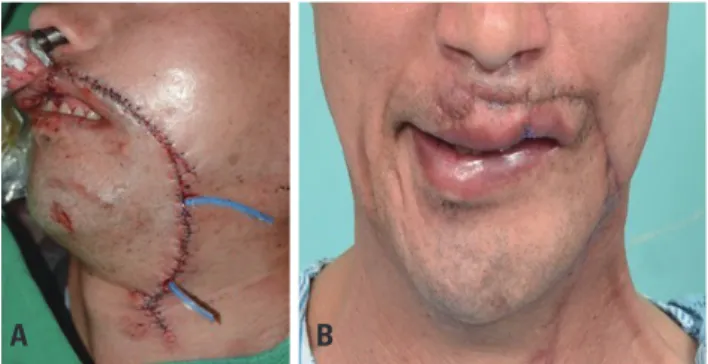
deep lacerations of the tongue, lip, and neck; and arterial bleeding around his mandible. The patient’s blood pres- sure and heart rate were 135/80 mmHg and 100 beats/min, respectively. He leaned against the seat and raised his head to maintain the airway patency during helicopter transportation. The wounds were compressed with he- mostatic gauzes. Trauma team activation was performed before helicopter arrival through social network system hotline. Bronchoscope-guided nasotracheal intubation was performed after ED arrival. Facial crushing wounds, open mandibular fracture, and partial tongue laceration were noted, and neurovascular injury was highly suspect- ed based on the physical examinations performed after intubation (Fig. 1). Moreover, mild metabolic acidosis was noted (pH 7.3, PaO2 90 mmHg, PaCO2 30 mmHg, bicarbonate 15 mEq/L, base excess -4.1 mEq/L), and he- moglobin level was 9 g/dL. For the first time, a successful primary repair was not expected due to massive bone and tissue loss. Emergency operation (open reduction and internal fixation and primary repair with neurorrhaphy) was performed by the trauma team, and the patient was discharged with facial palsy on the left mandibular area at 30 days postoperatively (Fig. 2).
Case 2
A 30-year-old male patient injured his face with a chain- saw. He was transferred to our Level I trauma center from a local hospital. Multiple deep lacerations on the right up- per eyelid and forehead with bony exposure were noted.
He was conscious, and the vital signs were stable. Emer- gency operation was performed by the trauma team, and he was discharged at 20 days postoperatively (Fig. 3).
DISCUSSION
In case of chainsaw-related injuries, experienced EPs are aware of the potential risk of treatment in patient. How- ever, little is known about the incidence and characteris- tics of these injuries. Studies reported on chainsaw-related injuries are mostly case reports. The annual number of patients with chainsaw-related injuries was reported to be 23,000 in the United States [6]. Most of the patients were
Fig. 1. Facial crushing injuries caused by a chainsaw (A) before and (B) after nasotracheal intubation, which was performed at the resuscitation room at the trauma center.
A b
Fig. 2. (A) Primary repair with emergency open reduction without graft surgery of bone and skin. (B) Neuronal palsy was remained after surgery.
A b
170 https://doi.org/10.20408/jti.2019.027
Journal of Trauma and Injury Volume 32, Number 3, September 2019
male (95%), and the injuries most frequently occurred in the age group of 30–59 (57%). Although, there is no de- fined index to estimate the incidence of chainsaw-related injuries in South Korea, the frequency can be estimated according to the Korean government reports on the ac- cidents in industrial fields. According to the report of the Occupational Safety and Health Research Institute in Ko- rea, the number of patients who experienced amputation, cut, or stab injuries was 3,680 (8%) during 2013–2017 [7].
Additionally, the Ministry of Employment and Labor in Korea reported that there were 8,752 patients with ampu- tation, cut, and stab injuries in 2017, and this constituted 10% of the total industrial accidents [8].
In the United States, 58% of the injuries occur at home [6], whereas in Europe, most of the accidents occur at industrial fields [9]. This difference is based on different cultural techniques in using these tools. This factor should be considered while collecting data in South Korea. In the United States, the most frequent type of chainsaw-re- lated injury is laceration (81%), which most frequently injures hands (28.8%), knees (17.6%), and calves (12.5%) [6]. The injury pattern in the United States is different from that in the Europe. Injuries caused by fallen objects while operating a chainsaw are more frequently observed (47.7%) than direct injuries caused by a chainsaw itself (39.3%). In the case of injuries cause by fallen objects,
heads (34.8%), torsos (25.0%), and legs (16.8%) are com- monly injured [9].
The basic treatment concept for chainsaw-related inju- ries is not different from that for other types of injuries.
Patients with superficial wounds can be discharged from ED after primary repair and can visit the outpatient clinic for follow-up purposes. Only 3.6% of the total patients with chainsaw-related injuries are hospitalized for care [6].
Initial emergency care including airway patency is para- mount in the cases of facial injury due to the possibility of the compromised airway or vascular injury. In the case 1, the patient was transported by a doctor-helicopter. In South Korea, board-certificated EPs are usually present on such helicopters. Therefore, initial advanced airway ma- neuver such as nasotracheal intubation is performed on patient by the EP on board. In this case, the patient was conscious and the airway patency was maintained despite the crushing wound, and thus nasotracheal intubation was not performed at the scene or in the helicopter. How- ever, we focused on the bleeding control. Moreover, aspi- ration of blood from the oral cavity is possible in supine position; he thus leaned against the seat in head-up posi- tion to prevent the aspiration. Thereafter, active bleeding was not observed during the transportation to hospital.
After ED arrival, bronchoscope-guided nasotracheal intu- bation was performed to minimize the additional injury to the perioral area. Emergency internal fixation surgery without skin graft was successfully performed by the trau- ma team.
To prevent any chainsaw-related injuries, it is necessary to wear protective equipment and to be familiar with properly handling the tool. In most countries, statutory guidance on using a chainsaw is inadequate; however, accidents are believed to occur despite cautious use.
Trauma team members do not frequently encounter patients with chainsaw-related injuries. According to the Advanced Trauma Life Support guidelines, the basic concept of airway–breathing–circulation is paramount in emergency care. Maintaining airway patency is the pri- ority after facial injuries. In this study, although injuries were caused by a chainsaw, bone or tissue loss was not as devastated as expected and the primary repair was thus possible. Once the airway patency and stabilization of the vital signs have been achieved, it is possible for patients to Fig. 3. (A) Multiple deep lacerations on the right upper eyelid and
forehead with bony exposure were noted on emergency department arrival. (B) Primary closure was performed without complications.
A b
171
http://www.jtraumainj.org Han Joo Choi. Successful Resuscitation of Severe Facial Injuries
resume their daily life. Hence, we suggest that aggressive treatment, including airway manipulation or bleeding control and maximal therapeutic opportunity, is required in cases of severe facial injuries related to chainsaw.
ACKNOWLEDGEMENTS
Thank you for all ED and trauma team members of Dan- kook university hospital attributing appropriate care for these cases.
The present research was conducted by the research fund of Dankook University in 2017.
REFERENCES
1. Brown AF. Chainsaw penetrating neck injury. Emerg Med J 1995;12:134-37.
2. Koehler SA, Luckasevic TM, Rozin L, Shakir A, Ladham S, Omalu B, et al. Death by chainsaw: fatal kickback injuries to the neck. J Forensic Sci 2004;49:345-50.
3. Marshall SW, Kawachi I, Cryer PC, Wright D, Slappendel C, Laird I. The epidemiology of forestry work-related injuries in New Zealand, 1975-88: fatalities and hospitalizations. N Z Med
J 1994;107:434-37.
4. Moreschi C, Da Broi U, Cividino S, Gubiani R, Pergher G. Neck injury patterns resulting from the use of petrol and electric chainsaws in suicides. Reports on two cases. J Forensic Leg Med 2014;25:14-20.
5. Lindroos O, Burström I. Accident rates and types among self-employed private forest owners. Accid Anl Prev 2010;42:
1729-35.
6. Hammig B, Jones C. Epidemiology of chain saw related inju- ries, United States: 2009 through 2013. Advances in Emergency Medicine 2015;2015:459697.
7. Occupational Safety & Health Research Institute (OSHRI).
News release for the annual numbers of injured workers from 2013 to 2017 [Internet]. Ulsan: OSHRI 2018 [cited 2018 Nov 19]. Available from: http://www.kosha.or.kr/kosha/data/indus- trialDisasterStatistics.do?mode=view&articleNo=398890&arti- cle.offset=0&articleLimit=10.
8. Ministry of Employment and Labor. Statistics of the Korean industrial disasters on 2017 [Internet]. Sejong: Ministry of Employment and Labor 2018 [cited 2018 Apr 27]. Available from: https://www.moel.go.kr/policy/policydata/view.do?bbs_
seq=20180400725.
9. Cividino SRS, Gubiani R, Pergher G, Dell’Antonia D, Maroncelli E. Accident investigation related to the use of chainsaw. J Agric Eng 2013;44(s2):686-9.