- 1761 -
모터 동력학식을 고려한 유연 연결 로봇의 적응 신경망 제어
유성진
*
, 최윤호**
, 박진배*
연세대*
, 경기대**
Adaptive Neural Control of Flexible-Joint Robots Considering Motor Dynamics
Sung Jin Yoo
*
, Yoon Ho Choi**
, Jin bae Park*
Yonsei University*
, Kyonggi University**
Abstract - In this paper, we propose an adaptive neural control method to solve this problem. It is assumed that the model uncertainties of the robots dynamics, joint flexibility, and motor dynamics are unknown. The dynamic surface design method is applied, and all uncertainties in the robot and motor dynamics are compensated by using the adaptive function approximation technique. Simulation results for three-link electrically driven flexible-joint (EDFJ) manipulators are provided to validate the effectiveness of the proposed control system.
1. Introduction
In this paper, we propose a simple adaptive control approach for EDFJ robots with uncertainties and disturbances. The dynamic surface method [1] which can solve the "explosion of complexity" problem of the backstepping technique is applied to design a simple controller of EDFJ robots. In addition, the function approximation technique using self-recurrent wavelet neural networks (SRWNNs) [2] and the adaptive technique are employed to compensate the model uncertainties and disturbances. From Lyapunov stability analysis, it is shown that all signals in a closed-loop adaptive system are uniformly ultimately bounded. Finally, we simulate an uncertain three-link EDFJ manipulator with complex nonlinear functions to demonstrate the simplicity and the robustness of the proposed control scheme.
This paper is organized as follows. In Section 2, we introduce the model and basic properties of EDFJ robot systems with uncertainties. In Section 3, the function approximation technique using SRWNN is presented and a simple adaptive control system for solving the robust control problem of the EDFJ robot system is proposed. In addition, the stability, robustness, and performance of the proposed control system are analyzed based on Lyapunov stability theorem. Simulation results are discussed in Section 4. Finally, Section 5 gives some conclusions.
2. Problem Formulation
The dynamic model [3] of an uncertain -link EDFJ robot consisting of robot dynamics, joint flexibility, and motor dynamics is considered. The objective of this paper is to design a simple adaptive control law for the position state vector of EDFJ robots to track the desired trajectory vector.
3. Main Results
3.1 Function Approximation Technique
To compensate the unknown uncertainty terms, we use SRWNNs and the adaptive technique. The SRWNN, a modified model of a wavelet neural network(WNN), has the attractive ability such as dynamic attractor, information storage for later use. Unlike a WNN, since the SRWNN has the mother wavelet layer which is composed of self-feedback neurons, mother wavelet nodes of the SRWNN can store the past information of the network [2]. Thus the SRWNN can be used as a better tool to approximate the nonlinear systems
than a WNN.
3.2 Adaptive Controller Design
In this section, we present the dynamic surface design approach for designing a simple adaptive control of EDFJ robots. The proposed control system is designed step by step.
3.3 Stability Analysis
Generally, the stability analysis of the DSC system is more complicated than that of the backstepping control system because the extra first-order filters must be considered. In this subsection, we prove the uniformly ultimately boundedness of the solution of the proposed control system, and the adaptation laws for all weights of the SRWNN are derived from this procedure. We first derive analytic expressions of the closed-loop system via the error surface vectors, a boundary layer error vector, and the weight estimation errors.
4. Simulation Results
In this section, to illustrate the validity of the suggested adaptive control system, the three-link EDFJ manipulator with model uncertainties and external disturbances is considered. The reference signals are defined as where
, , and . The nominal robot dynamics used in [2] is used. It is assumed that the external disturbances given by
Here, note that only one product node is used for each SRWNN.
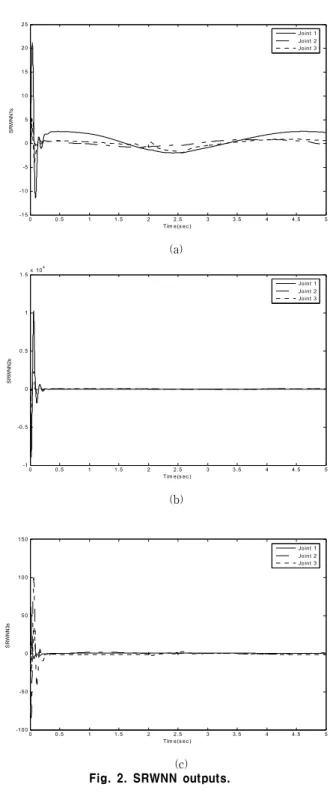
The tracking results and errors of the proposed control system as shown in Fig. 1 indicate that the suggested method can overcome unknown model uncertainties resulting from the robot dynamics, joint flexibility, and the motor dynamics, and time-varying external disturbances. Figure 2 displays the outputs of the SRWNNs. Figure 3 show the norm of weights of SRWNNs. Note that the uncertainty terms are approximated by SRWNNs and the adaptive technique, effectively. Besides, we can see that all signals in the closed-loop system are bounded.
3. Conclusions
In this paper, a simple adaptive control system for the EDFJ robot with model uncertainties has been developed. First, the dynamics of the EDFJ robots has been introduced. Second, the simple control law using the DSC technique and SRWNNs has been designed for the tracking control of EDFJ robots with model uncertainties and external disturbances. Third, from Lyapunov stability analysis, it is proved that all signals in the closed-loop system are uniformly ultimately bounded. Finally, from the simulation results for three-link EDFJ manipulator, it was shown that the proposed control system has the good tracking performance and the robustness against model uncertainties and external disturbances.
2008년도 대한전기학회 하계학술대회 논문집 2008. 7. 16 - 18
- 1762 -
This work was supported by the Korea Research Foundation Grant funded by the Korean Government (MOEHRD) (KRF-2007-313-D00262)
0 0.5 1 1.5 2 2.5 3 3.5 4 4.5 5
-0.8 -0.6 -0.4 -0.2 0 0.2 0.4 0.6
Tim e(s ec )
q1 and qd1 (Rad)q
1q
d1(a)
0 0.5 1 1.5 2 2.5 3 3.5 4 4.5 5
-1.5 -1 -0.5 0 0.5 1 1.5
Tim e(s ec )
q2 and qd2 (Rad)q
2q
d2(b)
0 0.5 1 1.5 2 2.5 3 3.5 4 4.5 5
-1 -0.5 0 0.5
Tim e(s ec )
q3 and qd3 (Rad)q
3q
d 3(c)
0 0.5 1 1.5 2 2.5 3 3.5 4 4.5 5
-1.4 -1.2 -1 -0.8 -0.6 -0.4 -0.2 0 0.2 0.4
Tim e(s ec )
Tracking errors (Rad)
q
1q
2q
3(d)
Fig. 1. Tracking results and errors .
0 0.5 1 1.5 2 2.5 3 3.5 4 4.5 5
-15 -10 -5 0 5 10 15 20 25
Tim e(s ec )
SRWNN1s
Joint 1 Joint 2 Joint 3
(a)
0 0.5 1 1.5 2 2.5 3 3.5 4 4.5 5
-1 -0.5 0 0.5 1 1.5 x 10
4Tim e(s ec )
SRWNN2s
Joint 1 Joint 2 Joint 3
(b)
0 0.5 1 1.5 2 2.5 3 3.5 4 4.5 5
-100 -50 0 50 100 150
Tim e(s ec )
SRWNN3s