A Review of the Research on E-commerce Ecosystem in China
Lan Gao 1 ,Jeong-Soo Han 2 , Hyung-Ho Kim 3*
1
Professor, School of Trade and Economics, Jilin Engineering Normal University
2
Professor, Faculty of ICT, BaekSeok University
3
Professor, Dept. of Air Transport & Logistics, Sehan University
중국 전자상거래 생태계 동향에 관한 연구
고람 1 , 한정수 2 , 김형호 3*
1
길림공정기술사범학원 경제무역학부 교수,
2백석대학교 ICT학부 교수,
3
세한대학교 항공교통물류학과 교수
Abstract Based on the theory of information ecology, this paper conducts a quantitative analysis on the research literature of e-commerce ecosystem in China, and clarifies the research hotspots and development trends, so as to provide reference for subsequent studies. With the key words related literatures collected by CNKI as the data source, and the software CiteSpaceIV is used to draw a visual knowledge map, the distribution of e-commerce ecosystem research papers in China is statistically analyzed by econometric analysis method, and literature research is summarized and evaluated. The research results show that previous studies mainly focus on the concept of e-commerce ecosystem, and there are relatively few research results on the construction and evolution mechanism of e-commerce ecosystem, so the depth and breadth of research should be expanded. Applying the concept of e-commerce ecosystem to solve the problems in cross-border e-commerce will be the future research trend.
Key Words : Convergence, Information Ecology, E-commerce Ecology, Econometric Analysis, Visual Knowledge Map
요 약 본 논문은 중국에서 발표된 전자상거래 생태계의 연구문헌에 대해 정보생태학 이론을 기초로 정량분석을 진행 하고 중점 연구추세와 발전추세를 명확히 하여 후속연구에 참고를 제공하는 목적으로 수행되었다. 본 논문에서는 CNKI에 수록된 전자상거래 관련 문헌을 소프트웨어 CiteSpaceIV를 사용하여 시각화된 지식지도를 작성하였고, 계량 경제학 분석기법을 활용하여 관련 문헌의 연구 동향을 파악하였다. 연구결과 기존의 연구는 전자상거래 생태계 개념에 대한 연구가 주로 진행되었고, 생태계 구축과 진화 메커니즘에 대한 연구는 결과는 상대적으로 많지 않음을 알 수 있었 다. 전자상거래생태계의 개념을 응용하여 역외 전자상거래에서 존재하는 문제를 해결하는 것은 미래의 연구추세라 할 수 있다.
주제어 : 융합, 정보생태학, 전자상거래 생태계, 계량경제학 분석, 시각 지식지도
*This Paper was supported by the Sehan University Research Fund in 2019.
*Corresponding Author : Hyung-Ho Kim([email protected])
Received May 15, 2019 Revised June 18, 2019
Accepted August 20, 2019 Published August 28, 2019
1. Introduction
Information ecology is a new research field that emerges from the intersection of information science and ecology. The research aims to realize the balance of information ecosystem and promote the sustainable and healthy development of human beings, information environment and even human society. Ecological problems have become the focus of attention and solutions in the development of various countries. Therefore, the related research on information ecology should also be considered and explored by more scholars.
E-commerce ecosystem is one of the most popular research fields in information ecology.
The study of information ecology in China started late in the 1990s. It is academician Zhang Xinshi who first proposed and defined information ecology in China.
High efficiency and low cost are the advantages of e-commerce. It only took a few decades for e-commerce to flourish, and now it has become a new growth point in economic development. Today, e-commerce has become the driving force behind China's economic development.
In the situation of rapid changes in domestic and international economic and social development, how to better adapt to the development trend of e-commerce system needs to take precautions. Therefore, it is necessary to analyze the research literature on e-commerce ecosystem in China, sort out the research hotspots and development trends of e-commerce ecosystem literature from a theoretical perspective, provide theoretical basis for the follow-up research, and provide beneficial references for the development and application of e-commerce ecosystem.
2. Theoretical background 2.1 Concept of e-commerce ecosystem
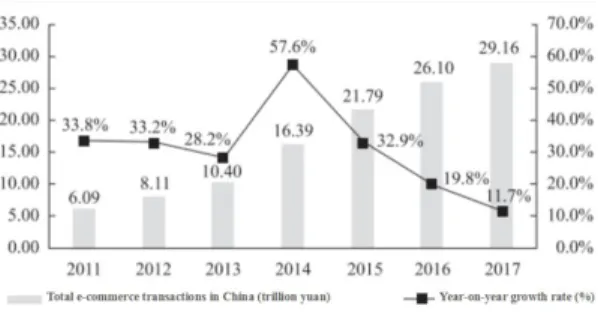
China's e-commerce started late, but the speed of development is amazing, It can be seen from Fig. 1[1] that from 2011 to 2017, China's e-commerce transaction volume keeps growing and maintains a high growth rate every year, among which from 2011 to 2015, the growth rate is more than 20%.
Fig. 1. China's total e-commerce transactions and growth rate in 2011-2017
From 1995 to 1996, Chen Shu published three articles respectively: "Imbalance and Balance of Information Ecology"[2], "Analysis of Information Ecology Imbalance"[3], and "Information Ecology Research"[4], becoming the first scholar to publish articles on information ecology in China.
Around the world, the concept of business
ecosystem is first put forward by MOORE, think
that the activities of the enterprise and the
natural ecological system, the core enterprise,
customers, market intermediaries, suppliers,
stakeholders, constitutes the value chain among
the members, the interaction between different
value chain to form the value network, through
the value network such as matter, energy and
information flow and circulation between consortium
members[5]. Based on the study of business ecosystem,
scholars put forward e-commerce ecosystem according
to the characteristics of e-commerce itself. E-commerce
ecosystem is a very open organism. Energy and
information can flow between it and the social
environment effectively. Through the continuous input
and output of energy and information, it can
effectively realize its stable and orderly operation.
2.2 Characteristics of the e-commerce ecosystem
The ecological clustering phenomenon of e-commerce ecosystem makes it have the similar characteristics with the biological ecosystem.
According to MIRVA Peltoniemi, the business ecosystem is a complex adaptive system with the characteristics of emergence, co-evolution, adaptability and self-organization[6]. E-commerce ecosystem has four characteristics different from traditional business ecosystem: high system renewal rate, leading position of core enterprises, fuzziness of system boundary and high environmental threat[7,8].
Based on the perspective of information ecology, Yang Keyan believes that e-commerce ecosystem has the characteristics of dynamics, adaptability, synergy and integrity[9]. Based on the perspective of network ecology, Zhang Qingfeng believes that e-commerce is artificial, open and dynamic[10].
2.3 Structure of the e-commerce ecosystem
E-commerce ecosystem consists of core layer, support layer and extension layer. The core layer refers to the participants of e-commerce, mainly including operating enterprises, suppliers and consumers. The support layer consists of many service enterprises derived from core enterprises, including logistics enterprises, payment enterprises, Banks, advertising companies and technology companies. The extension layer refers to the environment in which all e-commerce enterprises live, including the political, economic, legal environments.
Promote the harmonious development of the whole ecosystem through the interaction and collaborative innovation among the core layer, support layer and extension layer.
In the field of ecological research, research objects are usually divided into four levels, including individual ecology, population ecology, community ecology and ecosystem. Based on the theories of natural ecosystem and business ecosystem, through interdisciplinary research, scholars have
constructed the e-commerce ecosystem. In 2012, Ma Jie analyzed from the perspective of information ecology that e-commerce system is composed of leading information dynamic group, core information ecological group and supporting information ecological group[11]. From the perspective of information ecology, Yang Keyan and Zhang Xiangxian et al. divided e-commerce into three subsystems, namely, e-commerce information field, e-commerce information ecological chain and e-commerce ecosystem, so as to construct e-commerce information ecosystem[9,12].
2.4 Evolution mechanism of e-commerce ecosystem
Scholars at home and abroad have studied the evolution mechanism of e-commerce. In 2005, MOORE pointed out that the development process of business ecosystem should go through four stages: Exploration, expansion, leadership and self-renewal [13]. Deng Ruohong and Wang Wuyi established the evolution model of e-commerce ecosystem and discussed the evolution mechanism of e-commerce by studying the factors hindering e-commerce ecosystem[14]. Ji Shuxian explored the evolution process of Alibaba, a typical e-commerce ecosystem, and divided it into four stages: initial formation stage, expansion stage, Stable business body coordinated development stage, technical innovation continuous improvement stage[15].
3. Analyze scope and methodology
There are many ways to analyze research
trends, systematic literature review[16], social
network analysis(SNA)[17,18] and metrological
analysis. This paper use the bibliometric
statistical analysis method. In order to better
display the change of information ecological
research in the field of China's e-commerce,
firstly, this paper systematically analyzes the
development of the research on the origin of e-commerce ecosystem "information ecology" in China by using the visualization analysis software CiteSpaceIV, and sorts out one of its research hotspots e-commerce ecosystem. Then, select CNKI to collect the literature, use the method of literature induction and quantitative research, clarify the development of e-commerce network information ecological chain research, and obtain results of quantitative analysis. Finally, the future research direction and application of e-commerce ecosystem are proposed to provide reference for follow-up research.
4. Bibliometric analysis
4.1 Research hotspot in information ecology
In "China journal full-text database"(CNKI), use "information ecology" as the retrieval term, and the retrieval date is December 31, 2018.After screening and elimination, a total of 875 papers were retrieved, including journal papers, master's theses and doctoral theses. In the CiteSpaceIV software, Term Type selects Noun Phrases and Node Type selects Keyword. A threshold value is set to run software to obtain the map of research hotspots of information ecology, shown in Fig. 2.
Fig. 2. Keywords clustering map of information ecology in China
As can be seen from the results, the larger font means the more literature, which means this field is a hot field, and the farther away from the center means that it appears later. The hot research fields shown in the figure mainly include information ecosystem, information ecological chain, information ecological environment and information ecological niche, etc.
It can be seen that information ecosystem is one of the hot areas of current research.
Although it appears late, there are a large number of literatures. In the development of this area, due to the different main body, gradually derived a variety of information ecosystem, e-commerce ecosystem is one of them.
4.2 Research on e-commerce ecosystem 4.2.1 Research overview of e-commerce ecology
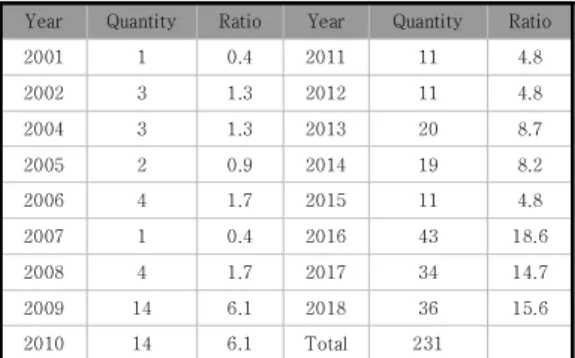
In "China journal full-text database" of CNKI, use"e-commerce ecology" as retrieval term, the retrieval date is December 31, 2018.A total of 287 related literatures were retrieved, and 231 literatures were retrieved after screening and elimination, including journal articles, master's theses and doctoral theses. The earliest domestic published research paper on e-commerce ecology was in 2001, the year, quantity and ratio of the literature are shown in Table 1.
Year Quantity Ratio Year Quantity Ratio
2001 1 0.4 2011 11 4.8
2002 3 1.3 2012 11 4.8
2004 3 1.3 2013 20 8.7
2005 2 0.9 2014 19 8.2
2006 4 1.7 2015 11 4.8
2007 1 0.4 2016 43 18.6
2008 4 1.7 2017 34 14.7
2009 14 6.1 2018 36 15.6
2010 14 6.1 Total 231
Table 1. Statistics on the number of research
literature on e-commerce ecology
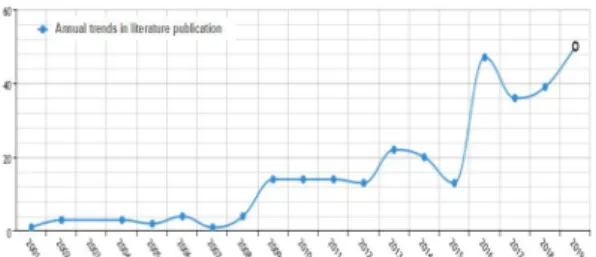
Based on the data statistics in Table 1, the development process of China's e-commerce ecological theory research is summarized. In Fig. 3, the evolution and development path of China's e-commerce ecological theory is drawn with the time as the abscissa and the number of posts as the ordinate.
Fig. 3. China's e-commerce ecological theory evolution development path
From 2001 to 2008, the number of relevant papers on the theory of e-commerce ecology in China was relatively small, and the thesis mainly focuses on "enterprise management, e-commerce, e-commerce enterprises, business ecosystem" and other aspects. This period is the initial stage of China's e-commerce, theoretical research is also in the initial stage.
From 2009 to 2015, the number of papers on the ecological theory of e-commerce began to increase significantly, and the range of research topics became wider and wider, mainly including
"ecological chain, ecosystem, information ecological chain, e-commerce information", etc., and the main body of research also increased significantly.
From 2016 to 2018, the number of papers on ecosystem and e-commerce ecosystem research surged, The number of these three years is obviously growing faster than the previous period, and the newly added research topics include "mobile e-commerce, cross-border e-commerce, rural e-commerce" and so on. The study of ecosystem theory has developed deeply, and the study of e-commerce ecosystem has become a new hot spot of theoretical research.
4.2.2 Major research institutes
200 literatures with high matching degree retrieved were statistically analyzed, and the distribution of major research institutions is shown in Fig. 4. The research institutions in the field of e-commerce ecology are mainly the school of information management of Central China Normal University and the school of management of Jilin University.
Fig. 4. Distribution of major research institutes
Fig. 5. Distribution of subjects
According to the statistical analysis of discipline distribution in Fig. 5, it can be seen tha t:1) economics and management and information management have more studies on e-commerce ecology. 2) The core research institutions in this field are all well-known universities in China, which also proves that this field has research value and research heat.
4.2.3 Distribution of journals
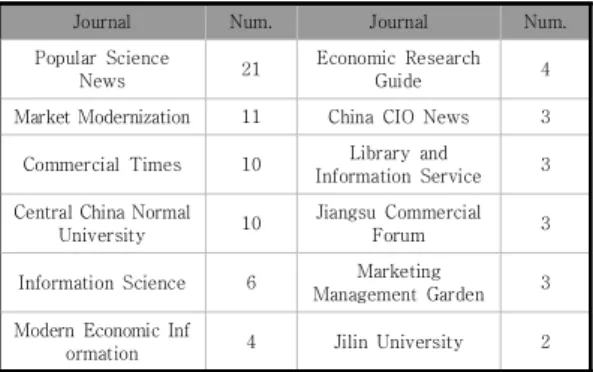
The publication volume of journals was
statistically analyzed, as shown in Table 2. The
table lists the top journals that publish research
literature in this field, as well as the number of
publications in each journal. It can be seen from
the analysis that most literatures are published in core journals, indicating that the research field of e-commerce ecology has been recognized by most of the core journals. Especially after the emergence of new research hotspots of cross-border e-commerce, the construction and development of e-commerce ecosystem have higher research value and urgency.
Journal Num. Journal Num.
Popular Science
News 21 Economic Research
Guide 4
Market Modernization 11 China CIO News 3
Commercial Times 10 Library and Information Service 3 Central China Normal
University 10 Jiangsu Commercial
Forum 3
Information Science 6 Marketing
Management Garden 3 Modern Economic Inf
ormation 4 Jilin University 2
Table 2. Journal publication statistics
4.2.4 Core author analysis
The core authors engaged in the study of e-commerce ecology were analyzed, mainly from three aspects: the number of articles published by the author, the number of citations, and the number of downloads of the article. The statistical results are shown in Table 3.
Author Articles Citations Downloads
Yang Yao 4 2 269
He Jun 4 38 2,092
Wang Yi 4 38 2,092
Zhou Jianliang 4 24 1,876
Liu Xiaoyun 3 35 1,871
Hu Ganglan 3 364 17,660
Wang Yihai 3 14 197
Jing Jipeng 3 80 2,804
Table 3. Core author analysis
By statistical analysis of the number of articles published by each author, the number of downloads of the article and the number of
citations, compared with the root "information ecology", there are few studies in this field.
However, the literature written by some scholars has been downloaded a lot, indicating that such scholars have a certain academic level and authority, laying a solid theoretical foundation for the study of e-commerce ecology. It also shows that the field is currently attracting a lot of attention and will become a new research hotspot in the future.
4.3 The results of the analysis
As can be seen from the CiteSpaceIV image, since the development of information ecology, the literature mainly focuses on the information ecosystem, information ecological environment, information ecological niche, information ecological chain and business information ecosystem.
By combing through the literature of e-commerce ecosystem, current research mainly focuses on the concept, structure model construction, function, evolution model and evolution logic.
5. Conclusion
Since the development of information ecology, the relevant literature in China mainly focuses on the fields: information ecosystem, information ecological environment, information ecological niche and information ecological chain. In recent years, there have been new research hotspots such as network information ecological chain, business network information ecological chain and e-commerce ecological chain. Research on technology maturity[19] is increasing.
This paper makes a statistical analysis of the
distribution of e-commerce ecosystem research
papers in China by combining quantitative
analysis and visual analysis. In this theoretical
research field, most scholars focus on the
concept of e-commerce ecosystem, the research is relatively sufficient. There are relatively few studies on the construction and evolution mechanism of the ecosystem, and there are also few multi-dimensional perspectives, which need to be further explored to constantly expand the depth and breadth of the research. In addition, in recent years, cross-border e-commerce has been rising rapidly and growing rapidly. How to use the concept of e-commerce ecosystem to solve problems in cross-border e-commerce will be the future research direction.
REFERENCES
[1] F. L. Qian. (2018). Report on the development of e-commerce in China in 2017. Beijing: China Commerce and Trade Press.
http://www.100ec.cn/detail--6452659.html
[2] S. Chen. (1995). Imbalance and Balance of Information Ecology. Information and Documentation Work, (4), 11-13.
http://www.cnki.com.cn/Article/CJFD1995-QBZL504.0 02.htm
[3] S. Chen. (1995). Analysis of Information Ecological Imbalance. Shan Dong Library Quarterly, (4), 4-7.
http://www.cnki.com.cn/Article/CJFD1995-SDTG504.0 02.htm 10.21326/ksdt.2008..21.010
[4] S. Chen. (1996). Information Ecology Research.
Library and Information, (2), 12-19.
http://www.cnki.com.cn/Article/CJFDTotal-BOOK602.
001.htm G704-SER000008947.2014.13.6.017 [5] J. F. Moore. (1996). The death of competition:
leadership and strategy in the age of business ecosystems. New York: Harper Business.
https://scholar.google.com/citations?user=InphnlIAAA AJ&hl=zh-CN&oi=sra
[6] M. PELTONIEMI & E. VUORI. (2004). Business ecosystem as the new approach to complex adaptive business environments. Empowerment in Organizations, (1), 267-281.
https://scholar.google.com/citations?user=O993cXwA AAAJ&hl=zh-CN&oi=sra
[7] G. L. Hu, X. H. Lu & L. H. Huang. (2009). An Essay on E-business Ecosystem and Its Evolutionary Path—
—With Focus on the Phenomenon of E-business Industrial Cluster in China. Economic Management Journal, 31(6), 110-116.
DOI : 10.19616/j.cnki.bmj.2009.06.020
[8] X. W. Guo. (2014). The Composition、Characteristics
and Evolution of E-commerce Ecosystem. Commercial Times, (10), 71-72.
http://www.cnki.com.cn/Article/CJFDTotal-SYJJ20141 0030.htm
[9] K. Y. Yang. (2014). Research on Information Ecosystem Construction about E-business.
Information Science, 32(3), 37-41.
DOI : 10.13833/j.cnki.is.2014.03.015
[10] Q. F. Zhang. (2000). Network Ecology Theory.
Information and Documentation Work, (4), 2-4.
http://www.cnki.com.cn/Article/CJFD2000-QBZL2000 04001.htm
[11] J. Ma, M. Yan & J. P. Jing. (2012). Optimization Study on Information Classification of E-commerce Sites with Information Ecology View. Information Science, 30(3), 360-363.
DOI : 10.13833/j.cnki.is.2012.03.021
[12] X. X. Zhang, X. Zhang & X. Zheng. (2010). Research on the Design of E-business Information Ecosystem Construction. Library and Information Service, 54(10), 20-24.
http://www.cnki.com.cn/Article/CJFDTotal-TSQB2010 10006.htm
[13] J. F. Moore. (2006). Business ecosystems and the view from the firm. The Antitrust Bulletin, 51(1), 31-75.
https://doi.org/10.1177/0003603X0605100103
[14] R. H. Deng, W. Y. Wang & C. J. Yu. (2008). Further Research on the Evolutive model of E-commerce Inhibitors. Mathematics in Practice and Theory, 38(23) , 40-46.
http://www.cnki.com.cn/Article/CJFDTotal-SSJS20082 3008.htm
[15] S. X. Ji & J. J. Li. (2012). Research of Evolution Balance in Electric Commerce Ecosystem. Journal of Modern Information, 32(12) , 71-74.
http://www.cnki.com.cn/Article/CJFDTotal-XDQB2012 12019.htm
[16] S. G. Kim & B. H. Hyun. (2019). Analysis of SMEs Internationalization theory through Systematic Literature Review. Journal of Convergence for Information Technology, 9(4), 88-99.
DOI : 10.22156/CS4SMB.2019.9.4.088
[17] J. Y. Lee & P. S. Jang. (2017). Study on Research Trends in Airline Industry using Keyword Network Analysis : Focused on the Journal Articles in Scopus.
Journal of the Korea Convergence Society, 8(5), 169-178.
DOI : 10.15207/JKCS.2017.8.5.169
[18] C. H. Choi & P. S. Jang. (2019). Keyword Network Analysis on Global Research Trend in Design (1999~
2018). Journal of Convergence for Information Technology, 9(2), 7-16.
DOI : 10.22156/CS4SMB.2019.9.2.007
[19] H. J. Cho & K. Jeong. (2019). A Study on the
Connective Validity of Technology Maturity and
Industry for Core Technologies based on 4th Industrial Revolution. Journal of the Korea Convergence Society, 10(3), 49-57.
DOI : 10.15207/JKCS.2019.10.3.049
고 람(Lan Gao) [정회원]
․ 2003년 6월 : 중국 장춘공업대학교 컴 퓨터학과(공학사)
․ 2008년 12월 : 길림대학교 컴퓨터학 과(공학석사)
․ 2018년 5월 ~ 현재 : 세한대학교 경영 학과(박사과정)
․ 2003년 6월 ~현재 : 길림공정기술사 범학원 경제무역학부 교수
․ 관심분야 : 국제전자상거래, 네트워크마케팅, 소프트웨어공 학
․ E-Mail : [email protected]
한 정 수(Jung-Soo Han) [정회원]
․ 1990년 2월 : 경희대학교 전자계산공 학과(공학사)
․ 1992년 2월 : 경희대학교 전자계산공 학과(공학석사)
․ 2000년 2월 : 경희대학교 전자계산공 학과(공학박사)
․ 2001년 3월 ~ 현재 : 백석대학교 ICT 학부 교수
․ 관심분야 : UML, 3D 모델링, 지능형 웹
․ E-Mail : [email protected]
김 형 호(Hyung-Ho Kim) [정회원]