• 검색 결과가 없습니다.

A Simple Dual-Antenna Diversity Gain Measurement System at 2.4GHz

N/A
N/A
Protected

Academic year: 2021

Share "A Simple Dual-Antenna Diversity Gain Measurement System at 2.4GHz"

Copied!
4
0
0

로드 중.... (전체 텍스트 보기)

전체 글

(1)

(220)

A Simple Dual-Antenna Diversity Gain Measurement System at 2.4GHz

Jingyong Kim *

, Kyungho Chung ** , Yochoul Ho ** , Moonil Kim *

Abstract

A simple measurement system is built to estimate the dual-antenna diversity gain at 2.4GHz easily in open lab environment. To obtain multipath fading propagation channel, the system consists of two transmission horn that placed on opposite direction and a rotating stage mechanically changing the position of test dual-antenna with time over distance greater than one wavelength. Estimated diversity is nearly same as theoretical value such that measured diversity gain of 30mm separated is about 6dB similar to theoretical value of 5.7dB and increases monotonically with the increasing separation distance as predicted by the theory. Proposed measurement system that is simple enough to fit in a small space can evaluate the performance of various dual-antennas with a reasonable accuracy with lower 5% difference between the ten sets of measured waveform distribution and theoretical Rayleigh cumulative distribution.

Key words: Multiple antennas, diversity gain

* Dept. of Electrical Engineering, Korea University

** Mobile Hand Set R&D Center, Mobile Communications Company, LG Electronics

★ Corresponding author

※ Acknowledgment

This work was supported by a grant (number R01–

2006-000–10687–0) from the Basic Research Program of the Korea Science and Engineering Foundation.

Manuscript received May. 11, 2009 ; revised Jun. 23, 2009

120

논문번호 09-02-17

I. Introduction

RF signals propagating in an urban environment are subject to the fading effect that causes performance degradation in wireless communication systems. The fading problem is alleviated by combining more than one signal through multiple communication channels. The final signal quality will depend on the degree of correlation among the individual signals [1]. The propagation path along with the physical arrangement of the multiple antennas determines the overall degree of signal correlation. For scattering-rich non-line-of-sight propagation paths, mainly the antenna coupling will decide the signal correlation. Therefore, the goal of dual antenna design is to remove the antenna coupling even when antennas are placed closely

together. The theoretical diversity gain for a dual-antenna is obtainable from its effective coupling coefficient (ECC) calculated using the far-field radiation patterns of individual antenna elements [2]. However, it is also necessary to confirm the diversity gain by direct measurements.

Several indoor measurement systems offering the fading-channel effect in a small laboratory space have been introduced [3-4]. In ref[3], reverberation chamber and several stirrer are used to make scattering-rich non-line-of-sight propagation paths.

Ref[4] proposed the spatial fading simulator which transmits the desired and interference signal simultaneously. These systems can provide accurate measurement results but the structures are complicated. In this paper, a simple alternative test setup that estimates diversity gains of linearly co-polarized dual antennas investigates quickly.

II. Measurement system

The measurement system assembled to achieve a

minimal path correlation at 2.4 GHz is described in

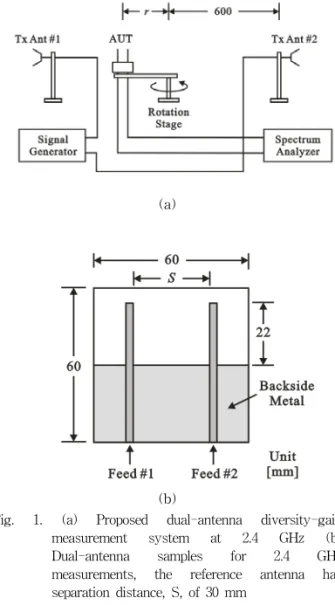
Fig. 1(a). The dual-antenna mounted on lateral

metallic arm on top of a rotating stage moves with

an angular speed of 10 rpm. Two open-end S-band

(2)

A Simple Dual-Antenna Diversity Gain Measurement System at 2.4GHz 121

(221) standard waveguides transmit 18 dBm of phase-synchronized fixed-frequency signal with 6 dB of radiation directivity. The transmit open-end guides are placed 60 cm away from the dual antenna in opposite directions with the main radiation beam pointing away from the dual antenna. The accuracy of our measurement system is tested by analyzing the signal waveforms received through the dual antenna that is shown in Fig. 1(b). The dual-antenna that consists of two 22 mm-long monopole antennas resonating at 2.4 GHz is fabricated using 1.5 mm-wide metal lines patterned on 0.8 mm-thick FR-4 substrate.

(a)

(b)

Fig. 1. (a) Proposed dual-antenna diversity-gain measurement system at 2.4 GHz (b) Dual-antenna samples for 2.4 GHz measurements, the reference antenna has separation distance, S, of 30 mm

The measurement procedure involves recording the two signal waveforms using spectrum analyzers with envelope-power-tester mode option, and

downloading the data to a personal computer. Signal waveforms measured for the time duration of 20 seconds are converted into the probability distribution function (PDF) curves using a linear power scale ranging from 0 to 8 times the average power value. Under an ideal fading-channel condition, the differences between measured PDF curves and the theoretical Rayleigh PDF are represented with sum of squared error (SSE) numbers, and they are plotted in Fig. 2 for various antenna rotation radiuses. Ten sets of measurements are performed to obtain the average and the standard deviation for each SSE values. The results show that the SSE decreases to 5 percent when the rotation radius becomes 20 cm indicating the measurement system provides an effective fading channel. Another key factor for the system evaluation is the mean effective gain (MEG) [5] for each antenna element in the dual antenna. When the two element antennas are identical, the measured MEG’s should be identical. With our setup, the MEG differences are always less than 1dB in all the measurements.

0 10 20 30 40

AUT rotation radius, [cm]

0 0.1 0.2 0.3 0.4

SS E t o R a yl e ig h pr of il e , [ % ]

Fig. 2. Sum of squared errors between the measured signal PDF’s and the Rayleigh PDF for different antenna rotation radiuses

III. Diversity gain measurement

Our proposed measurement system is applied to

estimating the diversity gain of various dual

antenna samples. Although many methods exist in

combining the two signals through the dual

(3)

122 전기전자학회 논문지(Journal of IKEEE) Vol. 13. No.2

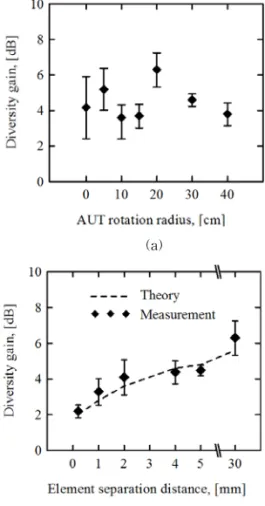
(222) antennas, we use a simple selection-combining technique that picks the stronger signal for a given time interval. The cumulative probability distribution (CDP) curves are then plotted for both individual and combined signal waveforms. Finally, the diversity gain is determined from the difference in signal strengths between the two CDP curves at the ten-percent probability level. The diversity gain of the reference antenna shown in Fig. 1(b) is tested first for various rotation radiuses to check the system accuracy with zero path correlation. The separation distance, S, of 30 mm is sufficiently large so that the diversity gain should reach theoretical value of 5.7 dB for completed uncorrelated dual-antenna signals. The measured gains plotted in Fig. 3 (a) show the diversity gain approaches the theoretical valueof 5.7dB when the rotation radius of 20 cm is used. This means that in this measurement system environment, 20 cm rotation radius can give zero path correlation.

(a)

(b)

Fig. 3. The diversity gain (a) for the reference antenna using different rotation radiuses, and (b) for dual-antenna samples with various separation distances

Similar dual-antenna samples with varying separation distances of 0.2, 1.0, 2.0, 4.0, 5.0 and 30 mm are tested next with a fixed rotation radius of 20 cm. Impedance mismatches for all samples are better than -10 dB. For each antenna samples, five sets of measurement are performed to extract the average and the standard deviation for the diversity gain. Theoretical values are obtained through similar procedure of comparing theoretical CDF curves of signal strength of individual signal and selection combined signal. According to [1], theoretical CDF curves of individual signal can be plotted as

     exp   



where  represents signal strength and 

represents MEG.

Then, CDF curves of selection combined signal can be obtained as

      exp   

        

 exp   

       

  

    

   

    

 

where  represents signal strength, 

and 

represents MEG of each antenna element, Q represents marcum q function and  represents envelope correlation coefficient[2] calculated with measured complex radiation patterns.

The results plotted in Fig. 3 (b) show that the

diversity gain increases monotonically with the

increasing separation distance as predicted by the

theory. This means that this system can estimate

the diversity gain degenerated by signal correlation

causes by antenna coupling.

(4)

A Simple Dual-Antenna Diversity Gain Measurement System at 2.4GHz 123

(223)

IV. Conclusion

A 2.4GHz dual-antenna diversity-gain measurement system that is simple enough to fit in a small open space is discussed in this paper. To achieve multipath fading channel and zero path correlation, AUT rotation radius is optimized with checking the individual signal distribution and the diversity gain of non-coupling reference dual antenna. The system evaluates the performance of various dual-antennas with a reasonable accuracy, and it could be used to optimize small-size dual-antenna designs. New antenna design techniques such as de-correlation antenna feed networks are being studied using the proposed measurement system.

References

[1] W. C. Y. Lee, Mobile Communication Engineering, McGraw Hill Book Company, New York, 1998 [2] R. G. Vaughan, and J. B. Andersen, “Antenna diversity in mobile communications,” IEEE Trans Vehicular Tech vol. 36, no. 4, pp. 149-172, Nov, 1987 [3] P. S. Kildal, K. J. Rosengren, J. H. Byun, and B.

J. Lee, “Definition of effective diversity gain and how to measure it in a reverberation chamber,” Microwave and Optic Technology Letters vol. 34, no. 1, pp.

56-59, May, 2002

[4] A. Yamamoto, T. Sakata, H. Iwai, K. Ogawa, J.

Takada, K. Sakaguchi and K. Araki, “BER measurements on a handset adaptive antenna array in the presence of cochannel interference generated using a spatial fading emulator”, Antennas and Propagation Society International Symposium, Los Angeles, USA, 4A, pp. 26-29, Jul, 2005

[5] T. Taga, “Analysis for mean effective gain of mobile antennas in land mobile radio environments,”

IEEE Trans Vehicular Tech vol. 39, no. 2, pp.

117-131, May, 1990

BIOGRAPHY

Kim Jinyong (Student Member)

2006 : BS degree in Electrical Engineering, Korea University.

2006~ : Unified MS and PhD candidate in Electrical Engineering, Korea University

Chung Kyungho (Non Member)

2000 : BS degree in Electrical Engineering, Hanyang University.

2002 : MS degree in Electrical Engineering, Hanyang University.

2006 : PhD degree in Electrical Engineering, Hanyang University.

2006~ : Research Engineer, LG Electronics.

Ho Yochoul (Non Member)

1987 : BS degree in Electrical Engineering, Seoul National University.

1989 : MS degree in Electrical Engineering, Korea Advanced Institute of Science and Technology.

2000 : PhD degree in Electrical Engineering, University of Florida.

2003~ : Managing Director, LG Electronics.

Kim Moonil (Non Member)

1987 : BS degree in Electrical Engineering, Illinois Institute of Technology.

1992 : PhD degree in Electrical Engineering, California Institute of Technology.

2000~ : Professor, Korea University

수치

Fig.  1.  (a)  Proposed  dual-antenna  diversity-gain  measurement  system  at  2.4  GHz  (b)  Dual-antenna  samples  for  2.4  GHz  measurements,  the  reference  antenna  has  separation  distance,  S,  of  30  mm
Fig.  3.    The  diversity  gain  (a)  for  the  reference  antenna  using  different  rotation  radiuses,  and  (b)  for  dual-antenna  samples  with  various  separation  distances

참조

관련 문서

Gain Boosting applied to both g pp signal path and load devices... CMFB Triode Example

This paper proposes the improved real time object detection and distance measurement system using IR-UWB radar.. Firstly, the IR-UWB signal is applied for

In this paper, the variable capacitors and the superconducting relay antenna were applied to the superconducting WPT system to increase efficiency and the transmission distance

The reason why I choose HAPPEN group and EXPERIENCE group to do research is that in English HAPPEN-words and EXPERIENCE-words show diversity in

 The developed FPGA based high-speed multi-channel DAQ system includes smoothing, triggering, and pulse height measurement.  Considering the stable performance and

Example 16.5: Small-Signal Gain Variation of NMOS Inverter..  the small-signal gain is the largest in

• Apply the principle of impulse and momentum. Since the initial momenta is zero, the system of impulses must be equivalent to the final system of momenta. • Assume

To create a smooth path with continuous position and velocity, we start with the linear function but add a parabolic blend region at each path point.. During the blend portion