액상소결을 이용한 탄소코팅 SiC
f /SiC복합재료의 파괴특성 Fracture Properties of Carbon Coated LPS-SiC f /SiC Composites
김성원
1*
, 이문희1*
, 황승국2
, 이상필3
Sung-Won Kim 1 , Moon-Hee Lee 1* , Seung-Kuk Hwang 2 , Sang-Pill Lee 3
<Abstract>
Mechanical properties of carbon coated SiC f /SiC composites have been investigated, in conjunction with a detailed analysis of microstructure. Especially, the fracture behavior of SiC f /SiC composites by the induction of carbon coating layers has been examined. The matrix region of SiC f /SiC composites with ultra-fine SiC powders were consolidated by a liquid phase sintering (LPS) process, using a sintering additive of Al 2 O 3 -Y 2 O 3 powder compound. In this composite, plain and satin- woven Tyranno SA fabrics were also utilized as a reinforcing material. A carbon interfacial layer was coated around satin-woven SiC fabrics. The characterization of LPS-SiC f /SiC composites was investigated by means of SEM and three point bending test.
Keywords : SiC/SiC composites, Liquid phase sintering, Microstructure, Flexural strength
1 동의과학대학교 기계계열
2 한국폴리텍대학 창원캠퍼스 컴퓨터응용기계과 3 동의대학교 기계공학과
1* 정회원, 동의과학대학교 기계계열 조교수, 박사(공학) E-mail : [email protected]
1 Division of Mechanical Engineering, Dong-Eui Institute of Technology
2 Computer Aided Mechanics Department, Changwon Campus Korea Polytechnic
3 Dept. of Mechanicla Engineering, Dong-Eui university 1* Corresponding Author, Division of Mechanical Engineering,
Dong-Eui Institute of Technology, Ph.D(Eng.)
extensive applications of SiC materials are still restricted due to the embrittlement at operating temperatures. The utilization of various reinforcing fibers was regarded as a promising approach for the toughness strengthening of SiC materials. SiC fiber reinforced SiC matrix composites (SiC f /SiC) have been studied for blanket module components of fusion power plants such as first wall and divertor coolant channel[1]. Composite materials has been understood improvement of mechnical property of conventional materials by adding inclusions (reinforcements)[2]. Majority of R&D researches for the developments of SiC f /SiC composites were focused on the formation of high density SiC matrices into various fabric structures, including unidirectional, two dimensional or three dimensional array cloths[3-4]. The polymer-derived SiC fibers such as Tyranno SA and Hi-Nicalon, which possessed high crystalline and excellent mechanical properties, were also developed to improve the mechanical properties of SiC f /SiC composites[5]. Among the manufacturing processes of SiC f /SiC composites, liquid phase sintering(LPS) process are recognized as an attractive method for making high dense SiC f /SiC composites with good thermal conductivity. The previous works
expected to improve the matrix strength of SiC f /SiC composites. In order to extend the application of SiC f /SiC composites for high temperature structural components, it is still necessary to examine a proper interfacial coating layer around SiC fibers for the strengthening of fracture energy.
In the present study, the mechanical properties of SiC f /SiC composites reinforced with two dimensional SiC fabrics were investigated, based on the detailed analysis of their microstructures. Especially, the fracture behavior of SiC f /SiC composites reinforced with carbon coated satin-woven SiC fabrics was examined through an observation of their fractured surfaces.
2. Experimental procedures
SiC f /SiC composites were fabricated by a
liquid phase sintering (LPS) process, using a
commercial ultra-fine SiC powder (Kojundo
Chemicals) with an average particle size of
about 0.3 μm. A complex mixture of
commercial Al 2 O 3 and Y 2 O 3 particles was used
as a sintering additive material for the
consolidation of SiC matrix. The average sizes of Al 2 O 3 and Y 2 O 3 particles were constant as about 1.0 μm. The complex mixture slurry containing SiC, Al 2 O 3 , Y 2 O 3 and acetone was prepared by the blending speed of 160 rpm for 12 hours, using a ball milling device. The complex slurry was prepared inside a SiC crucible mounted on a ball mill device. The total amount (Al 2 O 3 +Y 2 O 3 ) and the compositional ratio (Al 2 O 3 /Y 2 O 3 ) of additive materials in the complex mixture were 10 wt%
and 1.5, respectively. In this composite system, the reinforcing materials were plain-woven (P/W) and satin-woven (S/W) Tyranno SA SiC fabrics.
The carbon interfacial layer was also coated around satin-woven SiC fibers, using a chemical vapor deposition (CVD) process. The fabric preform for LPS-SiC f /SiC composites was prepared by the impregnation of complex mixture slurry into each SiC fabric, using a constant gas pressure of 6.0 MPa. LPS-SiC f /SiC composites composed of ten layers of fabric preform were sintered at the temperature of 1820℃ under applied pressure of 20 MPa for 1 hour. The
sintering temperature of LPS-SiC f /SiC composites was determined from the phase diagram of the Al 2 O 3 -Y 2 O 3 system for the creation of secondary liquid phases. The dimensions of as-pressed LPS-SiC f /SiC composites was 2(t)×40×40 mm 3 .
Both sintered density and porosity volume fraction of LPS-SiC f /SiC composites reinforced with different SiC fabric structures were determined by the Archimedes’ method. The microstructure of LPS-SiC f /SiC composites was observed by a scanning electron microscope (SEM), after a mechanical polishing by diamond powders. In order to investigate the mechanical properties of LPS-SiC f /SiC composites, the three point bending test was carried out at the room temperatures. The bending load for composites was applied to the upper portion of stacking fabric layers. The dimensions of bending test samples was 2(t)×4×25 mm 3 . The span length and the crosshead speed for the bending test were 18 mm and 0.5 mm/min, respectively.
The fractured surfaces of LPS-SiC f /SiC composites were also observed to examine the fracture behavior associated with the existence of carbon interfacial layer. All data of
Fig. 1 Microstructures of LPS-SiCf
/SiC composites reinforced with carbon coated satin-wovenTyranno SA fabrics.
LPS-SiC f /SiC composites reinforced with carbon coated satin-woven Tyranno-SA SiC fabrics. It was found that the composites represented a dense morphology with some amount of micropores. The good adhesion between satin-woven SiC fabrics and matrix region was also made in the microstructure of the composites. As shown in Figure 1(b), the detectable cracking of fiber by the infiltration of matrix slurry and the hot-pressing process was not observed in the cross section of fibers. Especially, the dense SiC matrix was created in the intra-fiber bundle region of composites, due to the sufficient infiltration of complex mixture slurry. The constant carbon coating layers with the thickness of about 0.5 μm were well formed around SiC fibers. It can be considered that the slurry infiltration process for the preparation of fiber preform is effective for providing dense SiC phases in the matrix region of the composite, accompanying the suppression of fiber damages.
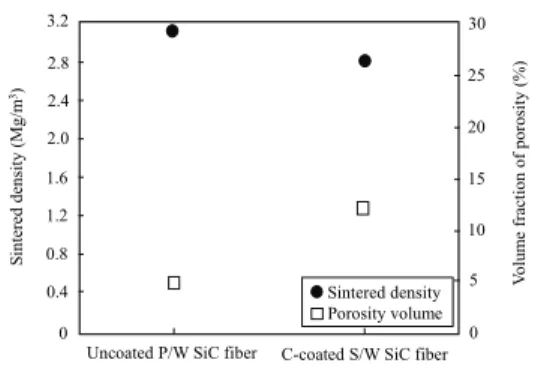
Figure 2 shows the sintered density of LPS-SiC f /SiC composites reinforced with different structures of Tyranno SA SiC fabrics. The porosity volume fraction of the composites depending on the woven structures of SiC fibers was also shown in this figure. The composites
reinforced with uncoated plain-woven SiC fabrics had an average sintered density of about 3.1 Mg/m 3 , which corresponded to about 94 % of theoretical density. This material also possessed a porosity volume fraction of about 5.3 %. On the other hand, the sintered density of the composites slightly decreased with the induction of carbon coated satin-woven SiC fabrics. In other words, SiC f /SiC composites reinforced with carbon coated satin-woven SiC fabrics possessed an average sintered density of about 2.8 Mg/m 3 , accompanying the porosity volume fraction of about 9.4%. The density reduction of the composites by the utilization of satin-woven SiC fabrics is maybe caused by the interruption of carbon interfacial layer for the infiltration of complex matrix slurry.
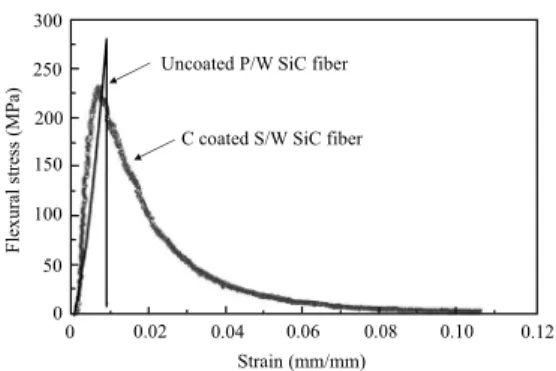
Figure 3 displays the fracture behaviors of LPS-SiC f /SiC composites reinforced with different structures of Tyranno SA SiC fabrics. It was found that the fracture behavior of the
Reinforcing materials
Fig. 2 Sintered density and porosity volume fraction of LPS-SiC
f
/SiC composites reinforced with different structures of Tyranno SA SiC fabrics.composites greatly depended on the induction of carbon interfacial layer. the composites reinforced with uncoated plain-woven SiC fabrics exhibited a typical brittle fracture behavior, which the bending load rapidly droped at the maximum value. On the contrary, the composites reinforced with carbon coated satin-woven SiC fabrics represented a pseudo-ductile fracture behavior with a stable crack propagation beyond the maximum load. Especially, the composites reinforced with carbon coated satin-woven SiC fabrics possessed the fracture energy of about 58.6 × 10 -3 J, corresponded to about four times of that reinforced with uncoated plain-woven SiC fabrics. Such a fracture behavior for the strengthening of fracture energy is caused by the variation of crack propagation path at the interface. In other words, since the carbon interfacial layer leads to the interfacial relaxation for the propagation of fracture crack across the SiC matrix, the subsequent creation of interfacial delamination and multiple fractures of fibers easily occur after the crack is arrested at the
interface. Therefore, the bending load after the occurrence of first cracking is maintained through the proper friction between reinforcement and matrix.
Reinforcing materials 700
600 500 400 300 200 100 0
Uncoated P/W SiC fiber
Fl ex ur al st re ngt h (M Pa )
C-coated S/W SiC fiber
Fig. 4 Effect of Tyranno SA SiC fabric structure on the flexural strength of LPS-SiC
f
/SiC composites.Figure 4 shows the effect of Tyranno SA SiC fabric structure on the flexural strength of LPS-SiC f /SiC composites. Five test specimens were used to determine the flexural strength of the composites. The fabric structure of SiC fiber did not provide a great difference in the flexural strength of the composites, even if satin-woven SiC fabrirics were coated with a carbon interfacial layer. the composites reinforced with carbon coated satin-woven SiC fabrics possessed an average flexural strength of about 200 MPa, which was slightly lower than that of the composites reinforced with uncoated plain-woven SiC fabrics (about 270 MPa). Such a slight difference of flexural strength is due to the increase of prosity volume fraction (See Fig, 2).
Figure 5 shows the fracture surface of
300 250
150
50 200
100
0
Fl ex ur al st re ss (M P a)
0 0.02 0.04 0.06 0.08 0.10 0.12
Strain (mm/mm) Uncoated P/W SiC fiber
C coated S/W SiC fiber
Fig. 3 Fracture behaviors of LPS-SiC
f
/SiC composites reinforced with different structures of Tyranno SA SiC fabrics.LPS-SiC f /SiC composites reinforced with carbon coated satin-woven Tyranno SA SiC fabrics.
The composites displayed an inter-granular fracture in the SiC matrix region of inter-fiber bundle region. On the contrary, both the fiber pull-outs and the interfacial delamination were mainly observed in the intra-fiber bundle region of the composites, due to the existance of an interfacial coating layer. It also seemed that the majority of SiC fibers maintained a
4. Conclusions
Both microstructure and mechanical property of LPS-SiC f /SiC composites reinforced with plain and satin-woven Tyranno SA SiC fabrics were investigated. LPS-SiC f /SiC composites reinforced with carbon coated satin-woven SiC fabrics represented a dense morphology in the intra-fiber bundle region, accompanying a good adhesion between SiC fabrics and matrix region. LPS-SiC f /SiC composites reinforced with uncoated plain-woven SiC fabrics possessed a sintered density of about 3.1 Mg/m 3 and a porosity volume fraction of about 5.3 %. On the other hand, LPS-SiC f /SiC composites reinforced with carbon coated satin-woven SiC fabrics had a sintered density of about 2.8 Mg/m 3 . LPS-SiC f /SiC composites reinforced with carbon coated satin-woven SiC fabrics also represented the flexural strength lower than that of SiC f /SiC composites reinforced with uncoated plain-woven SiC fabrics. However, the induction of carbon interfacial layer around SiC fibers greatly improved the fracture energy of LPS-SiC f /SiC composites, accompanying a pseudo-ductile fracture behavior. Such an improvement of fracture energy was caused 100 m
(a) Fracture surface
(b) Mag. of A
Matrix
Delamination
Pull-out C coating layer
20 m
Fig. 5 Fracture surface of LPS-SiCf
/SiC reinforced with carbon coated satin-woven Tyranno SA SiC fabrics.by the proper combination of pull-out of SiC fibers and extensive interfacial delamination.
References