• 검색 결과가 없습니다.

Comparative Analyses of Commercial Detonation Nanodiamonds

N/A
N/A
Protected

Academic year: 2021

Share "Comparative Analyses of Commercial Detonation Nanodiamonds"

Copied!
6
0
0

로드 중.... (전체 텍스트 보기)

전체 글

(1)

DOI: 10.4150/KPMI.2011.18.3.297

Comparative Analyses of Commercial Detonation Nanodiamonds

A. P. Puzyr, A. E. Burov

a

, V. S. Bondar, C. K. Rhee

b,

* , W. H. Rhee

c

, and K. C. Hwang

c

Institute of Biophysics SB RAS, Krasnoyarsk 660036, Russia

a

Special Design-Technology Bureau “Nauka” SB RAS, Krasnoyarsk, Russia

b

Korean Atomic Energy Research Institute, Daejeon 305-353, Korea

c
Daewha Alloytech. Co., Gyeonggi-do 445-862, Korea

(Received April 25, 2011; Revised May 17, 2011; Accepted June 8, 2011)

Abstract Colloidal stability is one of crucial factors for many applications of nanodiamond. Despite recent development, nanodiamonds available on the market often exhibit a high impurity content, wide size distribution of aggregates and low resistance to sedimentation. In the current study, four commercial nanodiamond powders synthesized by detonation synthesis were surface modified and then separated with respect to the size into six frac- tions by centrifugation. The fractions were evaluated by zeta potential, particle size distribution and elemental composition. The results showed that the modified nanodiamonds form stable colloidal suspensions without sed- imentation for a long time.

Keywords : Nanoparticles, Detonation nanodiamond, Surface modification, Colloidal stability

1. Introduction

Detonation nanodiamond (DND) is produced by detonation synthesis from carbon-containing explo- sives in an oxygen depleted atmosphere [1]. The material is receiving much attention due to its remarkable mechanical, electrical and thermal prop- erties, facile surface tailoring, narrow size distribu- tion of primary particles and high biocompatibility [2]. Nanodiamonds find wide applications in com- posite coatings for metals, drug delivery vehicles, diagnostic probes, micro-electro-mechanical devices, additives to polymers and lubricants etc [2, 3].

Despite recent development, DNDs available on the market often require additional treatment as the impurity content is usually high, size distribution of aggregates is wide, and resistance to sedimentation is low. While being stable in aqueous solution, upon drying DND particles coagulate and lose colloidal stability. This makes impossible their subsequent re- suspension or fractionating. It stipulates storage and

transportation of DND only in solutions at relatively low concentrations (max 10 wt%).

Colloidal stability is one of crucial factors for many applications of DND including but not limited to drug delivery systems, entesorbents, different types of injections, extraction and purification of proteins, indicator systems, lubricant additives, polishing compo- sitions and CVD precursors. Moreover, there is often the need for a certain particle size of DND [2-5]. For this purpose the centrifugal fractionation is often applied, which requires stable colloids.

Colloidal stability of commercial nanodiamonds can be achieved through the size reduction of aggre- gates and/or increase of repulsive inter-particle forces. Several approaches were developed so far to improve the sedimentation resistance of DND in solutions including the use of surfactants, purifica- tion by ion exchange and heat treatment [6-9]. How- ever, most of them are limited to certain solvents (usually non-aqueous), or require sophisticated equip- ment, high energy consumption, and hence, are

*Corresponding Author : [Tel : +82-42-868-8551; E-mail : [email protected]]

(2)

expensive. Moreover, subsequent drying may lead to the loss of ability of DND to form a stable suspen- sion [8].

In the current study, four commercial DND pow- ders were chemically treated to decrease aggregate size and modify the surface of nanoparticles. Analy- ses of XRD, SEM and TEM were carried out to investigate the colloidal stability, fractional and ele- mental compositions of the modified nanodiamonds.

2. Experimental

Unfractioned detonation nanodiamond powders pro- duced in Russia (two samples) and China (two sam- ples) are denoted as Ru1, Ru2, Ch1, Ch2 in the following text, respectively. The incombustible impu- rity contents in Ch1 and Ch2 powders provided by the producers were 1.19 and 0.52%, respectively.

The elemental composition of Ru1 and Ru2 pow- ders was determined experimentally.

All acquired DNDs are heterogeneous, polydis- perse systems and exhibit loosely and tightly bound aggregates up to 5 µ m in diameter (Fig. 1). The former are formed by the adsorption between the nanoparticles, while the latter are caused by chemi- cal bindings.

The DND powders were treated using a method describe previously [10, 11]. Briefly, the modifica-

tion and simultaneous fractionating started with prepa- ration of the initial hydrosol that included deionized water (Milli-Q system, 18 M cm), a DND powder at concentrations of 1-3 wt% and a modifying reagent (10 mg per 1 g of DND). Ethylenediaminetetraace- tic acid (EDTA) and sodium chloride (NaCl) were used as the modifiers. Ultrasonic pretreatment of the initial hydrosol was excluded for two reasons: the process is time and cost consuming; sonication inev- itably results in wear debris from the sonotrode tip, which is difficult to remove.

The suspension was held at room temperature for 1 hour. During this time DND particles fully precipi- tated and reaction products between the modifier and surface substances of DND were released into the supernatant. The precipitate was treated with water, intensively agitated with a stirrer and then centri- fuged. Centrifugal fractionation was performed using a Beckman Coulter Avanti J-E centrifuge at 10 °C.

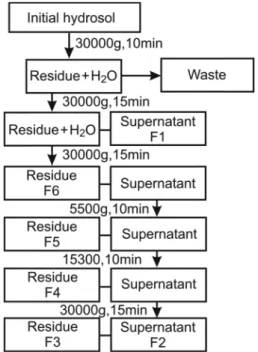
Six fractions were obtained from each sample. The fractionating scheme is presented in Fig. 2. The final centrifuging (F2 fraction) was done for additional

Fig. 1. TEM image of the nanodiamond(ND) produced by

detonation synthesis in Russia (Ru1). Fig. 2. Centrifugation scheme for purification and frac-

tioning of nanodiamond.

(3)

extraction of small particles that were “seized” by the larger aggregates during segregation. The obtained hydrosols were dried at 100°C for 24 h. Subse- quently, the powders were weighed to determine the mass yield of each fraction.

The DND size distribution within the fractions was determined at 22°C by the dynamic light scat- tering technique with the Beckman Coulter #5 ana- lyzer. Zeta potential measurements were performed on Particle Size Analyzer 90PLus (Brookhaven Instruments Corporation). The reported results were averaged over 5 measurements.

X-ray diffraction (XRD), scanning electron micros- copy (SEM) and transmission electron microscopy (TEM) were used to study the composition and struc- ture of DND fractions.

3. Results and Discussion

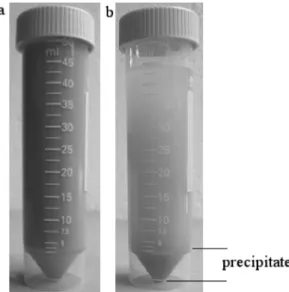
The stability of hydrosols prepared from all as- received powders was poor. Fig. 3 presents 2 wt%

suspension of the starting Ru1 powder just after dis- persion (a) and one day later (b). Most of nanoparti- cles precipitated making centrifugation fractionation impossible. We suppose that some of the impurities remained after extraction of DND from the detona- tion soot promote their aggregation and, thus, deteri- orate the stability of nanodiamond suspensions.

The modification imparted DNDs with a high col- loidal stability and no detectable precipitation was found after at least three months. The stability was

confirmed by high absolute values of zeta potential measured on 0.1 wt% suspensions (Table 1). The origin of the negative zeta potential of DND is dis- cussed elsewhere [5]. After repeated drying and re- suspending in water, stable hydrosols were obtained.

The particle size distribution within the fractions are shown in Table 1. These data demonstrate that centrifugation can be used to separate the initial pow- der in fractions of a certain average particle size.

However, a relatively high degree of polydispersity evidences that the procedure is not very selective due mainly to extremely irregular shape of DND aggregates (Fig. 1). To narrow the size distribution an additional fractionation with appropriate centrifu- Fig. 3. Hydrosol with 2 wt% nanodiamond (Ru1 sample) : a, initial and b, after 24 h.

Table 1. Properties of fractions with different sizes of modified nanodiamonds Fraction Mean diameter*, nm Polydis-

persity* Zeta potential*,

mV Powder

appearance Hydrosol appearance

F1 70 0.21 -51.4 Black Dark brown or black, transparent

F2 70 0.21 -50.0 Black Dark brown or black, transparent

F3 145 0.17 -49.2 Dark grey Dark grey or light brown, turbid

F4 175 0.16 -51.1 Light grey Grey, turbid

F5 250 0.18 -33.9 Brown Light grey or milky, turbid

F6 >400 0.23 -24.6 Milk white or beige Milky, turbid

*average value obtained from measurements

(4)

gation conditions is required.

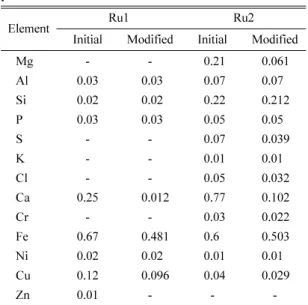
As result of the modification, the level of inor- ganic contamination was reduced (Table 2). The improved purification can be attributed to the ability of the modifiers to sequester metal ions in aqueous solutions.

All tested materials exhibit a feature that is intrin- sic for DND: the color of a powder depends on the average size of particles. It changes from a deep black for the smallest fraction through grey for the middle sized fraction to milk white or beige for the biggest one (Table 1). Traditionally [5, 10], fractions F1-F3 are called “black” or “dark” and fractions F4- F6 are called “grey”. In terms of serviceableness, the smaller the aggregates the more applications they can be used for, as percentage of non-diamond car- bon and impurities is relatively low, and composi- tion of surface groups is more uniform [5]. That is especially important for biomedical use of DND.

However, for some applications, such as lubricant additives or polishing agents, 200-400 nm particles can also be applied.

The fraction analysis shows that all DND powders are polydispersed systems containing aggregates of

different sizes. However, the yield of individual frac- tions varies significantly between DND powders (Fig. 4). The smallest F1 and F2 fractions comprise up to about 60% of Ru1 and Ru2 samples. On the contrary, the Ch1 and Ch2 samples contain 40% and 52% of the largest F6 fraction, respectively. This can be explained by different methods of the synthesis and soot purification used by the producers.

Besides the difference in size, the fractions signifi- cantly differ in composition. As it is seen on XRD patterns (Fig. 5) obtained on Ru2 samples, fraction F1 comprises mostly of the diamond carbon (reflec- tions from the (111) and (220) planes at 2 θ = 44° and Table 2. Percentage of impurities in the initial and modified

powders

Element Ru1 Ru2

Initial Modified Initial Modified

Mg - - 0.21 0.061

Al 0.03 0.03 0.07 0.07

Si 0.02 0.02 0.22 0.212

P 0.03 0.03 0.05 0.05

S - - 0.07 0.039

K - - 0.01 0.01

Cl - - 0.05 0.032

Ca 0.25 0.012 0.77 0.102

Cr - - 0.03 0.022

Fe 0.67 0.481 0.6 0.503

Ni 0.02 0.02 0.01 0.01

Cu 0.12 0.096 0.04 0.029

Zn 0.01 - - -

Fig. 4. Fraction compositions of nanodiamond powders.

Fig. 5. X-ray diffraction patterns of fractions obtained

from Ru2 samples.

(5)

76° respectively,). It includes little of nondiamond carbon such as graphite nanocrystals, carbon onions and amorphous carbon which presence is evident from reflection at 2 θ = 20°–30°. The content of non- diamond carbon gradually increases in larger frac- tions. Interesting is the fact that F1 powder is black and, for example, F4 is grey. Therefore, the nondia- mond carbon content does not correlate with the color of a powder and its hydrosol.

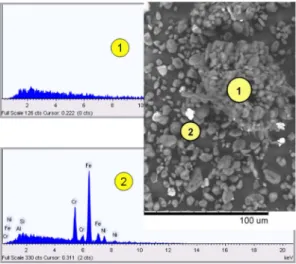
All tested powders include relatively small amount of micron-sized particles contained within the F6 fraction. They in quantities incorporate nondiamond

carbon, metals and other incombustible impurities, which originate mostly from a detonator and the walls of the detonation chamber (Fig. 6, 7). As the key requirement for the chemical composition of modern DND is a minimum of incombustible impu- rities, such large particles must be removed. Since the impurities are not exposed for acid of heat treat- ment this can be achieved only by fractionating. Fig- ures 6 and 7 show SEM images and elemental compositions obtained on the F6 samples.

4. Conclusions

Four DND powders from different vendors were evaluated in terms of hydrosol stability, fraction and elemental composition. In all cases, the stability of hydrosols prepared from the as-received polydis- persed DND powders was low.

The initial DNDs were modified to acquire sedi- mentation stability and were separated by centrifuga- tion in six fractions varied by the average size and mass yield. The modified DNDs are characterized by a high colloidal stability and form stable hydrosols even when water is simply added without ultrasonic dispersion. After repeated drying and re-suspending in water, a stable hydrosol can be obtained. The mod- ified DND can be used “as is” or be a basic material for further treatment towards certain applications.

The study revealed that properties of the powders such as the fraction composition and impurity con- tent are significantly different. This confirms a well- known fact that a universal detonation nanodiamond does not exist and commercial products are specific to the synthesis and post-synthesis methods adapted by the producers.

It should be mentioned that the modification did not always leads to desired results and there were examples of commercial DND, which did not exhibit colloidal stability after the modification. The authors believe that the content of impurities (espe- cially metallic ones) is responsible for such behav- ior.

Fig. 6. SEM images and elemental compositions of the F6 fraction of the Ch2 powder.

Fig. 7. SEM images and elemental compositions of the F6

fraction of the Ru2 powder.

(6)

Acknowledgment

The research was financially supported by Korea- Russia Technology Development Cooperation Pro- gram (Commercialization Short Period R&D) in the area of components and materials from Ministry of Knowledge Economy (MKE) of Republic of Korea.

References

[1] V. V. Danilenko: Phys. Solid State, 46 (2004) 595.

[2] A. M. Schrand, S. A. C. Hens and O. A. Shenderova:

Critical Reviews in Solid State and Mat. Sci., 34 (2009) [3] O. A. Shenderova and D. M. Gruen (Eds.): William 18.

Andrew Publishing, (2006).

[4] M.Yu. Koroleva, D. V. Berdnikova, B. V. Spitsyn and

E. V. Yurtov: Theor. Found. of Chem. Eng., 43 (2009) [5] N. Gibson, O. Shenderova, T. J. M. Luo, S. Moseen- 478.

kov, V. Bondar, A. Puzyr, K. Purtov, Z. Fitzgerald and D. Brenner: Diamond Relat. Mater., 18 (2009) 620.

[6] M. Ozawa,M. Inaguma, M. Takahashi, F. Kataoka, A.

Krüger and E. Osawa: Adv. Mater., 19 (2007) 1201.

[7] I. Petrov, O. Shenderova, V. Grishko, V. Grichko, T.

Tyler, G. Cunningham and G. Mcguire: Diamond Relat.

Mater., 16 (2007) 2098.

[8] E. Õsawa: Pure Appl. Chem., 80 (2008) 1365.

[9] Y. Liang, T. Meinhardt, G. Jarre, M. Ozawa, P. Vrdol- jak, A. Schöll, F. Reinert and A. Krueger: J. of Colloid and Interface Science, 354 (2011) 23.

[10] V. S. Bondar and A. P. Puzyr: Phys. Solid State, 46

(2004) 716.

[11] A. P. Puzyr and V. S. Bondar: Russia, RU Patent

2252192 (2003).

수치

Fig. 1. TEM image of the nanodiamond(ND) produced by
Table 1. Properties of fractions with different sizes of modified nanodiamonds Fraction Mean diameter*, nm
Fig. 5. X-ray diffraction patterns of fractions obtained from Ru2 samples.
Fig. 6. SEM images and elemental compositions of the F6 fraction of the Ch2 powder.

참조

관련 문서