Recent Research Progress in the Microbial Production of Aromatic Compounds Derived from L-Tryptophan
Ji-yeong Lee and Jin-ho Lee*
Major in Food Science & Biotechnology, School of Food Biotechnology & Nutrition, Kyungsung University, Busan 48434, Korea Received August 19, 2020 /Revised September 9, 2020 /Accepted September 9, 2020
Aromatic compounds are widely used in the chemical, food, polymer, cosmetic, and pharmaceutical industries and are produced by mainly chemical synthesis using benzene, toluene, and xylene or by plant extraction methods. Due to many rising threats, including the depletion of fossil fuels, global warming, the strengthening of international environmental regulations, and the excessive harvesting of plant resources, the microbial production of aromatic compounds using renewable biomass is re- garded as a promising alternative. By integrating metabolic engineering with synthetic and systems biology, artificial biosynthetic pathways have been reconstituted from L-tryptophan biosynthetic path- way in relevant microorganisms, such as Escherichia coli and Corynebacterium glutamicum, enabling the production of a variety of value-added aromatic compounds, such as 5-hydroxytryptophan, serotonin, melatonin, 7-chloro-L-tryptophan, 7-bromo-L-tryptophan, indigo, indirubin, indole-3-acetic acid, viola- cein, and dexoyviolacein. In this review, we summarize the characteristics, usage, and biosynthetic pathways of these aromatic compounds and highlight the latest metabolic engineering strategies for the microbial production of aromatic compounds and suitable solution strategies to overcome prob- lems in increasing production titers. It is expected that strain development based on systems metabolic engineering and the optimization of media and bioprocesses using renewable biomass will enable the development of commercially viable technologies for the microbial production of many aromatic compounds.
Key words : Aromatic compound, L-tryptophan, metabolic engineering, microbial production
*Corresponding author
*Tel : +82-51-663-4716, Fax : +82-51-622-4986
*E-mail : [email protected]
This is an Open-Access article distributed under the terms of the Creative Commons Attribution Non-Commercial License (http://creativecommons.org/licenses/by-nc/3.0) which permits unrestricted non-commercial use, distribution, and reproduction in any medium, provided the original work is properly cited.
서 론
방향족 화합물(aromatic compound)은 화학, 식품, 고분자, 화장품, 의약 산업 등에 이용되는 중요한 물질이다[14]. 현재까 지 대부분의 방향족 화합물은 석유의 납사(naphta) 정제과정 에서 얻어지는 벤젠(benzene), 톨루엔(toluene), 크실렌(xly- lene)으로부터 화학 합성법으로 만들어지며, 일부 효능을 갖는 기능성 방향족 화합물은 식물 추출법으로 만들어진다[4, 22].
그러나, 화석원료의 지나친 사용에 의한 연료의 고갈, 지구 온 난화 문제, 국제 환경규제의 강화, 식물자원의 과다한 채취에 의한 환경 파괴 등의 많은 위협요인에 직면하면서 재생 가능 한 생물자원(renewable biomass)을 이용한 생물공학적 방법 으로 방향족 화합물을 생산하는 연구가 매우 활발히 진행되고 있다[23].
일반적으로 전구물질인 phosphoenolpyruvate와 erythrose- 4-phosphate로부터 7단계 반응을 거쳐 chorismate가 합성되
는 shikimate 경로의 대사물질에서 L-트립토판(L-tryptophan), L-페닐알라닌(L-phenylalanine), L-티로신(L-tyrosine)과 같은 방향족 아미노산(aromatic amino acids, AAA)이 생합성된다 [22]. 대사경로에 관여하는 유전자 발현의 조절 측면에 보면,
Escherichia coli의 경우 TrpR repressor가 L-트립토판과 결합하여 aroH, aroL, mtr, trpR, trpEDCBA 유전자의 발현을 조절하 며, 전사 활성/억제 단백질인 TyrR은 L-티로신과 결합하여
aroFtyrA, aroG, aroL, aroP, mtr, tyrB, tyrP, tyrR 유전자의 발현을 조절한다[24]. Corynebacterium glutamicum의 경우, shiki- mate 경로의 분지경로인 quinate/shikimate 이용 경로에 관여 하는 qusABCD operon의 발현이 chorismate와 결합한 QsuR 에 의해 조절된다[21]. 탄소 대사흐름의 조절 측면에서 보면, 세균에서 AAA의 생합성 경로는 최종산물인 AAA에 의해 되 먹임 저해(feedback inhibition), 전사 억제/활성(transcriptio- nal repression/activation), 또는 attenuation 등에 의해 전체 대사흐름이 조절된다[24].
방향족 화합물인 AAA, 엽산(folic acid), ubiquinone, me-
naquinone, siderophore 등은 모두 shikimate 경로 또는 AAA
경로에서 생합성되는 물질이다. 최근 합성 생물학(synthetic
biology)과 시스템 생물학(systems biology)이 대사공학(me-
tabolic engineering)과 접목된 시스템 대사공학(systems met-
abolic engineering)이 발달하면서[24] 기존 미생물에는 존재
하지 않는 대사경로의 신규 유전자를 E. coli와 C. glutamicum
- Review -
Fig. 1. Schematic representation of artificial biosynthetic routes in microorganisms for production of aromatic compounds derived from L-tryptophan. PEP and E4P mean phosphoenolpyruvate and erythrose-4-phosphate, respectively. Linear and dashed lines mean a single-step and multi-steps, respectively.
과 같은 산업미생물에 도입하여 4-hydroxybenzoate, 4-hy- droxybenzyl alcohol, gastrodin, phenol, protocatechuate, cat- echol, vanillin, cis,cis-muconic acid 등의 보다 더 다양한 방향 족 화합물 또는 그 유도물질을 생산할 수 있게 되었다[23].
방향족 화합물 중에서 미생물 발효를 통해 생산되는 대표적 인 물질 중의 하나인 L-트립토판은 동물사료 첨가용으로 많이 사용되기 때문에, 대사공학을 이용하여 고농도, 고수율의 L-트 립토판 생산 균주가 많이 개발되고 있다[5, 7, 15]. 또한, 신규의 외래 유전자를 도입하여 5-히드록시트립토판(5-hydroxytryp- tophan), 세로토닌(serotonin), 멜라토닌(melatonin), 7-염화- L-트립토판(7-chloro-L-tryptophan), 7-브로모-L-트립토판(7- bromo-L-tryptophan), 인디고(indigo), 인디루빈(indirubin), 인돌-3-초산(indole-3-acetic acid), 바이오라세인(violacein) 등
다양한 기능성 화합물이 L-트립토판으로부터 만들어 질 수 있 어, 미생물을 이용한 생물공학적 방법으로 이들 물질을 생산 하는 것은 매우 의미가 크다고 사료된다[4, 14, 23](Fig. 1). 따라 서, 본 논문은 L-트립토판에서 유래되는 다양한 기능성 방향족 화합물을 미생물을 이용하여 개발 및 생산하는 연구에 관한 최신의 대사공학 전략과 생산농도를 올리는데 제기되는 현안 을 해결하기 위한 전략 등을 정리하여 보고한다(Table 1).
본 론
5-Hydroxytryptophan, 세로토닌, 멜라토닌 생산
세로토닌(serotonin, 5-hydroxytryptamine)은 사람의 감정,
수면 등의 조절에 관여하는 신경전달물질(neurotransmitter)
Table 1. Microbial production of aromatic compounds derived from L-tryptophan
Compound Host Engineered strategy Titer Culture
type References 5-Hydroxytryptophan
Serotonin
E. coli Expression of truncated tryptophan hydroxylase I gene, PTPS, mtrA, SPR, PCD, DHPR, trpEmDCBA and aroH in
Δ
tnaA strain1.3 g/l 5.1 g/l
Flask Bioreactor
38
E. coli Expression of phhA (W179F), phhB, folM, and trpEmDCBA in
Δ
tnaAΔ
pheAΔ
tyrA strain153 mg/l Flask 25
E. coli Expression of salABCD and trpEmG in
Δ
tnaAΔ
trpD strainExpression of trpDCBA in
Δ
tnaAΔ
trpE strain224 mg/l 5-HAA* 98 mg/l
Flask Flask
34
E. coli Expression of aromatic amino acid hydroxylase (W192F), PCS, and DHPR genes in ∆aroF
∆aroG ∆mtr ∆tnaA ∆tnaB
∆aroH::PJ23119-rpsL-tac-(aroGS180F-serAH344A/N364A
) Ptrc-trpES40FDCBA ∆trpR strain
Expression of TDC gene in ∆tnaA strain
962 mg/l
154 mg/l serotonin
Bioreactor
Bioreactor 27
Melatonin E. coli Expression of sheep SNAT and rice COMT genes 1.46 mg/l Flask 3 7-Cl-L-tryptophan C. glutamicum Expression of rebH , rebF, and trpD in
trp-producing TP679
(
Δ
csmΔ
trpL::PilvCM –trpEmΔ
vdh::PilvCaroGm)108 mg/l Flask 37
7-Br-L-tryptophan C. glutamicum Expression of rebH , rebF, and trpD in trp- producing TP679
0.49 g/l 1.2 g/l
Flask Bioreactor
36
Indigo E. coli Expression of flavin-containing monooxygenase gene from Methylophaga aminisulfidivorans (mFMO)
920 mg/l Flask 6
E. coli Expression of mutated FMO gene from C.
glutamicum
1,040 mg/l Flask 16
Indirubin
E. coli Expression of mFMO in medium with 0.36 g/l cysteine
223.6 mg/l Flask 12
E. coli Expression of mFMO and tnaA in
Δ
trpRΔ
pykFΔ
pykA PtktA:Ptrc strain56 mg/l Bioreactor 8
Indican E. coli Expression of PtUGT1 and mFMO genes in
Δ
bglA strain2.9 g/l Bioreactor 13
Indole-3-acetic acid E. coli Expression of aspC, ipdC, and iad1 in
Δ
tnaA strain 3 g/l Flask 31 C. glutamicum Expression of aspC, ipdC, and iad1 7.3 g/l Bioreactor 19 E. coli Expression of aro8, kdc, aldH, trpABCD, aroGm,trpEm, and serAm in
Δ
trpR RARE strain (Δ
dkgBΔ
yeaEΔ
yqhCΔ
yqhDΔ
dkgAΔ
yahKΔ
yjgB)744 mg/l Flask 10
Violacein E. coli Expression of vioABCE in
Δ
trpRΔ
tnaAΔ
sdaA aroFBLΔ
trpL trpEm tktA serAm strain Expression of vioABCE inΔ
trpRΔ
tnaAΔ
sdaAaroFBL
Δ
trpL trpEm tktA serAm vioD strain324 mg/l DVL**
710 mg/l
Bioreactor Bioreactor
30
E. coli Expression of vioABCDE in
tryptophan-producing
Δ
trpRΔ
tnaAΔ
pheA trpEmD aroGm serAm vioE strain4.45 g/l Bioreactor 40
C. glutamicum Expression of vioBAECD in tryptophan-producing strain
5.436 g/l Bioreactor 34
*5-Hydroxyanthranilate; **deoxyviolacein.
Fig. 2. Artificial biosynthetic pathways for the synthesis of 5-hydroxytryptophan, serotonin, and melatonin. Linear and dashed lines mean a single-step and multi-steps, respectively. TPH, TDC, AAAD, T5H, SNAT, ASMT, COMT, BH4, and MH4 are trypto- phan 5-hydroxylase, tryptophan decarboxylase, aromatic amino acid decarboxylase, tryptamine 5-hydroxylase, serotonin N-ace- tyltransferase, N-acetylserotonin O-methyltransferase, caffeic acid O-methyltransferase, tetrahydrobiopterin, and tetrahy- dromonapterin, respectively.
중의 하나로, 불면증, 우울증, 만성두통, 비만 등을 치료하는데 효과가 있다[4]. 그러나 세로토닌은 혈액-뇌 장벽(blood-brain barrier)을 통과하여 중추신경계에 도달하지 못하기 때문에, 통과가 가능한 전구체인 5-히드록시트립토판(5-hydroxytryp- tophan, 5-HTP)이 이러한 치료목적으로 사용되고 있다. 5-HTP 는 유기합성으로 생산하기 어렵기 때문에, 현재 아프리카에서 자생하는 식물인 Griffonia simplicifolia의 열매에서 추출하여 생 산되고 있다.
사람과 동물의 경우, L-트립토판은 tryptophan 5-hydrox- ylase (TPH)에 의해 5-HTP로 전환 된 후 tryptophan decar- boxylase (TDC) 또는 aromatic amino acid decarboxylase 촉 매에 의해 세로토닌으로 전환된다[4](Fig. 2). 식물의 경우, tryptophan decarboxylase에 의해 탈탄산 반응이 일어나 L-트 립토판이 tryptamine으로 전환되며, tryptamine 5-hydoxylase 에 의해 최종적으로 세로토닌이 만들어진다(Fig. 2). 사람과 동
물 유래의 TPH는 조효소로 tetrahydrobiopterin (BH4)을 요구
하며, 산화된 pterin-4α-carbinolamine은 재생(regeneration)경
로를 통해 BH4가 다시 공급되어야 한다[4]. 5-HTP 및 세로토
닌의 생물공학적 생산은 외래 유전자를 관련 미생물에 도입하
여 생산할 수 있지만, TPH 효소의 불안정 문제와 조효소 공급
의 복잡성으로 인해 효율적인 5-HTP의 생산에 많은 장애요인
이 된다[26]. Wang 등은 사람 유래의 tryptophan hydroxylase
I 유전자를 E. coli에서 발현할 때 N-말단 일부를 제거한 형태
로 도입하여 단백질의 안정적인 생산과 효소활성을 향상시켰
으며, 조효소인 BH4를 공급하기 위해 사람 유래의 BH4 생합
성(GTP cyclohydrolase, 6-pyruvoyl-tetrahydropterin syn-
thase 및 sepiapterin reductase 효소촉매) 및 재생경로(pterin-
4a-carbinolamine dehydratase 및 dihydropteridine reductase
효소촉매) 관련 유전자들을 동시에 도입하였다[38]. 또한 트립
토판 오페론을 플라스미드에서 발현하고 염색체 내 trytopha-
nase 유전자인 tnaA를 결손한 E. coli를 제작하였다. 그 결과, 플라스크에서 1.3 g/l 5-HTP가 생산되었으며, 10-L 생물배양 기에서 글리세롤을 탄소원으로 사용하여 유가식(fed-bacth) 배양을 통해 5.1 g/l 5-HTP가 배양액에 축적되었다(Table 1).
한편 E. coli는 tetrahydromonapterin (MH4) 합성경로가 있으 며, BH4 대신에 MH4를 조효소로 사용할 수 있는 일부 세균 유래의 aromatic amino acid hydroxylases가 알려져 있다. Lin 등은 Xanthomonas campestris 유래 phenylalanine 4-hydrox- ylase (P4H) 효소의 기질 특이성을 변화시켜 L-페닐알라닌 보 다 L-트립토판에 대한 높은 활성을 갖는 변이 P4H (W179F)를 단백질공학을 이용하여 개발하고 MH4 재생경로를 함유한 E.
coli에서 발현하였다[25]. 최종적으로, L-트립토판을 생산하는
QH4ΔtnaA 균주에 도입하여 포도당으로부터 153 mg/l 5- HTP를 생산하였다(Table 1). Ralstonia eutropha에는 salicylate 를 gentisate로 전환하는데 관여하는 효소인 ferredoxin reduc- tase, ferredoxin, salicyclate 5-hydroxylase를 암호화하는
salABCD 유전자가 알려져 있다[39]. 이 효소는 salicylate와 구조적으로 유사한 anthranilate를 hydroxylation 할 수 있으며 BH4 대신에 조효소로 NAD(P)H를 사용할 수 있는 장점이 있 다(Fig. 2). 이들 유전자를 E. coli에 도입하여 224 mg/l 5-hydro- xyanthranilate가 성공적으로 생산되었으며, 상등액을 trpDCBA 가 발현되는 세포에서 배양하는 2단계 공정을 통해 98 mg/l 5-HTP가 생산되었다[34](Table 1). Mora-Villalobos 등은 5- HTP와 세로토닌을 생산하는 E. coli와 배양 공정을 개발하였 다[27]. 기질 특이성이 변화된 Cupriavidus taiwanensis 유래의 변이 aromatic amino acid hydroxylase (W192F/F197L/
E219C) 유전자와 사람유래의 BH4 재생경로를 tnaA가 결손된
E. coli에 도입하여 유가식 배양을 통해 962 mg/l 5-HTP를 생산하였다. 그런데 5-HTP로부터 세로토닌을 합성하는 TDC 효 소가 L-트립토판을 기질로 사용하여 tryptamine이 먼저 만들 어질 수 있기 때문에, 이를 방지하기 위해 5-HTP를 함유한 배양액을 분리한 후에 Catharanthus roseus 유래의 TDC를 암호 화하는 유전자를 발현하여 52시간 배양하는 2단계 배양 공정 을 통해 154 mg/l 세로토닌을 생산하는 기술을 개발하였다 [27](Table 1).
멜라토닌(melatonin, N-acetyl-5-methoxytryptamine)은 세 균, 곤충, 진균류, 동물, 식물, 사람 등의 생명체에서 발견되는 L-트립토판 유래의 천연 방향족물질이다[3]. 동물의 하루 주기 리듬(circadian rhythm) 조절, 노화방지, 선천성 면역, 줄기세 포 분화, DNA 수선 등의 조절에 관여하는 기능을 가지고 있는 것으로 알려져 있다. 식물의 경우, 성장, 발달, 많은 비생물학 적/생물학적 스트레스 요인에 대한 방어에서 다양한 생리학 적 역할을 한다[2]. 사람의 경우, 송과선(pineal gland)에서 분 비되는 수면-각성 주기를 조절하는 호르몬으로, 불면증의 단 기적인 치료에 많이 사용되는 물질이다[3].
멜라토닌은 세로토닌에서 2단계의 효소 촉매반응으로 생합
성 된다(Fig. 2). 먼저, serotonin N-acetyltransferase (SNAT) 효소에 의해 세로토닌이 N-acetylserotonin으로 전환되며, N- acetylserotonin O-methyltransferase (ASMT) 또는 caffeic acid
O-methyltransferase (COMT)에 의해 N-acetylserotonin에서멜라토닌이 만들어 진다[2]. 효소의 기능 및 생산측면에서 SNAT는 문제가 없지만, 동물 및 식물 유래의 ASMT 단백질은
E. coli에서 발현이 잘 안되거나 활성이 매우 낮은 문제점이있다[3]. 이를 해결하기 위해 다양한 출처의 유전자를 발현하 여 평가한 결과, 양 유래의 SNAT 유전자와 벼 유래의 COMT 유전자를 E. coli에서 동시에 발현한 결과 1.46 mg/l 멜라토닌 이 생성되었다(Table 1).
7-Chloro-L-tryptophan과 7-bromo-L-tryptophan 생산 아미노산 유래의 할로겐 화합물은 의약, 화학, 농약 산업과 관련된 활성물질의 중요한 중간체 또는 성분으로[37], 천연물 로는 항생제인 chloramphenicol, pyrroindomycin, 항암/항생 효과가 있는 rebeccamycin, 식물 성장조절제인 thienodolin, 항 곰팡이제인 pyrrolnitrin 등이 있다[11, 28, 35]. L-트립토판 유래의 할로겐 화합물로는 7-chloro-L-tryptophan (7-Cl-Trp) 및 7-bromo-L-tryptophan (7-Br-Trp) 등이 있다. 7-Cl-Trp은 rebeccamycin과 pyrrolnitrin의 전구체(precursor)이며, 7-Br- Trp은 proteasome inhibitor 활성을 갖는 Apiospora montagnei 유래의 TMC-93A와 세포분열 억제활성을 갖는 diazonamide A의 전구체로 이용된다[20, 36]. 일반적으로 할로겐 화합물의 화학합성에는 매우 독성이 강한 물질을 사용하거나 공정이 위 험한 측면이 있기 때문에 생물공학적 방법으로 생산하는 연구 가 매우 의미가 있다.
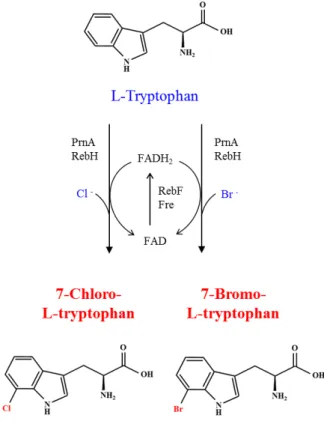
효소 촉매를 이용한 L-트립토판의 할로겐화에는 FADH-
dependent halogenase (PrnA 또는 RebH)와 flavin reductase
(Fre 또는 RebF)가 필요하다[29](Fig. 3). Halogenase는 FADH
2,
O
2, Cl
-를 사용하여 L-트립토판의 7번 위치에 선택적으로 염소
화를 촉매하는 flavin-dependent monooxygenase type이다
[29]. 산화된 FAD는 NADH-dependent flavin reductase에 의
해 다시 환원되어야 정상적인 반응이 진행된다. 최근 Veld-
mann 등은 Lechevalieria aerocolonigenes 유래의 rebH와 rebF를
C. glutamicum에 도입하여 생물공학적 방법으로 7-Cl-Trp과7-Br-Trp을 생산하는 기술을 개발하였다[36, 37]. 먼저 전구체
인 L-트립토판의 공급을 강화하기 위해 염색체에 되먹임-내성
(feedback-resistant) anthranilate synthase를 암호화하는 변이
trpE의 도입, chorismate mutase를 암호화하는 csm 결손, E. coli유래의 되먹임-내성 3-deoxy-D-arabinoheptulosonate-7-pho-
sphate synthase를 암호화하는 변이 aroG 도입을 통해 TP679
를 개발하였다[37]. 이 균주에 플라스미드 형태로 E. coli 유래
의 trpD를 발현하여 L-트립토판 생산균주를 개발하였다(Table
1). 탄소 공급원으로 포도당을, 염소 공급원으로 CaCl
2를 첨가
한 조건에서 플라스크 발효한 결과, 108 mg/l 7-Cl-Trp이 축적
Fig. 3. Artificial biosynthetic pathway for the synthesis of 7- chloro-L-tryptophan and 7-bromo-L-tryptophan. PrnA and RebH are FAD-dependent halogenases. RebF and Fre are NADH-dependent flavin reductases.
되었다. FADH-dependent halogenase는 염소뿐만 아니라 브 롬을 기질로 이용할 수 있다(Fig. 3). 브롬 공급원으로 NaBr을 첨가한 조건에서 플라스크 발효한 결과, 0.49 g/l 7-Br-Trp이 축적되었으며, 생물 발효조에서 유가식 배양을 하면서 55시간 발효한 결과, 1.2 g/l 7-Br-Trp이 생산되었다[36].
인디고와 인디루빈 생산
인디고(indigo)는 주로 청바지의 데님 천 생산에 사용되는 청색 색소화합물로, 식물추출법 또는 화학합성법으로 얻어지 고 있다[4]. 인디루빈(indirubin)은 인디고의 3,2-bisindole 이 성질체로, 전통적으로 중국에서 만성 골수성 백혈병 치료용으 로 사용되는 약초인 당귀(Danggui Longhui Wan)의 주요 활성 성분 중의 하나이다[9]. 더욱이, 인디루빈과 그 유도체는 여러 암, 알츠하이머 병, 지연된 과민증(delayed hypersensitivity) 에 대해 상당한 치료효과를 나타내는 것으로 알려져 있다. 인 디고와 인디루빈의 생산은 화학 합성법, Indigofera, Polygonum
tinctorium과 같은 식물을 이용한 추출법으로 주로 생산되고있으며, 생물공학적 생산방법에 대한 연구가 활발히 진행되고 있다[1].
인디고와 인디루빈은 L-트립토판에서 3단계 과정을 거쳐 생합성된다(Fig. 4). 먼저 tryptophanse에 의해 L-트립토판이 분해되어 indole이 만들어지며, 다양한 종류의 oxygenase 촉
매반응으로 indole이 산화되어 indoxyl로 전환된 후, 2분자의 indoxyl이 자발적인 반응(spontaneous reaction)으로 인디고 가 만들어진다[1, 4]. 인디루빈은 oxygenase에 의해 indoxyl이 더 산화된 형태인 isatin과 indoxyl이 자발적으로 결합하여 만 들어진다[18]. Indole 산화에 관여하는 대표적인 효소들로는
Pseudomonas putida 유래의 naphthalene dioxygenase, toluenedioxygenase, Bacillus megaterium 유래의 변이 cytochrome P450 monooxygenase, Burkholderia cepacia 유래의 toluene monooxygenase, Rhodococcus sp. 유래의 indole oxygenase, C.
glutamicum 유래의 flavin-containing monooxygenase (cFMO), Methylophaga aminisulfidivorans 유래의 flavin-containing
monooxygenase (mFMO) 등이 알려져 있다[1, 6, 17]. L-트립 토판을 첨가한 조건에서, mFMO를 함유한 E. coli를 배양하여 920 mg/l 인디고와 5 mg/l 인디루빈이 생산되었으며[6], cFMO를 함유한 E. coli에서는 685 mg/l 인디고와 103 mg/l 인디루빈이 생산되었으며[1], 변이 cFMO를 함유한 E. coli에서 는 1,040 mg/l 인디고와 112 mg/l 인디루빈이 생산되었다 [16](Table 1). 그러나, 미생물을 이용한 인디고의 생산농도는 낮은 수준이며, 염색을 할 때 불용성인 인디고를 수용성인 leu- coindigo로 만들기 위해 환원제를 첨가해야 하며, 공정의 복잡 성 등의 문제점이 있다[13]. 이를 해결하기 위해 Hsu 등은
Polygonum tinctorium 유래의 glucosyltransferase PtUGT1을암호화하는 유전자와 mFMO 유전자를 bglA가 결손된 E. coli 에서 동시에 발현하여 인디고 대신에 indoxyl에 포도당이 결 합된 인디칸(indican)이 2.9 g/l 생산되었으며(Fig. 4), β-gluco- sidase를 첨가하여 다시 인디고가 생산되는 것을 확인하여, 최종적으로 생물 전환법으로 환원제를 사용하지 않고 발효에 의해 얻어지는 인디칸을 원료로 섬유를 직접 염색할 수 있는 기술을 개발하였다[13].
인디루빈은 인디고 생산과정에서 부산물로 소량 생산되지 만, 배지에 0.36 g/l의 L-cysteine을 첨가하면 인디고는 생산되 지 않고 특이적으로 223.6 mg/l 인디루빈이 축적되었다[12].
이는 cysteine이 indoxyl과 반응하여 2-cysteinylindoleninone 을 형성하여 indoxyl의 이합체화(dimerization)를 방지하여 인디고가 생산되지 않고 인디루빈을 선택적으로 만드는 것을 유도하는 것으로 밝혀졌다[18]. 최근 포도당을 이용하여 발효 를 통해 인디루빈을 생산하는 E. coli가 대사공학적으로 개발 되었다[8]. E. coli 염색체내 transcriptional repressor 유전자
trpR의 결손, 되먹임-내성 유전자 aroG, trpE의 도입, pykF 및 pykA (pyruvate kinase I, II)의 결손, tktA (transketolase) 과발현 균주를 개발하고, 플라스미드에서 mfmo와 tnaA를 과발현 후 유가식 배양을 통해 포도당으로부터 56 mg/l 인디루빈이 생산되었다.
인돌-3-초산 생산
인돌-3-초산(indole-3-acetic acid, IAA)은 식물의 세포 확대
Fig. 4. Artificial biosynthetic pathways for the synthesis of indigo and indirubin. TnaA, FMO, UGT1, Bgl are tryptophanase, flavin-con- taining monooxygenase, glucosyltransferase, and β-glucosidase, respectively.
Fig. 5. Artificial biosynthetic pathways for the synthesis of in- dole-3-acetic acid. AspC, IpdC, Iad1, IaaM, and IaaH are aminotransferase, indole-3-pyruvate decarboxylase, in- dole-3-acetaldehyde dehydrogenase, tryptophan-2-mono- oxygenase, and indole-3-acetamide hydrolase, respectively.
및 분열, 조직분화, 광 및 중력 반응과 같은 많은 생리적 과정 을 제어하는 식물 성장호르몬(plant growth hormone) 중의 하나이다[32, 33]. 많은 근권 미생물(rhizosphere bacteria)에 의해 생성되는 IAA는 식물의 뿌리 성장에 영향을 주며, 숙주 에 대한 감염, 식물 방어 등 식물과 미생물의 상호작용에 중요 한 역할을 한다[32, 33].
세균들은 L-트립토판으로부터 각각 indole-3-acetamide
(IAM), indole-3-pyruvate (IPA), tryptamine, indole-3-ace-
taldoxime, indole-3-acetaldehyde의 5가지의 중간체를 거쳐
IAA를 합성하는 경로가 보고되어 있다[33](Fig. 5). 이들 경로
중 IAM과 IPA를 경유하는 경로가 잘 알려져 있다. IAM경로
는 두 단계로 이루어져 있는데 tryptophan-2-monooxygenase
에 의하여 L-트립토판으로부터 IAM으로 전환된 다음 IAM
hydrolase에 의하여 IAA로 전환된다. IPA 경로는 aminotrans-
ferase에 의하여 L-트립토판으로부터 IPA로 전환된 후 IPA
decarboxylase에 의하여 indole-3-acetaldehyde (IAAld)가 만
들어지며 마지막으로 IAAld dehydrogenase에 의하여 IAAld
가 산화되어 IAA가 생성되는 과정이다. Romasi 등은 IPA경로
에 관여하는 3가지 유전자, 즉 E. coli 유래의 aminotransferase
를 암호화하는 aspC 유전자, Enterobacter cloacae 유래의 in-
dole-3-pyruvate decarboxylase를 암호화하는 ipdC, Ustilago
maydis 유래의 IAAld dehydrogenase를 암호화하는 iad1 유전자를 동시에 E. coli에서 발현시켜 4 g/l L-트립토판을 넣어준
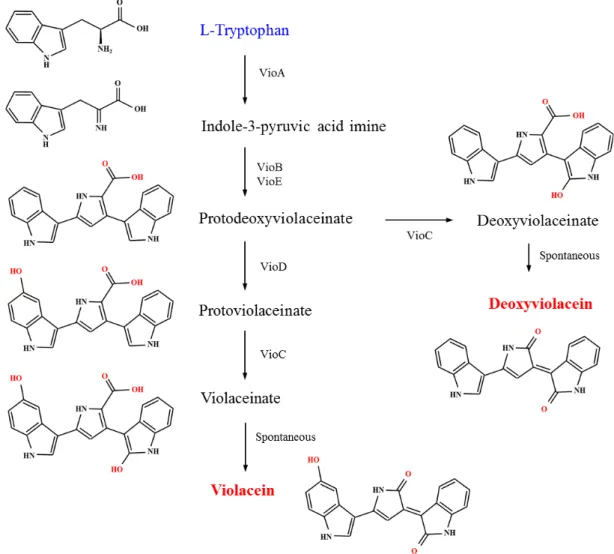
Fig. 6. Artificial biosynthetic pathways for the synthesis of violacein and deoxyviolacein. VioA, VioB, VioE, VioD, and VioC are tryptophan oxidase, iminophenyl-pyruvate dimer synthase, violacein biosynthesis enzyme, protodeoxyviolaceinate mono- oxygenase, and violacein synthase, respectively.
LB 배지에서 3 g/l IAA를 얻었다[31](Table 1). IAA의 생산량 을 더 올리기 위해 동일한 유전자를 C. glutamicum에 도입하여 L-트립토판을 함유한 배지에서 배양한 결과, flask에서는 2.3 g/l, 5-L 발효조에서는 7.3 g/l IAA가 생산되었다[19]. 최근 Guo 등은 L-트립토판을 첨가하지 않고 포도당에서 발효를 통 해 IAA를 생산하는 E. coli를 대사공학적으로 개발하였다[10].
7개의 aldehyde reductase 유전자가 결손된 RARE 균주에
trpR을 추가적으로 결손한 후, 플라스미드에 Saccharomyces cerevisiae 유래의 aminotransferase를 암호화하는 aro8 유전자와 decarboxylase를 암호화하는 kdc 유전자, E. coli 유래의 al- dehyde dehydrogenase를 암호화하는 aldH, trpABCD 유전자, 되먹임-내성 aroG, trpE, serA 유전자를 각각 발현하였다(Table 1). 최종적으로 개발된 균을 사용하여 변형된 M9 배지에서 플라스크 발효한 결과, 20 g/l의 포도당을 소비하여 744 mg/l IAA가 생산되었다.
바이오라세인과 데옥시바이오라세인 생산
바이오라세인(violacein)과 데옥시바이오라세인(deoxyvio- lacein)은 항 세균, 항 바이러스성, 항산화, 항암 활성을 갖는 bis-indole 계 색소로[4], Alteromonas luteoviolacea, Chromobac-
terium violaceum, Janthinobacterium lividum, Pseudoalteromonas luteoviolacea와 같은 세균에서 생산되는 2차 대사산물이다[30,34]. L-트립토판으로부터 vioABCDE 오페론에 의해 해독된 효 소들의 촉매반응을 통해 생합성된다(Fig. 6). 먼저 tryptophan oxidase (VioA)는 L-트립토판을 indole-3-pyruvic acid imine 으로 전환하며, iminophenyl-pyruvate dimer synthase (VioB) 와 violacein biosynthesis enzyme (VioE)에 의해 protodeoxy- violaceinate로 전환되며, protodeoxyviolaceinate monooxy- genase (VioD)와 violacein synthase (VioC)의 작용에 의해 vi- olacein이 만들어진다. Protodeoxyviolaceinate는 VioC의 촉매 에 의해 violacein 대신에 직접 deoxyviolacein으로 전환된다.
Rodrigues 등은 deoxyviolacein 생산경로의 유전자인 Chro-
mobacterium violaceum 유래의 vioABCE를 E. coli 염색체에 도
입하여 arabinose 유도조건에서 발현되는 dVio-1 균주를 제작 하여 평가한 결과 176 mg/l deoxyviolacein이 생산되는 것을 확인하였다[30]. 여기에 전구물질인 트립토판의 공급을 원활히 하기 위해 염색체내 trpR 결손, tnaA 결손, sdaA 결손, aroFBL 과발현, trpL 결손, 되먹임-내성 trpE 도입, tktA 과발현, 되먹임 -내성 serA가 도입된 dVio-6균주를 제작하였으며, 이를 생물배 양기에서 배양하여 324 mg/l deoxyviolacein이 생산되었다 (Table 1). 또한 violacein을 생산하는 균을 제작하기 위해
Janthinobacterium lividum 유래의 vioD를 추가적으로 염색체에도입된 Vio-4균주를 개발하여 생물배양기에서 유가식 배양한 결과 710 mg/l violacein이 축적되는 결과를 얻었다. Zhou 등 은 E. coli 염색체내에 trpR/tnaA/pheA 결손, 되먹임-내성
trpED/aroG/serA를 도입하여 0.45 g/l L-트립토판을 생산하는 균주를 개발한 후 vio operon 중 vioE가 제한-율속 단계임을 확인하고, viaABCDE 발현균주에 추가적으로 vioE를 과발현 후, 5-L 생물배양기에서 유가식 발효를 한 결과 48시간에 4.45 g/l violacein을 생산하며, 생산성은 98.7 mg/l/h를 보이는 결 과를 얻었다[40]. 한편, Sun 등은 GRAS 미생물이며, L-트립토 판을 생산하는 C. glutamicum을 이용하여 Ch. violaceum 유래 의 vioBAECD operon 형태로 발현을 최적화 및 유도 발현하 여, 3-L 생물배양기에서 유가식 배양하여 현재까지 가장 높은 수준인 5.436 g/l violacetin을 생산하는 기술을 개발하였다 [34].
결 론
5-히드록시트립토판, 세로토닌, 멜라토닌, 7-chloro-L-tryp- tophan, 7-bromo-L-tryptophan, 인디고, 인디루빈, 인돌-3-초 산, 바이오라세인 등은 기존에는 화학합성법, 식물추출법 등 으로 생산되는 방향족 화합물이다. 시스템 대사공학이 발달하 면서 L-트립토판 생합성 경로로부터 최종 생산물의 생합성에 관련된 유전자들을 E. coli 또는 C. glutamicum과 같은 미생물 에 도입하여 생물공학적으로 이들 화합물들을 생산할 수 미생 물이 개발되었으며, 상세한 유전적인 특징을 정리하였다. 향 후 관련 대사경로의 추가적인 유전자 조작과 재생 가능한 자 원을 탄소원으로 이용할 수 있는 균을 개발하면, 기존의 생산 공정과 비교하여 보다 더 경제적으로 효율적으로 생산할 수 있는 미생물과 생산공정을 개발할 수 있을 것으로 기대한다.
감사의 글
본 논문은 한국연구재단 이공분야기초연구사업(NRF-2018 R1D1A1B07047207) 및 부산광역시 2020년도 BB21
+사업의 지 원을 받아 수행되었습니다.
The Conflict of Interest Statement
The authors declare that they have no conflict of interest with the contents of this article.
References
1. Ameria, S. P. L., Jung, H. S., Kim, H. S., Han, S. S., Kim, H. S. and Lee, J. H. 2015. Characterization of a flavin-con- taining monooxygenase from Corynebacterium glutamicum and its application to production of indigo and indirubin.
Biotechnol. Lett. 37, 1637-1644.
2. Arnao, M. B. and Hernández-Ruiz, J. 2018. Melatonin and its relationship to plant hormones. Ann. Bot. 121, 195-207.
3. Byeon, Y. and Back, K. W. 2016. Melatonin production in Escherichia coli by dual expression of serotonin N-acetyl- transferase and caffeic acid O-methyltransferase. Appl. Micro- biol. Biotechnol. 100, 6683-6691.
4. Cao, M., Gao, M., Suásteguia, M., Mei, Y. and Shao, Z. 2020.
Building microbial factories for the production of aromatic amino acid pathway derivatives: From commodity chem- icals to plant-sourced natural products. Metab. Eng. 58, 94- 132.
5. Chen, Y., Liu, Y., Ding, D., Cong, L. and Zhang, D. 2018.
Rational design and analysis of an Escherichia coli strain for high-efficiency tryptophan production. J. Ind. Microbiol. Bio- technol. 45, 357-367.
6. Choi, H. S., Kim, J. K., Cho, E. H., Kim, Y. C., Kim, J. I.
and Kim, S. W. 2003. A novel flavin-containing mono- oxygenase from Methylophaga sp. strain SK1 and its indigo synthesis in Escherichia coli. Biochem. Biophys. Res. Commun.
306, 930-936.
7. Du, L., Zhang, Z., Xu, Q. and Chen, N. 2019. Central meta- bolic pathway modification to improve L-tryptophan pro- duction in Escherichia coli. Bioengineered 10, 59-70.
8. Du, J., Yang, D., Luo, Z. W. and Lee, S. Y. 2018. Metabolic engineering of Escherichia coli for the production of indir- ubin from glucose. J. Biotechnol. 267, 19-28.
9. Eisenbrand, G., Hippe, F., Jakobs, S. and Muehlbeyer, S.
2004. Molecular mechanisms of indirubin and its de- rivatives: novel anticancer molecules with their origin in tra- ditional Chinese phytomedicine. J. Cancer Res. Clin. Oncol.
130, 627-635.
10. Guo, D., Kong, S., Chu, X., Li, Xun. and Pan, H. 2019. De novo biosynthesis of indole-3-acetic acid in engineered Escherichia coli. J. Agric. Food Chem. 67, 8186-8190.
11. Hammer, P. E., Hill, D. S., Lam, S. T., Van Pée, K. H. and Ligon, J. M. 1997. Four genes from Pseudomonas fluorescens that encode the biosynthesis of pyrrolnitrin. Appl. Environ.
Microbiol. 63, 2147-2154.
12. Han, G. H., Gim, G. H., Kim, W., Seo, S. I. and Kim, S.
W. 2012. Enhanced indirubin production in recombinant Escherichia coli harboring a flavin-containing monooxyge- nase gene by cysteine supplementation. J. Biotechnol. 164, 179-187.
13. Hsu, T. M., Welner, D. H., Russ, Z. N., Cervantes, B., Prathuri, R. L., Adams, P. D. and Dueber, J. E. 2018. Employ- ing a biochemical protecting group for a sustainable indigo dyeing strategy. Nat. Chem. Biol. 14, 256-261.
14. Huccetogullari, D., Luo, Z. W. and Lee, S. Y. 2019. Metabolic engineering of microorganisms for production of aromatic compounds. Microb. Cell Fact. 18, 41.
15. Ikeda, M. and Takeno, S. 2020. Recent advances in amino acid production. In: Inui M., Toyoda K. (eds) Corynebacte- rium glutamicum. Microbiology Monographs, vol 23. pp. 175- 226, Springer, Cham, Switzerland.
16. Jung, H. S., Jung, H. B., Kim, H. S., Kim, C. G. and Lee, J. H. 2018. Protein engineering of flavin-containing mono- oxygenase from Corynebacterium glutamicum for improved production of indigo and indirubin. J. Life Sci. 28, 656-662.
17. Kang, M. S. and Lee, J. H. 2009. Cloning and expression of indole oxygenase gene derived from Rhodococcus sp.
RHA1. Kor. J. Microbiol. Biotechnol. 37, 197-203.
18. Kim, J., Lee, J., Lee, P. G., Kim, E. J., Kroutil, W. and Kim, B. G. 2019. Eluciding cysteine-assisted synthesis of indirubin by a flavin-containing monooxygenase. ACS Catal. 9, 9539- 9544.
19. Kim, Y. M., Kwak, M. H., Kim, H. S. and Lee, J. H. 2019.
Production of indole-3-acetate in Corynebacterium gluta- micum by heterologous expression of the indole-3-pyruvate pathway genes. Microbiol. Biotechnol. Lett. 47, 242-249.
20. Koguchi, Y., Kohno, J., Nishio, M., Takahashi, K., Okuda, T., Ohnuki, T. and Komatsubara, S. 2000. TMC-94A, B, C, and D, novel proteasome inhibitors produced by Apiospora montagnei Sacc. TC 1093. Taxonomy, production, isolation, and biological activities. J. Antibiot. 53, 105-109.
21. Kubota, T., Tanaka, Y., Takemoto, N., Watanabe, A., Hiraga, K., Inui, M. and Yukawa, H. 2014. Chorismate-dependent transcriptional regulation of quinate/shikimate utilization genes by LysR-type transcriptional regulator QsuR in Cor- ynebacterium glutamicum: carbon flow control at metabolic branch point. Mol. Microbiol. 92, 356-368.
22. Lee, J. H. 2009. Research trend about the development of white biotech-based aromatic compounds. Kor. J. Microbiol.
Biotechnol. 37, 306-315.
23. Lee, J. H. and Wendisch, V. F. 2017a. Biotechnological pro- duction of aromatic compounds of the extended shikimate pathway from renewable biomass. J. Biotechnol. 257, 211-221.
24. Lee, J. H. and Wendisch, V. F. 2017b. Production of amino acids-Genetic and metabolic engineering approaches. Bio- resour. Technol. 245, 1575-1587.
25. Lin, Y., Sun, X., Yuan, Q. and Yan, Y. 2014. Engineering bac- terial phenylalanine 4-hydroxylase for microbial synthesis of human neurotransmitter precursor 5-hydroxytryptophan.
ACS Synth. Biol. 3, 497-505.
26. McKinney, J., Knappskog, P. M., Pereira, J., Ekern, T., Toska, K., Kuitert, B. B., Levine, D., Gronenborn, A. M., Martinez, A. and Haavik, J. 2004. Expression and purification of hu- man tryptophan hydroxylase from Escherichia coli and Pichia pastoris. Protein Expr. Purif. 33, 185-194.
27. Mora-Villalobos, J. A. and Zeng, A. P. 2018. Synthetic path- way and processes for effective production of 5-hydroxy- tryptophan and serotonin from glucose in Escherichia coli.
J. Biol. Eng. 12, 3.
28. Nishizawa, T., Aldrich, C. C. and Sherman, A. D. 2005.
Molecular analysis of the rebeccamycin L-amino acid oxi- dase from Lechevalieria aerocolonigenes ATCC 39243. J. Bacter- iol. 187, 2084-2092.
29. Pawar, S., Chaudhari, A., Prabha, R., Shukla, R. and Singh, D. P. 2019. Microbial pyrrolnitrin: Natural metabolite with immense practical utility. Biomolecules 9, 443.
30. Rodrigues, A. L., Trachtmann, N., Becker, J., Lohanatha, A.
F., Blotenberg, J., Bolten, C. J., Korneli, C., de Souza Lima, A. O., Porto, L. M., Sprenger, G. A. and Wittmann, C. 2013.
Systems metabolic engineering of Escherichia coli for pro- duction of the antitumor drugs violacein and deoxyviola- cein. Metab. Eng. 20, 29-41.
31. Romasi, E. F. and Lee, J. H. 2013. Development of indole-3- acetic acid-producing Escherichia coli by functional expre- ssion of IpdC, AspC, and Iad1. J. Microbiol. Biotechnol. 23, 1726-1736.
32. Spaepen, S. and Vanderleyden, J. 2011. Auxin and plant-mi- crobe interactions. Cold Spring Harb. Perspect. Biol. 3, a001438.
33. Spaepen, S., Vanderleyden, J. and Remans, R. 2007. Indole- 3-acetic acid in microbial and microorganism-plant signal- ing. FEMS Microbiol. Rev. 31, 425-448.
34. Sun, H., Zhao, D., Xiong, B., Zhang, C. and Bi, C. 2016.
Engineering Corynebacterium glutamicum for violacein hyper production. Microb. Cell Fact. 15, 148.
35. van Pée, K. H. and Hölzer, M. 1999. Specific enzymatic chlorination of tryptophan and tryptophan derivatives. Adv.
Exp. Med. Biol. 467, 603-609.
36. Veldmann, K. H., Dachwitz, S., Risse, J. M., Lee, J. H., Sewald, N. and Wendisch, V. F. 2019. Bromination of L-tryptophan in a fermentative process with Corynebacterium glutamicum.
Front. Bioeng. Biotechnol. 7, 219.
37. Veldmann, K. H., Minges, H., Sewald, N., Lee, J. H. and Wendisch, V. F. 2019. Metabolic engineering of Corynebacte- rium glutamicum for the fermentative production of halo- genated tryptophan. J. Biotechnol. 291, 7-16.
38. Wang, H., Liu, W., Shi, F., Huang, L., Lian, J., Qu, L., Cai, J. and Xu, Z. 2018. Metabolic pathway engineering for high-level production of 5-hydroxytryptophan in Escherichia coli. Metab. Eng. 48, 279-287.
39. Zhou, N. Y., Al-Dulayymi, J., Baird, M. S. and Williams, P. A. 2002. Salicylate 5-hydroxylase from Ralstonia sp. strain U2: a monooxygenase with close relationships to and shared electron transport proteins with naphthalene dioxygenase.
J. Bacteriol. 184, 1547-1555.
40. Zhou, Y., Fang, M. Y., Li, G., Zhang, C. and Xing, X. H.
2018. Enhanced production of crude violacein from glucose in Escherichia coli by overexpression of rate-limiting key en- zyme(s) involved in violacein biosynthesis. Appl. Biochem.
Biotechnol. 186, 909-916.
초록:미생물을 이용한 L-트립토판 유래 방향족 화합물 생산 최근 연구
이지영․이진호*
(경성대학교 식품응용공학부 식품생명공학전공)