DOI:10.5229/JKES.2011.14.2.083
−
83
−Preparation of Porous TiO
2Thin Films by
Poly(vinyl chloride)- graft -poly(N-vinyl pyrrolidone) and Their Applications to Dye-sensitized Solar Cells
Seung Hyeon Yeon, Rajkumar Patel, Jong Kwan Koh, Sung Hoon Ahn, and Jong Hak Kim*
Department of Chemical and Biomolecular Engineering, Yonsei University, 262 Seongsanno, Seodaemun-gu, Seoul 120-749, South Korea
(Received March 10, 2011 : Accepted April 25, 2011)
Abstract :
Mesoporous titanium dioxide (TiO
2) thin films were prepared using poly(vinyl chlo- ride)- graft -poly(N-vinyl pyrrolidone) (PVC-g-PVP) as a templating agent via sol-gel process. Grafting of PVC chains from PVC backbone was done by atom transfer radical polymerization (ATRP) technique. The successful grafting of PVP to synthesize PVC-g-PVP was checked by fourier-trans- form infrared spectroscopy (FT-IR) and gel permeation chromatography (GPC). The carbonyl group interaction of PVC-g-PVP graft copolymer with TiO
2was confirmed by FT-IR. The porous morphologies of the TiO
2films genereated after calcination at 450
oC was characterized by X-ray diffraction (XRD) and scanning electron microscopy (SEM). The mesoporous TiO
2films with 580 nm in thickness were used as a photoelectrode for solid state dye sensitized solar cell (DSSC) and showed an energy conversion efficiency of 1.05% at 100 mW/cm
2.
Keywords :
Polymer electrolytes, Dye-sensitized solar cell, Graft copolymer, Titania (TiO
2), Sol-gel
1. Introduction
Polymer electrolytes are materials that consist of metal salts dissolved in a solid polymeric matrix containing polar groups such as ester, ether, amide linkages. The interaction between a metal salt and a polymer matrix directly determines the dissolution behavior of the metal salt and consequently the concentration of free ions, which are responsible for the ionic conductivity, mass transport properties, and nanostructural properties.
Polymer electrolytes have been utilized in various electrochemical devices such as lithium batteries,
1)electrochromic devices,
2)polymer electrolyte membrane fuel cells,
3,4)facilitated transport membranes,
5)and dye- sensitized solar cells (DSSC).
6,7)After O’Regan and Grazel invented a new type of solar cell in 1991,
8)DSSCs have been extensively studied due to relatively lower cost than silicon based solar cell and potential use of flexible panels. An energy conversion
efficiency of more than 11% has been achieved in DSSC using an organic liquid-based electrolytes containing triiodide/iodide, i.e. I
3−/I
−as a redox couple.
8)However, utilization of liquid electrolytes in DSSC is not practical for long-term operation due to problems associated with electrolyte leakage or evaporation. Thus, many research groups have been searching for alternatives to replace the liquid electrolytes, such as inorganic or organic hole cond- uctors,
9)ionic liquids,
10,11)gel electrolytes,
12,13)quasi- solid
14-16)or solid polymer electrolytes.
17-23)The porosity of TiO
2electrode is one of the most im- portant factor that determines the photoelectron transport and dye adsorption. The physical properties of TiO
2mainly depend on the morphology, type and size of its crystallites. There are several methods to prepare TiO
2nanoparticle such as hydrothermal process,
24)surfactant directed,
25)and sol-gel approaches.
26-30)Among them, sol- gel methods are usually used to prepare targeted material due to the easy control of their structural and morpho- logical behavior. Structure directing agents such as surfactants or amphiphilic block copolymer are often introduced to prepare well-defined porous thin films.
26-30)*E-mail: [email protected]
However, graft copolymer is more economical than block copolymer as well as the method of synthesis is simple.
In our previous paper, poly(vinylidene fluoride-
co-chloro trifluoroethylene)-
graft-poly(oxyethylene methacrylate) (P(VDF-
co-CTFE)-g-POEM)
31)and poly(vinyl chloride)-
graft
-poly(oxyethylene methacrylate) (PVC-g-POEM) were used as a structure directing agent to synthesize mesoporous TiO
2films.
31,32)In this study, poly(vinyl chloride)-
graft-poly(N-vinyl pyrrolidone) (PVC-g-PVP) graft copolymer was synthesi- zed by using atom transfer radical polymerization (ATRP) technique. It is because PVP is a hydrophilic polymer that can coordinate to TiO
2precusor while PVC is a hydrophobic polymer, which would provide good phase-separated morphology. The graft copolymer was characterized by FT-IR, NMR and the self assembly behaviour was analyzed by transmission electron micros- copy (TEM). This graft copolymer solution was mixed with titania isopropoxide (TTIP) sol-gel precursour to form in situ TiO
2thin films, followed by calcination at high temperature. The thin films were characterized by scanning electron microscope (SEM) and X-ray diffrac- tion (XRD) analysis. Finally, the porous thin TiO
2films were used as a photoelectrode for quasi-solid-state dye- sensitized solar cell (DSSC) fabrication.
2. Experimental
2.1. Materials
Fumed silica nanoparticles (SiO
2, 14 nm), poly(ethy- lene glycol dimethyl ether) (PEGDME, M
n= 500 g/
mol), iodine (I
2), titanium (IV) bis(ethyl acetoacetato) diisopropoxide, chloroplatinic acid hexahydrate (H
2PtCl
6), titanium (IV) isopropoxide (TTIP, 97%), hydrogen chloride solution (HCl, 35 wt%), and sodium hydroxide solution (NaOH, 0.1 N) were purchased from Aldrich. Distilled water was obtained with a water purification system made by Millipore Corporation. 1- Methyl-3-propyl imidazolium iodide (MPII) and ruthenium dye (535-bisTBA, N719) were purchased from Solaronix, Switzerland. Acetonitrile, butanol, 2- propanol, chloroform, and ethanol were purchased from J.T. Baker. Fluorine-doped tin oxide (FTO) conducting glass substrate (TEC8, 8 ohms/sq, 2.3 mm thick) was purchased from Pilkington, France. Poly(vinyl chloride) PVC, Mw~ 97,000g/mol, Mn~ 55,000g/mol, PDI 1.76), N-vinyl pyrrolidone(VP,
≥99%), 1,1,4,7,10,10-
hexamethyltriethylene tetramine (HMTETA, 99%), and copper(I) chloride (CuCl, 99%), are procured form Aldrich. 1-methyl-3-propylimidazolium iodide (MPII), lithium iodide (LiI), were purchased from Aldrich chemicals and used as received without further puri- fication.
2.2. Synthesis of PVC-g-PVP
Six grams of PVC and 18 g of VP were dissolved in 50 mL of NMP together in a round bottom flask.
0.1 g CuCl catalyst and 0.23 mL of HEMTA ligand was added to the round bottom flask. The whole system was deoxygenated by purging of nitrogen into the system for half an hour. Then the temperature was raised to 90
oC with stirring and the reaction continued for 18 h. The resultant product was diluted with THF and passed through activated Al
2O
3column to remove catalyst and then precipitated in methanol. The product was purified by dissolving in THF and reprecipitated in methanol. The product was dried in vacuum oven at 50
oC overnight. PVC-g-PVP with 64:36 wt ratio were obtained.
2.3. Preparation of photoelectrodes
Transparent glass, coated with conductive FTO, was
used for the photoelectrode. The neat glass was
cleaned by sonication in isopropanol and then in
chloroform. The clean conducting surface of the FTO
glass was blocked by a layer of titanium (IV) bis
(ethyl acetoacetato) diisopropoxide using spin coating,
followed by heating to 450
oC for 2 h, holding for 30
min, and cooling to 30
oC for 4 h. 0.05 mL of HCl
(37%) was added slowly to 0.3 mL TTIP solution in
THF under vigorous stirring. In another vial, PVC-g-
PVP graft copolymer was prepared in 1wt% THF and
added to the TTIP/HCl/THF solution slowly to make
a clear sol-gel solution. The solution was aged by
stirring at ambient temperature for at least 3 h. The
film was casted on a FTO glass with blocking layer at
2000 rpm for 30 sec. The organic compounds were
completely removed via sintering by heating to 450
oC
for 4 h, holding at 450
oC for 30 min and cooling to
30
oC for 8 h. The nanocrystalline TiO
2layers were
then sensitized with a 10
−4mol dm
−3alcoholic ruthe-
nium solution at 50
oC for 2 h in darkness. Finally, the
dye-sensitized photoelectrodes were rinsed with absolute
ethanol and dried in a vacuum oven.
2.4. Preparation of counter electrode
Transparent glasses coated with a conductive FTO were used for counter electrodes. These glasses were cleaned by sonication in isopropanol and then in chloroform. The counter electrodes were prepared by spin coating 4 wt% H
2PtCl
6propanol solution onto the conductive FTO glass and sintering at 450
oC for 2 h, holding for 30 min, and cooling to 30
oC over 8 h.
2.5. Preparation of polymer electrolytes A polymer electrolyte solution was prepared by dissolving fumed silica nanoparticles (SiO
2), PEGDME, MPII, and I
2in acetonitrile. The mole ratio of ether oxygen to iodide salt was fixed at 20, and the iodine content was fixed at 10 wt% with respect to the salt.
33)After casting polymer electrolyte solution onto photo- electrode, the solvent was evaporated very slowly to allow penetration of the electrolytes through the mesopores of TiO
2layer. Both electrodes were then superposed together and pressed between two glass plates in order to achieve a thin electrolyte layer. The cells were placed in a vacuum oven for 1 day for complete evaporation of the solvent.
2.6. Fabrication of DSSC
DSSCs with an active area of 0.24 cm
2were con- structed by drop-casting of electrolyte solution onto the photoelectrode and covering with the counter electrode, according to the following procedure.
31-34)The cells were placed in a vacuum oven for a day to permit complete evaporation of solvent and were then sealed with an epoxy resin. Photoelectrochemical performance characteristics, including short-circuit current (
Jsc, mA/
cm
2), open-circuit voltage (
Voc, V), fill factor (
ff), and overall energy conversion efficiency (
η) were measured using a Keithley Model 2400 and a 1000 W xenon lamp (Oriel, 91193). The light was homogeneous over an 8
×8 in
2area, and its intensity was calibrated with a Si solar cell (Fraunhofer Institute for Solar Energy System, Mono- Si+KG filter, Certificate No. C-ISE269) for a sun light intensity of 1 (100 mW/cm
2). This cali- bration was double-checked with a NREL-calibrated Si solar cell (PV Measurements Inc.).
2.7. Dye adsorption amount
The N719 dye-sensitized TiO
2photoelectrodes were dipped into 10 mL of 0.01 M aqueous ethanolic (1:1)
alkaline solution of NaOH. The mixtures were stirred until complete desorption of the N719 dye. The volume of the alkali solution containing the fully desorbed dye was carefully measured by UV-visible spectroscopy (Hewlett–Packard, Hayward, CF) at 515 nm. The adsorbed dye was calculated according to the Beer-Lambert law.
2.8. Characterization
FT-IR measurements were performed on Perkin Elmer spectrum 100, between frequency 4000-600 cm
−1using an ATR. The XRD experiment was performed on a Rigaku 18 kW rotating anode X-ray generator with Cu-Ka radiation operated at 40 kV and 300 mA.
UV-visible spectroscopy was measured with a spec- trophotometer (Hewlett Packard) in the range of 200 to 800 nm. TEM images were obtained from JEM 1010 which was made by JEOL. For getting TEM images, the polymer was dissolved in THF with 0.3 wt%
concentration, and then cast a drop of solution on the copper grid. Morphological characterization for mesoporous TiO
2thin films was carried out using a field-emission scanning electron microscope (FE-SEM, S-4700, Hitachi).
3. Results and discussion
The PVC-g-PVP amphiphilic graft copolymer having hydrophobic PVC main chain and hydrophilic PVP side chain was synthesized by ATRP, as shown in Scheme 1. This technique has been used to prepare a graft copolymer having well defined structures.
35,36)Scheme 1. ATRP synthesis of PVC-g-PVP graft copolymer.
GPC traces for pristine PVC and PVC-g-PVP graft copolymer are presented in Fig. 1. The grafting of PVP from PVC backbone led to distribution shifted up in molecular weight relative to the PVC: number- average molecular weight (M
n) increased from 6.6
×10
4to 7.8
×10
4g/mol whereas weight-average molecular weight (M
w) increased from 1.6
×10
5to 2.2
×10
5g/
mol. Accordingly, polydispersity index (PDI) value increased from 2.4 to 2.8. The molecular weight distribution for PVC-g-PVP graft copolymer was monomodal, indicating no evidence of homopolymer contamination or coupling reactions. Fig. 2 shows the FT-IR spectra of pristine PVC, PVC-g-PVP graft copolymer and PVC-g-PVP/TTIP film before calicina- tion. The sharp peak at 1678 cm
−1in PVC-g-PVP is
assigned to the stretching vibration of carbonyl (-C=O) group in PVP, indicating the successful grafting of PVP from PVC backbone.
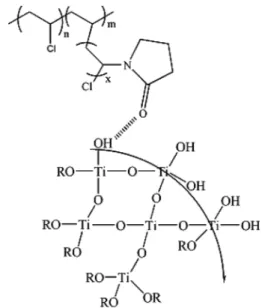
Scheme 2 shows the hydrogen bonding interaction between the PVP of the PVC-g-PVP graft copolymer and TiO
2nanoparticles formed from TTIP in the sol- gel solution. The interaction of PVP hydrophilic part of the amphiphilic graft copolymer without any surfactant addition leads to the selective affinity between the TTIP and the PVP chains of PVC-g-PVP graft copolymer.
37,38)This selective interaction may result in specific morphology formation in PVC-g-PVP/TTIP film. The hydrogen bonding interaction between the hydroxyl group of titania and the carbonyl group of the PVP chains was investigated, as seen in Fig. 2.
The presence of broad peak at 3119 cm
−1in PVC-g- PVP/TTIP film is due to the stretching vibration of Ti- OH groups. The hydroxyl group results from the incomplete polycondensation reaction of TTIP. The hydrogen bonding interaction between the carbonyl group of PVP chains and the hydroxyl group result in lowering of stretching vibration mode of carbonyl (-C
=O) group in PVC-g-PVP from 1678 cm
−1to 1618 cm
−1. This indicates the presence of hydrogen bonding interaction between the hydroxyl group present in uncondensed TTIP and the carbonyl group of the PVP moiety.
39)Fig. 1. GPC traces of pristine PVC and PVC-g-PVP graft copolymer.
Fig. 2. FT-IR spectra of pristine PVC, PVC-g-PVP graft copolymer and PVC-g-PVP/TTIP film before calicination.
Scheme 2. Interaction between PVC-g-PVP graft copolymer
and TTIP sol-gel solution.
XRD analysis was performed to investigate the structural pattern of pristine PVC, PVC-g-PVP graft copolymer and crystallized mesoporous TiO
2thin film templated by PVC-g-PVP, as seen in Fig. 3. Pristine PVC exhibited some weak peaks at 18
o, 25
oand 40
o, indicating its amorphous state. Upon grafting of PVP from PVC backbone, two peaks at 18
oand 25
ogradually merged to a single broad peak centered at 19
o, demonstrating more structureless morphology of the graft copolymer. The mesoporous TiO
2thin film showed several crystalline sharp peaks at 25.3
o, 48.2
oand 54.5
o(2
θ) value which are assigned to (101), (200), and (211) planes, respectively, of the anatase TiO
2phase.
40,41)The rest of the peak arises from FTO glass. This result demonstrates that the structural changes and phase transformation of TiO
2to crys- talline anatase occur around 450
oC. By using Scherrer equation,
42)the crystallite size of the TiO
2film templated by PVC-g-PVP graft copolymer was determined from the diffraction peak broadening:
D = K
λ/
βcos
θ, where D is the crystallite size of the particles,
λis the X-ray wavelength,
βis the full width at half maximum (FWHM) of the (101) crystalline peak, K = 0.9 is a coefficient, and
θis the diffraction angle. The average crystallite size of the mesoporous TiO
2thin film was calculated to be about 20 nm.
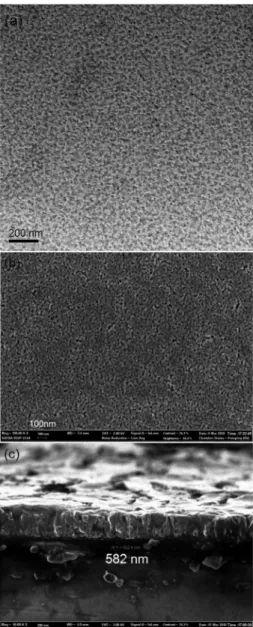
TEM and SEM analysis were performed to char- acterize microphase-separated morphology of graft copolymer and porous structures of TiO
2thin film, as shown in Fig. 4. Unstained TEM sample provided a
clear image contrast due to large difference of electron densities between the PVC backbone and the PVP side chains. Dark area shows the hydrophobic domains of PVC backbone whereas bright region represents the hydrophilic PVP side chains. The PVC-g-PVP graft copolymer showed microphase-separated morphology which molecularly self-assembled into the continuous nanophase domains of PVC interweaved with the hydrophilic domains of PVP (Fig. 4a). Fig. 4b shows
Fig. 3. XRD patterns of pristine PVC, PVC-g-PVP graft copolymer and PVC-g-PVP/TTIP film after calicination 450
oC.
Fig. 4. (a) TEM image of PVC-g-PVP graft copolymer and SEM images of (b) surface and (c) cross-section of
TiO2film templated by PVC-g-PVP graft copolymer.
the SEM image of mesoporous TiO
2thin film templated by PVC-g-PVP graft copolymer which involves a sol- gel process based on the hydrolysis and condensation of TTIP. The cylindrical worm-like micelles formed around PVC chains were burned out under calcination to form the worm-like pores of 30-40 nm in diameter. The TiO
2film was 582 nm in thickness, as characterized by cross- sectional SEM image (Fig. 4c).
There are some advantages of quasi-solid-state DSSC than liquid based one due to flexibility, lightness and long term stability. Thus, quasi-solid-state polymer electrolyte was employed to make solar cell and the cell performance was measured using linear sweep voltammetry, as represented in Fig. 5. The polymer electrolyte consisting of PEODME, fumed nanosized silica (SiO
2), ionic liquid (MPII) and I
2was used to due to its higher conductivity and higher energy conversion efficiency.
33)The DSSC performances such as Jsc, FF and efficiency were summarized in Table 1.
The DSSC fabricated using 582 nm-thick mesoporous TiO
2film and PEODME/SiO
2/MPII/I
2polymer electrolyte exhibited cell performance with J
scof 2.87 mA/cm
2, V
ocof 0.75 V, FF of 49% and overall con- version efficiency of 1.05%. The dye adsorption value was also measured using UV-visible spectroscopy.
Dye adsorption onto mesoporous TiO
2film was deter- mined to be 26.35 nmol/cm
2, which was 0.031 mg/cm
2.
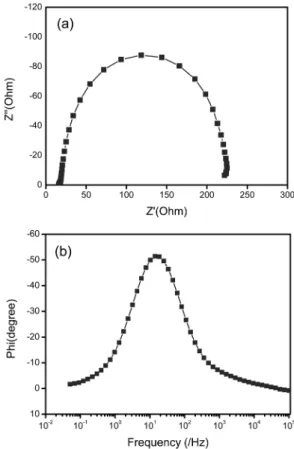
EIS is very powerful technique to define recombi- nation life time and resistive elements on the photo- voltaic performance. Nyquist plot was used to investi- gate resistance relation for charge transfer process at the Pt counter electrode, resistance for TiO
2/electrolyte interface and Nernst diffusion in the electrolyte. The Nyquist plot of DSSC with AC amplitude of 0.02 V and light intensity of 100 mW/cm
2is presented in Fig.
6a. In general, the impedance spectra can be interpreted and modeled using equivalent circuits. Each equivalent
Fig. 6. EIS data of DSSC fabricated using TiO
2film templated by PVC-g-PVP graft copolymer and PEGDME/
SiO
2/MPII/I
2polymer electrolyte at 100 mW/cm
2; (a) Nyquist plot and (b) Bode plot.
Fig. 5. J-V curve of DSSC fabricated using TiO
2film templated by PVC-g-PVP graft copolymer and PEGDME/
SiO
2/MPII/I
2polymer electrolyte at 100 mW/cm
2.
Table 1. Cell performance of DSSC fabricated using TiO
2film templated by PVC-g-PVP graft copolymer and PEGDME/
SiO
2/MPII/I
2polymer electrolyte at 100 mW/cm
2.
V
oc(V) J
sc(mA/cm
2) FF Efficiency (%) Dye adsorption (nmol/cm
2) Dye adsorption (mg/cm
2)
0.75 2.87 0.49 1.05 26.35 0.031
circuit consists of several components: ohmic resistance (R
s), charge transfer resistance at counter electrode/elec- trolyte (R
1), charge transfer resistance at photoelectrode/
electrolyte (R
2), resistance at the Warburg diffusion of redox I
−/I
3−couple in electrolyte (W
s). However, the sample had two semi-circles, in the high frequency region and low frequency region. The semi-circle for Nernst diffusion and resistance for TiO
2/electrolyte interface was overlapped because our TiO
2layer is very thin (< 600 nm) and polymer electrolyte has higher resistance than liquid electrolyte. The characteristic frequency peak (10
−2-10
6Hz) in the Bode phase plot is shown in Fig. 6b. The characteristic frequency is related to the inverse of the recombination lifetime (
τr) or electron lifetime (
τe), in the TiO
2film.
43,44)Electron lifetime of DSSC fabricated using mesoporous TiO
2film and PEODME/SiO
2/MPII/I
2polymer electrolyte was found to be 11.45 ms.
4. Conclusion
PVC-g-PVP graft copolymer was synthesized by ATRP method by using the labile chloride group as the initiating site. The synthesis of graft copolymer was characterized by FT-IR, GPC and TEM analysis. The PVC-g-PVP graft copolymer was used as a template to synthesize in situ mesoporous TiO
2thin film, which was characterized by XRD and SEM. The resultant TiO
2porous films were efficiently used as a photoelectrode for fabricating quasi-solid-state DSSC and the maximum energy conversion efficiency of 1.05% at 100 mW/cm
2by using PEODME, fumed nanosized silica, MPII/I
2as a polymer electrolyte.
Acknowledgements
This work was supported by the Human Resources Development of the Korea Institute of Energy Technology Evaluation and Planning (KETEP) grant funded by the Korea government Ministry of Knowledge Economy
(No. 20104010100500) and by the Low Observable Technology Research Center program of Defense Acquisition Program Administration and Agency for Defense Development. This work was also supported by the Ministry of Knowledge Economy (MKE) and Korea Institute for Advancement in Technology (KIAT) through the Workforce Development Program in Strategic Technology.
References
1. N. Yoshimoto, O. Shimamura, T. Nishimura, M. Egashira, M. Nichioka, and M. Morita,
‘A novel polymeric electrolyte based on a copolymer containing self-assembled stearylate moiety for lithium-ion batteries
’Electrochem. Commun.,
11, 481 (2009).
2. J. Lee, Y. Kim, and E. Kim,
‘Electrochromic Property of a Conductive Polymer Film Fabricated with Vapor Phase Polymerization
’Membrane Journal ,
20, 8 (2010) 3. B. L. Langsdorf, J. Sultan, and P. G. Pickup,
‘Partitioning
and polymerization of pyrrole into perfluorosulfonate (Nafion) membranes under neutral conditions
’J. Phys.
Chem. B ,
107, 8412 (2003).
4. E.-M. Jung, Y.-W. Rhee, D.-H. Peck, B.-R. Lee, S.-K. Kim, and D.-H. Jung,
‘Reduction of methanol crossover in a direct methanol fuel cell by using the Pt-coated electrolyte membrane
’J. Electrochem. Soc.
11, 1 (2008).
5. J. H. Kim, B. R. Min, J. Won, S. H. Joo, H. S. Kim, and Y. S. Kang,
‘Role of polymer matrix in polymer/silver complexes for structure, interactions, and facilitated olefin transport
’Macromolecules,
36, 6183 (2003).
6. T. Stergiopoulos, I. M. Arabatzis, G. Katsaros, and P. Falaras,
‘
Binary polyethylene oxide/titania quasi-solid-state redox electrolyte for highly efficient nanocrystalline TiO
2photoelectrochemical cells
’Nano Lett.,
2, 1259 (2002).
7. J.-K. Lee and J.-J. Lee,
‘Perspective of hybridization technology for next-generation solar cells
’J. Electrochem.
Soc.
13, 1 (2010).
8. B. O
’Reagan and M. Grätzel,
‘A low-cost, high-efficiency solar cell based on dye-sensitized colloidal TiO
2films
’Nature ,
353, 737 (1991).
9. J.E. Kroeze, N. Hirata, L. Schmidt-Mende, C. Orizu, S.D.
Ogier, K. Carr, M. Gratzel, and J.R. Durrant,
‘Parameters Influencing Charge Separation in Quasi-solid-state Dye- Sensitized Solar Cells Using Novel Hole Conductors
’Adv. Fucnt. Mater.,
16, 1832 (2006).
10. M. Wang, X. Xiao, X. Zhou, X. Li, and Y. Lin,
‘Investi- gation of PEO-imidazole ionic liquid oligomer electrolytes for dye-sensitized solar cells
’Sol. Energy Mater. Sol.
Cells ,
91, 785 (2007).
11. N. Yamanaka, R. Kawano,W. Kubo, N. Masaki, T. Kita- mura, Y. Wada, M. Watanabe, and S. Yanagida,
‘Dye-Sen- sitized TiO
2Solar Cells Using Imidazolium-Type Ionic Liquid Crystal Systems as Effective Electrolytes
’J. Phys.
Table 2. EIS results of DSSC fabricated using TiO
2film templated by PVC-g-PVP graft copolymer and PEGDME/
SiO
2/MPII/I
2polymer electrolyte at 100 mW/cm
2. Characteristic
frequency (Hz) Electron lifetime
(ms) R
1(
Ω) R
2(
Ω)
13.9 11.45 4 200
Chem. B ,
111, 4763 (2007).
12. P. Wang, S. M. Zakeeruddin, J. E. Moser, M. K. Nazeeruddin, T. Sekiguchi, and M. Grätzel,
‘A stable quasi-quasi-solid- state dye-sensitized solar cell with an amphiphilic ruthenium sensitizer and polymer gel electrolyte
’Nature Mater .,
2, 402 (2003).
13. W. Kubo, K. Murakoshi, T. Kitamura, S. Yoshida, M.
Haruki, K. Hanabusa, H. Shirai, Y. Wada, and S. Yanagida,
‘
Quasi-quasi-solid-state dye-sensitized TiO
2solar cells:
effective charge transport in mesoporous space filled with gel electrolytes containing iodide and iodine
’J. Phys.
Chem. B ,
105, 12809 (2001).
14. G. D. Sharma, P. Suresh, M. S. Roy, and J. A.
Mikroyannidis,
‘Effect of surface modification of TiO
2on the photovoltaic performance of the quasi solid state dye sensitized solar cells using a benzothiadiazole-based dye
’J. Power Sources ,
195, 3011 (2010).
15. J. A. Mikroyannidis, M. M. Stylianakis, M.S. Roy, P.
Suresh, and G. D. Sharma,
‘Synthesis, photophysics of two new perylene bisimides and their photovoltaic perfor- mances in quasi solid state dye sensitized solar cells
’J.
Power Sources ,
194, 1171 (2009).
16. M. Li, S. Feng, S. Fang, X. Xiao, X. Li, X. Zhou, and Y.
Lin,
‘The use of poly(vinylpyridine-co-acrylonitrile) in polymer electrolytes for quasi-solid dye-sensitized solar cells
’Electrochim. Acta ,
52, 4858 (2007).
17. J. N. Freitas, A. S. Gonçalves, M. A. Paoli, J. R. Durrant, and A. F. Nogueira,
‘The role of gel electrolyte composition in the kinetics and performance of dye-sensitized solar cells
’Electrochim. Acta ,
53, 7166 (2008).
18. I. C. Flores, J. N. Freitas, C. Longo, M. A. Paoli, H.
Winnischofer, and A. F. Nogueira,
‘Dye-sensitized solar cells based on TiO
2nanotubes and a quasi-solid-state electrolyte
’J. Photochem. Photobio. A: Chem.
189, 153 (2007).
19. J. E. Benedetti, M. A. Paoli, and A. F. Nogueira,
‘
Enhancement of photocurrent generation and open circuit voltage in dye-sensitized solar cells using Li+
trapping species in the gel electrolyte
’Chem. Commun .,
9
, 1121 (2008).
20. J. K. Koh, J. H. Koh, S. H. Ahn, J. H. Kim, and Y. S. Kang,
‘
Quasi-solid-state dye-sensitized solar cells employing one-pot synthesized supramolecular electrolytes with multiple hydrogen bonding
’Electrochim. Acta ,
55, 2567 (2010).
21. J. H. Koh, J. K. Koh, N. G. Park, and J. H. Kim,
‘Azide- induced crosslinking of electrolytes and its application in quasi-solid-state dye-sensitized solar cells
’Sol. Energy Mater. Sol. Cells,
94, 436 (2010).
22. D. H. Cho, Y. Y. Jung, M. H. Yun, S. Y. Kwon, and J. K.
Koo,
‘Effect of plasticizer on electrolyte membranes for dye sensitized solar cells
’Membrane Journal ,
20, 13 (2010).
23. T. Kang, C. H. Shin, M.-J. Choi, J. K. Koo, and N. Cho,
‘
A study on the ionic conducting characteristics of electrolyte membranes containing KI and I2 for dye sensitized solar cell
’Membrane Journal ,
20, 21 (2010).
24. Y. Kotani, T. Matoda, A. Matsuda, T. Kogure, M.
Tatsumisago, and T. Minami,
‘Anatase nanocrystal- dispersed thin films via sol-gel process with hot water treatment: effects of poly(ethylene glycol) addition on photocatalytic activities of the films
’J. Mater. Chem .
11, 2045 (2001).
25. P. D. Yang, D. Y. Zhao, D. I. Margolese, B. F. Chmelka, and G. D. Stucky,
‘Block copolymer templating syntheses of mesoporous metal oxides with large ordering lengths and semicrystalline framework
’Chem. Mater .,
11, 2813 (1999).
26. H. C. Kim, X. Jia, C. M. Stafford, D. H. Kim, T. J.
McCarthy, M. Tuominen, C. J. Hawker, and T. P. Russell,
‘
A route to nanoscopic SiO
2posts via block copolymer templates
’Adv. Mater. ,
13, 795 (2001).
27. A. M. Urbas, M. Maldovan, P. DeRege, and E. L. Thomas,
‘
Bicontinuous cubic block copolymer photonic crystals
’Adv. Mater .,
14, 1850 (2002).
28. S. W. Yeh, K. H. Wei, Y. S. Sun, U. S. Jeng, and K. S.
Liang,
‘Morphological transformation of PS- b -PEO diblock copolymer by selectively dispersed colloidal CdS quantum dots
’Macromolecules ,
36, 7903 (2003).
29. A. W. Fahmi, H. G. Braun, and M. Stamm,
‘Fabrication of metallized nanowires from self-assembled diblock copolymer templates
’Adv. Mater .,
15, 1201 (2003).
30. C. Liang, K. Hong, G. A. Guiochon, J. W. Mays, and S. Dai,
‘
Synthesis of a large-scale highly ordered porous carbon film by self-assembly of block copolymers
’Angew. Chem.
Int. Ed .,
43, 5785 (2004)
31. S. H. Ahn, J. H. Koh, and J. A. S. J. H. Kim,
‘Structure control of organized mesoporous TiO
2films templated by graft copolymers for dye-sensitized solar cells
’Chem.
Commun .,
46, 1935 (2010).
32. S. H. Ahn, H. Jeon, K. J. Son, H. Ahn, W. G. Koh, D. Y.
Ryu, and J. H. Kim,
‘Efficiency improvement of dye- sensitized solar cells using graft copolymer-templated mesoporous TiO
2films as an interfacial layer
’J. Mater.
Chem. ,
21, 1772 (2011).
33. J. T. Park, D. K. Roh, R. Patel, E. Kim, D. Y. Ryu, and J. H. Kim,
‘Preparation of TiO
2spheres with hierarchical pores via grafting polymerization and sol-gel process for dye-sensitized solar cells
’J. Mater. Chem .,
20, 8521 (2010).
34. D. K. Roh, J. T. Park, S. H.Ahn, D. Y. Ryu, and J. H. Kim,
‘
Amphiphilic poly(vinyl chloride)-g-poly(oxyethylene meth- acrylate) graft polymer electrolytes: Interactions, nanostruc- tures and applications to dye-sensitized solar cells
’Electrochem. Acta ,
55, 4976 (2010).
35. K. J. Lee, J. T. Park, J. H. Goh, and J. H. Kim,
‘Synthesis of amphiphilic graft copolymer brush and its use as template film for the preparation of silver nanoparticles
’J. Polym. Sci. A: Polym. Chem .,
46, 3911 (2008).
36. J. K. Koh, J. A. Seo, J. H. Koh, and J. H. Kim,
‘Templated synthesis of Ag loaded TiO
2nanostructures using amphi- philic polyelectrolyte
’Mater. Lett .,
63, 1360 (2009).
37. G. Martinez, M. A. Gomez, R. Gomez, and J. L. Segura,
‘