http://dx.doi.org/10.5229/JKES.2011.14.3.157
−
157
−리튬 이차전지의 흑연 음극에 형성된 표면피막의 열적 안정성
정순기*·이하나·김양수
†,*
순천향대학교 나노화학공학과, †한국기초과학지원연구원 순천센터 (2011년 8월 22일 접수 : 2011년 8월 25일 채택)
Thermal Stability of Surface Film Formed on a Graphite Negative Electrode in Lithium Secondary Batteries
Soon-Ki Jeong*, Ha-Na Lee, and Yang Soo Kim
†,*
Department of Chemical Engineering, Soonchunhyang University, Asan, Chungnam 336-745, Republic of Korea
†
Suncheon Center, Korea Basic Science Institute, 413, Jungangno, Suncheon 540-742, Republic of Korea
(Received August 22, 2011 : Accepted August 25, 2011)
초 록
투과형 전자 현미경과 전기화학 임피던스 분광법을 이용하여 리튬 이차전지의 흑연 음극에 생성 되는 표면피막의 고온 안정성을 고찰하였다. 투과형 전자 현미경을 이용한 분석에 의해 60oC에 서 저장되는 동안 표면피막의 일부가 전해질 용액 중에 용해되는 것이 확인되었으며, 이 과정에 서 피막의 두께 감소 및 피막의 형상이 다공성 구조로 변하였다. 한편, 이 과정에서 피막의 조 성 변화에 기인하는 것으로 추측되는 표면피막의 저항 증가가 전기화학 임피던스 분광법에 의하 여 확인되었다. 표면피막의 고온 안정성은 vinylene carbonate, 1,3-propane sultone, etylene sulfite와 같은 첨가제에 의해 제한적으로 개선되었다.
Abstract :
The stability at elevated temperatures of a surface film formed on a graphite elec- trode in lithium secondary batteries was investigated by transmission electron microscopy (TEM) and electrochemical AC impedance spectroscopy (EIS). TEM analysis revealed that the surface film partly dissolved in the electrolyte solution during storage at 60
oC, resulting in a decrease in the thickness of the surface film and a change in its morphology to a porous struc- ture. On the other hand, an increase in the impedance of the surface film which is attributable to a change in composition of the surface film was confirmed by EIS analysis during the stor- age at 60
oC. It was also shown that the addition of vinylene carbonate or 1,3-propane sultone or etylene sulfite, even if limited, improves the stability of the surface film at elevated tem- peratures.
Keywords :
Litihium secondary battery, Graphite negative electrode, Thermal stability, Surface film, TEM, EIS
1. 서 론
흑연은 에너지밀도가 큰 재료는 아니지만, 리튬의 산화
및 환원반응에 대한 가역성이 높고 사이클 특성 또한 매우 우수하기 때문에 리튬 이차전지의 음극 재료로써 폭넓게 사용되고 있다. 흑연 표면에서 진행되는 리튬 이온의 삽입(환원) 및 탈리(산화) 반응은 매우 낮은 전위 영역(0.0~0.25 V vs. Li/Li+)에서 진행되기 때문에1-4) 전극
*E-mail: [email protected](Soon-Ki Jeong)
[email protected](Yang Soo Kim)
반응에수반되어전해질이분해되면서흑연표면에피막 이형성된다
.
5)이피막은SEI(Solid Electrolyte Interface
또는
Solid Electrolyte Interphase)
라고 불리며,
6,7) 리튬 이온이흑연에삽입되기에앞서비가역적인 전해질의 분해에의해전극표면에형성되는데,
리튬이온을통 과시키는성질은가지고있으나전자의이동은차단시 키는성질을가지고있다.
따라서일단피막이형성되면 전극과 전해질 사이에서의 전자 이동에의한 전해질 분해가억제되고선택적으로리튬이온의삽입과탈리만 가능하게된다.
이처럼표면피막은비가역용량의직접적원인이되고있지만
,
한편으로는전해질이계속하여분해 되지않도록하는보호막으로서의역할또한감당하고 있어 리튬이차전지에 있어서매우 중요한요소이다.
이와같은흑연의표면피막은고분자를함유하는유
기물과무기물의혼합물로 이루어져있고
,
8-16)전지외부로부터도입되는열에의해그성질이변하는것으로
보고되어있다
.
17,18)이렇게피막의성질이변하게되면앞서설명한피막의기능이저하되게되어
,
결과적으로는전지의열화를가져오게된다
.
따라서흑연을음극재료 로서사용하는리튬이차전지의열화를억제하기위한 한가지방법으로,
흑연표면피막의 열적안정성을확보하는것은매우중요하다
.
이를위해서는표면피막의 물리화학적성질이열에의해어떻게변하는지를이해 하는것이매우중요하다할수있는데,
이와관련하여 지금까지 매우한정된 연구가이루어져있다.
따라서본연구에서는흑연표면피막의열안정성에초점을맞
추어
, 25~80
oC
의온도영역에서 열에의해흑연표면피막의형상및저항이어떻게변하는지를고찰하였다
.
2. 실 험
음극 재료로는 천연흑연
(The Kansai Coke and
Chemicals Co., NG-7)
분말을 사용하였다.
순환전위주사법
(Cyclic Voltammetry, CV)
에의해흑연표면에 피막을생성시킨후,
투과형전자현미경(Transmission Electron Microscopy, TEM, Hitachi, H-800)
을 이용 하여피막의형상을관찰하였고,
전기화학교류임피던스분광법
(Electrochemical AC Impedance Spectroscopy, EIS, Radiometer, Voltalab 402)
에의해 피막의 저항을 측정하였다. TEM
측정에는구리재질의마이크로그 리드위에흑연분말을코팅한전극을사용하였다.
흑연분말을코팅하기위해
poly(vinylidene difluoride)(PVDF)
바인더와
1-methyl-2-pyrrolidinone
용매가 사용되었고,
흑연분말과
PVDF
의중량비는9 : 1
이었다. CV
에의해 표면피막이생성된흑연전극은공기와접촉되지않도록특수하게제작된시료홀더를이용하여
TEM
챔버로옮겨져 가속전압
300 kV
의조건에서TEM
측정이 진행되었다
. CV
및EIS
측정은연구실에서자체적으로제작한테플론재질의
3
전극셀을이용하여수행되었다.
작업전극으로는천연흑연을사용하였고기준전극과상 대전극은 리튬호일을 사용하였다
.
전해질은ethylene carbonate(EC)
와diethyl carbonate(DEC)
가1 : 1
의체 적비로 혼합된용매에1moldm
−3(M)
의LiClO
4가 용해 된 비수용액(PANAX ETEC Co., Battery grade)
을 사 용하였다.
전해질첨가제로는vinylene carbonate(VC, Aldrich, 97%), 1,3-propane sultone(PS, Aldrich, 99%), etylene sulfite(ES, Aldrich, 98%)
가사용되었고,
이러한첨가제를각각중량비
3%
로전해질에첨가하여사용 하였다. 5 mVs
−1의주사속도로2
사이클의CV
가진행된 전극은25
oC, 45
oC, 60
oC, 80
oC
의온도에서각각12
시간저장된후에
EIS
측정이이루어졌다. EIS
는리튬의삽입및탈리반응이진행되는
0.2 V(vs. Li/Li
+)
에서측정되었 으며,
주파수범위는100 kHz~10 mHz,
진폭은5 mV
이었다
.
3. 결과 및 고찰
Fig. 1
에CV
에의해25
oC
에서천연흑연분말의전극표면에피막을형성시킨후
, 25
oC
와60
oC
각각의온도에서
12
시간저장한후에, TEM
을이용하여ex-situ
로 관찰한결과를나타내었다.
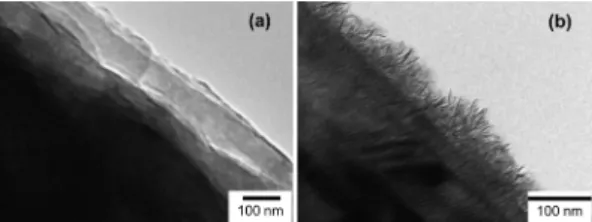
생성된온도와동일한온 도인25
oC
에서저장된시료의피막에서는12
시간후에형상의변화가없었으며약
100 nm
의두께를가진치밀한피막이관찰되었다
(Fig. 1(a)).
한편, 60
oC
에서저장 된시료에서는 피막의형상 및두께가크게 변해있는 것이관찰되었다(Fig. 1(b)).
피막의 두께는약100 nm
에서약
50 nm
로얇아졌고,
치밀했던피막은다공성의피막으로바뀌었다
.
이것은흑연표면피막이열에의해 전해질중에용해된것으로추측되는데,
두께에있어서 문헌에보고된이전연구와는다른결과를나타내고있 다.
원자간력 현미경(Atomic Force Microscopy, AFM)
을이용하여고배향성열분해흑연의기저면
(basal plane)
에생성된피막의두께및형상을
in-situ
로관찰한이전Fig. 1. TEM images of the natural graphite powder (NG-
7) after second cycle of CV in 1 M LiClO
4/EC + DEC
(1 : 1) at 25
oC, followed by storage at (a) 25
oC and (b) 60
oC
for 12 hours.
연구에서는
, 60
oC
에서12
시간보관후에,
치밀한피막이 다공성의 피막으로 변하긴 하였으나 피막의 두께가16 nm
에서50 nm
로증가하였음을보고하고있다.
17,18)이처럼피막의두께에 있어서본연구에서얻어진 결 과가이전의결과와다른이유는다음과같이두가지 관점에서설명이가능하다고생각된다
.
첫째는,
본연구에서관찰된피막은흑연의단면
(edge plane)
에생성된것이고
,
이전연구에서는흑연의기저면에생성된피막을 관찰한것이므로,
생성된피막의본질이다르기때문에서로다른열적거동을나타낸것으로생각된다
.
단면과기저면에생성된피막의조성이다르다는
Peled
그룹의보고는이러한생각을일부지지하는것이다
.
9,10)둘째는,
사용된전해질의용매가다르다는점이다
.
본연구에서는EC
와DEC
의혼합용매를사용하였는데,
이전연구에서는EC
단일용매를사용하였으므로,
생성된피막의본질이 다를것으로생각된다.
전해질용매의종류는기저면에 생성된 피막의 두께 및 충방전 특성에 크게 영향을 주는 것으로보고되어있다.
열에의한피막의두께및형상변화는리튬이온의 전도에영향을줄것으로예상할수있다
.
왜냐하면리튬 이온이 흑연내부로삽입되거나(
환원반응)
흑연내부로부터빠져나오기
(
산화반응)
위해서는반드시피막을 통과하면서이동하기때문이다.
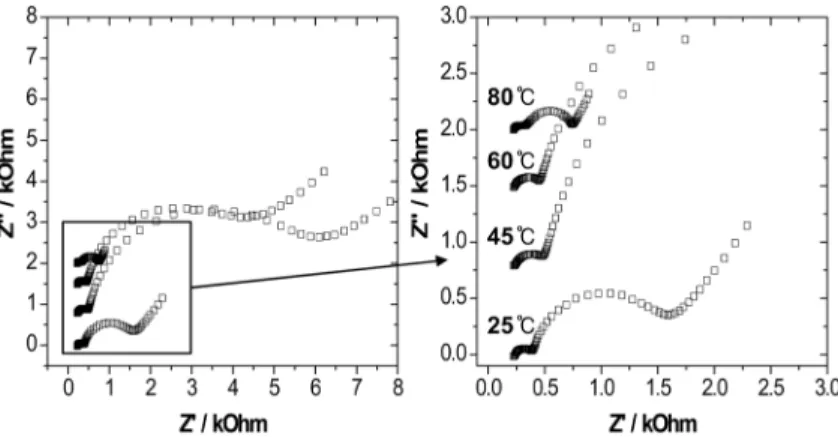
이러한리튬전도에의영향을 알아보기위해
EIS
분석법을이용하여피막의저항을측정하였고그결과를
Fig. 2
에나타낸다.
열에의한저항의변화를보다세밀하게검토하기위하여표 면피막이생성된흑연전극의저장온도를
25
oC, 45
oC, 60
oC, 80
oC
로설정하였다.
일반적으로흑연전극의EIS
측정데이터로부터는
2
개의반원이얻어지는데,
고주파영역의반원이표면피막의저항에기인하며
,
중주파영 역의반원은전하전달저항에기인하는것으로해석할 수 있다.
19)이와 같은해석에근거하여Fig. 2
로부터,
45
oC
와60
oC
에서저장된전극의표면피막저항이약2
배 정도증가한것을알수있다. Fig. 1
의TEM
결과에서는60
oC
에서저장후에피막의두께가약1/2
로줄어들었는데
, EIS
결과에서는 피막의 저항이약2
배 증가하였다
.
저항의크기는이동거리에반비례하므로TEM
결과와
EIS
결과는서로일치하지않는것처럼보이지만,
이것은표면피막의조성이열에의해변했기때문인것 으로추정된다
.
바꾸어말하면,
표면피막의조성이변하 지않은상태에서두께가1/2
로줄었다면,
저항또한1/2
로감소해야하지만
,
오히려저항이증가했다는 것은피막의조성자체가변하여리튬이온과의상호작용이 달라졌기때문인것으로생각된다
.
한편, 80
oC
에서저장 된흑연전극의표면피막저항은낮은온도에서저장된 전극의피막 저항보다작은 값을 나타내었다.
이러한원인또한리튬이온이전도되기쉬운물질로피막의조 성이바뀌었기때문으로추정되나
,
각온도에서피막의 조성이어떻게변하였는지에관한구체적정보를얻기 위한연구는본연구에서는진행되지않았다. Fig. 2
의EIS
결과로부터주목할만한또한가지는,
피막저항뿐 만아니라전하전달저항의크기도온도에따라피막저 항과유사한증감거동을나타내고있다는것이다.
이러한현상역시온도변화에따른피막의조성변화와관 련이 있을 것으로 추측되나 구체적 이유는명확하지 가않다
.
Fig. 1
과Fig. 2
의결과로부터흑연표면피막이80
oC
이하의비교적낮은온도영역에서도열적으로불안정 하다는것을확인할수있었는데
,
이러한열적불안정성을개선하기위한목적으로전해질중에
VC, PS, ES
와같은유기물을첨가하여피막특성을조사하였다
.
이러한유기물은
propylene carbonate
계의전해질중에서우수한피막을형성하는물질로제안된것으로
,
20-23)EC
계에도일부적용되어왔으나
,
피막의열적안정성에미치는영Fig. 2. EIS spectra of the natural graphite powder (NG-7) after second cycle of CV in 1 M LiClO
4/EC + DEC (1 : 1) at
25
oC, followed by storage at each temperature for 12 hours.
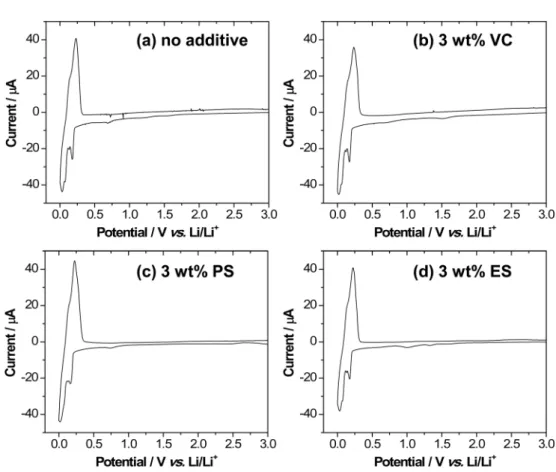
향에 관해서는 보고되어있지 않다. 이들 유기물이 첨가된 전해질 중에서의 피막 생성 거동을 알아보기 위해 CV를 실시하였으며 그 결과를 Fig. 3에 나타낸다. 모든 전해질 중에서 리튬의 환원 및 산화 반응이 가역적으로 진행 되었고, 피막 형성과 관련해서는 첨가제를 포함하지 않 은 전해질 중에서는 약 1.25 V와 0.75 V(Fig 3(a)), VC 함유 전해질 중에서는 약 1.5 V와 0.75 V(Fig. 3(b)), PS 함유 전해질 중에서는 약 0.75 V(Fig. 3(c)), ES 함유 전 해질 중에서는 약 1.3 V와 1.05 V(Fig. 3(d))에서 관찰되 었다. 이처럼 피막 형성 전위가 다른 것은 물리화학적 성 질이 다른 피막이 흑연 표면위에 생성되었음을 의미한다.
Fig. 3에서 생성된 피막의 열적 안정성을 알아보기 위해 Fig. 2와 동일한 방법으로 EIS 측정을 실시하였고 그 결과를 Fig. 4에 나타낸다. Fig. 4와 첨가제를 포함하 지 않은 Fig. 2의 결과에서 25oC에서 저장된 결과를 비 교해보면, 첨가제를 사용한 모든 경우에 피막의 저항이 감소하였음을 알 수 있으며, VC 및 ES를 사용한 경우에 는 전하전달 저항도 감소함을 확인할 수 있다. 특히 ES 를 사용한 경우에 가장 작은 피막 저항과 전하전달 저항
을 나타내었다. VC를 사용한 경우에는, 저장 온도의 상 승에 따라 피막 저항도 서서히 증가하였고 전하전달 저항은 급격히 증가하였다. PS를 사용한 경우에는, 피막 저항은 VC의 경우와 유사하게 저장 온도의 상승에 따라 서서히 증가하였고, 전하전달 저항은 첨가제를 사용하지 않은 경우와 유사하게 60oC까지 급격히 증가하다가 80oC 에서 다시 감소하였다. ES를 사용한 경우에는 VC와 PS의 경우에는 다르게 60oC까지 피막 저항과 전하전달 저항이 매우 완만하게 증가하였으나, 80oC에서는 블로킹 전극의 거동을 나타내었다(Fig. 4에는 80oC의 결과를 표 시하지 않음). 이러한 EIS 결과는, VC, PS, ES와 같은 첨가제를 이용하여 흑연 표면피막의 열적 안정성을 온도 영역에 따라 제한적으로 개선할 수 있음을 의미하는 것이다.
4. 결 론
TEM 및 EIS를 분석 수단으로 이용하여 흑연 표면 피막의 열적 안정성에 관한 고찰을 하였다. 60oC에서 저
Fig. 3. Cyclic voltammograms of the natural graphite powder (NG-7) during the first cycle in 1 M LiClO
4/EC + DEC
(1 : 1) with and without additives.
장된 흑연 전극의 표면피막은 열에 의해 두께가 얇아지 고 치밀했던 형상이 다공성으로 변하였고, 피막의 저항은 증가하였다. 공기 중에서 불안정한 흑연 표면피막의 열적 안정성을 공기와 접촉하지 않은 상태로 TEM을 이용하여 직접 관찰한 결과는 지금까지 보고된 예가 없으며, 본 논문에서 처음으로 보고되는 것으로, 흑연 표면피막의 열적 거동을 이해하는데 있어서 TEM은 매우 유용한 분석 수단이다. VC, PS, ES와 같은 유 기물을 전해질에 첨가함으로 인해 제한된 온도 영역 에서 흑연 표면피막의 열적 안정성이 개선되었다.
참고문헌
1. J. R. Dahn, ‘Phase-diagram of Li
xC
6’ Phys. Rev .,
B44, 9170 (1991).
2. T. Ohzuku, Y. Iwakoshi, and K. Sawai, ‘Formaion of lithium-graphite intercalation compounds in nonaqueous electrolytes and their application as a negative electrode
for lithium ion (shuttlecock) cell’ J. Electrochem. Soc .,
140
, 2490 (1993).
3. Z. Jiang, M. Alamgir, and K. M. Abraham, ‘The electrochemical intercalation of Li into graphite in Li/
polymer electrolyte/graphite cells’ J. Electrochem. Soc. ,
142
, 333 (1995).
4. M. Inaba, H. Yoshida, Z. Ogumi, T. Abe, Y. Mizutani, and M. Asano, ‘In situ Raman study on electrochemical Li intercalation into graphite’ J. Electrochem. Soc .,
142, 20 (1995).
5. R. Yazami and D. Guerard, ‘Some aspects on the ppeparation, structure and physical and electrochemical properties of Li
xC
6’, J. Power Sources ,
43-44, 39 (1993).
6. E. Peled, “Handbook of Battery Materials” 419, Wiley- VCH, Weinheim (1999).
7. E. Peled, ‘The electrochemical behavior of alkali and alkaline earth metals in nonaqueous battery systems? The solid electrolyte interphase Model’ J. Electrochem. Soc .,
126