C57BL/6 마우스에서 복합한약재(RAA)의 모발 성장 효능
김유진#, 이예지, 김미려*
대구한의대학교 한의과대학 본초약리학교실
Effect of herbal mixture (RAA) on hair growth in C57BL/6 mice
Yoo-Jin Kim
#, Ye Ji Lee, Mi Ryeo Kim
*Department of Herbal Pharmacology, Daegu Haany University, Daegu, Korea
ABSTRACT
Objective : Recently, hair has become one of the important aspects of beauty. So, there are many studies about prevention and treatment of alopecia. Finasteride and minoxidil have been known to drug for alopecia treatment.
However, these agents have side effects such as irritation, pruritus, and erythema when they were used for a long time.
So, we assessed hair growth effect on herbal mixture (RAA) include in Rehmanniae Radix Preparata, Achyranthis Radix, and Acanthopanacis Cortex.
Methods : 6 weeks aged C57BL/6 mice were divided three treatment groups. : CON group (vehicle solution), MNXD group (positive control, 3% minoxidil), RAA group (15% RAA solution). And we applied 200 ㎕ of three groups to shaved dorsal skin every day. Hair growth effects of treatment were determined through phototrichogram by folliscope and hair follicle morphometry by H&E staining. And we assessed hair growth-related gene (VEGF, IGF-1, TGF-β1) expressions by western blot and 5-α reductase Ⅱ analysis of dermal (skin) or internal organ (prostate gland).
Results : Hair density and hair follicle size in MNXD or RAA group was enhanced compared to those of CON group, respectively. Also, the protein expression levels in dermal of VEGF, IGF-1 increased but TGF-β1 decreased in RAA and MNXD group, compared to CON group, respectively. 5-α reductase Ⅱ levels of tissues in MNXD or RAA group significantly decreased compared to those of CON group, respectively.
Conclusion : These results suggest that RAA has the promoting effect on hair growth.
1)
Key words : Herbal mixture, Hair growth, Alopecia, Minoxidil, C57BL/6 mice
Ⅰ. Introduction
Hair is one of the specific characteristics of mammals, which has main function to protect the head from external shocks and hazards such as the sun's rays and cold
1). In addition, the perception of appearance has changed owing to the influence of the mass media, and its ornamental function has been maximized
2). So hair plays an important role in makeup or fashion in the standard of beauty. Therefore, hair condition such
as hair loss and white hair affects the social and psychological problems of appearance
3,4).
In the past, alopecia was not recognized as an independent disease because it was thought to be caused by aging. But recently, alopecia has been increased due to social stress, irregular lifestyle, disease, nutritional imbalance by diet or instant intake, etc
2,5).
Hair loss is classified into male pattern hair loss (androgen alopecia), female pattern hair loss, alopecia areata, and etc. Androgen alopecia is the most common
*Corresponding author : Mi Ryeo Kim, Department of Pharmacology, College of Korean Medicine, Daegu Haany University .
·Tel : +82-53-770-2361 ·Fax : +82-53-770-2241 ·E-mail : [email protected]
# First author : Yoo-Jin Kim, Department of Pharmacology, College of Korean Medicine, Daegu Haany University.
·Tel : +82-53-770-2241 ·Fax : +82-53-770-2241 ·E-mail : [email protected]
·Received : 11 October 2019 ·Revised : 26 November 2019 ·Accepted : 30 November 2019
hair loss. It can occur when too much testosterone and dihydrotestosterone, a kind of androgen hormone, is secreted. And it may occur when 5-α reductase is abundant, because testosterone is converted to dihydrotestosterone by 5-α reductase
6-9).
Finasteride is used as a treatment for male alopecia through inhibiting 5-α reductase which converts from testosterone to dihydrotestosterone
10). And minoxidil is a hair growth promoter, which is one of approved drugs by the food and drug administration (FDA, USA) with finasteride. Minoxidil is not well known for its mechanism of action on hair growth. But minoxidil induces the expression of vascular endothelial growth factor (VEGF), provides nourishment by vasodilation. Also, it improves blood circulation via vascular endothelial cell and smooth muscle cell activation, and stimulates the hair growth factor to promote hair growth
11). However, long-term treatment for hair loss can cause side effects such as skin irritation, pruritus, erythema, scaling and dryness, male sexual dysfunction, and birth defects. So, many researches on natural products are actively processing to minimize the side effects
12, 13).
Hair is produced or eliminated by repeating anagen, catagen, and telogen according to each hair follicle period
14). During the anagen, stage hair follicles grow in the papilla of the dermis and actively act for hair growth. In the catagen, the dermis becomes thinner and gets closer to the epidermis. Also, the hair dermal papilla cell in hair follicle was degraded and hair growth stops. During the telogen, hair follicle activity stops and leads to anagen again. At this time, when the anagen becomes short and telogen becomes long, alopecia symptom appears
15,16). It is known that insulin-like growth factor-1 (IGF-1) and VEGF are factors that induce hair growth and transforming growth factor-β1 (TGF-β1) is known as a hair inhibitor factor
17). In particular, TGF-β1 inhibits hair growth and reduced the anagen by acting on the anagen. So hair loss is occurred by rapid turnover to the catagen
18).
Herbal mixture (地黃飮, Jihwangeum, RAA) is a prescription derived from the ‘Taepyeongsunghyebang (太平成惠方)', which consists of Rehmanniae Radix Preparata, Achyranthis Radix, and Acanthopanacis Cortex.
It has been previously reported that Rehmanniae Radix Preparata is significantly increased in the expression of genes such as IGF-1 and VEGF, which are known as hair growth promoting factors
19). Rehmanniae Radix Preparata and Acanthopanacis Cortex have been reported to be used as the main patent materials for hair growth solution and hair loss prevention
20). Achyranthis Radix to have an anti-atopic effect, is also known not only to prevent gray hair, but also treat hair loss through
promoting blood circulation and blood production
21). Therefore, RAA was extracted from mixed herbs to search its efficiency on hair growth. Thus, we investigated the effect of RAA extract on hair growth
in vivousing both male and female mice in order to exclude hormonal effects.
Ⅱ. Materials and methods
1. Preparation of extract
The RAA extracted with 50% ethanol solution, which are comprised of three medicinal herbs such as Rehmanniae Radix Preparata (China), Achyranthis Radix (China), and Acanthopanacis Cortex (China). All of the RAA were purchased from Korean medicinal herbal market (Joeunhanyak, Daegu, Korea). RAA with the washed three herbs as above were boiled at 100℃ for 10hr after adding to 50% ethanol solution (500 ℓ) in extractor (COSMOS-660, Kyongshe Machine Industry).
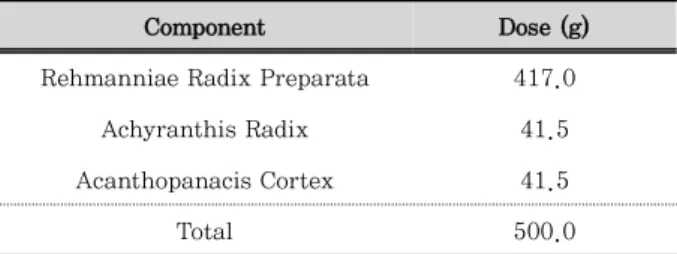
The quantity of the each medicinal herb for the RAA was shown in Table 1. After extraction, the RAA were filtered and concentrated in rotary evaporator (N-1110 V, Eyela, Japan). Then, they were centrifuged (large capacity refrigerated centrifuge, Continent R, Hanil, Korea) at 7,000 rpm for 20 min. After secondary filtration, they were lyophilized by Freeze Dryer (PVTFD10R, Ilshinlab, Seoul, Korea), then lyophilized powder was 243.6 g (yield, 48.7%). And it was stored at -80℃ until starting experiment.
Component Dose (g)
Rehmanniae Radix Preparata 417.0
Achyranthis Radix 41.5
Acanthopanacis Cortex 41.5
Total 500.0
Table 1. Composition of herbal mixture (RAA)
2. Animals
6-week old male and female C57BL/6 mice (Orientbio,
Busan, Korea) with around 20 g were used to do an
experiment after adaptation for one week on a 12 h
illumination cycle at a temperature of 23 ± 3℃ and a
relative humidity of 50 ± 10%. Diets (Formula : Ain-76A
based cereal feed, Research diets, New Brunswick, USA)
and drinking water were freely ingested. The total
process of animal experiment was conducted after the
review of Daegu Haany University animal experimental
ethics committee.
3. Treatment of RAA ethanol extract
Experimental animals were anesthetized with isoflurane (JW pharmaceutical, Seoul, Korea) and then animal clipper (Oster, A6 comfort, 0.25 mm, McMinnville, USA) was used to remove hair from the dorsal portion of the mouse. The depilatory (Niclean, Ildong Pharmaceutical, Seoul, Korea) was applied to remove some of remaining hairs on the skin. Then, mice rested for 24 h to stabilize the skin. The vehicle (distilled water : poly ethylene glycol (Sigma, USA) : 99.9% ethanol (EMD Millipore Corp., Germany) = 3 : 1 : 1 mixture), and RAA (RAA extract powder dissolved in vehicle solution in 15%) application solutions were prepared. The positive control group was 3% minoxidil (Hanmi Pharmaceutical, Seoul, Korea).
6-week old male, which appear pink color on the removed area, have telogen hair and were classified into three groups according to randomization method : 9 mouse (5 males, 4 females) per group. 200 ㎕ of each solution was applied the dorsal skin every day for 2 weeks in CON group (vehicle solution), MNXD group (3% minoxidil), and RAA group (15% RAA solution), respectively.
The animals were starved for 12 h before sacrifice, and anesthetized with isoflurane. Blood was collected from the inferior vena cautery. The skin of the experimental animals was divided for analysis of each experiment, and it was rapidly cooled to liquid nitrogen and stored at -80℃ until analysis.
4. Folliscope analysis
After the application of the sample, the dorsal skin of mice was removed and fixed in a 4% formaldehyde solution (Junsei, Tokyo, Japan) until analyzing. Fixed skins were analyzed at the same time and flattened on Watman paper (Watman, 1140-320, GE Healthcare, Shanghai, China) and then measured with a folliscope (ver. 2.8, Lead M, Seoul, Korea). The same two areas were determined per sample and the average density and thickness of hair were calculated per unit area (㎠) of two sites.
5. Histomorphometric observation
To observe the effect of RAA ethanol extract on morphology the hair follicles, dorsal skin of sacrificed mouse was collected after 15 days of RAA application and fixed in 4% formaldehyde solution for 24 h. After paraffin was embedded, microtome (Leica, RM2255, Chicago, USA) was used to make three sections of dorsal skin. The slides were heated for 1 h and deparaffinized
with xylene (Samchun chemical co., Suncheon, Korea).
And it was functionalized in the order of 70%, 80%, 90%, and 100% alcohol. This was stained with hematoxylin (Muto pure chemicals, Tokyo, Japan) and eosin (Source medical products, Illinois, USA) and then sealed. H&E stained tissue slides were photographed using a microscope (Motic AE31, Xiangan, China) at 10 × 0.25 magnification.
6. Measurement of 5-α reductase Ⅱ activity
Male Sprague Dawley rat (250~300 g) were purchased from Hyochang Scientific (Daegu, Korea). Prostate gland and skin were separated and homogenized with PBS buffer (Hyclone, Logan, Utah, USA) at a concentration of 100 ㎎/㎖. The homogenate was centrifuged (Centrifuges 5415R, Eppendorf, Hamburg, Germany) at 5,000 rpm at 4℃ for 15 min and the supernatant was used as an enzyme source.
The Bradford assay was used to quantitate the amount of protein. The manual was followed the rat 5-α reductase II ELISA kit (My Bio Source, San Diego, USA). In other words, the amount of protein and the amount of the sample at a concentration of 200 ㎍/㎖
were homogenized at 50 ㎕ according to the result of quantifying the protein by dissolving the enzyme solution at room temperature for 30 min before the experiment. The positive control, finasteride (Tocris, Bristol, UK), was used at 10 μM in prior experiments.
50 ㎕ of 200 ㎍/㎖ sample, 10 μM finasteride, and standard were treated into each well. Horseradish peroxidase (HRP) -conjugate was treated with 100 ㎕ in each well, and incubated at 37℃ for 1 h. After washing 4 times, the chromogen solution was treated with 50 ㎕ of each solution, followed by shading at 37℃ for 15 min.
After 15 min, 50 ㎕ of stop solution was dispensed and the reaction was terminated. The absorbance at 450 ㎚ was measured. The standard curve for each concentration was quantified and the measured value was calculated as % of control.
7. Western blot analysis
The extracted dorsal skin was lysed with a
homogenizer (Tissue tearer, Biospec, Korea) by adding
lysis buffer (50 mM Tris pH 7.8, 120 mM NaCl, 2 mM
EDTA, 1% Triton X-100). After centrifugation at
13,000 rpm at 4℃ for 30 min, the supernatant was
collected. Protein quantification was analyzed using
the Bradford method and separated on a 12% SDS-
polyacrylamide gel using an electrical method (Powerpac
basic, Bio-rad, California, USA). And then separated
protein was transferred to a PVDF (Polyvinylidene fluoride) microporous membrane (Millipore, Darmstadt, Germany). The membrane was blocking in 5% skim milk (Becton, Dickinson and Company, New Jersey, USA) for 1 h. The primary antibody including vascular endothelial growth factor (VEGF) antibody, insulin-like growth factor (IGF)-1 antibody, and transforming growth factor (TGF)-β1 antibody (Santa Cruz bio technology, Bergheimer, Germany) were diluted 1 : 1,000 and 1 : 250, respectively, and reacted at 4℃ for 12 h. The secondary antibody was diluted 1: 1,000 and reacted for 1 h at RT.
The expression level of each factor was analyzed using Image Analyzer (Sensi Q 2000, Lugen Sci, Bucheon, Korea).
8. Statistical analysis
The results are presented as mean ± S.E. of independent experiments. Data were analyzed by one- way analysis of variance (ANOVA) followed by Fisher’s least significant difference (LSD) post hoc test using
SPSS 11.5. (SPSS Inc., USA). The accepted level of significance for the test was P < 0.05.
Ⅲ. Results
1. Effects of RAA ethanol extract on hair density and thickness
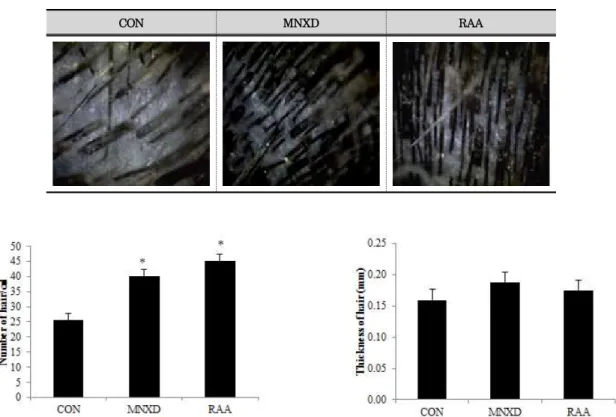
To investigate the effect of RAA treatment on hair density and thickness, applied dorsal skin for 15 days was photographed with folliscope, which is a high- resolution hair analyzer. As a result, the hair density was 25.67, 40.17, and 45.00 ㎠, respectively. So, RAA group was significantly higher than CON group and, density of RAA group was similar to MNXD group. The thickness was 0.16, 0.19, and 0.17 ㎜, respectively. There was no significant difference in thickness, RAA group showed an increase of thickness compared with CON group (Fig. 1).
CON MNXD RAA
Figure 1. Effects of RAA ethanol extract on hair density and hair thickness in alopecia model of C57BL/6 mice by Folliscope.
Data represent the mean ± S.E. of triplicate determinations from three separate experiments. * : p < 0.05 vs CON.
CON ; vehicle-treated group, MNXD ; 3% minoxidil-treated group, RAA ; 15% RAA ethanol extract-treated group.
2. Effects of RAA ethanol extract on morphology of hair follicle
To investigate the effect of RAA treatment on the number and size of hair follicles, skin tissues applied for 15 days were stained with H&E staining. As a result,
the number of hair follicles in MNXD and RAA groups
was increased compared to CON group. But, the size of
hair follicles was similar to each group (Fig. 2).
CON MNXD RAA
1
2
3
Figure 2. Effects of RAA ethanol extract on morphology of hair follicle in alopecia model of C57BL/6 mice by H&E staining.
CON ; vehicle-treated group, MNXD ; 3% minoxidil-treated group, RAA ; 15% RAA ethanol extract-treated group.
3. Effects of RAA ethanol extract on 5-α reductase Ⅱ activity
The activity of 5-α reductase Ⅱ was measured in the prostate gland and skin of rats at a concentration of 200 ㎍/㎖ of RAA. As a result, the 5-α reductase Ⅱ activity was 100.00, 59.99, and 58.06% in prostate gland
and 100.00, 76.13, and 76.37% in skin, respectively.
RAA group in the prostate gland and skin was significantly inhibited compared to CON group (Fig. 3).
(A) (B)
Figure 3. Effects of RAA ethanol extract on 5-α reductase Ⅱ activity in prostate gland and skin Data were measured by in the prostate gland (A) and skin tissues (B) of rats.
Data represent the mean ± S.E. of triplicate determinations from three separate experiments. * : p < 0.05 vs CON.
CON ; vehicle-treated group, MNXD ; 3% minoxidil-treated group, RAA ; 15% RAA ethanol extract-treated group.
4. Effects of RAA ethanol extract on hair growth-related protein expressions
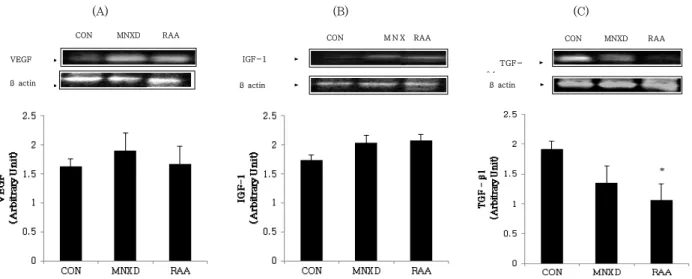
Protein expression level of VEGF, IGF-1 and TGF-β 1 were measured in skin. As a result, protein expression of VEGF was 1.63, 1.91, and 1.67, IGF-1 was 1.73, 2.03,
and 2.08, and TGF-β1 was 1.92, 1.35, and 1.07,
respectively. The expression of VEGF and IGF-1 inducing
hair growth was increased in MNXD and RAA groups
compared to that of CON group. On the other hand, the expression of TGF-β1, which inhibits hair growth,
was significantly decreased in MNXD compared to that of CON group (Fig. 4).
(A) (B) (C)
ß actin
VEGF
CON MNXD RAA
ß actin
IGF-1
CON M N X RAA
ß actin
TGF- ß1
CON MNXD RAA
Figure 4. Effects of RAA ethanol extract on hair growth-related protein expressions in alopecia model of C57BL/6 mice.
Data were analyzed protein expression of VEGF (A), IGF-1 (B) and, TGF-β1 (C) in skin tissue.
Data represent the mean ± S.E. of triplicate determinations from three separate experiments. * : p < 0.05 vs CON.
CON ; vehicle-treated group, MNXD ; 3% minoxidil-treated group, RAA ; 15% RAA ethanol extract-treated group.
Ⅳ. Discussion
In recent, hair loss is increasing, which is caused by frequent dyeing, permanent, diet and, stress. Also, it acts one of the source of trouble for woman as well as man
22). Minoxidil, known as a medicine for hair loss, plays a role in opening potassium channels. And it has been developed as a treatment for hypertension. It also stimulates the growth of hair follicle cells and turns the hair cycle into the anagen. Han
et al.23)reported that minoxidil has cell proliferation and anti-apoptosis effects in dermal papilla. However, finasteride and minoxidil, which are placed them on the market, are concerned to side effects such as skin diseases when they are used for a long period of time.
Rehmanniae Radix Preparata of major component in RAA has a sweet taste and warmth. Also, it tonifies the blood and enriches the yin
24). So it has the effect of supplementing the blood. It is used as a component of the prescriptions that treat to early whitening of hair and whiskers resulted from lack of blood circulation, though supplement of blood
25).
The C57BL/6 mice used in this experiment are 6-week old male, female black mice. Because these mice are known that the telogen is started from 6 weeks at the hair cycle. When mice are shaved, the color of epidermis showed pink, to mean starting of telogen. When hair cycle changes to anagen over time, it becomes black color
pigment. In addition, melanocytes exist limitedly in hair follicles, melanin is produced in them only during the anagen. Thus, these mice are suitable as an animal model for hair growth experiment
26).
A folliscope, which is a type of phototrichogram, was used to measure the density and thickness of the mouse hair after treatment of the sample. It is a device used in clinical field, because it can accurately measure the skin by reflecting environmental factors such as temperature and humidity
27). In this study, RAA group showed a significant increase in density compared to that of CON group.
5-α reductase is a male hormone testosterone reductase that induces a catagen hair follicle to the anagen hair follicle. This leads directly to the cell death of the hair follicle, causing hair follicle shrinkage and hair loss. Therefore, many studies have been conducted to develop a 5-α reductase inhibitor to treat male alopecia
28). Thus, RAA group showed a significant decrease compared to CON group, and it was thought that RAA could be effectively used for male alopecia group.
Recently, studies on various factors and mechanism
related to hair growth have been actively conducted. It
has been reported that hair loss growth is caused by
the cytokine involved in cell growth depending on the
hair growth cycle. In the catagen, cell proliferation is
reduced and apoptosis occurs. The factors promoted
catagen are known as interleukin (IL)-1α, tumor necrosis factor (TNF)-α, endothelial growth factor (EGF)-5, transforming growth factor (TGF)-α, β1. In addition, growth factors such as insulin-like growth factor (IGF)-1, keratinocyte growth factor (KGF), vascular endothelial growth factor (VEGF) act to induce anagen and prevent hair loss by stimulating proliferation and differentiation of dermal papilla cells
29, 30). VEGF is known to be a factor that increases hair follicle size and hair thickness by promoting hair follicle growth when hair follicle is rapidly cell division and improves blood circulation and then, angiogenesis is induced
31, 32). It has been reported that IGF-1 is secreted from dermal papilla cells to promote the proliferation of epithelial cells and increase the length of follicular tissue
33). In addition, IGF-1 overexpression in mouse skin has been reported to promote the development of hair follicles, and it is supposed that IGF-1 as a survival factor will prevent cell death and inhibit hair follicle cell degeneration
34). Therefore, we measured TGFβ1, IGF-1 and VEGF in mouse tissues by western blot. The expressions of IGF-1 and VEGF were increased in RAA group compared to CON group. Also, the expression of TGFβ1 was decreased in RAA group compared to CON group. RAA group showed no significant difference from MNXD group, suggesting that RAA may play an important role in hair growth.
In vivo