http://dx.doi.org/10.5763/kjsm.2015.33.1.6 pISSN 1226-3729 eISSN 2288-6028
한국 프로야구 리그의 관중 부상 사고 및 질환에 대한 역학:
2011
−2012, 두 연속된 시즌의 잠실야구장 분석
서울대학교 의과대학 분당서울대학교병원 정형외과1, 명지병원 정형외과2
오주한1ㆍ김준엽2ㆍ조병채1ㆍ성광영2
The Epidemiology of Spectator Injury and Illness in the Korean Professional Baseball League: 2 Consecutive Seasons (2011−2012) at the Jamsil Stadium
Joo Han Oh1, Joon Yub Kim2, Byung Chae Jo1, Gwang Young Sung2
1Department of Orthopedic Surgery, Seoul National University Bundang Hospital, Seoul National University College of Medicine, Seongnam,
2Department of Orthopedic Surgery, Myongji Hospital, Goyang, Korea
The aim of this study was to verify the epidemiology of spectator injury and illness in the baseball stadium during the games and the role of the on-site physician in hospital referral of spectators. We retrospectively reviewed the
‘Documents of the medical aids’ from 2011 to 2012 at Jamsil stadium. We have provided medical consultation to spectators as on-site physicians since 2012. The incidence of spectator injury and illness was 0.009% (1.68 spectators/game). During the study period, a total 448 spectators visited the first aid station, of which 324 cases (72%) were injuries and 124 cases (28%) were illness. The most common cause of injury was direct foul ball attacks (58.6%). According to the location of injuries, upper extremity injuries were most common, however, severe injury cases that were immediately referred to the hospital by ambulance were more commonly facial and oral injuries (p=0.000). Severe injuries occurred more frequently in games on weekends than weekdays (p=0.000).Headache was the most common illness followed by gastrointestinal problems. Hospital referrals were more frequent in the 2012 season when we were designated on-site physicians, as compared to the 2011 season (p=0.035).
Keywords: Baseball, Injuries, Illness, Spectator
Received: March 10, 2015 Revised: May 9, 2015 Accepted: May 22, 2015
Correspondence: Joon Yub Kim
Department of Orthopedic Surgery, Myongji Hospital, 55 Hwasu-ro 14beon-gil, Deokyang-gu, Goyang 415-826, Korea Tel: +82-31-810-5114, Fax: +82-31-969-0500
E-mail: [email protected]
Copyright ©2015 The Korean Society of Sports Medicine
CC This is an Open Access article distributed under the terms of the Creative Commons Attribution Non-Commercial License (http://creativecommons.org/
licenses/by-nc/4.0) which permits unrestricted non-commercial use, distribution, and reproduction in any medium, provided the original work is properly cited.
Introduction
The necessity of medical support during events of mass gathering such as the Olympics, have been reported1-5). However, there are few reports on medical aids for spectators in specific sporting games. Spectator injury and illness during sporting events are still unknown. Furthermore, no evidence based medical support system for spectator injury and illness has been established. The epidemiologic study of spectator injury and illness for specific sporting games would clarify the role of the first aid station and
medical personnel at the stadium, and prepare medical support systems.
Korean professional baseball games have been the most popular sporting event in Korea, attracting large numbers of spectators.
The number of spectators in Korean professional baseball games has increased in the last 30 years disproportionate to the interest in spectator injury and illness. According to the Korea Baseball Organization (KBO), the number of spectators has increased from 1,438,768 in 1982 to 7,156,157 in 2012 or an almost 7 times increase in number6).
Our experience as on-site physicians or field doctors during professional baseball games since 2012 has raised our interest in spectator injury and illness. We hypothesized that the features of spectator injuries and illness in the baseball game might differ from other sporting games due to crowded conditions and unex- pected attack by foul balls. We also assumed that the on-site physicians’ consultation could reduce hospital referrals. The pur- pose of the study was to verify the characteristics of baseball spectator injury and illness and to establish the role of the on-site physician at the first aid station, as well as medical preparedness during the game.
Methods
1. The first aid station and spectator medical records The Jamsil stadium is the largest stadium for professional baseball games held in Seoul, Korea. This home stadium for the LG Twins and Doosan Bears, Korean professional baseball teams, has a seating capacity of 26,606 and accommodates 30,500 spectators. The Jamsil stadium first-aid station is located on the ground floor just next to the dugout of the visiting team. It administers immediate care of serious injuries or illness occurring on the ground and spectators as well. The orthopedic doctors as on-site physician, field doctors, the registered nurses and emergency medical technicians comprise a team in charge of caring for the various injuries and illness occurring around the station. Spectator injury and illness has been recorded since 2011 by registered nurses; we have played a role as on-site physicians or field doctors at the Jamsil stadium since 2012. The on-site physicians or field doctors were firstly introduced in 2012 and
they had never been at any time before 2012. The records contain the home team name, date, and the records of patients including sex, diagnosis, causes, treatments, and hospital referrals.
A total 266 games (LG Twins 66 games, Doosan Bears 67 games in 2011, LG Twins 67 games, Doosan Bears 66 games in 2012) were held in the Jamsil stadium during 2 years. We retrospectively reviewed ‘The records of medical aids’ for 266 games held from 2011 to 2012.
2. Statistical analysis
The Pearson chi-square analysis was used to evaluate the all categorized values in this study. SPSS ver. 13.0 (SPSS Inc., Chicago, IL, USA) was used for the statistical analyses and p<0.05 was considered indicative of statistical significance.
Results
1. Incidence of spectator injury and illness during the 2011 and 2012 seasons
Totally, 4,996,633 spectators attended the 266 official games or mean 18,784 spectators per game during the study period;
and total 448 spectators or mean 1.68 spectators per game visited the first aid station of the stadium. The incidence of spectator injury and illness was 0.009%. Among 448 cases, 324 cases (72%) were injuries and 124 cases (28%) were illness (Table 1).
2. Location of injury
We classified the location of injury as head and neck, face and oral, upper extremity, lower extremity and trunk. The incidence according to the location was 12% (40/324 cases) in head and neck, 19% (60/324 cases) facial and oral, 39% (126/324 cases) in the upper extremity, 24% (77/324 cases) in the lower extremity, and 6% (21/324 cases) in trunk (Fig. 1).
3. Causes of injury
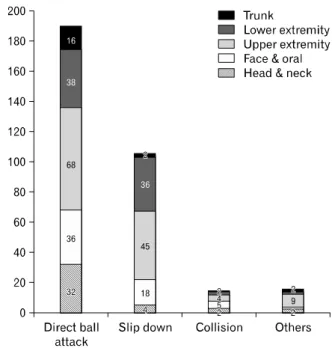
We classified the causes of injuries as direct ball attack, slip down, collision and others (burns, insect bites). Direct ball attack related injuries was predominant at 58.6% (190/324 cases). Slip downs comprised 32.4% (105/324 cases) of causes, collisions caused 4.3% (14/324 cases) of injuries and other causes were
Fig. 2. The cause and location of injury.
Table 2. The cross table of causes and location of injuries
Direct ball attack
Slip
down Collision Others p-value
Head & neck 32 4 2 2 0.309
Face & oral 36 18 5 1
Upper extremity 68 45 4 9
Lower extremity 38 36 2 1
Trunk 16 2 1 2
Table 1. Incidences of injuries and illness of the study
Value Number (%)
Injury
Contusion 187 (58)
Sprain 61 (19)
Abrasion 27 (8)
Fracture 20 (6)
Others (burns, insect bite) 15 (5)
Laceration 14 (4)
Total 324 (100)
Illness
Headache 50 (40)
Gestrointestinal symptoms 39 (31)
Common cold 15 (12)
Dehydration 9 (7)
Menstrual pain 6 (5)
Dizziness 3 (3)
Hyperventilation 2 (2)
Total 124 (100)
4.6% (15/324 cases). Among the other causes there were 8 burns cases and 7 insect bite cases (Fig. 2). Direct ball attack caused 81% of head and neck injuries, 76% of trunk injuries, 60% of face and oral injuries, 54% of upper extremity injuries and 49%
of lower extremity injuries. Slip down was the second most common cause of lower extremity injury at 48% (Table 2).
4. Injuries: diagnosis and hospital referrals
We defined the severe injury as the injury that might be insufficiently managed in the first aid station, therefore transferred to the emergency room by ambulance. Among the 40 spectators with head and neck injuries, 8 spectators were classified as severe
injuries and referred to the hospital by ambulance. Head lacerations were 4, skull fracture was 1, and the other 3 were concussion with loss of consciousness. Eight of the remaining 32 patients with head and neck injuries visited the hospital by themselves.
Among 60 cases of face and oral injuries, 19 cases were referred to hospital by ambulance. 7 cases were face and oral lacerations, 2 cases were direct eyeball injuries, 7 cases were orbital wall fractures and 3 cases were crown fractures. 11 patients visited the hospital by themselves. Nine of the 126 upper extremity injury cases were immediately referred to the hospital. Fractures were 5 cases and lacerations were 4 cases. 17 cases visited the hospital by themselves. Among 76 cases of lower extremity injuries, 1 case was referred to the hospital with laceration. One case of ankle sprain visited the hospital by himself. No severe injury was noticed among the 21 cases of trunk injuries (Table 3). A
Fig. 3. Sexual differences of injuries and illness.
Table 3. Hospital referrals according to the location of injuries
Ambulance (%) Self-visit (%) Rest (%) p-value
Head & neck 8 (20.0) 8 (20.0) 24 (60) 0.000
Face & oral 19 (31.67) 11 (18.33) 30 (50)
Upper extremity 9 (7.14) 17 (13.49) 100 (79.37)
Lower extremity 1 (1.30) 1 (1.30) 75 (97.40)
Trunk 0 (0) 0 (0) 21 (100)
Table 4. Location and severity of injuries in Doosan Bears and LG Twins spectators
Doosan LG p-value
Location 0.737
Head & neck 19 21
Face & oral 36 24
Upper extremity 70 56
Lower extremity 46 31
Trunk 11 10
Severity 0.202
Laceration 11 4
Fracture & dislocation 10 7
Eyeball injury 1 1
Loss of consciousness 2 1
total 37 spectators were referred to the hospital immediately.
Immediate hospital referrals by ambulance were predominantly facial and oral injuries, rather than other injuries (p=0.000).
5. Sexual differences in injury and illness
Two hundred and forty-six cases (54%) were male spectators and 202 cases (46%) were female. Among male spectator cases, 179 (73%) were injuries and 67 (27%) were illness. Among female spectator cases, 145 (72%) were injuries and 57 (28%) were illness. The locational difference of injuries between sexes was not observed (p=0.362) (Fig. 3).
6. The differences between 2 teams (Doosan Bears vs.
LG twins)
According to the KBO, spectators of Doosan Bears were 2,545,438 and outnumbered the 2,451,195 LG twins spectators.
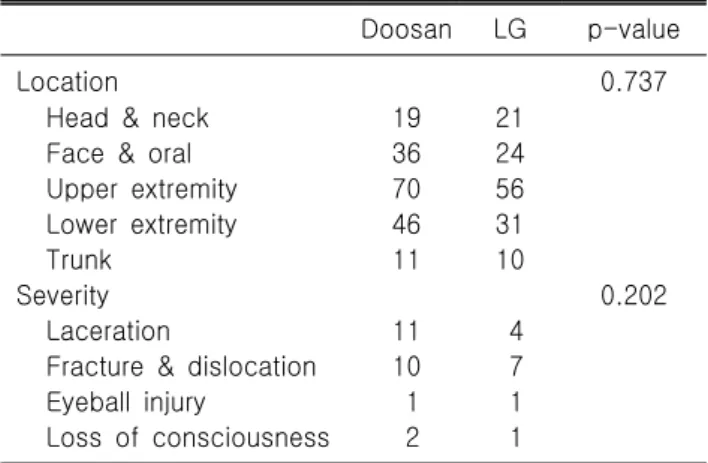
Doosan Bears spectors had 182 injuries during 2 years and 142 injuries occurred among LG Twins spectators. Among Doosan Bears spectator injuries, 19 cases were head and neck injuries, 36 cases were face and neck injuries, 70 cases were upper extremity injuries, 46 cases were lower extremity injuries, and 11 cases
were trunk injuries. There were 24 cases of severe injuries.
Lacerations were 11 cases, fractures and dislocations were 10 cases, eyeball injuries were 1 case and head concussions with loss of consciousness were 2 cases. Among LG twins spectator injuries, head and neck injuries were 21 cases, face and oral injuries were 24 cases, upper extremity injuries were 56 cases, lower extremity injuries were 31 cases and trunk injuries were 10 cases. There were 13 cases of severe injuries, 4 cases of lacerations, 7 cases of fractures and dislocations, 1 case of eyeball injuries and 1 case of head concussion with loss of consciousness.
There were no statistical differences between two teams with respect to the location of injury (p=0.737), incidence of severe injury (p=0.419) and type of severe injury (p=0.202) (Table 4).
7. Crowd density (weekdays vs. weekends)
The weekday games were held from Tuesday to Friday and mean number of spectators was 18,671 on weekdays, however the mean numbers of spectators on weekends (Saturday and Sunday) were 24,426. 178 games were held on weekdays and 88 games were held on weekends during the 2 seasons. There were 251 cases of spectator injury and illness (72 cases of illness
Fig. 4. The differences of injuries and illness between week- Fig. 5. The seasonal variations of illness. GI: gastro- [28.6%] and 179 cases of injuries [71.3%]) on weekday games
and 197 cases of spectator injury and illness (54 cases of illness [27.4%] and 143 cases of injury [72.5%]) in weekend games.
On weekdays, 1.41 spectators per game visited the first aid station and 2.24 spectators per game visited the first aid station on weekends (p=0.000). From the point of view of injuries, 1 spectator visited the first aid station per game on weekdays, however 2.03 spectator visited the first aid station per game on weekends (p=0.000).
The incidence of severe injuries were also predominant on weekends (26 cases vs. 11 cases) (p=0.012) (Fig. 4). However, the incidence and type of illness were not influenced by crowd density (p=0.731 and p=0.232).
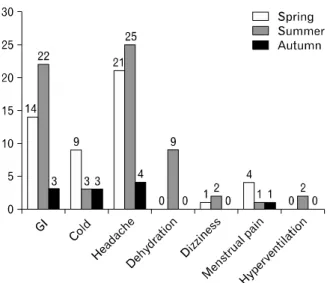
8. Illness: Diagnosis and seasonal, sexual variations Illness was classified as headache, gastroenteritis (e.g., abdom- inal pain), common cold and fever, dehydration or heat related illness, dizziness, urticaria, menstrual pain and hyperventilation (Table 1). The baseball games were divided into 3 seasons, i.e., spring (March, April, and May), summer (June, July, and August) and autumn (September and October) seasons (Fig. 5). Among the 124 cases of illness, headache was most common (50 cases, 40%); the second most common was gastrointestinal problems (39 cases, 32%). The common cold was also a frequent illness causing spectators to visit the first aid station (15 cases, 14.5%).
Nine cases of common cold occurred in the spring season, 3 cases in summer and 3 cases in autumn. All 9 cases of dehydration or heat related illness (7.2%) and 2 cases of hyperventilation occurred in the summer season (June, July, August). Dehydration and heat-related illness occurred only in male spectators and
hyperventilation, menstrual pain, and dizziness occurred only in female spectators (p=0.038).
Discussion
Professional baseball is the biggest mass gathering event in Korea. The dense populations and foul balls during the games could be risk factors for spectator injury, as compared with other sporting events. However, there have been few studies on the epidemiology of injuries and illness among players or spectators, and poor established evidence for medical support during the games7,8). The players were usually managed and treated by athletic trainers and team doctors. The medical records of athlete injury and illness were recorded and managed by team athletic trainers.
However, medical services provided to spectators at the first aid station are not well recorded and analyzed yet. We were on-site physicians or field doctors since 2012 at the Jamsil stadium and our experiences and observation of visits due to injury and illness accounted for more than 1 case per game (1.68 spectator/game) raised our interest in spectator injury and illness. Most of the reports on spectator injury and illness in sporting games were related with single sporting events such as the Olympics3-5,9). Baker et al.3) reported that the majority of medical problems were managed by non-physician health care providers in the 1984 Los Angeles Summer Olympics. They noticed spectator injury and illness were more common than athletes’ and employees’ injury and illness
and insisted that the on-site physician might decrease hospital referrals. We found that the spectator injury in baseball games had unique characteristics with respect to direct foul ball attack.
According to reports from 1984 and 2002 Olympics, the most common spectator injury was minor musculoskeletal trauma such as sprain, however we noticed relatively high incidence of hospital referrals by ambulance in spectator injury of baseball games due to fractures, lacerations and eye ball injuries, etc.3,4). Ishikawa et al.7) previously investigated spectator injury and illness in professional baseball games in Japan; however, their data from medical aids records is limited to only 67 games at the Meiji Jingu stadium in a single season. A study reviewed the first-aid at a stadium during a US Major League Baseball season in 1991;
however, it lacks detailed patient data10).
Since the medical records at the first aid station are maintained since 2011 and we worked as on-site physicians at the stadium since 2012, it was possible to compare the data between 2011 and 2012 to determine whether on-site physician consultation resulted in fewer hospital referrals. We interestingly found that spectator injury and illness were more frequently confronted problems by on-site physicians.
According to our study, 0.009% of spectators in a game visited the first aid station. The study revealed a lower incidence, as compared to the previous study on the national football league game in the USA that revealed an incidence of 0.04% and other previous study of sickness and trauma in professional baseball stadium by Ishikawa et al.7) which reported the incidence of 0.016%11).
Injuries were more common causes of spectator visits to the first aid station than illness. Upper extremity was the most common injury location. It was related with foul balls, because when foul balls occurred, spectators usually tried to catch the balls or protect their heads and faces with their hands before contact with the balls. The most common cause of injury was direct attack by foul balls and the most common type of injury was contusion by foul balls. The most common cause of severe injury cases that were transferred immediately by ambulance was also foul balls attacks. Severe injury by foul balls occurred more often as facial and oral or head and neck, than extremity and trunk injury. The following causes of injuries were slip downs, collision and burns due to hot foods or beverages. Laceration injuries
occurred by foul balls and sharp edged stadium facilities; incidence of male spectators was more dominant in this type of injury.
Severe injuries frequently occurred on weekend games with more crowded conditions than weekday games. As mentioned above, foul balls and the crowded conditions definitely affected the injuries to spectators in the stadium. Lower extremity injuries were mostly sprains and contusion. The narrow, steep and numerous steps in the stair-ways are characteristic features of the baseball stadium that might often cause lower extremity injury. The incidence of slip down and low extremities injuries was higher at the Jamsil stadium, as compared to the report of the Japanese professional baseball stadium7).
The huge meshes were screened in front of spectator seats on both sides of the Jamsil stadium to protect spectators from foul ball injuries. The foul balls on a straight trace could not injure spectators because of the meshes, however high curved foul balls over the meshes were the cause of spectator injury.
The incidence of injuries with foul balls was lower than previously reported because the meshes protected from straight trace foul balls7).
Immediate hospital referrals by ambulance as well as self visits to the hospitals increased in 2012 from 2011. These results were unexpected at the time of the study design. It suggested that the role of on-site physician negatively affected hospital referrals.
Illness was not related with foul balls or crowded condition.
Headache was most common and gastrointestinal problems were the second most common illness; they appeared to be the most common illness in any population. Heat related symptoms and hyperventilation occurred in the summer season, and most common colds occurred in the spring season.
However, the study had some limitations. First, this was a retrospective study with the review of first aid station records with the possibility of data loss. Second, we had no idea of spectator age because the record of the first aid station had no record of age. Third, this study was only performed at the Jamsil stadium in Seoul, Korea, hence whether the data can be generalised is not known. Fourth, there could be some mis-diagnoses of injuries and illness in 2011 due to lack of on-site physicians. Fifth, most of hospital referrals were checked by telephone post-game day, hence we were not sure whether the spectators really visited the hospitals. Sixth, the records of medical aids could be affected
by the difference of registered nurses who wrote down the records.
However, this was the first study in Korea, to investigate spectator injury and illness according to on-site physician roles. Further studies are required to investigate spectator injury and illness in other sports events and the effect of advancement of medial preparedness.
The incidence of spectator injury and illness was 0.009% and it was relatively lower than previously reported. The most common cause of injury was the foul ball attack (58.6%). Special attention to the face and oral injuries was needed due to the higher incidence of severe injuries rather than other locations (p=0.000). Crowd density seemed to be related with the incidence (p=0.000) and severity (p=0.012) of injury. Medical consultation with on-site physicians increased hospital referrals among spectators (p=0.035).
Acknowledgements
We thank to Yong Il Kim, the team training coach of LG twins, Heum Duck Kang, the team training coach of Doosan Bears and all on-site physicians who worked as field doctors.
We also thank to all staffs of LG twins for the kind cooperation for this study.
References
1. Michael JA, Barbera JA. Mass gathering medical care: a twenty-five year review. Prehosp Disaster Med 1997;12:305-12.
2. Milsten AM, Maguire BJ, Bissell RA, Seaman KG. Mass- gathering medical care: a review of the literature. Prehosp Disaster Med 2002;17:151-62.
3. Baker WM, Simone BM, Niemann JT, Daly A. Special event medical care: the 1984 Los Angeles Summer Olympics ex- perience. Ann Emerg Med 1986;15:185-90.
4. Allen TL, Jolley SJ, Cooley VJ, et al. The epidemiology of illness and injury at the alpine venues during the Salt Lake City 2002 Winter Olympic Games. J Emerg Med 2006;30:
197-202.
5. Thompson JM, Savoia G, Powell G, Challis EB, Law P.
Level of medical care required for mass gatherings: the XV Winter Olympic Games in Calgary, Canada. Ann Emerg Med 1991;20:385-90.
6. Korea Baseball Organization. The document of KBO [Internet].
Seoul (KR): Korea Baseball Organization; c2015 [cited 2015 May 8]. Available from: http://www.koreabaseball.com/History.
7. Ishikawa H, Hori S, Aikawa N. The incidence of sickness/
trauma in spectators of professional baseball at the Meiji Jingu Baseball Stadium. Keio J Med 2007;56:85-91.
8. Nicholls RL, Elliott BC, Miller K. Impact injuries in baseball:
prevalence, aetiology and the role of equipment performance.
Sports Med 2004;34:17-25.
9. McCaffery M. Preparing for the worst: medical services at the Calgary Olympics. CMAJ 1988;138:151-3.
10. Buns LS, Ellison PA. First aid and emergency care at a major-league baseball stadium. J Emerg Nurs 1992;18:329-34.
11. Pons PT, Holland B, Alfrey E, Markovchick V, Rosen P, Dinerman N. An advanced emergency medical care system at National Football League games. Ann Emerg Med 1980;9:203-6.