• 검색 결과가 없습니다.

Eutectic Temperature Effect on Au Thin Film for the Formation of Si Nanostructures by Hot Wire Chemical Vapor Deposition

N/A
N/A
Protected

Academic year: 2021

Share "Eutectic Temperature Effect on Au Thin Film for the Formation of Si Nanostructures by Hot Wire Chemical Vapor Deposition"

Copied!
6
0
0

로드 중.... (전체 텍스트 보기)

전체 글

(1)

1. Introduction

Nano-structure Si solar cells have been extensively investi- gated for their high conversion efficiency. The optical layer of Si nano- structures with surface plasmon waves plays an important role in enhancing light absorption in a broad spectral range that gives rise to photo-current response and increases the performance of solar cells

1,2)

.

For surface plasmon effect, Ag is widely used for its low absorption losses whereas Au can be used in order to obtain high efficiency

3)

. Nano-particles of Ag and Au have plasmon resonances at 350 and 480 nm respec- tively, and these plasmon resonances can be red-shifted by embedding in Si at a spectral wavelength range of 500 to 1500 nm

4)

. Furthermore, Au nano-particles have a lower frequency resonance than Ag nano-particles. Alloying two metals of different ratios can create resonances between nano-particles, but these can be controlled using nano-shells. The red-shifting of resonance leads to enhancement scattering at longer wave- lengths which is beneficial for high light absorption in Si solar

cells

5, 6)

.

The melting points of Au and Si are 1064 and 1414 ℃, respectively, whereas the melting point is only 363℃ in the eutectic point case according to the phase diagrams of binary Au alloys of Massalski

7)

. Au silicide formation occurs at this low annealing temperature. The interaction between Au and Si leads to the formation of the alloy Au silicide, and it is also known that Si alloy with Au forms the eutectic alloy temperature, which can be used as low melting point solder of an Si transistor device

8-10)

.

In this work, we investigated eutectic effects on Au thin film for the formation of Si nano-structures. The fabricated small Si and Si carbide(SiC) nano-particles were coated and biased on textured p-n junction Si solar cells, respectively. Then, Au thin film of 10 nm and Si thin film of 100 nm were deposited on the samples. The Si and SiC nano-particles and Au thin film were structurally embedded in Si thin films, but Au silicide nano- balls were formed by the eutectic bonding of Au and Si during the hot wire chemical vapor deposition(HWCVD) process of the substrates pre-heated temperature of 450℃ on the Si thin film surface. Various formations of nano-structures and balls were formed depending on the deposited metal and Si surfaces.

Eutectic Temperature Effect on Au Thin Film for the Formation of Si Nanostructures by Hot Wire Chemical Vapor Deposition

Hyung Yong Ji

1)

․ Bhaskar Parida

2)

․ Seungil Park

1)

․ MyeongJun Kim

1)

․ Jong Hyeon Peck

1)

․ Keunjoo Kim

2)

*

1)

Energy Conversions Technology Center, Korea Institute of Industrial Technology, Cheonan 331-825, Korea

2)

Department of Mechanical Engineering, Chonbuk National University, Jeonju 561-756, Korea

ABSTRACT: We investigated the effects of Au eutectic reaction on Si thin film growth by hot wire chemical vapor deposition. Small SiC and Si nano ‐particles fabricated through a wet etching process were coated and biased at 50 V on micro ‐textured Si p‐n junction solar cells.

Au thin film of 10 nm and a Si thin film of 100 nm were then deposited by an electron beam evaporator and hot wire chemical vapor deposition, respectively. The Si and SiC nano ‐particles and the Au thin film were structurally embedded in Si thin films. However, the Au thin film grew and eventually protruded from the Si thin film in the form of Au silicide nano‐balls. This is attributed to the low eutectic bonding temperature (363 ℃) of Au with Si, and the process was performed with a substrate that was pre‐heated at a temperature of 450℃

during HWCVD. The nano ‐balls and structures showed various formations depending on the deposited metals and Si surface.

Furthermore, the samples of Au nano ‐balls showed low reflectance due to surface plasmon and quantum confinement effects in a spectra range of short wavelength spectra range .

Key words: Si solar cell, Si nano-structure, Eutectic temperature, Au silicide

*Corresponding author: [email protected]

Received March 19, 2013; Revised April 12, 2013;

Accepted April 18, 2013

ⓒ 2013 by Korea Photovoltaic Society

This is an Open Access article distributed under the terms of the Creative Commons Attribution Non-Commercial License (http://creativecommons.org/licenses/by-nc/3.0)

which permits unrestricted non-commercial use, distribution, and reproduction in any medium, provided the original work is properly cited.

63

(2)

mixed with ethanol as liquid source in order to disperse on the textured Si solar cell. In the case of the Si nano-particles, the mixed solution of the 80 um Si powder with solution of HF + HNO

3

+ Ethanol + H

2

O = 20 + 2 + 2 + 2 ml was etched for 40 min at 40 Hz and 150 V by the ultravibrator, and this solution was cleaned in ethanol with a PH of 7.32. The solution was etched again in order to disperse the etched powder in ethanol and ultra-sonicated for 30 min, and the colloid was extracted by centrifuging for 30 min at 2500 rpm. The dispersed Si and SiC nano-particles were coated and biased to arrange nano-particles at 50 V on the samples, and dried in the oven at a temperature of 70 ℃ for 10 min.

After drying, Au thin film with thickness of 10 nm was deposited on samples which were coated by Si and SiC nano- particles, respectively by electron beam evaporator (E-beam) with deposition condition of 8.97 V, 0.06 A, and 3.3 × 10

-6

Torr.

Then, deposition of Si thin film was carried out on each of the samples by HWCVD at filament temperature of 1800 ℃ with pressure 250 mTorr and gas ratio of H

2

:SiH

4

= 50:7 sccm.

During this deposition, substrate was pre-heated to 450 ℃ for 160 sec in 200 sccm of N

2

ambient. Furthermore, one sample which deposited SiC nano-particles and Au thin film was additionally fabricated by the above deposition condition of E-beam in order to compare to the eutectic effect of the Si thin film with Au thin film, as in the reference(Ref.) sample. This sample without HWCVD process was annealed by horizontal furnace up to 650℃ at the rate of 5℃ for a min 1hr of process time to compare Au formation by eutectic temperature. Then, we characterized field-emission scanning electron microscope (FE-SEM), energy dispersive X-ray spectroscopy(EDX), x-ray diffraction(XRD), and photo-reflectance for the morphological and electrical properties of four types of nano-structure Si solar cells.

deposited Au thin film is changed to nano-balls due to the low eutectic temperature of 363 ℃ with Si surface, like the Au silicide nano-balls. Furthermore, the Au silicide nano-balls are uniformly and densely located at the edge, valley, and flat portions of the single crystalline micro-textured Si(111) solar cell surfaces with various sizes and formations. During the transformation of Au by the low eutectic temperature with Si, the sizes and distances of nano-balls are formed depending on the slopes of surface. In ridge portion of Si surface, the Au silicide nano-balls have larger sizes and farther distances of nano-balls than the other portions, indicating that the formation of nano-balls is highly sensitive to surface bend, such as gentle slope or flat sections. Figure 1(d) is a magnified image of Si nano structure in Fig. 1(a), and it is effective on SiC nano- particles.

Figure 2 shows the top and cross-sectional FE-SEM images of the Si solar cells which are deposited by Si nano-particles, Au thin film, and Si thin film. Overall, the Au silicide nano-balls

Fig. 1. FE-SEM images of sample with deposited Au thin film

and SiC nano-particles. Au silicide nano-balls and Si

nano-structures are shown in (a). Images (b) and (c) are

magnified images of the Au silicide nano-balls shown in

(a). The Au silicide nano-balls are uniformly and densely

located on the Si micro-textured surface. Image (d)

shows the Si nano- structure of the sample in (a).

(3)

appear uniformly on the micro-textured Si solar cell surface as shown in Fig. 2(a). Figure 2(b) and (c) are magnified images, and the sizes of Au silicide nano-balls are about 400 nm. These sizes are also larger than the nano-balls of Ref. sample, indicating that the nano-balls are an alloy of Au and Si thin films, and it shows that the Au thin film is grown to come out of the Si thin film like a root. Therefore, the increase in volume of Au silicide nano-ball formations is highly effective on Si thin film in comparison with the Ref. sample. Furthermore, almost all nano-balls are located at the edge and valley portion of micro- mountains on the Si thin film. In addition, the cross sectional image of Fig. 2(d) shows that the Si thin film of 100 nm is deposited on the Si solar cell surface like forest.

Figure 3 shows the FE-SEM images of the Si solar cells

deposited by SiC nano-particles, Au thin film, and Si thin film.

The Au silicide nano-balls, Si nano-structure as shown in Fig.1 (a), and Si thin film are shown in Fig. 3(a). Figure 3(b) is the image of Au silicide nano-balls and Si thin film without the Si nano-structure as in Fig. 2(b). Figure 3(c) is the magnified image of the middle portion in Fig. 3(a). The Au silicide nano-balls have a smaller size of about 200 nm than the Au silicide nano-balls in Fig. 2, and Si nano-structure lumps are shown multiform on the Si thin film surface, indicating that Si nano-structure is formed from the SiC nano-particles with Au thin film. Figure 3(d) shows the cross-sectional image of Si thin film, which has a similar shape to the Au silicide nano-balls in Fig. 2(d).

Figure 4 shows the EDX spectra images of the Si solar cells which are deposited Si (Fig. 5 a and b) and SiC (Fig. 5 c and d) nano-particles, Au thin film, and Si thin film. Figure 4(a) shows that the point of detection of the spectrum process is Si thin film portion, which has Si and O. The elements of Si and O show the weight % of 94.26 and 5.74, and atomic % of 90.34 and 9.66, respectively. Figure 4(b) shows the spectrum of Au silicide nano-balls, which has Au, Si, and C. The elements of Au, Si, and C show the weight % of 82.21, 13.01, and 4.78, and atomic % of Fig. 2. FE-SEM images of the Si solar cell samples which

deposited Si nano-particles, Au thin film, and Si thin film. The Au silicide nano-balls are located uniformly on the micro-textured Si solar cell surface as shown in (a).

In magnified images, the Si thin film shows a uniform structure and the Au silicide nano-balls show a size of about 400 nm, and almost all Au silicide nano-balls are located at edge and valley parts on the micro-mountains.

Fig. 3. FE-SEM images of the Si solar cell samples deposited SiC nano-particles, Au thin film, and Si thin film. The Si nano-structure with Au silicide nano-balls are shown on the micro-textured Si solar cell.

Fig. 4. EDX spectrum images of the Si solar cells which are

deposited Si or SiC nano-particles, Au thin film, and Si

thin film. (a) and (b) are the sample deposited by Si

nano-particles, Au, and Si thin films. (b) and (c) are the

sample deposited by SiC nano-particles.

(4)

respectively. In the spectrum of Fig. 4 (b) and (d), the Au silicide nano-balls have two peaks, involving the pure Au even if Fig.

4(c) is also Au silicide.

In the transformation mechanism of Au thin film to nano-balls on Si surface, the Au silicide of the intermediate diffusion zone is formed at the interface between Au and Si. The Au is very miscible with Si surface. When the too thin Au film on Si surface is annealed at low temperature, the Au silicide generally has a four-step changing phenomena of formation.

First, the Au thin film shows a layer, then Au clusters and islands are formed from Au thin film due to large surface tension, then Si reacts with Au to form silicide, and finally this silicide diffuses out along the Si surface. These steps are very sensitive to temperature and annealing times

11, 12)

. The Au thin film thickness is also effective on Au silicide mechanism which forms the size and shape of nano-balls

13)

. Therefore, our samples are the third step for Au silicide as shown in Fig. 4. EDX analysis of the four spectrum points shows that Fig. 4(a) is only for Si and the other spectral peaks are Au silicide.

We placed an emphasis on the Au silicide formation for the slopes of surface using micro-textured Si solar cell substrate.

The distances and sizes of each nano-ball on the gentle slope of surface are farther and larger than other portions such as flat and valley, indicating that the deposited layer is uniform and the surface tension of Au is acting on the Si surface. The melted Au thin film by eutectic point shows an agglomerative phenomena, and the formations depend upon the slopes of the surface, as shown in Fig. 1. Furthermore, the samples deposited by Si thin film on Au thin film also show different phenomena; the Au silicide nano-balls seem to come out of Si of 100 nm, show a larger size, and locate at edge and valley portions. This indicates that the Si thin film results in high cohesiveness of Au, even if annealing temperature is lower. Also, Si nano-structure is formed by SiC nano-particles, as shown in Figs. 1 and 3. The coated SiC nano-particles of 10 nm became larger and came out

of Si thin film due to the annealing temperature.

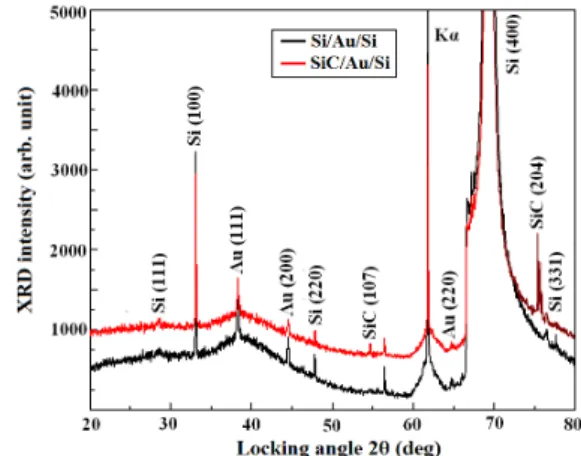
Figure 5 shows the XRD patterns of the Si solar cells which are deposited Si or SiC nano-particles, Au thin film, and Si thin film, which were measured using the CuK

α

radiation. The XRD analysis of the Si nano-particle samples with Au and Si thin films shows that the characteristic planes at (111), (211), (220), and (400) depending on the peaks centered at 2θ=28°, 33.03°, 47.75°, and 69.32° are of the Si which is indexed in JCPDS#

72-1426, respectively. And the Au is found at (111), (200), and (220) depending on the peaks centered at 2θ=38.22°, 44.40°, and 64.67° indexed in JCPDS# 04-0789, respectively. Further- more, the SiO

2

peaks are additionally found at (112), (013), and (113) depending on the peaks centered at 2 θ=56.35°, 61.70°, and 66.56° indexed in JCPDS# 81.0069, respectively.

For the sample of SiC nano-particles with Au and Si thin films, the analysis shows that Si is characterized as planes at (111), (311), (400), and (331) depending on the peaks centered at 2θ=28.41°, 56.36°, 69.20°, and 76.40° which is indexed in JCPDS# 27-1402, respectively. And the Au peaks are found at (111) and (200) depending on the peaks centered at 2θ=38.24°

and 44.44° indexed in JCPDS# 04-0784, respectively. The SiC peaks are found at (008), (107), and (209) depending on the peaks centered at 2 θ=47.77°, 54.59°, and 75.33° indexed in JCPDS# 73.1663, respectively.

Figure 6 shows the photo-reflectances of the Si solar cells

which are deposited by Si or SiC nano-particles, Au, and Si thin

films, and are measured by the UV-VIS-IR spectro-photometer

for investigation of plasmonic effect of the formed Au silicide

nano-balls. The samples of Au silicide nano-balls show lower

reflectance than Si thin film sample in the spectral range of the

Fig. 5. XRD intensity patterns of the Si solar cells which are

deposited Si or SiC nano-particles, Au thin film, and Si

thin film.

(5)

wavelength below 510 nm. And the reflectance of Si thin film sample also starts to decrease at wavelength range of 423 nm, and shows the lowest reflectance visible-IR wavelength ranges from 516 to 1002 nm.

In plasmonic surface of solar cell, the light is scattered and trapped into the cell by various angle scattering from metal nano-particles at the surface, indicating the increase in light absorption

14, 15)

. Furthermore, this light scattering and trapping is very sensitive to the size, shape, and position of nano-particles on solar cell. The light absorption is better for smaller metal nano-particles at plasmonic surface, but very small nano- particles also cause Ohmic loss, so that the enhancement of scattering rate is appropriate for larger nano-particles

16-19)

. Therefore, the sample of larger Au nano-balls as shown in Fig.

2 shows lower reflectance than the sample of smaller nano-balls and structure overall. Furthermore, the lower reflectance of Au nano-balls with Si thin film samples than the Si thin film sample, in spectra range of short wavelength below the 480 nm of Au plasmon resonance, indicates the quantum confinement effect of very small Au quantum dots embedded in Si thin film

20, 21)

. Also, the Si thin film affects the decrease in reflectance in short wavelength range compared with general solar cells. Further- more, the sample of SiC nano-particles rapidly starts to increase at visible wavelength range of 684 nm due to multiform Si nano structure from the SiC energy band gap(2.3 eV), which also has no effect on the light absorption in the visible-IR wavelength range.

4. Conclusions

The fabricated samples using Si and SiC nano-particles, Au thin film by E-beam, and Si thin film by HWCVD show Au silicide nano-balls and Si structure. In the Au thin film and Si surface system, the Au silicide nano-balls have various sizes depending on the edge, flat, and valley portions of the micro- textured surface. The larger nano-balls are located at gentle slope, and the gaps of each nano-ball are farther than nano-balls on flat surface, indicating that the surface tension of melted Au by eutectic point of 363 ℃ is very effective on the slopes of surface for the formation of nano-balls. Furthermore, these Au silicide nano-balls become larger when Si thin film deposits on Au thin film. The nano-balls are grown to come out of Si film as Au silicide, which indicates the high cohesiveness of Au by the Si thin film like forest. In terms of photo-reflectance, the samples of Au nano-balls show lower reflectance than the sample without nano-balls due to the surface plasmonic at 480 nm and the quantum confinement effect of very small Au nano-balls in short wavelength spectra range.

Acknowledgment

This work was supported by Green part production base and Technical Support (PJD13041) of the Korea Institute of Industrial Technology (KITECH) and Basic Science Research Program through the National Research Founda- tion of Korea (NRF) funded by the Ministry of Education, Science and Technology (NRF (2010-0025598).

References

1. K. Nakayama, K. Tanabe, H. A. Atwater, J. Appl. Phys. Vol.

93, pp. 121904, 2008.

2. M. Kirkengen, J. Bergli, and Y. M. Galperin, J. Appl. Phys.

102, 093713, 2007.

3. K. R. Catchpole and S. Pillai, J. Lumin. 121, 315, 2006.

4. H. A. Atwater and A. Polman, Nat. Mater. 9, 205, 2010.

5. S. Pillai, K. R. Catchpole, T. Trupke, and M. A. Green, J. Appl.

Phys. 101, 093105, 2007.

6. P. Spinelli1, V. E. Ferry, J. Groep, M. Lare, M. A.

Verschuuren, R. E. I. Schropp, H. A. Atwater, and A. Polman, J. Opt. 14, 11, 2012.

7. J. S. Lin, C. C. Chen, E. W. Diau, and T. F. Liu, J. Mater.

Process. Technol. 206, 425, 2008.

Fig. 6. Photo-reflectance of the Si solar cells which are deposited

Si or SiC nano-particles, Au, and Si thin films. The sam-

ples with Au silicide nano-balls show lower reflectance

than Ref. sample in spectra range of wavelength below

510 nm, indicating the contribution of the plasmon

effects. The reflectance of Ref. sample starts to decrease

at wavelength range of 423 nm, and shows the lowest

reflectance until 1002 nm.

(6)

14. D. Derkacs, S. H. Lim, P. Matheu, W. Mar, and E. T. Yu, Appl. Phys. Lett. Vol. 89, p. 1, 2006.

15. H. A. Atwater and A. Polman, Nat. Mater. Vol. 9, p. 205, 2010

p. 1029, 2010.

21. P. Claus, A. Bruckner, C. Mohr, and H. Hormeister, J. Am.

Chem. Soc. Vol. 122, p. 11430, 2000.

수치

Figure 2 shows the top and cross-sectional FE-SEM images  of the Si solar cells which are deposited by Si nano-particles, Au  thin film, and Si thin film
Figure 4 shows the EDX spectra images of the Si solar cells  which are deposited Si (Fig
Figure 5 shows the XRD patterns of the Si solar cells which  are deposited Si or SiC nano-particles, Au thin film, and Si thin  film, which were measured using the CuK α  radiation
Fig. 6. Photo-reflectance of the Si solar cells which are deposited Si or SiC nano-particles, Au, and Si thin films

참조

관련 문서

Regarding SI or BI EMG measured at upright posture on hard platform, bio-feedback group under the condition with opening both eye and aqua group under the condition with

Fig.. X-ray diffraction patterns for GTD-111 alloys after cyclic hot corrosion.. 염 도포 방법에 따른 부식속도는 SI D,SISDD순이다.염 도포량이 많을수록

Si 마이크로머시닝(mi cromachi ni ng)은 마이크로 열센서(thermalmi crosensor)나 가스 센서의 발달에 영향을 주고 있다 1-3) .현재까지 pol y Si 4) ,Si C 5) ,Ni Fe Al l oy 6) ,Ni

The data are corrected for temperature error due to solar radiation and the effect of low temperature on the anerod capsule and curvature of the surface of

Figure 4.15 Measured proportional constant A as a function of Cu content in Al-Si-Cu ternary alloys cast with

Electron probe micro-analyzer image of Zr-4%Si binary alloys; (a).. X-ray diffraction profiles of as-cast Zr-xSi binary alloys, which shows the dual phases.. Magnetic

(a) is without vibration condition, (b) is with vibration casting condition... Figure 4.24 Measured proportional constant a as a function of Si content in Al-Si binary

16 and 4 subjects were i ncl uded.In subdi vi si on 3 the frequency spectrums showed short,i rregul ar pattern bel ow 300Hz i s accompani ed by si mul taneous l ong durati