Vol. 19, No. 4, pp. 30-35, August 2015
Low Temperature Performance and Compressive Strength Characteristics of an Extruded Homogeneous SCR
Choong-Kil Seo*, Kwang-Chul Oh**†and Shin-Han Kim***
(Received 16 April 2015, Revision received 30 June 2015, Accepted 30 June 2015)
Abstract: The purpose of this study is to identify the low temperature performance and strength characteristics of V-based extruded homogeneous SCR. The extruded catalyst and the coated catalyst showed 50% and 27% of NOx conversion performance respectively at about 210℃ of catalyst temperature, so the extruded SCR was higher in de-NOx performance than the coated SCR especially at a low temperature zone. The compressive strength of the Enhanced Extrusion #1, in which the content of promoters such as silica, clay, glass fiber and binder was optimized, was a 120% improvement compared to the Extrusion#1 catalyst, higher than the coated SCR.
Key Words:Diesel engine, NOx, SCR, Extrusion, Coating, V
2O
5, Strength
**
†
Kwang-Chul Oh(corresponding author) : Korea Automotive Technology InstituteE-mail : [email protected], Tel : 041-559-3089
* Choong-Kil Seo : Howon university
*** Shin-Han Kim : Ceracom
1. Introduction
The emission regulations for diesel automobiles are becoming still stricter. For a diesel engine, there is some difficulty in reducing both PM and NOx simultaneously due to its combustion method, and various post-treatment technologies for each exhaust gas have been developed and applied. For a PM (Particulate Matter), a DPF (Diesel Particulate Filter) device has been already installed after Euro-4 to meet the emission regulations. However, for a nitrogen oxide (NOx), various technologies, such as EGR (Exhaust Gas Recirculation), LNT (Lean NOx Trap)
1), SCR (Selective Catalytic Reaction)
2)and a combination of the mentioned technologies, are being applied. A strong technology to reduce the
NOx emitted from a car is urea-SCR. For SCR catalysts, the vanadium (V
2O
5) SCR catalyst, which is excellent in sulfur resistance and is low in price, was most generally used for an initial stationary purpose. The SCR shows a difference in de-NOx performance depending on the temperature of exhaust gas, which is decreasing according to development in regulation modes and engine performances. Accordingly, the demand for the low temperature activity of a nitrogen oxide reducing device is strongly rising
3).
For SCR catalysts for vehicles, coated catalysts
are generally being used, but recently the R&D and
commercialization of extruded SCR catalysts are
under way because of the demand for enhancement
of low temperature activity and the advantage of
simplifying the catalyst manufacturing process. The
extruded catalyst has an advantage of reducing the
volume of SCR catalysts due to an increase in
surface area of the reaction according to an increase
in the structure or porosity of the wall flow such as
DPF as well as the reaction on the existing wall surface because the whole substrate is composed of catalysts without inactive parts
4-6). As kinds of extruded SCR, zeolite and vanadium SCRs have been used, of which the vanadium SCR has an advantage of a high NOx conversion rate at a low temperature but has a disadvantage that vanadium melts at 690℃. Therefore, the calcination temperature for production of extruded SCR is low to reduce its strength, so the research to improve the low temperature performance and strength of extruded SCR catalysts is important and meaningful.
The purpose of this study is to investigate the low temperature performance and compressive strength characteristics of extruded SCR.
2. Experimental setup and method
2.1 Catalyst preparation and characteristics The extruded SCR manufactured in this study is a vanadium-based V
2O
5-WO
3/TiO
2catalyst for diesel engines. The coated catalyst should go through complicated processes such as a process to make a substrate, a process to coat a substrate with catalysts and a process to calcinate it finally. On the contrary, the process to produce a extruded SCR catalyst gone through a process of mixing, extruding, drying and calcinating the raw material store in force the strength of substrates for the raw material of catalysts, to be economical.
The extruded SCR used for this study was manufactured as follows: Put a support TiO
2into an aqueous solution, stir it, put the designated precursor NH
4VO
3and ammonium paratungstate into it, and mix it. The SCR was manufactured through drying (110℃, 12h) and calcination (400℃, 5.5h), and the details of catalyst manufacturing cannot be provided due to the security for the company. The Brunauer- Emmett-Teller (BET) method was used to measure
the specific surface areas, pore volumes and pore size distributions of the catalyst samples (ASAP 2020, Micromeritics). Before the measurements, all of the samples were degassed to 1ⅹ10
-4Torr. The adsorption isotherms were obtained after degassing the pre-adsorbed hydrogen at 300℃ at 1ⅹ10
-6Torr for 0.5h. For the catalyst strength test, tester to measure the bending and compressive strength at 3points was used Tinius Olsen(H50K-SUTM).
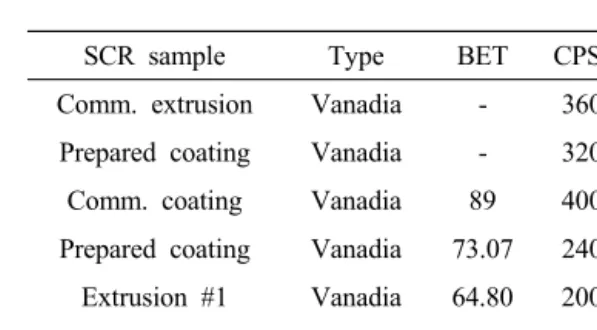
Table 1 shows the analytical results of SCR samples. The coated and extruded catalysts #1 are vanadium SCR catalysts, and are different in the manufacturing process. The extruded catalysts #1 and #2 are catalysts manufactured through a extrusion process, but are a vanadium SCR manufactured by an impregnation method and a Fe-zeolite catalyst manufactured by a ion exchange method, whose compositions are different.
Table 1 Analysis conditions
SCR sample Type BET CPSI
Comm. extrusion Vanadia - 360 Prepared coating Vanadia - 320 Comm. coating Vanadia 89 400 Prepared coating Vanadia 73.07 240 Extrusion #1 Vanadia 64.80 200 Extrusion #2 Fe-zeolite 248.2 200
2.2 Compression test method
Table 2 shows the specification of SCR catalysts to evaluate the strength of catalysts. In general, the extrusion #2 is larger in size (W*L*H) and thicker in wall thickness than the 2 kinds of SCR catalysts.
The calculation of bending strength can be
represented with the Equation (1) below, and the
SCR catalysts used for this experiment are hollow
cores, not solid cores, so it was converted into the
area of the red part in figure of Fig. 1, and
calculated. The converted cross-sectional area of the
compressive strength used the area cut in the longitudinal direction.
(1)
Bending strength σ
b, load P (kgf), width b (mm), thickness t (mm), distance between nodes l (mm)
Fig. 1 Calculation of the three-point bending strength
Table 2 Catalyst specification for evaluating strength SCR Comm.
coating Coating Extrus ion #1
Extrusi on #2 W*L*H
(mm)
4.35*4.3 5*6.3
5.3*5.3
*6.1
5.5*5.
5*6.62
6.5*6.5
*6.28 Wall
thick.
(mm)
0.212 0.336 0.305 0.462
Sectional
area(mm
2) 5.34 8.20 8.08 11.61
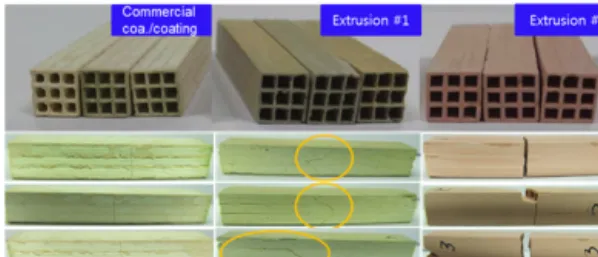
Fig. 2 shows the shape and cross section of the 3*3 cells of SCR catalysts to measure the strength of extruded catalysts compared to coated catalysts.
The cell density and wall thickness of each sample are different from each other, but an average value of 5 measurements at different locations was used to minimize errors in measurements. In Fig. 2, it can be seen that the wall of the coated SCR was coated with washcoat, and that the corner part of the wall was coated a little thicker. It can be seen that the extruded #1 and 2 were manufactured in an extrusion type, so the wall was not coated. The thicknesses of the wall was in the order of Extruded
#2 > Coating > Extruded #1 > Commercial coating.
Fig. 2 Photo of SCR catalyst for evaluating strength (three type of SCR (3*3 cell)
3. Experimental results and discussion
3.1 Enhancement of low temperature performance of an extruded SCR Fig. 3 shows the de-NOx performance depending on a change in the space velocity of the commercial extruded (vanadium) and coated SCR catalyst (vanadium) whose surface area ratios are relatively similar. For SV 20,000 h
-1, the extruded and the coated SCR catalysts show 50% and 27% of NOx conversion performance respectively at an about 21 0℃ of catalyst temperature. They show 87% and 76% respectively at 350℃ of catalyst temperature, and the extruded SCR was higher in the de-NOx performance than the coated SCR especially at a low temperature zone. The NOx conversion performance dropped more as the SV increased
0 20 40 60 80 100
150 200 250 300 350 400 450
Temperature(℃ )
NOx conversion(%)
C/E SV=20,000 h-1 C/E SV=45,000 h-1 C/E SV=60,000 h-1 P/C SV=20,000 h-1 P/C SV=45,000 h-1 P/C SV=60,000 h-1
Fig. 3 Enhanced low temperature performance of
extrusion SCR compared to coating SCR
(NH3/NOx=1.0)
0 20 40 60 80 100
150 200 250 300 350 400 450
Temperature(℃)
NOx conversion(%)
C/E 360 CPSI P/E 35 CPSI P/E 200 CPSI P/C 320 CPSI
Fig. 4 NOx conversion according to CPSI of extrusion SCR compared to coating SCR
more, because the reaction time shortened according to an increase in flow speed in a catalyst during a series of processes such as adsorption, reaction and desorption of NOx.
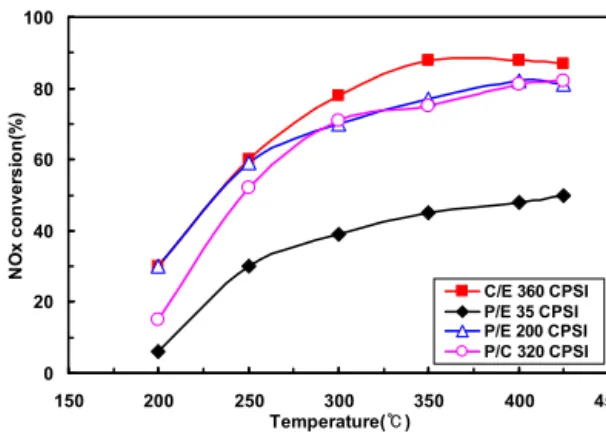
Fig. 4 shows the NOx conversion rate depending on CPSI of an extruded SCR compared to a coated SCR. Extrusion #1 (35 CPSI) shows the lowest NOx conversion rate compared to other SCR, because a less amount of catalysts are extruded due to a small CPSI. Extrusion #1 (200 CPSI) shows 10-13% higher NOx conversion rate at below 250℃
of catalyst temperature compared to the coated catalyst (320 CPSI), and the same level of NOx conversion performance at higher than 250℃. The overall trend, the NOx conversion of commercial extrusion SCR (360 CPSI) was higher than the prepared coating SCR (320 CPSI) of the same level.
The reason is because the substrate itself of extrusion SCR was composed of the catalyst materials with higher active area.
3.2 Compressive strength characteristics of a extruded SCR catalyst
The vehicles should also secure the strength of post-treatment catalysts due to the rotations and vibrations in many directions that occur during a drive. The extruded catalysts were weak in
mechanical strength in the past to be less frequently used in vehicles, but have recently overcome the weakness in mechanical strength due to development in the canning and material technology to be commercialized in cars, so a research on this should be continued. The calcination temperature for a vanadium-based extruded SCR is less than the substrate calcination temperature for a coated SCR because vanadium melts at about 690℃.
Accordingly, the compressive strength of an extruded SCR can be lower than the existing SCR coated on a ceramic structure.
Fig. 5 shows a photograph after a 3point bending strength test of SCR catalysts. For every SCR catalyst, fracture and destruction are realized at the central point to which bending was applied. The Fe-zeolite SCR of Extrusion #2 was highest in bending strength.
Fig. 6 shows the behavior of the 3point bending strength of the Extrusion #1 SCR. When a bending load was applied to a SCR catalyst, 1
stfracture happened about 85 seconds later and 2
ndfracture happened about 116 seconds later. When a 2.5kg
fload was applied, 3
rdfracture happened about 128 seconds later, and the catalyst samples was destroyed at 150 seconds.
Fig. 7 shows the loads depending on the
displacement of catalyst samples for 3 kinds of
SCR. The commercial coating and Extrusion #1
SCR catalysts was destroyed at a 0.3mm
displacement, and when a 17 and 4 kg
fload is
applied, a 0.3mm displacement happens, so the
commercial coating is larger in bending strength. On
the contrary, the Extrusion#1 catalyst is destroyed
when a 4kg
fbending load is applied, and is weakest
in bending strength. The coated SCR samples was
destroyed at a 0.4mm displacement when a about
7kg
fbending load was applied, and was better in
expansion property compared to other catalyst
samples.
Fig. 5 Photo after the three-point bending strength test
Fig. 6 Behavior of the 3 point bending strength of Extrusion #1
0 2 4 6 8 10 12 14 16 18 20
0 0.1 0.2 0.3 0.4 0.5
Displacement(mm)
Weight(kgf)