http://dx.doi.org/10.15433/ksmb.2014.6.2.076 ISSN 2383-5400 (Online)
Hexabromobenzens 농후 배양에 따른 해면( Axinella sp.) 공생 미생물의 군집구조 변화
Change of Sponge( Axinella sp.)-Associated Bacterial Community during the Cultivation with Hexabromobenzene
서현석1, 양성현1, 배승섭1, 이정현1,2, 권개경1,2*
Hyun-Seok Seo1, Sung-Hyun Yang1, Seung Seob Bae1, Jung-Hyun Lee1,2, Kae Kyoung Kwon1,2*
1한국해양과학기술원, 경기도 안산시 상록구 해안로 787, 426-744, 대한민국
2한국과학기술연합대학원대학교 한국해양과학기술원 캠퍼스, 경기도 안산시 상록구 해안로 787, 426-744, 대한민국
1Korea Institute of Ocean Science & Technology, Ansan 426-744, Republic of Korea
2Korea University of Science & Technology KIOST Campus, Ansan 425-600, Republic of Korea (Received 22 December 2014, Revised 29 December 2014, Accepted 29 December 2014)
적 요: 할로겐화 또는 탈할로겐화에 관여하는 미생물을 특정하고자 해양의 주된 할로겐화합물 생산자인 해면 공생미생물의 군집구조에 미치는 HBB (hexabromobenzene)의 영향을 밝히고 자 했다. 혐기 marine broth 2216에서 100ppm HBB첨가 유무에 관계없이 검출된 균주들은 산호나 해면에서 유래한 클론들과 높은 유사도를 보였으며 그 중 Deltaproteobacteria에 속하 는 Desulfovibrio marinisediminis와 99% 유사도를 보이는 클론이 우점하는 것으로 나타났다.
Clostridia계통의 Fusibacter paucivorans와 유사도가 높은 클론과 Lentisphaerae에 속하는 균 주들은 HBB에 의해 감소하는 반면 Clostridia계통의 Vallitalea guaymasensis와 유사도가 높 은 균주들은 HBB가 있는 경우에만 검출되었다. 알려진 균주들과의 비교 결과로 볼 때 D.
marinisediminis 및 V. guaymasensis 계통의 균주들이 할로겐화 및 탈할로겐화에 관여하는 것 으로 추정된다.
Abstract Bacteria associated with marine sponges seemed to be concerned in halogen- ation/dehalogenation process of natural compounds. In the present study, the effect of hex- abromobenzene (HBB) on the community structure of bacteria associated with a marine sponge Axinella sp. from Chuuk State under anaerobic condition was investigated.
Regardless of 100 ppm HBB, most of detected microorganisms displayed high similarity with clones reported from coral or sponges. Amongst, Desulfovibrio marinisediminis like clones were dominant. Clones affiliated with Lentisphaerae and Fusibacter paucivorans (Clostridia) were detected at the conditions without HBB but clones affiliated with Vallitalea guaymasensis (Clostridia) increased its proportion with HBB. From these results and previous reports clones affiliated with D. marinisediminis and V. guaymasensis seemed to be concerned in halogenation/dehalogenation process.
Keywords : dehalogenation, sponge, bacteria, Desulfovibrio marinisediminis, Vallitalea guaymasensis
* Corresponding author
Phone: 82-31-400-6242 Fax: 82-31-400-6232 E-mail: [email protected]
This is an open-access journal distributed under the terms of the Creative Commons Attribution Non-Commercial License
(http://creativecommons.org/licenses/bync/3.0)
서 론
브롬화난연제(Brominated Flame Retardant; BFR) 는 전 세계 난연제의 70% 이상에 이용되고 있다.
이 중 hexabromobenzene (HBB)은 중 플라스틱류, 섬유류, 전기제품류, 나무 등에 첨가되어 사용되고 있다 [23, 25]. HBB는 퇴적물, 토양, 알 및 쥐 생 체에 직접 축적되거나 광분해되어 tri-, tetra 또는 penta-bromobenzenes 형태로 탈브롬화하여 축적되 는 것으로 알려져 있다 [8, 25, 26]. HBB와 그 부 산물은 환경을 오염시키는 유해물질로서 환경을 파괴하고 먹이망(Food Web)을 거쳐 고등생물의 체내에 축적(Bioaccumulation)되고 바닷새에 의한 생물학적 이동(Biotransport)이 가능함으로써 오염 범위가 확산된다 [4, 8, 27, 28]. 이에 그린피스는 9번째 ‘Guide to Greener Electronics'를 발간하여 BFR와 같은 물질을 사용할 때 발생하는 유해물질 을 제거함으로써 침출(leaching)과 배출(offgassing) 방지, 폐전자제품이 안전하게 재활용되도록 하는 등의 친환경적 기업활동을 유도하고 있다.
할로겐화 화합물은 해양환경에서는 다양한 해면 동물에 의해서도 생산된다 [1, 19]. 또한, 해면동물이 많은 양의 할로겐화 화합물을 함유하고 있다는 것 은 탈할로겐화시킬 수 있는 해면 공생 미생물의 존 재를 암시하기도 한다 [1]. 해면 Aplysina aerophoba 의 경우 공생 미생물 중 주로 δ-Proteobacteria에 속 하는 미생물들이 탈할로겐화 효소인 dehalogenase효 소를 가질 것으로 보고되었다 [1].
본 연구에서는 Aplysina aerophoba와 같은 Ceractinomorpha 아강(subclass)에 속하는 Axinella sp. 공생 미생물의 16S rDNA 염기서열을 이용하 여 100 ppm HBB의 영향에서 생존 가능한 미생 물의 다양성을 분석하고자 한다. 이는 향후에 dehalogenase 효소 생산이 가능한 미생물 탐색에 활용될 수 있을 것이다.
재료 및 방법 시료 및 배양
배양에 사용한 배지는 anaerobic chamber(COY Lab)에서 무산소상태로 만들어진 Marine Broth
2216으로 만들어진 UTC Broth (Untreated Control Broth)와 UTC Broth에 HBB 100 ppm이 첨가된 HBB Broth 두 종류가 사용되었다. 시료로는 남태 평양 마이크로네시아 연방공화국 축(Chuuk)주에서 채집된 해면(Axinella sp.)이 이용되었는데, 해면 체 액 1 mL씩을 무산소 UTC Broth와 HBB Broth에 접종하여 25℃에서 배양시켰다. 동일 배지에 1주 일 간격으로 5주 동안 계대되어 배양되었다. 본 연구에는 1주, 3주, 5주차 배양액이 이용되었다.
Genomic DNA 추출
배양 시료 1 mL의 genomic DNA는 QIAGEN DNeasyⓇ Tissue kit로 추출하였고, Nano Drop (Nanodrop, USA)과 0.8% agarose gel을 이용하여 genomic DNA의 양을 정량분석 하였다.
16S rDNA 증폭
추출된 genomic DNA의 16S rDNA는 세균 도메 인의 보전 염기서열을 기초로 제작된 27F (5'-AGA GTT TGA TCM TGG CTC AG-3‘) primer 와 1518R(5'-AAG GAG GTG ATC CAN CCR CA-3’) primer를 이용하여 증폭되었다. PCR은 20
㎕ 용액에 주형 DNA 10-100 ng, 0.2 mM dNTPs, 0.2 μM primer, 1X Ex Taq buffer와 1.0 U ExTaq polymerase (Takara, Japan)로 구성되었다. PCR 반 응은 T1 Thermocycler (Biometra, Germany)를 이용 하여 94℃에서 5분 반응 후, 94℃에서 1분, 55℃
에서 1분, 72℃에서 2분씩 35회 반복 반응시켰으 며 마지막에 72℃에서 7분간 더 반응을 진행하였 다. PCR 산물인 1.5 Kb 크기의 DNA 절편은 0.8% agarose gel에서 확인한 다음 AccuPrepⓇ PCR Purification system(Bioneer, Korea)을 이용하 여 정제하였다.
16S rDNA 클로닝
증폭된 1.5 kb 크기의 16S rDNA는 pGEM-T Easy vector (Promega Corp.)에 제조사 방법대로 ligation 되었고, E. coli. DH5α에 형질전환 되었으 며 ampicillin (100 ㎍/㎕)이 포함된 LB(Difco Co., USA) 평판배지에서 blue-white colony 선별법에 의해 white 클론이 선별되었다.
유전자 서열 분석과 계통학적 분석
무작위로 선별된 클론의 콜로니 PCR은 선별된 클론을 주형으로 하여 primer T7(5'-TAA ATC CAA GAA TTT CAC C-3')과 SP6 (5'-ATT TAG GTG ACA CTA TAG AA-3')를 이용하여 수행되 었다. 증폭된 16S rDNA 산물은 96 well NucleoFast PCR prep system(MN, Germany)을 이 용하여 정제되었고, 518R(5'-GTA TTA CCG CGG CTG CTG G) primer와 ABI PRISMⓇ BigDyeⓇ Terminator v3.1 Cycle sequencing Kit(PE Applied Biosystems, USA)로 제조사의 방법에 따라 반응 시켰다. 최종적으로 알콜로 세척시킨 다음 ABI PRISM 3100 automated sequencer(PE Applied Biosystems, USA)로 유전자 서열을 분석하였다.
얻어진 약 400 base의 16S rDNA 염기서열은 BLAST 분석 툴 [2]을 이용하여 NCBI의 GenBank에 등록된 서열 중 가장 유사도가 높은 서열을 검색하 였으며 PHYLIP(Version 3.5c; [6]) 프로그램이 내장 된 PHYDIT 프로그램을 이용하여 2차구조 기반으로 정열시키고 Juke and Cantor distance [10] algorithm 과 Neighbor-Joining [17] 방법으로 계통분석을 실시 하였다. 계통도의 각 분기점의 지지도는 1,000번의 bootstrap 분석을 실시하여 검증하였다 [5].
한편 MVSP ver. 3.0 (Kovach, UK)을 이용하여 각 시료간의 유사도를 분석하였다.
결과 및 고찰 클론 분석 정보 요약
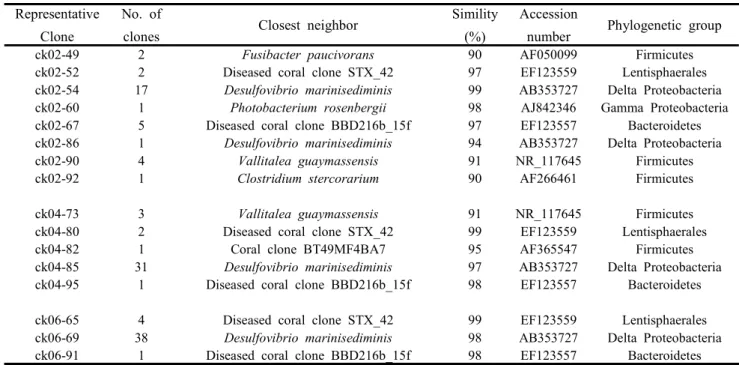
각각의 시료 중 1주차 62개(ck01와 ck02), 3주차 78개(ck03와 ck04), 5주차 85개(ck05와 ck06) 등 총 225개의 클론 염기서열을 얻었다(Table 1 과 2). 각 주차 배지별로 97% 유사도를 기준으로 클론들을 정리하고 Rarefaction curve를 그렸을 때 그래프가 포화곡선에 가까웠으므로 (자료 미제시) 충분한 샘 플이 확보되었음을 확인할 수 있었다 [11, 18].
HBB의 영향을 받은 1주차(ck01) 클론들은 Desulfovibrio marinisediminis [24], Lissodendoryx sp. 공생세균 클론 291P, Fusibacter paucivorans, 산호 공생세균 클론 SGUS930, Eubacterium oxidoreducens, human intestinal firmicute CO39와 유사도가 높은 7개 계통군으로, 3주차(ck03) 클론
은 D. marinisediminis, E. oxidoreducens, 클론 SGUS930, 산호공생 세균 클론 (AF365547), 비배 양 Planctomycetales와 유사도가 높은 5개 계통군 으로 나누어졌고, 5주차(ck05) 클론은 D.
marinisediminis, E. oxidoreducens, Photobacterium rosenbergii, Pseudovibrio denitrificans, Vallitalea guaymassensis, 비배양 Planctomycetales, 클론 SGUS930와 유사도가 높은 7개 계통군으로 나누 어졌다(Fig. 1, Table 1).
HBB가 첨가되지 않은 배지로부터 얻어진 클론 중 1주차(ck02) 클론은 C. stercorarium, D.
marinisediminis, E. oxidoreducens, F. paucivorans, 산호클론 STX_42, P. rosenbergii, 클론 SGUS930 와 유사도가 높은 8개 계통군으로, 3주차(ck04) 클론은 산호공생 세균 클론 (AF365547), D.
marinisediminis, E. oxidoreducens, 산호클론 STX_42, 클론 SGUS930와 유사도가 높은 5개 계 통군으로, 5주차(ck06) 클론은 D. marinisediminis, 산호클론 STX_42, 클론 SGUS930와 유사도가 높 은 3개 계통군으로 나누어졌다(Fig. 1, Table 2).
δ-Proteobacteria
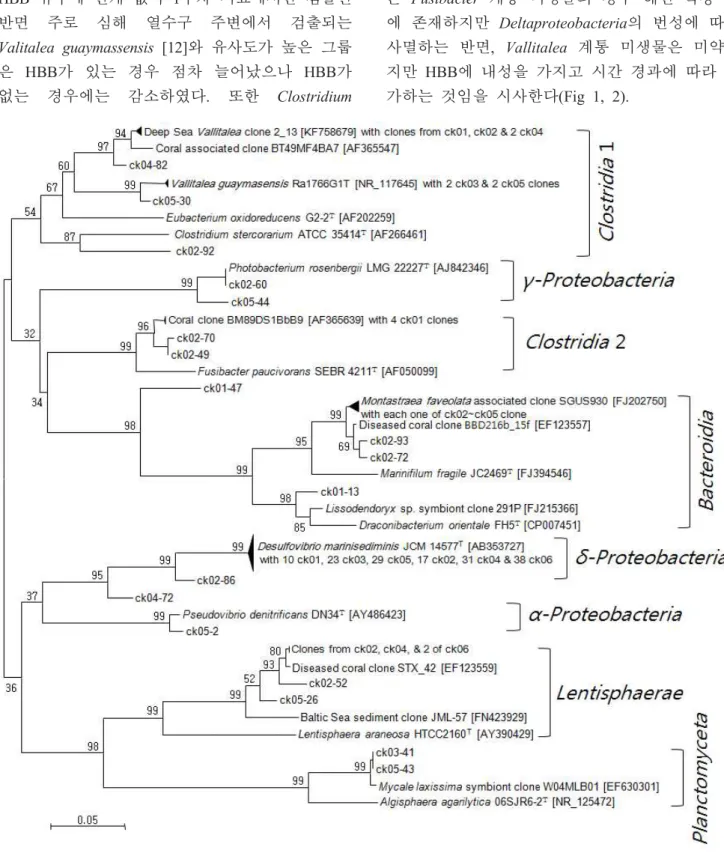
Deltaproteobacteria에 속하는 균주는 HBB 유무에 상관없이 D. marinisediminis, Desulfovibrio sp. TBP-1과 매우 높은 유사도를 보여 이들 그룹은 HBB의 영향을 받지 않는 것으로 추정된다(Fig 1, 2). 또한 전체 클론 중 70.7%를 차지하였으며 1주차보다 3주차 이후에 우 점도가 높아지는 것으로 볼 때 주어진 배양조건에 가 장 잘 적응한 분류군인 것으로 생각된다. 한편 Desulfovibrio sp. TBP-1은 2,4,6-tribromophenol의 dehalogenation을 하는 것으로 보고된 것을 감안하면 [3] 이들이 HBB의 탈브롬화에 관여할 것으로 추정된 다. 남태평양에 서식하는 Axinella sp. 해면에 공생하는 Deltaproteobacteria는 동일 아강에 속하는 해면인 Aplysina aerophoba 공생 미생물의 분포 [1]와 일치하 는 결과를 보였다.
α-Proteobacteria
및γ-Proteobacteria
α
-Proteobacteria인 Xanthobacter autotrophicus로 부터는 haloalkane dehalogenase gene과 결정구조가 밝혀졌지만 [7, 9], 본 연구 결과α
-Proteobacteria 와γ
-Proteobacteria는 각각 1개, 2개의 클론만이검출됨으로써 배양 시간과 HBB 영향의 존재 여 부를 판단하기 어려웠으나 (Fig 1) 이들 분류군에 속하는 세균이 해면에서의 혐기적 dehalogenation 에 관여하지는 않을 것으로 추정된다.
Firmicutes
검출된 Firmicutes 클론은 모두 Clostridia강에 속했 으며 HBB 유무에 따라, 또 종에 따라 시간경과에 대 해 다른 반응을 보였다. Fusibacter paucivorans [15]와
Table 1. Summary of representative bacterial clones from hexabromobenzene treated sponge cavity fluid culture
Representative Clone
No. of
clones Closest neighbor Simility
(%)
Accession
number Phylogenetic group ck01-5 10 Desulfovibrio marinisediminis 99 AB353727 Delta Proteobacteria ck01-13 1 Lissodendoryx sp. symbiont clone 291P 95 FJ215366 Bacteroidetes
ck01-18 13 Fusibacter paucivorans 90 AF050099 Firmicutes
ck01-22 2 Diseased coral clone BBD216b_15f 97 EF123557 Bacteroidetes
ck01-39 2 Vallitalea guaymassensis 92 NR_117645 Firmicutes
ck01-47 1 human intestinal firmicute CO39 84 AB064889 Bacteroidetes
ck03-10 3 Vallitalea guaymassensis 99 NR_117645 Firmicutes
ck03-11 2 Diseased coral clone BBD216b_15f 97 EF123557 Bacteroidetes
ck03-22 1 Coral clone BT49MF4BA7 98 AF365547 Firmicutes
ck03-39 33 Desulfovibrio marinisediminis 99 AB353727 Delta Proteobacteria ck03-41 1 Mycale laxissima clone W04MLB01 97 EF630301 Planctomycetales
ck05-2 1 Pseudovibrio denitrificans 98 AY486423 Alpha Proteobacteria ck05-26 3 Diseased coral clone BBD216b_15f 97 EF123557 Bacteroidetes
ck05-30 1 Clostridium oroticum 86 M59109 Firmicutes
ck05-34 6 Vallitalea guaymassensis 98 NR_117645 Firmicutes
ck05-37 29 Desulfovibrio marinisediminis 98 AB353727 Delta Proteobacteria ck05-43 1 Mycale laxissima clone W04MLB01 98 EF630301 Planctomycetales ck05-44 1 Photobacterium rosenbergii 96 AJ842346 Gamma Proteobacteria
Table 2. Summary of representative bacterial clones from untreated sponge cavity fluid culture
Representative Clone
No. of
clones Closest neighbor Simility
(%)
Accession
number Phylogenetic group
ck02-49 2 Fusibacter paucivorans 90 AF050099 Firmicutes
ck02-52 2 Diseased coral clone STX_42 97 EF123559 Lentisphaerales ck02-54 17 Desulfovibrio marinisediminis 99 AB353727 Delta Proteobacteria ck02-60 1 Photobacterium rosenbergii 98 AJ842346 Gamma Proteobacteria ck02-67 5 Diseased coral clone BBD216b_15f 97 EF123557 Bacteroidetes ck02-86 1 Desulfovibrio marinisediminis 94 AB353727 Delta Proteobacteria
ck02-90 4 Vallitalea guaymassensis 91 NR_117645 Firmicutes
ck02-92 1 Clostridium stercorarium 90 AF266461 Firmicutes
ck04-73 3 Vallitalea guaymassensis 91 NR_117645 Firmicutes
ck04-80 2 Diseased coral clone STX_42 99 EF123559 Lentisphaerales
ck04-82 1 Coral clone BT49MF4BA7 95 AF365547 Firmicutes
ck04-85 31 Desulfovibrio marinisediminis 97 AB353727 Delta Proteobacteria ck04-95 1 Diseased coral clone BBD216b_15f 98 EF123557 Bacteroidetes
ck06-65 4 Diseased coral clone STX_42 99 EF123559 Lentisphaerales ck06-69 38 Desulfovibrio marinisediminis 98 AB353727 Delta Proteobacteria ck06-91 1 Diseased coral clone BBD216b_15f 98 EF123557 Bacteroidetes
유사도가 높은 클론들(Fig. 1의 Clostridia 2)의 경 우 산호와 공생관계인 것으로 추정되는데 [16], HBB 유무에 관계 없이 1주차 시료에서만 검출된 반면 주로 심해 열수구 주변에서 검출되는 Valitalea guaymassensis [12]와 유사도가 높은 그룹 은 HBB가 있는 경우 점차 늘어났으나 HBB가 없는 경우에는 감소하였다. 또한 Clostridium
oroficum과 유사도가 높은 클론은 HBB 배지에서 5주차에만 검출되었다 (Table 1, 2). 이상의 결과 는 Fusibacter 계통 미생물의 경우 해면 복강 내 에 존재하지만 Deltaproteobacteria의 번성에 따라 사멸하는 반면, Vallitalea 계통 미생물은 미약하 지만 HBB에 내성을 가지고 시간 경과에 따라 증 가하는 것임을 시사한다(Fig 1, 2).
Fig 1. Neighbor-Joining tree based on partial sequence of 16S rRNA gene from clones of the untreated and hexabromobenzene treated sponge-associated samples with closely related clones in GenBank.
Bacteriodetes
Bacteriodetes문에 속하는 미생물 클론들은 모두 Bacteroidia강에 속하며 해양미생물로 이루어진 Marinilabiliaceae, Draconibacteriaceae 등의 과에 속하 였다. 또한 해면이나 산호에서 발견된 클론들과 높은 유사도를 보임으로써 이들은 해면 [13] 산호 [20, 22]
등의 해양생물과 공생관계에 있는 것으로 추정된다.
또한 HBB 영향과 배양시간에 무관하게 생존할 수 있는 균주로 추정된다(Fig 1, 2).
Lentisphaerae
Lentisphaerae에 속하는 미생물은 병든 산호 [20]나 기수역 퇴적토 [21]의 미생물과 유사도가 높았다. 이들은 HBB가 없을 경우에만 검출되는 것으로 보아 HBB의 영향이 치명적인 미생물일 가능성이 높다(Fig 1, 2).
Fig 2. Proportional changes of clone groups with transfer times. Transfer was conducted with one week interval.
Clostridia 1 group showed high 16S rRNA gene sequence sim- ilarity with the genus Vallitalea, Clostridia 2 group was similar with the genus Fusibacter. Others in treated samples were con- sisted with Planctomycetes and alpha- and gamma-Proteobacteria and in untreated control were consisted with Lentisphaerae.
Planctomyceta
Planctomyceta에 속하는 클론은 모두 2개였으며 HBB가 있는 경우에 검출되었다(Fig. 1, 2). 또한 이들은 수족관으로 옮긴 해면에서 검출된 것으로 보아 해면의 공생미생물인 것으로 추정된다 [14].
그러나 이들 미생물의 역할은 확실하지 않다.
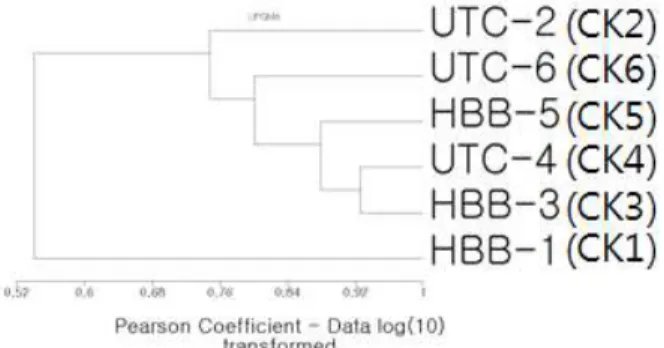
Fig 3. Cluster analysis using UPGMA clustering method based on Pearson's correlation coefficient similarity. The addi- tion of HBB maybe significantly affect only in the first week of treatment. Except at first week with HBB, microbial commun- ity structure depend on not addition of HBB but transfer times.
시간별 HBB 영향에 따른 상관관계
Cluster 분석 결과는 1주차 HBB 시료의 세균군집 이 현저하게 다른 것으로 나타났으며(Fig. 3) HBB 가 없는 경우에도 1주차 미생물군집이 다른 시료 에 비해 차이가 큰 것으로 나타났다. 이상의 결과 는 HBB 첨가는 아마도 초기 1주간에 심각한 영향 을 미치지만 이후 배양환경의 변화가 미생물 군집 구조에 더 큰 영향을 미쳤을 가능성을 시사한다.
요약 및 결론
남태평양에 위치하는 마이크로네시아 연방공화국 축(Chuuk)주에서 채집된 해면(Axinella sp.)의 복강 체 액을 무산소상태에서 100 ppm의 HBB를 주었을 때
HBB가 주어지지 않은 조건과 비교하여
Deltaproteobacteria에 속하는 Desulfovibrio mar- inisediminis가 우점한다는 점에서 동일하였으나 HBB 에 의하여 Lentisphaerae에 속하는 미생물이 사멸한 다는 점과 Clostridia강 미생물의 경우 HBB 유무에 따라 검출되는 종에 차이를 보였다. 또한 보고된 자 료와 비교하였을 때 halogenation/ dehalogenation 관련 유전자를 확보하기 위해서는 D. marinisediminis와 Vallitalea속 미생물을 선택적으로 배양하는 방법을 적용하는 것이 타당한 것으로 사료된다. 또한 1주차 배양 시료의 경우에 HBB의 영향이 크게 나타난 반 면 시간 경과에 따라 시료간 미생물 군집구조 차이 가 줄어드는 것으로 볼 때 이들 미생물을 얻기 위해 서는 배양에 의한 왜곡이 심해지기 전인 1주 정도의 배양만으로 충분한 것으로 판단된다.
감사의 글
본 논문은 한국해양과학기술원 기관고유과제 (PE99212)의 지원으로 수행되었습니다. 시료 채 취에 도움을 주신 KIOST 김충곤 박사님과 태평 양해양과학기지 여러분께도 감사를 드립니다.
References
1. Ahn, Y-B., Rhee, S-K., Fennell, D. E., Kerkhof, L.J., Hentschel, U. and Häggblom, M. M. 2003.
Reductive dehalogenation of bromi- nated phenolic compounds by microorganisms associated with the marine sponge Aplysina aerophoba. Appl Environ Microbiol. 69, 4159-4166.
2. Bowman JP and McCuaig RD. 2003.
Biodiversity, community structural shifts, and biogeography of prokaryotes within Antarctic continental shelf sediment. Appl Environ Microbiol. 69, 2463-2483.
3. Boyle, A.W., Phelps, C.D. and Young, L.Y. 1999.
Isolation from estuarine sediments of a Desulfovibrio strain which can grow on lactate coupled to the reductive dehalogenation of 2,4, 6-tribromophenol.
Appl. Environ. Microbiol. 65, 1133-1140.
4. Bruchajzer, E., Frydrych, B, and Szymańska, J. A.
2004. Effect of repeated administration of hexabromobenzene and 1,2,4,5-tetrabromo- benzene on the levels of selected cytochromes in rat liver.
Int J Occup Med Environ Health. 17, 347-353 5. Felsenstein, J. 1985. Confidence limits on phylogenies:
an approach using the bootstrap. Evolution. 39, 783-791.
6. Felsenstein, J. 1993. PHYLIP: Phylogeny inference package version 3.5c. University of Washington, USA.
7. Franken, S. M., Rozeboom, H. J., Kalk, K. H. and Dijkstra, B. W. 1991. Crystal structure of haloackane dehalogenase: an enzyme to detoxify halogenated alkanes. The EMBO Journal. 10, 1297-1302.
8. Gauthier, L. T., Potter, D., Hebert, C. E, and Letcher, R. J. 2009. Temporal trends and spatial distribution of non-polybrominated diphenyl ether flame retardants in the eggs of colonial populations of Great Lakes Herring Gulls. Environ. Sci. Technol. 43, 312-317.
9. Janssen, D. B., Pries, F., VAN DER Ploeg, J., Kazemier, B., Terpstra, P. and Witholt, B.
1989. Cloning of 1.2-dichlorethane degradation genes of Xanthobacter autotrophicus GJ10 and expression and sequencing of the dhlA Gene. J.
Bacteriol. 171, 6791-6799.
10. Jukes, T. H. and Cantor, C. R. 1969. Evolution of protein molecules. In Mammalian Protein Metabolism, vol. 3, pp.21-32. Edited by H. N.
Munro. New York: Academic Press.
11. Kemp, P. F., and Aller, J. Y. 2004. Bacterial diversity in aquatic and other environments:
what 16S rDNA libraries can tell us. FEMS Microbiol. Ecol. 47, 161-177.
12. Lakhal, R., Pradel, N., Postec, A., Hamdi, M., Ollivier, B., Godfroy, A., and Fardeau, M.L.
2013. Characterization of Vallitalea guaymasensis gen. nov., sp. nov., a novel marine bacterium, isolated from sediments of Guaymas basin. Int.
J. Syst. Evol. Microbiol. 63, 3019-3023.
13. Lopez, J., A. Ledger, C. Peterson, K. Sfanos, D.
Harmody, S. Pomponi, and P. McCarthy. 2006.
Molecular census and comparison of cultured and uncultured microbial symbiont diversity from an ancient metazoan host, phylum Porifera, abstr. 6.15. Abstr. 5th Int. Symbiosis Soc.
Congr., Vienna, Austria, 4 to 10 August 2006.
14. Mohamed, N.M., Enticknap, J.J., Lohr, J.E., McIntosh, S.M. and Hill, R.T. 2008. Changes in bacterial communities of the marine sponge Mycale laxissima on transfer into aquaculture.
Appl. Environ. Microbiol. 74, 1209-1222.
15. Ravot, G., Magot, M., Fardeau, M.L., Patel, B.K.,
Thomas, P., Garcia, J.L., and Ollivier, B. 1999.
Fusibacter paucivorans gen. nov., sp. nov., an anaerobic, thiosulfate-reducing bacterium from an oil-producing well. Int. J. Syst. Bacteriol. 49, 1141-1147.
16. Rohwer, F., Breitbart, M., Jara, J., Azam, F., and Knowlton, N. 2001. Diversity of bacteria associated with the Caribbean coral Montastraea franksi. Coral Reefs 20, 85-91.
17. Saitou, N. and Nei, M. 1987. The neighbor- joining method: a new method for reconstructing phylogenetic trees. Mol Biol Evol. 4, 406-425.
18. Schloss, P. D., and Handelsman, J. 2005.
Introducing DOTUR, a computer program for defining operational taxonomic units and estimating species richness. Appl. Environ.
Microbiol. 71, 1501-1506.
19. Schmitz, F. J. and Gopichand, Y. 1978. (7E, 13ξ, 15Z)-14,16-dibromo-7,13,15-hexadecatrien- 5ynoic acid. A novel dibromo acetylenic acid from the marine sponge Xestospongia muta.
Tetrahedron Lett. 19, 3637-3640.
20. Sekar, R., Kaczmarsky, L.T. and Richardson, L.L. 2008. Microbial community composition of black band disease on the coral host Siderastrea siderea from three regions of the wider Caribbean. Mar. Ecol. Prog. Ser. 362, 85-98.
21. Sinkko, H., Lukkari, K., Jama, A.S., Sihvonen, L.M., Sivonen, K., Leivuori, M., Rantanen, M., Paulin, L., and Lyra. C. 2011. Phosphorus chemistry and bacterial community composition interact in brackish sediments receiving agricultural discharges. PLoS One 6, e21555.
22. Sunagawa, S., DeSantis, T.Z., Piceno, Y.M., Brodie, E.L., DeSalvo, M.K., Voolstra, C.R., Weil, E., Andersen, G.L. and Medina, M. 2009. Bacterial diversity and White Plague Disease-associated community changes in the Caribbean coral Montastraea faveolata. ISME J 3, 512-521.
23. Szymańska, J.A, and Piotrowski, J.K. 2000.
Hepatotoxicity of monobromobenzene and hexa- bromobenzene: effects of repeated dosage in rats. Chemosphere. 41, 1689-1696.
24. Takii, S., Hanada, S., Hase, Y., Tamaki, H., Uyeno, Y., Sekiguchi, Y. and Matsuura, K.
2008. Desulfovibrio marinisediminis sp. nov., a novel sulfate-reducing bacterium isolated from coastal marine sediment via enrichment with Casamino acids. Int. J. Syst. Evol. Microbiol.
58, 2433-2438.
25. Watanabe, I., Kashimoto, T, and Tatsukawa, R.
1986. Confirmation of the presence of the flame retardant decabromobiphenylether in river sediment from Osaka, Japan. Bull. Environ.
Contam. Toxico. 36, 839-842.
26. Yamaguchi, Y., Kawano, M, and Tatsukawa, R.
1986. Tissue distribution and excretion of hexabromobenzene (HBB) and hexachloro- benzene (HCB) administered to rats.
Chemosphere. 15, 453-459.
27. Yamaguchi, Y., Kawano, M, and Tatsukawa, R.
1988. Hexabromobenzene and its debrominated compounds in human adipose tissues of Japan.
Chemosphere 17, 703-707.
28. Zitko, V., and Hutzinger, O. 1976. Uptake of Chloro- and Bromobiphenyls, Hexachloro- and Hexabromobenzene by Fish. Bullet. Environ.
Contam. & Toxicol. 16, 665-673.