• 검색 결과가 없습니다.

Effect of thermal annealing on low-energy C-ion irradiated MgB<sub>2</sub> thin films

N/A
N/A
Protected

Academic year: 2021

Share "Effect of thermal annealing on low-energy C-ion irradiated MgB<sub>2</sub> thin films"

Copied!
5
0
0

로드 중.... (전체 텍스트 보기)

전체 글

(1)

Vol.21, No.3, (2019), pp.13~17 https://doi.org/10.9714/psac.2019.21.3.013

```

1. INTRODUCTION

Since the discovery of superconductivity in MgB 2 [1], numerous results have been reported on its practical applications [2-6]. A simple binary compound MgB 2 has the potential to replace the most commercialized superconducting (SC) materials, such as NbTi (T c ~ 9 K) and Nb 3 Sn (T c ~ 18 K), owing to its relatively high SC transition temperature (T c ~ 40 K) and high self-field critical current density (J c ) [7]. In addition, no weak-link problem in MgB 2 makes it more attractive for real applications [7, 8]. Although two-dimensional (2D)  bands of in-plane boron (B) p x and p y orbitals are mainly contributed to the superconductivity of MgB 2 , there is no weak link in MgB 2 unlike high-T c cuprate superconductors (HTSCs) with 2D pancake vortices [7-10]. However, the J c

of MgB 2 rapidly decreases in an applied magnetic field due to lack of pinning sites [11].

Ion irradiation is a unique method for creating flux pinning sites in superconductors, and swift heavy-ion irradiation is widely used for improving J c (H) of HTSCs because columnar defects, which act as strong pinning sites, are produced along ion tracks [12, 13]. Swift heavy-ion irradiations were also performed on MgB 2 , but the enhancement of J c (H) was marginal [14, 15]. Moreover, no columnar defects were observed along the ion tracks in MgB 2 , probably due to its metallicity [16].

In this paper, we studied the effect of thermal annealing on MgB 2 thin films irradiated by 350 keV C-ions with a dose of 1  10 15 atoms/cm 2 . Low-energy ion irradiations

into MgB 2 led to an expansion of the c-axis lattice constant together with changes in SC critical properties, such as T c

and J c . Interestingly, the T c and J c in the irradiated MgB 2

thin films were comparable to that of the pristine state after a thermal annealing. This was accompanied by the recovery of the c-axis lattice constant, indicating that the lattice displacements are critical in determining the SC critical properties of MgB 2 . These results provide useful information on the effect of ion irradiation in MgB 2

superconductor.

2. EXPERIMENTAL METHODS

Highly c-axis-oriented MgB 2 thin films were fabricated by using hybrid physical chemical vapor deposition (HPCVD) technique and the details of the growth process are described elsewhere [17, 18]. MgB 2 thin films with thicknesses of 400 (MB400nm) and 800 nm (MB800nm) were prepared for 350 keV C-ion irradiation with a dose of 1  10 15 C atoms/cm 2 (1E15), and C-ion irradiation was carried out by using Cockcroft-Walton type 400 kV ion beam accelerator at Korea Institute of Science and Technology (KIST), Seoul. Mean projected range (R p ) and damage events were calculated from the stopping and range of ions in matter (SRIM) Monte Carlo simulation program [19]. The R p of irradiated C ions was estimated to be around 560 nm from the surface of MgB 2 with a density of 2.57 g/cm 3 .

The films were investigated by using X-ray diffraction (XRD) before and after C-ion irradiation to examine the

Effect of thermal annealing on low-energy C-ion irradiated MgB 2

thin films

Soon-Gil Jung a,b , Seung-Ku Son a,b , Duong Pham b , W. C. Lim c , J. Song c , W. N. Kang b , and T. Park a,b,*

a Center for Quantum Materials and Superconductivity (CQMS), Sungkyunkwan University, Suwon 16419, Korea

b Department of Physics, Sungkyunkwan University, Suwon 16419, Korea

c Advanced Analysis Center, Korea Institute of Science and Technology (KIST), Seoul 02792, Korea

(Received 22 July 2019; revised or reviewed 25 July 2019; accepted 26 July 2019)

Abstract

We investigate the effect of thermal annealing on MgB 2 thin films with thicknesses of 400 and 800 nm, irradiated by 350 keV C-ions with a dose of 1  10 15 atoms/cm 2 . Irradiation by low-energy C-ions produces atomic lattice displacement in MgB 2 thin films, improving magnetic field performance of critical current density (J c ) while reducing the superconducting transition temperature (T c ). Interestingly, the lattice displacement and the T c are gradually restored to the original values with increasing thermal annealing temperature. In addition, the magnetic field dependence of J c also returns to that of the pristine state together with the restoration of T c . Because J c (H) is sensitive to the type and density of the disorder, i.e. vortex pinning, the recovery of J c (H) in irradiated MgB 2 thin films by thermal annealing indicates that low-energy C-ion irradiation on MgB 2 thin films primarily causes lattice displacement. These results provide new insights into the application of low-energy irradiation in strategically engineering critical properties of superconductors.

Keywords: Thermal annealing, MgB 2 thin films, C-ion irradiation, critical current density

* Corresponding author: [email protected]

(2)

change in the c-axis lattice constant. Superconducting transition of the samples was characterized by measuring the temperature dependence of electrical resistivity (  ) and dc magnetization (M) via the standard 4-probe method and the magnetic property measurement system (MPMS 5T, Quantum Design), respectively. Magnetic field dependence of the critical current density (J c ) was estimated from the magnetization hysteresis (M ‒ H) loops based on the Bean’s critical state model [7], and the flux pinning force density (F p ) was calculated using the relation F p = J c   0 H.

To investigate the effect of thermal annealing on the C- ion irradiated MB400nm and MB800nm, we annealed both irradiated films at temperatures of 200, 300, 400, and 500

o C for 30 min in a box furnace. Both the films were sealed in an evacuated quartz tube after wrapping them with tantalum (Ta) foil to minimize the decomposition of magnesium (Mg) during the heat treatment [20], [21].

XRD, M(T), and M ‒ H loops for the irradiated MB400nm and MB800nm were measured after annealing, for each annealing temperature.

3. RESULTS AND DISCUSSION

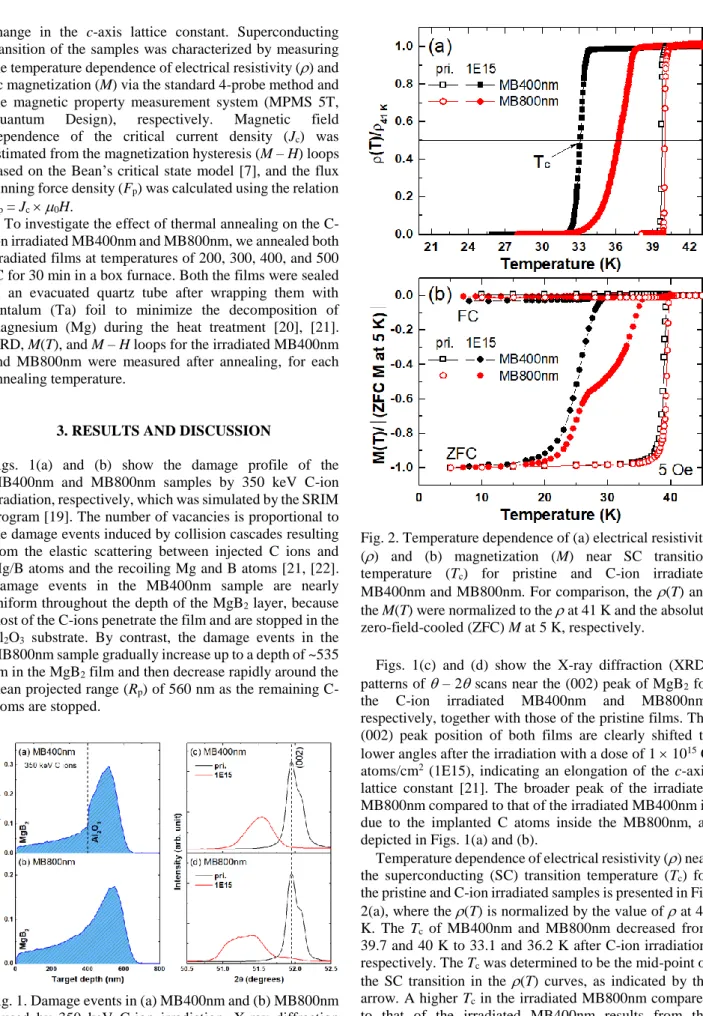
Figs. 1(a) and (b) show the damage profile of the MB400nm and MB800nm samples by 350 keV C-ion irradiation, respectively, which was simulated by the SRIM program [19]. The number of vacancies is proportional to the damage events induced by collision cascades resulting from the elastic scattering between injected C ions and Mg/B atoms and the recoiling Mg and B atoms [21, [22].

Damage events in the MB400nm sample are nearly uniform throughout the depth of the MgB 2 layer, because most of the C-ions penetrate the film and are stopped in the Al 2 O 3 substrate. By contrast, the damage events in the MB800nm sample gradually increase up to a depth of ~535 nm in the MgB 2 film and then decrease rapidly around the mean projected range (R p ) of 560 nm as the remaining C- atoms are stopped.

Fig. 1. Damage events in (a) MB400nm and (b) MB800nm caused by 350 keV C-ion irradiation. X-ray diffraction pattern around (002) peak of MgB 2 for pristine and 1E15 irradiated (c) MB400nm and (d) MB800nm.

Fig. 2. Temperature dependence of (a) electrical resistivity (  ) and (b) magnetization (M) near SC transition temperature (T c ) for pristine and C-ion irradiated MB400nm and MB800nm. For comparison, the  (T) and the M(T) were normalized to the  at 41 K and the absolute zero-field-cooled (ZFC) M at 5 K, respectively.

Figs. 1(c) and (d) show the X-ray diffraction (XRD) patterns of  ‒ 2  scans near the (002) peak of MgB 2 for the C-ion irradiated MB400nm and MB800nm, respectively, together with those of the pristine films. The (002) peak position of both films are clearly shifted to lower angles after the irradiation with a dose of 1  10 15 C atoms/cm 2 (1E15), indicating an elongation of the c-axis lattice constant [21]. The broader peak of the irradiated MB800nm compared to that of the irradiated MB400nm is due to the implanted C atoms inside the MB800nm, as depicted in Figs. 1(a) and (b).

Temperature dependence of electrical resistivity (  ) near the superconducting (SC) transition temperature (T c ) for the pristine and C-ion irradiated samples is presented in Fig.

2(a), where the  (T) is normalized by the value of  at 41

K. The T c of MB400nm and MB800nm decreased from

39.7 and 40 K to 33.1 and 36.2 K after C-ion irradiation,

respectively. The T c was determined to be the mid-point of

the SC transition in the  (T) curves, as indicated by the

arrow. A higher T c in the irradiated MB800nm compared

to that of the irradiated MB400nm results from the

proximity effect between the undamaged and the damaged

layers [23].

(3)

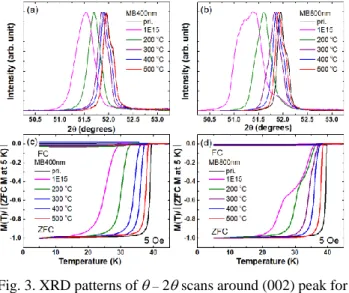
Fig. 3. XRD patterns of  ‒ 2  scans around (002) peak for thermally annealed (a) MB400nm and (b) MB800nm.

Temperature dependence of normalized magnetization for thermally annealed (c) MB400nm and (d) MB800nm. The shifted (002) peak position and the suppressed superconductivity caused by C-ion irradiation are gradually restored to the corresponding values of the pristine state with increasing annealing temperature.

Temperature dependence of magnetization (M) also shows a result similar to  (T). Fig. 2(b) shows the temperature dependence of zero-field-cooled (ZFC) and field-cooled (FC) dc M at 5 Oe for the pristine and C-ion irradiated samples, where the M(T) is normalized by the absolute ZFC M value at 5 K for comparison. The transition temperature of ZFC M for both MgB 2 thin films was reduced after C-ion irradiation. A kink is observed in the M(T) curve of irradiated MB800nm owing to difference in T c s of the damaged and the undamaged MgB 2 layers.

Because low-energy ion irradiation on crystalline materials is primarily known to produce damages related to lattice displacement, thermal annealing of the irradiated MB400nm and MB800nm was performed at temperatures

Fig. 4. Magnetic field dependence of the critical current density (J c ) at 5 K for (a) MB400nm and (b) MB800nm.

Normalized flux pinning force density (f p ) at 5 K as a function of reduced magnetic field (h) for (c) MB400nm and (d) MB800nm.

of 200, 300, 400, and 500 o C. Interestingly, the shifted (002) peak of the irradiated samples gradually returns to their original position with increasing annealing temperature, as shown in Figs. 3(a) and (b). The suppressed superconductivity of both films following the C-ion irradiation is also gradually restored to the pristine state with increasing annealing temperature, as shown in Figs.

3(c) and (d). The diamagnetic transition temperature for both irradiated films in the ZFC M(T) curves become close to that for the pristine films after annealing them at 500 o C.

Considering our previous study of thermally annealed MgB 2 films investigated using the energy dispersive spectroscopy (EDS), it is believed that the difference in ZFC transition between the pristine films and the annealed films at 500 o C is primarily due to the decomposition of Mg during the thermal annealing [20, 21]. In addition, a slight difference in the behavior of MB400nm and MB800nm is probably due to the C atoms remaining inside the MB800nm. These results indicate that the lattice displacement produced by the C-ion irradiation crucially influences the superconductivity of MgB 2 thin films.

Figs. 4(a) and (b) show the effect of thermal annealing on the critical current density (J c ) at 5 K for the C-ion irradiated MB400nm and MB800nm, respectively. Here, the magnetic field is applied perpendicular to the plane of the films. A large J c in self-field and its rapid decrease under applied magnetic fields represents that the prepared MB400nm and MB800nm are of high quality. The behavior of J c under applied magnetic fields for both films improved after C-ion irradiation. However, J c was largely suppressed at low fields, probably due to the suppression of T c and the SC volume fraction. Surprisingly, the field performance of J c for both irradiated films nearly returned to their pristine state after thermal annealing at 500 o C. This result is considerably different compared to neutron irradiated MgB 2 , which showed an enhancement of J c

under applied magnetic fields after thermal annealing [21, 24]. Since the magnetic field dependence of J c is strongly influenced by the characteristics and density of the pinning sites, this behavior of J c provides strong evidence that the damage caused low-energy ion irradiation on MgB 2 thin films is chiefly concerned with atomic lattice displacements [21].

Figs. 4(c) and (d) show normalized flux pinning density (f p = F p /F p,max ) as a function of reduced magnetic field (h = H/H peak ), where F p,max is the maximum flux pinning force density (F p ), and H peak is the magnetic field corresponding to F p,max . The f p (h)s of the pristine MB400nm and MB800nm are not explained by the flux pinning mechanisms given by the following equations [25, 26]:

𝑓 p (ℎ) = 3ℎ 2 (1 − 2ℎ

3 ) for ∆  pinning, (1) 𝑓 p (ℎ) = 9

4 ℎ (1 −

3 ) 2 for normal point pinning, (2) 𝑓 p (ℎ) = 25

16 √ℎ (1 − 5 ) 2 for surface pinning. (3)

On the other hand, the f p (h)s for both C-ion irradiated films

are close to the normal point pinning, indicating that the C-

ion irradiation of MgB 2 films produces point defects, such

as vacancies and interstitials, which are accompanied by

(4)

lattice displacements. Interestingly, the changed flux- pinning force behavior in the C-ion irradiated MgB 2 thin films was recovered to that of the pristine state after thermal annealing at 500 o C due to the reversal of lattice displacements. This is consistent with the results of the field dependence of J c . Since C doping in MgB 2 is well known as one of the most effective methods to improve the field performance of J c , a slight difference between the results obtained in case of MB800nm and MB400nm is most probably owing to the implanted C atoms inside the MB800nm [27, 28]. However, the C-doping effect on the J c (H) of MB800nm is not remarkable, because the concentration of C atoms at R p , where the C concentration is maximum, is about 0.35 % of the B concentration in MgB 2 [21]. These results also strongly support the viewpoint that the main defects produced by low-energy ion irradiation on MgB 2 thin films are due to displacement damages.

4. CONCLUSION

We investigated the effect of thermal annealing on 350 keV C-ion irradiated MgB 2 thin films with thicknesses of 400 and 800 nm. The superconducting transition temperature (T c ) for both irradiated MgB 2 films was suppressed by the atomic lattice displacements caused by collision cascades, while the magnetic-field performance of critical current density, J c (H), was improved due to the pinning sites created by the lattice displacements together with the Frenkel defect, vacancies and interstitials.

However, the lattice displacements reversed after thermal annealing, resulting in the restoration of the behavior of both T c and J c (H) corresponding to that observed in pristine samples. These results support the view that low-energy ion irradiation on MgB 2 induces a lattice displacement, which acts as a main disorder to change superconducting critical properties of MgB 2 . This observation provides new insights into the application of low-energy irradiation in strategically engineering superconducting properties of MgB 2 thin films.

ACKNOWLEDGMENTS

This work was supported by the National Research Foundation (NRF) of Korea by a grant funded by the Korean Ministry of Science, ICT and Planning (No.

2012R1A3A2048816) and the Basic Science Research Program through the National Research Foundation of Korea (NRF) funded by the Ministry of Education (NRF- 2016R1D1A1B03934513, 2015R1D1A1A01060382, and 2018R1D1A1B07048987). This work is also supported by KIST institutional program (2V06030).

REFERENCES

[1] J. Nagamatsu, N. Nakagawa, T. Muranaka, Y. Zenitani, and J.

Akimitsu, “Superconductivity at 39 K in magnesium diboride,”

Nature. London, vol. 410, pp. 63-64, 2001.

[2] M. Angst, S. L. Bud’ko, R. H. T. Wilke, and P. C. Canfield,

“Difference between Al and C doping in anisotropic upper critical field development in MgB 2 ,” Phys. Rev. B, vol. 71, pp.144512, 2005.

[3] J. Y. Lim, et al., “Effects of surface-treated boron powder using chemical solvents,” PSAC, vol. 20, pp. 11-14, 2018.

[4] Y. Kimishima, T. Okuda, M. Uehara, T. Kuramoto, "Doping effects of some metallic elements for SiC/MgB 2 bulk system,” Physica C, vol. 463–465, pp. 286–289, 2007.

[5] S. –G. Jung, et al., “A simple method for the enhancement of J c in MgB 2 thick films with an amorphous SiC impurity layer,”

Supercond. Sci. Technol., vol. 22, pp. 075010, 2009.

[6] K. Vinod, R. G. A. Kumar, and U. Syamaprasad, “Prospects for MgB 2 superconductors for magnet application,” Supercond. Sci.

Technol., vol. 20, pp. R1-R13, 2007.

[7] H. -J. Kim, W. N. Kang, E. -M. Choi, M. -S. Kim, K. H. P. Kim, and S. –I. Lee., “High current-carrying capability in c-axis-oriented superconducting MgB 2 thin films,” Phys. Rev. Lett., vol. 87, pp.

087002, 2001.

[8] D. C. Larbalestier, et al., “Strongly linked current flow in polycrystalline forms of the superconductor MgB 2 ,” Nature.

London, vol. 410, pp. 186-189, 2001.

[9] M. Kawasaki, et al., “Weak link behavior of grain boundaries in Nd-, Bi-, and Tl-based cuprate superconductors,” Appl. Phys. Lett., vol.

62, pp. 417-419, 1993.

[10] D. C. Larbalestier, A. Gurevich, D. M. Feldmann, and A. Polyanskii,

“Enhancement of the high-magnetic-field critical current density of superconducting MgB 2 by proton irradiation,” Nature. London, vol. 414, pp. 368-377, 2001.

[11] D. Y. Bugoslavsky, et al., “High-T c superconducting materials for electric power applications,” Nature. London, vol. 411, pp. 561- 563, 2001.

[12] A. K. Pradhan, S. B. Roy, P. Chaddah, D. Kanjilal, C. Chen, and B.

M. Wanklyn, “Flux pinning by columnar defects in Bi 2 Sr 2 CaCu 2 O 8+

single crystals,” Physica C, vol. 264, pp. 109-119, 1996.

[13] W. S. Seow, et al., “Influence of columnar defects on vortex dynamics in Bi 2 Sr 2 CaCu 2 O 8 from out-of-plane and flux transformer transport measurements,” Phys. Rev. B, vol. 53, pp. 14611-14620, 1996.

[14] A. Gupta, et al., “Study of magnetization and pinning mechanisms in MgB 2 thin film superconductors: effect of heavy ion irradiation,”

Supercond. Sci. Technol., vol. 16, pp. 951-955, 2003.

[15] N. Chikumoto, A. Yamamoto, M. Konczykowski, and M.

Murakami, “Magnetization behavior of MgB 2 and the effect of high energy heavy-ion irradiation,” Physica C, vol. 378-381, pp. 466-469, 2002.

[16] D. M. Duffy, N. Itoh, A. M. Rutherford, and A. M. Stoneham,

“Making tracks in metals,” J. Phys.: Condens. Matter., vol. 20, pp.

082201, 2008.

[17] W. K. Seong, S. Oh, and W. N. Kang, “Perfect domain-lattice matching between MgB 2 and Al 2 O 3 : single-crystal MgB 2 thin films grown on sapphire,” Jpn. J. Appl. Phys., vol. 51, pp. 083101, 2012.

[18] W. K. Seong, et al., “Growth of superconducting MgB 2 thin films by using hybrid physical-chemical vapor deposition,” J. Korean Phys. Soc., vol. 51, pp. 174-177, 2007.

[19] The mean projected range and damage events by C ion irradiation in the MgB 2 were calculated using the SRIM software (www.srim.org/)

[20] J. Y. Huh, W. K. Seong, S. –G. Jung, and W. N. Kang, “Influence of Mg deficiency on superconductivity in MgB 2 thin films grown by HPCVD,” Supercond. Sci. Technol., vol. 20, pp. 1169-1172, 2007.

[21] S. –G. Jung, et al., “Influence of carbon-ion irradiation on the superconducting critical properties of MgB 2 thin films,” Supercond.

Sci. Technol., vol. 32, pp. 025006, 2019.

[22] D. M. Parkin, “Radiation effects in high-temperature superconductors: A brief review,” Metall. Mater. Trans. A, vol. 21, pp. 1015-1019, 1990.

[23] S. –G. Jung, et al., “Giant proximity effect in single-crystalline MgB 2 bilayers,” Sci. Rep., vol. 9, pp. 3315, 2019.

[24] R. H. T. Wilke, S. L. Bud’ko, P. C. Canfield, J. Farmer, and S. T.

Hannahs, “Systematic study of the superconducting and normal- state properties of neutron-irradiated MgB 2 ,” Phys. Rev. B, vol. 73, pp. 134512, 2006.

[25] S. –G. Jung, et al., “Enhanced critical current density in the carbon- ion irradiated MgB 2 thin films,” J. Phys. Soc. Jpn., vol. 88, pp.

034716, 2019.

(5)

[26] T. Higuchi, S. I. Yoo, and M. Murakami, “Comparative study of critical current densities and flux pinning among a flux-grown NdBa 2 Cu 3 O y single crystal, melt-textured Nd-Ba-Cu-O, and Y-Ba- Cu-O bulks,” Phys. Rev. B, vol. 59, pp. 1514-1527, 1999.

[27] J. L. Wang, R. Zeng, J. H. Kim, L. Lu, and S. X. Dou, “Effects of C substitution on the pinning mechanism of MgB 2 ,” Phys. Rev. B, vol.

77, pp. 174501, 2008.

[28] W. Dai, et al., “High-field properties of carbon-doped MgB 2 thin

films by hybrid physical–chemical vapor deposition using different

carbon sources,” Supercond. Sci. Technol., vol. 24, pp. 125014,

2011.

수치

Fig. 1. Damage events in (a) MB400nm and (b) MB800nm  caused  by  350  keV  C-ion  irradiation
Fig.  4.  Magnetic  field  dependence  of  the  critical  current  density (J c ) at 5 K for (a) MB400nm and (b) MB800nm

참조

관련 문서

In order to analyze thermal stability and capacity loss according to the temperature of the battery cell by applying different C-rate discharge and

The data are corrected for temperature error due to solar radiation and the effect of low temperature on the anerod capsule and curvature of the surface of

Among the sub-factors of autonomy support coaching behavior, strategy recognition had the most direct influence on the grit of athletes, followed by

For job characteristics sub-factors, while the average of functional diversity was high in graduate school graduates, the average of task importance, job

No.. 4.24 Effect of solid fuels on the area ratio of Slag, Calcium-Ferrite and Matrix phase of C/S... 4.25 Comparison of Fe 2 O 3 and CaO contents measured by ICP-OES

The polarization-voltage (P-V) characteristics showed the typical hysteresis loop of PZT thin films after a post-CMP cleaning process with the optimized conditions

The results of the study on how Boswellia affects the hair cycle of the inflammatory skin(? scalp) caused by DNCB in mice are as follows, Experimental method : 5 week-old

Fourth, for the sub-factors of personality traits according to weight lifters’ education, while there was a high difference in neuroticism and agreeableness