Symptoms of Posttraumatic Stress Disorder and Mental Health in Women Who Escaped Prostitution and Helping Activists in Shelters
Young-Eun Jung,
1Jeong-Min Song,
2Jihye Chong,
3Ho-Jun Seo,
1and Jeong-Ho Chae
1Department of Psychiatry,
1The Catholic University of Korea, Seoul;
2Keyo Mental Hospital, Uiwang, Korea;
3Princeton University, Princeton, USA.
Received August 22, 2007 Accepted November 14, 2007
This study was supported by grants from Bombit Women’s Foundation, the Korean Health 21 R&D Project, Ministry of Health and Welfare (A060273) and the Specific Research Program (M10644 000013-06N4400-01310), Ministry of Science & Technology, Republic of Korea.
Reprint address: requests to Dr. Jeong-Ho Chae, Department of Psychiatry, The Catholic University of Korea, 62 Yeouido-dong, Yeongdeungpo-gu, Seoul 150-713, Korea. Tel: 82-2-3779-1250, 2019, Fax: 82-2-780-6577, E-mail: [email protected]
Purpose: This study compared the mental symptoms, especially symptoms of posttraumatic stress disorder (PTSD), of women who escaped prostitution, helping activists at shelters, and matched control subjects. Materials and Methods:
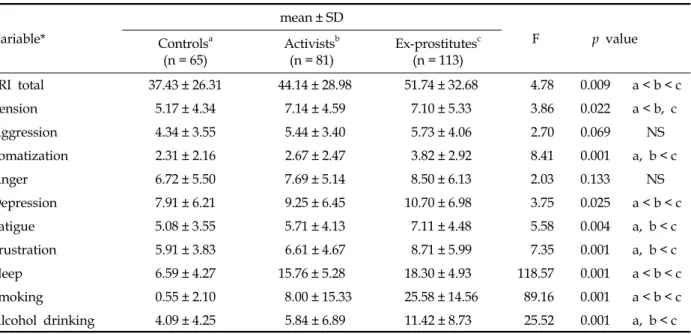
We assessed 113 female ex-prostitutes who had been living at a shelter, 81 helping activists, and 65 control subjects using self-reporting questionnaires on demographic data, symptoms related to trauma and PTSD, stress-related reactions, and other mental health factors. Results: Female ex-prostitutes had significantly higher stress response, somatization, depression, fatigue, frustration, sleep, smoking and alcohol problems, and more frequent and serious PTSD symptoms than the other 2 groups. Helping activists also had significantly higher tension, sleep and smoking problems, and more frequent and serious PTSD symptoms than control subjects. Conclusion: These findings show that engagement in prostitution may increase the risks of exposure to violence, which may psychologically traumatize not only the prostitutes themselves but also the people who help them, and that the effects of the trauma last for a long time. Future research is needed to develop a method to assess specific factors that may contribute to vicarious trauma of prostitution, and protect field workers of prostitute victims from vicarious trauma.
Key Words: Posttraumatic stress disorder, prostitution, mental health
INTRODUCTION
Prostitution is the practice of engaging in sexual activities with an individual other than a spouse or friend in exchange for payment. Although prostitution is a global and deeply rooted social phenomenon, substantial disparity exists in its perception, depending on different social and cul- tural factors.
1One view is to consider prostitution as a crime that induces violence; such as human trafficking, sexual abuse, rape, physical or verbal abuse, and racial discrimination, including serious violations of human rights.
2,3The other extreme is to consider prostitution as a type of occupation in which the people involved are known as special workers, or "sex workers".
4Despite the different points of view, a general consensus shows that women engaging in prostitution may be exposed to serious health risks,
5-7such as sexually trans- mitted diseases and HIV.
8-10In addition, studies on mental health problems suggest that depres- sive symptoms, anxiety, and psychological dis- tress are higher in women in prostitution.
5,11,12To examine the mental health of women who are engaged in prostitution, the characteristics of the process of prostitution must be understood.
According to previous studies, prostitution is
essentially a multi-traumatic phenomenon.
13First,
women in prostitution may occasionally be
involved in violence.
3A recent study of 854
women in prostitution in 9 countries reported that
70 - 95% of the women experience physical
assault, among which 60 - 75% had been raped.
2Similarly in Korea, where prostitution is illegal,
prostitutes experience sexual and physical violence.
In a study of 100 Korean women in prostitution, 96% of respondents answered that they experienced physical danger from weapons, physical violence, and injury from rape.
14Direct or indirect exposure to traumatic events in the course of prostitution is associated with psychological problems, including PTSD.
15PTSD can result from extremely traumatic experiences that are direct, personal, and involve actual or threatened death or serious injury; threat to one's personal integrity, witnessing an event that in- volves death, injury, or threat to the physical in- tegrity of another person, or learning about un- expected or violent death, serious harm, or threat of death or injury experienced by a family mem- ber or close associate.
16Several factors have been associated with an increased risk of developing PTSD following trauma exposure. These include background variables such as childhood trauma, comorbid mental health problems, family in- stability, and substance abuse.
17,18PTSD is a chronically disabling disorder asso- ciated with a large degree of morbidity. It rarely exists as a pure disorder and psychiatric co- morbidities such as depression, alcohol abuse, substance abuse, other anxiety disorders, and sui- cidal tendencies worsen the burden of this disorder.
19PTSD may be especially severe or long lasting when the stressor is planned and im- plemented by humans such as war, rape, incest, battery, or prostitution rather than natural catastrophes.
3Previous studies on prostitution have shown that prostitutes have a high prevalence of PTSD.
Sixty-eight percent of 827 prostitutes in 9 coun- tries met the criteria for lifetime diagnosis of PTSD.
3The severity of PTSD symptoms in the participants in the above study was in the same range as treatment-seeking combat veterans,
20,21battered women in protective shelters,
22,23rape survivors,
24and refugees.
25A study performed in Korea found that 81% of women with a history of prostitution had symptoms of PTSD,
14and research has suggested that prostitutes might have many risk factors for developing PTSD. Experiences of child sexual abuse are commonly reported among prostitutes. Additionally, violence related to pros- titution and adult sexual assaults are prevalent.
5,26Exposure to violence through engagement in
prostitution may contribute to persistent and se- vere psychological problems in not only direct victims but also people in close proximity who can suffer from a range of emotional symptoms in spite of not being directly exposed to the trau- matic events. This phenomenon has been de- scribed by a number of terms, including indirect traumatization, and has been documented among children of Holocaust survivors,
27wives of combat soldiers,
28and therapists who treat trauma victims.
29A number of terms describe the negative impacts that result from working with trauma- tized victims, including "burnout", "compassion fatigue", "secondary traumatic stress", and more recently "vicarious traumatization".
30The term "vicarious trauma" was first used by McCann and Pearlman to describe pervasive changes occurring within clinicians or counselors over time from working with victims who experienced sexual trauma.
31In our study, the term was used to describe secondary trauma and/
or traumatic stress. The unique features of counseling for sexual violence that contribute to the development of vicarious traumatization result from empathically listening to victims as they share graphic details of their traumatic experiences and psychological pain. Compared to other fields, sexual violence counselors have a higher risk of experiencing vicarious trauma.
31,32In a qualitative study of female counselors working with sexual assault victims, approximately 2/3 of participants reported intrusive imagery, dreams, and thoughts, including increased vigilance related to their safety, which decreases the level of trust in social interactions.
33Counselors and researchers who experience these negative effects may stop working with traumatized individuals,
34and the activists helping women exposed to trauma may experience more vicarious traumatic effects than workers in other fields. Therefore, recognizing and resolving vicarious traumatiza- tion may be crucial to the well-being of victims as well as counselors.
35Only a few studies examined PTSD symptoms
or its associations in the mental health of
prostitutes and control groups. In particular, a
controlled comparison of vicarious traumatic
effects among field workers who help female
prostitutes has not yet been performed.
The present study compared the mental health status of former female prostitutes who live in shelters, field workers helping prostitutes in shelters, and a normal control group. In keeping with the literature, we examined the specific PTSD symptoms and other manifestations of distress and mental health among the 3 groups.
MATERIALS AND METHODS Participants
We collected cross-sectional data using self- reporting questionnaires for 2 mos. Participants were former female prostitutes in shelters (ex- prostitutes), activists helping the ex-prostitutes in shelters (activists), and a control group. Ex- prostitutes and activists were recruited from 18 shelters with the support of the Bombit Women's Foundation that aids female prostitutes and workers who help prostitutes in Korea.
Female subjects age-matched to the ex-pro- stitutes were recruited from the surrounding community of each shelter as the control group.
Data were collected from all 3 groups during the same period, and the subjects were notified orally and also in writing on the first page of the questionnaire that their answers would be used only for research purposes. Informed consent was obtained from all participants.
Measures
The questionnaire consisted of demographic data, symptoms related to trauma and PTSD, stress-related reactions, and other mental health factors. Participants’ PTSD symptoms were as- sessed using the Davidson Trauma Scale (DTS)
36and the modified Impact of Event Scale-Revised (IES-R).
37DTS is a self-rating scale that assesses the frequency and severity of 17 symptoms re- lated to PTSD on a scale from 0 to 4. IES-R in- cludes 22 items scored on a 5-point scale that is designed to determine the impact of traumatic events. Scale validation studies conducted in Korea have shown that the measures are all high in reliability and validity.
38,39Stress reactions were assessed using the Stress Response Inventory
(SRI),
40a 39-item self-rating instrument developed to assess the severity of stress responses, specifi- cally on emotional, somatic, cognitive, and behav- ioral responses that occurred in the previous week. Stress reactions were rated on a Likert scale ranging from "not at all" (0), to "absolutely" (4).
The rated items were factor-analyzed using 7 sub- scales: tension, aggression, somatization, anger, depression, fatigue, and frustration.
Other factors related to mental health were included in the questionnaires, such as sleep, personal past history, family history varying from psychiatric illness to physical illness, and smoking or alcohol drinking history. Questions on sleep involved the frequency of awakening, whether alcohol or drugs were used for the induction of sleep, quality of sleep, early morning awakening, and the restoration level of sleep.
Analysis
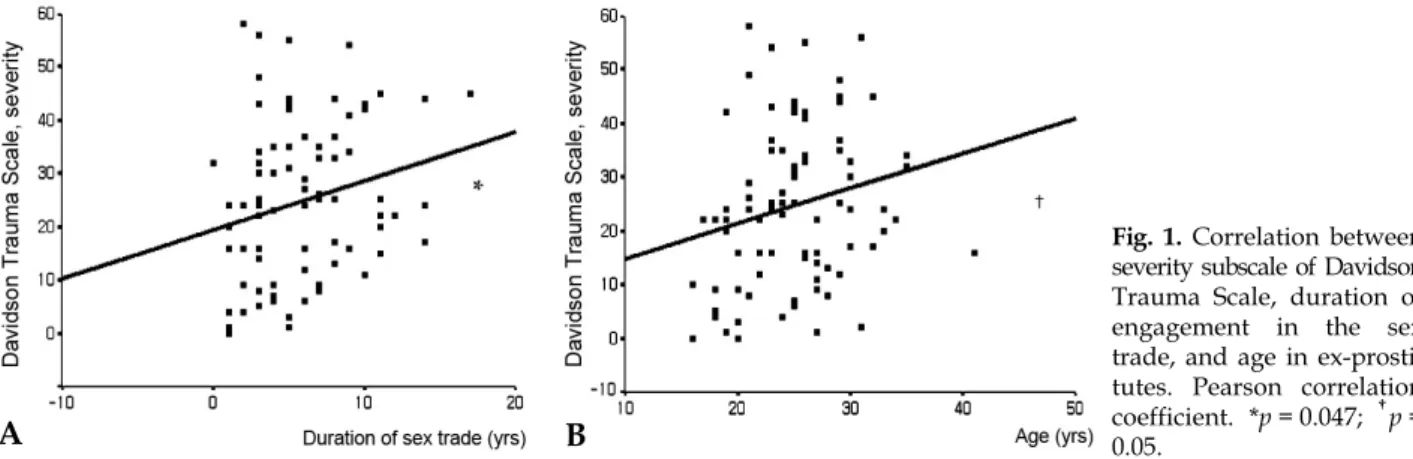
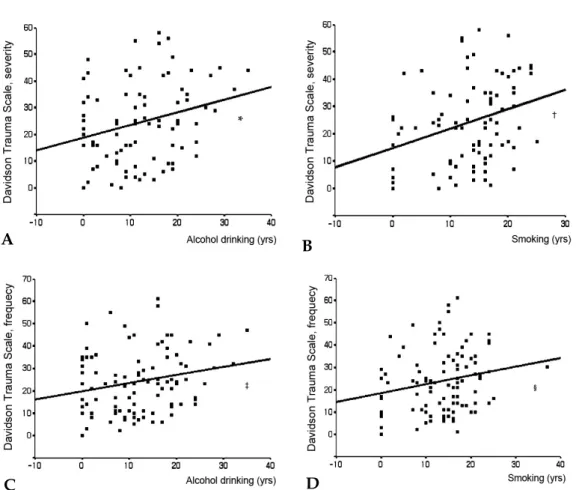
The statistical significance of differences among the results of the demographic data of the 3 groups was assessed by chi-square test and one-way ANOVA analysis. One-way ANOVA was also performed to analyze the differences in the total score, subscale score of the DTS, IES-R and SRI, and the sleep-, drinking-, and smoking-related scores of the 3 groups. Duncan's multiple compar- isons were then applied as post-hoc analysis to de- termine where the differences existed among the 3 groups. Pearson's correlation analysis was applied to determine which variables correlated sig- nificantly with symptoms of PTSD and mental health problems. The significance level was de- termined as p < 0.05.
RESULTS
Demographic characteristics
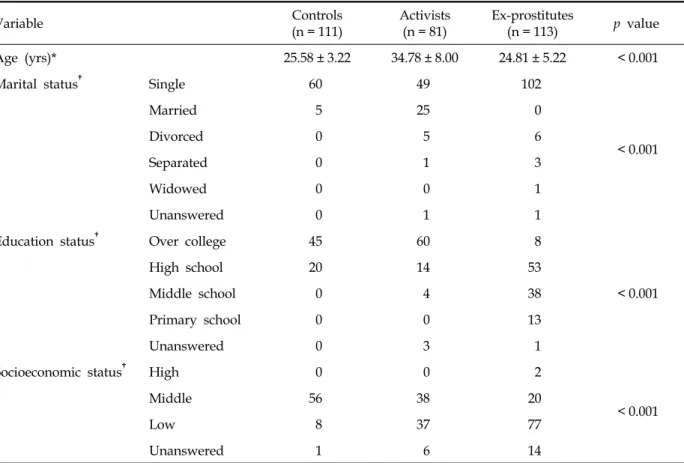
The demographic characteristics of the partic- ipants are presented in Table 1. A total of 113 ex-prostitutes (mean age, 25.58 ± 3.22 yr), 81 acti- vists (mean age, 34.78 ± 8.00 yr), and 65 control subjects (mean age, 24.81 ± 5.22 yr) participated.
The ages of the ex-prostitute group and the con-
trol group were not significantly different. None-
Table 1. Demographic Data of Ex-Prostitutes, Activists, and Controls
Variable Controls
(n = 111) Activists
(n = 81) Ex-prostitutes
(n = 113) p value
Age (yrs)* 25.58 ± 3.22 34.78 ± 8.00 24.81 ± 5.22 < 0.001
Marital status
†Single 60 49 102
< 0.001
Married 5 25 0
Divorced 0 5 6
Separated 0 1 3
Widowed 0 0 1
Unanswered 0 1 1
Education status
†Over college 45 60 8
< 0.001
High school 20 14 53
Middle school 0 4 38
Primary school 0 0 13
Unanswered 0 3 1
Socioeconomic status
†High 0 0 2
< 0.001
Middle 56 38 20
Low 8 37 77
Unanswered 1 6 14
*One-way ANOVA with post-hoc analysis.
†