Case Report
급성 족관절 염좌에 대한 복합 침치료의 효과: 사례군 연구
조남훈⋅김미령⋅정 훈⋅김동섭⋅김은수⋅박지용⋅박현민⋅이진호⋅하인혁
강남자생한방병원 한방재활의학과
The Effect of Combined Acupuncture Treatment on Acute Ankle Sprain:
Case Series
Nam-Hoon Cho, K.M.D., Mi-Riong Kim, K.M.D., Hoon Jeong, K.M.D., Dong-Sub Kim, K.M.D., Eun-Soo Kim, K.M.D., Ji-Yong Park, K.M.D., Hyun-Min Park, K.M.D., Jin-Ho Lee, K.M.D., In-Hyuk Ha, K.M.D.
Department of Rehabilitation Medicine of Korean Medicine, Gang-Nam Jaseng Hospital of Korean Medicine
RECEIVED November 5, 2013 REVISED November 13, 2013 ACCEPTED November 15, 2013
CORRESPONDING TO Nam-Hoon Cho, Department of Rehabilitation Medicine of Korean Medicine, Gang-Nam Jaseng Hospital of Korean Medicine, 858 Eonju-ro, Gangnam-gu, Seoul 135-896, Korea
TEL (02) 3218-2000 FAX (02) 3445-6644
E-mail [email protected]
Copyright © 2014 The Society of Korean Medicine Rehabilitation
The purpose of this study is to report the effect of combined acupuncture treatment on acute ankle sprain patients. The subjects included in this study were 15 acute ankle sprain patients who visited Jaseng Hospital of Korean Medicine from Oct. 15th, 2012 to Feb. 8th, 2013. We treated 15 patients with combined acupuncture treatment. The treatment con- sisted of Hwangrunhaedok-tang (Huanglianjiedutang) pharmacupuncture, electroacupunc- ture (applied to GB39, ST36 on the affected side), acupuncture (applied to TE17, SI6 on the unaffected side with Dong-Qi therapy). To assess the effect of treatment, the numeric rating scale (NRS) was applied before and after treatment. After first combined acupuncture treat- ment, the NRS scores significantly decreased from 8.33±0.94 to 2.26±0.44 (p<0.01).
We suggested that Combined acupuncture treatment are effective and useful on acute an- kle sprain. And, further studies will be needed. (J Korean Med Rehab 2014;24(1):119-123)
Key words Combined acupuncture treatment, Acute ankle sprain, NRS
서론»»»
일반적으로 족관절은 아주 흔히 외상이 발생하는 부위 중 하나이고, 모든 스포츠 상해의 10~30%를 차지한다.
스포츠로 인한 대부분의 족관절 외상은 외측 족관절 인대 손상을 포함하고, 77%가 족관절 염좌(ankle sprain)로 나 타난다1).
족관절 염좌가 일어나는 주요 원인은 비골근의 약화, 고유감각의 손상, 기계적인 불안정성 등이며2), 특히 고유 감각의 손상은 급성기와 재발성 발목손상의 중요한 원인 이 된다3). 족관절 염좌는 통증과 부종, 움직임의 제한이
나타나며, 그 결과 직장생활 또는 스포츠 활동의 원활히 할 수 없게 한다4).
발목염좌는 한번 발생하게 되면 섬유 조직이 신전되거 나 손상되어 약해진 상태에서 인대의 기능이 저하되어 내 번이 일어나는 횟수가 증가하며, 손상 초기에 효과적인 치료를 받지 않을 경우 만성발목 불안증(chronic ankle instability)으로 이환되는 확률이 높고5), 만성 재발생 염 좌로 진행되므로 조기치료와 재발 방지가 필요하다6).
족관절 염좌의 한의학적 치료에는 체침요법7), 이침요 법8), SSP 전자침요법9), 자락발관법10), 동씨요법11), Trigger point 치료12), 약침요법13), 봉약침요법14), 경근 첩대요법15),
추나요법16,17), 전침치료(쥐모델)18,19), 심부가열침술20) 등 의 다양한 방법을 사용한 치료법이 보고되고 있다.
이런 치료법들 사이의 치료 효과 비교연구도 계속되고 있다. VAS가 건측취혈(健側取穴) 치료군이 환측취혈(患側 取穴) 치료군보다 유의하게 감소하였고21), 원위취혈(遠位 取穴) 치료군이 근위취혈(近位取穴) 치료군에 비해 유의 하게 감소하였다22). 동씨침법과 일반 침치료의 비교에서 는 치료율에서는 큰 유의성이 나타나지 않지만, 치료효과 는 신속하게 나타나고23), 동기요법을 사용하였을 경우 동 기요법을 사용하지 않은 군보다 VAS가 유의하게 감소하 였다11). 체침과 Trigger point 치료에서는 두 군간 치료 효과에 유의한 차이가 없었다12). 체침과 약침 비교연구에 서는 황련해독탕 약침 치료군이 체침 치료군보다 NRS가 유의하게 감소하였고13), 일반 침치료와 봉약침 비교연구 에서는 부종상태의 호전은 일반 침치료군에서, VAS감소 는 봉약침 치료군에서 더 빠른 효과를 나타냈다24).
이에 저자는 급성 족관절 염좌에 대한 이전 연구에서 효과적으로 나타난 침치료법을 결합하여, 자생한방병원에 내원한 환자를 대상으로 연구를 시행하고 그 결과 유의한 효과를 얻은 증례가 있어 자생한방병원 IRB 위원회의 승 인(승인번호:SIRB2013-24)을 받아 보고하는 바이다.
대상 및 방법»»»
1. 연구대상
차트분석을 통해 2012년 10월 15일부터 2013년 2월 8 일까지 자생한방병원 외래에 내원한 환자 중 X-ray상 골 절 소견을 배제하고 발병 48시간 이내에 내원하여, 타 의 료기관에서 치료를 받지 않았으며, 증상, 손상의 기전, 이 학적 검사에 의거하여 급성 족관절 염좌로 진단된 NRS가 7 이상인 15명을 대상으로 후향적으로 분석하였다.
2. 치료방법
아래의 1), 2), 3)을 순차적으로 진행하였다.
1) 약침치료
자생 원외탕전원에서 제조한 황련해독약침을 患側의
縣種 (GB39), 足三里 (ST36)에 각 0.1 cc씩 총 0.2 cc를 일회용 Insulin syringe (29 gauge, 신창메디칼(주) 제조, 한국)를 이용하여 피부내 약 0.5~1 cm 깊이로 피부와 수 직으로 주입하였다.
2) 患側 近位 침치료 및 전침치료
患側의 縣種 (GB39), 足三里 (ST36)에 자침하고, 침은 직경 0.25 mm, 길이 30 mm인 동방침구제작소가 제작한 stainless steel 호침을 사용하였다. 앙와위에서 피하 1.5~2 cm의 깊이로 補瀉없이 자입하였다. 그리고 7.6 mA mixed pulse (1 ms long square wave pulses, low frequency 2 Hz and High frequency 100 Hz)로 전침 (9-V DC pulse generator device (STN-111, 스트라텍 (주), 한국)을 사용하였고, 자극 강도는 환자가 인내하는 범위내로 하였으며, 10분간 유침하였다. 유침시간동안 적 외선을 患側에 40~50 cm거리에서 80~90o로 조사하였다.
3) 健側 遠位 침치료 및 동기요법
健側의 翳風 (TE17), 養老 (SI6)에 자침하고, 환자로 하 여금 자침한 상태로 5 m거리를 왕복으로 5분간 능동보행 하게 하였다.
3. 평가방법
대상환자들의 연령, 성별, 발병 원인 등을 조사하였으 며, 통증의 정도를 객관화하기 위해서 외래 내원시부터 치료 전 Numeric Rating Scale (NRS)를 확인하여 기록하 고, 치료 후 변화된 NRS를 확인하였다. 통증이 없는 상태 를 0으로 하고 참을 수 없는 통증을 10으로 하여 표시해 놓고 환자가 숫자를 선택하도록 하였다.
4. 자료 분석 방법
자료의 분석은 SPSS 18.0 for Windows program을 사 용하여 통계처리를 하였다. 모든 측정값은 평균값±표준 편차(mean±standard deviation)로 나타내었고, 유의수준 은 p<0.05로 하였다. NRS변화에서의 유의성은 비모수통 계인 Wilcoxon signed rank test를 사용하여 분석하였다.
Table I. Patient Characteristics
Categories N %
Gender Male 5 33.3
Female 10 66.7
Age group 11~20 years 2 13.3
21~30 years 6 40.0
31~40 years 4 26.7
41~50 years 0 0
51~60 years 2 13.3
60 years 1 6.7
Injury Lesion Medial 0 0
Lateral 14 93.3
Anterior 1 6.7
Cause Walking slip 11 73.3
Sports injury 3 10
Falling 1 6.7
Table II. Comparison of NRS Score between Before and After Treatment
Before treatment After treatment p-value
NRS 8.33±0.98 2.26±0.46 0.01*
*p<0.01, significant difference between before and after treatment.
The data are expressed as the mean value±SD.
Statistical significance was evaluated by Wilcoxon signed rank test.
결과»»»
1. 환자의 일반적 특성
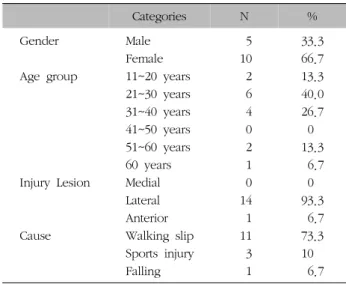
총 15명의 환자 중 남자 5명, 여자 10명이었으며, 평균 연령은 33.1±11.7세였다. 외측부 손상이 14예로 가장 많 았고, 족배부 손상이 1예였다. 발병원인으로는 보행시 접 질린 경우가 11예로 가장 많았고, 운동 중 다친 경우가 3 예, 높은 곳에서 떨어져서 생긴 경우가 1예였다(Table I).
2. 치료성적 평가
1회 치료 결과 NRS의 변화는 치료 전 8.33±0.94에서 치료 후 2.26±0.44로 통계적으로 유의한 감소를 보였다 (p<0.01) (Table II).
고찰»»»
족관절 염좌는 임상에서 흔히 접하는 질환이다. 손상의 가장 흔한 메카니즘은 ‘내번 염좌’인데, 이는 내번과 발의 족저굴곡의 결합으로 인한 손상에서 나타나고, 족관절의 외측인대 복합체에 손상을 준다25).
족관절 염좌의 치료는 비교적 간단하고 안정시 저절로 회복되는 경우도 많다. 하지만 일상생활에 큰 불편을 주
며, 충분히 치료하지 않아 손상받았던 부위를 다시 다치는 일이 많아 초기에 완전하게 치료하는 것이 중요하다26). 족 관절 염좌에 대한 치료는 일반적으로 PRICE (protection, rest, ice, compression, elevation)을 유지하는 것을 추천 한다. 경도와 중등도 염좌에서 탄력밴드, 테이핑 같은 기 능 치료(functional treatment)가 고정(immobilization)보 다 통계적으로 더 나은 것으로 밝혀졌다27).
임상경험상 가벼운 족관절 염좌는 1회의 침치료로 통 증의 소실과 관절 운동 회복을 보이는 경우가 많아서 치 료 경과를 관찰하기에 부적합하여, 본 연구에서는 치료 전에 보행시 통증 정도가 NRS상 7이상인 경우로 제한하 였다. 또한 치료의 급성 족관절 염좌에 대한 호전율을 비 교하기 위하여 발병 48시간 이내의 환자로 대상을 제한하 였다.
그리고 본 연구에서는 급성 족관절 염좌에 대한 이전 연구의 효과적인 침치료법을 선별, 결합하였다. 황련해독 탕 약침은 팔강약침에 속하는 것으로, 황련, 황백, 황금, 치자의 황련해독탕 처방을 달여서 나온 증류액을 모아서 냉각시킨 후 여과과정과 pH조절과정 등을 거쳐서 고압멸 균뒤에 사용하는데, 청열해독(淸熱海毒)의 효능이 있어 급성 족관절 염좌의 치료에 효과가 입증되었다13). 일반침 치료의 경우 患側과 健側21) 모두 진행하였고, 먼저 患側 의 경우 近位에, 전경골근의 대표인 足三里 (ST36), 비골 근에 위치한 縣種 (GB39)에 심자로 자침하였다12,22,28). 그 리고 두 부위를 전침으로 연결하였다18,19). 그 후에 健側 의 遠位에, 翳風 (TE17), 養老 (SI6)에 자침7,19)하고 자침 한 상태로 능동보행하게 하였다11).
특히 자침한 상태로 환자로 하여금 능동보행하게 한 것은 동기요법과 고유수용성 감각 운동의 복합으로 볼 수 있다. 이는 족관절 염좌 치료시 관절가동범위의 조기 회
복과 고유수용성 감각의 장애를 예방하기 위한 방법으로, 급성 족관절 염좌에서 동기요법이 효과적이라 하였고9,11), 고유수용성 감각 운동은 급성기의 초기 치료와 재발성 염 좌를 예방하는데 효과가 있다 하였다29,30).
본 연구는 차트분석을 통해 2012년 10월 15일부터 2013년 2월 8일까지 자생한방병원 외래에 급성 족관절 염좌로 내원한 환자 중 결합된 침치료를 받은 15명을 대 상으로 연구하였다. 총 15명의 환자 중 남자 5명, 여자 10명이었으며, 평균연령은 33.1±11.7세였다. 손상부위는 외측부 손상이 14예로 가장 많았고, 족배부 손상이 1예였 다.
통증 감소측면을 살펴보면, 본 연구의 결합된 침치료를 받은 15예에서 1회 치료전후 NRS의 변화는 치료 전 8.33±0.94에서 치료 후 2.26±0.44로 통계적으로 유의한 감소를 보였다(p<0.01). 기존연구에서는 동씨침군, 일반 침 치료군에서 각각 VAS상 5점이하가 나타날 때까지 1.57±0.85일, 2.15±0.96일이 걸린다 하였고23), 1회치료 후 VAS감소는 봉약침치료에서 6.94±0.75에서 4.00±1.12 으로24), 심부가열치료에서 5.62±2.24에서 2.14±2.08로20), NRS감소는 일반침군, 봉침군, 황련해독약침군에서 각각 6.41±0.87에서 3.88±0.69, 6.11±0.96에서 4.06±1.06, 6.12±0.99에서 4.59±0.94로 줄었다13). 이상의 결과로 본 연구의 결합된 침치료가 이전 연구에서의 단독 침치료 와 비교하여 급성 족관절 염좌에서 1회 치료시 통증 감소 에 보다 우수한 효과를 나타냈다.
급성 족관절 염좌는 한방에서 다빈도로 내원하는 질환 으로, 본 연구의 결합된 침치료법을 사용하여 1회 치료 후 통증정도를 보다 빠르고 크게 감소시킬 수 있다면, 환 자의 치료만족도 및 삶의 질 개선정도도 높아지고, 관련 질환으로 치료받고자 한방치료를 선택하는 환자수도 늘 어날 것이다.
하지만 본 연구에서는 NRS의 측정만으로 치료의 효과 를 평가한 것이 미흡한 점이었다. Ankle-Hind-foot scale (AHS)나 Bearing test와 같은 기능평가를 추가하여 보충 되어야 할 것으로 생각된다. 그리고 증례로 제시한 환자 수가 모집단의 크기가 정규분포를 이룰 만큼 충분하지 못 한 점이 있어 향후 충분한 모집단을 대상으로 한 연구가 지속되기를 바란다. 또한 본 연구는 차트를 통한 후향적 연구로, 제시한 방법 이외에 다른 여러 가지 選穴法이나 刺法에 대한 비교연구, 무작위 대조임상시험 등의 연구가
진행되어야 할 것으로 사료된다.
참고문헌»»»
1. Fong DT, Hong Y, Chan LK, Yung PS, Chan KM. A sys- tematic review on ankle injury and ankle sprain in sports. Sports Med. 2007;37(1):73-94.
2. Alt W, Lohrer H, Gollhofer A. Functional properties of adhesive ankle taping: neuromuscular and mechanical effects before and after exercise. Foot Ankle Int. 1999;
20(4):238-45.
3. Stefanini L, Marks R. Proprioception and recurrent ankle inversion injuries - a narrative review. 2003;31(1):25-39.
4. Kemler E, van de Port I, Backx F, van Dijk CN. A sys- tematic review on the treatment of acute ankle sprain:
brace versus other functional treatment types. Sports Med. 2011;41(3):185-97.
5. Anandacoomarasamy A, Barnsley L. Long term outcomes of inversion ankle injuries. Br J Sports Med. 2005;39(3):
e14.
6. Kerkhoffs GM, Rowe BH, Assendelft WJ, Kelly KD, Struijs PA, van Dijk CN. Immobilisation for acute ankle sprain. A systematic review. Arch Orthop Trauma Surg.
2001;121(8):462-71.
7. Kim KS, Cho NG. 염좌(捻挫)의 침치료에 관한 연구. The Journal of Korean Acupuncture & Moxibustion Medicine Society. 1995;12(1):73-8.
8. Han KJ, Oh MS, Choi SH. Clinical research on effect by the technique of auricular acupuncture therapy on ankle sprain. Daejeon University Institute of Oriental Medicine Collection of Theses. 2004;13(1):287-93.
9. Kim KY. The effects of alphabet exercise with SSP elec- trotherapy on lateral ankle sprain. The Journal of Korean Society of Physical Therapy. 2004;16(2):323-31.
10. Hwang JS, Lim DJ, Hwang JH, Cho HS, Kim KH. Study of the effect of blood-letting cupping treatment for acute ankle sprain: a randomize controlled trial. The Journal of Korean Acupuncture & Moxibustion Medicine Society.
2005;22(3):243-52.
11. Yoon HS, Kim SH, Jeong KS, Park SK, Ahn HJ. The study on the effects of Dong-Qi acupuncture therapy for the patient with ankle sprain. The Journal of Korean Acupuncture & Moxibustion Medicine Society. 2005;22(4):
65-72.
12. Kim YI, Kim YH, Lee H, Lee BR. Clinical comparison studies on 26 cases of patient with ankle sprain with acupuncture treatment group & trigger point treatment group. The Journal of Korean Acupuncture & Moxibus- tion Medicine Society. 2001;18(5):50-9.
13. Kang I, Moon JY, Lim MJ, Cho JH, Lee HE. The com-
parison study between different interventions for treating acute ankle sprain -Using dry needle, bee venom acu- puncture, hwangryunhaedoktang herbal acupuncture-.
The Journal of Korean Acupuncture & Moxibustion Medicine Society. 2008;25(5):89-95.
14. Seo JW, Park MJ, Sung IH, Kim NO, Ahn CK. A clinical study of bee venom acupuncture therapy on the treat- ment of acute ankle sprain. The Journal of Korean Acupuncture & Moxibustion Medicine Society. 2006;
23(1):95-103.
15. Park JM, Yoon MS, Woo I, Park WS, Youn YS, Jung SY, Kim SY, Lee JS. The effect of ankle meridian tendino- musculature taping on lateral ankle sprain; randomized controlled clinical study. Journal of Korean Medicine Rehabilitation. 2006;16(1):63-71.
16. Choi YJ, Kim JH, Yoon KJ, Yeo IH, Lee CK, Lee EY, Roh JD. Comparative study of general oriental medical treatment with or without ankle joint chuna therapy on ankle sprain. The Journal of Korea CHUNA Manual Medicine for Spine & Nerves. 2012;7(2):109-17.
17. Shim YS, Song HS. Effect of manipulation complex ther- apy on ankle sprain with ankle pain. The Journal of Korean Acupuncture & Moxibustion Medicine Society.
2013;30(2):65-71.
18. Hahm TS. The effect of 2 Hz and 100 Hz electrical stim- ulation of acupoint on ankle sprain in rats. J Korean Med Sci. 2007;22(2):347-51.
19. Kim HY, Koo ST, Kim JH, An K, Chung K, Chung JM.
Electroacupuncture analgesia in rat ankle sprain pain model: neural mechanisms. Neurol Res. 2010;32(1):10-7.
20. Lee YH, Kim CW, Lim CS, Lee KH. Clinical study on 21 cases of burning acupuncture therapy on ankle sprain.
The Journal of Korean Acupuncture & Moxibustion Medicine Society. 2012;29(4):19-24.
21. Jung HK, Jeong YP, Chiang SY, Lee JE, Wi J, Im JA, Gim JH, Ryu CY, Cho MR, Yun YC. The comparative study on the acupuncture at affected limb and un- affected limb on treating ankle sprain of acute stage.
The Journal of Korean Acupuncture & Moxibustion
Medicine Society. 2008;25(3):107-13.
22. Kim DJ, Choi YJ, Kim DH, Um JY, Song GH, Lee JS, Cho NG. The comparison of effectiveness between near acupuncture point needling and remote acupuncture point needling on treating ankle sprain of acute stage.
The Journal of Korean Acupuncture & Moxibustion Medicine Society. 2007;24(4):25-33.
23. Ahn HJ, Jeong DH, Hwang KS, Yoon KB, Kim TW, Moon JH, Baek JY, Lee SM. The comparative study on the dong-si acupuncture therapy and general acu- puncture therapy for the patient with ankle sprain. The Journal of Korean Acupuncture & Moxibustion Medicine Society. 2003;20(1):120-30.
24. Lee H. The comparative study on the bee-venom thera- py and common acupuncture therapy for the acute ankle sprain. The Korean Journal of Meridian & Acupoint.
2004;21(4):133-43.
25. Balduini FC, Tetzlaff J. Historical perspectives on injuries of the ligaments of the ankle. Clin Sports Med. 1982;
1(1):3-12.
26. You TS, Park DS, Kang SK. Clinical observations on treatment of ankle-sprain. The Journal of Korean Acu- puncture & Moxibustion Medicine Society. 2004;21(1):
168-75.
27. Seah R, Mani-Babu S. Managing ankle sprains in primary care: what is best practice? A systematic review of the last 10 years of evidence. Br Med Bull. 2011;97:105-35.
28. Park JS, Kim WY, Baek ST, Lee SD, Kim KS.
Comparison of superficial and deep acupuncture in the treatment of ankle sprain: a randomized controlled trial.
The Journal of Korean Acupuncture & Moxibustion Medicine Society. 2004;21(5):137-47.
29. Koh DH, Park DS, Shin WS, Song CH. The effect of a proprioceptive exercise and conservative therapy for functional recovery of subacute ankle sprain. The Korean Journal of Sports Medicine. 2008;26(2):167-74.
30. Cha SH, Kim JS. The effects of balance exercises on functional ankle stability with ankle sprained patients.
Health & Sports Medicine. 2009;11(2):73-83.