Introduction
Traditional Korean medicine (TKM) now plays an important role in medical treatment in Korea. TKM is often used for the treatment of various diseases including yin-yang deficiency conditions, menopausal disorders, autonomic imbalances, cold syndromes, etc. These diseases are still difficult to treat using Western medicine; however, by correcting the imbalance of the whole body, TKM are relatively effective
treatments
1-3). TKM uses eight treatment methods which are tonification, diaphoresis, emesis, purgation, mediation, warming, clearing and resolution. All these are for the harmonization of yin and yang
4-6).
In terms of TKM, thrombosis is a type of blood indigestion caused by circulation problems in the blood veins. Blood stasis is defined as blood indigestion of the internal body. It is a pathological effect and a factor that induces blood circulation disorders related to pathological processes. It also Objectives: Formulas for treatment of yin or yang deficiency conditions have been commonly used in traditional Korean medicine. The aim of this study is to examine the possible inhibitory effects of yin- or yang-tonifying formulas on in vivo anti-platelet activity and in vivo anti-thrombotic activity.
Methods: We tested the effects of 26 types of yin- or yang-tonifying formulas on platelet aggregation induced by collagen in human whole blood using the impedance method of aggregometry and accessed a biomarker of platelet activation using thromboxane B
2immunoassay. We also tested the anti-thrombotic effects of effective candidates on experimental models of thrombosis in mice.
Results: 3 types of yin-tonifying formulas and 3 types of yin-yang-tonifying formulas were selected to be the most effective candidates (p<0.01). Also, through in vivo study, the antithrombotic activities of Igyeong-tang, Gamisipjeondaebo-tang, and Gamisoyo-san-treated groups, with recovery rate of 60, 50, and 45.45%, respectively, were observed to be higher than those of the control group (saline, 36.8%) in mouse acute thrombosis.
Conclusion: These results show that yin-tonifying formulas are more effective in anti-platelet and anti-thrombotic activity than yang-tonifying formulas.
Key Words : formulas, tonifying, yin , yang , platelet aggregation, antithrombotic.
A Trend of Yin-tonifying Formulas Compared with Yang-tonifying Formulas on Anti-platelet and
Anti-thrombotic Activity
Won Kyung Jeon
1, Bo Kyung Yoo
1, Sang Young Ahn
3, Ju Hyun Lee
2, Sang Woo Ahn
3, Byoung Seob Ko
21
TKM Converging Research Division, Korea Institute of Oriental Medicine, Korea
2
Herbal Quality Control Center, Korea Institute of Oriental Medicine, Korea
3
TKM Information Research Division, Korea Institute of Oriental Medicine, Korea Original Article
Received:27 April 2009 Revised:2 July 2009 Accepted:6 July 2009
Correspondence to:Byoung Seob Ko
Korea Institute of Oriental Medicine, Daejeon 305-811, Korea.
Tel:+82-42-8689542, Fax:+82-42-8639541, E-mail:[email protected]
means hemorrheological disorder, peripheral circulatory disturbance and hemodynamic disorder. Thrombus is the main hemorrheological element involved in these
7,8). Platelet aggregation plays an important role in both physiological hemostatic and pathological thrombotic processes. Once vascular injury occurs, platelets will be activated by endogenous agonists such as ADP, collagen, and thrombin and adhere to the site of injury. The formation and release of thromboxane (TBX) A
2is a central component in the platelet response to a variety of agonists
9). The mod- ulation of platelet activity by specific pharmacological agents has proven to be a successful strategy for preventing thrombosis
10). Platelets have multiple acti- vation signaling mechanisms. Therefore, agents with anti-platelet and anti-thrombotic effects may have wide therapeutic potential for circulatory diseases
11-13).
In this context, in the search of another prospective of yin- and yang-tonifying, we selected 26 types of yin- or yang-tonifying formulas of every functional category based on Donguibogam
14)and evaluated the potential effect of these formulae on the blood circulation and blood stasis using in vitro whole blood aggregation assay and mouse acute thrombosis model.
Materials and Methods
1. Materials
Collagen and epinephrine were obtained from Chrono-Log Co. (USA). Thromboxane B
2immunoassay kit was obtained from R&D systems (USA). 68 species of medicinal herbs used in the study were purchased from a commercial supplier in Seoul, Korea, in 2003. All herbs were identified by and deposited at the herbarium of the Herbal Quality Control Center, Korea Institute of Oriental Medicine (KIOM) in Daejeon, Korea. All of the herbs were ground using a food mixer. These ground powders were prepared to formulas according to Donguibogam
14).
Each mixture of formula was refluxed with distilled water (10 g/100 mL) for 30 min below 100 . The extracted solutions were filtered and concentrated respectively under vacuum using a rotary evaporator and then freeze-dried to obtain dry extract powders.
2. Volunteers
A total of 8 healthy volunteers (females, aged range 20-28 years) took part in the study. For this study, blood was collected in Vacutainer tubes (Becton Dickinson, USA) containing 3.8% sodium citrate with a draw volume of 2.7 mL using standard phlebotomy techniques. All subjects had no history of bleeding disorders or cardiovascular disease, and refrained from any pharmacological therapy for at least 2 weeks before enrollment. None of the subjects smoked, and none exhibited hypertension, diabetes or abnormal hematocrit (HCT). All subjects gave written informed consent before participation. This study was approved by the Ethics Committee of the Korea Institute of Oriental Medicine in Daejeon, Korea.
3. Platelet-cell cytotoxicity
We examined platelet-cell cytotoxicity by formula extracts with a Coulter counter. The complete blood count (CBC) was analyzed using a Coulter JT automatic blood cell analyzer (Becton Dickinson, USA).
Briefly, platelet-cell damage was studied in whole blood adjusted to a count of 4×10
8platelet cells/mL with 0.9% saline in plastic cuvettes (Chrono-Log, USA) incubated at 37 for 10 min. 50-μL of formula extracts or saline (vehicle control) was added and incubated at 37 for 5 min and were counted using a blood cell analyzer.
4. Whole-blood platelet aggregation
We investigated inhibition of platelet aggregation from selected formulas by non-cytotoxicity results.
For the whole blood studies, blood was drawn
intravenously from healthy volunteers into vacuum
tubes to give 3.2% sodium citrate. Platelet aggregation was studied in whole blood preparation according the platelet-cell cytotoxicity process but containing a magnetic stir bar (Chrono-Log, USA). Whole blood aggregation was monitored for 10 min after addition of collagen (final concentration of 2μg/mL); during aggregation testing, samples were continuously stirred at 200μg in 37 with a 500VS Chrono-Log aggregometer (Chrono-Log, USA) using the impedance method
15,16), which allows the quantification of aggregation by electrical resistance between two electrodes immersed in whole blood.
5. Thromboxane B 2 immunoassay
For the TXB
2immunoassay, whole blood samples after aggregation assay were centrifuged at 2,000 g for 15 min. Supernatant aliquots were immediately frozen and stored at -20 until assay. The concen- tration of TXB
2, a stable metabolite of thromboxane A
2(TXA
2), was quantified using an ELISA kit (R&D systems, Inc. USA) according the manufacturer’s instructions. The absorbance was measured at 405 nm using a SpectraMax 340 reader (Molecular Devices, USA). The concentration of TXB
2calculated corresp- onded to the mean absorbance from the standard curve.
6. Acute pulmonary thromboembolism model A modification of the method reported by DiMinno and Silver was used
17). ICR mice, aged 3 weeks, were purchased from Orient Co. (Korea). The most effective extracts were suspended in saline and administered orally to ICR mice (4 weeks) once a day at a dose of 100 mg/kg. All experiments were performed 1 h after the final administration. A thrombotic challenge was induced by rapid intravenous injection of a mixture of collagen (1,200 μg/kg) and epinephrine (120 μg/kg) into the mouse tail. Each mouse was carefully watched for 15 min to determine whether the mouse was paralyzed, died or recovered
from paralysis caused by the acute thrombotic challenge. Animal experiments were approved by the committee on animal care at our institute and were carried out according to institutional guidelines.
7. Statistical analysis
The results are presented as mean±standard deviation (S.D.). Groups were compared with a paired t-test and a test using SPSS 11.0 for Windows (SPSS, Chicago, IL, USA). Values of p<0.05 were considered to be statistically significant.
Results
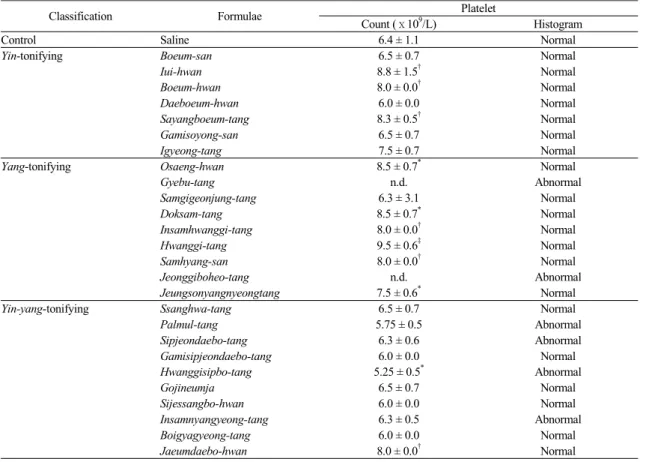
1. Influence on platelet-cell cytotoxicity For the evaluation on platelet damage, we examined 26 types of formula on platelet-cell cytotoxicity because platelets are a most important cell in whole blood aggregation
18,19). These results showed whether the inhibitory influence of extracts on platelet aggregation do or do not cause platelet-cell damage.
Using a Coulter counter, the formula extracts were examined for platelet-cell cytotoxicity effects. As shown in Table 1, platelet-cell cytotoxicity was observed in the presence of formula extracts. Among them, 4 types of yin-tonifying formulas, 1 type of yang-tonifying formula, and 5 types of yin-yang tonifying formulas did not cause any damage on platelet counts and histograms. Finally, we selected the extract of 10 types of formulas as candidates for screening for anti-platelet activity.
2. Inhibition on platelet aggregation in human whole blood
Control aggregation in saline induced by collagen
was systematically carried out at the beginning of
each experiment to verify the physiological status of
the platelets. Using the impedance method of
aggregometry, we tested the in vitro effect of 10
types of formula on the platelet aggregation that is
Classification Formulae Platelet
Count ( ⅹ10
9/L) Histogram
Control Saline 6.4 ± 1.1 Normal
Yin-tonifying Boeum-san 6.5 ± 0.7 Normal
Iui-hwan 8.8 ± 1.5
†Normal
Boeum-hwan 8.0 ± 0.0
†Normal
Daeboeum-hwan 6.0 ± 0.0 Normal
Sayangboeum-tang 8.3 ± 0.5
†Normal
Gamisoyong-san 6.5 ± 0.7 Normal
Igyeong-tang 7.5 ± 0.7 Normal
Yang-tonifying Osaeng-hwan 8.5 ± 0.7
*Normal
Gyebu-tang n.d. Abnormal
Samgigeonjung-tang 6.3 ± 3.1 Normal
Doksam-tang 8.5 ± 0.7
*Normal
Insamhwanggi-tang 8.0 ± 0.0
†Normal
Hwanggi-tang 9.5 ± 0.6
‡Normal
Samhyang-san 8.0 ± 0.0
†Normal
Jeonggiboheo-tang n.d. Abnormal
Jeungsonyangnyeongtang 7.5 ± 0.6
*Normal
Yin-yang-tonifying Ssanghwa-tang 6.5 ± 0.7 Normal
Palmul-tang 5.75 ± 0.5 Abnormal
Sipjeondaebo-tang 6.3 ± 0.6 Abnormal
Gamisipjeondaebo-tang 6.0 ± 0.0 Normal
Hwanggisipbo-tang 5.25 ± 0.5
*Abnormal
Gojineumja 6.5 ± 0.7 Normal
Sijessangbo-hwan 6.0 ± 0.0 Normal
Insamnyangyeong-tang 6.3 ± 0.5 Abnormal
Boigyagyeong-tang 6.0 ± 0.0 Normal
Jaeumdaebo-hwan 8.0 ± 0.0
†Normal
Results are mean ± S.D.
*
p<0.05 represents significant differences between the experimental and control values.
†
p<0.01 represents significant differences between the experimental and control values.
‡
p<0.001 represents significant differences between the experimental and control values.
Table 1.
Classification Formulae
Aggregation Ohm
( Ω) Inhibition
(%)
Control Saline 12.9 ± 2.7
Yin-tonifying Boeum-san 6.0 ± 4.2† 63.5 ± 12.3
Daeboeum-hwan 8.7 ± 2.1 29.6 ± 9.4
Gamisoyong-san 1.3 ± 0.6
‡90.4 ± 1.8
Igyeong-tang 3.0 ± 2.0
‡78.2 ± 12.3
Yang-tonifying Samgigeonjung-tang 9.0 ± 5.3 45.6 ± 21.9
Yin-yang-tonifying Ssanghwa-tang 8.0 ± 1 38.8 ± 14.5
Gamisipjeondaebo-tang 4.7 ± 3.1
‡68.3 ± 12.3
Gojineumja 2.7 ± 1.2
‡82.4 ± 7.8
Sijessangbo-hwan 10.3 ± 3.2 31.9 ± 22.2
Boigyagyeong-tang 6.3±5.0
‡55.7 ± 34.9
Results are mean ± S.D.
*
p<0.05 represents significant differences between the experimental and control values.
†
p<0.01 represents significant differences between the experimental and control values.
‡