• 검색 결과가 없습니다.

The Effect of Growth Condition on a Soluble Expression of Anti-EGFRvIII Single-chain Antibody in Escherichia coli NiCo21(DE3)

N/A
N/A
Protected

Academic year: 2021

Share "The Effect of Growth Condition on a Soluble Expression of Anti-EGFRvIII Single-chain Antibody in Escherichia coli NiCo21(DE3)"

Copied!
9
0
0

로드 중.... (전체 텍스트 보기)

전체 글

(1)

The Effect of Growth Condition on a Soluble Expression of Anti-EGFRvIII Single-chain Antibody in Escherichia coli NiCo21(DE3)

Kartika Sari Dewi

1

*, Ratna Annisa Utami

2

, Hariyatun Hariyatun

1

, Riyona Desvy Pratiwi

1

, Dian Fitria Agustiyanti

1

, and Asrul Muhamad Fuad

1

1

Research Center for Biotechnology, Indonesian Institute of Sciences (LIPI), Jalan Raya Bogor Km. 46, Bogor 16911, Indonesia

2
School of Pharmacy, Institut Teknologi Bandung, Jalan Ganesha No. 10, Bandung 40132, Indonesia

Received: June 9, 2020 / Revised: January 26, 2021 / Accepted: January 27, 2021

Introduction

Epidermal growth factor receptor variant III (EGFRvIII) is a mutant variant of EGFR that has a dele- tion on the gene encoding its extracellular domain. Thus, it cannot bind the ligand such as EGF and transforming growth factor- α (TGF-α). However, it can activate the

signal transduction process through constitutive auto- phosphorylation which leads to uncontrolled cell pro- gression. Besides, it is known that EGFRvIII is not expressed in healthy cells and only found on malignant cells such as gliomas, breast, ovarian, prostate, and non- small cell lung carcinomas [1 −3]. Therefore, this malig- nant-cell distinctive molecule is very potential as a tar- get for the development of antibody-based cancer therapy.

Single-chain variable fragment antibody (scFv) is a 30 kD molecule consists of heavy chains (VH) and light Single-chain antibodies against epidermal growth factor receptor variant III (EGFRvIII) are potentially promising agents for developing antibody-based cancer treatment strategies. We described in our previous study the successful expression of an anti-EGFRvIII scFv antibody in Escherichia coli. However, we could also observe the formation of insoluble aggregates in the periplasmic space, limiting the production yield of the active product. In the present study, we investigated the mechanisms by which growth conditions could affect the expression of the soluble anti-EGFRvIII scFv antibody in small-scale E. coli NiCo21(DE3) cultures, attempting to maximize production. The secreted scFv molecules were purified using Ni-NTA magnetic beads and protein characterization was performed using SDS-PAGE and western blot analyses.

We used the ImageJ software for protein quantification and determined the antigen-binding activity of the scFv antibody against the EGFRvIII protein. Our results showed that the highest percentage of soluble scFv expression could be achieved under culture conditions that combined low IPTG concentration (0.1 mM), low growth temperature (18 ℃), and large culture dish surface area. We found moderate-yield sol- uble scFv production in the culture medium after lactose-mediated induction, which was also beneficial for downstream protein processing. These findings were confirmed by conducting western blot analysis, indi- cating that the soluble, approximately 30-kDa scFv molecule was localized in the periplasm and the extra- cellular space. Moreover, the antigen-binding assay confirmed the scFv affinity against the EGFRvIII antigen. In conclusion, our study reveals that low-speed protein expression is preferable to obtain more sol- uble anti-EGFRvIII scFv protein in an E. coli expression system.

Keywords: Escherichia coli, EGFRvIII, scFv, periplasmic expression, PelB signal peptide

*Corresponding author

Tel: +62218754587, Fax: +62218754588

E-mail: [email protected]

(2)

chains (VL) which are coupled by a flexible peptide linker or disulfide bonds. Clinically, this miniature anti- body has several advantages, including rapid blood clearance, better tumor penetration, lower retention times in non-target tissue, and lower immunogenicity [4]. For those reasons, scFv against EGFRvIII has an excellent opportunity to be developed as a targeting agent for cancer treatment.

In comparison to its parental antibody, scFv can be economically expressed in E. coli because it is neither glycosylated nor complicated folding. However, an oxida- tive environment is still needed to get correct folding. In this case, the periplasmic compartment in E. coli is a good alternative to express scFv in a soluble form. For secreting this molecule into periplasm, scFv proteins must be equipped with a signal sequence to lead protein translocation across the cytoplasmic membrane [5]. In this experiment, we used PelB signal peptide which derived from periplasmic Pectate Lyase B of Erwinia carotovora [6]. This short sequence will help the scFv protein across the cytoplasmic membrane through SecYEG translocon [7].

Many environmental factors contribute to the heterol- ogous expression of periplasmic proteins. Overexpres- sion of these proteins will lead to the formation of inclusion bodies. There are several approaches to avoid the inclusion body formation in E. coli expression system, such as optimization of growth temperature, type, and concentration of inducer, vessel shape, and medium additives [8 −10]. For those reasons, in this study we examined the effect of incubation temperature, growth vessel, and induction-type on the soluble expression of scFv against EGFRvIII in E. coli periplasmic space. The goal of this study was to find the optimum condition for producing a highly soluble recombinant anti-EGFRvIII scFv protein.

Material and Methods

Strain

Escherichia coli NiCo21(DE3) harboring pJ414-scFv employed for scFv protein production was obtained from previous works [11, 12].

Medium for growth and expression

Medium that used in this experiment were Lysogeny

Broth (1% Tryptone, 0.5% Yeast Extract, and 1% NaCl) and Terrific Broth (1.2% Tryptone, 2.4% Yeast Extract, 0.015% MgSO

4

, 0.71% NaHPO

4

, 0.05% glucose, and 0.2% lactose). Medium for growth and expression was the same, except for lactose removal and the addition of 0.1% glucose in the preculture preparation.

Single colony purification

About 3 µl of glycerol stock suspension of E. coli NiCo21(DE3) carrying pJ414-scFv was spotted onto an agar plate containing 100 µg/ml Ampicillin (LB-Amp) and streaked using metal loop until four quadrants [13].

The plate was incubated overnight at 37 ℃. Eight single colonies were each inoculated into 2 ml liquid LB-Amp medium and grown overnight at room temperature (RT) with shaking at 150 rpm. Dilutions (1:50) of the over- night cultures in LB-Amp medium were grown at RT with shaking at 150 rpm until OD

600

= 0.8. Subse- quently, isopropyl β-D-1-thiogalactopyranoside (IPTG) with a final concentration of 0.1 mM was added and growth was continued overnight. The colony which produces the most significant amount of total scFv protein was used for further experiments.

Growth condition for scFv protein expression

Precultures were prepared by growing E. coli NiCo21(DE3) carrying pJ414-scFv recombinant plasmid in LB-Amp and TB medium which already supple- mented with 100 µg/ml Ampicillin (TB-Amp). By the next morning, dilutions (1:50) of precultures were grown either as 20 ml culture in 100 ml shake-tube or as 20 ml culture in 100 ml shake-flask. The incubation was carried out at 18 ℃ and 25℃ with continuous shaking at 150 rpm. For LB-Amp medium, IPTG with a final concentra- tion of 0.1 mM was added after the value of OD

600

= 0.8, and then incubation was continued for 24 h. For TB auto-induction medium, the growth was carried out for 48 h and lactose contained in the medium was acted as an inducer.

Isolation of periplasmic proteins

Pelleted cells from 20 ml culture were suspended

using 1.6 ml 5 mM CaCl

2

and incubated for 5 min. Then,

the suspension was centrifuged at 10,000 rpm for

10 min. The obtained pellet was resuspended in a cold

hypertonic solution (20% sucrose, 33 mM Tris-Cl, and

(3)

5 mM EDTA pH 8) and incubated at 4 ℃ with slow agita- tion for 10 min. The suspension was centrifuged at 10,000 rpm for 10 min and the supernatant was kept as soluble periplasmic proteins.

Micro-scale purification of scFv proteins using Ni-NTA Magnetic Beads

About 60 µl of HisPur

TM

Ni-NTA magnetic beads (Thermo Fisher Scientific, USA) were washed two times using phosphate buffer saline (PBS) pH 7.4 and then the supernatant was removed. About 900 µl cell-free culture medium and 100 µl 10× PBS pH 7.4 were added into magnetic beads and incubated overnight using end to end rotator at 4 ℃. Supernatant was removed and kept as flow-through fraction. Magnetic beads were then washed four times with 100 µl PBS and the supernatant was kept as wash fraction. Finally, the scFv protein was eluted from magnetic beads using 50 µl PBS containing 300 mM imidazole and done four times. The yield of purified scFv was quantified using Qubit™ 4 fluorometer (Thermo Fisher Scientific).

Protein characterization and quantification

The sample preparation was begin with normalization of cell number by diluting the culture until the value of OD

600

= 1.4. Thus, the cell number was assumed to be equal in all samples. The sample for total protein was made by pelleting 1 ml culture and then resuspended with 100 µl 5× SDS sample buffer. Sample was boiled for 10 min and centrifuged at 10,000 rpm for 10 min. About 5 µl sample supernatant was used for protein characteri- zation.

Sample for periplasmic proteins was prepared by mix- ing 18 µl soluble periplasmic proteins with 2 µl 5× SDS sample buffer. For analysis of extracellular scFv protein, sample was made from 500 µl cell-free culture medium which precipitated using Trichloroacetic acid (TCA) solution according to Link and Labaer [14]. Precipitated extracellular proteins were then resuspended using 20 µl 5× SDS sample buffer. Both samples were boiled for 10 min and centrifuged at 10,000 rpm for 10 min.

Supernatant obtained was used for protein character- ization.

Sodium dodecyl sulfate-polyacrylamide gel electropho- resis (SDS-PAGE) analysis was carried out according to Laemmli using 13% acrylamide gel [15]. For Western

blot analysis, KPL HisDetector Nickel-HRP (SeraCare life science Inc, USA) was used for direct detection of recombinant proteins [16]. Protein samples were applied onto acrylamide gel then transferred to nitrocellulose membranes using Mini Protean

®

II transblot unit (Bio-Rad). The membrane was blocked with 1% BSA in TBS (Tris-buffered saline) pH 7.6 for 1 h at room tem- perature with gentle agitation. After that, KPL HisDe- tector Nickel-HRP was added directly into the block solution with 1:2000 dilutions. Incubation was continued for 1 h and the membrane was washed three times with TBS-Tween 20 each for 5 min. Detection was carried out by adding KPL TMB membrane substrate directly to the membrane and developed for 5 −10 min.

The yield of target proteins was calculated based on Carter’s method [17]. The electropherogram of SDS- PAGE containing Bovine Serum Albumin (BSA) and scFv proteins were subjected to ImageJ software [18]. A series of BSA with known gradient concentration was used as a standard to make a linear regression equation by calculating its area under the curve (AUC) using ImageJ analysis. After that, AUC of target proteins was analyzed and the obtained value was entered into the equation to get the actual yield of target proteins. For quantification of scFv proteins with many other proteins bands nearby, the ratio between the migration of 25 kDa protein marker and the target protein in Western blot analysis was used to determine the precise target band in SDS-PAGE gel.

Antigen binding assay

The procedure of antigen-binding assay was the same as described in the purification procedure except for removing the elution step. After washing with PBS, the magnetic beads assumed to have been completely coated with scFv proteins were incubated with 20 µl recombinant EGFRvIII::BFP fusion proteins for 1 h. Next, the magnetic beads were washed with 30 µl PBS pH 7.4 and visual- ized using confocal fluorescence microscopy at 100×

magnification (Leica DM1000, Germany).

Results and Discussion

Single colony purification

The utilization of glycerol stock for preculture prepa-

ration often leads to low-yield protein expression.

(4)

Despite it might previously produce a high yield of the target protein [19]. This situation occurred quite often when the recombinant proteins were derived from humans which tend to be toxic to the host cell. Based on that reason, we began this study with colony purification followed by expression level analysis to select a high expressing colony.

In colony purification, the bacteria were streaked to isolate a pure E. coli NiCo21(DE3) carrying pJ414-scFv.

Subsequently, the expression level of scFv protein from selected colonies was screened by inducing the culture with IPTG and continued with SDS-PAGE characteriza- tion. Fig. 1 showed the expression of total scFv protein from eight selected colonies. It can be seen that there were thick protein bands around 30 kDa which corre- spond to the theoretical size of scFv protein. After com- paring the AUC value of target proteins from every colony, it was sure that colony number 1 produces the highest level of scFv protein.

The effects of different expression conditions

In this experiment, the effects of induction type, vessel shape, and growth temperature on the expression of soluble scFv protein were investigated. Plasmid used in this study harboring T7 promoter that is known for basal leaky expression results in a poor yield of protein production. In order to prevent the basal expression before the induction begin, about 0.1% of glucose was added into precultures. Precultures were prepared by inoculating colony number 1 into LB-Amp and TB-Amp medium, while subcultures were made by diluting the precultures (1:50) using fresh medium in two different vessels.

For IPTG-induction, the inducer was added after the culture reached the early log-phase (OD

600

= 0.8) and then the incubation was carried out for 24 h. The final concentration of IPTG used was based on the optimiza- tion made in previous works [11]. Besides, it has been known that low induction levels resulted in high amount of soluble proteins. Increasing the inducer concentration will lead high expression rates, resulted in more misfold- ing proteins and aggregates [20, 21]. For autoinduction, lactose contained in the medium was acted as an inducer and the incubation was carried out for 48 h. The entire study was performed at 18 and 25 ℃. Erlenmeyer flask and test tube were also used for protein production to observe the effect of growth vessel on the soluble expres- sion of scFv protein.

The scFv proteins found in the periplasmic compart- ment, culture medium, and cytoplasmic (including the aggregates) were analyzed using SDS-PAGE and quanti- fied by ImageJ analysis. To determine the optimum condition for producing soluble scFv, we calculated the relative percentage between total soluble scFv and total expressed scFv (including the aggregates). Fig. 2 showed the SDS-PAGE analysis of scFv protein expression in various growth conditions. To simplify the observation, we summarized the result of protein quantification in Table 1.

Posttranslational pathway was employed to export the pre-protein through the Sec translocon or SecYEG sys- tem. Nascent pre-protein binds first to trigger factor, then SecB and SecA. To deliver the bound pre-proteins to the translocon, SecB will bind specifically into SecA.

Binding of SecA bound pre-proteins to SecYEG translo- case initiates the translocation process [22, 23]. In the cytoplasm, pre-proteins should be maintained in a com- petent export conformation before translocation begins.

This conformation is maintained by many chaperones such as SecB, GroEL, DnaK, and DnaJ which also aid in preventing the aggregation and improper intramolecu- lar interactions of exported proteins [24, 25].

However, the availability of chaperon proteins was limited in the host cell. If the target proteins are overex- pressed, then the available chaperons will not be enough to maintain the nascent pre-protein in the intermediate state until the folding begins [26]. It is well-known that temperature affects recombinant protein expression sig- nificantly, especially for soluble protein expression. Low- Fig. 1. Colony selection of E. coli NiCo21(DE3) transformant

harbouring pJ414-scFv. Lane 1-8, total protein from colony

number 1-8. Lane 9, total protein of E. coli NiCo21(DE3) non-

transformant as a negative control.

(5)

ering growth temperature was proven to decrease in vivo aggregation of recombinant proteins. Thus a higher amount of soluble proteins are achieved. Suboptimal cul- tivation temperatures slow down the cellular process including replication, transcription, and translation which makes the nascent proteins have more time to fold correctly [27, 28].

To analyze the influence of growth temperature on the soluble scFv expression, all experiments were carried out at 18 and 25 ℃. According to our result, expression at a lower temperature can significantly increase the yield

of soluble scFv. However, total scFv that successfully expressed at 25 ℃ was much higher than at 18℃ in all culture conditions. This is indicated that most of scFv expressed at 25 ℃ becomes aggregates. Based on the data above, we also found that the relative percentage of soluble scFv toward total scFv protein in shake-tube is higher than that of shake-flask at 18 ℃ under the same type of inducer (Table 1). However, no significant dif- ference was found when incubation was carried out at 25 ℃.

Based on Kram and Finkel, vessel shape can affect the Fig. 2. SDS-PAGE characterization of scFv expression in various cultivation conditions. (A) Total protein of scFv in E. coli NiCo21(DE3) transformant cells. (B) scFv protein that localized in periplasmic space. (C) scFv protein that secreted into the culture medium. ScFv protein band was marked within a box. Lane C is a negative control obtained from E. coli NiCo21(DE3) non-transformant.

M, protein ladder.

(6)

availability of dissolved oxygen in the medium, which correlates with the growth phase of bacterial culture [29]. On the other side, intramolecular disulfide bond formation in E. coli is oxygen-dependent. The surface area of the gas-liquid interface between media in tubes and media in flasks is different and affects the oxygen transfer rate in the culture medium [30]. In this experi- ment, the slanting tube has a larger surface area (34.2 cm

2

) compared to the Erlenmeyer flask (28.26 cm

2

). As seen in Table 1, the percentage of soluble scFv expressed in tube is higher than that of flask at 18 ℃, regardless of the induction type. Our results indicated that the type of vessel and oxygen availability might be contributed to the correct folding of scFv which lead to increase its solubility in E. coli expression system.

Autoinduction and traditional IPTG-induction are a common method to express the recombinant proteins in E. coli expression system. In this study, we used both methods to observe the effect of induction-type in scFv solubility. The incubation time used was different between IPTG-induction and lactose-induction. It was considered based on the previous study which proved that no protein band can be observed in TB medium if the incubation time is too short. In this system, the cells would not express the target protein until quite high cell-density was reached. Glucose and amino acids con- tained in TB medium will prevent lactose to induce the protein expression until they are depleted [31, 32]. For this reason and also based on our previous experiment, we decided to harvest the cell culture at the late loga- rithmic phase which is 24 h for LB medium and 48 h for TB medium [31].

According to the result, a combination of IPTG-induc- tion at low growth temperature can produce the highest percentage of soluble scFv. We also found that IPTG- induction causes the accumulation of soluble scFv in the periplasmic space. On the other side, lactose-induction increases the extracellular product of scFv proteins. As seen in Table 1, the scFv protein was accumulated in the culture medium when the expression was carried out under lactose induction at 25 ℃. Even so, the amount of extracellular scFv is higher if incubation was carried out at 18 ℃. This might result from membrane leakiness and cell lysis. The excess of lactose in E. coli growth medium can triggered lactose killing phenomenon. The lactose transport trough the cell membrane influenced the proton motif force and leading to E. coli death [33].

However, the extracellular scFv found in culture medium offers a valuable advantage for downstream processing including cost and time-saving. In this exper- iment, we successfully purified the extracellular scFv using affinity chromatography (Fig. 3). Although the yield was moderate, this method may also give the bene- fit for further protein processing such as protein purifi- cation.

Purification of anti-EGFRvIII scFv antibody

ScFv proteins were previously fused with 6× Histidine tag at C-terminal to facilitate downstream purification [11]. A crude sample was prepared by harvesting the cell-free culture medium from lactose induction culture which grown at 18 ℃ in tube. Incubation between mag- netic beads and samples was carried out to allow binding between His-tag and Nickel beads. The elution step was Table 1. Influence of temperature, growth vessel and type of inducer on a soluble expression of anti-EGFRvIII single-chain antibody.

Growth

vessels Inducer Temperature Yield of soluble scFv (μg/ml) Total scFv

(μg/ml)

% of soluble scFv

Periplasm Medium Total

Flasks Lactose 18 ℃ 20.13 9.05 29.18 192.75 15.13

25 ℃ 1.76 4.63 6.39 277.93 2.5

IPTG 18 ℃ 20.36 0.67 21.03 108.87 19.31

25 ℃ 3.83 0.4 4.23 130.2 3.25

Tubes Lactose 18 ℃ 23.78 9.42 33.2 191.42 17.34

25 ℃ 1.5 4.6 6.1 253.8 2.4

IPTG 18 ℃ 19.45 0.9 20.35 77.5 26.25

25 ℃ 3.9 0.47 4.37 139.67 3.13

(7)

done using an isocratic elution buffer consisting of 300 mM of imidazole. Fig. 3 showed that the purified scFv protein was only found in the first elution fraction (E1). Protein quantification using Qubit™ 4 fluorometer showed about 1.2 µg of scFv protein has been success- fully purified from 900 µl cell-free culture medium.

Protein characterization

Western blot analysis was carried out to confirm the correct expression of recombinant scFv protein. Total scFv protein, periplasmic extract, cell-free culture medium and purified scFv protein, which were har- vested from lactose-induction culture incubated at 18 ℃ in tube, were used as a representative sample for west- ern blot characterization. The result showed that there was a specific band around 30 kDa found in all fractions.

This analysis proved that scFv proteins were success- fully expressed in E. coli expression system and can be

localized in periplasmic compartment and secreted into extracellular space (Fig. 4). Moreover, it was proven that scFv protein can be purified from cell-free culture medium.

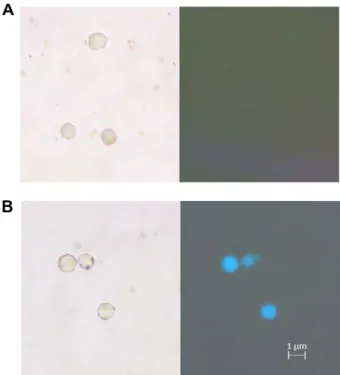
To analyze the antigen-binding activity of scFv against EGFRvIII, a qualitative study was worked in this experiment. EGFRvIII antigen, which has been con- jugated with a blue fluorescent protein (BFP), was used to visualize the antigen-binding activity through the flu- orescence produced by BFP. Fig. 5A dan 5B showed the scFv bound magnetic beads before and after incubation with EGFRvIII::BFP. The figure demonstrated that the anti-EGFRvIII scFv wrapped magnetic beads generated fluorescence after incubated with EGFRvIII::BFP anti- gen. This result indicated that the scFv produced in this experiment has antigen-binding activity against the EGFRvIII antigen.

After all of analyses have been performed, we reported that the combination of low concentration of IPTG inducer, lower growth temperature, and larger surface area of a vessel could produce a higher percentage of Fig. 3. Purification of scFv from cell-free culture medium

using HisPur

TM

Ni-NTA magnetic beads. C: crude; FT: flow- through fraction; W1-W4: Wash fraction number 1-4; E1-E4:

Elution fraction number 1-4.

Fig. 4. Western blot characterization of scFv protein. Lane 1, total scFv protein in E. coli cells. Lane 2, periplasmic scFv protein.

Lane 3, extracellular scFv protein. Lane 4, Purified scFv protein.

Fig. 5. Antigen-binding assay of scFv protein against

EGFRvIII::BFP antigen which visualized under confocal flu-

orescence microscopy (100× magnification). (A) magnetic

beads coated with anti-EGFRvIII scFv antibody (no fluorescence

detected) and (B) anti-EGFRvIII scFv wrapped magnetic beads

followed by incubation with EGFRvIII::BFP.

(8)

soluble scFv proteins than that of other condition, such as different type of inducer, higher growth temperature and smaller surface area of vessel. As seen in Table 1, about 26.25% of soluble scFv protein was reached when the culture has grown in a shake-tube with 0.1 mM of IPTG-induction and incubated at 18 ℃. Interestingly, the total expression of scFv protein in this condition was lowest among others, which indicated that slower pro- tein expression is needed to increase the percentage of soluble scFv. Moreover, we found that lactose inducer can promote the secretion of soluble scFv into a culture medium regardless of the type of growth vessel and growth temperature. For the next study, we have to con- sider the effect of medium additives (such as sucrose and Mg

2+

), medium pH, and method for periplasmic protein extraction to improve the solubility of scFv expression.

Conflict of Interest

The authors declare no conflict of interest to disclose.

References

1. Huang HJ, Nagane M, Klingbeil CK, Lin H, Nishikawa R, Ji XD, et al.

1997. The enhanced tumorigenic activity of a mutant epidermal growth factor receptor common in human cancers is mediated by threshold levels of constitutive tyrosine phosphorylation and unattenuated signaling. J. Biol. Chem. 272: 2927-2935.

2. Batra SK, Castelino-Prabhu S, Wikstrand CJ, Zhu X, Humphrey PA, Friedman HS, et al. 1995. Epidermal growth factor ligand-inde- pendent, unregulated, cell-transforming potential of a naturally occurring human mutant EGFRvIII gene. Cell Growth Differ. 6:

1251-1260.

3. Sok JC, Coppelli FM, Thomas SM, Lango MN, Xi S, Hunt JL, et al.

2006. Mutant epidermal growth factor receptor (EGFRvIII) con- tributes to head and neck cancer growth and resistance to EGFR targeting. Clin. Cancer Res. 12: 5064-5073.

4. Ahmad ZA, Yeap SK, Ali AM, Ho WY, Alitheen NB, Hamid M. 2012.

scFv antibody: principles and clinical application. Clin. Dev.

Immunol. 2012: 980250.

5. Choi JH, Lee S. 2004. Secretory and extracellular production of recombinant proteins using Escherichia coli. Appl. Microbiol.

Biotechnol. 64: 625-365.

6. Lei SP, Lin HC, Wang SS, Callaway J, Wilcox G. 1987. Characteriza- tion of the Erwinia carotovora pelB gene and its product pectate lyase. J. Bacteriol. Res. 169: 4379-4383.

7. du Plessis DJ, Berrelkamp G, Nouwen N, Driessen AJ. 2009. The lateral gate of SecYEG opens during protein translocation. J. Biol.

Chem. 284: 15805-15814.

8. Kipriyanov SM, Moldenhauer G, Little M. 1997. High level pro-

duction of soluble single chain antibodies in small-scale Escherichia coli cultures. J. Immunol. Methods 200: 69-77.

9. Donovan RS, Robinson CW, Glick BR. 2000. Optimizing the expression of a monoclonal antibody fragment under the tran- scriptional control of the Escherichia coli lac promoter. Can. J.

Microbiol. 46: 532-541.

10. Sina M, Farajzadeh D, Dastmalchi S. 2015. Effects of environmen- tal factors on soluble expression of a humanized anti-TNF-α scFv antibody in Escherichia coli. Adv. Pharm. Bull. 5: 455.

11. Dewi KS, Retnoningrum DS, Riani C, Fuad AM. 2014. Periplasmic expression of gene encoding anti-EGFRviii single-chain variable fragment antibody using pelb leader sequence in Escherichia coli. Proceeding of the 1

st

International Conference on Pharma- ceutics and Pharmaceutical Sciences, Surabaya, 11-12, November 2014: 24-29.

12. Dewi KS, Fuad AM. 2017. Comparison of gene expression between two types of anti-EGFRvIII ScFv antibodies having different variable domain orders in Escherichia coli. Ann. Bogor.

21: 29-37.

13. Sanders ER. 2012. Aseptic laboratory techniques: plating methods.

J. Vis. Exp. 11: e3064.

14. Link AJ, LaBaer J. 2011. Trichloroacetic acid (TCA) precipitation of proteins. Cold Spring Harb. Protoc.

15. He F. 2011. Laemmli-sds-page. Bio-protocolBio. 101: e80.

16. Levin JD, Russel D, Pajkovic G, Astatke M. 2006. Rapid detection of his-tagged fusion proteins in western blots with KPL’s nickel- NTA enzyme conjugates. FASEB J. 20: LB67-LB67.

17. Carter J, Petersen BP, Printz SA, Sorey TL, Kroll TT. 2013. Quantitative application for SDS-PAGE in a biochemistry lab. J. Chem. Educ. 90:

1255-1256.

18. Schneider CA, Rasband WS, Eliceiri KW. 2012. NIH Image to ImageJ: 25 years of image analysis. Nat. Methods 9: 671-675.

19. Sivashanmugam A, Murray V, Cui C, Zhang Y, Wang J, Li Q. 2009.

Practical protocols for production of very high yields of recombi- nant proteins using Escherichia coli. Protein Sci. 18: 936-948.

20. Schultz T, Martinez L, De Marco A. 2006. The evaluation of the factors that cause aggregation during recombinant expression in E. coli is simplified by the employment of an aggregation- sensitive reporter. Microb. Cell Fact. 5: 28.

21. Weickert MJ, Pagratis M, Curry SR, Blackmore R. 1997. Stabiliza- tion of apoglobin by low temperature increases yield of soluble recombinant hemoglobin in Escherichia coli. Appl. Environ. Microbiol.

63: 4313-4320.

22. Crane JM, Randall LL. 2018. The Sec system: protein export in Escherichia coli. EcoSal Plus. 7. doi: 10.1128/ecosalplus. ESP-0002- 2017.

23. Ytterberg AJ, Zubarev RA, Baumgarten T. 2019. Posttranslational targeting of a recombinant protein promotes its efficient secre- tion into the Escherichia coli periplasm. Appl. Environ. Microbiol.

85: e00671-19.

24. Singh P, Sharma L, Kulothungan SR, Adkar BV, Prajapati RS, Ali PS,

et al. 2013. Effect of signal peptide on stability and folding of

Escherichia coli thioredoxin. PLoS One 8: e63442.

(9)

25. Saibil H. 2013. Chaperone machines for protein folding, unfold- ing and disaggregation. Nat. Rev. Mol. Cell Biol. 14: 630-642.

26. Upadhyay AK, Murmu A, Singh A, Panda AK. 2012. Kinetics of inclusion body formation and its correlation with the characteris- tics of protein aggregates in Escherichia coli. PLoS One 7: e33951.

27. Peternel Š, Komel R. 2011. Active protein aggregates produced in Escherichia coli. Int. J. Mol. Sci. 12: 8275‐8287.

28. Sørensen HP, Mortensen KK. 2005. Soluble expression of recom- binant proteins in the cytoplasm of Escherichia coli. Microb. Cell Fact. 4: 1.

29. Kram KE, Finkel SE. 2014. Culture volume and vessel affect long- term survival, mutation frequency, and oxidative stress of Escherichia coli. Appl. Environ. Microbiol. 80: 1732-1738.

30. Riedel TE, Berelson WM, Nealson KH, Finkel SE. 2013. Oxygen consumption rates of bacteria under nutrient-limited conditions.

Appl. Environ. Microbiol. 79: 4921-4931.

31. Dewi KS, Permadi DG, Aminah, Fuad AM. 2020. Expression of recombinant human granulocyte-colony stimulating factor in Escherichia coli using various induction methods IOP Conf Ser:

Earth Environ. Sci. 439: 012042.

32. Studier FW. 2005. Protein production by auto-induction in high- density shaking cultures. Protein expression and purification.

Protein Expr. Purif. 41: 207-234.

33. Hausjell J, Kutscha R, Gesson JD, Reinisch D, Spadiut O. 2020. The

effects of lactose induction on a plasmid-free E. coli T7 expres-

sion system. Bioengineering 7: 8.

수치

Fig. 5. Antigen-binding assay of scFv protein against EGFRvIII::BFP antigen which visualized under confocal  flu-orescence microscopy (100× magnification)

참조

관련 문서