273 서 론
우리나라 여성암 발생분포에서 유방암이 차지하는 비 율은 최근 20년간(1983∼2005) 날로 증가하여 1999∼ 2001 년 연평균 암발생 비율 조사에서 위암(상대분율 16.4%) 다음으로 2위를 기록하여(13.7%), 3위 대장암(10.4%), 4 위인 자궁암(9.8%)를 넘고 있다.1) 또한, 유방암이 여성암 발생의 차지하는 비중으로 볼 때 우리나라의 암 발생 패 턴은 점차 선진국형에 유사한 것으로 나타나고 있다.2)
증가하는 유방암을 예방하기 위한 병인학 연구는 es- trogen receptor 발현 차이, 비만, 생활습관, 식이, 대사효소 의 유전자다형 등을 중심으로 다양하게 전개되어 왔다.3) 한편, 늘어나는 유방암의 발생에 대하여 내분비장애물 질의 노출은 새로운 유방암 발생에 대한 병인으로서 주 목되고 있다.4) 현재까지 유방암과의 관련이 조사된 내분 비장애물질(endocrine disrupting chemicals, EDC)은 p,p-di- chlorodiphenyl dichloroethane (DDE) 등 aromatase inhibitor를 중심으로 연구되었는데, 처음 in vitro 또는 in vivo 실험결 과5)와는 달리, DDT 또는 DDE 노출은 유방암과의 상관
내분비장애물질 노출이 유방암에 미치는 영향 -비스페놀 A를 중심으로
숙명여자대학교 약학대학 독성학교실 양 미 희
Exposure to Endocrine Disrupting Chemicals and Its Effects on Breast Cancer
Mihi Yang
Department of Toxicology, Sookmyung Women's University College of Pharmacy, Seoul 140-742, Korea Incidence ratio of breast cancer to total cancer has been increased in last 2 decades in Korea and breast cancer ranks second as a cause of death in women. In addition, exposure to endocrine disruptors has been emphasized as a new etiology of breast cancer. In this study, the effects of bisphenol A exposure on breast cancer in Korean women (100 breast cancer patients; 100 hospital controls) were investigated. Conjugated form of blood bisphenol A was designated as an exposure biomarker and analyzed with HPLC/FD. As results, blood bisphenol A could be detected in 94% of the subjects and the range of blood bisphenol A was 0.69∼33.7μg/L (median, 5.3μg/L). The geomeric mean of bisphenol A was somewhat higher in the cases than that in the controls, however, was not statistically significant due to multivariate analysis including age, alcohol dringking, breast feeding, and age of menarche. Thus, bisphenol A exposure may not work as a breast cancer risk factor. (Cancer Prev Res 11, 273-277, 2006)
ꠏꠏꠏꠏꠏꠏꠏꠏꠏꠏꠏꠏꠏꠏꠏꠏꠏꠏꠏꠏꠏꠏꠏꠏꠏꠏꠏꠏꠏꠏꠏꠏꠏꠏꠏꠏꠏꠏꠏꠏꠏꠏꠏꠏꠏꠏꠏꠏꠏꠏꠏꠏꠏꠏꠏꠏꠏꠏꠏꠏꠏꠏꠏꠏꠏꠏꠏꠏꠏꠏꠏꠏꠏꠏꠏꠏꠏꠏꠏꠏꠏꠏꠏꠏꠏꠏꠏꠏꠏꠏꠏꠏꠏꠏꠏꠏꠏꠏꠏꠏꠏꠏ Key Words: Endocrine disruptor, Bisphenol A, Breast cancer
책임저자:양미희, ꂕ 140-742, 서울시 용산구 효창원길 52 숙명여자대학교 약학대학 독성학교실
Tel: 02-2077-7179, Fax: 02-710-9871 E-mail: [email protected]
접수일:2006년 10월 2일, 게재승인일:2006년 10월 24일
Correspondence to:Mihi Yang
Department of Toxicology, Sookmyung Women's University College of Pharmacy, 52, Hyochangwon-gil, Yongsan-gu, Seoul 140-742, Korea Tel: +82-2-2077-7179, Fax: +82-2-710-9871
E-mail: [email protected]
이 미흡하다는 역학보고도 상당히 발표되었다.6,7) 비스페놀 A [bisphenol A, 2, 2-bis (4-hydroxyphenyl) pro- pane, Fig. 1]는 다이옥신이나 PCB (polychlorinated biphen- yls)와 같이 환경유래 내분비계장애물질로 추정되고, 주 로 in vitro 실험에서 17β-estradiol과 비교해 약한 에스트 로겐 작용이 알려져 있다.8,9) 그러나, 비스페놀 A 유도체 인 polycarbonate나 epoxy 수지를 사용한 음료캔, 생수통, 아기젖병, 페인팅, 치과용제, 그리고 비스페놀 A 자체를 첨가제로 사용한 PVC (polyvinyl chloride) 제품 등으로 인 해 우리국민이 주변으로부터 쉽게 비스페놀 A에 노출될 수 있다. 또한, 본인은 최근 3년간(2001∼2003년)에 걸친 비스페놀 A 노출모니터링 결과, 현 노출 수위는 안전역 에 속하지만 거의 전 자원자에서 비스페놀 A가 검출됨 을 발견하여 비스페놀의 노출에 대한 지속적 감시가 필 요함을 지적하였다.10) 또한, 우리국민은 일일 평균 8μg 정도로 환경 중 비스페놀 A에 노출되는 것을 추정하였 다.11) 이러한 노출정도는 미국과 유럽연합의 비스페놀 A 耐容량(TDI, Tolerable daily intake)인 50μg/kg body weight/
day12)를 고려할 때, 양호한 것으로 여겨지지만, 내분비계 장애물질은 전통적인 용량-반응관계를 따르지 않고 U자 형의 용량-반응곡선이나, hormesis, low dose effect를 따를 수 있으므로,13) 비스페놀 A는 그 양에 관계없이 내분비 장애작용 및 유방암 등 호르몬 관련암을 유발할 위험을 갖고 있다. 따라서 본 연구는 유방암환자와 대조군 연구 를 통하여 비스페놀 A 노출정도와 유방암 발생과의 관 련을 조사하기 위하여 수행하였다.
재료 및 방법 1. 연구대상자
서울대학교병원에 내원하여 유방암으로 조기 진단된 여성 100명, 대조 군은 같은 병원을 내원하여 유방암으로 진단되지 않은 hospital control, 여성 100명, 총 200명으로 동의서에 응답한 자원자를 대상으로 하였다.
2. 혈중 비스페놀 A 분석
자원자로부터 제공받은 말초혈 1 ml를 각각 0.5 ml로
나누어 liquid extraction을 통해 free form 및 total 비스페놀 A를 분석하여11) 실제 인체 내 노출은 total 비스페놀 A량 에서 free form 비스페놀 A량을 뺀 conjugated form 비스페 놀 A량으로 판단하였다(Fig. 2). 정량에 사용한 HPLC/FD (High performance liquid chromatography/Fluorescence detec- tor)의 구성은 다음과 같다: Waters 515 HPLC Pump with automated gradientcontroller, Waters 717 plus auto sampler, the 474 Scanning Fluorescence Detector; Waters X Terra RP18, 5μm (4.6 mm×250 mm) column; mobile phase A, 2.5% tetrahydrofuran in water; mobile phase B, acetonitrile;
0∼30 min, flow rate, 1.0 ml/min, ratio of A to B, 70:30 to 40:60; 30∼35 min, 1.0 ml/min, 40:60 to 0:100; 35∼40 min, 1.0 ml/min, 0:100; 40∼45 min, 0:100 to 70:30;
45∼60 min, 1.0 ml/min, 70:30; fluorescence, excitation 275 nm, emission 300 nm. 또한, LC/MS (Liquid chromatography/
Mass spectrometry)를 통하여 HPLC로 분리한 비스페놀 A 동정 확인하였다.
3. 통계분석
정량된 혈중 비스페놀 A량과 유방암발생과의 관련을 역학 통계 프로그램, JMP (SAS Institute, Inc., Cary, NC)의 Fig. 1. Chemical structure of bisphenol A.
Fig. 2. Flow of bisphenol A analysis.
IS: internal standard, bisphenol B.
ANOVA 및 likelihood ratio test 그리고 multiple logistical regression을 이용하여 분석하였다.
결과 및 고찰 1. 대상자의 특성
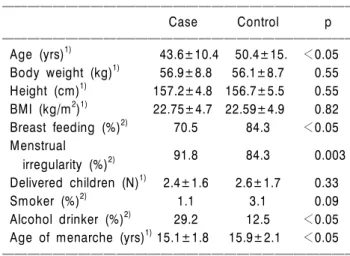
유방암의 위험인자로 다른 여러 역학조사에서 언급된 인자들, 예를 들면, 수유 유무, 음주, 초경연령 등이 본 환자-대조군에서도 유의적으로 차이가 있음이 나타났다 (Table 1). 유방암에 상관이 나타난 위 인자 및 예상 외로 유의적 차이를 보인 연령 등의 인자를 고려하여 차후 유 방암과 비스페놀 A 노출 간의 상관을 비교하였다.
2. 혈중 비스페놀의 분포
혈 중 비스페놀 A는 시료 중 94%에서 검출되었고 범
위는 0.69∼33.7μg/L (median, 5.3μg/L)에 해당하였다. 비 스페놀 A의 분포는 Fig. 3과 같이 좌측으로 기울어진 분 포로 정규분포를 따르지 않았다(Shapiro-Wilk W Test, p<
0.05). 검출한계 이하의 시료에 대하여 통계를 위하여 최 소 검출값(0.69μg/L)의 절반, 0.345μg/L를 지정하고 기하 학적 전환을 실시하여 차후 통계분석을 수행하였다.
3. 유방암과 비스페놀 A 노출
혈중 비스페놀 A level과 유방암을 단변량분석 시 평균 값 비교에서는 다소 환자군에서 높았으나 유의적이지는 않았다(환자 vs. 대조군, geometric mean [geometric standard deviation]: 5.01 [0.02] vs. 3.98 [0.03]μg/L; p=0.53).또한, 단 변량분석으로부터 유방암과 관련을 보인 연령, 수유여 부, 음주여부, 초경연령을 고려하여 다변량분석 결과, 초 경나이가 높은 것이 유방암 발생에 대한 억제효과를 기 대할 수 있을 것으로 추정되나 그 이외 인자 들, 특히 혈 중 비스페놀 A level은 유방암 발생과는 상관이 없는 것으로 나타났다(Table 2).
고 찰
내분비장애물질의 건강危害, 특히 유방암과의 관련은 동물실험 및 세포수준의 분자생물학적 증거를 기초로 하여 예견되어졌다. 예를 들면, 최근 2,3,7,8-tetrachlorodi- benzo-p-dioxin (TCDD)를 이용한 단백질체학 연구를 통하 여 출생 전 TCDD에 노출은 성장 후 유선 단백질(mam- mary proteom)의 변화를 초래하여 유방암의 감수성을 높 일 수 있다고 보고되었다.5) 또한 내분비장애물질에 의해 산화적 손상이 유도되며,14) 또한, TCDD에 의한 super- oxide dismutase 1 (SOD1)의 발현감소는 내분비장애물질 에 의한 ‘산화적 손상’ 수복 저하마저 초래하는 것이 보 고되었다.5) 하지만 아직 내분비장애물질의 노출과 유방 암과의 관련은 아직 논쟁의 여지가 많다. PCB 및 DDE Table 1. Characteristics of subjects
ꠏꠏꠏꠏꠏꠏꠏꠏꠏꠏꠏꠏꠏꠏꠏꠏꠏꠏꠏꠏꠏꠏꠏꠏꠏꠏꠏꠏꠏꠏꠏꠏꠏꠏꠏꠏꠏꠏꠏꠏꠏꠏꠏꠏꠏꠏꠏꠏꠏꠏꠏꠏꠏꠏꠏ
Case Control p
ꠏꠏꠏꠏꠏꠏꠏꠏꠏꠏꠏꠏꠏꠏꠏꠏꠏꠏꠏꠏꠏꠏꠏꠏꠏꠏꠏꠏꠏꠏꠏꠏꠏꠏꠏꠏꠏꠏꠏꠏꠏꠏꠏꠏꠏꠏꠏꠏꠏꠏꠏꠏꠏꠏꠏ Age (yrs)1) 43.6±10.4 50.4±15. <0.05 Body weight (kg)1) 56.9±8.8 56.1±8.7 0.55 Height (cm)1) 157.2±4.8 156.7±5.5 0.55 BMI (kg/m2)1) 22.75±4.7 22.59±4.9 0.82 Breast feeding (%)2) 70.5 84.3 <0.05 Menstrual
91.8 84.3 0.003 irregularity (%)2)
Delivered children (N)1) 2.4±1.6 2.6±1.7 0.33
Smoker (%)2) 1.1 3.1 0.09
Alcohol drinker (%)2) 29.2 12.5 <0.05 Age of menarche (yrs)1)15.1±1.8 15.9±2.1 <0.05 ꠏꠏꠏꠏꠏꠏꠏꠏꠏꠏꠏꠏꠏꠏꠏꠏꠏꠏꠏꠏꠏꠏꠏꠏꠏꠏꠏꠏꠏꠏꠏꠏꠏꠏꠏꠏꠏꠏꠏꠏꠏꠏꠏꠏꠏꠏꠏꠏꠏꠏꠏꠏꠏꠏꠏ
1)ANOVA, 2)Likelihood ratio test.
Fig. 3. Distribution of blood bisphenol A (μg/L): a histogram of bisphenol A levels with outliers, median, 5.3μg/L.
Table 2. Lack of association between blood bisphenol A levels and breast cancer adjusted for other risks
ꠏꠏꠏꠏꠏꠏꠏꠏꠏꠏꠏꠏꠏꠏꠏꠏꠏꠏꠏꠏꠏꠏꠏꠏꠏꠏꠏꠏꠏꠏꠏꠏꠏꠏꠏꠏꠏꠏꠏꠏꠏꠏꠏꠏꠏꠏꠏꠏꠏꠏꠏꠏꠏꠏꠏ Odd ratio Confidence interval ꠏꠏꠏꠏꠏꠏꠏꠏꠏꠏꠏꠏꠏꠏꠏꠏꠏꠏꠏꠏꠏꠏꠏꠏꠏꠏꠏꠏꠏꠏꠏꠏꠏꠏꠏꠏꠏꠏꠏꠏꠏꠏꠏꠏꠏꠏꠏꠏꠏꠏꠏꠏꠏꠏꠏ
Age 1.17 0.03∼45.4
Breast feeding 0.81 0.26∼2.75
Alcohol drinking (%) 2.30 0.65∼7.97 Age of menarche (yrs) 0.491) 0.00∼0.72 Blood bisphenol A 0.34 0.04∼2.71 ꠏꠏꠏꠏꠏꠏꠏꠏꠏꠏꠏꠏꠏꠏꠏꠏꠏꠏꠏꠏꠏꠏꠏꠏꠏꠏꠏꠏꠏꠏꠏꠏꠏꠏꠏꠏꠏꠏꠏꠏꠏꠏꠏꠏꠏꠏꠏꠏꠏꠏꠏꠏꠏꠏꠏ
1)p<0.05.
level과 유방암 환자-대조 군 연구에서 1992∼1993년 미 국 Connecticut와 New York에서의 연구는 양의 관계를 보 고하였으나,15,16) 직업적으로 PCB에 고노출 시, 이는 유방 암과의 상관을 나타내지 않았다.7) 심지어 다른 동물실험 모델, Sprague-Dawley rats에서도 TCDD와 고농도 PCB mixtures는 자연발생적인 유방암발생을 낮추었다.17,18) 본 연구는 광범위한 노출로 공중보건 부분에 이슈로 떠오른 내분비계장애물질 비스페놀 A의 위해를 밝히기 위하여 그 노출과 유방암과의 관련을 조사한 첫 논문으 로 의의가 있는데, Table 2와 같이 두 인자간의 유의적인 상관은 관찰되지 않았다. 본 연구는 비스페놀 A의 노출 분석에서 한 시점에서 측정한 cross sectional study의 제한 점을 갖고 있으며 실험대상자의 인구수에도 제한점이 있음을 고려할 때 향후 본 연구의결과를 확인할 필요가 있다고 사료된다.
결 론
1. 본 연구결과로부터, 혈중 비스페놀 A는 시료 중 94%에 해당하는 인구에서 검출되었고 범위는 0.69∼
33.7μg/L (median, 5.3μg/L)에 해당하였다.
2. 혈중 비스페놀 A level과 유방암을 단변량분석 시 평 균값에서는 다소 환자군에서 높았으나 유의적이지 않았 고 본 연구대상자에서 유방암과 관련을 보인 연령, 수유 여부, 음주 여부, 초경연령을 고려하여 다변량분석 결과, 초경나이가 높은 것이 유방암 발생에 대한 억제효과를 기대할 수 있을 것으로 추정되나 그 이외 인자 들, 특히 혈 중 비스페놀 A level은 유방암 발생과는 상관이 없는 것으로 나타나 환경 중 저 농도 비스페놀 A의 장기 노출 은 유방암 발생에 영향이 미흡한 것으로 추정된다. 그러 나, 본 연구는 연구대상자수, cross sectional study 등 몇 가지 제한점을 가지고 있으므로 향후 확대된 인구, 반복 적인 노출지표분석을 통하여 본 연구결과에 대한 확인 이 필요하다.
감사의 글
대상자 모집에 도움을 주신 서울의대 유근영, 강대희 교수님께 감사 드립니다.
참 고 문 헌
1) 국립암센터, http://www.ncc.re.kr.
2) Yoo KY, Kang D. Current researches on breast cancer epide-
miology in Korea. Breast Cancer 10, 289-293, 2003.
3) 강대희, 이경무. 유전체 역학연구의 동향. 예방의학회지 36, 213-222, 2003.
4) Kortenkamp A. Breast cancer, oestrogens and environmental pollutants: a re-evaluation from a mixture perspective. Int J Androl 29, 193-198, 2006.
5) Jenkins S, Rowell C, Wang J, Lamartiniere CA. Prenatal TCDD exposure predisposes for mammary cancer in rats.
Reprod Toxicol. http://www.ncbi.nlm.nih.gov/entrez/query.fcgi?
CMD=search&DB=PubMed, 2006.
6) Laden F, Collman G, Iwamoto K, Alberg AJ, Berkowitz GS, Freudenheim JL, Hankinson SE, Helzlsouer KJ, Holford TR, Huang HY, Moysich KB, Tessari JD, Wolff MS, Zheng T, Hunter DJ. 1,1-Dichloro-2,2-bis(p-chlorophenyl)ethylene and polychlorinated biphenyls and breast cancer: combined analy- sisof five U.S. studies. J Natl Cancer Inst 93, 768-776, 2001.
7) Safe SH. Endocrine disruptors and human health--is there a problem? An update. Environmental Health Perspectives 108, 487-93, 2000.
8) Roy D, Palangat M, Chen CW, Thomas RD, Colerangle J, Atkinson A, Yan ZJ. Biochemical and molecular changes at the cellular level in response to exposure to environmental estrogen-like chemicals. J Toxicol Environ Health 50, 1-29, 1997.
9) Safe S. Bisphenol A and related endocrine disruptors. Toxicol Sci 56, 251-252, 2000.
10) Yang M, Kim SY, Chang SS, Lee IS, Kawamoto T. Urinary concentrations of bisphenol A in relation to biomarkers of sensitivity and effect and endocrine-related health effects.
Environ Mol Mutagen 47, 571-578, 2006.
11) Yang M, Kim SY, Lee SM, Chang SS, Kawamoto T, Jang JY, Ahn YO. Biological monitoring of bisphenol a in a Korean population. Arch Environ Contam Toxicol 44, 546-551, 2003.
12) European commission health & consumer protection direc- torate-general. Opinion of the scientific committee on food on bisphenol A. SCF/CS/PM/3936 final, (http://europa. eu.int/
comm/food/fs/sc/ scf/out128_en.pdf), 2002.
13) Lyons G. http://www.worldwildlife.org/toxics/pubres/bpa.pdf (A WWW European Toxics Programme Report), 2000.
14) Chen ZH, Hurh YJ, Na HK, Kim JH, Chun YJ, Kim DH, Kang KS, Cho MH, Surh YJ. Resveratrol inhibits TCDD- induced expression of CYP1A1 and CYP1B1 and catechol estrogen-mediated oxidative DNA damage in cultured human mammary epithelial cells. Carcinogenesis 25, 2005-2013, 2004.
15) Falck F Jr, Ricci A Jr, Wolff MS, Godbold J, Deckers P.
Pesticides and polychlorinated biphenyl residues in human breast lipids and their relation to breast cancer. Arch Environ Health 47, 143-146, 1992.
16) Wolff MS, Toniolo PG, Lee EW, Rivera M, Dubin N. Blood levels of organochlorine residues and risk of breast cancer. J Natl Cancer Inst 85, 648-652, 1993.
17) Kociba RJ, Keyes DG, Beyer JE, Carreon RM, Wade CE,
Dittenber DA, Kalnins RP, Frauson LE, Park CN, Barnard SD, Hummel RA, Humiston CG. Results of a two-year chro- nic toxicity and oncogenicity study of 2,3,7,8-tetrachloro dibenzo-p-dioxin in rats. Toxicol Appl Pharmacol 46, 279-303, 1978.
18) Mayes BA, McConnell EE, Neal BH, Brunner MJ, Hamilton
SB, Sullivan TM, Peters AC, Ryan MJ, Toft JD, Singer AW, Brown JF Jr, Menton RG, Moore JA. Comparative carcino- genicity in Sprague-Dawley rats of the polychlorinated biphe- nyl mixtures Aroclors 1016, 1242, 1254, and 1260. Toxicol Sci 41, 62-76, 1998.