• 검색 결과가 없습니다.

Efficacy of Single-Port Video-Assisted Thoracoscopic Surgery Lobectomy Compared with Triple-Port VATS by Propensity Score Matching

N/A
N/A
Protected

Academic year: 2021

Share "Efficacy of Single-Port Video-Assisted Thoracoscopic Surgery Lobectomy Compared with Triple-Port VATS by Propensity Score Matching"

Copied!
7
0
0

로드 중.... (전체 텍스트 보기)

전체 글

(1)

ISSN: 2233-601X (Print) ISSN: 2093-6516 (Online)

Received: December 12, 2016, Revised: January 31, 2017, Accepted: March 29, 2017, Published online: October 5, 2017

Corresponding author: Chang Kwon Park, Department of Thoracic and Cardiovascular Surgery, Keimyung University Dongsan Medical Center, Keimyung University School of Medicine, 56 Dalseong-ro, Jung-gu, Daegu 41931, Korea

(Tel) 82-53-250-7307 (Fax) 82-53-250-7307 (E-mail) [email protected]

© The Korean Society for Thoracic and Cardiovascular Surgery. 2017. All right reserved.

This is an open access article distributed under the terms of the Creative Commons Attribution Non-Commercial License (http://creativecommons.org/

licenses/by-nc/4.0) which permits unrestricted non-commercial use, distribution, and reproduction in any medium, provided the original work is properly cited.

Efficacy of Single-Port Video-Assisted Thoracoscopic Surgery Lobectomy Compared with Triple-Port VATS by

Propensity Score Matching

Kyung Sub Song, M.D., Chang Kwon Park, M.D., Jae Bum Kim, M.D.

Department of Thoracic and Cardiovascular Surgery, Keimyung University Dongsan Medical Center, Keimyung University School of Medicine

Background: In recent years, single-port video-assisted thoracoscopic surgery (VATS) for lobectomy in non-small cell lung cancer (NSCLC) patients has become increasingly common. The objective of this study was to compare the feasibility and safety of single-port and triple-port VATS lobectomy. Methods: A total of 73 patients with NSCLC who underwent VATS lobectomy from December 2011 to August 2016 were retro- spectively reviewed, including 47 in the triple-port group and 26 in the single-port group. Statistical analysis was performed after propensity score matching. Patients were matched on a 1-to-1 basis. Results: Operative time and intraoperative blood loss in the triple-port group and the single-port group were similar (189.4±50.8 minutes vs. 205.4±50.6 minutes, p=0.259; 286.5±531.0 mL vs. 314.6±513.1 mL, p=0.813). There were no cases of morbidity or mortality. No significant differences in complications or the total number of dissected lymph nodes were found between the 2 groups. In the single-port group, more mediastinal lymph nodes were dissected than in the triple-port group (1.7±0.6 vs. 1.2±0.5, p=0.011). Both groups had 1 patient with bronchopleural fistula. Chest tube duration and postoperative hospital stay were shorter in the sin- gle-port group than in the triple-port group (8.7±5.1 days vs. 6.2±6.6 days, p=0.130; 11.7±6.1 days vs.

9.5±6.4 days, p=0.226). However, the differences were not statistically significant. In the single-port group, the rate of conversion to multi-port VATS lobectomy was 11.5% (3 of 26). The rates of conversion to open thoracotomy in the triple-port and single-port groups were 7.7% and 3.8%, respectively (p=1.000).

Conclusion: In comparison with the triple-port group, single-port VATS lobectomy showed similar results in safety and efficacy, indicating that single-port VATS lobectomy is a feasible and safe option for lung cancer patients.

Key words: 1. Video-assisted thoracic surgery 2. Lobectomy

3. Lung neoplasms

Introduction

The first lobectomy was successfully performed us- ing single-port video-assisted thoracoscopic surgery (VATS) by Gonzalez et al. [1] in 2011. Subsequently,

the number of attempted single-port VATS lobec-

tomies has increased. Studies have evaluated the ef-

fectiveness and feasibility of single-port VATS lobec-

tomy [2-7]. However, due to the difficulty of the pro-

cedure, single-port VATS lobectomy is only per-

https://doi.org/10.5090/kjtcs.2017.50.5.339

(2)

formed in a limited range of hospitals. In South Korea, the first single-port VATS lobectomy was per- formed by Kang et al. [8] in 2012. In Dongsan Medical Center, it has been routinely performed since September 2015. Only a few results have been re- ported comparing the effectiveness of single-port VATS lobectomy and conventional triple-port VATS lobectomy. The objective of this study was to com- pare the feasibility and safety of single-port and tri- ple-port VATS lobectomy for lung cancer patients.

Methods

1) Patients

A total of 73 patients with non-small cell lung can- cer (NSCLC) who underwent VATS lobectomy from December 2011 to August 2016 were retrospectively reviewed, including 47 in the triple-port group and 26 in the single-port group. The preoperative staging workup included a complete blood count, serum bio- chemistry tests, computed tomographic (CT) scan of the chest, and positron emission tomography-CT and magnetic resonance imaging of the brain. The oper- ability workup included pulmonary function tests (PFT) and a transthoracic echocardiogram.

The variables studied in each patient included age, sex, smoking habit, PFT, the presence of associated comorbidities, tumor type and location, type and du- ration of surgical intervention, operation-associated adhesion, cancer stage, histologic type, tumor size, lymph node staging (number of lymph nodes re- trieved and number of nodal stations explored), du- ration of chest tube in place, length of hospital stay, postoperative complications, and intraoperative bleeding.

The selection criteria between single-port and tri- ple-port VATS were not complicated. After September 2015, single-port VATS lobectomy was performed in all NSCLC patients except for those with broncho- genic lung cancer or tight pleural adhesion.

2) Propensity score matching

To create comparable groups of patients, propen- sity score matching (PSM) between triple-port VATS and single-port VATS lobectomy patients was per- formed. Patients were matched at a 1-to-1 ratio. The propensity score was calculated using clinical varia- bles such as age, sex, smoking habit, PFT, comorbid- ities, pulmonary disease, preoperative T and N stag-

ing, pleural adhesion, incomplete fissure, and body mass index. Finally, a total of 52 patients, including 26 who underwent triple-port VATS lobectomy and 26 who underwent single-port VATS lobectomy, were enrolled in this study.

3) Operative procedure

In both groups, all patients were given general an- esthesia with double-lumen endobronchial tube intubation. The operation was performed with 1-lung ventilation in the decubitus position. For triple-port VATS lobectomy, a 10-mm 2-port incision was made in the seventh intercostal space at the midaxillary line and the scapular line. After that, a minimal thor- acotomy, with a size of approximately 2.0 to 3.0 cm, was made on the fourth or fifth intercostal space of the anterior axillary line. In the single-port group, a 2.0- to 3.0-cm minimal thoracotomy incision was made in the sixth intercostal space of the anterior axillary line. The operation was performed after at- taching a wound protector (Elexis Wound Protector/

Retractor; Applied Medical Technology Inc., Brecksville, OH, USA) to the minimal thoracotomy site. In the tri- ple-port group, a 10-mm, 30

o

oblique-viewing thor- acoscope was used. At the end of the operation, a chest drain was placed through the 10-mm port in- cision site in the seventh intercostal space.

Single-port VATS lobectomy was performed using a 5-mm, 30

o

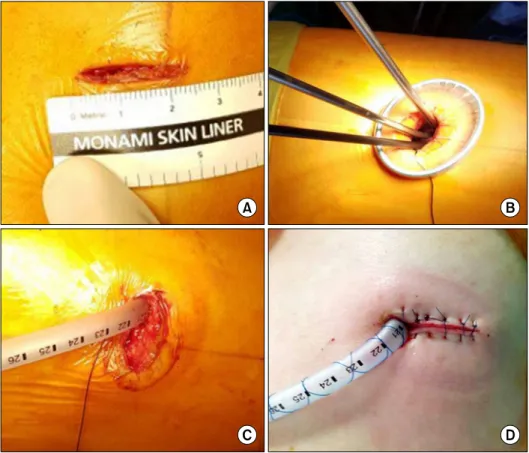
oblique-viewing thoracoscope. A 2.0- to 3.0-cm minimal thoracotomy was made in the sixth intracostal space at the anterior axillary line after checking for pleural adhesion through a 5-mm trocar (Fig. 1A, B). The majority of dissections were done using endoscopic hook electrocautery and a peanut dissector. After dissection of the pulmonary vessels and bronchus, resection was performed using flexible curved-tip endoscopic staplers. Lymphadenectomy was facilitated by electrocautery. After lobectomy, a pro- tective specimen bag was used to remove specimens through minimal thoracotomy, and a single chest tube (24-Fr chest tube) was placed at the end of the incision (Fig. 1C, D).

In both groups, lymph node dissections including

mediastinal, subcarinal, and lobe-specific lymph no-

des were performed. In lobectomies on the left side,

the para-aortic and subaortic lymph nodes were also

dissected.

(3)

Fig. 1. (A) A minimal thoracotomy incision of 2.0 to 3.0 cm was made in the sixth intercostal space. (B) We used a 5-mm, 30

o

oblique-view- ing thoracoscope. (C, D) After lo- bectomy, a 24-Fr chest tube was placed at the end of the incision.

4) Postoperative course

All patients stayed in the intensive care unit for 1 night. Their chest drain was removed according to the following criteria: (1) the amount of chest drain- age was less than 200 mL without air leakage; and (2) there was no pneumothorax or localized pleural effusion on chest X-rays. Patients were discharged from the hospital 2 days after removing the chest tube.

5) Statistical analysis

Continuous variables are presented as means with standard deviations, while categorical variables are presented as frequencies and percentages. The pro- pensity score was calculated using multivariate logis- tic regression. To compare the 2 groups, the in- dependent-samples t-test was used for continuous variables, while the Fisher exact test was used for categorical variables. IBM SPSS ver. 20.0 (IBM Corp., Armonk, NY, USA) was used for all statistical analyses. All p-values <0.05 were considered to in- dicate statistical significance.

Results

From February 2011 to August 2016, 73 patients underwent curative thoracoscopic lobectomy, includ- ing 47 patients who underwent triple-port VATS from February 2011 to September 2015. Single-port VATS was performed in 26 patients by the same thoracic surgeon from September 2015 to August 2016. Patients in both groups were matched 1-to-1 with respect to clinical variables. After PSM, the male-to-female ratio, age, and results of preoperative PFT were similar between the triple-port group and the single-port group (57.7% versus 57.7%; 65.0±9.4 years versus 64.8±9.7 years; 2.3±0.4 L versus 2.3±0.7 L) (Table 1).

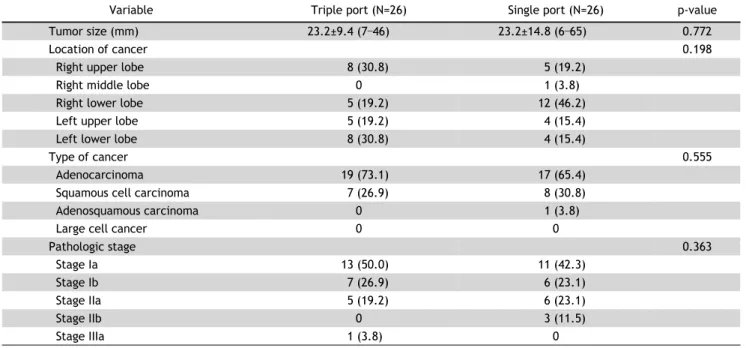
In terms of histologic factors, the mean tumor size

in the triple-port and the single-port groups was

23.2±9.4 mm and 23.2±14.8 mm, respectively. The

most common procedures in the triple-port group

were right upper lobectomy (30.8%) and left lower

lobectomy (30.8%). In the single-port group, the

most common procedure was right lower lobectomy

(46.2%). In both groups, adenocarcinoma was the

(4)

Table 2. Histopathological factors after propensity score matching

Variable Triple port (N=26) Single port (N=26) p-value

Tumor size (mm) 23.2±9.4 (7 –46) 23.2±14.8 (6 –65) 0.772

Location of cancer 0.198

Right upper lobe 8 (30.8) 5 (19.2)

Right middle lobe 0 1 (3.8)

Right lower lobe 5 (19.2) 12 (46.2)

Left upper lobe 5 (19.2) 4 (15.4)

Left lower lobe 8 (30.8) 4 (15.4)

Type of cancer 0.555

Adenocarcinoma 19 (73.1) 17 (65.4)

Squamous cell carcinoma 7 (26.9) 8 (30.8)

Adenosquamous carcinoma 0 1 (3.8)

Large cell cancer 0 0

Pathologic stage 0.363

Stage Ia 13 (50.0) 11 (42.3)

Stage Ib 7 (26.9) 6 (23.1)

Stage IIa 5 (19.2) 6 (23.1)

Stage IIb 0 3 (11.5)

Stage IIIa 1 (3.8) 0

Values are presented as mean±standard deviation (range) or number (%).

Table 1. Patient characteristics before and after PSM

Characteristic

Before PSM After PSM

Triple port (N=47)

Single port

(N=26) p-value Triple port (N=26)

Single port

(N=26) p-value

Age (yr) 64.6±8.9

(45 –80)

64.8±9.5 (41 –83)

0.912 65.0±9.4 (45 –80)

64.8±9.7 (41 –83)

0.954

Sex (male) 25 (53.2) 15 (57.7) 0.957 15 (57.7) 15 (57.7) 1.000

Smoking 25 (53.2) 15 (57.7) 0.845 15 (57.7) 15 (57.7) 1.000

Comorbidity

Chronic obstructive pulmonary disease 4 3 1.000 4 3 1.000

Tuberculosis 3 1 1.000 1 1 1.000

Asthma 1 0 1.000 0 0 1.000

Cardiac disease 3 2 1.000 2 2 1.000

Previous cancer 7 2 0.476 3 2 1.000

Preoperative forced expiratory volume in 1 second (L)

2.2±0.5 (1.3 –3.3)

2.3±0.1 (1.3 –3.6)

0.841 2.3±0.4

(1.4 –3.4)

2.3±0.7 (1.3 –3.6)

0.887

Values are presented as mean±standard deviation (range) or number (%).

PSM, propensity score matching.

most common type of cancer (73.1% in the tri- ple-port group and 65.4% in the single-port group) . The percentage of stage I lung cancer was 76.9% in the triple-port group and 65.4% in the single-port group (Table 2).

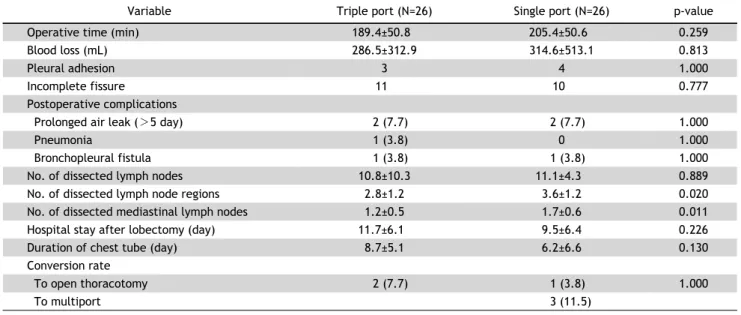
In terms of operative factors, the operative time and intraoperative bleeding in the triple-port group and single-port group were similar (189.4±50.8 mi-

nutes versus 205.4±50.6 minutes, p=0.259; 286.5±312.9

mL versus 314.6±513.1 mL, p=0.813). The numbers

of resected lymph nodes in the triple-port group and

the single-port group were 10.8±10.3 and 11.1±4.3,

respectively (p=0.889). The mean number of nodal

stations explored in the triple-port group and the

single-port group was 2.8±1.2 and 3.6±1.2, respec-

tively (p=0.020). The mean number of mediastinal

(5)

Table 3. Postoperative outcomes related to major lung resection after propensity score matching

Variable Triple port (N=26) Single port (N=26) p-value

Operative time (min) 189.4±50.8 205.4±50.6 0.259

Blood loss (mL) 286.5±312.9 314.6±513.1 0.813

Pleural adhesion 3 4 1.000

Incomplete fissure 11 10 0.777

Postoperative complications

Prolonged air leak ( >5 day) 2 (7.7) 2 (7.7) 1.000

Pneumonia 1 (3.8) 0 1.000

Bronchopleural fistula 1 (3.8) 1 (3.8) 1.000

No. of dissected lymph nodes 10.8±10.3 11.1±4.3 0.889

No. of dissected lymph node regions 2.8±1.2 3.6±1.2 0.020

No. of dissected mediastinal lymph nodes 1.2±0.5 1.7±0.6 0.011

Hospital stay after lobectomy (day) 11.7±6.1 9.5±6.4 0.226

Duration of chest tube (day) 8.7±5.1 6.2±6.6 0.130

Conversion rate

To open thoracotomy 2 (7.7) 1 (3.8) 1.000

To multiport 3 (11.5)

Values are presented as mean±standard deviation or number (%).

lymph node stations in the triple-port group and the single-port group was 1.2±0.5 and 1.7±0.6, respectively (p=0.011) (Table 3). The rate of conversion to open thoracotomy was 7.7% in the triple-port group and 3.8% (p=0.100) in the single-port group. In the sin- gle-port group, conversion to multiple-port lobectomy (2- or 3-port lobectomy) occurred in 3 patients (11.5%) (Table 3).

A prolonged air leak was defined as an air leak for over 5 days after the lobectomy. Prolonged air leak developed in 7.7% of patients in both groups (p=

1.000). One case of bronchopleural fistula occurred in each group. In both groups, the hospital stay after lobectomy and chest drain duration were shorter in the single-port group than in the triple-port group (9.5±6.4 days versus 11.7±6.1 days, p=0.226; 6.2±6.6 days versus 8.7±5.1 days, p=0.130). However, the dif- ferences were not statistically significant. Postoperative pneumonia occurred in 1 patient in the triple-port group. There were no cases of postoperative bleed- ing, morbidity, or mortality in either group (Table 3) .

Discussion

VATS lobectomy was introduced in 1992. Since then, VATS lobectomy has been widely practiced us- ing 3 to 4 port incisions [9-15]. In 2011, Gonzalez et al. [1] reported the first successful VATS lobectomy

using a single port. After that, good results have been reported for single-port VATS lobectomy [2-7,16].

Today, single-port VATS is also used in pneumo- nectomy, sleeve lobectomy, and chest wall resection procedures [17-19]. However, single-port VATS lobec- tomy is performed only in a limited number of hos- pitals in several countries due to its technical difficulty. In this study, the safety and effectiveness of triple-port and single-port VATS lobectomy were compared retrospectively.

The results of this study revealed that the oper- ative time and intraoperative bleeding for both groups were similar (189.4±50.8 minutes versus 205.4±50.6 minutes, p=0.259; 286.5±312.9 mL versus 314.6±513.1 mL, p=0.813). In addition, the rates of conversion to open thoracotomy in the triple-port and single-port groups were similar (7.7% versus 3.8%, p=1.000).

These results indicate that the safety and efficacy of single-port and triple-port VATS lobectomy proce- dures were similar. Other studies have similarly in- dicated that the operative time, intraoperative bleed- ing, and rate of conversion to open thoracotomy in triple- and single-port VATS lobectomies were similar [3-7,20]. Those studies reported that the operative time and intraoperative bleeding of the single-port group were 154.1 to 198.8 minutes and 38.4 to 99.1 mL, respectively [4-7].

Regarding the results of dissection for mediastinal

(6)

lymph nodes, the single-port group had better out- comes than the triple-port group. This indicates that the dissection of mediastinal lymph nodes via sin- gle-port VATS was not more difficult than in tri- ple-port VATS. Other centers have reported that the number of dissected mediastinal lymph nodes did not significantly differ between the 2 procedures [2-4].

After lobectomy, the occurrence of complications was not different between the 2 groups (Table 3). In addition, the recovery period in both groups was similar. This suggests that single-port VATS lobec- tomy is not more traumatic than triple-port VATS lobectomy.

This study has several limitations. First, the oper- ator effort could affect the number of excised media- stinal lymph nodes. Starting in 2015, the Department of Health Insurance Review and Assessment Service in Republic of Korea has recommended performing mediastinal lymph node biopsy in more than 2 me- diastinal lymph node areas for lobectomy in lung cancer patients. Thus, the surgeon responsible for the procedures analyzed in this study endeavored to comply with that recommendation. This change might have made a difference in the results for the 2 groups. In other reports, the numbers of excised me- diastinal lymph nodes were similar in both groups [2-4]. Second, this study included no long-term fol- low-up data after single-port VATS lobectomy on on- cologic factors such as recurrence of cancer or sur- vival rate. After accumulating long-term data for sin- gle-port VATS, these results will be reported. Third, we performed triple- and single-port VATS lobectomy in different periods. There may have been differences in the devices used and in the accumulated experi- ence of the surgeon. This might have resulted in re- search or intentional bias between the 2 groups.

Because single-port VATS lobectomy is a relatively new procedure, there is still not enough evidence to support its superiority to triple-port VATS for lobec- tomy. However, more results on single-port VATS lo- bectomy are being reported and the number of thoracic surgeons performing single-port VATS lobec- tomy is increasing. As a result, for a thoracic surgeon with experience in thoracoscopic surgery, single-port lobectomy is an effective and feasible option.

In conclusion, our experience showed that single- port VATS lobectomy and triple-port VATS lobectomy

had similar safety and efficacy. This indicates that single-port VATS lobectomy is a feasible and safe op- tion for lung cancer patients.

Conflict of interest

No potential conflicts of interest relevant to this article are reported.

Acknowledgments

This study was supported by a Grant of the Samsung Vein Clinic Network (Daejeon, Anyang, Cheongju, Cheonan; Fund no. KTCS04-084).

References

1. Gonzalez D, de la Torre M, Paradela M, et al. Video-as- sisted thoracic surgery lobectomy: 3-year initial experi- ence with 200 cases. Eur J Cardiothorac Surg 2011;40:

e21-8.

2. Shen Y, Wang H, Feng M, Xi Y, Tan L, Wang Q. Single- ver- sus multiple-port thoracoscopic lobectomy for lung can- cer: a propensity-matched study. Eur J Cardiothorac Surg 2016;49 Suppl 1:i48-53.

3. Han KN, Kim HK, Choi YH. Comparison of single port versus multiport thoracoscopic segmentectomy. J Thorac Dis 2016;8(Suppl 3):S279-86.

4. Zhu Y, Liang M, Wu W, et al. Preliminary results of sin- gle-port versus triple-port complete thoracoscopic lobec- tomy for non-small cell lung cancer. Ann Transl Med 2015;3:92.

5. Gonzalez-Rivas D, Paradela M, Fernandez R, et al.

Uniportal video-assisted thoracoscopic lobectomy: two years of experience. Ann Thorac Surg 2013;95:426-32.

6. Hirai K, Takeuchi S, Usuda J. Single-port video-assisted thoracic surgery for early lung cancer: initial experience in Japan. J Thorac Dis 2016;8(Suppl 3):S344-50.

7. Wang BY, Tu CC, Liu CY, Shih CS, Liu CC. Single-incision thoracoscopic lobectomy and segmentectomy with radical lymph node dissection. Ann Thorac Surg 2013;96:977-82.

8. Kang DK, Min HK, Jun HJ, Hwang YH, Kang MK. Single-port video-assisted thoracic surgery for lung cancer. Korean J Thorac Cardiovasc Surg 2013;46:299-301.

9. Daniels LJ, Balderson SS, Onaitis MW, D’Amico TA.

Thoracoscopic lobectomy: a safe and effective strategy for patients with stage I lung cancer. Ann Thorac Surg 2002;74:860-4.

10. Swanson SJ, Herndon JE 2nd, D’Amico TA, et al. Video-as- sisted thoracic surgery lobectomy: report of CALGB 39802:

a prospective, multi-institution feasibility study. J Clin

Oncol 2007;25:4993-7.

(7)

11. McKenna RJ Jr, Houck W, Fuller CB. Video-assisted thora- cic surgery lobectomy: experience with 1,100 cases. Ann Thorac Surg 2006;81:421-5.

12. Hansen HJ, Petersen RH. A video-atlas of video-assisted thoracoscopic lobectomy using a standardized three-port anterior approach. Ann Cardiothorac Surg 2012;1:104.

13. Rocco G, Martin-Ucar A, Passera E. Uniportal VATS wedge pulmonary resections. Ann Thorac Surg 2004;77:726-8.

14. Landreneau RJ, Mack MJ, Hazelrigg SR, et al. Video-as- sisted thoracic surgery: basic technical concepts and in- tercostal approach strategies. Ann Thorac Surg 1992;54:

800-7.

15. Roviaro G, Rebuffat C, Varoli F, Vergani C, Mariani C, Maciocco M. Videoendoscopic pulmonary lobectomy for cancer. Surg Laparosc Endosc 1992;2:244-7.

16. Wang BY, Liu CY, Hsu PK, Shih CS, Liu CC. Single-incision versus multiple-incision thoracoscopic lobectomy and seg-

mentectomy: a propensity-matched analysis. Ann Surg 2015;261:793-9.

17. Gonzalez-Rivas D, de la Torre M, Fernandez R, Garcia J.

Video: single-incision video-assisted thoracoscopic right pneumonectomy. Surg Endosc 2012;26:2078-9.

18. Gonzalez-Rivas D, Delgado M, Fieira E, Fernandez R.

Double sleeve uniportal video-assisted thoracoscopic lo- bectomy for non-small cell lung cancer. Ann Cardiothorac Surg 2014;3:E2.

19. Gonzalez-Rivas D, Fernandez R, Fieira E, Mendez L.

Single-incision thoracoscopic right upper lobectomy with chest wall resection by posterior approach. Innovations (Phila) 2013;8:70-2.

20. Harris CG, James RS, Tian DH, et al. Systematic review and

meta-analysis of uniportal versus multiportal video-as-

sisted thoracoscopic lobectomy for lung cancer. Ann

Cardiothorac Surg 2016;5:76-84.

수치

Fig. 1. (A) A minimal thoracotomy  incision of 2.0 to 3.0 cm was made  in the sixth intercostal space
Table 1. Patient characteristics before and after PSM
Table 3. Postoperative outcomes related to major lung resection after propensity score matching

참조

관련 문서

Incheon is also developing smart tourist city contents, selected for the first time among the cities in Korea, in the whole area of the open port area by April 2021

Incheon is still advancing ceaselessly as demonstrated in its plentiful milestones including, the expansion of the Incheon Port and opening of the Incheon Metro subway

The strategy of Russian new eastern policy and Chinese One Belt Load using ports in the east sea area, Korean new northern policy, Japanese west coast

Even though one-stop service is critical in competitions with Northeast Asian ports as well as within Busan Port, we should keep in mind that the

At first, I arranged the current conditions and function of container terminal in the port of Busan through the existing literature study on the function

Results of the study, first, enhanced support services for route expansion to take advantage of the geographical advantage of the Busan port, second,

And the VTS service area of new Busan port should be established to protect human life and marine environment by offering marine traffic information needed

Secondly, the important factors to attract T/S cargo at Kwangyang Port are geographical location, promotion activity to introduce Port and expansion of