INTRODUCTION
Splenic abscess is an unusual condition usually seen in immunocompromised patients or associated with intravenous drug abuses (1). Several conditions including trauma, immuno- deficiency, corticosteroid and/or immunosuppressive therapy and diabetes mellitus have been listed under the predisposing factors for a splenic abscess (1). Splenic abscess in a patient on hemodialysis is rare but life-threatening conditions if not corrected (2).
During the early years of the 20th century, frequent caus- es of splenic abscess were typhoid fever; the mortality rates approximated 100% (3, 4). More recently, hematogenous seeding from septic foci has been the most common cause of a splenic abscess, whereas the predisposing factors have been endocarditis, closed splenic trauma, and sickle-anemia (3, 5, 6). But splenic abscess in hemodialysis patients has not been well described.
We describe a case of splenic abscess with bacterial endo- carditis on maintenance hemodialysis, in which case the pri- mary infection was probably acquired through the dialysis access site.
CASE REPORT
A 65-yr-old male patient was admitted to Chonnam Nation-
al University Hospital because of fever and chills with drowsy mental status after hemodialysis. His symptoms and signs were acute onset. Fifteen years earlier, he was found to have diabetes and well controlled by insulin and oral hypoglycemics, and to have hypertension. Five years earlier, he had developed chronic renal failure due to diabetic complication. Three years earlier, he was operated native brachiocephalic arteriovenous fistula formation on his left arm and has been taken mainte- nance hemodialysis with 3 sessions in each week. Other past medical history including tuberculosis, hepatitis or abdomi- nal surgery had not been known. He was non-smoker, and non-alcoholics. There was no history of trauma. His blood pressure was 130/80 mmHg and his body temperature was 38.1℃on admission. On physical examination, there was diffuse tenderness on the abdomen, especially on the left hypochondrium. There was ecchymosis around the left bra- chiocephalic arteriovenous fistula area with tenderness and swelling. Auscultation of his chest revealed diastolic cardiac murmurs on apex.
On chest radiography and electrocardiogram, there was cardiomegaly. Biochemical analysis revealed that hemoglobin level was 8.2 g/dL, white blood cell count 11,500/ L, platelet count 84,000/ L, blood urea nitrogen level 25.0 mg/dL, and serum creatinine level 4.6 mg/dL, sodium 140 mEq/L, potas- sium 4.7 mEq/L, chloride 97 mEq/L, aspartate aminotrans- ferase 28 IU/L, alkaline phosphatase 81 IU/L, serum albumin 3.4 g/dL, C-reactive protein 25.97 mg/dL, erythrocyte sedi-
Hyun Soo Kim, Min Seok Cho, Seung Hwan Hwang, Seong Kwon Ma, Soo Wan Kim, Nam Ho Kim, Ki Chul Choi
Department of Internal Medicine, Chonnam National University Medical School, Gwangju, Korea
Address for correspondence Ki Chul Choi, M.D.
Department of Internal Medicine, Chonnam National University Medical School, 8 Hak-dong, Dong-gu, Gwangju 501-757, Korea
Tel : +82.62-220-6271, Fax : +82.62-225-8578 E-mail : [email protected]
313 J Korean Med Sci 2005; 20: 313-5
ISSN 1011-8934
Copyright � The Korean Academy of Medical Sciences
Splenic Abscess Associated with Endocarditis in a Patient on Hemodialysis
: A Case Report
Splenic abscess is an unusual condition usually seen in immunocompromised patients or associated with intravenous drug abuses. Several conditions including trauma, immunodeficiency, corticosteroid and/or immunosuppressive therapy and diabetes mellitus have been listed under the predisposing factors for a splenic abscess. Splenic abscess in a patient on hemodialysis is a rare but life-threatening condition if not corrected. We describe a case of splenic abscess with bacterial endocarditis on maintenance hemodialysis. He had staphylococcal septicemia secondary to bacterial endocarditis at the mitral valve from the dialysis access-site infection. Although hematologic seeding from endocarditis has been the predis- posing factor for splenic abscess, we postulate that access-site infections may predispose hemodialysis patients to splenic abscess. Splenic abscess may be considered as one of the causes when patients on hemodialysis develop unex- plained fever.
Key Words : Spleen; Abscess; Dialysis; Renal Dialysis
Received : 19 February 2004 Accepted : 9 April 2004
314 H.S. Kim, M.S. Cho, S.H. Hwang, et al.
mentation rate 31 mm/hr, fibrinogen degradation product
<5 g/mL, D-dimer 0.4 mg/L (reference value 0-0.3), aPTT 37.3 sec, PT 13.1 sec/INR 1.08, and fibrinogen 716 mg/dL.
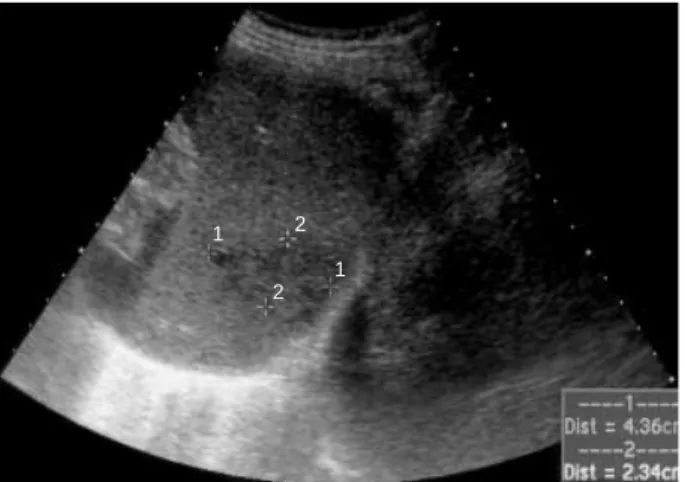
Abdominal sonography revealed two hypoechoic space occupying lesions and one cystic lesion in the spleen (Fig. 1).
To differentiate splenic abscess or infarction, abdominal com- puted tomography (CT) was performed. Abdominal CT re- vealed multiple septated cystic lesions in the spleen, the largest 4.3 cm, and 2 cm low attenuated lesion in the left buttock area, compatible with multiple splenic abscesses and an abscess in the left buttock area (Fig. 2). We performed 2D-echocar- diography, and found mobile hyperechoic mass on posterior mitral valve leflet tip with calcified valve. His brain CT was normal. We obtained blood samples at two different sites for bacteriologic culture and then started empirical antibi- otics with ceftriaxone and aminoglycoside. He had continu- ous fever and left hypochondrial pain. Blood culture revealed methicillin sensitive Staphylococcus aureus (MSSA). We changed the antibiotics with cefazoline based on the drug sensitivity
test. Inflammatory signs and hypoechoic lesions in the spleen did not respond to antibiotic therapy. On the 4th hospital day, emergency splenectomy was performed for the splenic abscess based on blood culture and abdominal CT. We aspi- rated blood from the evacuated spleen for bacteriologic cul- ture and sent the evacuated spleen to pathologist for histologic diagnosis (Fig. 3). MSSA was cultured from the evacuated splenic blood, too. The pathologic findings showed splenic abscesses and infarction (Fig. 4). Antibiotic therapy was con- tinued and he became afebrile. CBC findings and other chemi- cal laboratory findings were returned to normal.
DISCUSSION
Splenic abscess in hemodialysis patient was rarely report- ed. In a report published in 2002, Chuang et al. analyzed the clinical characteristics of extra-renal abscess in chronic hemo- dialysis patients. Among sixteen patients who had extra-renal abscess, the most common site of extra-renal abscess were
Fig. 1.Abdominal sonography reveals two hypoechoic space occupying lesions and one cystic lesion in the spleen.
Fig. 2.Abdominal CT reveals multiple septated cystic lesion in the spleen, the largest 4.3 cm, compatible with multiple splenic abscesses.
Fig. 3.Gross finding of removed spleen shows abscess pockets. Fig. 4.Pathologic findings showed the splenic abscess (H&E,×100).
1
1 2
2
liver (8/16) and lung (5/16), and one patient had concurrent liver and spleen abscess (7). We could identify only three addi- tional reports of splenic abscess in hemodialysis patients by medline and KoreaMed search (2, 8, 9).
Trauma, immunodeficiency, corticosteroid and/or immuno- suppressive therapy and diabetes mellitus had been reported as risk factors of splenic abscess (1). In the present patient, he had diabetes as a known risk factor, but no history of trauma or immunosuppressive therapy. Since ultrasound scan was easy to apply, ultrasound scan was first employed and revealed two hypoechoic space occupying lesions and one cystic lesion in the spleen. Computed tomography is reported to be supe- rior to ultrasonography in diagnosing splenic abscess (1). And computed tomography was checked to confirm the presence of the two hypoechoic space occupying lesions and one cys- tic lesion in the spleen and showed that there were multiple septated cystic lesions in spleen, largest 4.3 cm, and 2 cm low attenuated lesion in the left buttock area, compatible with multiple splenic abscesses and abscess in the left but- tock area. Inflammatory signs and hypoechoic lesions in spleen did not respond to antibiotic therapy. So this patient under- took emergency splenectomy and was diagnosed as having splenic abscesses and infarction.
Untreated splenic abscesses are fatal, and there is no con- sensus regarding treatment. Treatment of a splenic abscess varies according to the response to antibiotics. Especially when there is a splenic defect on an abdominal computed tomog- raphy in patients who are refractory to antibiotic therapy, total splenectomy is the mainstay of the treatment (10). Splenec- tomy eliminates the source of sepsis and circumvents prob- lems with drainage from the subphrenic area. Splenectomy is superior than medical treatment and percutaneous drainage (11). Needle aspiration under radiological guidance can be used, but infection of neighboring organs is a known com- plication, which includes infection of the lung and the peri- toneal cavity, or formation of a fistula (1, 2).
In a report, the most common cause of bacteremia in hemo- dialysis patients was Staphylococcus aureus, and the most fre- quent focus of infection was the access site for hemodialysis (12). Splenic abscess in hemodialysis patients was reported to be due to Staphylococcus from access-site infection (2).
Hemodialysis patients have been reported to have an im- paired immune system (13) and a tendency to develop vari- ous infectious diseases (14). Infections of fistulae and dialy-
sis catheters are not uncommon. We conclude that splenic abscess in hemodialysis patients is a rare disorder but infec- tion of the dialysis access site may predispose to splenic abscess.
Clinical features may be subtle and early radiological inves- tigation with treatment of the lesion may be essential in dialy- sis-treated patients who develop an otherwise unexplained fever.
REFERENCES
1. Nelken N, Ignatius J, Skinner M, Christensen N. Changing clinical spectrum of splenic abscess. Am J Surg 1987; 154: 27-34.
2. Fonseca V, Baillod R, Berger L, Fernando O, Moorhead J. Splenic abscess in patients on hemodialysis. Am J Kidney Dis 1990; 15: 273-5.
3. Eliting AW. Abscess of spleen. Ann Surg 1915; 62: 182-92.
4. Reid SE, Land SJ. Abscess of the spleen. Am J Surg 1954; 88: 912-7.
5. Chulay JD, Lankerani MR. Splenic abscess. Report of 10 cases and review of the literature. Am J Med 1976; 61: 513-22.
6. Johnson JD, Raff MJ, Barnwell PA, Chun CH. Splenic abscess com- plicating infectious endocarditis. Arch Intern Med 1983; 143: 906-12.
7. Chuang FR, Lee CH, Chen JB, Cheng YF, Yang BY, Hsu MS, Wu MS. Extra-renal abscess in chronic hemodialysis patients. Ren Fail 2002; 24: 511-21.
8. Nakamura T, Iwashima A, Honma T, Higuma N, Tamura K. Splenic abscess in a patient on hemodialysis. Nephron 1992; 60: 255-6.
9. Kim TY, Rho SY, Son SH, Kim BS, Park JH, Yang CW, Kim YS, Bang BK. A case of liver and spleen abscesses secondary to Yersinia enterocolitica septicemia in a chronic renal failure patient on hemo- dialysis. Korean J Nephrol 1999; 18: 339-42.
10. Cheesbrough JS, Jones EW, Finch RG. The management of splenic abscess. Q J Med 1985; 57: 653-7.
11. Ting W, Silverman NA, Arzouman DA, Levitsky S. Splenic septic emboli in endocarditis. Circulation 1990; 82 (Suppl IV): S105-9.
12. Lentino JR, Baddour LM, Wray M, Wong ES, Yu VL. Staphylococ- cus aureus and other bacteremias in hemodialysis patients: antibi- otic therapy and surgical removal of access site. Infection 2000; 28:
355-60.
13. Hosking CS, Atkins RC, Scott DF, Holdsworth SR, Fitzgerald MG, Shelton MJ. Immune and phagocytic function in patients on mainte- nance dialysis and post-transplantation. Clin Nephrol 1976; 6: 501-5.
14. Parsons FM, Brunner FP, Gurland HJ, Harlen H. Combined report on regular dialysis and transplantation in Europe I. Proc Eur Dial Transplant Assoc 1971; 8: 3.
Splenic Abscess in Hemodialysis Patient 315