What Factors Impact Consumer Perception of the Effectiveness of Health Information Sites? An Investigation of the Korean National Health Information Portal
Lay public’s concerns around health and health information are increasing. In response, governments and government agencies are establishing websites to address such concerns and improve health literacy by providing better access to validated health information.
Since 2011, the Korean government has constructed the National Health Information Portal (NHIP) website run in collaboration with the Korean Academy of Medical Sciences (KAMS). This study therefore aimed to 1) examine consumer use of NHIP, with respect to the usage patterns, evaluation on health information provided, and perceived effectiveness of the site; and 2) identify factors that may impact perceived effectiveness of the site. An online survey was conducted with 164 NHIP users, recruited through a popup window on the main screen of the portal website from October to November 2015. The significant predicting factors supported by the data include the relevance of health information on the site, the usefulness of information in making health decisions, and the effective visualization of information. These factors can inform future efforts to design more effective health information websites, possibly based on metadata systems, to further advance the lay public’s information seeking and health literacy.
Keywords: Metadata; Health Literacy; Health Information; Consumer; Internet Ji Tae Choung,1* Yoon-Seong Lee,2*
Heui Sug Jo,3 Minsun Shim,4 Hun Jae Lee,5 and Su Mi Jung3
1Department of Pediatrics, Korea University College of Medicine, Seoul, Korea; 2Department of Forensic Medicine, Seoul National University College of Medicine, Seoul, Korea; 3Department of Health Policy and Management, Kangwon National University College of Medicine, Chuncheon, Korea;
4Department of Communication and Information, Inha University, Incheon, Korea; 5Department of Social and Preventive Medicine, Inha University College of Medicine, Incheon, Korea
* Ji Tae Choung and Yoon-Seong Lee contributed equally to this work.
Received: 25 January 2017 Accepted: 10 April 2017 Address for Correspondence:
Heui Sug Jo, MD, MPH, PhD
Department of Health Policy and Management, Kangwon National University College of Medicine, 1 Kangwondaehak-gil, Chuncheon 24341, Republic of Korea
E-mail: [email protected]
Funding: This study is supported by 2015 project from the National Health Promotion Fund of Ministry of Health and Welfare and 2017 research for health policy from the Korea Centers for Disease Control and Prevention, Republic of Korea.
https://doi.org/10.3346/jkms.2017.32.7.1077 • J Korean Med Sci 2017; 32: 1077-1082
INTRODUCTION
Due to aging and increasing chronic illness, the importance of capacity-building for disease prevention and self-management is increasing (1). Health information is a key element in strength- ening individuals’ ability to manage their own health, and health literacy is what allows them to find and evaluate health informa- tion themselves, actively and not as mere passive consumers, and to build more egalitarian, cooperative relationships with healthcare providers through health information sharing (2).
Accordingly, there is an increasing demand that health infor- mation be provided conveniently through a variety of media in- cluding the Internet. However, there is a high chance that peo- ple are being flooded with unverified health information and are becoming confused, making decisions that negatively affect their health (3). Therefore, national health systems should be considering how to provide health information that can be eas-
ily found by the entire population. For this reason, many gov- ernments and health agencies are disseminating health infor- mation via the Internet and trying to ensure that it is verified and easy for laypeople to understand.
For example, in the United States, the Centers for Disease Con- trol and Prevention (CDC) provide a variety of information through their website, and the National Library of Medicine (part of the National Institutes of Health) operates MedlinePlus, which links health information from over 100 institutions and provides with linked 35,000 health information. Also, federal, state, and local governments provide health information services through NHS Choices in UK and Healthdirect in Australia (3).
In Korea, the Ministry of Health and Welfare has operated since 2011 a governmental health information portal site (http:
//health.mw.go.kr), in cooperation with the Korean Academy of Medical Sciences (KAMS). In particular, in 2007 the KAMS began to be in charge of developing a wide range of validated ORIGINAL ARTICLE
Medicine General & Social Medicine
2017-03-16 https://crossmark-cdn.crossref.org/widget/v2.0/logos/CROSSMARK_Color_square.svg
health information and contents on behalf of the Ministry, and in 2011 the National Health Information Portal (NHIP) website was launched.
The NHIP is meant to provide the public with health informa- tion that is verifiable and easy to understand. In more detail, this means it should be scientifically sound and up-to-date (which is the responsibility of the Korean Medical Association and 160 medical professionals’ societies); visually enriched (with imag- es and videos) and repurposable (for example, sharable on a user’s blog by request).
The use of health information online is increasing and expect- ed to continue to increase; however, if health information is pro- vided based only on the perspectives of experts, bureaucrats, and/or web developers, it might not meet the needs of users.
For effective health information provision online, it is necessary to pay attention to the opinions and evaluations of portal users and their experiences using the healthcare system. Such resear- ch is already ongoing in many countries (3). In Korea, the num- ber of visits to the NHIP is more than 2 million per month and expected to rise. However, there has been no effort to investigate the effectiveness of the portals for citizens, only suppliers (4).
The goals of this study are 1) to examine consumer use of the NHIP, focusing on their usage patterns, evaluation on health information provided on the site, and perceived effectiveness of the site; and 2) more importantly, to identify important fac- tors affecting the perceived effectiveness of the site. The find- ings of this study will have practical implications in guiding fu- ture site development and research in the domain of health in- formation engagement and literacy.
MATERIALS AND METHODS Participants
The results of this study were obtained from a panel survey con- structed to evaluate the effectiveness of the NHIP for users and confirm factors affecting effectiveness. The panel was composed of users who voluntarily agreed to participate through a popup window on the portal homepage. A total of 164 respondents agreed to participate; all were included. Participants provided informed consent and were paid US $30 each for participating.
The size of the required sample was determined by a formula using the population size, confidence level, and error range. The average number of visitors per month in the NHIP is 20,000. When the questionnaire is conducted with a probability of 10% with 95% confidence, it is necessary to get over 100 persons on the sample size. People who participated in the panel is considered as a representative sample (5).
The survey period stretched from October 26, 2015 to Novem- ber 30, 2015; the survey was conducted online using SurveyMon- key (San Mateo, CA, USA).
Survey content
The survey covered the demographic characteristics of respon- dents, their usage patterns of the NHIP site, evaluation of the health information available on the site, and perceived effective- ness of their site use. The demographic characteristics covered were gender, age (in decades), and education level (high school graduate only and university/college graduation or higher).
The patterns of NHIP usage was examined by assessing 1) the sources of awareness, such that how come participants first learned about the portal; 2) the type of health information they looked for on the portal; and 3) the frequency of portal use over the past year.
The evaluation of health information provided on the NHIP was assessed using a set of 13 items asking participants’ satis- faction with various aspects of health information. For the eval- uation questionnaires, some items were added into Evaluation Checklist for Internet Health/Disease Information (ECIHD), 8 items, which are developed to evaluate the quality of domestic health information by Kim et al. (6). Additional items were 1) whether the information helped to make personal decisions (3 items); and 2) whether data visualization was effective (2 items).
Lastly, the perceived effectiveness of the NHIP was examined in terms of 1) participants’ overall satisfaction with their portal site use; 2) intention to revisit the site; and 3) intention to rec- ommend the site to others. Scoring of survey 13 items ranged from “very much” to “not at all” on a 5-point Likert-type scale.
Analysis methods
Frequency analysis was performed to identify the population’s
Fig. 1. Result of awareness of NHIP.
NHIP = National Health Information Portal.
Awareness of NHIP (Multiple responses)
Aware through searching of a keyword related to health information in the portal site search engine 46.2%
Awareness through others (family member, friends, etc.) 43.6%
Awareness through Internet use other than portal site search 26.3%
Awareness through medical personnel 11.5%
Awareness through mass media 5.1%
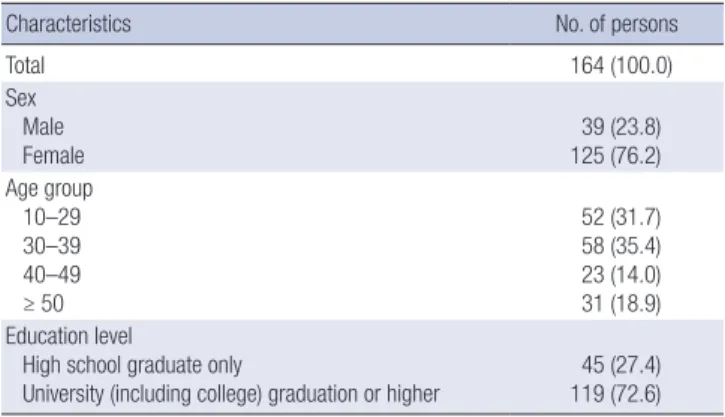
Table 1. The sociodemographic characteristics of the surveyed population
Characteristics No. of persons
Total 164 (100.0)
Sex Male Female
39 (23.8) 125 (76.2) Age group
10–29 30–39 40–49 ≥ 50
52 (31.7) 58 (35.4) 23 (14.0) 31 (18.9) Education level
High school graduate only
University (including college) graduation or higher
45 (27.4) 119 (72.6) Values are presented as number (%).
demographic characteristics. For portal usage patterns, the sour- ces of portal awareness (Fig. 1) and the type of information sear- ched were calculated by considering multiple responses; the frequency of portal use was calculated as the frequency of ac- cess in the last year.
For evaluation on the information available on the portal, ex- ploratory factor analysis (EFA) was used to determine the con- struct validity of the items. In EFA, the researcher has no partic- ular expectations about the number and nature of factors; prin- cipal component analysis with varimax rotation is the most com- monly used method to find factors (7).
Based on the results of the factor analysis, the communality, which indicates the amount of information related to the vari- ables included in the extracted factors, was analyzed, and items with scores of less than 0.5 were deleted. The final number of fi- nal factors was selected based on an eigenvalue of 1 and a cu- mulative variance ratio over 0.6. Cronbach’s alpha was calculat- ed to determine the internal consistency, which was commonly used to estimate the reliability of the questionnaire.
For effectiveness of the health information portal, Likert-type results for overall satisfaction, intention to revisit, and intention to recommend to others were broken into “high” and “low” by median scores.
Because the 3 items on the effectiveness of the health infor- mation portal were dichotomous (“high/low”) variables, multi- ple logistic regression analysis was used and the odds ratio (OR) of effectiveness of the health information portal was verified by a 1 score increase of each item for health information evalua- tion. The collected data were analyzed using SPSS ver. 23 (IBM Corp., Armonk, NY, USA). All statistical tests were 2-sided. Sta- tistical significance was set at a P value < 0.05.
Ethics statement
The present study protocol was reviewed and approved by the Institutional Review Board of Kangwon National University (KW- NUIRB-2015-08-002). Informed consent was submitted by all subjects when they were enrolled.
RESULTS
The sociodemographic characteristics of the surveyed population
Among the 164 respondents, men accounted for 23.8% and wom- en 76.2%. As for age, people in their 20s accounted for 31.7%, 30s for 35.4%, 40s for 14.0%, and 50s and over for 18.9%. On ed- ucation level, the proportion of “high school graduate only” was 27.4% and that of “university (including college) graduation or higher” was 72.6% (Table 1).
Usage patterns in relation to the NHIP Awareness of NHIP (multiple responses)
Forty-six point two percent of the respondents answered that they were “aware through searching of a keyword related to health information in the portal site search engine.” The source of this awareness could be broken down into “awareness through oth- ers” (43.6%), “awareness through Internet use other than portal site search” (26.3%), “awareness through medical personnel”
(11.5%), and “awareness through mass media” (5.1%) (Fig. 1).
Type of information searched through the NHIP (multiple responses)
“The characteristics of disease/symptoms” accounted for 62.7%, the highest. “Treatment and management methods” accounted for 46.8%, “improvement in lifestyle (exercise, nutrition, drink- ing, and non-smoking)” for 39.9% “preventive measures” for 39.2%, “diagnostic methods” for 38.6%, and “medical institu- tions and medical personnel” for 10.8%—the lowest. Other re- sponses included “basic medical information,” “reference ma- terials,” “human anatomy,” and so on.
Frequency of NHIP use
The frequency of accessing the NHIP in the past year was 38.4%
for “once (this connection is the only one),” 16.5% for “less than once a month,” 12.2% for “once a month,” 17.7% for “2 to 4 times a month,” 10.4% for “2–3 times a week,” and 4.9% for “more than 4 times a week.”
Site users’ evaluation about health information on the NHIP: EFA
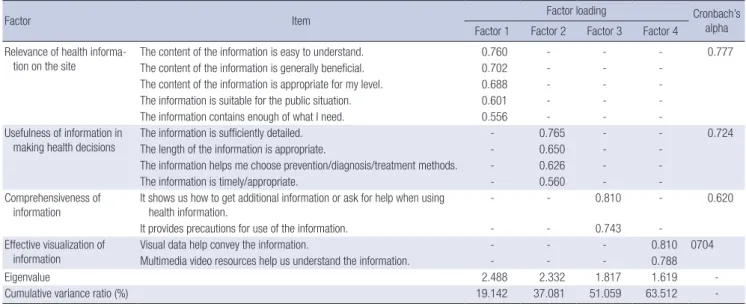
EFAs revealed 4 factors with an eigenvalue > 1, explaining 63.51%
of the total variance (Table 2). The Kaiser-Meyer-Olkin (KMO) index in this study was 0.825, indicating sufficient data for anal- ysis. Bartlett’s test of sphericity, with 655.514, was also significant (P value < 0.001), indicating that the correlations between items were sufficient and warranted factor analysis (8,9).
Two items, “The information is convenient to use” and “It’s fun to find information on this website,” exhibited low commu- nality scores (< 0.5) and were removed from the analysis. The minimum factor loading for each item in the factor matrix and the rotated matrix was 0.556.
As for factor analysis of health information evaluation items, 13 items were classified into 4 factors related to content: “the relevance of health information on the site,” “the usefulness of information in making health decisions,” “comprehensiveness of information,” and “effective visualization of information.” Cron- bach’s alphas for the 4 factors were 0.777, 0.724, 0.620, and 0.704, respectively, and showed high internal consistency.
Perceived effectiveness of the NHIP and influencing factors
The results for participants’ perceived effectiveness of the health information portal, are “satisfied overall” at 71.3%, “intention to
revisit” at 51.2%, and “intention to recommend to others” at 40.9%. We further examined what factors may impact the per- ceived effective of the NHIP (Table 3) by conducting a 3 sets of multiple logistic regression analysis. First, multiple logistic re- gression analysis with overall satisfaction as a dependent vari- able showed that the relevance of health information on the site and the usefulness of information in making health decisions were statistically significant—as they increased, so did overall satisfaction (ORs, 1.85 and 2.53, respectively), confirming that they positively affect overall satisfaction.
Second, with reuse intention as a dependent variable, we found that age, the relevance of health information on the site, Table 3. Multiple logistic regression models of factors related to perceived effectiveness of the NHIP
Category (ref)
Perceived effectiveness of the health information portal Overall satisfaction
(ref = low) Intention to revisit
(ref = low) Intention to recommend to others (ref = low)
OR 95% CI OR 95% CI OR 95% CI
Sex (male) P = 0.363 P = 0.369 P = 0.089
Female 1.52 0.617–3.735 0.64 0.243–1.692 0.41 0.146–1.144
Age group (19–29) P = 0.629 P = 0.044 P = 0.456
30–39 0.50 0.175–1.437 0.50 0.180–1.392 0.45 0.157–1.312
40–49 0.54 0.141–2.073 0.37 0.101–1.333 0.46 0.120–1.719
≥ 50 0.67 0.195–2.341 0.18 0.055–0.598 0.54 0.165–1.765
Education level (high school graduate only) P = 0.701 P = 0.694 P = 0.031
University graduation or higher 0.83 0.311–2.193 0.82 0.312–2.171 3.04 1.107–8.357
Relevance of health information on the site P = 0.004 P < 0.001 P < 0.001
1.85 1.210–2.819 3.05 1.814–5.130 3.64 2.074–6.390
Usefulness of information in making health decisions P < 0.001 P < 0.001 P < 0.001
2.53 1.615–3.965 3.38 2.050–5.588 4.18 2.448–7.135
Comprehensiveness of information P = 0.811 P = 0.550 P = 0.999
1.05 0.705–1.563 0.88 0.586–1.328 1.00 0.657–1.523
Effective visualization of information P = 0.585 P = 0.010 P = 0.016
1.12 0.746–1.679 1.75 1.143–2.689 1.69 1.101–2.600
NHIP = National Health Information Portal, ref = reference level, OR = odds ratio, CI = confidence interval.
Table 2. EFA and reliability analysis of health information evaluation
Factor Item Factor loading Cronbach’s
alpha Factor 1 Factor 2 Factor 3 Factor 4
Relevance of health informa- tion on the site
The content of the information is easy to understand. 0.760 - - - 0.777
The content of the information is generally beneficial. 0.702 - - -
The content of the information is appropriate for my level. 0.688 - - -
The information is suitable for the public situation. 0.601 - - -
The information contains enough of what I need. 0.556 - - -
Usefulness of information in
making health decisions The information is sufficiently detailed. - 0.765 - - 0.724
The length of the information is appropriate. - 0.650 - -
The information helps me choose prevention/diagnosis/treatment methods. - 0.626 - -
The information is timely/appropriate. - 0.560 - -
Comprehensiveness of
information It shows us how to get additional information or ask for help when using
health information. - - 0.810 - 0.620
It provides precautions for use of the information. - - 0.743 -
Effective visualization of information
Visual data help convey the information. - - - 0.810 0704
Multimedia video resources help us understand the information. - - - 0.788
Eigenvalue 2.488 2.332 1.817 1.619 -
Cumulative variance ratio (%) 19.142 37.081 51.059 63.512 -
EFA = exploratory factor analysis.
the usefulness of information in making health decisions, and effective visualization of information were statistically signifi- cant. Compared with people in their 20s, above-50s had lower reuse (OR, 0.18); as relevance of health information on the site, usefulness of information in making health decisions, and ef- fective visualization of information increased, reuse intent ORs were 3.05, 3.38, and 1.75, respectively.
Finally, with recommendation to others as a dependent vari- able, we found that education level, the relevance of health in- formation on the site, the usefulness of information in making health decisions, and effective visualization of information were statistically significant. Compared with high school graduate only, the level of recommendation by people who were univer- sity graduates was higher (OR, 3.04), and as the relevance of heal- th information on the site, usefulness of information in making health decisions, and effective visualization of information in- creased, recommendation level did also (ORs, 3.64, 4.18, and 1.69, respectively).
DISCUSSION
Our survey finding suggest people’s demand for health infor- mation is rapidly increasing, and effective use of health infor- mation has been proven to help health behavior and health.
According to the results of survey, patients who have access to appropriate health information and use it well are more likely to have better outcomes (10-13). However, the provision of com- mercial health information by private institutions has many problems in terms of reliability and quality of information. Also, according to the Health on the Net Foundation (HON, Geneva, Switzerland) survey 2015 (14), 79% of health system users an- swered that government and government agencies were respon- sible for online health information provision. Therefore, it is im- portant for government to take responsibility to provide people with correct and appropriate health information (14).
Another responsibility of the government is sound manage- ment of health information. Currently, many health sites, espe- cially commercial sites, contain unverified and in some cases incorrect information. However, it is difficult for laypeople to evaluate the quality of health information sites and evaluate whether information is commercial or not. Most people want to visit a site and easily find information, but few are interested in basic questions about who created this information and why (15).
Eysenbach and Köhler (13), using focus group, usability test, and in-depth interview results to study how to find information on health information sites, found that users searched the con- tent that they came to find first, but only rarely searched about
“about us.” Currently, there is no policy to control health infor- mation quality and avoid distortion led by government in Ko- rea. It is necessary for the government to evaluate information
providers, filter out wrong information, and identify websites with high quality and introduce them through the health infor- mation portal.
Various evaluation tools for evaluating online information have been developed, as have new standards and methods for developing and providing health information (6,16-18). How- ever, these tools and criteria have been conducted from the per- spectives of providers, not consumers, and the evaluation has often been performed by experts, not actual users. To increase the utilization of health information by lay people and improve the effectiveness of health portal sites, it is important to be aware which factors affect users’ site satisfaction, intention of reuse, and intention to recommend to others.
Currently, several health sites are being operated by the Ko- rean government and its agencies. In addition to the NHIP, there are “People In” provided by the National Health Insurance Cor- poration, health promotion information provided by the Korea Health Promotion Development Institute, and information on medical institutions provided by the Health Insurance Review
& Assessment Service (HIRA). However, research has not previ- ously been conducted to identify the advantages and disadvan- tages of each site from the user perspective, a gap this study aimed to help fill.
We found that the characteristics of health information con- tent that make it relevant and aid treatment decisions affect overall satisfaction with the portal site, intention to reuse, and intention to recommend to others. In this sense, the results of this study are similar to those of previous studies; for instance, in the HON survey 2015 results, information relevance, indicat- ing the extent to which the information answers the searcher’s questions, was most important to health system users (14).
Eysenbach et al. (19) presented that most frequently used quality criteria included readability, visual images, and refer- ences provided through their results of systematic review on as- sessing the quality of health information for consumers. We also found that satisfaction with visual data positively affected site reuse and recommendation. Recently, visualization, including the use of infographics, has been emphasized as an information delivery method for big data.
We did not address search convenience in our research, but it is likely an important factor. Eysenbach et al. (19) have em- phasized that it is important to improve the user’s search expe- rience on health information portals such as MedlinePlus, Mayo Clinic (Mayo Foundation for Medical Education and Research, Rochester, MN, USA), HON, and HealthInsite (Health|Insite (Pty) Ltd., Johannesburg, South Africa), and Better Health (Bet- ter Health, LLC., Miami, FL, USA). Another factor that should be considered is user experience, including customization, and satisfaction with search and information found. Finally, the mat- ter of sharing metadata among health sites and portals across agencies and even countries should be considered.
The object of this questionnaire was recruited by non-proba- bilistic convenience sampling, meaning they may not represen- tative of all users of the portal site. However, Ko and Lee (20) suggest that research based on non-random samples can pro- vide useful qualitative as well as quantitative data. This study aimed to find factors affecting experience of the portal site as effective.
In conclusion, this study examined the information attributes that affect overall satisfaction with the site, willingness to reuse, and intention to recommend the portal to other people, from among a panel of users. The results showed that appropriate- ness of health information content and information character- istics that help decision-making affect all 3 dependent variables, while satisfaction with visual information positively affected re- use and recommendation intention. The results of this study will be used as basic data to establish strategies to develop bet- ter health information provision through the NHIP.
DISCLOSURE
The authors have no potential conflicts of interest to disclose.
AUTHOR CONTRIBUTION
Conceptualization: Choung JT, Lee YS, Jo HS. Data curation:
Choung JT, Lee YS, Jo HS. Formal analysis: Jo HS, Jung SM. In- vestigation: Jo HS, Shim M, Lee HJ, Jung SM. Writing - original draft: Choung JT, Lee YS, Jo HS. Writing - review & editing: Choung JT, Lee YS, Jo HS, Shim M, Lee HJ.
ORCID
Ji Tae Choung https://orcid.org/0000-0003-0432-4048 Yoon-Seong Lee https://orcid.org/0000-0002-1899-3632 Heui Sug Jo https://orcid.org/0000-0003-0245-3583 Minsun Shim https://orcid.org/0000-0003-4248-7120 Hun Jae Lee https://orcid.org/0000-0002-0163-6815 Su Mi Jung https://orcid.org/0000-0003-0536-4914 REFERENCES
1. Jung SM, Jo HS, Oh HW. Internal motivation, perceived health compe- tency, and health literacy in primary and secondary cancer prevention.
Asian Pac J Cancer Prev 2016; 17: 5127-32.
2. Jang H, Sim J, Kim Y. Sources of health information by customer’s charac- teristics. J Korean Soc Med Inform 2004; 10: 415-27.
3. Glenton C, Paulsen EJ, Oxman AD. Portals to Wonderland: health portals
lead to confusing information about the effects of health care. BMC Med Inform Decis Mak 2005; 5: 7-14.
4. Ahn J, Lim IS. The significant role of the National Health Information Por- tal, http://health.mw.go.kr. J Korean Med Assoc 2011; 54: 957-60.
5. Bartlett JE, Kotrlik JW, Higgins CC. Organizational research: determining appropriate sample size in survey research. Inf Technol Learn Perform J 2001; 19: 43-50.
6. Kim MJ, Kang NM, Kim SW, Rhyu SW, Chang H, Hong SK, Kim J. Devel- opment of an evaluation checklist for Internet health/disease information.
J Korean Soc Med Inform 2006; 12: 283-92.
7. Park HJ, Yang HK, Shin DW, Kim YY, Kim YA, Yun YH, Nam BH, Bhatia S, Park BK, Ghim TT, et al. Cross-cultural adaptation of the Korean version of the minneapolis-manchester quality of life instrument-adolescent form.
J Korean Med Sci 2013; 28: 1788-95.
8. Kaiser HF. An index of factorial simplicity. Psychometrika 1974; 39: 31-6.
9. Han DH, Lee JJ, Moon DS, Cha MJ, Kim MA, Min S, Yang JH, Lee EJ, Yoo SK, Chung US. Korean version of inventory of complicated grief scale: psy- chometric properties in Korean adolescents. J Korean Med Sci 2016; 31:
114-9.
10. Park S, Lee S. Exploring categories of health information users on the ba- sis of illness attitude and health information seeking behavior on the In- ternet. Korean J Journal Commun Stud 2011; 55: 105-33.
11. Yu HJ, An CH, Hwang SY. Interactivity represented on health-related web- sites: a content analysis of Korean health information websites. Korean J Advert Public Relat 2011; 13: 65-104.
12. Nam J, Park T. A study on structural relationship among perceived inter- activity and user related variables in health information websites. J Kore- an Soc Inf Manage 2014; 31: 103-31.
13. Eysenbach G, Köhler C. How do consumers search for and appraise health information on the world wide web? Qualitative study using focus groups, usability tests, and in-depth interviews. BMJ 2002; 324: 573-7.
14. Health on the Net Foundation (CH). Health on the Net Foundation (HON) survey 2015. Your usage of Internet for health/medical purposes [Inter- net]. Available at http://www.hon.ch/Survey/Survey2005/raw_data.html [accessed on 17 November 2016].
15. Childs S. Developing health website quality assessment guidelines for the voluntary sector: outcomes from the judge project. Health Info Libr J 2004;
21 Suppl 2: 14-26.
16. Jadad AR, Gagliardi A. Rating health information on the Internet: navigat- ing to knowledge or to Babel? JAMA 1998; 279: 611-4.
17. Chung YC, Park HA. Development of a health information evaluation sys- tem on the Internet. J Korean Soc Med Inform 2000; 6: 53-66.
18. Lee YS, Ju YH, Im MK, O SW. The analysis of health promotion informa- tion on the Internet. J Korean Soc Med Inform 2001; 7: 11-20.
19. Eysenbach G, Powell J, Kuss O, Sa ER. Empirical studies assessing the qual- ity of health information for consumers on the world wide web: a system- atic review. JAMA 2002; 287: 2691-700.
20. Ko ES, Lee KH. Pre-service teachers’ understanding of statistical sampling.
J Educ Res Math 2011; 21: 17-32.