J Korean Soc Radiol 2018;78(4):284-288 https://doi.org/10.3348/jksr.2018.78.4.284
INTRODUCTION
Pulmonary metastases are common and can be classified ac- cording to the growth site, number of tumors, and pattern of radiological manifestations. With respect to the seeding mecha- nism, pulmonary metastases usually develop when tumor cells lodge in a small distal arteriole or in the interstitium. However, sometimes the cancerous cells are deposited as an endobron- chial lesion (1). Pulmonary metastases most commonly present as multiple nodules or masses; however, in some cases of colorec- tal cancer or skeletal sarcoma, solitary metastases are predomi- nant. Furthermore, pulmonary metastases can manifest in vari- ous patterns, including “military pattern,” “consolidation with
air bronchogram,” “cavity,” and “perinodular” or “peritumoral ground-glass opacity” (2). These radiological features are help- ful in determining the primary site of malignancy. However, to the best of our knowledge, only a few reports have documented chest computed tomography (CT) showing a dilated vascular structure in metastatic nodules or masses. Herein, we present a unique case of pulmonary metastasis manifesting as multiple nodules with tortuous, serpentine, aneurysmal, dilated, intratu- moral vessels, which originated from uterine sarcoma.
Case RepORT
A 60-year-old woman presented with generalized weakness,
Pulmonary Metastasis Originated from Uterine Sarcoma, Presenting as Multiple Nodules with Tortuous, Serpentine, Aneurysmal, Dilated Intratumoral Vessels: A Case Report
종양 내 구불구불한 동맥류성 혈관 확장을 보이는 자궁 육종의 폐전이:
증례 보고
Hyeon Ji Jang, MD
1, Song Soo Kim, MD
1*, Hee Sun Park, MD
2, Jeong Eun Lee, MD
2, Jin Hwan Kim, MD
11Department of Radiology, Chungnam National University Hospital, Chungnam National University School of Medicine, Daejeon, Korea
2Division of Pulmonology, Department of Internal Medicine, Chungnam National University Hospital, Chungnam National University School of Medicine, Daejeon, Korea
Pulmonary metastases present a wide spectrum of radiological findings, some of which have been known to be useful for analogizing the possible origin or site of primary tumors. In the present report, we describe a unique case of pulmonary me- tastasis manifesting on chest computed tomography as multiple nodules with tor- tuous, serpentine, aneurysmal, dilated, inner intratumoral vessels. The metastasis originated from uterine sarcoma.
Index terms Sarcoma Lung Neoplasms Neoplasm Metastasis
Tomography, X-Ray Computed
Received June 29, 2017 Revised September 20, 2017 Accepted November 11, 2017
*Corresponding author: Song Soo Kim, MD
Department of Radiology, Chungnam National University Hospital, Chungnam National University School of Medicine, 282 Munhwa-ro, Jung-gu, Daejeon 35015, Korea.
Tel. 82-42-280-7333 Fax. 82-42-253-0061 E-mail: [email protected]
This is an Open Access article distributed under the terms of the Creative Commons Attribution Non-Commercial License (http://creativecommons.org/licenses/by-nc/4.0) which permits unrestricted non-commercial use, distri- bution, and reproduction in any medium, provided the original work is properly cited.
dyspnea, and weight loss that had persisted for 5 months. Her medical history revealed hypertension diagnosed two years earlier. After admission, she underwent all available routine laboratory tests, which displayed the following abnormal labo- ratory findings: increased white blood cell count (17400/µL) and high level of C-reactive protein (23.3 mg/dL), suggesting active inflammation throughout the body. Moreover, her hemoglobin level was 5.3 g/dL, mean corpuscular volume was 70.9 fL, se- rum iron level was 22 µg/dL, and ferritin level was 1478 ng/mL, suggesting microcytic anemia with iron deficiency.
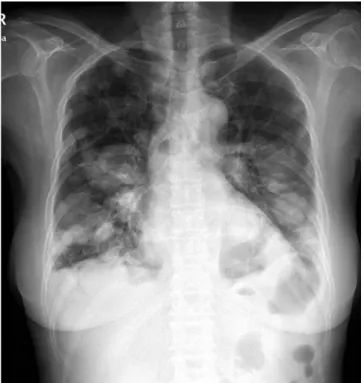
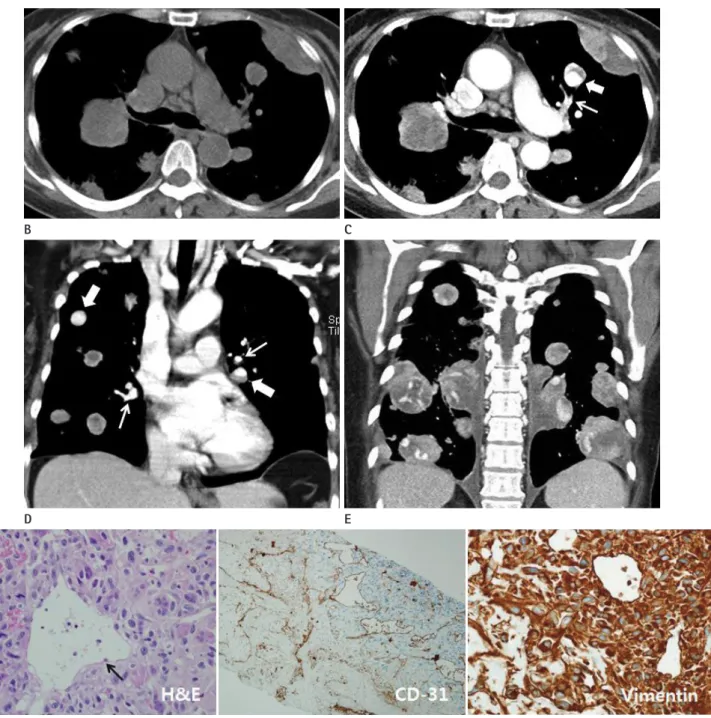
She underwent radiological testing, and a chest radiograph showed diffuse, variably sized, nodular opacities in both lungs (Fig. 1A). They were well-defined round masses. For further evaluation, she underwent chest CT. Pre-contrast axial chest CT showed multiple, variably sized, well-defined, round-to-ovoid soft tissue nodules and masses without any inner calcific foci in both lungs (Fig. 1B). Contrast-enhanced CT revealed multiple diffuse, heterogeneous, enhancing nodules and masses with tortuous, serpentine, or engorged inner vascular structures (Fig.
1C-E). We first considered the possibility of pulmonary vascu-
lar pseudoaneurysms associated with pulmonary vasculitis or septic pneumonia. However, the vascular structures did not have any direct connection with the pulmonary artery or its branches. They were confined within the masses and nodules.
Some nodules had a low attenuation portion, suggesting inter- nal necrosis. Collectively, these findings suggested pulmonary metastasis. Laboratory examination revealed that the patient’s serum cancer antigen-125 level was markedly elevated (245.2 U/mL; normal: < 35 U/mL). Subsequently, for further evalua- tion, she underwent pelvic ultrasonography, which revealed a 6.6-cm, heterogeneous, irregular, putative primary mass in the uterus. She then underwent abdominal CT to rule out other malignancies, such as ovarian cancer. The abdominal CT showed a large, cystic, uterine mass with a partially enhancing solid portion in the right uterine wall; the mass was regarded as uter- ine malignancy, and a biopsy was recommended, but the pa- tient refused the procedure. Therefore, a percutaneous core-nee- dle biopsy of a nodule in the right lower lobe of the lung was performed. Microscopic examination revealed multiple cystic spaces with a flat, endothelial-like cell lining, indicating vascu- lar spaces, and the tumors proved to be lung metastases derived from sarcomatous carcinoma (Fig. 1F). The patient underwent one course of palliative chemotherapy, but her general condi- tion worsened. After discussions with her family, she decided not to undergo any more aggressive treatments, such as chemo- therapy and radiotherapy. She was then transferred to another hospital in her hometown for conservative treatment.
DIsCUssION
In this report, we have presented a unique case of multiple, variably sized, pulmonary metastatic masses and nodules show- ing engorged, aneurysmal, and dilated tumor vessels, and these metastatic masses and nodules originated from uterine sarcoma.
Pulmonary metastases are common and show a wide range of radiological features. On one hand, these features help in de- termining the original tumor site; on the other hand, as in the present study, the unusual radiological features of some metas- tases make it difficult to distinguish them from non-malignant pulmonary diseases (2). The various known features of lung metastases are cavitation, calcification, hemorrhage around the metastatic nodules, pneumothorax, air-space pattern, tumor A
Fig. 1. A 60-year-old woman with pulmonary metastasis from uterine sarcoma, presenting as multiple nodules with tortous, serpentine, an- eurysmal dilated intraumor vessels.
A. Initial chest radiograph shows multiple, round, variably sized nodules
B C
D E
Fig. 1. A 60-year-old woman with pulmonary metastasis from uterine sarcoma, presenting as multiple nodules with tortous, serpentine, aneu- rysmal dilated intraumor vessels.
B. Pre-enhanced image shows well-defined homogeneous, variably sized, soft-tissue nodules with a density similar to that of the back muscles and no inner calcific foci.
C. Axial contrast-enhanced CT image shows aneurysmal dilatated intratumoral vessel (thick arrow). It has no connection with adjacent branch of the pulmonary artery (thin arrow).
D. Coronal contrast-enhanced CT image also show aneurysmal dilatated intratumoral vessels (thick arrows). Branches of the pulmonary artery (thin arrows) pass through the nodules without any connection.
E. Coronal contrast-enhanced CT image show multiple variable sized nodues and masses with tortous, dilatated intratumoral or intranodal ves- sels with an inner cystic or necrotic portion.
F. Photomicrographs show tumor cell infiltration with circumscribed cystic spaces lined with flat, endothelial-like cells (arrow), suggesting vascu- lar structures (hematoxylin and eosin, × 100). Cystic spaces show CD-31 positivity (CD-31, × 100) and tumor cells react strongly with mesenchy- mal antigen (Vimentin, × 400).
CD-31 = cluster of differentiation-31, CT = computed tomography F
embolism, endobronchial metastasis, solitary mass, and dilated vessels within a mass (2). Squamous cell carcinoma is the most common cancer type that yields a cavitating metastasis with a thick and irregular wall. In contrast, thin-walled cavities can be observed in metastases from sarcomas and adenocarcinomas.
Furthermore, calcification can occur in metastatic sarcomas or adenocarcinomas, making it difficult to differentiate these dis- eases from benign granulomas or hamartomas. Peritumoral hemorrhage results in areas of nodular attenuation surrounded by a halo of ground-glass opacity. Pneumothorax commonly occurs as a result of metastases from an osteosarcoma. Air- space consolidation is often seen in metastases from gastroin- testinal tract malignancies, whereas a common radiological manifestation of endobronchial metastasis is atelectasis (2).
Therefore, these findings are helpful in the differential diagnosis of pulmonary masses, even though they are not specific.
Dilated vascular structures within the masses occur in cases of metastasis from a sarcoma, in particular, alveolar soft-part sarcoma or leiomyosarcoma (2). Some studies have shown lung metastases from soft-part sarcoma, which contain dilated intra- tumoral vessels; however, there are few cases of lung metastases from uterine sarcoma (3, 4).
Uterine sarcomas are rare neoplasms, comprising 5% of uter- ine malignancies (5), and uterine leiomyosarcoma is the second most common subtype of uterine sarcoma, accounting for 30–
40% of all uterine sarcomas (5, 6). Leiomyosarcomas are the most malignant smooth muscle tumors of the uterus, and they show the microscopic constellation of hypercellularity, severe nuclear atypia, and high mitotic rate. Sahdev and colleagues re- ported that most uterine sarcomas show strong enhancement of the mass (7). The precise pathogenesis of engorged intratu- moral vessels in tumors is unknown, but these engorged tumor vessels may be suggestive of the hypervascular nature of the metastatic nodules (8).
When a patient presents with dilated and tortuous vessels in lung masses, other vascular lesions should be ruled out, includ- ing arteriovenous fistulae, pulmonary artery aneurysms, and pulmonary vein varices. Furthermore, primary lung cancer and pulmonary metastases can cause erosion of the pulmonary ar- teries and result in pseudoaneurysm formation. In rare cases, primary tumors arising from the pulmonary arteries, such as leiomyosarcomas and angiosarcomas, can cause focal expan-
sion and aneurysmal dilatation of the pulmonary artery itself (9, 10). However, in the present case, the vascular structures did not show any direct connection with the pulmonary artery or its branches. Infection with tuberculosis bacteria, pyogenic bac- teria, and fungi can also cause pseudoaneurysms (9, 10). How- ever, in such cases, the main findings are likely to be ground-glass opacity or consolidation, reflecting infection or inflammation of the lung, rather than multiple metastatic nodules.
In summary, we have presented a unique case of pulmonary metastasis manifesting as multiple nodules with well-devel- oped, tortuous, serpentine, aneurysmal, dilated inner intratu- moral vessels, and the metastasis may have originated from uterine sarcoma.
RefeReNCes
1. Davis SD. CT evaluation for pulmonary metastases in pa- tients with extrathoracic malignancy. Radiology 1991;180:
1-12
2. Seo JB, Im JG, Goo JM, Chung MJ, Kim MY. Atypical pulmo- nary metastases: spectrum of radiologic findings. Radio- graphics 2001;21:403-417
3. Daly BD, Cheung H, Gaines PA, Bradley MJ, Metreweli C.
Imaging of alveolar soft part sarcoma. Clin Radiol 1992;46:
253-256
4. Choi JI, Goo JM, Seo JB, Kim HY, Park CK, Im JG. Pulmonary metastases of alveolar soft-part sarcoma: CT findings in three patients. Korean J Radiol 2000;1:56-59
5. Shah SH, Jagannathan JP, Krajewski K, O'Regan KN, George S, Ramaiya NH. Uterine sarcomas: then and now. AJR Am J Roentgenol 2012;199:213-223
6. Tirumani SH, Deaver P, Shinagare AB, Tirumani H, Hornick JL, George S, et al. Metastatic pattern of uterine leiomyosarco- ma: retrospective analysis of the predictors and outcome in 113 patients. J Gynecol Oncol 2014;25:306-312
7. Sahdev A, Sohaib SA, Jacobs I, Shepherd JH, Oram DH, Reznek RH. MR imaging of uterine sarcomas. AJR Am J Roentgenol 2001;177:1307-1311
8. Ueda M, Otsuka M, Hatakenaka M, Sakai S, Ono M, Yoshim- itsu K, et al. MR imaging findings of uterine endometrial stromal sarcoma: differentiation from endometrial carci- noma. Eur Radiol 2001;11:28-33
9. Kreibich M, Siepe M, Kroll J, Höhn R, Grohmann J, Beyersdorf F. Aneurysms of the pulmonary artery. Circulation 2015;
131:310-316
10. Nguyen ET, Silva CI, Seely JM, Chong S, Lee KS, Müller NL.
종양 내 구불구불한 동맥류성 혈관 확장을 보이는 자궁 육종의 폐전이: 증례 보고
장현지
1· 김성수
1* · 박희선
2· 이정은
2· 김진환
1악성 종양으로부터의 폐전이는 다양한 범위의 영상학적 소견을 보인다. 폐전이의 몇 가지 특징들에서는 종양의 원발 위치 를 유추할 수 있는 것으로 알려져 있다. 저자들은 흉부 전산화단층촬영에서 다수의 전이성 폐 결절 내부에 구불구불하게 늘어난 혈관들을 보이는, 독특한 양상의 자궁 육종 폐전이 1예를 경험하였기에 이를 보고하고자 한다.
충남대학교 의과대학 충남대학교병원 1영상의학과, 2호흡기내과
Pulmonary artery aneurysms and pseudoaneurysms in adults: findings at CT and radiography. AJR Am J Roentgen- ol 2007;188:W126-W134