Chapter7. Polymer Solubility and Solutions
-Three factors are of general interest:
1. What Solvents will dissolve what polymer?
2. How does the polymer-solvent interaction influence the solution properties/
3. To what applications do the interesting properties of polymer solutions lead?
-General rules foe polymer solubility:
1. Like dissolve like;
Polar polymers- polar solvents Nonpolar polymer-nonpolar solvent (e.g.)
poly(vinyl alcohol)
C C
n
H H
H OH H
: H2Opolystyrene
C C
n
H H
H
:
CH
32. Solubility will decrease with increasing molecular weight at const. temp.
3. Crystallinity decreases solubility.
4. Crosslinking eliminates solubility.
5. The rate of solubility increases with short branches, allowing the solvent molecules to penetrate more easily.
6. The rate of solubility decreases with longer branches, because the entanglement makes it harder for individual molecules to separate.
-The thermodynamic basis
ΔGm=ΔHm-TΔSm < 0
Where ΔGm = the change in Gibbs free energy in the process ΔHm = the change in enthalpy in the process
ΔSm = the change in entropy in the process
Only if ΔGm is negative will the solution process be feasible.
A positive ΔH – solvent and polymer “prefer their own company”, 즉, the pure materials are in a lower energy state.
A negative ΔH – the solution is in the lower energy state, specific interactions are formed between the solvents and polymer molecules.
(a) (b)
Fig. Lattice model of solubility.
Solvent, open circles ; solute, filled circles.
(a) Low-molecular-weight solute (b) polymeric solute.
-for(a): non polymer liquids:
free energy of dilution of a solution
ΔGm = RTln(
A0
A
P
P
) (1)where ΔG : free energy of dilution resulting from the transfer of one molecule of liquid A from the pure liquid state with vapor pressure
P
A0 to a large amount of solution with vapor pressure PA.when the solution is ideal-Rault’s law is obeyed.(mixing of A and B), PA=
A0
P
A0B A
A P
N N
N
=
+
nA (2)nA: mole fraction of A
then Eq(1) becomes : ΔGA=RTln(nA) (3)
The total free energy of mixing is
ΔGm = NAΔGm + NBΔGB
= RT(NAln(nA)+ NBln(nB)) (4)
For ideal mixing ΔH = 0, since ΔG=ΔH-TΔS
∴ΔSm=-R(NAln(nA)+ NBln(nB)) (5)
For (b): a polymer molecule located in the liquid lattice
• The Flory-Huggins model uses a simple lattice representation for the polymer solution and calculates the total number of ways the lattice canbe occupied by small molecules and by connected polymer segments.
ΔSm=-R(N1ln(φ1)+ N2ln(φ2)) (6) ΔHm= RTχ12N1φ2 (7)
ΔGm=ΔHm-TΔSm= RT(N1ln(φ1)+ N2ln(φ2)+ χ12N1φ2) (8) 여기서, N1 = number of moles of the ith component
φ1 = volume fraction
- for a system consisting of two polymers
) (
ln
ln
1 2 2 12 1 2 1 1 2 21 n mn m n
RT n Gm
+ +
+
Δ = φ φ χ φ φ
(9)
(ref) H.Tompa; polymer solutions, Butterworths,London, 1956,chapter 7
where
φi=mini/( mini+mjnj) (i,j=1,2 and i
≠
j),χ12=polymer-polymer interaction parameter.
m1=degree of polymerization m1=ν1/ν0 , m2=ν2/ν0
chemical potential of mixing of component I : partial derivative of (eq.9) with respect to ni
Δμ1/RT=ln φ1 + (1-m1/m2) φ2 + m1 χ12 φ22 (10) Δμ2/RT=ln φ2 + (1-m2/m1) φ1 + m2 χ12 φ12 (11)
At equilibrium the chemical potencial of each component must be the same in both phase.
Δμ1'=Δμ1"
Δμ2'=Δμ2"
From eqs.(10),(11),(12), and (13),
χ12 =
)
"
' )(
"
' ( 2
)]}
'
"- )(
( ) ' /
"
ln(
)[
"
' (
)]
'
"- )(
( ) ' /
"
ln(
)[
"
' {(
2 2 2 2 2 1 2 1 2 1
1 1 1 2 1
2 1 2 2 2 2
2 2 2 1 1
1 2 2 1 2 1
φ φ φ φ
φ φ φ
φ φ
φ
φ φ φ
φ φ
φ
−
−
− +
−
+
− +
−
m m
m m m
m m m
Assumptions : 1. χ12 is taken to be constant
2. both components of the mixtures are considered to be monodisferse.
To examine χ12 as a function of concentration (or compositions), 즉, linear function of
φ2,
g12(φ2)=g0+g1 φ2 is employed.
The (eq.9) becomes:
) (
) g g ( ln
ln
1 2 2 0 1 2 1 2 1 1 2 21 n m n m n
RT n Gm
+ +
+ +
Δ = φ φ φ φ φ
(14)Partial differentiation of eq.(14) with respect to ni :
2 2 1 1
1 2 2 0 1 2 2 1 1
1
ln φ ( 1 / ) φ g φ g(1 - 2 φ ) φ
μ
m m m mRT
= + − + +
Δ
(15)2 2 1 1 2 2 1 0 12 12 1 12 12
2
ln φ ( 1 / ) φ g φ 2 g φ φ
μ
m m m mRT
= + − + +
Δ
(16)At equilibrium;
Δμ1'=Δμ1"
Δμ2'=Δμ2"
Eq(15) will give,
)
"
/ '
ln( φ1 φ
1 +( 1 −
m1/
m2) ( φ2'- φ2" )
+m1g0( '
2"
2)
2
'- φ2" )
+m1g0( '
2"
2)
2
2
φ
φ + +m1g1[(1-2φ
1'
)φ
2'
2
- (1-2
φ
1"
)φ
2"
2 ] = 0 (17) Similarly Eq(16) yields,)
"
/ '
ln( φ
1φ
1 +( 1 −
m2/
m1) ( φ
1'- φ
1" )
+m2g0(φ
1'
2+ φ1"
2)
+
2m2g1(
φ
1'
2φ
2'
-φ
1"
2φ
2"
) = 0 (18)Using eqs.(17) and (18), g12 =g0+g1
φ
2 is obtained.• The solubility parameter
- the estimation of ΔHm in regular solutions :
(those in which solute and solvent do not form specific interactions)
)
) 2 - (1 g g
) 1 ( 1
ln
2 1 0 22 1 1 1 222 1
1
φ φ φ φ φ
μ
m mm m
RT
= + − + +
Δ
ΔHm =
φ
1φ
2[δ
1-δ
2]2 *Vm≅
ΔEwhere
φ
= volum fractionsδ
= solubility parametersubscripts 1 = polymer , 2=solvent ΔE= the change in internal energy
δ
= (CED)1/2 = (ν
νΔ
E)1/2 [(cal/cm3)1/2]
Hildebrandwhere (CED)=cohesive energy density, a measure of the strength of the intermolecular forces holding the molecules together in the liquid state.
(
Δ E
ν )=molar change in internal energy on vaporization,cal/g*molν
= molar volume of liquid, cm3/g*mol• The cohesive of a volatile liquid can be estimated from the work required to vaporize unit amount of the material.
The molecules are transported from their equilibrium distances in the liquid to an infinite seperation in the vapor.
ΔGm=ΔHm-TΔSm, ΔHm=
φ
1φ
2[δ
1-δ
2]2 *Vwhere V is total volume of the mixture.
사실상 ΔHm is always positive.
2
δ1− δ < 0.5 (solubility)
• Measuring the solubility parameter of a low-molecular-weight solvent is no problem.
• Polymers degrade long before reaching their vaporization temp, making it impossible to evaluate
Δ E
ν directly.• The greatest tendancy of a polymer to dissolve occurs when its solubility parameter matches that of the solvent.
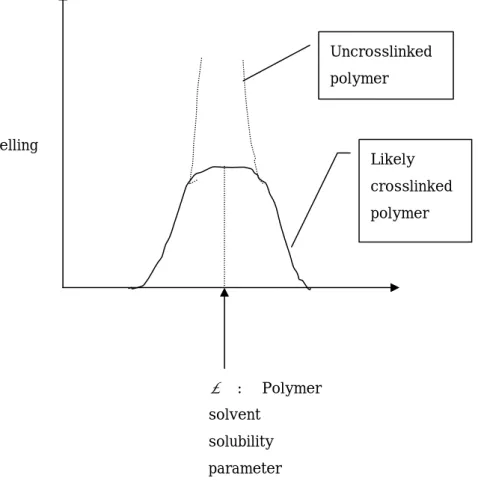
• For the crosslinked polymers, the value of the solvent at which maximum swelling is observed is taken as the solubility parameter of the polymer.
Fig. Determination of
δ
(polymer ) by swelling• solubility parameter of solvent mixture
δ
mixture =δ
Aφ
Aδ
Bφ
Bν χ ν χ
δ ν χ δ ν
χ = +
+ +
2 2 1 1
2 2 2 1 1 1
where
χ
=mole fraction• Estimation of solubility parameter by Group Molar Attraction Constants:
δ
=σ F
i/ M
0 (By van Krevelen-“Properties of Polymer”) swellingLikely crosslinked polymer Uncrosslinked polymer
δ
: Polymer solventsolubility parameter
where
σ =
density of the amorphous polymerM0 = formula molecular weight of the repeating unit
F
i = sum of all the molar attraction constants(ex) polystyrene
C C
n
H H
H
Group Fi No.group
F
i DescriptionCH2 131.5 1 131.5 Density=1.05g/cm3
CH 85.99 1 85.99 M=104g/mol
-C=
(aromatic)
117.12 6 702.72
δ =
1.05(896.77)/104=9.0(cal/cm3)1/26- MEMBERED
RING
-23.44 1 -23.44
896.77 1/2
3
* ) ( mol
cm cal
• Hansen’s Three-dimensional solubility Parameter
2 2 2 2
H p
d
δ δ
δ
δ = + +
-The cohesive energy,
δ
2, is divided into three parts:1) dispersion forces (
δ
d)2) polar forces (
δ
p)3) hydrogen bonding (
δ
H)ex)
solvent
δ
dδ
Pδ
Hδ
Chloroform 808 1.5 2.8 9.36
THF 802 2.8 3.9 9.50
MEK 7.77 4.4 2.5 9.27
m-cresol 8.8 2.5 6.3 11.1
Methanol 7.4 6.0 10.9 14.5
Toluene 8.82 0.7 1.0 8.91
H2O 6.0 15.3 16.7 23.5
PS 8.6 3.0 2.0 9.33
Styrene 9.09 0.49 2.0 9.32
• Properties of dilute solutions
-Good solvent : Solubility parameter closely matches that of the polymer. The secondary forces between polymer segments and solvent molecules are strong, and the polymer molecules are strong, and the polymer molecules will assume a spread-out conformation in solution.
• poor solvent : the attractive forces between the segments of the polymer chain are greater than those between the chain segments and the solvent.
Ex) polystyrene (
δ = 9 . 0 ~ 9 . 3
) Chloroform (δ = 9 . 2
)Then non-solvent is added , methanol(
δ = 14 . 5
),the mixed solvent(Chloroform + methanol) becomes too”poor” to sustain solution, and the polymer precipitates out.When ΔG= 0 and ΔH = TΔS (
θ
condition)• Paint Industry에의 응용
-By adding non-solvent into the polymer solution, the solution viscosity will decrease.
-the viscosity for optimum spraying or brushing characteristics might be obtained with a mixed solvent, with the poorer component the more volatile.
- the poorer component evaporates first, leaving a high viscosity and, therefore, sag-and run-resistant film on the substrate.
Ex 4.1) Estimate the densities of amorphous PET and crystalline PET.
O C
n
CH
2CH
2C O
Sol) Molecular wight of repeating unit = 192.2
At room temperature, amorphous PET is in the glassy state.(see Table 4.9,p 87)
group Vg(298) VC(298,cm3/mol)
1* 65.5 59.0
2*
coo
46.0 43.0
2*
CH
232.7 29.4
총합계 144.2 131.4
So,
σ
g( 298 ) = 1 . 33 2 . 144
2 .
192 =
(g/cm3)실험치는
σ
g( 298 ) =
1.33For
1 . 465
4 . 131
2 . ) 192 298
( = =
σ
c (g/cm3)실험치는
σ
c( 298 ) =
1.477The ratio
1 . 10
33 . 1
465 .
1 ≅
=
g c