J. Exp. Biomed. Sci. 11 (2005) 1–8
Effects of Fenofibrate on Adipogenesis in Female C57BL/6J Mice
Sunhyo Jeong
1, Won Chang Choi
2and Michung Yoon
1†1Department of Life Sciences, Mokwon University, Taejon 302-729, Korea,
2Department of Biomedical Labaratory Science, Hyechon College, Taejon 302-715, Korea
Fibrates are a class of hypolipidemic agents whose effects are mediated by activation of a specific transcription factor called the peroxisome proliferator-activated receptor α (PPARα). PPARα regulates the pathways of lipid catabolism such as fatty acid oxidation and the triglyceride metabolism, resulting in the treatment of hyperlipidemia. The decreased levels of plasma triglycerides by fibrates are responsible for hypertrophy and hyperpalsia of adipose cells. To determine whether fenofibrate regulates adipogenesis in female C57BL/6J mice, we measured the effects of fenofibrate on not only body weight, adipose tissue mass and serum triglycerides, but also the histology of adipose tissue and the expression of adipocyte marker genes. Fenofibrate did not inhibit high fat diet-induced increases in body weight, adipose tissue mass and serum triglycerides. Furthermore, fenofibrate did not cause the changes in the size and number of adipocytes and the expression of adipocyte-specific genes such as leptin and TNFα. Therefore, this study demonstrates that fenofibrate does not affect adipogenesis in female mice.
Key Words: Fenofibrate, Adipogenesis, Peroxisome proliferator-activated receptor α (PPARα), Female mice
INTRODUCTION
Fibrates are hypolipidaemic drugs used in the treatment of hyperlipidemia and act as the nuclear peroxisome proliferator-activated receptor α (PPARα) ligands. Fibrates activated PPARα heterodimerizes with retinoid X receptor (RXR) and binds to peroxisome proliferator responsive elements (PPREs) in the promoter region of target genes (Sander et al., 2000). PPARα target genes include those in- volved in hydrolysis of plasma triglycerides such as lipo- protein lipase (LPL) and apoC-III (Hertz et al., 1995; Auwerx et al., 1996; Schoonjans et al., 1996), fatty acid uptake and binding such as fatty acid transport protein and acyl-CoA synthetase (Martin et al., 1997), and fatty acid β-oxidation acyl-CoA oxidase (ACOX), enoyl-CoA hydratase/3-hydro- xyacyl-CoA dehydrogenase (HD) and thiolase for (Zhang et al., 1992; Osumi et al., 1996; Nicolas-Frances et al., 2000), all of which result in increased hepatic oxidation of fatty
acids, as well as reduced synthesis and secretion of trigly- cerides.
Since fenofibrate increases hepatic fatty acid oxidation and thus decreases plasma triglycerides responsible for adi- pose cell hypertrophy and hyperplasia, it may inhibit a rise in body weight and adipose tissue weight, suggesting that PPARα may be involved in obesity. The most striking ob- servation was that mice lacking PPARα have abnormal tri- glyceride and cholesterol metabolism and become a delayed onset form of obesity (Costet et al., 1998). Another piece of evidence suggesting a link between PPARα and adipose tissue function is that treatment of rats or mice fed a high fat diet with synthetic PPARα activators reduces adiposity (Guerre-Millo et al., 2000; Mancini et al., 2001).
Adipogenesis is a complex sequence of events that cul- minates in the differentiation of fibroblast-like preadipocytes into specialized lipid-filled adipocytes and also a complex process involving a cascade of expression of many tran- scription factors. Accumulating evidence suggests that two families of transcription factors, PPARγ and CCAAT/
enhancer-binding proteins (C/EBPs) are synergistically acce- lerate the conversion of NIH-3T3 fibroblasts into adipo- cytes (Tanaka et al., 1997; Tang et al., 2003; Kim et al., 2004). In addition to PPARγ, PPARα is expressed to some
*Received: December 10, 2004
Accepted after revision: January 17, 2005
†Corresponding author: Michung Yoon, Department of Life Sciences, Mokwon University, Taejon 302-729, Korea
Tel: 82-42-829-7585, Fax: 82-42-829-7580 e-mail: [email protected]
extent in adipose tissue and the possible role of PPARα agonists in adipocyte differentiation is reported (Brandes et al., 1986, 1987, 1990; Burn et al., 1996; Pasquali et al., 2004). Although PPARα is very weakly expressed in white adipose tissue and is less adipogenic than PPARγ, changes in the PPARα expression level of white adipose tissue have been observed in PPARα-null mice. In addition, in vitro experiments using pre-adipocyte and fibroblast cell lines established that PPARα can stimulate adipogenesis. How- ever, it remains to be determined whether it is applicable to
in vivo adipocyte differentiation.The aim of our study is to investigate the link between PPARα and adipogenesis in female C57BL/6J mice. Thus, we examined body weight, adipose tissue mass, adipocyte histology and adipocyte marker gene expression. Here we report that fenofibrate does not affect adipose tissue weight, adipocyte size and number as well as the expression of adipocyte-specific genes, suggesting that PPARα is not in- volved in adipogenesis of female mice.
MATERIALS AND METHODS
1. Animal treatments
For all experiments, eight-week-old female C57BL/6J mice were housed and bred at the Korea Research Institute of Bioscience and Biotechnology under pathogen-free con- ditions with a standard 12h light/dark cycle. Prior to the ad- ministration of special diets, mice were fed standard rodent chow and water ad libitum. Female mice were each ran- domly divided into two groups and received either a high fat diet containing 15% fat (w/w, Oriental Yeast Co. Ltd., Tokyo, Japan), or the same high fat diet supplemented with fenofibrate (0.05% w/w) for 14 weeks. In all experiments, body weights were monitored throughout the treatment pe- riod. At the end of the study, blood samples were collected, from which serum was isolated and stored at -20℃ until further analysis. Animals were sacrificed by cervical dislo- cation, and tissues were harvested, weighed, and snap frozen in liquid nitrogen and stored at -80℃ until use.
2. Serum assays
Serum concentrations of total cholesterol and triglyce- rides were measured using an automatic blood chemical analyzer (CIBA corning, Oberlin, OH, USA).
3. RT-PCR
Total RNA was prepared using Trizol reagent (Gibco- BRL, Grand Island, NY, USA) and relative levels of specific mRNA were assessed by reverse transcription-polymerase chain reaction (RT-PCR). Complementary DNA was syn- esized from RNA samples by mixing 2 µg of total RNA and 0.5 µg of the reverse primer in a total volume of 14 µl in water, heating the mixture at 75℃ for 15 min, cooling the mixture immediately on ice for 5 min, and adding 5X M-MLV reaction buffer, 10 mM dNTP mixture and 200 units M-MLV RT (Promega, Madison, WI, USA) in a total volume of 25 µl. Samples were incubated at 42℃ for 60 min. A five µl aliquot of the RT reaction was then used for subsequent PCR amplification with specific primers.
Fifty µl of PCR contained 5 µl of the 10X reaction bu- ffer with MgCl
2, 10 mM dNTP, 5 units of Taq polymerase (Solgent, Taejon, Korea) and 10 µM of each primer. The sequences of the sense and antisense primers used for am- plication were as follows: leptin, 5'-CCAAGAAGAGGG- ATCCCTGCTCCAGCAGC-3' and 5'-AGAATGGGGTG- AAGCCCAGGA-3'; TNFα, 5'-CTCGAGTGACAAGCCC- GTAG-3' and 5'-TTGACCTCAGCGCTGAGCAG-3'. PCR was performed in a PTC-100
TMProgrammable Thermal Controller (MJ Research, Inc., Waltham, MA, USA). After an initial denaturation for 1 min at 95℃, PCR was perfor- med for 34 cycles. Each cycle consisted of denaturation at 94℃ for 1 min, primer annealing at 58℃ for 1 min, and
Fig. 1. Regulation of high fat diet-induced body weight gain by fenofibrate in female mice. Female C57BL/6J mice (n=5/group) received a high fat or the same high fat diet supplemented with fenofibrate (FF; 0.05% w/w) for 13 weeks. All values are expre- ssed as the mean ± SD.
primer extension at 72℃ for 7 min. PCR products were
electophoresed on a 2% agarose gel.
4. Histologic analysis and morphometryAdipose tissues were fixed in 10% phosphate-buffered
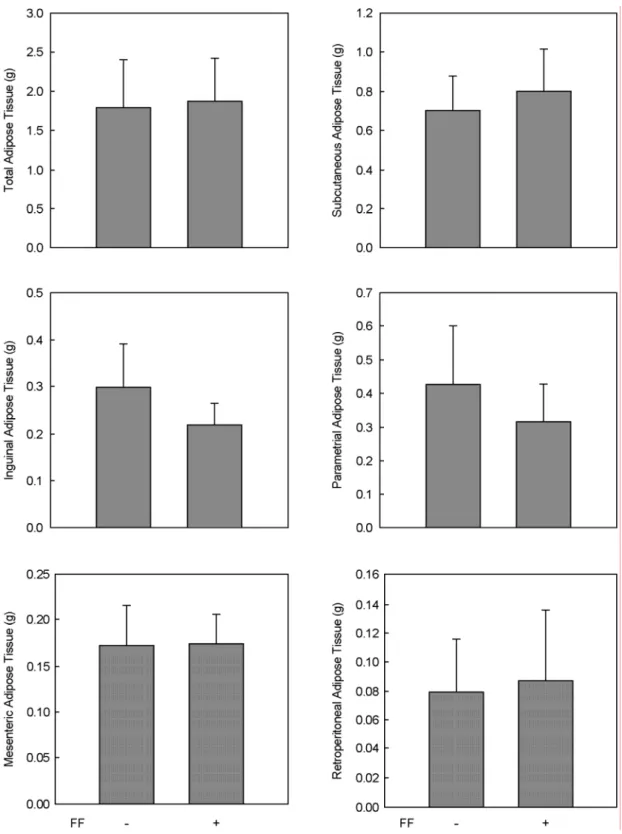
Fig. 2. Modulation of high fat diet-induced adipose tissue mass by fenofibrate in female mice. Female C57BL/6J mice (n=5/group) received a high fat or the same high fat diet supplemented with fenofibrate (FF; 0.05% w/w) for 13 weeks. All values are expressed as the mean ± SD.
formalin for l day and processed in a routine manner for paraffin section. Sections (5 µm) were stained with hemato- xylin and eosin for microscopic examination. For the quan- titation of number and size of adipocytes, the sectional areas of adipose tissues in the hematoxylin and eosin-stained preparations were analyzed with image analysis system (Image pro-plus, Silver Spring, MD, USA).
5. Statistics
Unless otherwise noted, all values are expressed as mean
± standard deviation (SD). All data were analyzed by ANOVA for statistically significant differences between each group.
RESULTS
To determine whether fenofibrate reduces body weight gain and adiposity in female mice, the influence of feno- fibrate on body weight and adipose tissue mass was exa- mined in diet-induced obese C57BL/6J female mice. As shown in Fig. 1, fenofibrate treatment did not prevent the high fat diet-induced increase in body weight gain, thus yielding a final weight of fenofibrate-treated mice similar to high fat diet-fed control mice. Similarly, fenofibrate also did not reduce high fat diet-induced adipose tissue mass (Fig. 2). These data indicate that fenofibrate does not exert a regulatory effect on obesity in female mice.
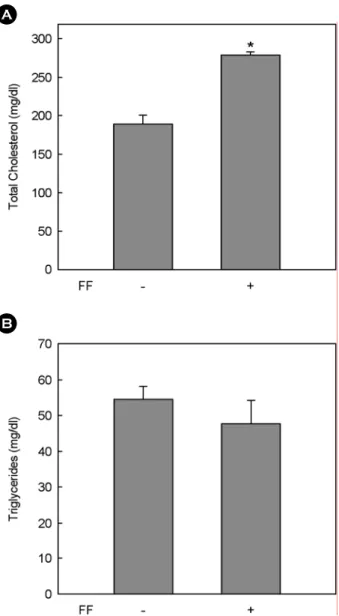
Since fenofibrate has beneficial effects on lipid profiles and acts as an efficient lipid-lowering drug, its effects on serum total cholesterol and trigycerides were examined in high fat diet-induced obese C57BL/6J female mice (Fig. 3).
In comparison with high fat diet-fed control mice, the trea- tment of mice with fenofibrate did not decrease circulating triglycerides and in contrast, increased total cholesterol by 30% (P<0.01). Our data show a strong correlation between unchanged serum triglycerides, body weight and adipose tissue mass following fenofibrate treatment in female mice.
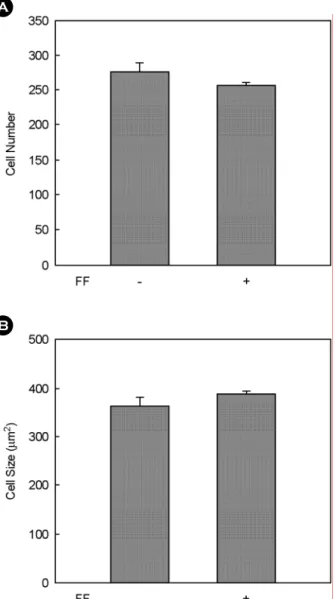
To determine whether fenofibrate regulates adipogenesis in female mice, the size and number of adipocytes were measured by histological analysis and image analysis sys- tem (Figs. 4 and 5). In comparison with high fat diet-fed control mice, fenofibrate treatment did not cause the chan- ges in the size and number of adipocytes. These results are consistent with circulating levels of triglycerides, from which lipids accumulated in the adipose tissue largely de-
rive. In addition, we determined the expression of adipocyte marker genes, leptin and tumor necrosis factor α (TNFα) by RT-PCR (Fig. 6). The expression levels of leptin and TNFα genes were not different between fenofibrate-treated high fat diet-fed mice and high fat diet-fed control mice.
DISCUSSION
PPARα is known to regulate lipid and lipoprotein meta- bolism and is effectively activated by fibrates, which are
B A
Fig. 3. Changes in circulating total cholesterol (A) and trigly- cerides (B) by fenofibrate in female mice. Female C57BL/6J mice (n=5/group) received a high fat or the same high fat diet supple- mented with fenofibrate (FF; 0.05% w/w) for 13 weeks. All values are expressed as the mean ± SD. *Significantly different versus high fat group, P<0.05.
used for the treatment of hyperlipidemia. Since PPARα activators are also shown to reduce body weight gain and adipose tissue mass in rats and mice, fenofibrate may be involved in the regulation of adipogenesis. This study was therefore undertaken to determine whether fenofibrate mo- dulates adipogenesis as well as obesity in female mice on a high fat diet.
According to recent reports, fenofibrate seems to act as a weight-stabilizer through PPARα, but these results were obtained using male and female ovariectomized animal mo- dels (Chaput et al., 2000; Guerre-Millo et al., 2000; Mancini, 2001; Yoon et al., 2002; Jeong et al., 2004). These reports suggest that fenofibrate prevents excessive body weight
and fat from adipose tissue by increasing fat catabolism in the liver. Although fenofibrate improves obesity in several animal models, our results demonstrate that fenofibrate trea- tment did not decrease high fat diet-induced body weight gain and adipose tissue mass in female mice.
Similar to the effects of fenofibrate on body and adipose tissue weights, our results failed to show the deceased levels of circulating total cholesterol and triglycerides in fenofi- brate treated-female mice. In contrast to results presented in the present study, previous works reported that fenofi- brate significantly reduced serum concentrations of these
Fig. 5. Number (A) and size (B) of parameterial adipocytes in female mice. Female C57BL/6J mice (n=5/group) received a high fat or the same high fat diet supplemented with fenofibrate (FF;0.05% w/w) for 13 weeks. Number and size of adipocytes in a fixed area (100,000 µm2) were quantified by an image analysis system. All values are expressed as the mean ± SD.
20 µm
20 µm
(B) High fat + FF
Fig. 4. Light microscopy of parameterial adipose tissues stained with hematoxylin and eosin (original magnification ×100). Fe- male C57BL/6J mice (n=5/group) received a high fat or the same high fat diet supplemented with fenofibrate (FF; 0.05% w/w) for 13 weeks.
(A) High fat
B A
lipid parameters in male animals and men (Lupien et al., 1991; Fruchart et al., 1998; Staels et al., 1998). Conflicting reports suggest that fenofibrate controls lipid metabolism with sexual dimorphism and fenfibrate-activated PPARα actions on lipid metabolism may be influenced by other factors, including ovarian factors.
Adipogenesis, or the development of fat cells from pre- adipocytes, includes morphological changes, cessation of cell growth, expression of many lipogenic enzymes, exten- sive lipid accumulation, and establishment of sensitivity to most or all of key hormones that impact on this cell type (Rosen and Spiegelman, 2000). In the respect to morpholo- gical changes and lipid accumulation during adipogenesis, it was reported that a high fat diet induced adiposity and the increase in adipose tissue mass was due to the enlar- gement of the preexisting adipocytes with increased lipid accumulation (Ogawa et al., 2004; Villena et al., 2004; Yagi et al., 2004). Similar to these investigators, our histological
analysis showed that a high fat diet (15% fat) increased hypertrophic adipocytes compared with a chow diet (4.5%
fat) (not shown). However, a fenofibrate-containing high fat diet did not decrease the size and concomitantly increase the number of adipocytes compared with a high fat diet alone. Brun et al. (1996) reported that PPARα might play a role in differentiation of certain adipose depots in response to a different set of physiological activators. Brandes et al.
(1986 and 1987) also showed the adipocyte conversion of cultured 3T3-L1 preadipocytes by bezafibrate and the adi- pose conversion of cultured rat primary preadipocytes by hypolipidemic drugs, suggesting that fibrate-activated PPARα may promote the differentiation of preadipocytes into adi- pocytes. Although there are evidences that support the role of PPARα in adipogenesis, our results demonstrate that fenofibrate cannot stimulate the differentiation of preadipo- cytes into adipocytes in female mice, consistent with the effects of fenofibrate on adipose tissue mass and circula-
AFig. 6. Effects of fenofibrate on the expression of leptin and TNFα mRNA in parametrial adipose tissue of female mice. (A) Female C57BL/6J mice (n=5/group) received a high fat or the same high fat diet supplemented with fenofibrate (FF; 0.05% w/w) for 13 weeks. Total RNA (2 µg) was analyzed by RT-PCR. All values are expressed in arbitrary units (A.U.) using β-actin as a reference. (B) Representative RT-PCR analysis, from an indepen- dent experiment.
B
ting triglycerides in female mice.
Adipogenesis is a complex process involving a cascade of expression of transcription factors (PPARγ and C/EBPs) and adipocyte-specific genes. In the course of differentia- tion of adipocytes, PPARγ and C/EBPs cooperatively in- duce adipogenic genes, including adipsin, TNFα, leptin and plasminogen activator inhibitor-1 (Choy et al., 1992; Zhang et al., 1994; Kern et al., 1995; Alessi et al., 1997). Among these adipocyte-specific genes, leptin is known to be a mar- ker for the number of large adipocytes, as hypertrophic adi- pocytes in obesity increase generation or production of leptin (Zhang et al., 1994). Moreover, the smaller size of adipocytes in mice are association with a decrease in the expression of adipocyte-specific genes, TNFα and leptin, suggesting that adipose expression of TNFα and leptin genes reflects the size of adipocytes (Okuno et al., 1998). Cabrero et al. (2001) reported that the exposure of adipocytes to be- zafibrate, independent of its hepatic effects, reduces mRNA levels of adipocyte markers and increases fatty acid oxida- tion in primary culture of adipocytes. In contrast to data of Cabrero et al. (2001), our results presented that fenofibrate treatment did not decrease the mRNA expression of these two genes compared with high fat diet-fed control mice, indicating that fenofibrate do not induce an adipose pheno- type, which is defined by lipid accumulation and expression of fat-specific marker genes in female mice, leading to the conclusion that PPARα does not regulate adipogenesis in female mice.
In conclusion, our results provide evidence that the feno- fibrate do not have influences on obesity and adipogenesis in female C57BL/6J mice, and the actions of fenofibrate on adipogenesis may be influenced in the presence of ovaries.
Acknowledgements
This work was supported by a grant No. KRF-2003-015- C00621 from the Basic Research Program of the Korea Research Foundation.
REFERENCES
Auwerx J, Schoonjans K, Fruchart JC, Staels B. Transcriptional control of triglyceride metabolism: fibrates and fatty acids change the expression of the LPL and apo C-III genes by activating the nuclear receptor PPAR. Atherosclerosis. 1996.
124: S29-S37.
Alessi MC, Peiretti F, Morange P, Henry M, Nalbone G, Juhan- Vague I. Production of plasminogen activator 1 by human adipose tissue: possible link between visceral fat accumula- tion and vascular disease. Diabetes. 1997. 46: 860-867.
Brandes R, Arad R, Bar-Tana J. Adipose conversion of cultured rat primary preadipocytes by hypolipidemic drugs. Biochim Biophys Acta. 1986. 27: 314-321.
Brandes R, Hertz R, Arad R, Naishtat S, Weil S, Bar-Tana J.
Adipocyte conversion of cultured 3T3-L1 preadipocytes by bezafibrate. Life Sci. 1987. 9: 935-941.
Brandes R, Arad R, Benvenisty N, Weil S, Bar-Tana J. The induction of adipose conversion by bezafibrate in 3T3-L1 cells. Synergism with dibutyry1-cAMP. Biochim Biophys Acta. 1990. 1: 219-224.
Burn RP, Tontonoz P, Forman BM, Ellis R, Chen J, Evans RM, Spiegelman BM. Differential activation of adipogenesis by multiple PPAR isoforms. Genes Dev. 1996. 15: 974-984.
Cabrero A, Alegret M, Sanchez RM, Adzet T, Laguna JC, Vazquez M. Bezafibrate reduces mRNA levels of adipocyte markers and increases fatty acid oxidation on primary culture of adipocytes. Diabetes. 2001. 50: 1883-1890.
Chaput E, Saladin R, Silvestre M, Edgar AD. Fenofibrate and rosiglitazone lower serum triglycerides with opposing effects on body weight. Biochem Biophys Res Commun. 2000. 271:
445-450.
Choy LN, Rosen BS, Spiegelman BM. Adipsin and an endo- genous pathway of complement from adipose cells. J Biol Chem. 1992. 267: 12736-12741.
Costet P, Legendre C, More J, Edgar A, Galtier P, Pineau T.
Peroxisome proliferator-activated receptor alpha-isoform de- ficiency leads to progressive dyslipidemia with sexually di- morphic obesity and steatosis. J Biol Chem. 1998. 273:
29577-29585.
Fruchart JC, Brewer HB Jr, Leitersdorf E. Consensus for the use of fibrates in the treatment of dyslipoproteinemia and coro- nary heart disease. Fibrate Consensus Group. Am J Cardiol.
1998. 81: 912-917.
Guerre-Millo M, Gervois P, Raspe E, Madsen L, Poulain P, Derudas B, Herbert JM, Winegar DA, Wilson TM, Fruchart JC, Berge RK, Staels B. Peroxisome proliferator-activated receptor alpha activators improve insulin sensitivity and reduce adiposity. J Biol Chem. 2000. 275: 16638-16642.
Hertz R, Bishara-Shieban J, Bar-Tana J. Mode of action of pero- xisome proliferators as hypolipidemic drugs. Suppression of apolipoprotein C-III. J Biol Chem. 1995. 270: 13470-13475.
Jeong S, Han M, Lee H, Kim M, Kim J, Nicol CJ, Kim BH, Choi JH, Nam KH, Oh GT, Yoon M. Effects of fenofibrate on high fat diet-induced body weight gain and adiposity in female C57BL/6J mice. Metabolism. 2004. 53: 1284-1289.
Kern PA, Saghizadeh M, Ong JM, Bosch RJ, Deem R, Simsolo RB. The expression of tumor necrosis factor in human adi- pose tissue. J Clin Invest. 1995. 95: 2111-2119.
Kim M, Jeong S, Song YH, Kim DI, Yoon M. Two synthetic ligands for peroxisome proliferator-activated receptor γ. J Biomed Lab Sci. 2004. 10: 137-142.
Lupien P, Brun D, Gagne C, Moorjani S, Bielman P, Julien P.
Gemfibrozil therapy in primary type II hyperlipoproteinemia:
effects on lipids, lipoproteins and apolipoproteins. Can J Car- diol. 1991. 7: 27-33.
Mancini FP, Lanni A, Sabatino L, Moreno M, Giannino A, Con- taldo F, Colantuoni V, Goglia F. Fenofibrate prevents and reduces body weight gain and adiposity in diet-induced obese rats. FEBS Lett. 2001. 491: 154-158.
Martin G, Schoonjans K, Lefebvre AM, Staels B, Auwerx J. Coor- dinate regulation of the expression of the fatty acid transport protein and acyl-CoA synthetase genes by PPARalpha and PPARgamma activators. J Biol Chem. 1997. 272: 28210 -28217.
Nicolas-Frances V, Dasari VK, Abruzzi E, Osumi T, Latruffe N.
The peroxisome proliferator response element (PPRE) present at positions -681/-669 in the rat liver 3-ketoacyl-CoA thiolase B gene functionally interacts differently with PPARalpha and HNF-4. Biochem Biophys Res Commun. 2000. 269: 347-351.
Ogawa R, Mizuno H, Watanabe A, Migita M, Hyakusoku H, Shimada T. Adipogenic differentiation by adipose-derived stem cells harvested from GFP transgenic mice-including re- lationship of sex differences. Biochem Biophys Res Commun.
2004. 319: 511-517.
Okuno A, Tamemoto H, Tobe K, Ueki K, Mori Y, Iwamoto K, Umesono K, Akanuma Y, Fujiwara T, Horikoshi H, Yazaki Y, Kadowaki T. Troglitanzone increases the number of small adipocytes without the change of white adipose tissue mass in obese Zuker rats. J Clin Invest. 1998. 101: 1354-1361.
Osumi T, Osada S, Tsukamoto T. Analysis of peroxisome proliferator-responsive enhancer of the rat acyl-CoA oxidase gene. Ann N Y Acad Sci. 1996. 804: 202-213.
Pasquali D, Pierantoni GM, Fusco A, Staibano S, Colantuoni V,
Bellis AD, Bellastella A, Sinisi AA. Fenofibrate increases the expression of high mobility group AT-hook 2 (HMGA2) gene and induces adipocytes differentiation of orbital fibroblasts from Graves' ophthalmopathy. J Mol Endocrinol. 2004. 33:
133-143.
Rosen ED, Spiegelman BM. Molecular regulation of adipogenesis.
Annu Rev Cell Dev Biol. 2000. 16: 145-171.
Sander K, Beatrice D, Walter W. Roles of PPARs in health and disease. Nature. 2000. 405: 421-424.
Schoonjans K, Staels B, Auwerx J. Role of peroxisome proliferator- activated receptor (PPAR) in mediating the effects of fibrates and fatty acids on gene expression. J Lipid Res. 1996. 37:
907-925.
Staels B, Dallongeville J, Auwerx J, Schoonjans K, Leitersdorf E, Fruchart JC. Mechanism of action of fibrates on lipid and lipoprotein metabolism. Circulation. 1998. 98: 2088-2093.
Tanaka T, Yoshida N, Kishimoto T, Akira S. Defective adipocyte differentiation in mice lacking the C/EBPβ and/ or C/EBPδ gene. EMBO J. 1997. 16: 7432-7443.
Tang QQ, Otto TC, Lane MD. CCAAT/enhancer-binding protein β is required for mitotic clonal expansion during adipoge- nesis. Proc Natl Acad Sci USA. 2003. 100: 850-855.
Villena JA, Viollet B, Andreelli F, Kahn A, Vaulont S, Sul HS.
Induced adiposity and adipocyte hypertrophy in mice lacking the AMP-activated protein kinase-alpha2 subunit. Diabetes.
2004. 53: 2242-2249.
Yagi K, Kondo D, Okazaki Y, Kano K. A novel preadipocyte cell line established from mouse adult mature adipocytes. Bio- chem Biophys Res Commun. 2004. 321: 967-974.
Yoon M, Jeong S, Nicol CJ, Lee H, Han M, Kim J, Seo Y, Ryu C, Oh GT. Fenofibrate regulates obesity and lipid metabolism with sexual demorphism. Exp Mol Med. 2002. 34: 481-488.
Zhang B, Marcus SL, Sajjadi FG, Alvares K, Reddy JK, Subra- mani S, Rachubinski RA, Capone JP. Identification of a peroxisome proliferator-responsive element upstream of the gene encoding rat peroxisomal enoyl-CoA hydratase/3- hydroxyacyl-CoA dehydrogenase. Proc Natl Acad Sci USA.
1992. 89: 7541-7545.
Zhang Y, Proenca R, Maffei M, Barone M, Leopold L, Friedman JM. Positional cloning of the mouse obese gene and its human homologue. Nature. 1994. 372: 425-432.