Gaze Effects on Spatial and Kinematic Characteristics in Pointing to a Remembered Target
Young-uk Ryu, M.S., P.T.
Won-dae Kim, M.S.
Dept. of Health and Kinesiology, Texas A & M University Hyeong-dong Kim, Ph.D., P.T.
Dept. of Physical Therapy, Catholic University of Daegu
Abstract
1)The purpose of the present study was to examine gaze effects on spatial and kinematic characteristics during a pointing task. Subjects were asked to watch and point to an aimed target (2 ㎜ in diameter) displayed on a vertically mounted board. Four gaze conditions were developed as combinations of
"seeing-aiming" in terms of the eye movements: Focal-Focal (F-F), Focal-Fixing (F-X), Fixing-Focal (X-F), and Fixing-Fixing (X-X). Both the home target and an aimed target were presented for 1 second and then were disappeared in F-F and X-F. In X-F and X-X, only an aimed target disappeared after 1 second. Subjects were asked to point (with index finger tip) to an aimed target accurately as soon as the aimed target was removed. A significant main effect of gaze was found (p<.01) for normalized movement time. Peripheral retina targets had significantly larger absolute error compared to central retina targets on the x (medio-lateral) and z (superior-inferior) axes (p<.01). A significant undershooting to peripheral retina targets on the x axis was found (p<.01). F-F and X-F had larger peak velocities compared to F-X and X-X (p<.01). F-F and X-F were characterized by more time spent in the deceleration phase compared to F-X and X-X (p<.01). The present study demonstrates that central vision utilizes a form of on-line visual processing to reach to an object, and thus increases spatial accuracy. However, peripheral vision utilizes a relatively off-line visual processing with a dependency on proprioceptive information.
Key Words: Aiming movements; Motion analysis; Motor control; Spatial accuracy; Visual information.
Introduction
An aimed arm movement to an object requires a transformation between visual and motor activities of the arm. An external location of an object should be mapped and transformed into an internal coordination system controlled by the central nervous system (CNS). Thus, the visuomotor transformation generally consists of the visual perception of an object's loca- tion and the motor transformation to the location information. The failure of one or both of these two processes leads to a degraded spatial accuracy in ac- tivities such as reaching and pointing. Many pointing studies have shown that a spatial error made to-
wards a target is a result of faulty integrations of visual and proprioceptive information (Adamovich et al, 1998; Seochting and Flanders, 1989). Spatial accu- racy thus is dependent on visual feedback conditions (Adamovich et al, 1998), proprioception (Messier et al, 2003), limb configuration (Ghilardi et al, 1995), target location (Ghilardi et al, 1995), and initial pos- ture of a limb (Desmurget et al, 1998).
However, few studies have directly manipulated visual acuity besides the creation of an environment including an illusion or darkness (e.g., no visual in- formation) condition. That is, most aiming experi- ments, including aforementioned experiments, required performers to move their eyes freely so that in- Corresponding author: Hyeong-dong Kim [email protected]
formation of a target position is stored on the central retinal field, which has the highest density of cones, the anatomical particles responsible for visual acuity.
Two visual systems-central and peripheral vision-can be categorized by the density of cones, which again determines visual acuity. Central vision is usually thought to be up to 10 of retinal eccentricity and works mainly for a displacement system (Mckay, 1976). Peripheral vision is in outer regions of 10 of retinal eccentricity where the density of cones is dra- matically reduced, and the regions are denser with rods. Thus, visual acuity for positional information can be directly manipulated by utilizing the two dis- tinctive central and peripheral vision systems.
Recently, studies examining the utilization of pe- ripheral vision information have reported that spatial and directional accuracy increase with increased pe- ripheral vision (Bedard and Proteau, 2003, 2004).
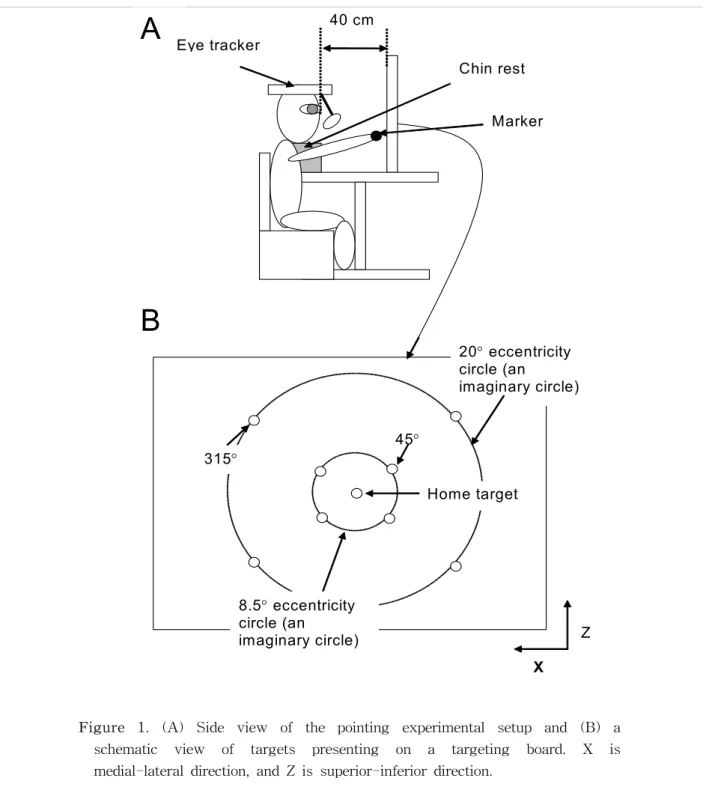
However, these studies did not investigate the influ- ence of the degree of visual acuity in terms of a vi- suomotor transformation task, but instead examined how the peripheral vision information of external en- vironments was utilized in aimed movements. The purpose of the present study was to examine gaze effects on spatial and kinematic characteristics during a pointing task. Based on central and peripheral vi- sion systems, aimed targets were created in four targets placed on 8.5 visual eccentricity and four tar- gets placed on 20 visual eccentricity (Figure 1B).
That is, the aimed targets placed on 8.5 eccentricity of participants' eyes were placed for a central vision condition regardless of eye movement requirement, and the placed targets on 20 eccentricity were the conditions to examine the peripheral vision when eyes were fixed on a target. Additionally, four ex- perimental conditions were produced based on re- quirements of eye fixation during gazing at and pointing to an aimed target.
Methods
Subjects
Five subjects (23~32 yrs) served as participants in the current study. One participant was aware of the foundations comprising this study while the oth- ers were unaware of any details regarding the study.
All participants were self-labeled right-handers with normal vision.
Tasks and apparatus2)3)4)
Participants sat on an adjustable chair and were asked to face a wall equipped with a screen display- ing target points (Figure 1A). Participants were asked to rest their chin on a rest located central to the board and approximately 40 ㎝ away (Figure 1A). Participants were asked to wear an ASL®
headmounted 501 eye tracking system1), along with a video based pupil tracker (Figure 1A). In this study, however, eye movements were not recorded, but only monitored to determine if participants utilized their eyes for the task requirements. In the initial position, the wrist and index finger of a dominant arm were extended and placed on the table. Wrist orthosis2) was adapted on each participant's wrist for full ex- tension during experimental phases.
Markers were attached on the top of index finger, the index metacarpal joint, and wrist joint. A Vicon®
system3) was used to record positions of the markers. In this study, only positional data of index finger was used to analyze dependent variables. The markers were sampled at a rate of 120 ㎐ and stored on disk during the experiment for later offline analysis. The three-dimensional xyz data were low-pass-filtered using a 2nd order dual pass Butterworth filter with a cut-off frequency of 10 ㎐.
Targets were displayed on the board, which was mounted vertically on the table (Figure 1A and 1B).
The targets (2 ㎜ in diameter) were generated with
1) Applied Science Group, INC, Bedford, MA.
2) Smith & Nephew, Memphis, TN.
3) Vicon, Los Angeles, CA.
a Visual Basic program4) and projected on the board from directly behind each participant. There were 2 types of targets which constituted a home and aimed target (Figure 1B). The home target (red-colored) was located at the center of the board which was approximately the same level of each participants' eyes. The four aimed targets were positioned 6 ㎝ apart from the home target at 45°, 135°, 225°, and 315°. These target positions make 8.5° retinal eccen- tricity of participants' eyes located 40 ㎝ away from the board. The four aimed targets were also posi- tioned 14.5 ㎝ apart from the home target producing 20° retinal eccentricity at 45°, 135°, 225°, and 315°
(Figure 1B). Each of these eight aimed targets was displayed at random occasions on the board.5)
At the beginning of each trial, a "Ready" message box was shown on the center of the board so that participants were alerted to point. The home target was shown on the center of the board for two sec- onds just as the "Ready" message box was removed.
Participants were asked to keep their gaze on the home target for two seconds. After this duration, one of aimed targets appeared on the board, and lasted for one second, yet the home target remained visible during the trial.
The task required participants to point at each of the eight random targets shown on the board. The four conditions were developed as combinations of
"seeing" and "aiming" in terms of the eye move- ments; 1) Focal-Focal (F-F): participants were free to move their eyes to see the target and also free to move their eyes when they pointed the target, 2) Focal-Fixing (F-X): participants were free to move their eyes to see the aimed targets, but were asked to fix their eyes on the home target when pointing, 3) Fixing-Focal (X-F): participants were asked to fix their eyes on the home target during presentation of an aimed target on the board, but were required to move their eyes to the location an aimed target ap- peared in order to point to that target, and 4) Fixing-Fixing (X-X): participants were asked to
constantly fix their eyes on the home target during a trial. For F-F and F-X condition, participants were asked to move their eyes back to the home target after looking towards the aimed target with focal vision. As soon as the aimed target was removed, participants were asked to point at an aimed target accurately using their index finger tip at a comfort- able speed. After pointing to an aimed target, partic- ipants were asked to move their index finger back to the home position which was located on the middle of the table, approximately 13 ㎝ away from the board.
Data Analysis
Dependent variables include normalized movement time (NMT), absolute error (AE), constant error (CE), peak velocity (Vpk), and percentage of time spent in the deceleration phase. Movement time (MT) was a time taken between movement initiation and cessation at the aimed target. NMT was calcu- lated as movement time normalized by movement distance, which was computed as follows: NMT = MT / sqrt[(xe-xs)2 + (ye-ys)2 + (ze-zs)2] (the sub- scribts e and s represent ending and starting points, respectively). CE was computed as the horizontal (x) and vertical (z) distance between the target's initial location and the final position of the index finger used for pointing. In this study, negative values re- ferred to positions located on the left side (x axis) or below (z axis) the actual target position. CE was used to define whether pointing movements showed a bias. AE measured absolute spatial error of the fi- nal pointing position regardless of the overshoot or the undershoot of aimed targeting on x and z axes.
In order to compute percentage of acceleration and deceleration phase, velocity was computed. Time be- tween initiations of movement and Vpk represents an acceleration phase and the time between Vpk and the final position represents a deceleration phase.
The percentage of deceleration phase was computed as follows: (time for deceleration phase / MT) × 100. The percentage of deceleration phase could characterize the
4) Microsoft, Seattle, WA, U.S.A.
A
40 cmChin rest
Home target
315° 45°
20° eccentricity circle (an
imaginary circle)
8.5° eccentricity circle (an
imaginary circle)
B
Marker
X Z Eye tracker
Figure 1. (A) Side view of the pointing experimental setup and (B) a schematic view of targets presenting on a targeting board. X is medial-lateral direction, and Z is superior-inferior direction.
adjustment characteristics of pointing to acquire spatial accuracy. In addition, Vpk was also measured.
For the purpose of statistics, four 8.5 targets were grouped as central retina targets (CV) and four 20 targets were grouped as peripheral retina targets (PV). All dependant variables were analyzed in 2
Retina Vision Condition (CV, PV) and 4 Condition (F-F, F-X, X-F, X-X) General Linear Model (GLM) procedure. The Duncan's multi-range test was used for post-hoc tests. Statistical significance was set using a p value less than .05.
0 2 4 6 8 10 12 14 16
CV PV
Retina Vision
Spatial Error (mm)
X Z
0 2 4 6 8 10 12 14
FF FX XF XX
Gaze Condition
Spatial Error (mm)
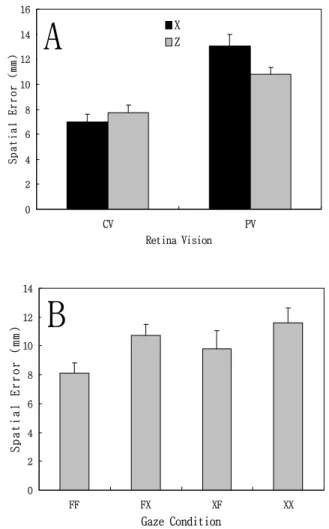
Figure 2. (A) Absolute error as a function of retina vision condition in x- and z-axis. CV:
central retina targets, PV: peripheral retina targets. (B) Absolute error as a function of gaze condition. The error bars represent the standard error of the group mean. FF:
focal-focal, FX: focal-fixing, XF: fixing-focal, XX: fixing-fixing.
Results
Absolute Error (AE)
PV had significantly larger AE compared to CV on the x and z axes, Fs(1, 439)=13.81, ps<.01 (Figure 2A). A significant main effect of condition was found on the x axis, F(3, 439)=2.71, p<.05, and its post-hoc test revealed that X-X had the largest AE and F-F had the smallest error (Figure 2B).
Constant Error (CE)
Pointing was characterized by a significant under- shoot to PV targets on the x axis, F(1, 439)=9.57, p<.01. (CV=.1 ㎜, PV=-4 ㎜).
Normalized Movement Time (NMT)
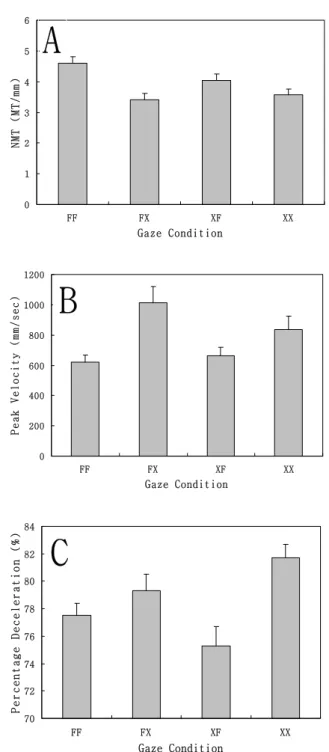
A significant main effect of condition was found, F(3, 439)=8.21, p<.01, revealing that F-F and X-F took longer compared to F-X and X-X (Figure 3A).
Peak Velocity (Vpk)
A significant main effect of condition was found F(3, 439)=5.64, p<.01, revealing that F-F and X-F had larger peak velocities compared to F-X and X-X (Figure 3B).
Percentage of Deceleration Phase (%dec) A significant main effect of condition was found F(3, 439)=5.51, p<.01, revealing that F-F and X-F were characterized by more time spent in the decel- eration phase compared to F-X and X-X (Figure 3C).
Discussion
In the present study, utilizing focal vision for both
"gazing" and "targeting" had better accuracy than fix- ing eyes on a home target. This was generally ex- pected since the human visual system adapts two sep- arated mechanisms - "displacement" and "movingness"
system - in terms of perceiving of external environments. While central retinal vision is used for
"displacement" in which the retinal sensitivity to spa- tial frequencies is highest, peripheral retinal vision is for "movingness" in which the retinal sensitivity is sensitive to temporal frequencies (Pillard, 1996). Spatial sensitivity depends on the density of cones in the retinal field. That is, a larger density of cones is found during a centered gaze, approximately up to 1 0~15 of eccentricity in the central retinal field (Pillard, 1996). This is why we instinctively utilize our center of gaze to the location we are looking. An important feature about spatial accuracy is the fact
A
B
0 200 400 600 800 1000 1200
FF FX XF XX
Gaze Condition
Peak Velocity (mm/sec)
70 72 74 76 78 80 82 84
FF FX XF XX
Gaze Condition
Percentage Deceleration (%)
Figure 3. (A) NMT: Normalized movement time, (B) peak velocity, and (C) percentage of deceleration as a function of gaze condition.
The error bars represent the standard error of the group mean. FF: focal-focal, FX:
focal-fixing, XF: fixing-focal, XX: fixing-fixing.
0 1 2 3 4 5 6
FF FX XF XX
Gaze Condition
NMT (MT/mm)
that the F-X condition had a larger spatial error than F-F and that X-X had a larger spatial error than X-F. These results suggest that motor transformation from spatial memory (information) requires focal reti- nal vision to improve spatial accuracy. These results are consistent with other studies showing that point- ing accuracy decreases without visual feedback of the environment or limb (Adamovich et al, 1998;
Admiraal et al, 2003). Soeching and Flanders (1989) also suggested that errors in pointing result from er- rors in the transformation from an extrinsic to an in- trinsic coordination. These findings in the present study imply an importance of utilizing central gaze on a target in motor executions.
An interesting finding in the current study is that motor executions with central gaze (F-F and X-F) took longer compared to pointing with eyes fixed on the home target (F-X and X-X). This result could suggest that the central gaze on a remembered target utilizes closed-loop visual feedback to search the tar- get location, thus increasing spatial accuracy. This idea is also supported by the peak velocity data in which the F-X and X-X conditions consisting of pointing with eyes fixed on the home target had higher peak velocities compared to the other con- ditions consisting of pointing with central gaze. In other words, the conditions utilizing pointing with eyes fixed on the home target used positional in- formation of remembered targets relatively in a form appearing to be off-line. Series of studies conducted by Bedard and Proteau (2001, 2003, 2004) showed that environmental information stored in peripheral vision is used off-line in which the central nervous system pre-plans an aimed movement. The differences in vis- ual feedback utilization result from the fact that the central and peripheral vision systems have a distinc- tive role in an aiming movement. That is, while cen- tral vision within the central retinal field mainly serves to provide error-detection of positional cues with a slow corrective feedback loop, peripheral vision provides the detection of motion cues with a quick correction of movement trajectories (Paillard, 1996).
C
B
A
This article was received September 23, 2006, and was accepted October 30, 2006.
Contrary to NMT and Vpk data, however, F-X and X-X spent longer times in the deceleration phase. Many aiming movement studies have sug- gested that deceleration phase is thought to be char- acteristic of more feedback and corrective processes while approaching a target when visual information (feedback) is needed for accuracy (Khan and Franks, 2003). How can we explain this paradoxical fact that F-X and X-X had shorter movement times yet spent longer time in the deceleration phase? We suggest that two distinctive feedback processes are used during pointing with non-focal visual information.
That is, the central nervous system (CNS) uses open-loop feedback during an acceleration phase, while the CNS uses closed-loop feedback to a target during a deceleration phase. However, the difference between focal vision pointing and non-focal vision pointing might be due to sources of the closed-loop feedback during the deceleration phase. Visual feed- back could be mostly utilized during pointing with focal vision, whereas proprioceptive information (i.e., contacting sense, proprioception of joints) and visual feedback might contribute together during pointing with non-focal vision. This idea might be evident during time spent gazing away from a target com- pared to time spent gazing at the target.
The present study demonstrates that motor trans- formation from spatial information requires focal retinal vision to improve spatial accuracy. Central vision utilizes a form of on-line visual processing to reach to an ob- ject, and thus increases spatial accuracy. However, pe- ripheral vision utilizes a relatively off-line visual proc- essing with a dependency on proprioceptive information.
References
Adamovich SV, Berkinblit MB, Fookson O, et al.
Pointing in 3D space to remembered targets. I.
kinematic versus visual target presentation. J Neurophysiol. 1998;79(6):28332846.
Admiraal MA, Keijsers NL, Gielen CC. Interaction be-
tween gaze and pointing toward remembered vis- ual targets. J Neurophysiol. 2003;90(4):21362148.
Bedard P, Proteau L. On the role of static and dy- namic visual afferent information in goal-di- rected aiming movements. Exp Brain Res.
2001;138(4):419431.
Bedard P, Proteau L. On the role of peripheral visual afferent information for the control of rapid vid- eo-aiming movements. Acta Psychol (Amst).
2003;113(1):99117.
Bedard P, Proteau L. On-line vs. off-line utilization of peripheral visual afferent information to en- sure spatial accuracy of goal-directed movements. Exp Brain Res. 2004;158(1):7585.
Desmurget M, Grea H, Prablanc C. Final posture of the upper limb depends on the initial position of the hand during prehension movements. Exp Brain Res. 1998;119(4):511516.
Ghilardi MF, Gordon J, Ghez C. Learning a visuomo- tor transformation in a local area of work space produces directional biases in other areas. J Neurophysiol. 1995; 73(6):25352539.
Khan MA, Franks IM. Online versus offline processing of visual feedback in the production of component submovements. J Mot Behav. 2003;35(3):285295.
Mackay DM. Perceptual conflict between visual mo- tion and change of location. Vision Res.
1976;16(5);557558.
Messier J, Adamovich S, Berkinblit M, et al. Influence of movement speed on accuracy and coordination of reaching movements to memorized targets in three-dimensional space in a deafferented subject.
Exp Brain Res. 2003;150(4):399416.
Pillard J. Fast and slow feedback loops for the visual correc- tion of spatial errors in a pointing task: A reappraisal.
Can J Physiol Pharmacol. 1996;74(4):401417.
Seochting JF, Flanders M. Errors in pointing are due to approximation in sensorimotor transformations.
J Neurophysiol. 1989;62(2):595608.