Introduction
The average life expectancy of Koreans increased from 65.7 in 1980 to 81 in 2012. In 2011, the average life expectancy of Korean men was 77.7, 6.8 years lower than that of women, 84.5 (Statistics Korea, 2014). Thus, aged women have more health problems than aged men because the body functions deterio- rate with the aging process (Sung et al, 2004).
Moreover, women experience menstruation, preg- nancy, and menopause due to hormonal changes, and have less muscles and a lower bone density, and perform less physical exercise, than men, so their risk of chronic degenerative diseases is higher than that of men (Choi et al, 2012).
The prevalence of obesity in Korean men in their 20s is 31%; in their 30s, 41.7%; in their 40s, 37.9%;
and in their 50s, 41.7%, these figures show an in-
creasing trend with age. But in Korean women in their 20s, it is 12.6%; and in their 30s, 12.8%. These figures show no significant difference from those of men. However, the prevalence of obesity in Korean women in their 40s is 26.6%, which is 13.8% higher than that in the Korean women in their 30s; and in Korean women in their 50s, it is 56.4%, which is 30% higher than that in the Korean women in their 40s (Korea Centers for Disease Control and Prevention, 2008). Obese individuals are known to show high levels of total cholesterol (TC), triglycerides (TG), low-density lipoprotein-cholesterol (LDL-C), and insulin resistance, and a low level of high-density lip- oprotein-cholesterol (HDL-C). Hypercholesterinemia in- creases the prevalence of coronary artery diseases, so active preventive measures are required (Park et al, 1999).
Deterioration of the physical functions of the eld- Corresponding author: Seok-hwan Kim [email protected]
Comparative Study on the Effects of Proprioceptive Neuromuscular Facilitation and Elastic Band Exercise on the Physical Function and
Blood Lipid Levels of Obese Elderly Women
Hyeon-jeong Noh1, MSc, PT, Seok-hwan Kim2, PhD, PT
1Dept. of Physical Therapy, The Graduate School, Daejeon University
2Dept. of Physical Education, College of Education, Chonnam National University
Abstract
1)The effects of Proprioceptive Neuromuscular Facilitation (PNF) and elastic band exercise on the physical functions and blood lipids of obese elderly women were investigated. The experimental group (n1=16) patients underwent PNF for 12 weeks, and the control group (n2=15) patients performed elastic band exercises. SPSS 21.0 was used to compute the means and standard deviations. After the 12-week PNF, both the experimental and control groups showed statistically significant differences in the physical functions (cardiovascular endurance, strength of the lower extremity, muscular endurance, flexibility, balance, and agility) (p<.05), but the difference in the experimental group was more significant than that in the control group (p<.05). In terms of the changes in the blood lipid levels (total cholesterol, triglycerides, high-density lipoprotein, and low-density lipoprotein), the experimental group showed significant changes (p<.05). In conclusion, PNF was confirmed as more effective than elastic band exercise in improving the physical functions and blood lipid levels of obese elderly women.
Key Words: Obese elderly women; Physical function; Proprioceptive neuromuscular facilitation.
erly is caused by the loss of skeletomuscular func- tions, joint movement, and sense of balance (Kim and Choi, 2004). Elderly obesity results in physical function disorders and metabolic disorders. Physical and physiological changes can cause fall accidents, fractures, and cardiovascular diseases. Nevertheless, not enough studies on these issues and exercise methods have been conducted (Hong and Oak, 2013).
Korean studies on the exercise programs for aged people include combination exercise (Moon, 2008), exercise program (Park, 2009), muscle power re- inforcing exercise (Lee et al, 2010), and studies abroad include a combined program of exercise, edu- cation, environmental modification therapy, and an intake of nutritional supplements (Steinberg et al, 2000) and program (Robertson et al, 2001). Unlike drug therapy, exercise do not have side effects and are low-cost. In addition, exercises can increase muscular strength and reduce the body fat mass.
Particularly, combined exercises can increase the ef- fects of both aerobic exercises (American College of Sports Medicine, 2009). In a study of Park et al (2010), combined exercise was confirmed to have si- multaneously shown the effects for anaerobic exercises.
Proprioceptive Neuromuscular Facilitation (PNF) is a method of stimulating the myoreceptors in the muscles and ligaments using a specific helical pat- tern to improve the physical functions, muscle power, flexibility, and balance (Klein et al, 2002). PNF is a treatment or training method that uses human move- ment patterns. Local studies on PNF targeted pa- tients (Lee et al, 2009; Oh et al, 2011) and were fo- cused on the physical functions of elderly women (Cho et al, 2007), preventing falling accidents (Kim and Kim, 2013), and training (Kim, 2008; Kim, 2009).
The reports on PNF studies published abroad stated that the physical activities significantly improved.
Addition of intensive repetition of facilitation exercise to multidisciplinary rehabilitation promotes motor functional recovery of the hemiplegic lower limb (Kawahira et al, 2004). PNF training and physical
function in assisted-living older adults (Klein et al, 2002) and effects of two 4-week PNF programs on muscle endurance, flexibility and functional perform- ance in women with chronic low back pain (Kofotolis and Kellis, 2006). Acute effects of static and PNF stretching on muscle strength and power output (Marek et al, 2005).
Elastic band exercise has been used for re- habilitation, but it recently started to be used as well to improve physical functions. Since it requires whole body resistance, the muscular strength increase and the correct posture is maintained. Elastic band ex- ercise safe, low-cost, effective for increasing muscu- lar strength, and highly accessible and mobile, there- by reducing the psycholocal burden of the user.
Moreover, the elastic resistance exercise for the lum- bar-pelvic and leg muscles has proven highly effec- tive in improving elderly people’s walking and bal- ancing performance (Kim et al, 2006). Milkesky et al (1994), confirmed that elastic band exercise had helped increase elderly people’s muscular strength. In this study of Krebs et al (1998), elderly people were asked to perform intermediate elastic band exercise for six months, after which their leg’s muscular strength significantly improved.
Many studies on PNF and elastic band exercise have been conducted, but few comparative studies on these two methods that targeted obese elderly wom- en have been reported. In this study, the effects of PNF, which is frequently used as a combined ex- ercise methods, and elastic band exercise, which is often used as a resistance exercise, on obese elderly women’s physical functions and blood lipid levels were compared for use as basic data for exercise prescription.
Methods
Subjects
The experimental group was asked to perform PNF exercise, and the control group, which consisted
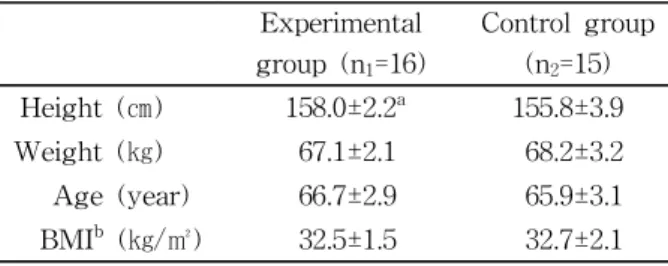
of 31 obese elderly women (aged 65∼70) living in G city who did not have regular physical activities, was asked to perform elastic band exercise, for 12 weeks. The effective size calculation equation was used to determine the sample size. The determined size range was .6 to 1.0, and .8 was estimated as an effective size for the power analyses. When pow- er=.83, alpha=.05, and d=.8, the sample size by group was 23, so considering possible dropouts, 52 partic- ipants were supposed to be selected. However, since the selection was challenging due to the requirement for inclusion of obese elderly women, only 35 sub- jects were selected through face-to-face interviews after they voluntarily signed the consent form. They were randomly assigned to the groups, but four of them voluntarily dropped out or were uncooperative, so eventually, 31 subjects were included (16 in the experimental group and 15 in the control group). The inclusion criteria were; no difficulty in managing dai- ly life activities, capability to walk independently for at least 10 meters without a walker, no serious skel- etomuscular problems in the last six months, and a body mass index of at least 28 ㎏/㎡. The general features of the subjects are shown in Table 1.
Measurement tools and methods
Body composition
The water and food intakes of the subjects were restricted from two hours before the measurements.
Their body fat percentage was measured using a body composition analyzer (InBody 570, Biomedical, Seoul, Korea).
Physical functions
The Senior Fitness Test (SFT) was used to measure the physical functions in this study. Such test determines elderly people’s physical strength to measure the parameters of their functional activities and their capability to manage their daily activities.
SFT was designed to have such features as reli- ability, validity, and discrimination. It is easy and safe to use, and requires no permission from a doc- tor (Jang et al, 2006). It is used for healthy in- dividuals in a community, and includes items that represent the muscle power and flexibility of the up- per and lower extremities power, cardiorespiratory endurance, agility, and dynamic balance. The refer- ence data of normal males and women aged 64∼94 are included in SFT. The SFT references to cardior- espiratory endurance, the lower extremities, muscular endurance, flexibility, balance, and agility were used in this study (Rikli and Jones, 1999).
Cardiorespiratory endurance test: two- minute walking in place
In a straight standing position, the subjects raised their knee up to the middle of their patellar and iliac bones. The number of times they could do this in two minutes was recorded. A higher score meant higher aerobic endurance and physical strength. In both men and women, less than 65 steps is a risky level. In this study, the test was conducted twice with a one-minute interval, and the higher measure- ment result was recorded.
Lower-extremity test: sit-to-stand It is used for healthy individuals in a community, and includes items that represent the muscle power and flexibility of the upper and lower extremities, cardiorespiratory endurance, agility, and dynamic balance. The reference data of normal males and women aged 64∼94 are included in SFT. The SFT references to cardiorespiratory endurance, the lower extremities, muscular endurance, flexibility, balance, and agility were used in this study.
Experimental group (n1=16)
Control group (n2=15) Height (㎝) 158.0±2.2a 155.8±3.9
Weight (㎏) 67.1±2.1 68.2±3.2
Age (year) 66.7±2.9 65.9±3.1
BMIb (㎏/㎡) 32.5±1.5 32.7±2.1
amean±standard deviation, bbody mass index.
Table 1. General characteristics of subjects (N=31)
Muscular endurance test: sit-up
In a supine position, the subjects were asked to flex their knees up to 90 degrees with their feet on the floor. Their hands had to be on their chest, with their arms folded. They elevated their upper body to touch their knees with their hands, and then they extended their back to touch the floor. The number of times they could do this in 30 seconds was recorded. The test was conducted twice with a one-minute interval, and the higher measurement re- sult was recorded.
Flexibility test: standing and forward bending
The subjects stood on a 40 ㎝-high table, their hands were stretched upward to their head, and they bent forward. Rebound was prohibited when they bent forward slowly, and the tips of their hands slightly touched their legs and stretched downward.
The maximum distance of their hand tips below the table was measured. The tips had to be horizontal and to remain still for at least three seconds. The test was conducted twice with a one-minute interval, and the higher measurement result was recorded.
Balance test: standing on one foot For the balance test, the subjects were asked to stand on one foot. This test has a high correlation with the lower extremities. The subjects put one leg flat on the floor with their hands on the side of their waist. After the ‘start’ signal, they raised one leg with their eyes open, and the length of time in which they could maintain this position was meas- ured (Casio HS-3, Casio, Hong Kong, China). The test was conducted twice with a one-minute interval, and the higher measurement result was recorded.
Agility test: time’s up and go test This test measures the functional mobility and ambulation functions. The intra-measurer reliability was .99, and the inter-measurer reliability was .98 (Podsiadlo and Richardson, 1991). A 46 ㎝-high chair
was prepared on a flat floor, and the three-meter distance from the chair was marked. The subjects stood up from the chair to reach the mark with the
‘start’ signal, and go back to the chair. The duration between their standing up from the chair and their sitting on the chair after coming back was measured with a stopwatch to the second (Casio HS-3, Casio, Hong Kong, China). The test was conducted twice with a one-minute interval, and the higher measure- ment result was recorded.
Blood test
The subjects fasted overnight for at least eight hours to minimize the diet effects. Exercise was also prohibited 24 hours before the blood collection to minimize the exercise effects. The subjects arrived an hour before the blood collection and took a 30-minute rest, and then 10 ㎖ of blood was col- lected from their median cubital vein using a dis- posable syringe. The blood was collected before the exercise, and 6 weeks and 12 weeks later at 9:00 A.M. each time. The sample was centrifuged for five minutes at 3,000 rpm, and then frozen at -70∼-80 ̊C for the analyses at N Center.
Blood lipid level analysis
The levels of TC, TG, HDL-C, and LDL-C were analyzed using a blood analyzer (AU 680 Clinical Chemistry System, Beckman Coulter, California, USA).
Proprioceptive neuromuscular facilitation Based on the guidelines for exercise prescription for the aged provided by the American College of Sports Medicine (2009), the Sprint & Skate combined Exercise Program (Dietz, 2009) using PNF was ap- plied to the experimental group thrice a week for 12 weeks. According to the American College of Sports Medicine guidelines, an exercise frequency of three to five times a week is recommended to enhance cardiorespiratory endurance, and two to three times a week to enhance muscle power and muscular endurance. Based on the recommendations, the PNF
program was conducted with three categories thrice a week for 12 weeks at T Center in G city: a warm-up exercise, the main exercise, and a cooling-down exercise. The ratings of the perceived exertion (RPE 6
∼15) were used to determine the exercise level. The
frequency was gradually increased to twice for weeks 1∼4, thrice for weeks 5∼8, and four times for weeks 9∼12. The warming-up and cooling-down exercises were stretching and de-ambulation. The details of the program are shown in Table 2 and Table 3.
Procedures Sprint program Period (week)
1∼4 5∼8 9∼12
Warm up
∙Stretching: gluteus maximus, hamstrings, gastrocnemius, trunk rotators, quadratus lumborum, quadriceps
∙Walking: 100 m
10 min
Exercise
Head & neck ∙Stance phase direction: flexion, rotation, lateral flexion
10 min (2 sets)
20 min (3 sets)
30 min (4 sets) Upper
extremity
∙Stance phase
-Scapular anterior elevation
-Shoulder joint flexion, adduction, external rotation
-Elbow joint flexion, supination
-Wrist joint extention, ulnar deviation/finger extension
∙Swing phase
-Scapular posterior depression
-Shoulder joint extension, abduction, internal rotation
-Elbow joint extension, pronation
-Wrist joint flexion, radial deviation/finger extension
Lower extremity
∙Stance phase
-Hip joint extension, abduction, internal rotation -Knee joint extension
-Ankle joint plantar flexion, eversion -Pelvic posterior depression
∙Swing phase
-Hip joint flexion, adduction, external rotation -Knee joint flexion
-Ankle dorsiflexion, inversion -Pelvic anterior elevation
Cool down
∙Stretching: gluteus maximus, hamstrings, gastrocnemius, trunk rotators, quadratus lumborum, quadriceps
∙Walking: 100 m
10 min Table 2. Proprioceptive neuromuscular facilitation exercise program
Elastic band exercise
The elastic band exercise was conducted thrice a week for 12 weeks. It was composed of a 10-minute warming-up exercise, a 30-minute main exercise, and a 10-minute cooling-down exercise. The warm-
ing-up and cooling-down exercises were stretching and de-ambulation. Since the subjects were obese elderly women, the easiest yellow elastic band (Thera-band, Hygienic Corporation, Ohio, USA) was initially used, and after they completed 10 repetitions
Procedures Skate program Period (week)
1∼4 5∼8 9∼12
Warm up
∙Stretching: gluteus maximus, hamstrings, gastrocnemius, trunk rotators, quadratus lumborum, quadriceps
∙Walking: 100 m
10 min
Exercise
Head & neck
∙Stance phase direction: extension, lateral flexion
∙Swing phase direction: rotation
10 min (2 sets)
20 min (3 sets)
30 min (4 sets) Upper
extremity
∙Stance phase
-Shoulder posterior elevation
-Shoulder joint flexion, abduction, external rotation
-Elbow joint extension, pronation
-Wrist joint extension, radial deviation/finger extension
∙Swing phase
-Scapular anterior depression
-Shoulder joint extension, adduction, internal rotation
-Elbow joint extension, supination
-Wrist joint flexion, ulnar deviation/finger flexion
Lower extremity
∙Stance phase
-Pelvic posterior depression
-Hip joint extension, adduction, external rotation -Knee joint extension
-Ankle joint plantar flexion, inversion
∙Swing phase
-Pelvic posterior elevation
-Hip joint flexion, abduction, internal rotation -Knee joint flexion
-Ankle joint dorsiflexion, eversion
Cool down
∙Stretching: gluteus maximus, hamstrings, gastrocnemius, trunk rotators, quadratus lumborum, quadriceps
∙Walking: 100 m
10 min Table 3. Proprioceptive neuromuscular facilitation exercise program
or two sets, a blue band was used to increase the exercise intensity. The details of the program are shown in Table 4.
Data processing
The SPSS ver. 21.0 program (SPSS Inc., Chicago, IL, USA) was used for data processing. The mean and the standard deviation were obtained from each item.
Repeated-measurement two-way analysis of variance was used to investigate the difference in the items and the measurement time (at the baseline and on the 6th and 12th weeks) between the groups. When a significant difference was observed, the Duncan method was used.
An independent t-test was used to verify the mean difference between the groups at each measurement time. Statistical significance was accepted when p<.05.
Results
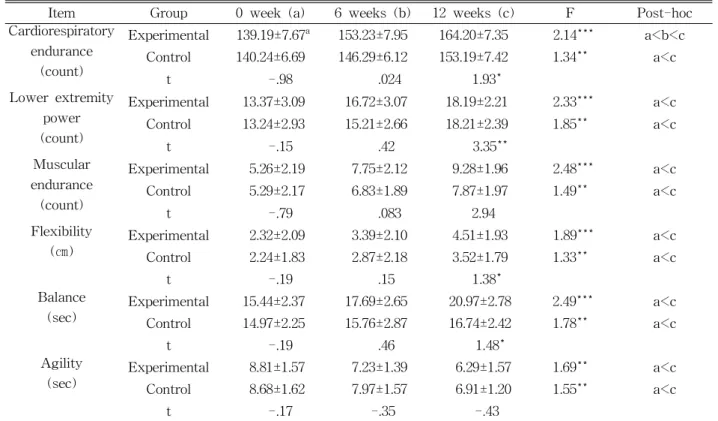
Changes in the physical functions The physical function changes after the PNF pro-
gram application are shown in Table 5. The cardior- espiratory endurance level of the experimental group significantly increased from 139.19±7.67 to 164.20±7.35 (p<.001), as did that of the control group, from 140.24±6.69 to 153.19±7.42 (p<.01). The lower-extremity power of the experimental group significantly in- creased from 13.37±3.09 to 18.19±2.21 (p<.001), as did that of the control group, from 13.24±2.93 to 18.21±2.39 (p<.01). The muscular endurance of the experimental group significantly increased from 5.26±2.19 to 9.28±1.96 (p<.001), as did that of the control group, from 5.29±2.17 to 7.87±1.97 (p<.01). The flexibility level of the experimental group significantly in- creased from 2.32±2.09 to 4.51±1.93 (p<.01), as did that of the control group, from 2.24±1.83 to 3.52±1.79 (p<.01). The balance level of the experimental group significantly increased from 15.44±2.37 to 20.97±2.78 (p<.001), as did that of the control group, from 14.97±2.25 to 16.74±2.42 (p<.01). Finally, the agility level of the experimental group significantly de- creased from 8.81±1.57 to 6.29±1.57 (p<.01), as did that of the control group, from 8.68±1.62 to 6.91±1.20.
Procedures Elastic band exercise
Period (week)
1∼4 5∼8 9∼12
yellow band blue band
Warm up
∙Stretching: gluteus maximus, hamstrings, gastrocnemius, trunk rotators, quadratus lumborum, quadriceps
∙Walking: 100 m
10 min
Exercise
Upper extremity
∙Elbow flexion, extension
∙Reverse files
∙Upright row
∙Side bend
∙Bilateral shoulder flexion, extension 10 min (2 sets)
20 min (3 sets)
30 min (4 sets) Lower
extremity
∙Hip flexion, extension
∙Hip adduction, abduction
∙Mini squat knee extension
∙Leg press
∙Ankle dorsiflexion, plantarflexion
Cool down
∙Stretching: gluteus maximus, hamstrings, gastrocnemius, trunk rotators, quadratus lumborum, quadriceps
∙Walking: 100 m
10 min Table 4. Elastic band exercise program
Changes in the blood lipid level
The changes in the blood lipid level after the PNF program application are shown in Table 6. The TC level of the experimental group significantly in-
creased from 234.87±10.12 to 201.79±19.52 (p<.001), unlike that of the control group (234.54±10.53 to 224.77±18.48, p>.05). The TG level of the experimental group significantly decreased from 245.16±17.97 to
Item Group 0 week (a) 6 weeks (b) 12 weeks (c) F Post-hoc
Cardiorespiratory endurance
(count)
Experimental 139.19±7.67a 153.23±7.95 164.20±7.35 2.14*** a<b<c Control 140.24±6.69 146.29±6.12 153.19±7.42 1.34** a<c
t -.98 .024 1.93*
Lower extremity power (count)
Experimental 13.37±3.09 16.72±3.07 18.19±2.21 2.33*** a<c Control 13.24±2.93 15.21±2.66 18.21±2.39 1.85** a<c
t -.15 .42 3.35**
Muscular endurance
(count)
Experimental 5.26±2.19 7.75±2.12 9.28±1.96 2.48*** a<c
Control 5.29±2.17 6.83±1.89 7.87±1.97 1.49** a<c
t -.79 .083 2.94
Flexibility
(㎝) Experimental 2.32±2.09 3.39±2.10 4.51±1.93 1.89*** a<c
Control 2.24±1.83 2.87±2.18 3.52±1.79 1.33** a<c
t -.19 .15 1.38*
Balance
(sec) Experimental 15.44±2.37 17.69±2.65 20.97±2.78 2.49*** a<c Control 14.97±2.25 15.76±2.87 16.74±2.42 1.78** a<c
t -.19 .46 1.48*
Agility
(sec) Experimental 8.81±1.57 7.23±1.39 6.29±1.57 1.69** a<c
Control 8.68±1.62 7.97±1.57 6.91±1.20 1.55** a<c
t -.17 -.35 -.43
amean±standard deviation, *p<.05, **p<.01, ***p<.001.
Table 5. Results of physical function
Item Group 0 week (a) 6 weeks (b) 12 weeks (c) F Post-hoc
Total
cholesterol Experimental 234.87±10.12a 218.35±19.59 201.79±19.52 17.90*** a<b<c Control 234.54±10.53 226.18±11.47 224.77±18.48 1.01
t -.07 -.70 -2.92
Triglyceride Experimental 245.16±17.97 223.32±19.44 205.73±16.03 17.91*** a<b<c Control 249.19±14.61 248.96±21.05 245.17±21.18 .16
t -.64 -2.66 -4.68
High density
lipoprotein Experimental 37.39±1.27 42.14±2.75 46.25±1.99 7.27* a<b<c
Control 38.68±2.97 38.96±2.63 39.56±4.52 .24
t -1.35 2.18 3.31
Low density
lipoprotein Experimental 242.26±6.39 231.07±7.15 217.11±14.24 16.76*** a<c Control 237.40±38.17 234.67±12.15 231.27±15.98 .19
t .48 -.75 -1.65
amean±standard deviation, *p<.05, **p<.01, ***p<.001.
Table 6. Results of blood lipid (Unit=㎎/㎗)
205.73±16.03 (p<.001), again unlike that of the control group (249.19±14.61 to 245.17±21.18, p>.05). The HDL-C level of the experimental group significantly increased from 37.39±1.27 to 46.25±1.99 (p<.01), still unlike that of the control group (36.68±2.97 to 39.56±4.52, p>.05). Finally, the LDL-C level of the ex- perimental group significantly decreased from 242.26±6.39 to 217.11±14.24 (p<.001), unlike that of the control group (237.40±38.17 to 231.27±15.98, p>.05).
Discussion
In this study, the effects of PNF on the physical functions and the blood lipid levels of obese elderly women were investigated, and the following are discussed.
Physical function changes
Through regular exercise, elderly people’s physical functions, which had deteriorated due to lack of en- durance, muscular strength, walking, and exercise, can their physical response speed (Rubenstein et al, 2000). Physical functions are major factors that affect the daily activities of aged people, and include car- diorespiratory endurance, muscular endurance, muscle power, balance, flexibility, walking speed, and agility. In this study, cardiorespiratory endurance, lower-extremity power, muscular endurance, flexibility, balance, and agility were operationally defined.
Cardiorespiratory endurance was investigated using the 20-minute walking-in-place test. The test results showed a significant difference in both the ex- perimental group and the control group, but a greater difference in the experimental group. These results corresponded to those of previous studies. The func- tional and structural changes in an aging heart could be prevented or increased through exercise.
Functional changes increase the maximum oxygen consumption, maximal heart rate, cardiac output, and stroke volume (Oxenham and Sharpe, 2003). This means PNF can positively affect the cardiorespiratory
endurance of obese elderly women who have regular physical activities.
The lower-extremity power was measured through the sit-to-stand method, which is most frequently used to estimate muscle power changes in the elderly. Significant changes in the lower-extremity power were observed in both the experimental and control groups, but the changes were greater in the experimental group than in the control group.
Deterioration of muscle functions in the elderly can cause falling accidents and deterioration of physical functions such as lower-extremity power, walking balance, and range of motion of the lower extremities (Lord et al, 2002). Aged people have significantly re- duced physical activities, which result in less use of their muscle fibers and a decrease in their muscle power, which aggravate the level of their daily ac- tivities and increase their risk of falling accidents (Yoon, 2006). A reduced muscle amount can cause chronic fatigue and deterioration in physical strength, physical response speed, and activities, which even- tually result in bone density reduction, function dete- rioration, walking impairment, balance function dete- rioration, and stress (Faulkner et al, 2007). In this study, the lower-extremity power increased in both groups, and the subjects who did not exercise earlier benefited from their participation in the regular physical activities during the study period. The sub- jects in both groups performed resistance exercises, which contributed to the strengthening of their leg muscles.
The muscular endurance was measured using the sit-up test. Both the experimental and control groups showed differences after the experiments, but a more significant difference was seen in the experimental group than in the control group. These results corre- sponded to those of the 10-week resistance exercise study of Jung and Lee (2004) and the effects of the exercise program for the elderly study of Kim (2007).
Flexibility was measured using the standing and forward bending test. During the aging process, the range of motion decreases, and independent daily ac-
tivities deteriorate. The flexibility levels in this study significantly differed in both the experimental and control groups, but the difference was greater in the experimental group than in the control group. These results corresponded to those of the study of Barbosa et al (2002) on a 10-week resistance ex- ercise program and the study of Fatouros et al (2002) on the effects of strength training, cardio vascular training and there combination on flexibility of in active older adults.
The balance was measured using the sin- gle-leg-balance test. In the aging process, the low- er-extremity power deteriorates, as do coordination, flexibility, and proprioceptive functions, which cause problems in the neural and skeletomuscular systems (Edelberg, 2001). Regular and intermediate-level ex- ercises are useful for preventing fall accidents and improving the sense of balance (Lin et al, 2004).
Balance is highly associated with falling accidents in obese elderly women. In this study, changes in bal- ance were significant both in the experimental and control groups, but the changes were greater in the experimental group. These results of the sin- gle-leg-balance test, which were highly associated with ambulation functions such as walking and with balance control, corresponded to those of the study of Persad et al (2010). The PNF in this study was composed of the coordination motions of the closed kinetic chain and the open kinetic chain, which con- tributed to the enhancement of the single-leg-balance test results.
The agility was tested using time’s up and go test, which is often used to test the dynamic balance ability level and rehabilitation in the elderly. The de- terioration of the exercise control functions is caused by the delay in the sensory information processing and the reduction in the physical response speed (Barnett et al, 2003). In this study, the agility level significantly changed both in the experimental and control groups, but the change was greater in the experimental group. The PNF in this study included patterns in the body, upper extremities, legs, and
head and neck, and programs for the four-step sprint and skating motions and the three-step motor learn- ing, which were associated with all the motions and activities (Koo et al, 2010).
Blood lipid level changes
The PNF in this study was a combination of re- sistance exercise and aerobic exercise. During a combined exercise, fat metabolism is facilitated through aerobic exercise, and the body fat mass is maintained or increased through resistance exercise, which results in positive physical changes (Izquierdo et al, 2004). In the meantime, the blood lipid levels must be controlled through continuous exercise (Roussel et al, 2009). In this study, PNF was sug- gested as an exercise program that can be easily used in daily life to improve the blood lipid levels of obses elderly women.
TC and LDL-C are the major risk factors of cor- onary artery diseases, and the HDL-C level functions as a protective factor of coronary artery diseases (Moon, 2005). In this study, the TC level in the ex- perimental group gradually decreased with statistical significance from the baseline 6 weeks and 12 weeks after the exercise, whereas in the control group, the TC level decreased, but the change was not statisti- cally significant. These results corresponded with those of the previous study, in that the TC level in the combined middle-aged women training group de- creased more significantly than that in the other ex- ercise group (Yoon, 2008). Accordingly, in this study, the TC level in the experimental group was more significantly affected than that in the control group.
The TG level in the experimental group gradually decreased with statistical significance from the base- line 6 weeks and 12 weeks after the exercise, whereas in the control group, the TG level de- creased, but the change was not statistically significant. These results corresponded with those of the previous study, in that after the long-term ex- ercise, the TG, TC and LDL-C levels decreased, and the HDL-C level increased (Taylor et al, 2004). The
HDL-C level in the experimental group gradually in- creased with statistical significance from the baseline 6 weeks and 12 weeks after the exercise, whereas in the control group, the change was not statistically significant. These results corresponded with those of the previous study, which showed that through regu- lar aerobic exercise or aerobic resistance exercise, the HDL-C level can be enhanced (Kim et al, 2004). The LDL-C level in the experimental group gradually de- creased with statistical significance from the baseline six weeks and 12 weeks after the exercise, whereas in the control group, the change was not statistically significant. These results corresponded with those of the previous study, in which long-term aerobic physical activities or reduced the TC and LDL-C levels and in- creased the HDL-C level (Katzmarzyk et al, 2003).
Accordingly, in this study, PNF was considered to have affected the blood lipid levels of obese elderly women.
In summary, after the PNF program was applied, the TC, TG, and LDL-C levels of the experimental group significantly decreased, and the HDL-C level significantly increased. The TG level change was the most significant, as in previous studies. This showed that regular aerobic and resistance exercise facilitated the activities of the lipoprotein lipase to dissolve TG in the blood and tissues (Sgouraki et al, 2001). As a combination of aerobic and resistance exercise, PNF was confirmed to have positively affected the blood lipid levels of the obese elderly women who did not have regular physical activities. The limitations of this study include its limited sample size, and the im- perfect control over the subjects, such as over their diet and drug intake. Accordingly, generalization of the results from the obese elderly subjects to the general population may be inappropriate. Further com- parative studies with a large sample size and with di- et and medical conrtrols may be needed in the future.
Conclusion
In this study, the effects of PNF and elastic band
exercise on the physical functions and blood lipid levels of obese elderly women were compared. The changes in the physical functions of the obese eld- erly subjects were significant both in the ex- perimental and control groups, but the experimental group showed more improvements. Therefore, PNF was considered to have more significantly affected the physical functions than elastic band exercise. In terms of the blood lipid levels, the experimental group showed significant changes, but the control group did not. The means that PNF, a combined ex- ercise, more significantly afferted the blood lipid lev- els than did elastic band exercise, a resistance exercise. In conclusion, PNF more effectively changed the physical functions and blood lipid levels of obese elderly women than did elastic band exercise.
References
American College of Sports Medicine. ACSM’s Guidelines for Exercise Testing and Prescription.
8th ed. Baltimore, Lippincott Williams &
Wilkins, 2009:204.
American College of Sports Medicine, Chodzko-zajko WJ, Proctor DN, et al. American college of sports medicine position stand. Exercise and physical activity for older adults. Med Sci Sports Exerc. 2009;41(7):1510-1530. http://www.
dx.doi.org/10.1249/MSS.0b013e3181a0c95c
Barbosa AR, Santarém JM, Filho WJ, et al. Effect of resistance training on the sit-and-reach test in elderly women. J Strength Cond Res. 2002;16(1):
14-18.
Barnett A, Smith B, Lord SR, et al. Community-based group exercise improves balance and reduces falls in at-risk older people: A randomised con- trolled trial. Age Ageing. 2003;32(4):407-414.
Cho JS, Bae SS, Park RJ. Review of the approach in the PNF and tai chi on frail elders. Journal of the Korean Proprioceptive Neuromuscular Facilitation Association. 2007;5(1):29-35.
Choi SI, Ko JU, Lee SM. The task of elderly health policy analysis and policy for the women elderly health promotion. The Journal of Sports and Entertainment Law. 2012;15(1):147-172.
Dietz B. Let’s sprint, let’s skate: Innovationen im PNF-konzept. Heidelberg, Springer, 2009:48-63.
Edelberg HK. Fall and function. How to prevent falls and injuries in patients with impaired mobility.
Geriatrics. 2001;56(3):41-45.
Fatouros IG, Taxildaris K, Tokmakidis SP, et al. The effects of strength training, cardiovascular train- ing and their combination on flexibility of in- active older adults. Int J Sports Med. 2002;23(2):
112-119.
Faulkner JA, Larkin LM, Claflin DR, et al. Age-re- lated changes in the structure and function of skeletal muscles. Clin Exp Pharmacol Physiol.
2007;34(11):1091-1096.
Hong JY, Oak JS. Effects of 12 weeks aerobic, anaerobic combined exercise training on fitness, body composition, skeletal muscle index and blood lipid profiles in obese elderly women.
Korean J Obes. 2013;22(1):30-38. http://dx.doi.
org/10.7570/kjo.2013.22.1.30
Izquierdo M, Ibañez J, Hakkinen K, et al. Once weekly combined resistance and cardiovascular training in healthy older men. Med Sci Sports Exerc. 2004;36(3):435-443.
Jang KT, Lee KY, Lim HN, et al. Physical Activity Instruction of Older Adults. Seoul, Daehanmedia, 2006:108-110.
Jung AR, Lee DT. Effects of resistance exercise on improvement of muscular strength and endur- ance according to ACE genotype in the elderly women. Korea Coaching Development Center.
2004;6(3):291-298.
Katzmarzyk PT, Leon AS, Wilmore JH, et al.
Targeting the metabolic syndrome with exercise:
Evidence from the heritage family study. Med Sci Sports and Exerc. 2003;35(10):1703-1709.
Kawahira K, Shimodozono M, Ogata A, et al.
Addition of intensive repetition of facilitation
exercise to multidisciplinary rehabilitation pro- motes motor functional recovery of the hemi- plegic lower limb. J Rehabil Med. 2004;36(4):
159-164.
Kim CS. Effects of the exercise program for the eld- erly: Using elastic band. Gwangju, Chosun University, Doctoral Dissertation. 2007.
Kim HJ, Choi JH. Effect of the PNF and weight training on muscular strength and flexibility of the lower limbs in the elderly. Korean J Growth Dev. 2004;12(1):125-134.
Kim JP. The effect of balance exercise on postural control and shooting record in archers. Kor J Sport Biomech. 2008;18(2):65-74. http://dx.doi.
org/10.5103/KJSB.2008.18.2.065
Kim JW, Han SW, Kim JK. The effects of elastic resistance exercise of lunbo-pelvic region and lower limbs muscle on walking ability and bal- ance ability of the elderly. Korean J Growth Dev. 2006;14(3):13-26.
Kim KB, Lee JH, Lee JA. Effects of resistance training on body composition, serum lipids and lipoprotein in obese high school girls. Korea Sport Res. 2004;15(1);1137-1145.
Kim SH. Effects of different stretching methods after exercise on delayed onset muscle soreness and exercise performance. Exerc Sci. 2009;18(4):527-538.
Kim SH, Kim DH. The effects of PNF exercise on body functions and fall efficacy of elderly women. The Korean J of Phys Educ. 2013;52(2):
495-512.
Klein DA, Stone WJ, Phillips WT, et al. PNF train- ing and physical function in assisted-living older adults. J Aging Phys Activ. 2002;10(4):476-488.
Kofotolis N, Kellis E. Effects of two 4-week proprio- ceptive neuromuscular facilitation programs on muscle endurance, flexibility and functional per- formance in women with chronic low back pain.
Phys Ther. 2006;86(7):1001-1012.
Koo BO, Bae SS, Kwon MJ, et al. Proprioceptive Neuromuscular Facilitation. 2nd ed. Seoul, Daihak Publishing Co., 2010:397.
Korea Centers for Disease Control and Prevention.
Food and nutrient intakes of koreans in 2007:
Korea national health and nutrition examination survey [Internet]. Choungju, 2008 Nov 18 [Cited 2014 Nov 19]. Available from: http://www.cdc.
go.kr/CDC/intro/CdcKrIntro0201.jsp?menuIds=
HOME001-MNU1154-MNU0005-MNU0011&fid=2 1&q_type=&q_value=&pageNum=95
Krebs DE, Jette AM, Assmann SF. Moderate ex- ercise improves gait stability in disabled elders.
Arch Phys Med Rehabil. 1998;79(12):1489-1495.
Lee HJ, Song CH, Lee KJ, et al. The effects of complex exercise training for lower legs muscle strength, muscle endurance, balance ability and gait ability in the elderly. J Sport Leis Stud.
2010;41(2)935-947.
Lee MK, Lee JS, Jeong WS, et al. The effect of proprioceptive neuromuscular facilitation on bal- ance ability in patients with hemiparetic. Journal of the Korean Proprioceptive Neuromuscular Facilitation Association. 2009;7(1):9-16.
Lin SI, Woollacott MH, Jensen JL. Postural response in older adults with different levels of functional balance capacity. Aging Clin Exp Res. 2004;16 (5):369-374.
Lord SR, Murray SM, Chapman K, et al. Sit-to- stand performance depends on sensation, speed, balance and psychological status in addition to strength in older people. J Gerontol A Biol Sci Med Sci. 2002;57(8):M539-M543.
Marek SM, Cramer JT, Fincher AL, et al. Acute ef- fects of static and proprioceptive neuromuscular facilitation stretching on muscle strength and power output. J Athl Train. 2005;40(2):94-103.
Milkesky AE, Topp R, Wiggleworth JK, et al.
Efficacy of a home-based training program for older adults using elastic tubing. Eur J Appl Physiol Occup Physiol. 1994;69(4):316-320.
Moon HJ. The effects of exercise program for falls prevention on physical fitness factors in the eld- erly females. Seoul, Korea National Sport University, Master Thesis. 2008.
Moon SJ. Related factors of coronary artery disease.
Seoul, Yonsei University, Master Thesis. 2005.
Oh DG, Sung SC, Lee MG. Effects of elastic band exercise using PNF and CNS stimulating ex- ercise on functional fitness and EMG in hemi- plegic stroke patients. Korean J Sport Sci. 2011;
20(2):815-827.
Oxenham H, Sharpe N. Cardiovascular aging and heart failure. Eur J Heart Fail. 2003;5(4):427-434.
Park JE, Park SR, Hwang CK, et al. The association of hypertension and dyslipidemia in post- menopausal women. Korean Circ J. 1999;29(11):
1195-1200.
Park SK, Kim EH, Kwon YC, et al. Effects of com- bined exercise program on health-related phys- ical fitness, anti-aging hormone and prevention of sarcopenia in elderly women with sarcopenia.
J Sport Leis Stud. 2010;40(1):435-442.
Park SH. The effects of motivative complex gym- nastic program on physical fitness, physiological psychological function in eldery attending senior center. Busan, Kosin University, Doctoral Dissertation. 2009.
Persad CC, Cook S, Giordani B. Assessing falls in the elderly: Should we use simple screening tests or a comprehensive fall risk evaluation?
Eur J Phys Rehabil Med. 2010;46(2):249-259.
Rikli RE, Jones CJ. Functional fitness normative scores for community-residing older adults, ages 60-94. J Aging Phys Activ. 1999;7(2):162-181.
Robertson MC, Devlin N, Gardner MM, et al.
Effectiveness and economic evaluation of a nurse delivered home exercise programme to prevent falls. 1: Randomised controlled trial.
BMJ. 2001;322(7288):697-701.
Roussel M, Garnier S, Lemoine S, et al. Influence of a walking program on the metabolic risk profile of obese postmenopausal women. Menopause.
2009;16(3):566-575.
Rubenstein LZ, Josephson KR, Trueblood PR, et al.
Effects of a group exercise program on strength, mobility, and falls among fall-prone elderly men.
J Gerontol A Biol Sci Med Sci. 2000;55(6):
M317-M321.
Sgouraki E, Tsopanakis A, Tsopanakis C. Acute ex- ercise: Response of HDL-C, LDL-C lipoproteins and HDL-C subfractions levels in selected sport disciplines. J Sport Med Phys Fitness. 2001;41 (3):386-391.
Statistics Korea. Population trend survey [Internet].
Daejeon, 2014 Sep 23 [Cited 2014 Nov 19].
Available from: http://kosis.kr/statHtml/statHtml.
do?orgId=101&tblId=DT_1B8000F&conn_path=I2 Steinberg M, Cartwright C, Peel N, et al. A sustain-
able programme to prevent falls and near falls in community dwelling older people: Results of a randomised trial. J Epidemiol Community Health.
2000;54(3):227-232.
Sung SC, Lee MG, Kim HS. Effect of age, falling
experience, and exercise habit on fitness level elderly men. Exerc Sci. 2004;13(3):367-379.
Taylor AH, Cable NT, Faulkner G, et al. Physical activity and older adults: A review of health benefits and the effectiveness of interventions. J Sports Sci. 2004;22(8):703-725.
Yoon SH. The effects on body composition lipid level according to training methods for middle aged obese women. Busan, Korea Maritime and Ocean University, Master Thesis. 2008.
Yoon SJ. Sports Health Medicine: Strength training for fall prevention in the elderly. Sport Science.
2006(96):88-95.
This article was received October 18, 2014, was reviewed October 20, 2014, and was accepted January 12, 2015.