REVIEW ARTICLE
H 2 수용체 길항제의 위산분비 억제 효과 및 임상적 응용
심영광
1, 김나영
1,2분당서울대학교병원 내과1, 서울대학교 의과대학 내과학교실 및 간연구소2
The Effect of H
2Receptor Antagonist in Acid Inhibition and Its Clinical Efficacy
Young Kwang Shim1 and Nayoung Kim1,2
Department of Internal Medicine, Seoul National University Bundang Hospital1, Seoungnam, Department of Internal Medicine and Liver Research Institute, Seoul National University College of Medicine2, Seoul, Korea
The first histamine H2 receptor antagonists (H2RAs) were developed in the early 1970s. They played a dominant role in treating peptic ulcer disease and gastroesophageal reflux disease (GERD). H2RAs block the production of acid by H+, K+-ATPase at the parietal cells and produce gastric luminal anacidity for varying periods. H2RAs are highly selective, and they do not affect H1 receptors. Moreover, they are not anticholinergic agents. Sequential development of H2RAs, proton pump inhibitors (PPIs), and discovery of Helicobacter pylori infection changed the paradigm of peptic ulcer disease with marked decrease of morbidity and mortality. PPIs are known to be the most effective drugs that are currently available for suppressing gastric acid secretion. Many studies have shown its superiority over H2RAs as a treatment for acid-related disorders, such as peptic ulcer disease, GERD, and Zollinger-Ellison syndrome. However, other studies have reported that PPIs may not be able to render stomach achlorhydric and have identified a phenomenon of increasing gastric acidity at night in individuals receiving a PPI twice daily. These nocturnal acid breakthrough episodes can be eliminated with an addition of H2RAs at night. The effectiveness of nighttime dose of H2RA suggests a major role of histamine in nocturnal acid secretion. H2RAs reduce secretion of gastric acid, and each H2RA also has specific effects. For instance, nizitidine alleviates not only symptoms of GERD, but also provokes gastric emptying, resulting in clinical symptom improvement of functional dyspepsia. The aim of this paper was to review the characteristics and role of H2RAs and assess the future strategy and treatment of upper gastrointestinal disease, including acid related disorders. (Korean J Gastroenterol 2017;70:4-12)
Key Words: Peptic ulcer; Histamine H2 antagonists; Gastric acid
Received May 31, 2017. Revised June 17, 2017. Accepted June 19, 2017.
CC This is an open access article distributed under the terms of the Creative Commons Attribution Non-Commercial License (http://creativecommons.org/licenses/
by-nc/4.0) which permits unrestricted non-commercial use, distribution, and reproduction in any medium, provided the original work is properly cited.
Copyright © 2017. Korean Society of Gastroenterology.
교신저자: 김나영, 13620, 성남시 분당구 구미로 173번길 82, 분당서울대학교병원 내과
Correspondence to: Nayoung Kim, Department of Internal Medicine, Seoul National University Bundang Hospital, 82 Gumi-ro 173beon-gil, Bundang-gu, Seongnam 13620, Korea. Tel: +82-31-787-7008, Fax: +82-31-787-4051, E-mail: [email protected]
Financial support: This work was supported by the National Research Foundation of Korea (NRF) grant for the Global Core Research Center (GCRC) funded by the Korea government (MSIP) (No. 2011-0030001).
Conflict of interest: None.
서 론
역사적으로 치유가 힘들고 치유된 후에도 재발되면서 출혈, 천공과 같은 합병증으로 소화기 질환에서 큰 비중을 차지해온 소화성 궤양에 대한 치료는 소화관 생리학을 근거로 꾸준히 발전해왔다. 위는 위산을 분비하여야 세균 제거 및 소화 등 생리적인 역할을 한다. 하지만 방어인자에 대한 공격인자의
균형이 깨지면서 발생하는 소화성 궤양은 의사들에게는 매우 큰 문제였다. 1970년대 초반 H2 수용체 길항제가 개발되면서 소화성 궤양 치료에 큰 발전이 있었고, 이후 H2 수용체 길항 제는 소화성 궤양의 주요 치료 약제가 된 바 있다.1이후 1980 년대에 H2 수용체 길항제보다 훨씬 강력한 양성자 펌프 억제 제(proton pump inhibitor, PPI)가 치료 약제로 사용되기 시 작하였는데, 1983년에 배양된 헬리코박터 파일로리가 소화성
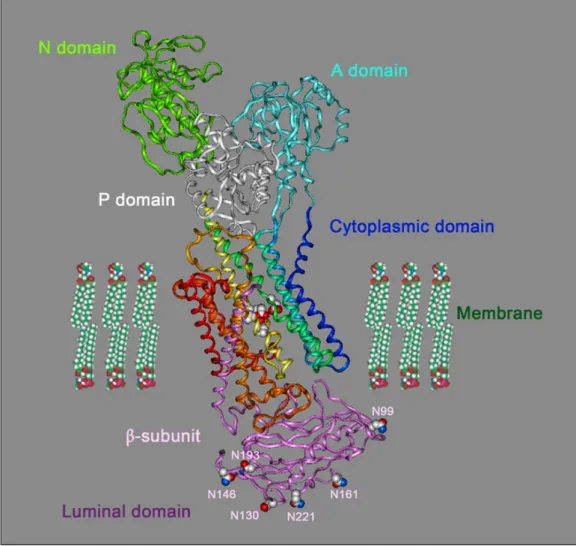
Fig. 1. A model structure of gastric H+, K+-ATPase. The gastric H+, K+-ATPase α subunit has 3 lobes, N (ATP binding), P (phosphorylation), and A (activation) domains in the cytoplasmic domain, and 3 transmembrane segments in the membrane domain. The gastric β-subunit has a short cytoplasmic region, 1 transmembrane segment, and a heavily glycosylated extracellular region. The number of Asn sites having carbohydrates is based on pig H+, K+-ATPase, as previously described by Shin and Kim.24
궤양의 원인으로 밝혀지면서 PPI를 이용한 헬리코박터 제균 요법이 도입되었고, 소화성 궤양은 내과적으로 치유 가능한 질환이 되었다. 이후 노령 인구 증가와 함께 많이 사용되기 시작한 비스테로이드 소염제(non-steroid anti-inflammatory drug, NSAID)에 의한 소화성 궤양 발생이 증가하면서 소화 성 궤양은 NSAID와 헬리코박터, 두 가지 원인에 따라 헬리코 박터 연관 소화성 궤양, 비스테로이드 소염제 연관 소화성 궤 양, 헬리코박터-음성, 비스테로이드 소염제-음성 소화성 궤양 으로 분류되게 되었다.2 이러한 소화성 궤양 치료에 대한 여러 연구에서 PPI와 H2 수용체 길항제 중 PPI가 소화성 궤양의 치료제로써 우월한 효과를 보여준 바 있는데,3,4 NSAID 연관 소화성 궤양 치료의 경우 라니티딘과 오메프라졸을 8주간 투 여할 시 십이지장 궤양의 치유율은 79%와 93%, 위 궤양의 치유율은 64%와 83%로 PPI의 치료 효율이 우수함이 보고되 었다.5 한편 비만 증가와 서구화된 식단으로 꾸준히 그 발생
빈도가 증가하고 있는 위식도 역류 질환은 초기 치료 후 1년 이내에 80-90%가 재발하는 만성 질환이다.6,7 생활습관 변화 와 위산분비 억제를 통해서 증상을 없애고 식도염의 호전, 합 병증을 예방하는 것이 치료의 목표이다. 위식도 역류 질환의 치료에서도 H2 수용체 길항제에 비해 PPI의 효과가 우수한 것으로 알려져 있다.8,9 또한 소화성 궤양이나 역류성 식도염 뿐 아니라 Zollinger-Ellison syndrome 등 위산분비 연관 질 환의 치료로써 PPI가 H2 수용체 길항제에 비해 우월하다고 발표되어 있다.3,4,10-13 그러나 골다공증과 같은 PPI 장기간 투 여에 의한 여러 부작용이 보고되고 있는데, 최근에는 간경화 증 환자에서 간성혼수 및 자발성 복막염의 증가 등 부작용에 대해 증거들이 보고되고 있어 관심이 집중되고 있다.14,15 한편 PPI보다 더 강력한 potassium channel binding inhibitor가 등장하고 있고, 이에 의한 부작용도 예측되고 있어16,17 비교적 부작용이 적은 H2 수용체 길항제 및 방어인자의 적극적 활용
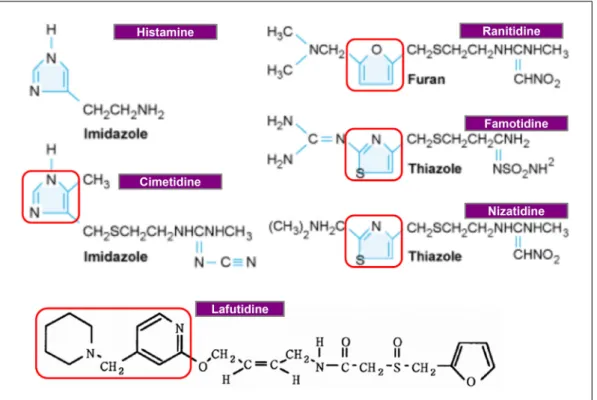
Fig. 2. Structures of H2 receptor antagonists. Red box indicates pyridine ring or modified structures.29-31 이 필요하다 하겠다.
이에 본 종설에서는 H2수용체 길항제의 역사 그리고 상부 위장관 질환의 치료에서 H2수용체 길항제의 특징과 효과를 정리하고, 최근 보고되고 있는 PPI 치료의 한계점과 부작용을 보완할 수 있는 방법에 대해 검토해보고자 한다.
본 론
1. H+, K+-ATPase 발견과 H2 수용체 길항제의 개발 역사 과거 H2수용체 길항제가 사용되기 이전의 소화성 궤양 치 료는 매우 어려웠고, 합병증 없는 소화성 궤양은 수술적 치료 없이 치료하기도 했지만, 지속적인 궤양 재발 그리고 천공, 출혈 등의 합병증 발생률이 높아 수술하는 환자들이 많았다.
또한 이러한 수술의 경우 응급수술로 진행하는 경우도 많아 6-13%의 경우는 수술 후 결과가 좋지 않았다.18-21 증상 완화 를 위해 제산제를 하루 7번 복용해야 하는 어려움과 집에서 절대 안정을 취하는 등 직접적 비용의 증가와 생산량 감소 등 간접적 사회적 손실이 많았다.22 이후 1976년도에 H+, K+-ATPase에 대한 개념이 발표되었고(Fig. 1),23,24 1977년 H2수용체 길항제가 개발되었다.25,26 H2수용체 길항제는 소화 성 궤양의 치유를 혁신적으로 향상시킴으로써 소화성 궤양 질 환 치료의 판도를 변경하게 되었고, H2수용체 길항제를 개발 한 Sir James Black은 1988년도에 노벨생리학상을 수상할 정도로 가히 의학계의 혁명적인 발견이 되었다. H2수용체 길
항제로 소화성 궤양 치료를 시작하면서 이후 소화성 궤양의 발생 및 합병증의 감소를 보여 이와 관련된 여러 연구들이 발표되었다. 즉, Macdougall 등이 1977년에 발표한 간성혼 수 환자 50명을 대상으로 한 연구에서 26명의 대조군 중 5명 의 환자에서 위장관 출혈이 있었는 데 반해, H2 수용체 길항 제로 치료한 24명 중 한 명에서만 위장관 출혈이 있었다.27 Jones 등이 1978년에 발표한 신장 이식을 시행한 환자를 대 상으로 한 연구에서는 대조군이 33명 중 6명에서 상부위장관 출혈이 있었던 반면, H2수용체 길항제로 치료한 환자군에서 는 30명 중 상부위장관 출혈이 발생한 환자가 없었다.28 이처 럼 간경화나 만성 신부전증 등 기존 질환이 심하여 위점막의 저항기전이 떨어진 환자에서의 합병증 치유가 잘 된다는 논문 을 시작으로 중증의 소화성 궤양 치료에 대한 H2수용체 길항 제 효과에 대한 많은 논문이 발표되어 왔다.
2. H2 수용체 길항제의 약리와 특성
위벽 세포에서의 위산분비는 미주신경말단에서 분비되는 아세틸콜린, 전정부 G 세포에서 분비된 가스트린, 장크롬친화 세포에서 분비된 히스타민에 의해 조절되고, 위산분비의 기능 적 주요 부위는 H2 수용체와 H+, K+-ATPase이다(Fig. 1).24 히스타민은 벽 세포의 H2 수용체에 결합하여 세포 내의 cyclic adenosine monophosphate 농도를 높이고 protein kinase A 효소를 활성화시킨다. 활성화된 protein kinase A는 H+, K+-ATPase를 세포질에서 원형질막으로 이동시키는 데 관여
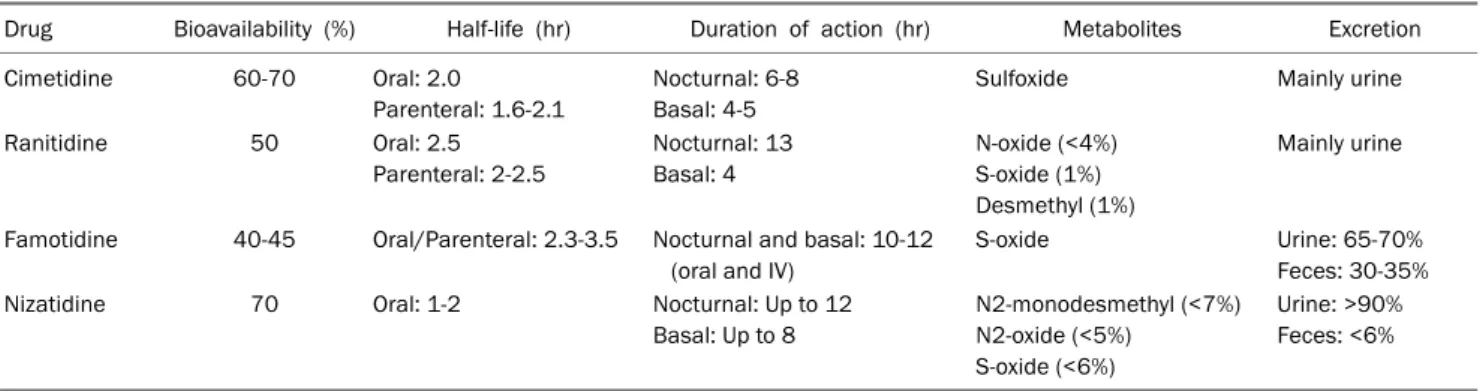
Table 1. Pharmacokinetics of H2 Receptor Antagonists32,33
Drug Bioavailability (%) Half-life (hr) Duration of action (hr) Metabolites Excretion
Cimetidine 60-70 Oral: 2.0
Parenteral: 1.6-2.1
Nocturnal: 6-8 Basal: 4-5
Sulfoxide Mainly urine
Ranitidine 50 Oral: 2.5
Parenteral: 2-2.5
Nocturnal: 13 Basal: 4
N-oxide (<4%) S-oxide (1%) Desmethyl (1%)
Mainly urine
Famotidine 40-45 Oral/Parenteral: 2.3-3.5 Nocturnal and basal: 10-12 (oral and IV)
S-oxide Urine: 65-70%
Feces: 30-35%
Nizatidine 70 Oral: 1-2 Nocturnal: Up to 12
Basal: Up to 8
N2-monodesmethyl (<7%) N2-oxide (<5%)
S-oxide (<6%)
Urine: >90%
Feces: <6%
하는 세포골격 단백질을 인산화시킨다. 즉, 소포막에서 비활 성화 상태로 있던 H+, K+-ATPase가 활성화된 후 소관으로 이동하게 된다. 소관으로 이동한 H+, K+-ATPase는 세포 밖의 KCl와 접촉하여 세포 내 양성자와 세포 외 K이온을 교환하면서 위산이 분비되는 것이다. H2 수용체는 벽 세포가 위산분비를 하는 형태로 만드는 데 중요한 역할을 하고, H+, K+-ATPase는 위산분비의 마지막 기능적 역할을 수행한다. H2 수용체 길항 제는 이러한 히스타민과 경쟁적으로 H2 수용체에 결합하여 위산분비를 억제한다.
H2 수용체 길항제는 경구 투여한 후 1-3시간에 혈중 농도 최고치에 이르고, 뇌혈류 장벽을 통과하며 전신에 분포된다.
역사적으로 개발된 각 H2 수용체 길항제들의 구조 및 특징을 간단히 비교하면 다음과 같다(Fig. 229-31, Table 132,33). 시메티 딘(cimetidine)과 파모티딘(famotidine), 라니티딘(ranitidine) 의 생체 이용률은 간에서 1차 대사를 거치면서 35-60%까지 감소되지만, 니자티딘(nizatidine)은 간대사를 거치지 않아 생 체 이용률이 100%에 이른다. 약물의 제거는 간대사와 신배설 에 의해 이루어진다. 니자티딘은 90%가 소변으로 배출되어 청소율이 신부전에 영향을 받지만 간부전에 영향을 받지는 않 는다(Fig. 229-31, Table 132,33). 간 cytochrome P450에 의해 다른 약물과의 상호작용이 발생할 수 있는데, 시메티딘과 라 니티딘을 투여한 후 다른 약물의 대사가 저하되어 혈중 농도 의 상승이 가능하다. 파모티딘과 니자티딘은 cytochrome P450과 친화도가 낮아 다른 약물과의 상호작용이 거의 없으 며, 라퓨티딘(Lafutidine)은 pyridine환을 모핵으로 한 H2수 용체 길항제와 달리 새로운 화학 구조를 가진 H2수용체 길항 제이다(Fig. 2).29-31즉, H2 수용체 길항제에 의한 공격인자 약 화와 함께 방어인자 증강 작용을 발현하는 라퓨티딘을 추가하 여 혈액순환을 촉진한다는 개념이 포함되어 있다. 니자티딘과 라니티딘은 시메티딘에 비해 효력(potency)이 4배 높고, 니자 티딘은 그 효과가 위에 국한되며 심혈관계나 중추신경계에 거 의 영향을 미치지 않는다. 파모티딘은 시메티딘보다는 20배,
라니티딘보다는 7.5배 위산 억제의 효력이 높다고 발표된 바 있다.34 파모티딘을 경구 섭취한 경우 1-3.5시간 뒤 혈중 최고 농도인 50-60 μg/L에 도달하며, 위산분비를 50% 이상 억제 하기 위해서는 혈중 농도 13 μg/L 이상을 유지해야 한다.34 한편 이러한 H2 수용체 길항제의 부작용들에 대해서도 많 이 알려진 바 있는데, 이들은 H2수용체 길항제에서 공통적으 로 나타나는 부작용들도 있고, 각 H2수용체 길항제 대사과정 등에 따라 각각 다른 부작용들도 있다. 즉, 시메티딘을 한 달 이상 장기 복용한 경우 여성유방증(gynecomastia)의 부작용 이 0.3-4%에서 발생 가능하며, 그 외 다른 H2수용체 길항제 에서는 아직 보고된 바가 없다. H2수용체 길항제를 복용하면 서 발생할 수 있는 다른 부작용들에는 설사, 두통, 어지럼증, 졸림, 변비 등이 있다. 또한 H2 수용체 길항제를 14일 이상 장기 복용할 시에 고가스트린 혈증 등으로 인하여 위산 억제 효과가 감소하는 내성이 발생하게 된다.35약물을 중단할 경우 에는 H2수용체 길항제로 유발된 고가스트린 혈증으로 인한 위산분비가 약 9일간 유지된다.36 또한 H2 수용체 길항제는 야간에 위산분비의 강력한 억제 효과가 있고 주간에 위산분비 효과는 제한적이다.37,38이로 인해 주간에 주로 증상이 발생하 는 경도(Los-Angeles 분류상 A or B) 역류성 식도염의 치료 에는 H2수용체 길항제의 효과가 적다.39 반대로 PPI는 주간 에 강력한 위산분비 효과가 있어 경도 역류성 식도염의 치료 효과가 좋다.40,41 H2 수용체 길항제나 PPI로 인한 위산분비 억제는 철분의 흡수를 저하시킨다. 위산은 비헴철(non-heme iron)을 흡수할 수 있게 촉진하고, 제1철(ferrous form)을 더 흡수가 잘되는 제2철(ferric form)로 전환시키기 때문이다.42,43 따라서 위산 억제 치료는 잠재적으로 철 결핍을 유발할 수 있고, 철분제제 치료를 방해할 수 있다. 증상이 심해 지속적으 로 약을 복용해야 하는 위식도 역류 질환 환자의 경우 이러한 PPI와 H2 수용체 길항제 부작용과 특성을 고려하여 주간에는 PPI를, 야간에는 H2수용체 길항제를 복용하는 방법이 선호되 기도 한다.
3. H2 수용체 길항제의 위산분비 억제 효과 및 임상 응용 H2수용체 길항제는 벽 세포의 H2수용체에 경쟁적으로 결 합하여 위산분비를 억제하며 H2 수용체에만 매우 선택적으로 결합하기 때문에 다른 히스타민 수용체에 거의 작용을 하지 않는다.44 이러한 위산분비 억제 효과는 H2 수용체 길항제가 제산제, 수크랄페이트보다 훨씬 우월하다.45 PPI와의 위산분 비 억제 효과 비교에 있어서는 아직 명확하지 않지만 위산과 관련된 질환 즉, Zollinger-Ellison syndrome, 역류성 식도염, 소화성 궤양 등의 치료에서 PPI가 H2 수용체 길항제에 비해 우월한 결과를 보여줬다.3,4,10-13 그러나 적절한 PPI 치료에도 불구하고 위산분비를 완전히 억제하는 것은 쉽지 않은 것으로 보여진다. 정상인이나 역류성 식도염 환자에서 오메프라졸 40 mg을 매일 복용한 경우에도 위산분비가 완전히 억제되지 않으며, 역류성 식도염 환자인 경우 PPI의 용량을 높이면 위 산 조절이 향상되어 호전을 보인다.46,47 또한 PPI를 하루 두 번 복용하는 경우에도 야간에 발생하는 위산분비로 인하여 1 시간 이상 pH가 4 미만으로 유지되는 야간 위산분비 억제 실패가 발생한 것48,49은 이러한 현상을 반증한다. 정상인과 역 류성 식도염 환자에서 야간 위산분비 억제 실패율은 69-79%
이며, 특히 PPI를 저녁에 복용한 후 6시간 이내, 수면 중에 특징적으로 많이 발생한다.48,50 이 시간대에는 특히 식도 운동 기능이 저하되고, 침샘에서 침의 분비가 줄어들어 역류성 식 도염의 치료나 예방에 악영향을 줄 수 있다. 이러한 야간 위산 분비 억제 실패의 감소 및 소실을 위해 H2수용체 길항제를 사용할 수 있다. 오메프라졸 20 mg을 하루 2회 복용한 정상 인에서 라니티딘 150 mg 또는 300 mg을 취침 전에 복용하 였을 때 야간 위산분비 억제 실패가 소실되었으며51 란소프라 졸과 파모티딘으로 한 연구에서도 H2 수용체 길항제가 야간 위산분비 억제 실패에 효과가 있었다.41 그러나 H2수용체 길 항제는 2주 이상 장기간 투여할 경우 약물 내성이 발생한다.35 무작위 위약-대조군 연구에서 파모티딘 40 mg을 저녁 식후 1회 복용 시에 첫날 24시간 위 내 평균 pH 3.2에서 28일째 1.9까지 감소하였고, 라니티딘 300 mg 하루 네 번 복용하였 을 때 첫날 24시간 위 내 평균 pH 5.0에서 7일째 3.0, 라니티 딘 300 mg을 하루 세 번 복용하였을 때 24시간 위 내 평균 pH 4.3에서 14일째 2.4까지 감소하였다.35이처럼 H2수용체 길항제 약물 내성이 발생하는 기전에 대해서는 가스트린과의 연관성을 들어 설명하고 있다. 즉 H2수용체 길항제는 위 pH 를 상승시킴과 동시에 혈중 가스트린 농도를 상승시키는데, 가스트린은 간접적으로 장크롬친화 세포로부터의 히스타민 분비를 통해 위산을 분비하고, 또한 직접적으로 가스트린 수 용체에 결합하여 벽 세포에서 위산분비를 촉진시킴으로써 약 제 내성을 유발시킨다.52
4. 소화성 궤양에서의 H2 수용체 길항제의 유용성
소화성 궤양은 그 원인에 따라 크게 헬리코박터 연관 궤양, 비스테로이드 소염제 연관 궤양, 헬리코박터-음성, 비스테로 이드 소염제-음성 궤양으로 분류되는데,2 H2수용체 길항제로 비스테로이드 소염제 연관 궤양을 치료할 시 비스테로이드 소 염제를 중단하지 않으면 중단할 경우보다 궤양의 치유 속도가
느리다.53-55 표준용량의 H2 수용체 길항제는 비스테로이드 소
염제 연관 궤양의 예방에는 효과적이지 않다. 시메티딘 400 mg을 10개월간 취침 전에 복용하였으나 궤양의 예방에 효과 적이지 않았으며,56 라니티딘은 십이지장 궤양의 발생률은 감 소시켰으나 위 궤양의 발생률은 감소시키지 못했다.57,58 비스 테로이드 소염제 연관 궤양의 치유는 더 강력한 위산억제 효 과가 있는 PPI가 H2수용체 길항제보다 우월하다.59 즉, 비스 테로이드 소염제 연관 위 궤양 발생 억제 및 위 궤양 치유에 있어서는 PPI가 H2수용체 길항제보다 우월하다고 정리할 수 있겠다. 그러나 파모티딘의 경우 고용량을 준 경우가 표준용 량의 H2 수용체 길항제나 위약(placebo)보다 비스테로이드 소염제 연관 위 궤양에서 더 나은 치료 효과를 보이며,60또한 방어인자 촉진제의 병용 투여에 의한 비스테로이드 소염제 연 관 소화성 궤양 예방이나 치료 방법도 적극 모색하고 있기에 반드시 PPI로만 치료가 가능하다고 하기는 어려울 수 있겠다.
한편, 아직도 이견이 많기는 하나 헬리코박터 감염이 비스테 로이드 소염제 연관 궤양의 발생을 증가시키지 않는다는 주장 도 많다.61,62 헬리코박터는 비스테로이드 소염제로 인한 프로 스타글란딘 합성 억제를 방해하여63 오히려 헬리코박터 양성 환자에서 헬리코박터 음성 환자에 비해 더 높은 비스테로이드 소염제 연관 궤양의 치유율을 보인다.64
5. 위식도 역류 질환에서의 H2 수용체 길항제의 유용성 위식도 역류 질환은 임상에서 접하게 되는 흔한 위장관 질 환 중에 하나이다. 위식도 역류 질환은 다인성(multifactorial) 질환으로, 역류된 위액의 산성도 증가, 식도나 식도 상부점막 의 역류물에 대한 증가된 민감도, 위식도 역류 현상의 과도한 발 생, 역류물에 대한 식도의 청소능 저하 등에 영향을 받는다. 따라 서 이와 관련된 하부식도조임근(lower esophageal sphincter, LES)의 기능장애에 의한 낮은 LES압과 일시적 LES 이완, 해 부학적 기전 중 대표적인 열공허니아(hiatal hernia), 식도배 출장애, 복압증가, 내장과민성, 점막 방어인자 손상, 중추 감 작(central sensitization), 정신적 요소 등은 잘 알려진 위식 도 역류 질환의 병태생리학적 기전이다. 점막 손상(mucosal break)이나 합병증의 유무는 위식도 역류 질환의 진단에 반드 시 필요한 사항은 아니지만, 내시경으로 관찰되는 점막손상의 유무에 따라 미란성 식도염(erosive esophagitis)과 비미란성 역류 질환(non-erosive reflux disease)으로 나누어진다. 역
류성 식도염의 경우 남성이 여성보다 높고 비미란성 역류 질 환은 여성에서 높아 성차의학의 예를 잘 보여준다.65
위식도 역류 질환의 치료 목적은 증상 개선, 식도염의 치료, 합병증 예방과 재발의 방지이다. 역류성 식도염의 중증도는 식도가 산에 노출되는 정도와 기간과 관계가 있다. 약제에 의 한 위산역류 효과도 산역류 증상과 식도염증의 개선과 직접 관련이 있다. 가장 기본적인 치료 약제로 PPI가 대표적인 약 물이다. H2수용체 길항제도 PPI와 마찬가지로 증상의 호전과 식도염의 치유에 있어 위약보다 유의한 효과가 있다.66 H2수 용체 길항제는 작용 시작시간이 빠르고 증상이 심하지 않은 환자에서 효과가 있다.
PPI와 H2수용체 길항제의 증상 개선 효과를 비교했을 때 PPI는 H2 수용체 길항제에 비해 우월한 효과를 보였다. 전형 적인 산역류 증상을 가진 환자의 증상 소실에 대한 위약 대비 상대위험도에서 PPI가 0.37로, H2 수용체 길항제 0.77에 비해 우월한 결과를 보였다.66-68 그러나 이러한 주 치료제인 PPI에 반응이 없는 불응성 환자에 대해서는 여러 병태생리기전에 근 거한 약물들이 연구되고 있으나 아직은 이에 대한 연구결과가 제한적이다. PPI를 하루 두 번 복용함에도 위산분비가 지속되 는 경우가 있는데, 특히 밤에 일어나는 야간 분비 억제 실패가 발생하는 경우가 많다.69 이러한 경우에 취침 전 H2 수용체 길항제를 병용 투여하는 경우에 효과적이다.70,71 이처럼 PPI 단독 치료로 증상 조절이 잘 되지 않는 경우에 H2수용체 길 항제가 도움이 될 수 있다.
6. H2 수용체 길항제의 위장관 운동 개선 효과
역류성 식도염은 부적절한 식도 운동과 위산분비로 생긴 만 성적인 병리학적 상태이다.72,73위산 억제를 위한 치료 약제로 써 PPI가 H2 수용체 길항제보다 우월한 효과를 보이지만,74,75 H2수용체 길항제 중 하나인 니자티딘은 시메티딘, 파모티딘, 라니티딘과 달리 아세틸콜린 분해효소를 억제하고 콜린신경 의 시냅스에 아세틸콜린의 농도를 높여 위장관의 운동을 활성 화시키는 유일한 효과를 지닌다.76,77 아세틸콜린은 직접적으 로 위장관 운동을 자극하고 그렐린(ghrelin)의 분비를 촉진하 여 시상하부자극을 통해 더욱 위장관 운동을 향상시킨다.78 위 장관의 운동이 향상되어 있는 상태에서 위장관 운동 조절 약 물을 투여하게 되면 식도의 연동 운동 향상과 하부식도괄약근 압력의 증가, 위 배출(gastric emptying)의 향상으로 인해 역 류성 식도염의 치유에 도움이 되고 호전 상태가 유지된다.79,80 니자티딘은 강력한 위장 운동 촉진 효과가 있고 콜린신경 활 성화로 인해 침의 분비를 증가시킨다.81,82 침 분비의 증가는 식도로 역류된 위산을 없애고, 역류성 식도염의 치료에 도움 이 된다.83,84
결 론
소화성 궤양이나 역류성 식도염, Zollinger-Ellision syn- drome 등의 위산 관련 위장관 질환의 치료제로 H2 수용체 길항제나 PPI가 많이 사용되고 있고, 그중에서도 PPI의 치료 효과가 더 우수하다고 알려져 있다. 그러나 PPI도 위산의 분 비를 완전히 억제하지는 못하며, PPI를 하루 두 번 복용할 경 우에도 야간 위산분비 억제 실패 등의 한계점이 있다. H2 수 용체 길항제를 같이 복용할 경우 이를 보완할 수 있을 것으로 보인다. 또한 H2수용체 길항제 중 니자티딘은 위장관 운동을 향상시키고 침 분비를 증가시키는 효과가 있어 역류성 식도염 의 치료에 도움이 된다. 또한 강력한 위산분비 억제로 인한 PPI의 부작용이 많이 밝혀지고 있는 바, H2수용체 길항제의 특징과 장점을 잘 파악하여 상부위장관 질환의 치료가 이루어 지기를 기대한다.
REFERENCES
1. Pounder R. Histamine H2-receptor antagonists. Baillieres Clin Gastroenterol 1988;2:593-608.
2. Shim YK, Kim N. Nonsteroidal anti-inflammatory drug and aspir- in-induced peptic ulcer disease. Korean J Gastroenterol 2016;
67:300-312.
3. Brunner G, Creutzfeldt W, Harke U, Lamberts R. Therapy with omeprazole in patients with peptic ulcerations resistant to ex- tended high-dose ranitidine treatment. Digestion 1988;39:80-90.
4. Double blind comparative study of omeprazole and ranitidine in patients with duodenal or gastric ulcer: a multicentre trial.
Cooperative study group. Gut 1990;31:653-656.
5. Yeomans ND. New data on healing of nonsteroidal anti-in- flammatory drug-associated ulcers and erosions. Omeprazole NSAID Steering Committee. Am J Med 1998;104(3A):56S-61S;
discussion 79S-80S.
6. Lagergren J, Bergström R, Lindgren A, Nyrén O. Symptomatic gas- troesophageal reflux as a risk factor for esophageal adeno- carcinoma. N Engl J Med 1999;340:825-831.
7. Katz PO. Pathogenesis and management of gastroesophageal reflux disease. J Clin Gastroenterol 1991;13 Suppl 2:S6-S15.
8. Fass R, Ofman JJ, Gralnek IM, et al. Clinical and economic assess- ment of the omeprazole test in patients with symptoms sugges- tive of gastroesophageal reflux disease. Arch Intern Med 1999;
159:2161-2168.
9. Habu Y, Oyasu K, Wakamatsu T, et al. Cost-effectiveness of the treatment of reflux esophagitis: proton pump inhibitor versus his- tamine-2-receptor antagonist. Nihon Rinsho 2000;58:1881-1885.
10. Delchier JC, Soule JC, Mignon M, et al. Effectiveness of omepra- zole in seven patients with zollinger-ellison syndrome resistant to histamine H2-receptor antagonists. Dig Dis Sci 1986;31:693- 699.
11. Lamers CB, Lind T, Moberg S, Jansen JB, Olbe L. Omeprazole in zollinger-ellison syndrome. Effects of a single dose and of long-
term treatment in patients resistant to histamine H2-receptor antagonists. N Engl J Med 1984;310:758-761.
12. Ducrotté P, Guillemot F, Elouaer-Blanc L, et al. Comparison of omeprazole and famotidine on esophageal pH in patients with moderate to severe esophagitis: a cross-over study. Am J Gastroenterol 1994;89:717-721.
13. Bate CM, Keeling PW, O'Morain C, et al. Comparison of omepra- zole and cimetidine in reflux oesophagitis: symptomatic, endo- scopic, and histological evaluations. Gut 1990;31:968-972.
14. Dam G, Vilstrup H, Watson H, Jepsen P. Proton pump inhibitors as a risk factor for hepatic encephalopathy and spontaneous bacterial peritonitis in patients with cirrhosis with ascites.
Hepatology 2016;64:1265-1272.
15. Freedberg DE, Kim LS, Yang YX. The risks and benefits of long-term use of proton pump inhibitors: expert review and best practice advice from the American Gastroenterological Association.
Gastroenterology 2017;152:706-715.
16. Li H, Meng L, Liu F, Wei JF, Wang YQ. H+/K+-ATPase inhibitors:
a patent review. Expert Opin Ther Pat 2013;23:99-111.
17. Andersson K, Carlsson E. Potassium-competitive acid blockade:
a new therapeutic strategy in acid-related diseases. Pharmacol Ther 2005;108:294-307.
18. Hallenbeck GA. What is the best elective operation for duodenal ulcer? Can Med Assoc J 1970;103:1255-1262.
19. Luff AP. Collective investigation into the after-history of gas- tro-enterostomy. Br Med J 1930;1:348-354.
20. Kemp D. An evaluation and comparison of the early and late re- sults of standardized polya gastrectomy. Gut 1967;8:151-165.
21. Whittaker LD Jr, Judd ES, Stauffer MH. Analysis of use of vagot- omy with drainage procedure in surgical management of duode- nal ulcer. Surg Gynecol Obstet 1967;125:1018-1026.
22. Kang JM, Seo PJ, Kim N, et al. Analysis of direct medical care costs of peptic ulcer disease in a Korean tertiary medical center. Scand J Gastroenterol 2012;47:36-42.
23. Sachs G, Chang HH, Rabon E, Schackman R, Lewin M, Saccomani G. A nonelectrogenic H+ pump in plasma membranes of hog stomach. J Biol Chem 1976;251:7690-7698.
24. Shin JM, Kim N. Pharmacokinetics and pharmacodynamics of the proton pump inhibitors. J Neurogastroenterol Motil 2013;19:
25-35.
25. Black JW, Duncan WA, Durant CJ, Ganellin CR, Parsons EM.
Definition and antagonism of histamine H 2-receptors. Nature 1972;236:385-390.
26. Okabe S, Takeuchi K, Urushidani T, Takagi K. Effects of cimeti- dine, a histamine H2-receptor antagonist, on various experimental gastric and duodenal ulcers. Am J Dig Dis 1977;22:677-684.
27. Macdougall BR, Bailey RJ, Williams R. H2-receptor antagonists and antacids in the prevention of acute gastrointestinal haemor- rhage in fulminant hepatic failure. Two controlled trials. Lancet 1977;1:617-619.
28. Jones RH, Rudge CJ, Bewick M, Parsons V, Weston MJ. Cimetidine:
prophylaxis against upper gastrointestinal haemorrhage after renal transplantation. Br Med J 1978;1:398-400.
29. Bossi A, Romeo G, Pezzoli A. Side-effects, structure, and H2-receptor antagonists. Lancet 1992;339:1366.
30. Song WJ, Kim MH, Lee SM, et al. Two cases of h(2)-receptor an-
tagonist hypersensitivity and cross-reactivity. Allergy Asthma Immunol Res 2011;3:128-131.
31. Aihara T, Nakamura E, Amagase K, et al. Pharmacological control of gastric acid secretion for the treatment of acid-related peptic disease: past, present, and future. Pharmacol Ther 2003;98:
109-127.
32. Berardi RR, Tankanow RM, Nostrant TT. Comparison of famoti- dine with cimetidine and ranitidine. Clin Pharm 1988;7:271-284.
33. Frank WO, Young M, Palmer RH, Karlstadt R, Rockhold F, Mounce W. Once-daily bedtime dosing regimen of cimetidine in the treat- ment of gastric ulcer. Clin Ther 1988;11:595-603.
34. Weir DG. Peptic ulceration. Br Med J (Clin Res Ed) 1988;296:
195-200.
35. Wilder-Smith CH, Ernst T, Gennoni M, Zeyen B, Halter F, Merki HS.
Tolerance to oral H2-receptor antagonists. Dig Dis Sci 1990;
35:976-983.
36. Fullarton GM, McLauchlan G, Macdonald A, Crean GP, McColl KE.
Rebound nocturnal hypersecretion after four weeks treatment with an H2 receptor antagonist. Gut 1989;30:449-454.
37. Nwokolo CU, Smith JT, Gavey C, Sawyerr A, Pounder RE. Tolerance during 29 days of conventional dosing with cimetidine, nizati- dine, famotidine or ranitidine. Aliment Pharmacol Ther 1989;4 Suppl 1:29-45.
38. Komazawa Y, Adachi K, Mihara T, et al. Tolerance to famotidine and ranitidine treatment after 14 days of administration in healthy subjects without helicobacter pylori infection. J Gastroenterol Hepatol 2003;18:678-682.
39. Adachi K, Fujishiro H, Katsube T, et al. Predominant nocturnal acid reflux in patients with Los Angeles grade C and D reflux esophagitis. J Gastroenterol Hepatol 2001;16:1191-1196.
40. Festen HP, Schenk E, Tan G, Snel P, Nelis F. Omeprazole versus high-dose ranitidine in mild gastroesophageal reflux disease:
short-and long-term treatment. The Dutch Reflux Study Group.
Am J Gastroenterol 1999;94:931-936.
41. Katsube T, Adachi K, Kawamura A, et al. Helicobacter pylori in- fection influences nocturnal gastric acid breakthrough. Aliment Pharmacol Ther 2000;14:1049-1056.
42. Bezwoda W, Charlton R, Bothwell T, Torrance J, Mayet F. The im- portance of gastric hydrochloric acid in the absorption of non- heme food iron. J Lab Clin Med 1978;92:108-116.
43. Golubov J, Flanagan P, Adams P. Inhibition of iron absorption by omeprazole in rat model. Dig Dis Sci 1991;36:405-408.
44. Wallace JL, Sharkey KA. Pharmacotherapy of gastric acidity, pep- tic ulcers and gastroesophageal reflux disease. In: Brunton LL, Chabner BA, Knollmann BC, eds. Goodman & Gilman’s the phar- macological basis of therapeutics. 12th ed. New York: McGraw- Hill Education, 2011:1309-1322.
45. Qadeer MA, Richter JE, Brotman DJ. Hospital‐acquired gastro- intestinal bleeding outside the critical care unit: risk factors, role of acid suppression, and endoscopy findings. J Hosp Med 2006;
1:13-20.
46. Leite LP, Johnston BT, Just RJ, Castell DO. Persistent acid secre- tion during omeprazole therapy: a study of gastric acid profiles in patients demonstrating failure of omeprazole therapy. Am J Gastroenterol 1996;91:1527-1531.
47. Kuo B, Castell DO. Optimal dosing of omeprazole 40 mg daily: ef-
fects on gastric and esophageal pH and serum gastrin in healthy controls. Am J Gastroenterol 1996;91:1532-1538.
48. Peghini PL, Katz PO, Bracy NA, Castell DO. Nocturnal recovery of gastric acid secretion with twice-daily dosing of proton pump inhibitors. Am J Gastroenterol 1998;93:763-767.
49. Katz PO, Anderson C, Khoury R, Castell DO. Gastro-oesophageal reflux associated with nocturnal gastric acid breakthrough on proton pump inhibitors. Aliment Pharmacol Ther 1998;12:
1231-1234.
50. Fackler WK, Vaezi MF, Ours TM, Richter JE. Nocturnal acid break- through cannot be eliminated in patients with atypical gastro- esophageal reflux disease. Gastroenterology 2000;118:A15.
51. Peghini PL, Katz PO, Castell DO. Ranitidine controls nocturnal gastric acid breakthrough on omeprazole: a controlled study in normal subjects. Gastroenterology 1998;115:1335-1339.
52. Walsh JH, Richardson CT, Fordtran JS. pH dependence of acid se- cretion and gastrin release in normal and ulcer subjects. J Clin Invest 1975;55:462-468.
53. Lancaster-Smith MJ, Jaderberg ME, Jackson DA. Ranitidine in the treatment of non-steroidal anti-inflammatory drug asso- ciated gastric and duodenal ulcers. Gut 1991;32:252-255.
54. Walan A, Bader JP, Classen M, et al. Effect of omeprazole and ra- nitidine on ulcer healing and relapse rates in patients with benign gastric ulcer. N Engl J Med 1989;320:69-75.
55. Soll AH, Achord JL, Bozymski G, et al. Medical treatment of peptic ulcer disease: practice guidelines. JAMA 1996;275:622-629.
56. Roth SH, Bennett RE, Mitchell CS, Hartman RJ. Cimetidine ther- apy in nonsteroidal anti-inflammatory drug gastropathy. Double- blind long-term evaluation. Arch Intern Med 1987;147:1798-1801.
57. Ehsanullah RS, Page MC, Tildesley G, Wood JR. Prevention of gas- troduodenal damage induced by non-steroidal anti-inflammatory drugs: controlled trial of ranitidine. BMJ 1988;297:1017-1021.
58. Robinson MG, Griffin JW Jr, Bowers J, et al. Effect of ranitidine on gastroduodenal mucosal damage induced by nonsteroidal anti- inflammatory drugs. Dig Dis Sci 1989;34:424-428.
59. Jones DB, Howden CW, Burget DW, Kerr GD, Hunt RH. Acid sup- pression in duodenal ulcer: a meta-analysis to define optimal dosing with antisecretory drugs. Gut 1987;28:1120-1127.
60. Taha AS, Hudson N, Hawkey CJ, et al. Famotidine for the pre- vention of gastric and duodenal ulcers caused by nonsteroidal antiinflammatory drugs. N Engl J Med 1996;334:1435-1439.
61. Graham DY, Lidsky MD, Cox AM, et al. Long-term nonsteroidal an- tiinflammatory drug use and helicobacter pylori infection. Gas- troenterology 1991;100:1653-1657.
62. National institutes of health consensus development confer- ence panel statement: management of hepatitis C. Hepatology 1997;26(3 Suppl 1):2S-10S.
63. Hudson N, Balsitis M, Filipowicz F, Hawkey CJ. Effect of heli- cobacter pylori colonisation on gastric mucosal eicosanoid syn- thesis in patients taking non-steroidal anti-inflammatory drugs.
Gut 1993;34:748-751.
64. Yeomans ND, Tulassay Z, Juhász L, et al. A comparison of omepra- zole with ranitidine for ulcers associated with nonsteroidal anti- inflammatory drugs. Acid Suppression Trial: Ranitidine versus Omeprazole for NSAID-associated Ulcer Treatment (ASTRONAUT) Study Group. N Engl J Med 1998;338:719-726.
65. Kim YS, Kim N, Kim GH. Sex and gender differences in gastro- esophageal reflux disease. J Neurogastroenterol Motil 2016;22:
575-588.
66. van Pinxteren B, Numans ME, Bonis PA, Lau J. Short‐term treat- ment with proton pump inhibitors, H2‐receptor antagonists and prokinetics for gastro‐oesophageal reflux disease‐like symp- toms and endoscopy negative reflux disease. Cochrane Database Syst Rev 2006;(3):CD002095.
67. Khan M, Santana J, Donnellan C, Preston C, Moayyedi P. Medical treatments in the short term management of reflux oesophagitis.
Cochrane Database Syst Rev 2007;(2):CD003244.
68. Dean BB, Gano AD Jr, Knight K, Ofman JJ, Fass R. Effectiveness of proton pump inhibitors in nonerosive reflux disease. Clin Gastroenterol Hepatol 2004;2:656-664.
69. Zacny J, Zamakhshary M, Sketris I, Veldhuyzen van Zanten S.
Systematic review: the efficacy of intermittent and on‐demand therapy with histamine H2‐receptor antagonists or proton pump inhibitors for gastro‐oesophageal reflux disease patients. Aliment Pharmacol Ther 2005;21:1299-1312.
70. Fackler WK, Ours TM, Vaezi MF, Richter JE. Long-term effect of H2RA therapy on nocturnal gastric acid breakthrough. Gas- troenterology 2002;122:625-632.
71. Mainie I, Tutuian R, Castell DO. Addition of a H2 receptor antago- nist to PPI improves acid control and decreases nocturnal acid breakthrough. J Clin Gastroenterol 2008;42:676-679.
72. Dodds WJ, Hogan WJ, Helm JF, Dent J. Pathogenesis of reflux esophagitis. Gastroenterology 1981;81:376-394.
73. Isolauri J, Laippala P. Prevalence of symptoms suggestive of gas- tro-esophageal reflux disease in an adult population. Ann Med 1995;27:67-70.
74. Vigneri S, Termini R, Leandro G, et al. A comparison of five main- tenance therapies for reflux esophagitis. N Engl J Med 1995;
333:1106-1110.
75. Kawano S, Murata H, Tsuji S, et al. Randomized comparative study of omeprazole and famotidine in reflux esophagitis. J Gastroenterol Hepatol 2002;17:955-959.
76. Neya T, Itano N, Mizutani M, Yamasato T, Takaki M, Nakayama S.
The effect of cisapride on neural 5-HT receptors in guinea-pig iso- lated ileum. Eur J Pharmacol 1984;106:221-222.
77. Ueki S, Matsunaga Y, Yoneta T, Tamaki H, Itoh Z. Gastroprokinetic activity of nizatidine during the digestive state in the dog and rat.
Arzneimittelforschung 1999;49:618-625.
78. Futagami S, Shimpuku M, Song JM, et al. Nizatidine improves clinical symptoms and gastric emptying in patients with func- tional dyspepsia accompanied by impaired gastric emptying.
Digestion 2012;86:114-121.
79. Inauen W, Emde C, Weber B, et al. Effects of ranitidine and cis- apride on acid reflux and oesophageal motility in patients with reflux oesophagitis: a 24 hour ambulatory combined pH and manometry study. Gut 1993;34:1025-1031.
80. Sekiguchi T, Nishioka T, Matsuzaki T, et al. Comparative efficacy of acid reflux inhibition by drug therapy in reflux esophagitis.
Gastroenterol Jpn 1991;26:137-144.
81. Adachi K, Ono M, Kawamura A, Yuki M, Fujishiro H, Kinoshita Y.
Nizatidine and cisapride enhance salivary secretion in humans.
Aliment Pharmacol Ther 2002;16:297-301.
82. Adachi K, Furuta K, Katsube T, et al. Nizatidine and cisapride in- crease salivary secretion in rats. Dig Dis Sci 2004;49:399-403.
83. Sonnenberg A, Steinkamp U, Weise A, et al. Salivary secretion in reflux esophagitis. Gastroenterology 1982;83:889-895.
84. Helm JF, Dodds WJ, Hogan WJ, Soergel KH, Egide MS, Wood CM.
Acid neutralizing capacity of human saliva. Gastroenterology 1982;83(1 Pt 1):69-74.