Printed in the Republic of Korea
http://dx.doi.org/10.5012/jkcs.2011.55.6.926
Synthesis and Characterization of Transition Metal Complexes with Benzimidazolyl-2-hydrazones of o-anisaldehyde and Furfural
R. K. Mohapatra*, U. K. Mishra†, S. K. Mishra†, A. Mahapatra†, and D. C. Dash† Department of Chemistry, Orissa School of Mining Engineering (Degree Stream), Keonjhar-758002,
Orissa, India. *E-mail: [email protected]
†School of Chemistry, Sambalpur University, Jyoti Vihar, Burla, Sambalpur-768019, Orissa, India (Received July 13, 2011; Accepted November 4, 2011)
ABSTRACT: A series of complexes of the type [ML2Cl2], where L=2-(o-anisylidene-2’-imino) amino benzimidazole (AIAB) and 2-(furfurylidene imino) amino benzimidazole (FIAB), M=Cu(II), Co(II), Ni(II) and Zn(II), have been synthesized and characterized on the basis of elemental analysis, thermal analysis, molar conductivity, magnetic moment, electronic, infrared,
1H-NMR spectral studies. The results are in consistent with bidentate chelation of ligand with azomethine nitrogen and ring nitrogen donors. All these Schiff bases and their complexes have also been screened for their antibacterial (Bacillus subtilis, Bacillus stearothermophilus, Escherichia coli and Salmonella typhi) and antifungal activities (Aspergillus niger and Aspergil- lus flavus).
Key words: Benzimidazolyl-2-hydrazones, o-anisaldehyde, Furfural and Transition metal complexes
INTRODUCTION
Schiff base complexes have undergone a phenomenal growth during the recent years because of the versatility offered by these complexes in the field of industries,1,2 catalysis3 and in biological system4,5 etc. In this way, the synthesis, structural investigation and reaction of transi- tion metal Schiff bases have received a special attention, because of their biological activities as antitumoral, anti- fungal and antiviral activities.6 Thus, Schiff base hydra- zones are also interesting from the point of view of pharmacology. Hydrazone derivatives are found to pos- sess antimicrobial,7 antitubercular,8 anticonvulsant9 and antiinflammatory10 activities. Particularly, the antibacte- rial and antifungal properties of hydrazones and their complexes with some transition metal ions was studied and reported by Carcelli et al..11 In addition, complexes of salicylaldehide benzoylhydrazone were shown to be a potent inhibitor of DNA synthesis and cell growth.12 This hydrazone also has mild bacteriostatic activity and a range of analogues has been investigated as potential oral ion chelating drugs for genetic disorders such as thalasemia.13,14 Following all these observations and as a part of our continuing research on the coordination chemistry of mul- tidentate ligands,15-22 we report here the synthesis and structural studies on the complexes of Cu(II), Co(II), Ni(II) and Zn(II) with some hydrazone derivatives containing benzimidazole moiety such as 2-(o-anisylidene-2’-imino)
amino benzimidazole (AIAB) and 2-(furfurylidene imino) amino benzimidazole (FIAB).
EXPERIMENTAL
Materials and Methods
All the chemicals used of AR grade. The solvents were purified before use by standard procedures. The starting material such as 2-hydrazinobenzimidazole was synthe- sized according to literature method.23
Preparation of Ligands
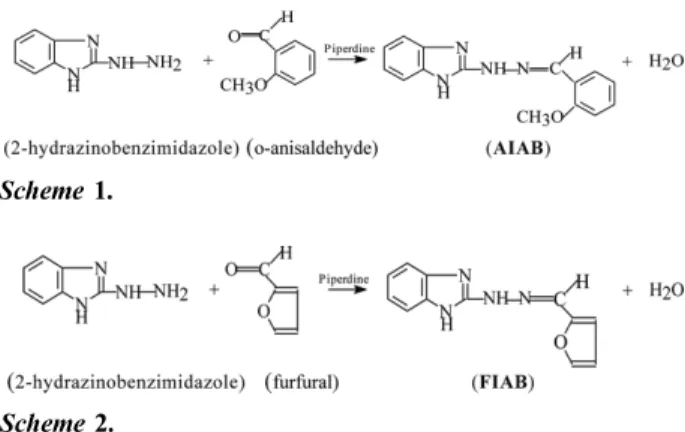
The ligands used in the present investigation were ben- zimidazolyl-2-hydrazones of aldehydes and ketones such as o-anisaldehyde and furfural have been synthesized by condensing 2-hydrazinobenzimidazole with respective aldehydes and ketone in the following manner.
Ethanolic solution of 2-hydrazinobenzimidazole (0.01 mol in 20 mL) was added to ethanolic solution of o-anis- aldehyde/furfural (0.01 mole in 20 mL), followed by addition of 2 to 3 drops of piperidine as condensing agent, to the above mixture. The resulting solution was refluxed on a water bath for 3 hours. It was concentrated and allowed to stand overnight when coloured precipi- tate was separated out in each case. It was filtered, washed and recrystallised from ethanol. The sample was dried in vacuo over fused calcium chloride and then analysed.
Preparation of the complexes
A hot ethanolic solution of the ligand AIAB/FIAB (0.02 mole in 20 mL) was treated with ethanolic solution of respective hydrated metal (II) chloride (0.01 mole in 20 mL) and the reaction mixture was refluxed on a water bath with constant stirring for about 2-3 hours. The resulting liquid was filtered and allowed to cool when coloured crystals of the corresponding metal complexes separated out in each case. The complexes were filtered, washed with ethanol followed by ether and finally dried in vacuo over fused CaCl2.
Analysis and Physical measurements: A weighed quantity of the compound (0.2-0.3 g) was treated with a few drops of concentrated H2SO4 and 1 cc. of concentrated HNO3. It was heated till all the organic matter decom- posed and sulphur trioxide fumes came out. The same pro- cess was repeated two to three times to decompose the substance completely. Then it was dissolved in water and the resulting solution was used for analysis of metal ions.
The metal contents in the complexes were determined gravimetrically following standard procedure.24 Sulphur was determined as BaSO4. The molar conductance mea- surements were carried out at room temperature with a
Toshniwal conductivity Bridge (model CL-01-06, cell constant 0.5 cm-1) using 1×10⁻³M solution of the com- plexes in DMSO. Carbon, hydrogen and nitrogen con- tents of the complexes were determined by using a MLW- CHN micro analyser. FTIR spectra in KBr pallets were recorded on a Varian FTIR spectrophotometer, Australia.
The electronic spectra of the complexes in DMSO were recorded on a Perkin-Elmer spectrophotometer. Thermo gravimetric analysis was done by Netzch-429 thermo ana- lyzer. The 1H-NMR spectra of the complexes were recorded in DMSO-d6 medium on JEOL, GSX-400 model equip- ment.
RESULTS AND DISCUSSION
The complexes were formulated from the analytical data and molar conductance data support the suggested formulae (Table 1). The complexes are highly coloured and insoluble in water and common organic solvents but soluble in highly coordinating solvents such as dioxane, DMF and DMSO. They are non hygroscopic, highly sta- ble under normal conditions and all of them decompose above 250oC. The molar conductance data values in DMSO for the complexes indicate them to be non-elec- trolyte in nature.
IR spectra
The IR spectra of the ligands AIAB and FIAB and their metal complexes have been studied in concert for the appraisal of the structure of the complexes. The formation of the above ligands via the condensation of each of o- anisaldehyde/furfural with 2-hydrazinobenzimidazole has been confirmed by the disappearance of band due to νNH2
and appearance of a new band at ~1600 cm-1 which undoubtedly originates due to newly introduced azome- Scheme 1.
Scheme 2.
Table 1. Analytical and physical data of the ligands and their complexes Sl no Compounds Colours Yields
(%) Λam C Found (Calcd)
H Found (Calcd)
N Found (Calcd)
Cl Found (Calcd)
M Found (Calcd)
1 AIAB Light yellow 80 - 40.78 (40.82) 5.23 (5.26) 44.41 (44.44) - -
2 FIAB Light brown 83 - 41.23 (41.26) 4.38 (4.42) 40.06 (40.11) - -
3 Co(AIAB)2Cl2 Silver grey 65 23.10 54.34 (54.38) 2.08 (2.11) 16.89 (16.92) 10.68 (10.72) 8.88 (8.91) 4 Ni(AIAB)2Cl2 Royal ivory 62 21.35 54.39 (54.41) 2.09 (2.11) 16.90 (16.93) 10.70 (10.73) 8.80 (8.84) 5 Cu(AIAB)2Cl2 Cannery yellow 63 21.90 53.98 (54.01) 2.07 (2.10) 16.76 (16.80) 10.61 (10.65) 9.48 (9.53) 6 Zn(AIAB)2Cl2 White 64 22.12 53.81 (53.86) 2.05 (2.09) 16.74 (16.76) 10.59 (10.62) 9.69 (9.73) 7 Co(FIAB)2Cl2 Brown 60 18.35 49.44 (49.48) 1.69 (1.72) 19.21 (19.24) 12.15 (12.19) 10.11 (10.13) 8 Ni(FIAB)2Cl2 Pale green 61 23.68 49.48 (49.51) 1.70 (1.72) 19.22 (19.25) 12.18 (12.20) 10.02 (10.06) 9 Cu(FIAB)2Cl2 Steel grey 63 21.65 49.08 (49.10) 1.68 (1.71) 19.05 (19.09) 12.06 (12.10) 10.79 (10.82) 10 Zn(FIAB)2Cl2 White 60 20.25 48.91 (48.95) 1.64 (1.70) 19.01 (19.04) 12.04 (12.07) 11.01 (11.05)
aOhm-1 cm2 mole-1
thine (C=N) group. The presence of furan ring in FIAB and -OCH3 group in AIAB are also indicated by the appearance of bands at ~1510 and ~2840 cm-1 in their respective spectrum assignable to νC-O-C of furan ring and -O-CH3 group of o-anisaldehyde respectively.25 The posi- tion of above bands remain practically unaltered in the IR spectra of complexes there by suggesting non participa- tion of furan ring oxygen and methoxy oxygen atom in coordination.
The characteristic IR bands observed in the spectra of the ligands at ~1560, ~1303 cm-1 are assigned to νC=N (cyclic) νC-N (cyclic) of benzimidazole group respectively. Anal- ogous to the previous complexes, the position of both the band remain unaltered suggesting there by nonparticipa- tion of ring N atom (-C=N) in complexation. However, νNH band of benzimidazole ring (-N-H) group was found invariably shifted 20-10 cm-1 towards negative side indi- cating the coordination of benzimidazole ring NH group to the metal ions. Where as band occurring at ~3100 cm-1 due to νN-H exocyclic remains practically unaltered indi- cating it’s non involvement either in coordination or eno- lisation. Besides the above, the bands occurring at ~1600 and ~1010 cm-1 assignable to azomethine (νC=N) group and (νN-N) respectively shifted their position on complex- asation. Like previous cases here also, νC=N band under goes red shift where as νCN band shows blue shift indi- cating coordination of azomethine nitrogen atom to metal ions. This is further confirmed by the presence of a band at
~525 cm-1 due to νNN. It is interesting to note that presence of electron releasing group like -OCH3 and -C-O-C- near the condensation site only enhance conjugation but do not take part in coordination most probably due to steric hin- drance.
Although evidence of νM-Cl band could not be brought in the present investigation due to instrumental limitation, the insolubility of the complexes in water and their non- electrolytic nature provide sufficient evidence for the
coordination of the counter ions Cl- to form neutral com- plexes.
Thermal analysis
Thermal characteristics of the complexes formed by AIAB and FIAB are recorded in Table 2. These com- plexes follow the same pattern of thermal decomposition.
An examination of thermograms of the complexes reveals that, the complexes remain almost stable up to ~235oC indicating absence of water molecules. Beyond this range, the complexes decompose rapidly leaving their stable res- idues. The rapid decomposition denotes loss of ligand moiety. It has been observed that the composition of the residue corresponds to the respective metal oxides. The decomposition temperature varies for different com- plexes. The representative thermogram of Cu(AIAB)2Cl2
complex is shown in Fig. 1. Thermal stability of the com- plexes is found to be in the following order:
AIAB Complexes: Co(II) < Zn(II) < Cu(II) < Ni(II) FIAB Complexes: Co(II) < Ni(II) < Cu(II) < Zn(II)
Electronic spectra and magnetic properties
The electronic spectral data and room temperature effective magnetic moment values of Co(II) complexes
Table 2. Important features of thermo gravimetric analysis (TGA) Sl.
no. Compounds Total wt. of
TG (mg)
Decomposition temperature (oC)
% weight of residue Found (calcd.)
Composition of the residue
1 Co(AIAB)2Cl2 19.2 237-560 11.29 (11.33) CoO
2 Ni(AIAB)2Cl2 21.2 258-555 11.23 (11.26) NiO
3 Cu(AIAB)2Cl2 17.5 247-540 11.91 (11.93) CuO
4 Zn(AIAB)2Cl2 15.8 240-550 12.08 (12.12) ZnO
5 Co(FIAB)2Cl2 22.3 236-570 12.84 (12.88) CoO
6 Ni(FIAB)2Cl2 21.7 240-570 12.78 (12.81) NiO
7 Cu(FIAB)2Cl2 20.1 252-575 13.52 (13.55) CuO
8 Zn(FIAB)2Cl2 16.4 260-585 13.75 (13.77) ZnO
Fig. 1. Thermogram of Cu(AIAB)2Cl2.
with the ligands AIAB and FIAB are recorded. The room temperature µeff value of these complexes lies in the range 4.40-4.63 B.M. i.e., lower than expected for high spin pesudo-octahedral Co(II) species.26 This lower µeff value may be due to distorted structure of Co(II) complexes under C2 symmetry. As in C2 symmetry the degeneracy of the ground state of the metal ion will be lifted and the new ground state being an orbital singlet state will give rise to much lower magnetic moment than expected.27 Thus one can infer that the present Co(II) complexes probably have an orbital singlet ground state with distorted octahedral environment, which is further evidenced by electronic spectral data.
The electronic spectra of these complexes show a broad band at ~9000 cm-1 (1111 nm) and a split band at ~19,200- 20,500cm-1 (520-487 nm). The former band is attributed to 4T1g(F)→4T2g(F) (ν1) and the later one is due to 4T1g(F)
→4T1g (P) (ν3) transitions respectively under Oh geome- try. The broad asymmetrical curve seen as ν1 suggests the presence of other bands which are superimposed by the ν1 band. It is possible to calculate the values of Dq and B using band position of ν1 and ν3, following same method as in previous cases. Value of ν2 has been calculated to be around ~19000 cm-1 (526 nm). Thus, the observed weak shoulder near ~19000 cm-1 may be tentatively assigned to ν2 transition. From this it is concluded that the band around ~16000-16,500 cm-1 is most likely due to spin for- bidden 4T1g(F)→2T2g (G) transition and not due to 4T1g (F)
→4A2g (F) (ν2) transition.
The spectral characteristics of Co(II) complexes with AIAB and FIAB ligands with Cl- as co ligand do not indi- cate pure octahedral or D4h symmetry, rather it suggests approximately C2 geometry having distorted six coordi- nate as supported by µeff values. This however requires splitting of ν1 and ν3 bands due to lowering of symmetry.28 The electronic spectra has bands in the region ~19,200- 20,500 cm-1 which may be considered as the split com- ponent of ν3 band and the shoulder near 19,000 cm-1 might also contain one of the split Component of ν3 band. Although no split Component of ν band is observed, yet the pres- ence of a broad envelope suggests superimposition of the different components into a single one.
The electronic spectral data and µeff value room tem- perature for Ni(II) complexes with ligands AIAB and FIAB with Cl- as co ligand have recorded. The observed µeff values for these complexes advocate for a tetragonal six-coordinated spin free Ni(II) species.29 The electronic spectra of the complexes show a number of bands in the range, ~8,600 cm-1 (1160 nm), ~10,400cm-1 (961nm),
~14,000 cm-1 (714 nm) and ~26,000 cm-1 (386 nm). These types of spectral features can be explained on the basis of energy level schemes derived by Ballhausen and coworkers30 for D4h symmetry. The first two bands cor- respond to the split components of 3T2g (F) namely; 3B1g
→3Eg and 3B1g→3B2g while the third and fourth are due to
3B1g→3A2g and 3B1g→3Eg the split components of 3T1g (F) term. The fifth one can be assigned to 3B1g (P)→3T1g (P) transition. In this case the ground state term A2g under Oh
symmetry has been transformed to 3B2g term under D4h
symmetry.31
The electronic spectral data and room temperature µeff
values of Cu(II) complexes with ligands AIAB and FIAB are recorded. The µeff value in theses cases lie in the range 1.82-1.88 B.M. as expected for hexa coordinated spin free Cu(II) complexes in distorted octahedral environment. In the electronic spectra of these complexes one broad enve- lope is seen at ~16,000 cm-1 (625 nm). Suggesting super- imposition of ν1, ν2 and ν3 transitions because of similar energy. Thus above band corresponds to 2Eg→2T2g tran- sition under a distorted octahedral environment. The width of the band provides evidence for distortion. The representative spectrum of the Ni(FIAB)2Cl2 complex is shown in Fig. 2.
1H-NMR spectra
In the 1H NMR spectrum of the ligand AIAB, the mul- tiplet is observed at δ 8.0-8.7 ppm correspond to 4 aro- matic protons of benzimidazolyl group and 4 aromatic protons -C6H4(OCH3) group. A signal observed at δ 7.0 ppm and δ 9.2 ppm correspond to ring NH proton of ben- zimidazolyl group and exocyclic -NH-N= proton respec- tively. Besides the above peaks, a sharp signal at δ 9.4 ppm and δ 4.7 ppm observed due to azomethine (-N=
CH-) protons and O-CH3 group respectively. In case of AIAB complexes, the NH (cyclic) proton of benzimi- dazolyl group show downfield shift indicating thereby
Fig. 2. Electronic spectra of Ni(FIAB)2Cl2.
the coordination of ring NH group to the metal ions, while the azomethine proton show upfield shift in the conformity with the coordination of azomethine group in complexes.
In the 1H NMR spectrum of the ligand FIAB, the mul- tiplet is observed at δ 8.0-8.7 ppm correspond to 4 aro- matic protons of benzimidazolyl group and 3 additional peaks at δ 5.4, δ 6.3 and δ 7.4 ppm corresponding to H-3, H-4 and H-5 of (-C4H3O) ring. A signal observed at δ 7.0 ppm and δ 9.0 ppm correspond to ring NH proton of ben- zimidazolyl group and exocyclic -NH-N= proton respec- tively. Besides the above peaks, a sharp signal at δ 9.4 ppm is observed due to azomethine (-N=CH-) protons. In case of FIAB complexes, the NH (cyclic) proton of ben- zimidazolyl group show downfield shift indicating thereby the coordination of ring NH group to the metal ions, while the azomethine proton show upfield shift in the confor- mity with the coordination of azomethine group in com- plexes. It is to be noted that the multiplet due to aromatic proton undergoes downfield shift to some extent probably due to the involvement of ring NH group to the complex- ation because of lowering electron density in the ring sys- tem.
Based on the foregoing observations the following ten-
tative structure (Fig. 3) has been proposed for the present complexes.
Antibacterial and antifungal activity
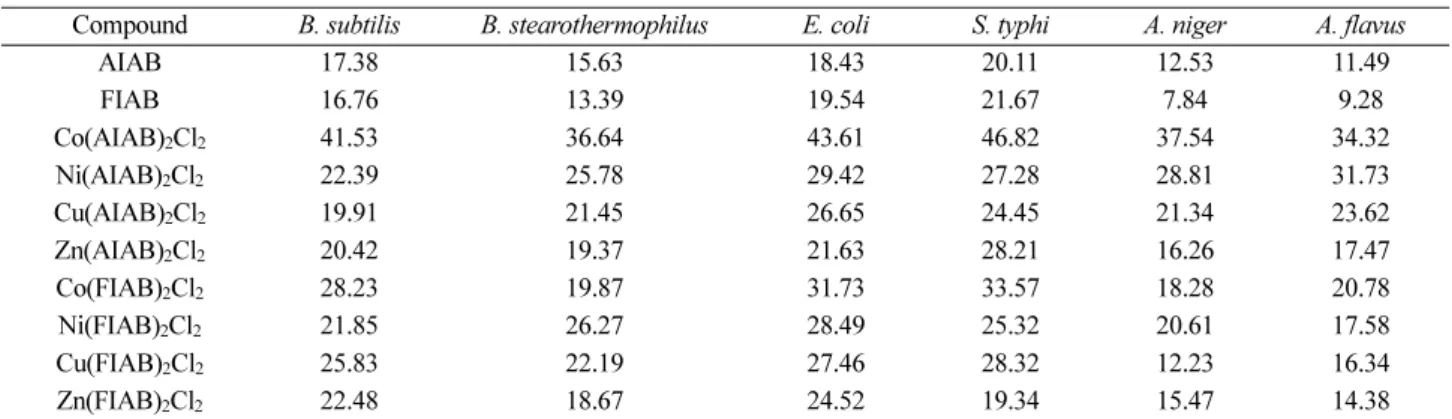
The Antibacterial activities of the synthesized com- plexes were evaluated by the Agar Well Diffusion Assay Technique against two Gram positive bacteria, i.e., Bacil- lus subtilis and Bacillus stearothermophilus and two Gram negative bacteria, i.e., Escherichia coli and Salmo- nella typhi. Solutions of the ligands and its complexes in DMF were plated onto the cultured agar medium and incubated for a period of 24h at 37oC. After the incuba- tion period, the plates were observed for zones of inhi- bition (in cm). The antifungal activities of the complexes were determined against two fungal strains, i.e., A. niger and A. flavus. The complexes showed good antibacte- rial and antifungal activities (Table 3) against the spe- cies. This may be explained on the basis that their structures mainly possess C=N bonds. Moreover, coor- dination reduces the polarity27,32 of the metal ion mainly because of the partial sharing of its positive charge within the chelate ring formed during coordination. This process increases the lipophilic nature of the central metal atom, which favors its permeation more effi- ciently through the lipid layer of the micro-organism33-35 thus destroying them more aggressively. In addition to this, many other factors, such as solubility, dipole moment and conductivity, which are influenced by the metal ion may be the possible reasons for the antibac- terial activities of these metal complexes.36
Fig. 3. M = Co(II), Ni(II), Cu(II) and Zn(II).
Table 3. Antibacterial and antifungal activities of the compounds (for a concentration of 100 µg mL-1)
Compound B. subtilis B. stearothermophilus E. coli S. typhi A. niger A. flavus
AIAB 17.38 15.63 18.43 20.11 12.53 11.49
FIAB 16.76 13.39 19.54 21.67 7.84 9.28
Co(AIAB)2Cl2 41.53 36.64 43.61 46.82 37.54 34.32
Ni(AIAB)2Cl2 22.39 25.78 29.42 27.28 28.81 31.73
Cu(AIAB)2Cl2 19.91 21.45 26.65 24.45 21.34 23.62
Zn(AIAB)2Cl2 20.42 19.37 21.63 28.21 16.26 17.47
Co(FIAB)2Cl2 28.23 19.87 31.73 33.57 18.28 20.78
Ni(FIAB)2Cl2 21.85 26.27 28.49 25.32 20.61 17.58
Cu(FIAB)2Cl2 25.83 22.19 27.46 28.32 12.23 16.34
Zn(FIAB)2Cl2 22.48 18.67 24.52 19.34 15.47 14.38
Acknowledgement. The authors gratefully acknowl- edge the services rendered by Director, Regional Sophis- ticated Instrumentation Center, I.I.T., Madras, for recording the spectra.
REFERENCES
1. Katsuki, T. Coord. Chem. Rev. 1995, 140, 189.
2. Di Bella, S. Chem. Soc. Rev. 2001, 30, 355.
3. Cogan, D. A.; Liu, G. C.; Kim, K. J.; Backes, B. J.; Ell- man, J. A. J. Am. Chem. Soc. 1998, 120, 8011.
4. Pandeya, S. N.; Sriram, D.; Nath, G.; De Clercq, E. Eur.
J. Pharma. Soc. 1999, 9, 25.
5. Raper, E. S. Coord. Chem. Rev. 1996, 153, 199.
6. Sridhar, S. K.; Pandeya, S. N.; Stables, J. P.; Ramesh, A.
Eur. J. Pharm. Sci. 2002, 16, 129.
7. Vicini, P.; Zani, F.; Cozzini, P.; Doytchinova, I. Eur. J.
Med. Chem. 2002, 37, 553.
8. Kocyigit-Kaymakcioglu, B.; Rollas, S. Farmaco 2002, 57, 595.
9. Ragavendran, J. V.; Sriram, D.; Patel, S. K.; Reddy, I. V.;
Bharathwajan, N.; Stables, J.; Yogeeswari, P. Eur. J. Med.
Chem. 2007, 42, 146.
10. Rollas, S.; Gulerman, N.; Erdeniz, H. Farmaco 2002, 57, 171.
11. Carcelli, M.; Mazza, P.; Pelizi, C.; Zani, F. J. Inorg. Bio- chem. 1995, 57, 43.
12. Johnson, D. K.; Murphy, T. B.; Rose, N. J.; Goodwin, W.
H.; Pickart, L. Inorg. Chim. Acta 1982, 67, 159.
13. Ranford, J. D.; Vittal, J. J.; Wang, Y. M. Inorg. Chem.
1998, 37, 1226.
14. Buss, J. L.; Greene, B. T.; Turner, J.; Torti, F. M.; Torti, S. V. Curr. Top. Med. Chem. 2004, 4, 1623.
15. Dash, D. C.; Mahapatra, A.; Pathjoshi, S. B.; Mishra, U.
K.; Naik, S. K. J. Indian Chem. Soc. 2006, 83, 782.
16. Dash, D. C.; Mahapatra, A.; Jena, P.; Naik, S. K.; Mishra, U. K. J. Indian Chem. Soc. 2007, 84, 1092.
17. Dash, D. C.; Mahapatra, A.; Mohapatra, R. K.; Ghosh, S.;
Naik, P. Indian J. Chem. 2008, 47A, 1009.
18. Dash, D. C.; Mohapatra, R. K.; Ghosh, S.; Naik, P. J.
Korean Chem. Soc. 2008, 52(5), 468.
19. Dash, D. C.; Mohapatra, R. K.; Ghosh, S.; Naik, P. J.
Indian Chem. Soc. 2009, 86, 121.
20. Mohapatra, R. K. J. Indian Chem. Soc. 2010, 87, 1251.
21. Mohapatra, R. K.; Dash, D. C. J. Korean Chem. Soc.
2010, 54(4), 395.
22. Dash, D. C.; Mahapatra, A.; Naik, P.; Mohapatra, R. K.;
Naik, S. K. J. Korean Chem. Soc. 2011, 55(3), 412.
23. Katz, L. J. Am. Chem. Soc. 1951, 73, 4007.
24. Vogel, A. I. A text book of Quantitative Inorganic Anal- ysis, 3rd ed.; Longman and ELBS: 1969.
25. Kalsi, P. S. Spectroscopy of Organic Compounds, New Age International limited; New Delhi, 1998; p 77.
26. Carlin, R. L. Transition Metal Chemistry; Marcel Dekker Inc.: New York, 1965.
27. Lever, A. B. P. Inorganic Electronic Spectroscopy; Elsevier Publication: New York, 1968.
28. Ali, M. A.; Livingstone, S. E. Coord. Chem. Rev. 1974, 13, 101.
29. Bustoup, O.; Jorgensen, C. K. Acta Chem. Scand. 1957, 11, 1223.
30. Sacconi, L. Trans. Metal Chem. 1968, 4, 199.
31. Ballhausen, C. J.; Liehr, A. D. J. Am. Chem. Soc. 1959, 81, 538.
32. Balhausen, C. J. An Introduction to Ligand Field; McGraw Hill: New York, 1962.
33. Chohan, Z. H.; Pervez, H.; Kausar, S.; Supuran, C. T.
Synth. React. Inorg. Met.-Org. Chem. 2002, 3, 529.
34. Chohan, Z. H.; Pervez, H.; Rauf, A.; Supuran, C. T. Metal- Based Drugs 2002, 8, 42.
35. Chohan, Z. H.; Scozzafava, A.; Supuran, C. T. J. Enzyme Inhib. Med. Chem. 2003, 18, 259.
36. Chohan, Z. H.; Hassan, M. U.; Khan, K. M.; Supuran, C.
T. J. Enzyme Inhib. Med. Chem. 2005, 20, 181.