
사료 및 보조사료로서의 생균제 급여에 따른 돈사 환경개선과 돼지 생산성에 미치는 영향
이은영*·임정수
수원대학교 환경에너지공학과
Received : August 22, 2011 / Revised : September 15, 2011 / Accepted : September 16, 2011
Effective Feeding Methods for the Reduction of Malodor and an Increase in Productivity in Livestock.
Lee, Eun-Young* and Joung Soo Lim. Department of Environmental Energy Engineering, Suwon University, Gyeonggi 445-743, Korea − Animals produce important commercial products such as meat, milk, and eggs.
Higher consumption and urbanization have increased the demand for more animal products to a stage where the demand is so strong that larger livestock are now being raised in more crowded conditions on small farms.
A greater production of excreta and the resulting malodor are an inevitable consequence of these more con- densed breeding patterns. Control of malodor has become a key environmental concern for the further devel- opment of the livestock industry. This research review illustrates that the major types of odor produced in livestock environments can be subdivided into four main categories; volatile fatty acids, ammonia and volatile amine, indole and phenols, and sulfur compounds. A number of studies concerning feed, co-feed and probiot- ics have been conducted in order to improve the environment and/or the productivity in the livestock industry.
The results suggest that, as more than half of excreted urea is nitrogen, low protein feed should be used. In addition, synthetic amino acid feed and supplements of digestive enzymes, microbial agents and/or probiotics, are all methods used for reducing nitrogen excretion.
Key words: Livestock, feeding, malodor, environment, productivity
서 론
최근 국내의 양돈 산업은 가족 단위로 운영되던 예전의 소 규모 작업 형태에서 농장주가 근로자를 고용하여 관리 운영 하는 대규모 형태의 작업장으로 전환되어가고 있는 추세이다.
1,000두 이상의 돼지를 사육하고 있는 중·대규모 양돈 농가 는 우리나라에 약 2,400여 개가 있고 농가당 사육 마릿수는 평균 2,600두 이상으로 매년 증가 추세에 있다[120]. 최근 구 제역이나 AI와 같은 가축 전염병으로 동물성 식품의 안전성 에 대한 소비자들의 관심이 높아지고 있으며, 참살이 바람으 로 인한 친환경 축산식품개발과 건강에 관심이 고조되고 있 다. 또한, 국민소득의 증가와 함께 식육에 대한 기호도가 변 화함에 따라서 “양”보다는 “질”적인 면을 추구하고 있다.
항생제, 설파제, 유산동[26, 33, 46, 61] 등은 1950년대부 터 가축사료 첨가제로 사용되어 오다 60년대에 이르러서 식 품내에 항생제 잔류문제가 제기되면서 그 사용에 제한을 받 기 시작하였다[81, 107, 108]. 이후 항생제 내성균의 출현으 로 인해 전 세계적으로 동물 사료용 항생제 사용에 대한 우
려가 고조되었다. 영국과 미국 등 선진국에는 이러한 문제 에 대처할 위원회를 설치하였으며, EU와 WHO는 1997년 이후 점차적으로 인체에 사용되고 있는 항생제를 항미생물 성장촉진제(AMGP) 및 호르몬제의 사용도 엄격히 금지하 고 있다[105]. 현재 국내에서는 penicillin, ampicillin 및 tetracycline 등의 항생제 남용으로 인하여 항생제에 대한 내 성균의 출현율이 20-90% 이상으로 높아짐에 따라[93] 2011 년 7월 이후 가축에 대한 항생제의 AMGP로의 사용은 전면 금지되었다. 따라서, 항생제를 대체할 새로운 제품이나 사료 첨가용 생균제의 개발이 요구된다. 이러한 시점에서 항생제 대체재로 효소제, 생균제 및 식물성 생리 활성물질에 대한 관 심이 증대되고 있다. 무항생제의 안전한 고품질의 육류를 생 산하고자 돼지에게 생봉독을 처리하거나[8], CLA(conjugated linoleic acid)[70, 71], 비타민 E[9, 37], 한약 부산물[118], 키토산[55, 69], 광물질(제오라이트, 게르마늄, 흑운모 등)[63, 64, 66] 및 Streptococcus faecium[56]을 사료에 첨가하여 육 류의 품질을 개선하고자 하는 연구개발이 보고되었다. 이 중 에서 항산화제는 첨가수준과 가축에게 급여하는 기간 등에 따라 육색과 막 조직에 함유된 다가 불포화지방산의 산화를 방지하여 식육의 저장기간 연장 및 고기의 안정성에 기여하 는 것으로 알려졌다[5].
*Corresponding author
Tel: +82-31-220-2614, Fax: +82-31-220-2533 E-mail: [email protected]
사료의 구성 및 주요 악취 발생원
사료의 사전적 의미는 가축의 생명을 유지하고 젖·고기·
알·털가죽 등을 생산하는 데 필요한 유기 또는 무기영양소 를 공급하는 물질이라 정의할 수 있으며, 사료의 주요성분 으로는 탄수화물, 전분, CP(조단백질), EE(조지방), CA(조회 분), NDF(중성 세제 섬유), ADF(산성 세제 섬유), NFC(비 섬유소탄수화물), 및 NFE(가용무질소물) 등을 포함하고 있다.
악취는 분뇨가 다양한 습기와 온도조건에서 혐기적으로 분해되는 과정에서 대기권으로 노출될 때 휘발성 물질 및 그 중간생성물이 대기로 방출되는 화합물이다. 이러한 미립자 물질(먼지)은 건물 표면 및 의류에 흡수될 수 있으며 대부분 방향족 화합물로 나타난다. 이전의 연구에서 폐쇄식 돈사의
공기에서 168개 이상의 화학적 화합물이 확인되었으며[88], 이 화합물은 불쾌한 악취로 인해 작업자의 심리 및 건강뿐 만 아니라 가축의 심리, 건강 및 생산 효율성에 영향을 미친 다고 보고되었다[110]. 그 중 주요 악취 화합물은 암모니아, 황화합물, 휘발성 지방산, 인돌, 스카톨, 페놀, 알콜 및 카보 닐로 조사되었다[12]. Fig. 1에 주요 악취 화합물의 생물학 적 생산 및 이용 및 악취 농도의 생산량 및 이용률의 상대 적 의존도를 나타내었다(Fig. 1).
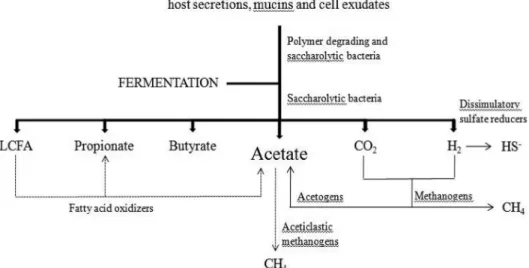
특히, 사료 내의 유기물은 주로 탄수화물로서 대부분이 acetic acids(C2), propionic acids(C3), butyric acids(C4), valeric acids(C5), hexanoic acids(C6; caproic) 및 heptanoic acids(C7; caprics)로 발효된다. 장에서의 탄수화물 발효 및 VFA 형성을 간단히 도식화하여 나타내었다(Fig. 2). 미생물
Fig. 1. (a) Production and utilization of odor compounds under anaerobic conditions and (b) Odor concentration is dependent on the relative rates of production and utilization [76].
Fig. 2. Simplified scheme showing carbohydrate fermentation and VFA formation in the intestinal tract. *Processes involved in the complete anaerobic degradation of organic matter in stored wastes are marked with broken arrows (···>) [39].
생체량, 발효 가스(CO2, CH4) 및 약간의 열은 혐기성 소화 도중 생성된다. 또한, 휘발성 지방산은 혈액에 흡수되어 장 기와 조직에 운반되고, 에너지의 원천으로서 계속해서 대사 작용을 하고, CO2와 CH4는 호흡과 트림으로 혹위에서 제거 된다. CH4의 손실은 크게 발효에 의해 결정되며, 사료에서 에너지의 5-10%는 이러한 방식으로 손실되고[4], 또한, CH4
은 무취이지만 온실 효과에 크게 영향을 나타낸다고 보고되 었다[101].
장관 및 분뇨는 중성(pH 6-7)인 환경이 일반적인데 아미
노산의 탈아미노반응(demination)이 진행되면, 탈아미노반응 은 NH3뿐만 아니라 VFA, CO2, 및 H2를 생산한다(Fig. 3).
Fig. 4에서는 분뇨의 주요악취물질인 인돌 및 페놀이 아미 노산 물질대사로부터 생산되는 과정을 설명하고 있다.
Phenol, p-cresol, 4-ethyl phenol 및 수산기를 가진 페놀 대 용 지방산은 tyrosine 발효의 주요 생성물이다. 또한, Indole 및 3-methyl indole(skatole)은 tryptophan 물질대사의 주요 한 최종 생산물인 반면, phenyl acetate 및 phenyl pro- pionate는 phenylalanine에서 생성된다고 보고되었다[75].
오줌의 90% 이상이 p-cresol로 이루어져 있고, 나머지는 소량의 4-ethyl phenol로 구성되어 있다. 특히, tryptophan 대사산물인 Indole 및 3-methyl indole은 지용성으로 대장으 로부터 빠르게 흡수된다. 이렇게 체내에 흡수된 동물성 지 방조직에서 skatole의 축적은, boar taint(웅취)에서 중요한 인 자로서 관련된다. 또한, 항생제와 같은 식이 성분 및 섬유질 식품은 장 미소생물학을 통하여 간접적으로 skatole 생산에 영향을 미친다.
섭취된 사료가 악취문제의 중요 원인 중 하나인 축산업에 서는 발생되는 악취 화합물질을 크게 휘발성지방산, 암모니 아와 휘발성 아민, 인돌그룹 및 페놀과 황화합물의 4그룹으 로 구분할 수 있다. 가축으로부터 질소의 50% 이상이 요소 로 배설되기 때문에, 분뇨에 포함된 질소원을 감소시키기 위 해서는 요소가 암모니아로 전환될 때, urease 효소를 억제해 야 한다고 보고되었다[76].
분뇨는 또한 도시와 시골 주민 사이에 민원을 유발하는 악취의 근원이며[73], 이러한 발생 오염 물질 및 질소의 배 설량을 감소시키기 위해서는 저단백질 사료를 급여하거나, 단백질 소화율을 개선할 수 있는 소화효소제나 미생물제제, 효모제, 및 생균제를 이용하여 배설량 및 질소의 배출량을 감소시킨다는 연구 등이 있었으며[80, 90], Sutton 등(1999) [109]과 Shriver 등(2003)[103]은 사료 내 단백질 수준을 낮 추고, 합성아미노산을 급여함으로써 질소 배설량을 감소시 Fig. 3. Overview of dietary and endogenous proteins, and pep-
tides and amino acid fermentation in the intestinal tract [75].
Fig. 4. Metabolic pathways involved in the formation of phenolic and indolic compounds by intestinal anaerobic bacteria [75].
켰다고 보고하였다. 이처럼 급이 사료에 대한 많은 연구가 이루어지고 있으며, 또한, 보조 사료로서의 생균제 급여는 축산업에 있을 뿐만 아니라 환경개선 및 생산성 향상에 많 은 영향을 미칠 것이다.
생균제 및 첨가제의 작용 및 종류별 특징 생균제 및 첨가제의 작용
생균제는 항생제적 물질을 배제하고 살아 있는 미생물 또 는 비항생제적 물질[22]로서 가축에게 급여 시 장내 유해 미 생물을 감소시키고, 성장을 촉진하며, 소화기관 미생물의 환 경을 개선함으로써 사료의 가치를 증진 시킬 수 있다고 하 였다[43]. 일반적으로 생균제의 작용은 가축 장내 유용미생 물의 성장, 사료의 소화 흡수율 향상, 축분 발효 촉진 연구 등이 보고되었으며[80, 90] 유해가스 발생감소 등으로 냄새 와 해충을 줄여 줌으로써 가축의 사육환경을 개선할 수 있 다고 알려져 있다[47]. 이러한 생균제의 기본 조건으로 산을 생성하는 동시에 산에 잘 견디고, lysozyme 같은 효소에 강 해야 하며, 소장에 쉽게 정착할 수 있어야 하고, 동결이나 동결건조에 대해서도 잘 견디며 가축에 대해 무해 무독해야 한다고 하였다[23]. 생균제는 해로운 균의 증식을 억제하거 나 유해균 억제물질생산[111], 세균이나 그 대사산물이 NH3, H2S, amines, indole 및 phenols 등의 독성물질 생성억제 [35], 비타민의 생성 촉진과 소화흡수 촉진[67] 등의 작용을 한다. 또한, 유산균의 유기산 분비에 의한 장내 pH 저하 및 병원균의 감소[112], 소화기관의 상피세포에서 병원체와 경 쟁적 작용에 의한 병원균 부착 및 서식 방지[3], 유산균 세 포벽에 존재하는 peptidoglycan의 작용에 의해 면역계 세포 자극에 의한 항병성 증진 효과를 가진다는 보고가 있다. 이 밖에도 돈 분뇨의 주요 악취 발생 물질인 NH3제거를 위한 방법으로는 미생물제의 첨가가 가장 효과적인 것으로 알려 져 있는데, 미생물 첨가제 종류에 따라 약 64%까지 제거할 수 있었다고 보고되었다[41, 47]. 이처럼 생균제는 악취 제 거뿐만 아니라 먹이를 통해 흡수하게 되면 가축의 소화율을 높여, 일거약득의 효과를 얻을 수 있다. 최근 사료첨가용이 나 치료약제로 이용되고 있는 동물용 항생제의 무절제한 사 용으로 축산물의 안전성에 큰 문제를 일으키고 있어, 효소 제, 생균제, 식물성 생리 활성물질 등이 많은 관심을 받고 연구되고 있다.
생균제 및 첨가제의 종류별 특징
생균제의 종류로는 Lactobacillus spp[11, 24, 32, 36, 62, 78, 92, 112], Streptococcus spp, Bacillus spp, Clostridium spp, Bifidobacterium spp[62, 89], Enterococcus[89, 91, 112], Saccharomyces cerevisiae, Lactobacillus acidophilus, Aspergillus oryzae 등의 균주가 주로 이용되고 있다[1, 7, 21].
특히 Lactobacillus는 숙주에 대한 부착능을 가지며, 병원성 세
균의 장내 부착을 방해하거나 억제하며, bacteriocin 등의 항균 단백질을 생성하여 물리적, 화학적으로 병원균의 성장을 저지 시킨다[2]. 뿐만 아니라 유산균은 장내 미생물에 영향을 미치 는 여러 종류의 대사산물을 생산하며, 장 내용물의 pH 저하와 Coliforms, Salmonella 및 Clostridia 균 등 유해 미생물의 독 소 작용을 억제하는 역할을 한다[115]. 또한 장내에 잔류 시 장내균총을 정상화 시켜 증체율, 생산성 및 사료 이용율을 증 진해 주며[32], 반추동물에 있어서 probiotic 유산균 균주는 반 추위에 발효 정상화와 성축의 설사를 예방하기 위하여 사용되 고 있다[114]. 유산균은 탄수화물을 다량 소비하여 유산이 많 이 생성되게 하는 균으로 식품이나 사료에서 부패를 막고 맛 을 개선하며 사람과 가축의 장내에서 영양분의 흡수 촉진, 변 비 개선, 항암 작용, 면역 기능 강화시켜주기 때문에 식품 제 조의 스타터나 생균제로 널리 이용된다[100, 104].
효모는 산소와 강한 친화력을 가지는 특성 때문에 장내 용존산소를 흡수함으로써 유익균이 증식되는 것을 돕는다.
특히 효모 배양물은 가축의 장내에서 유익균의 증식을 촉진 함으로 유해균의 증식을 억제하여 질병예방작용(prophylatic mechanism)을 하는 것으로 알려져 있다[96, 99]. 유산균, 바 실러스, 효모균, 백년초 등은 천연성분으로서 장기 투여 시 독성이나 내성 등의 문제점이 전혀 없다는 장점이 있어 유 기농 축산에 기여하는 바가 크다고 하겠다. 유산균 이외에 도 다양한 천연활성물질과 마늘, illite, zeolite, bentonite 등 의 규산염 광물질, 활성탄, 백년초, 목초액(죽초액) 및 Hub 가 다양한 기능을 가진 것으로 알려져 있다.
마늘(Allium sativum L.)은 대표적인 백합목 백합과 Allium 속에 속하는 다년초로, 대개 지중해와 중앙아시아 연 안 지방이 원산지로 알려졌으며, 요즘에는 세계 각지에서 재 배되고 있다. 마늘은 특유의 향미를 가지고 있어서 식품의 맛을 증진하는 향신료로서 널리 사용됐으며, 식중독균과 같 은 병원성 세균의 증식을 억제하는 항균작용[54, 98], 항암 작용[20], 항산화작용[6, 50], 항당뇨작용[40], 항돌연변이원 성[48], 혈청콜레스테롤 저하능[106] 및 심장질환 예방[84]
등 여러 가지 생리적 활성이 과학적으로 입증되어 향신료뿐 만 아니라 건강보조식품, 의약품으로도 널리 사용되고 있 다. 마늘을 이용할 때 발생하는 마늘 순, 쭉정이와 같은 마 늘 부산물은 항산화 작용을 하는 폴리페놀을 함유하고 있고, pectin과 같은 섬유소 함량이 높아서 장내 미생물의 성장개 선 효과가 있으며, 혈중 콜레스테롤 함량과 간 지방량을 감 소시키는 등의 기능이 있어, 가축 사육 시 투여되는 다량의 항생제에 대한 대체 효과가 있는 것으로 보고되고 있다[49].
또한, 세균, 진균류 및 바이러스 등에 비교적 넓은 항균활성 을 나타내며, 유산균보다는 병원성 세균의 증식 억제율[10]
이 있다고 보고된 바 있다. 마늘의 세균에 대한 항균력에도 불구하고 마늘 추출물이 첨가된 배지에서 생육 가능한 유산 균들은 마늘이 첨가된 사료에 생균제로 함께 첨가해도 사멸 하지 않고 생존할 수 있을 것으로 생각되며, 마늘 추출물의
유효성분이 일부 유산균의 생장을 촉진한다는 연구 결과도 보고되고 있다[38].
목초액은 목재를 이용하여 숯을 제조할 때 생성되는 연기 를 최적 포집 온도인 80-150oC에서 포집한 액체로서 생물체 내의 미생물이 살기에 적합한 생활환경을 조성하고 세포의 기능을 활성화하여 소화·흡수를 촉진함으로서 정장효과를 가져온다고 알려졌다.
또한 돼지는 무기태 광물질을 필요로 하는데, 이들 광물 질들 중 셀레늄은 지방 과산화물의 독성을 제거하고, 과산 화물에 의한 세포의 손상을 막는 glutathione peroxidase의 구성 성분의 생리활성에 중요한 무기물이며[30], 번식능력 및 포유자돈, 이유자돈의 스트레스 예방에 영향을 미친다고 보고되었다[72, 77].
Hub와 Ravenda가 함유된 식물성 천연향료는 돈사 내 악 취 은폐제로서의 역할 뿐 아니라, 황 계열 악취 원인 물질을 생성하는 분뇨 내 토착 미생물들의 활성 억제제로서의 역할 도 하는 것으로 보고되었다[113].
생균제의 가축 증체량 , 사료섭취량 및 사료요구율에 미치는 영향
일반적으로 미생물제제를 사료에 첨가 급여할 경우, 영양 소 소화율이 향상되는 것은 미생물제제가 장관 내의 pH를 낮 추어 유해균의 생성을 억제하고 유익균의 안정적인 정착을 도 와 사료의 기호성을 증진할 뿐만 아니라 장관 내의 유용한 효 소가 생성되는 영양소 소화율을 개선하는 것으로 알려졌다 [112]. Noh 등(1995)[87]과 Jeon 등(1996)[42]은 생균제 급여 시 육성비육돈의 사료섭취량에는 차이가 없었으나 증체량과 사료요구율에는 유의적인 개선 효과가 있었다고 하였다. Kim 등(2001(a))[52]이 발효사료 1.0%를 첨가한 경우 비육돈의 일당증체량과 사료요구율을 개선한다고 하였다. 한편 Yang 등(1998)[117]은 시판 중인 몇 가지 생균첨가제를 육성비육 돈에 급여하였을 경우, 증체량이 향상되고, 시판 생균제, 효 소제, 효모 및 항생제를 이용하여 이유자돈에서 비육시까지 급여한 결과 증체량과 사료효율이 뚜렷이 개선되었는데, 특 히 생균제의 급여효과가 가장 우수하였다고 보고하였다. Kim 등(2001(b))[53]은 육성·비육돈(YL×D)에 Lactobacillus casei, Saccharomyces lactics, Streptomyces albus 및 Rhodo- pseudomonas palustris 등의 복합 생균제를 사료에 0.5~
1.0% 첨가하여 급여 시 일당 증체량과 사료요구율이 향상 되었으며, 이는 생균제 내의 Lactobacillus faecium 균주에 의한 lysine 분비작용으로 육성돈의 발육을 개선한 결과로 판단된다고 하였다[86]. 또한, 시판 생균제, 효소제, 효모제 및 항생제를 이유자돈·비육시까지 급여한 결과 증체량과 사료효율이 뚜렷이 개선되었고, 특히 생균제의 급여효과가 가장 우수하다고 보고하여 성장촉진제로서의 효능을 입증 한 바 있다[119]. Kim과 Kim(2007)[59]은 복합 생균제에
Saccharomyces cerevisiae, Lactobacillus casei, Candida utilis, Mucor hiemalis, Streptomyces albus, Rhodopseudomonas palustris 및 Rhodopseudomonas sphaeroides 등의 균주가 혼 합되어 있어 lipase, protease, amylase 및 cellulase 등의 효 소가 다량 생산되어 난분해성 섬유소의 분해, 비타민 B군의 공급 및 UGF(Unknown Growth Factor)의 공급원으로서 증 체량의 향상 및 사료요구율이 개선된다고 하였다. 이러한 생 균제의 첨가는 미생물 균총이 장내에서 안정적으로 정착되 어 장관 내 유용균의 발육증식과 영양소의 흡수에 최적의 조 건이 조성되었기 때문이라 하였다. 육성·비육돈 사료에 illite 를 1.5% 첨가함으로써 증체량, 사료섭취량 및 사료요구율이 개선되어 가축의 생산성 향상을 위한 효과가 있었다고 보고 하였다[27]. 또한 시판되고 있는 사료 첨가용 생균제(Biopro, Ataphon-0, YC-2000및 Photo-plus)를 육성·비육돈에 급여 할 경우 증체량이 향상되었으며[117], 시판 생균제, 효소제, 효모 및 항생제를 이유자돈부터 비육 시까지 급여한 결과 증 체량과 사료효율성이 뚜렷이 개선되었고, 특히, 생균제의 급 여 효과가 가장 우수하다고 보고하여 생균제제의 성장촉진 제로서의 가능성이 입증된 바 있다. 백년초를 함유한 복합 생균제를 비육돈에 급여시 체중 증가 및 사료효율 향상뿐만 아니라 NH3및 H2S 가스의 발생을 감소시킴으로써 사육환 경 개선효과가 있었다고 하였다[97]. Illite는 zeolite, bentonite 등과 같이 대표적인 규산염 광물질로서 주로 탈취제, 이온 교환제 및 토양개량제로 사용되고 있다. 이러한 규산염광물 질을 육성·비육돈에 1.5% 첨가 급여할 경우 유해가스가 감소되고 연변방지효과가 있으며, 일당 증체량, 사료요구율 및 A등급 출현율이 향상된다고 보고되었다[27]. 이와 같은 효과는 소화율이 향상되고 정장작용에 의해 건강상태가 개 선됨으로서 질병 발생율과 폐사율이 감소되기 때문이다[31, 83].
반면에 Hale와 Newton(1979)[29]은 Lactobacillus spp.
균주 발효 생성물을 돼지에게 급여하였을 때, 파리의 발생 율은 감소하지만 질소축적률과 소화율 및 증체량의 개선효 과는 없었다는 보고를 하였는데, Kim 등(1997)[50]도 시판 되는 효소, 효모 및 생균제를 육성·비육돈에 급여한 결과 증체량과 사료요구율의 개선효과는 없었다는 상반된 보고를 하였는데 이는 첨가되는 균주의 종류와 첨가방법의 차이에 따른 결과로 판단되어진다[44].
생균제의 도체중 , 도체율 , 등지방두께 및 도체등급에 미치는 영향
생균제 급여가 가축의 생체무게에 대한 도체 무게의 비율 인 도체율의 개선효과에 미치는 영향을 알아보았다. 비육돈 의 사료에 생균제[51], 항생제, 복합설파제, 유산동 및 효소 제가 함유된 생균제[80]를 첨가할 경우 도체율의 개선효과 가 없다는 보고가 있었다. 그러나 Yang 등(1998)[117]은 시
판되는 사료 첨가용 생균제(Biopro, Ataphon-0, YC-2000및 Photo-plus)를 육성·비육돈에 급여할 때 대조구에 비하여 도체중량과 도체율은 향상되고 등지방 두께는 두꺼워졌다고 보고하였다. 반면에 Newman 등(1980)[85]은 효소제인 bacteria distase를 0.2% 첨가함으로서 도체율에는 효과가 없 었으나 등지방 두께에서는 개선효과를 보았다고 하였다. 이 처럼 생균제 급여 효과가 일치하지 않는 것은 주로 미생물 의 부정확한 배양 방법[25]과 첨가되는 균주의 종류와 첨가 방법[44] 및 환경에 의한 스트레스요인[119] 등이 크게 작용 한 것으로 생각되며, 복합생균제의 첨가에 대한 보다 구체 적인 연구가 지속적으로 수행되어야 할 것으로 판단된다.
육성·비육돈에 대한 활성탄과 목초액을 첨가하여 시험 한 보고는 미진한 상태이다. 도체특성을 결정하는 주요 요 인의 50% 이상은 유전력에 의존하며, 유전요인에 따라 glycongen 함량이 다르고 도축 전 스트레스 반응에 따라서 도 육질이 달라질 수 있다[102].
생균제의 식육 지방산 조성에 미치는 영향 지방산의 조성은 식육의 품질을 크게 좌우하는데 그 이유 는 지방산의 조성에 따라 지방의 경도나 응집성에 차이가 나 고, 불포화 지방산과 포화지방산의 비율에 따라 저장성에 영 향을 받기 때문이다[116]. 일반적으로 포화지방산 함량이 높 은 식육은 지방의 산화 안전성 및 육색 안전성이 좋은 것으 로 보고되고 있다[17]. 그러나 인체 건강과 관련하여 동맥경 화증, 고혈압 등과 같은 심혈관계 질환을 예방하기 위해서 는 건강에 유익한 필수지방산과 불포화지방산 비율이 높고, 포화지방산 비율이 낮아야 한다고 보고된 바 있다[13, 14, 18]. 일반적으로 단위동물의 경우, 근육 내 지방 함량 및 지 방산 조성은 급여되는 사료를 통해 변화될 수 있다고 보고 된 바 있다[68, 79].
죽초액을 급여한 연구에서 콜레스테롤 전구물질이며 포화 지방산에서 가장 높은 비율을 차지하는 palmitic acid는 대 조구에 비해 감소하는 경향이었고, 풍미와 향에 영향을 주 며 불포화 지방산에서 가장 높은 비율을 차지하는 oleid acid 는 대조구에 비해 유의적으로 증가함을 보고하였다. 또한, 돼지고기의 저장 중 전단가의 변화에서 2~4% 첨가한 급여 구에서 대조구에 비해 낮은 전단가를 보였으며 연도개선 효 과를 나타내었다[65]. 또한, 근육 단백태질소 화합물의 증가 에 의해 전단력이 감소하는 것으로 보고되었다[19].
일반성분 및 콜레스테롤 함량
생균제가 돈육의 일반성분 및 콜레스테롤 함량에 미치는 영향을 알아보는 많은 연구가 있었다. 생균제를 급여한 돈 육의 일반성분 분석에 대한 선행연구에서도 유의적인 차이 가 없었으며[45, 57, 58], 셀레늄 급여를 통한 일반성분 변
화에 대한 연구에서도 일반성분의 유의적인 변화가 없었다 고 보고하였다[94, 95]. 한편, Hah 등(2005)[28]은 생균제 급 여 시 돈육의 수분함량이 높고, 콜레스테롤 함량이 유의적 으로 낮았다고 보고하였다. 반면, Kim 등(2008)[60]은 복합 생균제 급여 시 돈육의 수분은 낮았다는 상반된 보고를 하였 다. 활성탄을 급여한 Moon 등(2002)[82]의 실험에선 돼지에 서 불포화지방산 함량이 증가함을 보고 하였다. 돈육의 지 방함량 조성 중 포화지방산에는 palmitic acid, 불포화지방산 에는 oleic acid 함량이 가장 높으며[34] 식육 내 oleic acid 함량이 높으면 식육의 맛을 좋게 하고[74] 관능평가에서 높 은 점수를 얻는다고[16] 보고된 바 있다.
요 약
동물은 고기, 우유, 및 달걀과 같은 중요한 산물을 생산한 다. 현대사회의 도시화과정 및 고도 성장은 보다 많은 동물 성 산물을 요구하고 작은 농장에서 밀집화된 사육이 이루어 지게 되는 원인이 되었다. 결과적으로 가축 분뇨생산량이 증 가되었으며, 그에 따른 악취문제도 필연적인 결과로 나타났 다. 분뇨로 인한 악취문제를 해결하지 못할 경우 축산업의 지속적인 발전과 환경개선을 이루는 큰 장애가 될 것이다.
축산환경으로 생산되는 악취는 휘발성지방산, 암모니아와 휘 발성아민, 인돌과 페놀, 그리고 황화합물 네 종류로 분류된 다. 질소성분의 절반 이상은 뇨로 배설되기 때문에 동물을 사육하는 과정에서 저단백 사료와 합성아미노산을 급여시키 고, 소화효소나 미생물제제 혹은 생균제를 사료에 첨가해줄 경우 질소원의 배출량을 감소시켜줄 수 있는 중요한 방법이 될 것이다. 따라서, 축산환경의 개선과 축산분야의 생산성을 향상시켜기 위하여 사료 및 보조사료를 급여하는 다양한 시 도가 진행되고 있다.
Acknowledgement
This work was supported by a grant (20110401-302- 552-001-05-00) from the Agenda program of Rural Devel- opment Administration (rda), for which the authors are grateful.
REFENENCES
1. Abdulrahim, S. M., S. Y. Haddadin, E. A. Hashlamoun, and R. K. Robinxon. 1996. The influence of Lactobacillus acidophilus and bacitracina on layer performance of chickens and cholesterol content of plasma and egg yolk.
British Poultry Science, Edinburgh. 37: 341-346.
2. Barefoot, S. F. and T. B. Klaenhammer. 1983. Detection and activity of lactacin B, a bacteriocin produced by Lacto- bacillus acidophilus. Appl. Environ, Microbiol. 45(6): 1808-
1815.
3. Berg, R. D. 1980. Mechanisms confining indigenous bacteria to the gastrointestinal tract. Am. J. Clin. Nutr. 33: 2472- 2484.
4. Bryant, M. P. 1979. Microbial methane production-theore- tical aspects. J. Anim. Sci. 48: 193-201.
5. Buckley, D. J., P. A. Morrissey, and J. I. Gray. 1995. In- fluence of dietary vitamin E on the oxidative stability and quality of pig meat. J. Anim. Sci. 71: 3122-3130.
6. Carmia, B. 2001. Recent advances on the nutritional effects associated with the use of garlic as a supplement. Anti- oxidant health effects of aged garlic extract. J. Nutr. 131:
1010S-115S.
7. Chiang, S. H. and W. M. Hsieh. 1995. Effect of direct-fed microorganisms on broiler growth performance and litter ammonia level. Asian-Austral. J. Anim. Sci. 8: 159-162.
8. Cho, S. K., K. S. Kim, and S. C. Lee. 2005. Effects of Honeybee (Apis mellifera ligustica) Venom Treatment on the Productivity in Pigs. Kor. J. Anim. Sci. Technol. 47(2):
293-304.
9. Chu, G. M. and B. H. Ahn, 2004. Effects of Dietary Vitamin C and E on Carcass Grade and Fatty Acid Composition of Hanwoo Steers. Kor. J. Anim. Sci. Technol.
46(3): 387-396.
10. Chung, K. S., S.Y. Kang, and J. Y. Kim. 2003. The anti- bacterial activity of garlic juice against pathogenic bacteria and lactic acid bacteria. Kor. J. Microbiol. Biotechnol. 31:
32-35.
11. Conway, P. L., S. L. Gorbach, and B. R. Goldin. 1987.
Survival of lactic acid bacteria in the human stomach and adhesion to intestinal cells. J. Dairy Sci. 70: 1-12.
12. Curtis, S. E. 1993. Environmental Management in Animal Agriculture. Iowa State University Press, Ames.
13. Decker, E, A. and N. C. Shantha. 1994. Concentrations of the anticarcinogen, conjugated linoleic acid in beef. Meat Focus Int. 3: 61-69.
14. Department of Health. 1994. Nutritional aspects of cardio- vascular disease. Report on health and social subjects No.
46. London: Her Majesty’s Stationery Office.
15. Dixon, B. 2000. Antibiotics as growth promoters: Risks and alternatives. ASM News. 66: 264-265.
16. Dryden, F. D. and J. A. Marchello. 1970. Influence of three bovine muscle. J. Anim. Sci. 31: 36-41.
17. Du, M., D. U. Ahn, and J. L. Sell. 2000. Effect of dietary conjugated linoleic acid (CLA) and linoleic/linolenic acid ration on polyunsaturated fatty acid status in laying hens.
Poultry Sci. 79: 1749-1756.
18. Engler, N. M., J. W. Karanian, and J. M. Salem. 1991.
Influence of dietary polyunsaturated fatty acids on aortic and plate fatty acid composition in the rat. Nutr. Res. 11:
753-762.
19. Field, R. A. and Y. O. Chang. 1969. Free amino acids in bovine muscle and their relationship to tenderness. J. Food Sci. 34: 329-335.
20. Fleischauer, A. T. and L. Arab. 1996. Garlic and cancer: a
critical review of the epidemiologic literature. J. Nutr. 131:
1032S-1040S.
21. Fuller, R. 1977. The impotance of lactobacilli in maintaing normal microbial balance in crop. Br. Poult. Sci. 18: 85-94.
22. Fuller, R. and C. B. Cole. 1989. The scientific basis of the pro-biotics concept. In: Probiotics-theory and applications.
Stark, B. A. and Wilkinson, J. M. (eds). pp.1-14.
23. Gilliland, S. E. 1979. Beneficial interrelationships between certain microorganism and humanism: Candidate microorga- nism for use as dietary adjuncts. J. Food Prot. 42: 164-167.
24. Gilliland, S. E., T. E. Staley, and L. T. Bush. 1984. Impor- tance of bile tolerance of Lactobacillus acidophilus used as a dietary adjunct. J. Dairy Sci. 67: 3045-3049.
25. Gilliland, S. E. 1987. Influence of bile tolerance in Lacto- bacilli used dietary adjunct. In Biotechnology in the Feed Industry (ed.) Lyons, T. P. Kentucky, USA: Alltech Feed Co. pp.149-155.
26. Guest, G. B. 1976. Status of FDA's program on the use of antibiotics in animal feeds. J. Anim. Sci. 42: 1052.
27. Ha, H. M., J. H. Kim, S. C. Kim, K. M. Kim, and Y. D. Ko.
2001. Effect of the dietary supplementation of illite on the growing and finishing pigs. Kor. J. Anim. Sci. Technol. 43:
663-670.
28. Hah, K. H., C. W. Lee, S. K. Jin, I. S. Kim, Y. M. Song, S.
J. Hur, H. Y. Kim, H. J. Lyou, and J. H. Ha. 2005. Effect of feeding probiotics on physico-chemical properties and sensory evaluation of pork. Kor. J. Food Sci. Ani. Res. 25:
295-303.
29. Hale, O. M. and G. L. Newton. 1979. Effect of a nonviable Lactobacillus species fermentation product on performance of pigs. J. Anim. Sci. 48: 770-775.
30. Hakkarainen, J., P. lindberg, G. Bengtsson, L. Jonsson, and N. Lannek. 1978. Requirement for selenium (as selenite) and vitamin E (as alphatocopherol) in weaned pigs. III. The effect on the development of the VESD syndrome of varying selenium levels with a low-tocopherol diet. J.
Anim. Sci. 46: 1001-1012.
31. Harms, R. H. and R. H. Damron.1973. The influence of various dietary follers on the utilization of energy by poultry. Poult. Sci. 52: 2034-2041.
32. Havenaar, R., B. T. Brink, and J. H. Veld. 1992. Selection of strains for probiotic use. In “Probiotics” : The scientific basis, Fuller, R.(ed.), Chapman & Hall, New York. pp.209- 224.
33. Hays, V. W. 1976. The role of antibiotics in efficient livestock production. International Symposium on Nutrition and Drug Interrelations. Nutrition Science Council. Iowa State University. Ames. August.
34. Hildith, T. P., E. C. Jones, and A. J. Rhead. 1984. The body fats of the han. J. Biochem. 28: 786-792.
35. Hill, I. R., R. Kenworthy, and P. Porter. 1970. Studies of the effect of dietary lactobacilli on intestinal and urinary amines in pigs in relation to weaning and post-weaning diarrhea. Res. Vet Sci. 11: 320-326.
36. Hong, S., W. J. Kim, S. Cha, and B. H. Lee. 1996. Growth
of Lactobacillus acidophilus in whey-based medium and preparation of cell concentrate for production of probiotics.
J. Microbiol. Biotechnol. 6: 128-134.
37. Hong, J. W., I. H. Kim, J. O. Kang, E. C. Hong, S. H. Lee, O. S. Kwon, and Y. J. Han. 2001. Effect of Vitamin E Supplementation in Diets on Pork Quality. Kor, J, Food Sci.
Ani. Res. 21(4): 344-348.
38. Hong, S. H. 2005. Partial purification of lactic acid bacteria growth factor form Allium sativum extract and the activation effect on murine immune cells. MS thesis. Seoul National University, Seoul, Korea.
39. Hudson, M. J. and P. D. Marsh. 1995. Carbohydrate meta- bolism in the colon. In: G. R. Gibson and G. T. Macfarlane (Ed.) Human Colonic Bacteria. CRC Press, New York. pp.
61-73.
40. Jain, R. C. and C. R. Vyas. 1975. Garlic in alloxan - induc- ed diabetic rabbits. American J.Clini.l Nutr. 28: 684-685.
41. Jang, Y. K., K. P. Song, H. J. Kim, and Y. H. Yoo. 2004.
AN Investigation on the Odor Ccharacteristics of Livestock Facilities, Environmental Impact Assessment. 13(1): 33-40.
42. Jeon, B. S., J. H. Kwag, Y. H. Yoo, J. O. Cha, and H. S.
Park. 1996. Effects of Feeding Enzymes, Probiotics or Yucca Powder on Pig Growth and Odor-Generating Sub- stances in Feces. Kor. J. Anim. Sci. 38(1): 52-58.
43. Jin, L. Z., Y. W. Ho, N. Abdullah, and S. Jalaludin. 1996.
Influence of dried Bacillus subtillis and Lactobacillus cul- tures on intestinal microflora and performance in broilers.
Asian-Austral. J. Anim. Sci. 9: 397-403.
44. Jin, L. Z., Y. W. Ho, N. Abdullah, and S. Jalaludin. 1998.
Growth performance, intestinal microbial population, and serem cholesterol of broilers fed diets containing Lactoba- cillus cultures. Poult. Sci. 77: 1259-1265.
45. Jin, S. K., I. S. Kim, Y. M. Song, J. H. Ha, K. H. Park, J. I.
Lee, J. R. Lee, and C. W. Lee. 2006. Effects of feeding probiotics on quality properties of pork. Kor. J. Food Sci.
Ani. Resour. 26: 49-57.
46. Jukes, T. H. 1972. Antibiotics in animal feeds and animal production. Bioscience. 22: 526.
47. Kang, K. H., S. K. Kim, C. G. Hu, and M. G. Lee. 2006.
The Effect of Reduction of Contaminants and Odor according to the Additives in the Anaerobic Maturation Process of Piggery Slurry. J. Environ. Sci. 15(2): 169-175.
48. Kim, S. H., J. O. Kim, S. H. Lee, K. Y. Park, H. J. Park, and H. Y. Chung. 1991. Antimutagenic compounds identi- fied from the chloroform fraction of garlic (Allium sativum).
J. Kor. Soc. Food Nutr. 20: 253-259.
49. Kim, M. H. 1996. The functional properties of garlic (Allium stavium L.) shoots as a food material. MS thesis.
Kyungpook National University, Taegu Korea.
50. Kim, S. M., K. Kubota, and A. Kobayashi. 1997. Antioxi- dative activity of sulfur-containing flavor compounds in garlic. Biosci. Biotech. Biochem. 61: 1482-1485.
51. Kim, M. C., C. C. Choung, D. K. Song, and Y. B. Kim.
1997. The Effect of Feed Additives on Performance and Carcass Composition of Growing-Finishing Pigs. Kor. J.
Anim. Nutr. Feed. 21(3): 231-236.
52. Kim, J. H., C. H. Kim, and Y. D. Ko. 2001. Effect of Dietary Supplementation of Fermented Feed(Bio-α®) on Performance of Finishing Pigs and Fecal Ammonia Gas Emission. Kor. J. Anim. Sci. Technol. 43(2): 193-202.
53. Kim, Y. J. and C. I. Park. 2001. Effects of addition of acti- vated carbon on productivity and physico-chemical charac- teristics in broilers. Kor. J. Food Sci. Anim. Res. 21: 24-31.
54. Kim, J. Y., Y. C. Lee, and K. S. Kim. 2002. Effect of heat treatments on the antimicrobial activities of garlic (Allium sativum). J. Microbiol. Biotechnol. 12: 331-335.
55. Kim, J. W., J. D. Kim, K. S. Seong, and S. N. Kang. 2003.
Addition of Fermented Chitosan on Carcass Composition and Physico-chemical Characteristics of Meat in Finishing Pig. 2003. Kor. J. Anim. Sci. Technol. 45(3): 463-472.
56. Kim, K. S., J. H. Lee, M. S. Shin, M. S. Cho, Y. P. Kim, S.
K. Cho, and Y. J. Kang. 2005. Effect of Dietary Probiotics Supplementation Contained with Astaxanthin Produced by Phaffia rhodozyma on the Productivity and Meat Quality of Ducks. Kor. J. Poult. Sci. 32(2): 73-80.
57. Kim, H. Y., Y. J. Kim, and G. B. Park. 2007(a). The effect of feeding probitotics, illite, active carbon and hardwood vinegar on the performance and fatty acid composition of finished pigs. Kor. J. Food Sci. Anim. Res. 27: 60-66.
58. Kim, H. Y., Y. J. Kim, and G. B. Park. 2007(b). Effect of probiotic supplemention on the performance and quality characteristics of meat from finishing pigs. Kor. J. Food Sci. Anim. Res. 27: 53-59.
59. Kim, H. Y. and Y. Y. Kim. 2007(c). Effect of the Feeding Probiotics on the Performance and Meat Quality Charac- teristics of the Finishing Pigs. Kor. J. Food Sci. Anim.
Resour. 27(1): 73-79.
60. Kim, K. S., J. C. Lim, M. S. Shin, Y. I. Choi, S. C. Lee, and S. K. Cho. 2008. Effect of dietary combined probitics(Any- Lac, R) supplementation contained with Phaffiarhodozyma on the growth performances and meat quality of pigs. Kor.
J. Anim. Sci. Technol. 50: 656-666.
61. Kiser, J. S. 1976. A perspective on the use of antibiotics in animal feeds. J. Anim. Sci. 42: 1058.
62. Klaver, F. A. M. and R. van der Meer. 1993. The assumed assimilation of cholesterol by and Bifidobacterium bifidum is due to their bile salt deconjugation activity. Appl. Environ.
Microbiol. 59: 1120-1124.
63. Kondo, N. and B. Wagai. 1968. Experimental use of clinoptilolite-trff as dietary supplements for pig. Yonokai, May. 1-4.
64. Kong, C. S., W. S. Ju, D. Y. Kil, J. S. Lim, M. S. Yun, and Y. Y. Kim. 2004. Effect of Silicate Mineral Filtered Water and Silicate Mineral Additive on Growth Performance and Pork Quality. Kor. J. Anim. Sci. Technol. 46(5): 743-752.
65. Kook, K. and K. H. Kim. 2003. Changes in meat quality characteristics on refrigerated pork loin fed with supple- mental bamboo vineger. Kor. J. Anim. Sci. Technol. 45:
265-272
66. Kwon, O. S., I. H. Kim, J. W. Hong, S. H. Lee, Y. K. Jung, B.
J. Min, W. B. Lee, and K. S. Shon. 2003. Effect of Dietary Germanium Biotite in Weaned, Growing and Finishing Pigs. Kor. J. Anim. Sci. Technol. 45(3): 355-368.
67. Langston, C. W. and C. Bouma. 1960. A study of the micro- organisms grass silage: The lactobacilli. Appl. Microbiol. 8:
223-234.
68. Larick, D, K., B. E. Turner, W. D. Schoenherr, M. T.
Coffey, and D. H. Pilkington. 1992. Volatile compound content and fatty acid composition of pork as influenced by linoleic acid content of the diet. J. Anim. Sci. 70: 1397- 1403.
69. Lee, J. R., S. J. Hur, G. H. Kang, S. T. Joo, and G. B. Park.
2001. The Effect of Chitosan Supplementation on pH, Shear Force, Moisture and Color of Pork. Kor. J. Food Sci.
Res. 21(3): 200-207.
70. Lee, J. I., C. S. Choi, J. D. Park, J. C. Park, Y. H. Kim, H.
K. Moon, S. T. Joo, and G. B. Park. 2001. Effect of Dietary Conjugated Linoleic Acid on Pork Quality. Kor. J. Anim.
Sci. Technol. 43(5): 735-746.
71. Lee, J. I., Y. J. Ha, S. C. Kwack, D. J. Lee, D. H. Kim, G. H.
Kang, S. J. Hur, and G. B. Park. 2003. Effect of Conjugated Linoleic Acid (CLA) Feeding Levels and Periods on Textural Property and Fatty Acid Composition of Pork.
Kor. J. Anim. Sci. Technol. 45(6): 1047-1060.
72. Lillie, R. J. and L. T. Frobish. 1978. Effect of copper and iron supplements on performance and hematology of confined sows and their progeny through four reproductive cycles. J. Anim. Sci. 46: 678-682.
73. Lowe, P. D. 1995. Social issues and animal wastes: A European perspective. In: Proceedings of International Livestock Odor Conference. pp 168-171. Iowa State Univ.
College of Agric., Ames.
74. Lunt, D. K. and S. B. Smith. 1991. Wagyu beefs holds profit potential for U.S. feed lot. Feedstuffs. 19: 18-22.
75. Macfarlane, J. and G. T. Macfarlane. 1995. Proteolysis and amino acid fermentation. In: G. R. Gibson and G. T.
Macfarlane (Ed.) Human Colonic Bacteria. CRC Press, New York. pp. 75-100.
76. Mackie, R. T., P. G. Stroot, and V. H. Barel. 1998. Bio- chemical identification and biological origin of key odor components in livestock waste. J. Anim. Sci. 76: 1331-1342.
77. Mahan, D. C., A. L. Moxon, and J. H. Cline. 1975. Efficacy of supplemental selenium in reproductive diets on sow and progeny serum and tissue selenium values. J. Anim. Sci. 40:
624-629.
78. McDonald, L. C., H. P. Flemming, and H. M. Hassan.
1990. Acid tolerance of Leuconostoc mesenteroides and Lactobacillus plantarum. Appl. Environ. Microbiol. 56:
2120-2128.
79. Miller, M. F., S. D. Shackelford, K. D. Hayden, and J. D.
Reagan. 1990. Determination of the alteration in fatty acid profiles, sensory characteristics and carcass traits of swine fed elevated levels of monounsaturated fats in the diet. J.
Anim. Sci. 68: 1624-1631.
80. Min, T. S., I. K. Han, I. B. Chung, and I. B. Kim. 1992.
Effects of Dietary Supplementation with Antibiotics, Sulfur compound, Copper sulfate, Enzyme and Probiotics on the Growing Performance and Carcass Characteristics of Growing-Finishing Pigs. Kor. J. Anim. Feed. 16(5): 265-274.
81. Mitsubashi, S., K. Harada. and M. Kameda. 1961. On the drug resistance of enteric bacteria. 6. Spontaneous and artificial elimination of transferable drug resistance factors.
Japan J. Microbiol. 31: 119.
82. Moon, S. S., C. W. Shin, G. H. Kang, S. T. Joo, and G. B.
Park. 2002. Effects of dietary activated carbon on physico- chemical characteristics and fatty acid composition of pork.
Kor. J. Food Sci. Ani. Res. 22: 145-150.
83. Mumpton, F. A. and P. H. Fishman. 1977. The application of natural zeolites in animal science. J. Anim. Sci. 45: 1188- 1203.
84. Neil, H. and C. Sigali. 1994. Garlic, its cardioprotective properties. Curr. Top. Lipidol. 5: 6-10.
85. Newman, C. W., R. F. Eslick, J. W. Peooer, and A. M. EL- Negoumy. 1980. Performance of pigs fed hulless and covered barley supplements with or without a bacterial distase. Nutr. Rep. Int. 22: 833-841.
86. Newman, C. W. D. C. Sands, M. E. Megeed, and R. K.
Newman. 1988. Replacement of soybean meal in swine diets with L-lysine and Lactobacillus fermentum. Nutr. Rep.
Int. 37: 347-352.
87. Noh, S. H., H. K. Moon, I. K. Han, and I. S. Shin. 1995.
Effects of Dietary Growth Promoting Substances on the Growth Performance in Pigs. Kor. J. Anim. Sci. 37(1): 66- 72.
88. O'Neill, D. H. and V. R. Phillips. 1992. A review of the control of odour nuisance from livestock building: Part 3, Properties of the odorous substances which have been identified in livestock wastes or in the air around them. J.
Agric. Eng. Res. 53: 23-50.
89. Park, S. Y., Y. T. Ko, H. K. Jeong, J. O. Yang, H. S. Chung, Y. B. Kim, and G. E. Ji. 1996. Effect of various lactic acid bacteria on the serum cholesterol levels in rats and resis- tance to acid, bile and antibiotics. Kor. J. Appl. Microbiol.
Biotechnol. 24: 304-310.
90. Park, H. R., I. K. Han, J. W. Kim, and K. N. Heo. 1994.
Effects of dietary yeast culture products on the performance of broiler and Yeast colony in intestinal tracks. Kor. J.
Anim. Nutr. Feed. 18(5): 346.
91. Park, C. J., J. S. Pyeon, Y. K. Cho, S. S. Hong, and H. S.
Lee. 1996(b). Characteristics of Enterococcus sp. isolated from animal intestine and its powder. Kor. J. Appl. Micro- biol. Biotechnol. 24: 393-398.
92. Park, H. K., S. H. Lee, and T. B. Uhm. 1998. Selection of microorganisms for probiotics and their characterization. J.
Kor. Soc. Food Sci. Nutr. 27: 433-440.
93. Park, J. C., I. S. Kim, S. K. Kwon, J. M. Noh, S. M. Lee, J.
P. Park, W. K. Lee, and S. R. Ryu. 2000. Prevalence of anti-biotic-resistant strains among bacteria isolated from bovine mastitis, swine diarrhea, and swine pneumonia. Kor.
J. Appl. Microbiol. Biotechnol. 28: 189-194.
94. Park, B. Y., J. H. Kim, I. H. Hwang, K. H. Hah, S. H, Lee, S. H. Cho, D. H. Kim, M. H. Lee, and W. Y. Kim. 2005(b).
Effects of feeding period of organic selenium supplementa- tion on meat quality of Hanwoo steers. Kor. J. Food Sci, Ani. Res. 25: 430-435.
95. Park, B. Y., S. H. Cho, P. N. Seong, K. H. Hah, S. H. Lee, I. H. Hwang, D. H. Kim, W. Y. Kim, J. M. Lee, and J. N.
Ahn. 2006. Effect of selenium sources on meat quality of Hanwoo steers. Kor. J. Anim. Sci. Technol. 47: 277-281.
96. Piva, G., S. Belladonna, G. Fusconi, and F. Sicbaldi. 1993.
Effect of yeast on dairy cow performance, ruminal ferment- ation, blood components and manufactureing properties. J.
Dairy Sci. 76: 2717-2723.
97. Ra, J. C., H. J. Han, and J. E. Song. 2004. Effect of probio- tics on production and improvement of environment in pigs and broiler. Kor. J. Vet. Publ. Health. 28: 157-167.
98. Rees, L. P., S. F. Minney, N. T. Plummer, J. H. Slater, and D. A. Skyrme. 1993. A quantitative assessment of the anti- microbial activity of garlic (Allium sativum). World J.
Microbiol. Biotechnol. 9: 303-307.
99. Rose, A. H. 1980. Recent research on industrially important strains of Saccharomyces cerebisiae. In: Biology and Activitics of Yeast. Skinner, F. A., Rassmore, S. M., and Daven, R. R.(eds.), The Society for Applied Bacteriology Symposium Series. Academic Press, London. 9: 103.
100. Sanders, M. E. 2000. Considerations for use of probiotic bacteria to modulate human health. J. Nutr. 130: 384S- 390S.
101. Schulte, D. D. 1997. Critical parameters for emissions. In:
J.A.M. Voermans and G. J. Monteny (Ed.) Proc. Ammonia and Odour Emissions from Animal Production Facilities.
NVTL Publishing, Rosmalen, The Netherlands. pp. 23-34.
102. Sellier, P. 1987. Cross-breeding and meat quality in pigs. In Evaluation and control of meat quality in pigs. Eikilen- boom, P. V. and Monin, G. (eds.), Dordecht. The Netherlands.
pp. 329-342.
103. Shriver, J. A., S. D. Carter, A. L. Sutton, B. T. Richert, B.
W. Senne, and L. A. Pettery. 2003. Effects of adding fiber sources to reduced-crude protein, amino acid-supplemented diets on nitrogen excretion, growth performance, and carcass traits of finishing pigs. J. Anim. Sci. 81: 492-502.
104. Simpson, K. L., B. Pettersson, and F. G. Priest. 2001. Char- acterization of lactobacilli from Scotch malt whisky dis- tilleries and description of Lactobacillus ferintoshensis sp.
nov., a new species isolated from malt whisky fermenta- tions. Microbiol. 147: 1007-1016.
105. Shin, H. T., D. H. Keum, H. W. Lee, D. K. Rhee, B. S.
Hwang, and J. H. Lee. 2001. Screening of yeasts for the development of direct-fed microbials. Kor. J. Anim. Sci.
Technol. 43(5): 721-726.
106. Slowing, K., P. Ganado, M. Sanz, E. Ruiz, and T. Tejerima.
2001. Study of garlic extracts and fractions on cholesterol plasma levels and vascular reactivity in cholesterol-fed rats.
J. Nutr. 131: 219-225.
107. Smith, H. W. 1962. The effects of the use of antibiotics on the emergence of antibiotic-resistant, disease-producing organisms in animals. Antibiotics in Agriculture. In Pro- ceedings of the University of Nottingham Ninth Easter School in Agriculture Science. Butterworth, London. pp.374.
108. Smith, H. W. 1975. Persistence of tetracycline resistance in pig E. coli. Nature. 258: 628.
109. Sutton, A. L., K. B. Kephart, M. W. A. Berstegen, T. T. Canh, and P. J. Hobbs. 1999. Potential for reduction of odours compounds in swine manure through diet modification. J.
Anim. Sci. 77: 430-439.
110. Tamminga, S. 1992. Gaseous pollutants by farm animal enterprises. In: C. Phillips and D. Piggins (Ed.) Farm Animals and the Environment. CAB International, Wallingford, U.K.
pp. 345-357.
111. Toutuero, F. 1973. Influence of the implantation of Lacto- bacilus acidophillus in chicks on the growth, feed conver- sion, malabsorption fats syndrome and intestinal flora.
Poult. Sci. 52: 197-203.
112. Underdahl, N. R., A. Torres-Medina, and A. R. Doster.
1982. Effect of Streptococcus faecium C-68 in control of Escherichia coli-induced diarrhea in gonotobiotic pigs. Am.
J. Vet. Res. 43: 2227-2232.
113. Varel, V. H. and D. N. Miller. 2001. Plant-derived oils reduce pathogens and gaseous emissions from stored cattle waste. Appl. Environ. Micorbiol. 67(3): 1366-1370.
114. Wallace, R. J. and C. J. Newbold. 1992. Probiotics for ru- minant, In : Probiotics : The scientific basis. Fuller, R.(ed.), Chapmann & Hall, London. pp. 317-353.
115. White, F. G., G. A. Wenham, A. S. Shatman, E. A. Johns, A. Rattray, and I. McKonald. 1969. Stomach function in relation to a scour syndrome in the piglet. Br. J. Nutr. 23:
847-858.
116. Wood, J. D., R. I. Richardson, G. R. Nute, A. V. Fisher, M.
M. Campo, E. Kasapidou, P. R. Sherd, and M. Enser. 2003.
Effect of fatty acid on meat quality; a review. 66: 21-32.
117. Yang, S. J., J. S. Hyon, C. B. Yang, S. M. Ko, and H. H.
Choi. 1998. Studies on the Effects of Feed Additives Fed to Pigs - Effects of feeding probiotics on the growth performance and carcass quality in pigs. Kor. J. Anim. Sci.
40(1): 21-30.
118. Yoo, Y. M., J. N. Ahn, S. H. Cho, B. Y. Park, J. M. Lee, Y.
K. Kim, a nd H. K. Park. 2002. Feeding Effect of Ginseng by-product on Characteristics of Pork Carcass and Meat Quality. Kor. J. Food Sci. Ani. Res. 22(4): 337-342.
119. Yu, D. J., J. C. Na, T. H. Kim, S. H. Kim, and S. J. Lee.
2004. Effect of supplementation of complex probiotics on performance, physico-chemical properties of meat and intestinal microflora in broiler. Kor. J. Anim. Sci. 46: 593- 602.
120. http://kosis.kr/common/meta_onedepth.jsp?vwcd=MT_
CTITLE&listid =114_11423
![Fig. 4. Metabolic pathways involved in the formation of phenolic and indolic compounds by intestinal anaerobic bacteria [75].](https://thumb-ap.123doks.com/thumbv2/123dokinfo/5437383.233692/3.892.76.434.149.576/metabolic-pathways-involved-formation-phenolic-compounds-intestinal-anaerobic.webp)
