| Abstract |
1)PURPOSE: This study compared the immediate effect of a passive mobilization of upper cervical spine (Kaltenborn’s joint mobilization) and an active upper cervical stretching (Olaf’s Auto-stretching) on patients with neck pain and ROM.
METHODS: Twenty-three subjects were randomized selected in the passive group (Kaltenborn’s joint mobilization) included twelve subjects and the active group (Olaf’s Auto-stretching) included eleven subjects. VAS (Visual Analogue Scale) was measured before and after neck rotation performance. DUALER IQ PRO (JTECH Medical, U.S.A.) was used to measure the neck ROM. Mean value of double measurement was used before performance and after performance. SPSS version 18 was used to compare values independent t–test and paired t-test were used to compare pain and ROM.
RESULTS: There are significant difference in the pain and the ROM in both of two group (p<.05). But there are no significant difference pain and ROM between two groups.
CONCLUSION: Both of the passive mobilization of
†Corresponding Author : [email protected] This is an Open Access article distributed under the terms of the Creative Commons Attribution Non-Commercial License (http://creativecommons.org/licenses/by-nc/3.0) which permits unrestricted non-commercial use, distribution, and reproduction in any medium, provided the original work is properly cited.
upper cervical spine and the active upper cervical stretching are effected on symptom improvement of patients with neck pain reduction and ROM increasing. Especially active upper cervical stretching is more economical, because it has similar effects with the passive mobilization, help to maintain the treatment effect of therapist by themselves and can help to save medical expenses of patients.
Key Words: Cervical mobilization, Auto stretching, Immediate effect
Ⅰ. Introduction
The pain in the neck is regarded as one of the age-old problems and incurs much social cost as well. Around 50 to 75% of patients with cervical diseases experience a recurrence of an illness within one to five years (Carroll et al., 2009).
In particular, musculoskeletal disorders in the neck have been increasing steadily due to unstable postures caused by the increase in computer or smartphone usage in recent years. Some of the typical changes in abnormal posture are straight cervical spine and forward head posture. These postures are characterized by showing an increase in flexion of the lower cervical and upper thoracic spines as well
Research Article Open Access
Immediate Effects of Active Stretching Versus Passive Mobilization of the Upper Cervical Spine on Patients with Neck Pain and ROM
Sang-Hak Kim, PT⋅Jin-Ho Choi, PT, PhD⋅Kwan-Woo Lee, PT, PhD
†Department of Physical Therapy, Daegu Haany University
Received: July 5, 2016 / Revised: July 19, 2016 / Accepted: September 19, 2016
ⓒ 2016 J Korean Soc Phys Med
as extension in the upper cervical spine (Saal, 1992).
Muscles that extend the upper cervical spine are relatively long muscles that are connected to lower cervical spine, thoracic spine, or shoulder girdle such as sternocleidomastoid, semispinalis capitis, and trapezius as well as suboccipital muscles such as obliquus capitis inferior muscle and rectus capitis posterior major muscles that cause extension and rotation by using only the upper cervical spine. A normal rotation angle of the cervical spine is around 90° and the upper cervical spine is responsible for 40–45° of the angle. The upper cervical spine is a highly important part to solve the rotational problem of the cervical spice (Häkkinen et al., 2007).
Stretching and manual therapy on cervical spines can be conducive to increases in a joint range of motion (ROM) and pain reduction as well as stretching muscles that are related to the entire cervical portion such as thoracic spine or therapies using myofascial release can be effective to the recovery of ROM and pain reduction in cervical portion compared to ultrasound therapy. However, few studies have been conducted on stretching that is applied only to suboccipital muscles in the upper cervical spine (Pawaria, 2015).
On the other hand, joint mobilization and stretching have been employed much to recover ROM and reduce pain.
The passive joint mobilization is one of the useful therapies to treat patients with neck pain or restriction of ROM (Gong et al., 2010; Lee et al., 2015). In particular, Kaltenborn proposed a method that can improve pain and joint motion efficiently and safely by using traction and gliding as straight motion based on the convex-concave rule (Kaltenborn et al., 2009).
There have been contradictory study results on stretching that some studies suggested stretching can relieve the pain in the neck and increase ROM whereas some studies reported stretching can damage tissues and continuous stretching can even be negative effect on ROM recovery (Morgan and Proske, 2004).
However, more and more studies have proven the positive effect of stretching in recent years. In addition, active stretching can be done at home without going to hospital, which can be a benefit economically and contribute to maintaining the effect of hospital care. Evjenth and Hamberg (1991) explained auto-stretching exercise that starts and finishes with safe posture and can produce the maximum stretching effect using minimum equipment.
The present study aims to emphasize the usefulness of active stretching by comparing active stretching on upper cervical spine based on the Olaf’s Auto-stretching and passive joint mobilization based on the Kaltenborn’s joint mobilization with regard to patients with pain in the neck and ROM restriction.
Ⅱ. Method
1. Study subjects
The present study was conducted with 23 patients with
pain in neck and ROM restriction who were admitted to
D Hospital in Daegu after verifying them whether no
symptoms were found in upper cervical spines via stability
examination. Their ages were ranged from 18 to 60 years
old and their visual analogue scale (VAS) before the
intervention was more than 3 for three month or longer
during the recent one year. Subjects who had major
problems in circulatory system, nervous system, and
respiratory system were excluded from the study and
pregnant women recently or currently and patients who
had operation in recent years were also excluded. The
subjects were divided into 12 active group and 11 passive
group randomly. All subjects were fully informed about
the study purpose and contents and the experiments were
conducted after gaining their consent (Table 1).
2. Measurement tool and method
1) Measurement of ROM
To measure ROM in the neck, DUALER IQ PRO (JTECH Medical, U.S.A.) was used. Subjects were in supine posture and the measuring tool was placed on the center of their forehead and marked followed by checking 0-point. Then maximum rotation was encouraged to measure ROM. The measurement was done twice before and after the intervention at the right and left sides and a mean value was used. And the measure result at the limited side before the intervention was used.
2) Measurement of intensity of pain
An intensity of pain during neck rotation was measured by using VAS before and after the intervention that patients filled out the form to indicate the intensity by themselves.
3. Intervention
1) Active stretching
For active stretching, auto-stretching proposed by Olaf Evjenth was employed (Evjenth and Hamberg, 1991). The direction of stretching was the side of limitation and pain part. Subjects were seated at the chair firmly to the chair back and a hand that needed ROM improvement was placed on the back of the neck and little finger was put on the first cervical vertebra (C1) and let the other fingers hold the back of the neck. Then, subjects repeated hold-relax (HR) for five sec. three times after placing the other hand on cheekbone at the other side of ROM improvement and face, directing the fingers upward. The HR motion was done by pushing the hand on the face to the direction of ROM improvement. Here, a force of isometric motion was given to have equilibrium by applying a force in the opposite direction without moving the face. The auto-stretching was done three times for 30 sec in the direction of ROM improvement.
2) Passive joint mobilization
For joint mobilization, a method proposed by Kaltenborn was employed (Kaltenborn et al., 2009). Subjects were in supine position and therapist let the patient place the hand that needed ROM improvement on the C1 lamina and let the patients wrap around the head with the other hand.
Then, therapist rotated the head along with lateroflexion at the other side in the preferred direction as much as it can and pushed the forehead in the direction of the hand that supported the forehead using the other shoulder. This posture was maintained for one and half min. An intensity of force at the beginning was different depending on sensitivity of patients and therapist increased an intensity gradually if the patient was adapted to the pressure.
4. Data analysis
SPSS version 18 was used for statistical processing and a normality test was done using Kolmogorov-Smirnov The comparison within group before and after the intervention was done using a paired t-test, and the comparison inter groups was done using an independent t-test. The significance level was set below .05.
Ⅲ. Results
General characteristics of subjects were shown table 1.
Variable Mean ± SD
Age(year) 32.69 ± 8.36
Height( ㎝ ) 168.86 ± 6.55 Weight( ㎏ ) 63.60 ± 11.87 Table 1. General Characteristics of subjects.(n=23)
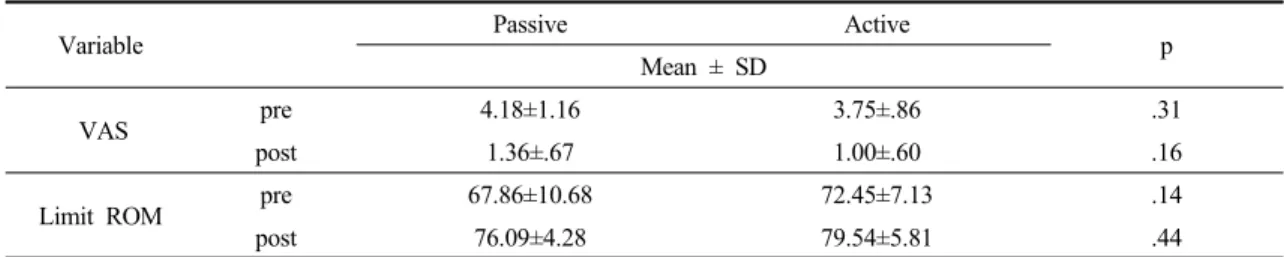
The study result showed that the VAS was decreased significantly from 4.18±1.16 before the experiment of passive joint mobilization to 1.36±.67 after the experiment.
The study result also showed that the VAS was decreased
significantly from 3.75±.86 before the experiment of active stretching to 1.00±.60 after the experiment (Table 2).
Furthermore, neck rotation was significantly improved statistically from 67.86±10.68 before the experiment of passive joint mobilization to 76.09±4.28 after the experiment. The study result also showed that neck rotation was significantly improved statistically from 72.45±7.13 before the experiment of active stretching to 79.54±5.81 after the experiment (Table 2).
The VAS and ROM does not showed a significant difference statically in the comparison inter groups both the passive joint mobilization group and the active stretching group (Table 3).
Ⅳ. Discussion
Modern people experience many diseases in the neck due to lack of exercise, constant stress, bad posture and habits. Furthermore, patients who complained neck pain have increased in recent years due to industrialization, automation, and advancement of computers (Cote et al.,
2004).
Thus, the present study aimed to identify the effect of the joint mobilization in upper cervical spines proposed by Kaltenborn and auto-stretching method of upper cervical spines for patients who had neck pain and ROM restriction thereby providing data of exercise program that can prevent a number of diseases in cervical spines.
1. Pain relief
In this study, the VAS was decreased significantly in the passive joint mobilization group and the active stretching group. Han (2015) reported that joint mobilization was conducted with 16 subjects and the exercise reduced pain in neck significantly and Joel et al.
(2009) reported that stretching exercise was applied to 20 elderly persons and the VAS was significantly reduced.
The above study results were consistent with the present study result. But, some people study the negative effect of stretching. Marshall and Paul (2011) reported that passive stretching have not enough effect to change the pain, and Morgan and Proske (2004) presented that passive stretching may cause the soft tissue damage. The other
Variable Mean ± SD
Pre Post p
Passive(N=11) VAS 4.18±1.16 1.36±.67 .00
*Limit ROM 67.86±10.68 76.09±4.28 .00
*Active(N=12) VAS 3.75±.86 1.00±.60 .00
*Limit ROM 72.45±7.13 79.54±5.81 .00
**