전자선 조사와 4-메틸모포린-N-옥사이드 용액을 이용한 볏짚의 전처리 방법
이병민, 이진영, 강필현, 전준표*
한국원자력연구원공업환경연구부
Received: July 15, 2014 / Revised: August 18, 2014 / Accepted: September 16, 2014
서 론
세계적으로화석연료의사용은지구온난화문제등의환 경문제를초래함과동시에화석연료의고갈로인하여지난
2005
년부터세계적으로화석연료의대체에너지개발이활발 히이루어져왔으며이중바이오연료(
바이오디젤과바이오 에탄올)
의개발과보급이활발히진행중이다[17].
리그노셀 룰로오스(lignocellulose)
는바이오연료의생산을위한후보 군으로서양이매우풍부한재생자원이다.
리그노셀룰로오 스의 주성분은 셀룰로오스(cellulose),
헤미셀룰로오스(hemicellulose),
리그닌(lignin)
이며이세가지주성분중가 장많은양을차지하는셀룰로오스는글루코시딕결합(
β-1,4- glucosidic bond)
으로연결된글루코스(glucose)
가반복되어 이루어진반결정성 고분자(semi-crystalline polymer)
이다[18].
반면에,
헤미셀룰로오스는펜토오스(pentose),
헥소오 스(hexose),
아세틸화당(acetylated sugar)
으로이루어져있 는무정형고분자(amorphous polymer)
이며리그닌은페닐 프로펜들(phenyl propane units: p-coumaryl, coniferyl and sinapyl alcohol)
이C-C, C-O-C
결합으로이루어진무정 형고분자이다[6, 10].
이러한세가지주성분으로이루어진 리그노셀룰로오스의 구조는 글루코스(glucose),
자일로스(xylose)
등의당으로전환이가능한탄수화물고분자(
셀룰로오스와헤미셀룰로오스
)
가리그닌과의물리적결합에의 하여둘러싸여있으므로가수분해시효소나미생물의접근 성을저해하는것으로알려져있다.
그러므로탄수화물고분 자와리그닌을분리하기위한리그노셀룰로오스의전처리는 필수적이다.
전처리의주목적은리그닌의제거에의한탄수 화물고분자의표면적증대를통한효소나미생물의접근성향상에있다
[13].
대표적인전처리방법으로는산이나염기를이용하는화학적전처리방법
[19, 30],
증기폭쇄전처리방 법[9],
용매전처리방법[28]
등이있으며이단일공정들의단 점을보완하기위한복합전처리방법[8, 14, 27]
도많이연구A Facile Pretreatment Method for Rice Straw using Electron Beam Irradiation and 4-methylmorpholine- N-oxide Solution
Byoung-Min Lee, Jin-Young Lee, Phil-Hyun Kang, and Joon-Pyo Jeun*
Research Division for Industry & Environment, Korea Atomic Energy Research Institute, Jeongeup 580-185, Republic of Korea In this study, a facile two-step pretreatment method was investigated for producing fermentable sugars. Rice straw was pre- treated using electron beam irradiation (EBI) and 4-methylmorpholine-N-oxide (NMMO) prior to enzymatic hydrolysis. In the first stage, the EBI on the rice straw was carried out at various doses (100, 300, 500 kGy) and then, irradiated rice straw was stirred with NMMO solution at 120
oC for 1 h for the second stage. The pretreated rice straw was hydrolyzed by cellulase 1.5 L (70 FPU/ml) and Novozyme-188 (40 CbU/ml) at 50
oC for 24, 48, and 72 h. A sugar yield of 83.8% was obtained from the pre- treated rice straw after 72 h of enzymatic hydrolysis. Also, FTIR and XRD results indicate that the pretreatment of the rice straw was effective due to the synergic effects of the two-step pretreatment. In conclusion, rice straw might be a potential substrate for bioethanol production by yeast fermentation.
Keywords: Biomass, pretreatment, lignocellulose, electron beam, rice straw
*Corresponding author
Tel: +82-62-570-3063, Fax: +82-62-570-3098 E-mail: [email protected]
© 2015, The Korean Society for Microbiology and Biotechnology
되고있다
.
4-methylmorpholine- N-oxide
용액(
이하NMMO)
은셀룰 로오스의용매로서산업적으로셀룰로오스섬유제조를위 한 소위Lyocell process
에서 사용되고 있다. Lyocell process
는NMMO
의구조중에서극성을띄는N-O
결합에 의하여셀룰로오스의수소결합이해리되는것을이용하여 셀룰로오스를용해하여셀룰로오스섬유를제조하는대표적인공정이다
[7].
최근에NMMO
를이용한리그노셀룰로오스의전처리법이보고되고있으며셀룰로오스와헤미셀룰로오 스에는영향을주지않고리스노셀룰로오스의결정화도를 감소시키며전처리후
NMMO
의재활용률은약98%
로알려져있다
. NMMO
전처리는셀룰로오스의용해후비용매(non-solvent)
에의한상전이(phase inversion)
를통하여셀 룰로오스를획득하여효소당화에이용된다[11, 21, 25].
그러나
, NMMO
를이용하여셀룰로오스의용해시일반적으로NMMO
용액중물이17%
이하일경우즉NMMO
의비율이
83%
이상에서셀룰로오스가용해되며물이17%
이상일경우낮은용해도를갖게되고주로셀룰로오스가팽윤되는 현상이나타난다고알려져있다
[5].
전자선조사를이용한전처리는물리적방법이며장점으
로는
(1)
리그노셀룰로오스의기공크기와표면적증가, (2)
결정화도의감소
, (3)
전자선조사량에따라전처리조건의 조절용이, (4)
짧은전처리시간, (5)
유해한화학물질의사 용이없으므로친환경적이다[1].
또한,
전처리후효소당화를 억제하는중간반응생산물의생성도거의없다고알려져있 다[15].
본연구에서는우리나라에서양이매우풍부한볏짚을대
상으로볏짚의전자선조사및
NMMO
처리,
두단계로전처리를수행하였다
. NMMO
는셀룰로오스의용해가목적이 아닌볏짚의팽윤제로사용하여전처리시볏짚의화학적결 합력에대한영향을목적으로연구를수행하였으며볏짚의 전처리전과후를비교대상으로성분분석과효소당화를통 하여전처리의효율을알아보았고이를뒷받침하기위하여X-
선회절과FT-IR
분석을통하여전처리조건에따른볏짚의물리화학적변화를분석하여이를바탕으로새로운전처 리방법으로서의가능성을검토하였다
.
재료 및 방법
실험재료
본연구에사용된볏짚은한국원자력연구원첨단방사선연 구소의육종시험농장에서
2013
년에재배한것을제공받아 실험용 고속분쇄기를이용하여 분쇄한후 체를 이용하여500
μm
이하의크기만걸러내어60
oC
의진공건조오븐에서12
시간 건조하였다. NMMO(50% in water, 4.8 mol/l)
는TCI
社에서구입하여사용하였고효소당화에사용된효소는Celluclast 1.5L (Cellulase 1.5L, Novo Co., Denmark)
과Novozyme-188 (
β-glucosidase, Novo Co., Denmark)
을 시 그마알드리치(Sigma-Aldrich Co., USA)
에서구매하였으며 구연산나트륨(sodium citrate buffer, 0.1 M, pH 4.8)
을제 조하여완충용액으로사용하였다.
전처리 방법
전자선조사를위하여건조된볏짚을
cell culture
용도의polystyrene bottle
에3 mm
의두께로넣고밀봉하였다.
전자 선 조사는2.5 MeV
선형 전자빔가속기(ELV-8 type, EB Tech. Co., Korea)
를사용하여25 mA
의전류세기, 25 kGy/
scan
의조사강도,
카트속도10 m/min
의조건으로100, 300, 500 kGy
의흡수선량을각각조사하였다.
조사된볏짚15 g
을NMMO
용액285 g
에첨가하여(
볏짚농도: 5 wt%)
고온고 압교반기에서NMMO
용액이끓지않게하기위하여10 bar
의압력하에120
oC
에서1
시간동안교반을한후Whatman
No.1
종이필터를이용하여증류수로수차례에걸쳐감압여과및세척한후잔류수분의제거를위하여
60
oC
의건조오 븐에서12
시간건조하였다.
이하전처리된볏짚은전자선조 사량에따라서E100N, E300N, E500N
으로명명하였고볏 짚의전처리실험과분석은각각세번씩수행하여결과의 평균값과더불어오차범위를제시하였다.
효소 당화
전자선조사및
NMMO
처리공정을거쳐세척및건조된볏짚은 미국 신재생에너지연구소
(National Renewable Energy Laboratory, NREL)
에서발표한리그노셀룰로오스 의최적당화조건을적용하여효소당화실험을수행하였다[24]. 5% (w/v)
의볏짚을구연산나트륨(0.1 M, pH 4.8)
완충 용액과혼합된후Celluclast 1.5L (70 FPU/ml)
와Novozyme- 188 (40 CbU/ml)
을 각각 첨가하고 진탕배양기(Jeio-Tech Co., Korea)
에서50
oC
의온도에서150 rpm
의속도로교반 하여각각24, 48, 72
시간동안수행하였다.
당수율 분석
전처리의효율을판단할수있는당수율분석을위하여
24, 48, 72
시간동안효소당화된효소당화액의상층을채취하여
0.2
μm
주사기필터로여과한후사용하였으며high
performance liquid chromatography (HPLC, Shimazu
Co., Japan)
에서수행하였다. HPLC
분석은Aminex HPX-
87P column(Bio-Rad, USA)
으로 분리하고RI detector
(410 refractive index detector, Waters, USA)
로검출하는 절차로진행하였다. HPLC
분석은column
과detector
모두65
oC
의온도에서column
에이동상(mobile phase)
으로초순수 증류수
(B&J HPLC certified solvent, SK chemical, Korea)
를0.6 ml/min
의유속으로흘려주며진행하였다.
본 연구에서전처리전후의볏짚에대한당수율은다음과같은 공식으로계산하였다.
성분 분석
전처리조건에따른볏짚의성분변화와당수율의분석은
NREL
의표준 바이오매스 분석절차인NREL Laboratory Analytical Procedures [22, 26]
와TAPPI
시험법(TAPPI standards and suggested methods) [29]
에따라수행하였다.
ATR-FTIR
전처리조건에따른볏짚의화학구조의변화를분석하기
위하여적외선분광기의전반사측정법
(ATR-FTIR Bruker
Vertex 70 spectrometer, Germany)
으로4 cm
-1의해상도로64
번스캔하여4,000-500 cm
-1 파장범위에대한흡광도를측 정하였다.
X-ray Diffraction
X-
선회절분석에서얻을 수있는결정지수(crystallinity
index, CrI)
는전처리의목적인리그노셀룰로오스의무정형부분이얼마나제거가되었는지판단할수있는기준이라고 할수있다
.
셀룰로오스는반결정성구조를갖고있고리그 닌과헤미셀룰로오스는무정형구조를갖고있기때문에리 그닌이나헤미셀룰로오스가제거됨으로인하여결정지수는 증가하게되고이는곧전처리효율이높아지게되는것과 관계가있다.
전처리조건에따른볏짚의결정지수(CrI)
를측 정하기 위하여X-
선 회절기(X'pert Powder, PANalytical, Netherlands)
를이용하여40 kV, 30 mA, Cu K
α(
λ= 1.54
Å),
주사속도1
o/min, 0.03
o간격으로2θ
의5-50
o범위에서측정 하였다.
일반적으로결정지수의값은Segal
의계산법[23]
에 의하여결정된다. I
cry는2θ = 22.4
o일때결정형영역의피크 강도이고I
am는2θ = 18.4
o일때무정형영역의피크강도이다.
Crystallinity Index (CrI,%) =
결과 및 고찰
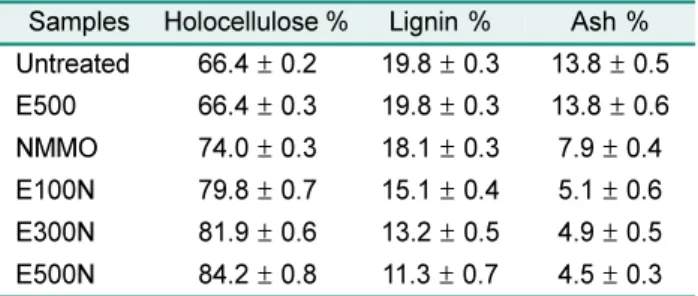
볏짚의 성분변화
볏짚의구성성분과전처리조건에따른구성성분의상대 적인함량변화를
Table 1
에나타내었다.
전처리전볏짚은 셀룰로오스41.1%
와 헤미셀룰로오스25.3%
를 포함하는66.4%
의전섬유소(holocellulose),
리그닌19.8%,
기타이물질
13.8%
로이루어져있었다.
전처리조건에따른성분분석결과전자선
500 kGy
조사된볏짚의구성성분의상대적인함량변화는미미하였으나
NMMO
단일처리된볏짚의경우66.4%
에서74%
로약7.6%
증가하였고전자선500 kGy
조사후
NMMO
처리과정을통하여전처리된볏짚의전섬유소의상대적인함량은전처리전의
66.4%
에서84.2%
로약17.8%
증가하였다.
이는두단계의전처리를통하여볏짚의리그닌과이물질이제거됨으로인하여상대적인함량이증 가한것이다
.
특히,
볏짚은이물질의함량이다른리그노셀 룰로오스보다높다고알려져있으며이물질은증기폭쇄법에 서효과적으로제거되는것으로보고되었다[2, 3].
이를이용 하여전자선조사된볏짚을증기폭쇄법과유사하게특정압력하에고온에서
NMMO
처리하는동안이물질을상당수제거하였다
.
또한, NMMO
단일처리와비교하여볼때서론 에서언급된바와같이전자선조사효과로볏짚의미세기공 크기가증가함으로NMMO
의침투가용이하여전자선조 사량의증가와함께리그닌과이물질의제거가가속화된것으로판단된다
[31].
이를바탕으로전처리된볏짚은리그닌의상대적인함량감소와동시에전섬유소의상대적인함량 의증가로인하여효소당화시효소접근성과동시에당수율 을높일것으로예상할수있다
.
당수율 분석
기존의연구결과들은리그노셀룰로오스별이론적당량
(
클루칸,
자일란등)
대비실제당화된양으로계산한것이일반적이다
. Table 2
에서알수있듯이전처리를하지않은 볏짚은72
시간동안효소당화를거쳐약44.39%
의당수율을 보였으며이때글루코스는약32.57%
이었다.
반면에,
전자선 단일 전처리 시
500 kGy
조사된 볏짚의 당수율은 약58.6%, NMMO
단일처리시72%
의당수율을획득하였다.
전 처리전의볏짚은자일로스가추출되지않았고전자선조사 와NMMO
단일처리시글루코스는각각36.9%, 45.7%
그 리고자일로스는각각5.8%, 13.8%
였다.
그러나전자선조사후
NMMO
처리를통하여얻어진볏짚의당수율은글루당수율
(%)=
추출된당의양(g)
×100
효소당화시투입한볏짚의양(g)
Icry–Iam Icry
--- 100×
Table 1. The compositional changes of the rice straw using different pretreatment methods.
Samples Holocellulose % Lignin % Ash %
Untreated 66.4 ± 0.2 19.8 ± 0.3 13.8 ± 0.5
E500 66.4 ± 0.3 19.8 ± 0.3 13.8 ± 0.6
NMMO 74.0 ± 0.3 18.1 ± 0.3 7.9 ± 0.4
E100N 79.8 ± 0.7 15.1 ± 0.4 5.1 ± 0.6
E300N 81.9 ± 0.6 13.2 ± 0.5 4.9 ± 0.5
E500N 84.2 ± 0.8 11.3 ± 0.7 4.5 ± 0.3
코스의경우전자선조사량에비례하여증가하는경향을보 였고
100, 300, 500 kGy
에서 각각51.9%, 56.6%, 60.8%
의 당수율을얻을수있었다.
반면에,
자일로스의경우NMMO
단일처리보다전자선조사후NMMO
처리시전자선조사 량의증가에따라13.8%
에서11.8%, 11.1%, 9.7%
로점차감 소하는경향을보였다.
이는앞서Table 1
에서성분분석결 과시전자선조사효과로인한리그닌제거의가속화와더 불어헤미셀룰로오스의손실이있는것으로판단할수있다.
그밖에마노스,
갈락토스,
아라비노스의수율은전처리조 건에따라오차범위내에서별차이가없었다.
서론에서언 급된대표적인전처리공정인산처리법은약70-80%
정도 의높은당수율을얻을수있는장점이있으나전처리의부 가생성물인 푸르푸랄(furfural),
하이드록시메틸푸르푸랄(HMF)
등이효소당화억제제로작용하여바이오매스의효소당화를저해한다고알려져있다
[12].
그러나본연구의공 정에서는전자선조사와친환경용액을사용함으로서부가생성물이발생하지않으며전처리에사용된
NMMO
의회수율은약
98%
로알려져있으므로재활용이가능하여경제적 이며전자선조사단일전처리와NMMO
단일전처리대비각각
43%, 15%
향상된당수율을얻을수있었다. Fig. 1
에전 처리의조건에따른효소당화시간별당수율을나타내었 다.
전처리가되지않은볏짚의효소당화는효소당화시간의 증가와관계없이낮은당수율(41.3-44.3%)
을보였으나본연 구에서 수행한 두 단계 전처리법을 수행한 결과24, 48, 72
시간 효소당화시당수율은각각E100N (70.0%, 75.9%, 79.2%), E300N (72.1%, 77.9%, 81.8%), E500N (77.2%, 79.5%, 83.8%)
으로 특히,
효소당화24
시간만에각각70%,
72.1%, 77.2%
의당수율을획득하여본연구에서수행한전처리의효율을입증하였다
.
적외선 분광 분석
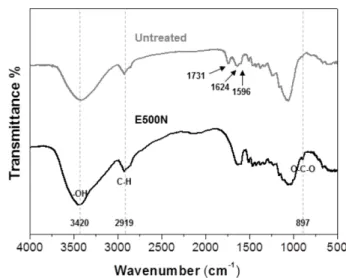
적외선분광분석결과주요피크들은
Fig. 2
에나타낸바와같이
3,420 cm
-1, 2,919 cm
-1 부근의셀룰로오스관련피 크들과1,300-1,800 cm
-1 파장범위에서의리그닌과헤미셀룰 로오스관련피크들이다. 3,420 cm
-1 부근의피크는셀룰로 오스내부의수소결합에의한-OH
스트레칭으로인하여나 타나며이피크강도의증가는전처리된볏짚의셀룰로오스 내부수소결합이약해진것을의미한다[20]. 2,919 cm
-1 부근Table 2. Sugar yields (%) of untreated and pretreated rice straw after 72 h of enzymatic hydrolysis.
Samples Glucose Xylose Mannose Galactose Arabinose Total
Untreated 32.57 ± 0.6 - 10.64 ± 0.3 0.35 ± 0.1 0.83 ± 0.1 44.39 ± 0.5
E500 36.94 ± 0.7 5.85 ± 0.7 12.93 ± 0.2 0.98 ± 0.1 1.91 ± 0.2 58.63 ± 0.6
NMMO 45.70 ± 0.5 13.89 ± 0.8 10.45 ± 0.3 0.25 ± 0.1 2.36 ± 0.2 72.65 ± 0.4
E100N 51.96 ± 0.6 11.89 ± 0.7 12.38 ± 0.3 0.25 ± 0.1 2.72 ± 0.2 79.20 ± 0.6
E300N 56.69 ± 0.8 11.10 ± 0.6 11.02 ± 0.2 0.28 ± 0.1 2.73 ± 0.1 81.82 ± 0.5
E500N 60.83 ± 0.7 9.74 ± 0.9 10.85 ± 0.4 0.28 ± 0.1 2.19 ± 0.2 83.89 ± 0.5
Fig. 1. Variations in the sugar yields based on the enzymatic hydrolysis time (24, 48, and 72 h) in untreated and pretreated samples.
Fig. 2. FT-IR Spectra in the range of 4,000-500 cm
-1indicating
changes in the chemical structures of untreated and E500N
sample.
의피크는셀룰로오스의메틸렌구조중
C-H
스트레칭으로 인하여나타나며전처리후피크의강도가약간증가하는것 으로알려져있다[16]. 1,731 cm
-1 부근의피크는리그닌과헤 미셀룰로오스의에스터결합(ester linkage)
관련피크로알 려져있고이피크강도의감소는전처리를통하여리그닌과 헤미셀룰로오스의결합력이감소되어리그닌과헤미셀룰로 오스가상당수제거되었음을의미한다.
그리고1,596 cm
-1과1,624 cm
-1 피크강도의감소역시전처리가리그닌의탄소-
탄소 결합을 약화시켜 리그닌이 제거됨을 의미한다[4].
897 cm
-1의 피크는β-1,4-
글루코시딕 결합(
β-1,4-glucosidic
bond)
으로나타나는데전처리후피크강도가증가하였으며이는셀룰로오스의상대적함량이증가한것을의미한다
.
X-선 회절 분석
Table 3
에서알수있듯이결정지수가증가할수록전처리의효율또한증가한다
.
전처리전의볏짚의결정지수는약43.5%
에서E500N
샘플의경우약56.3%
로약12.8%
증가 하여전자선조사량에따라결정지수가비례하여증가함으 로써결과적으로당수율에영향을미침을확인할수있었다.
셀룰로오스에의한볏짚의결정성은당수율에큰영향을미 치는요인으로볏짚의결정지수증가의원인은전처리조건 에따라볏짚의무정형영역인리그닌이상당수제거됨으로 인한셀룰로오스의상대적인함량이증가된성분분석의결 과와일치하게해석할수있다.
요 약
2
세대바이오매스볏짚을이용하여전자선조사후NMMO
처리 공정을 수행하고 이를 분석하였다.
볏짚은 전자선500 kGy
조사후NMMO
처리를한경우72
시간의효소당 화를거쳐글루코스60.8%
와자일로스9.7%
포함약83.8%
정도의당수율을보였다
.
이전처리공정은유해한화학물질 을사용하지않아서친환경적이며전자선조사와NMMO
처 리의시너지효과가있음을알수있었다.
그러나전자선조사량이너무높다는단점이있으며추후에는낮은전자선조 사량과여러가지단일공정을통합한새로운복합전처리방 법연구의필요성이있다
.
따라서이단점을보완한다면전자선조사라는친환경적방법과더불어
NMMO
용액의재활용성을이유로바이오에탄올생산등의산업현장에의적 용가능성이높다는것을알수있었다
.
Acknowledgments
This study was supported by the Nuclear R&D program of the Korea Science and Engineering Foundation, which is funded by the Ministry of Science, ICT and Future Planning of the Republic of Korea.
References